Global Food & Agriculture Futurist & Strategist | Keynote speaker | Comprehensive vision for the future of food and agriculture | Accurate foresight | Successful strategies | Thought leadership | No nonsense critical thinking
It is just a month away from the 15th anniversary of The Food Futurist. In the course of these years, it has become increasingly clear to me that some areas need more attention and effective action for the food and agriculture sector to remain successful. Indeed, the future of food and agriculture is not just about what cute robots will do in the future and what funky foods scientists will figure out. It is much broader than that. It is about making the right things happen. In the end, it is not just about producing foods, but it is to produce them in ways that have a future, and also to sell them to increasingly critical and discerning consumers. This milestone anniversary seems like just the perfect opportunity for me to reflect and reshuffle my services to some extent. By doing this exercise, I have decided to introduce two new areas of services by May 1st 2024. These are areas where many organizations miss opportunities. These are also two areas in which I am quite qualified, for having delivered strong performance in my professional career.
The first one is centered on Regaining Trust
It is no secret that trust is eroding in many areas. It happens with politics, with traditional media and even with some social media outlets, and it happens with food producers, especially the larger companies. One of the challenges that many food and agriculture organizations have been facing for decades is the loss of trust from consumers. The reasons why are many. Some are justified and some are not. Regardless of that, the loss of trust is a challenge that is becoming more and more difficult to overcome. In my career, I have had to deal with this problem in many occasions, but I always found ways of breaking the vicious circle of mistrust. In my opinion, the difficulty for organizations is not so much that people distrust some food producers, as it is to find the right way of addressing the issue and of truly creating a connection for a further conversation. PR does not work all that much anymore, simply because about everyone knows how it sounds and spot the communication exercise in action, which further erodes trust. Also, the timing is too often wrong and it makes the connection much more difficult. As a practitioner of martial arts for many years, I also see attempts to regain trust much more as an exercise in strength as one in flexibility and agility, and that is usually a losing tactic.
As a teaser, here are the pillars that we will use to build the tailor-made programs. You need to Relate
R: Respect
E: Empathy
L: Listening
A: Authenticity
T: Truth/Transparency
E: Exchange
Trust is essential for an organization in order to have a solid future. In this respect, I believe that it fits very well with the activities of The Food Futurist.
The second area of service will be Second Opinion
From what I have seen during my professional life, I believe that this is the kind of service that most organizations need. The number of strategic errors or implementation planning missteps that happen every day is there to prove that getting a second opinion is not a luxury, but in fact can prevent many costly mistakes.
Sometimes, it is about getting things done in some rush to meet a deadline. Sometimes it is about an excess of optimism and self-confidence. Sometimes it is the lack of a new eye. You name it. There are many reasons why an organization overlooks some details, or is becoming somehow blind out of habit, or is too eager to jump an anything that looks like a trend out of fear of missing out. An independent and objective second opinion can save many headaches.
I see this service quite useful for established businesses, but also for young companies, and also for investors who might benefit from a second opinion before risking their money in the wrong concept.
This service, too, deals with the future and as such fits quite well with the activities of The Food Futurist. The format and scope of this service will be adaptable and tailor-made for the specific needs of the client.
Copyright 2024 – Christophe Pelletier – The Food Futurist – The Happy Future Group Consulting Ltd.
Listen here to a Chrome AI-generated podcast type playback of the original article
Over the years, there has been no shortage of publications and conferences about the theme of “changing the food system(s)”. Yes, like everything else, nothing is carved in stone and ongoing evolution is a part of life. Yet, it is obvious that change is slow and there are many reasons for it. Well, there is one main reason actually: the economics of food production. Money is always what makes or breaks change. In previous posts on this blog, I mentioned the importance of economics many times, and in particular the need to change the economics if we want to succeed with change. To change the economics, we must look at externalities. For those who follow my blog, you know that externalities is one of my recurring topics, simply because we cannot ignore them. We cannot ignore them because of their very nature, which is about identifying the long-term effects -positive and negative- of our activities. If in doubt, the reason for the demand to change food systems is obvious: it is about the negative long-term impact of food production on the very conditions that affect food production and our future ability to do so. Nobody argues that we must have sustainable production systems. The difficulty is to agree on what is sustainable and what is not. One of the main causes of the disagreement is that many people seem to confuse efficiency and intensification. I posted a video on my YouTube channel some time ago, in which I explain the between those two terms and why it is so important not to confuse them, because otherwise we end up with all sorts of misconceptions and keep disagreeing because we do not use the same definition. I encourage you to look at the video.
As I explain, it is all about finding the optimum point from an environmental point of view. Environment is not the only aspect to consider, though. The optimum also needs to match technical goals, especially meeting food production volumes. It must be optimal from an economic point of view, too. If the products become too expensive, consumers don’t buy, and if they are too costly to produce, farmers and food manufacturers will stop producing. Everything is possible but everything has a cost. Once, when I was working in the poultry industry, I had a customer who asked me for a product specification change. He wanted us to trim chicken fillets in rather drastic manner. As the conversation went on, I had told him just that: everything is possible. I added that we probably could even cut the breast fillets in star-shaped bits if he wanted to. I just added that it all came down to a matter of whether he would be willing to pay for the additional costs. Actually, it was a friendly conversation, as we had known each other long enough to trust each other. Yes, everything is possible. It just has a cost but is the customer willing to pay for it? That is an important part of the conversation about changing food systems. Is the consumer willing to pay the price for a more respectful product? Well, sometimes yes and sometimes no. And some consumers are willing to pay and others are not.
Really, externalities are essential. The additional costs for a better system are about internalizing the externalities. It is about pricing products the right price, not just from a money point of view but actually from a triple bottom line point of view. Further, externalities are not just about the unit that produces the final product. It is about the entire system. Too often, a link of the entire chain makes sustainability claims simply because it shifts the environmental and/or social problem to other links of the chain, but as a whole, the system has not really improved. The externalities -and the responsibilities- have moved in the chain but the problem remains. When this happens, the link claiming to be “sustainable” is just forgetting to look at the entire system. Of course, people with a bit of critical thinking will notice that the problem has not been eliminated but just simply shifted. That is when the accusations of greenwashing arise, and rightly so. One link of the chain looks cleaner and probably think it is all shiny, but the entire chain is just as dirty as before.
But the greenwashing issue is not just a matter of producers and industries. Governments do that, too. Often, governments try to internalize externalities with subsidies and taxes but it is often simplistic and just focused only one element of the entire system. They make the same mistake. Let’s face it, it is often the result of political calculations and trying to offer good optics, but it is often short-sighted, nonetheless.
Another problem with externalities is that they are extremely difficult to calculate with accuracy. Just to illustrate what I mean just take a look of diagrams that the food system specialists like to produce. They are very complex, and rightly so because the system includes many dimensions and aspects. Here is one I have found on Dalhousie University website. This one is relatively easy on the eyes. Some others can be quite a bit less readable.
Those who produce such diagrams of food systems should calculate the externalities for all the lines and arrows they put in the charts otherwise the chart is just some intellectual exercise that will not produce much progress, and they tend to be rather useless as long as no economic aspect is included. Without the externalities of the existing system that we wish to replace and those of the new alternatives, we are stuck into rather unproductive dynamics.
For how much industry and governments approach systems and how to replace them in often incomplete manner, NGOs and activists make the same mistake. Wishing to see something disappear and be replaced but something more appealing is not enough. Actually, it is more in the realm of wishful thinking, which is why progress is so slow and encounters so much resistance. About activists, I often say that they are quite good at identifying problems, but quite a lot less so at finding workable and viable solutions. Opposite to that, industry is really good at finding solutions despite lacking the proactive attitude to recognize and acknowledge issues on time. They tend to make work of it only when severely challenged by the activists. It is pretty easy to see where the synergies are, don’t you think? A piece of advice that I have given n a number of occasions has been: “Talk with people you don’t like! That’s the only solution”.
Trying to change the food systems also faces a more general hurdle, which is the entire economic system. The entire economy is built around growth. As such, there is nothing wrong with growth, as long as it is “good” growth. In previous posts of this blog, I have mentioned the need to shift from quantitative growth to qualitative growth.
Just let me illustrate this with simple examples. A common joke about the GDP, which is our indicator of growth, is that if we decide to take rocks and smash all the windows, the window industry will get a huge boost as everybody would ask for new windows, but in the end from a quality of the society point of view, we would not create any improvement. We would be back to where we were, nothing more. On the other end, thanks to the window industry boom, the GDP would show a nice jump. It would be quantitative growth but there would not be qualitative growth.
Now, let’s imagine than instead of enticing people to always eat more of everything, and in particular of poor-quality foods, we would make sure that they eat really good food and have really good diets, the impact would be noticeable. There would be a lot less diabetes, obesity, cardiovascular diseases and other forms of morbidity caused by bad diets and bad foods. Quantitative growth would probably suffer, but qualitative growth would be impressive. The externalities would shift from negative to positive ones. For one, the costs for health care would decrease significantly and since there would be fewer sick people, all the other medical procedures could be carried out faster and thus also affect people’s health positively. I know some will tell me that this would affect the pharmaceutical industry negatively. True, although it also would mean that they could refocus they activities on other more difficult diseases to tackle and also grow as they would expand in other medical areas. Anyway, I hope that you get my drift about the difference between quantitative and qualitative growth. On a personal note, I really think it would be much better to help people eat just to meet their actual nutritional needs, therefore eat less but eat better. Their health would be better. There would be less food waste as there would less of it stored as unnecessary and useless excess body fat. Food producers would have to change the way to remunerate themselves differently, which is what I also mean with changing the economics. Quality focuses more on margin and less on volume.
In the end, we can create our own problems or we can create the solutions. Let’s think quick because time is running out.
Copyright 2024 – Christophe Pelletier – The Food Futurist – The Happy Future Group Consulting Ltd.
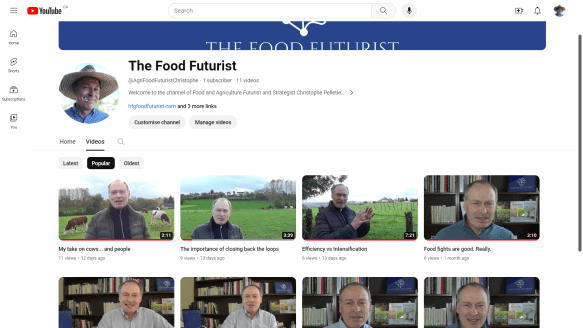
It was something that I have had on my mind for some time but I will admit I have been guilty of procrastination. In the past, I had placed some videos on a YouTube channel but I had not pursued that avenue. These videos are actually still there and you can find them in different areas of this website. Since I have no recollection of how to access that old account and I have not been able to retrieve the necessary information, I have just decided to create a new one, called -you’ll never guess- “The Food Futurist”.
My purpose with this channel is to post short videos, of three to five minutes maximum, in which I will share my thoughts on whichever topic I will find useful. Of course, if anyone of you wishes me to address one particular subject, I will be happy to listen to your requests. My goal is primarily to provoke some thoughts from the viewers and have them reflect on some issues. It is meant to be entertaining, and hopefully informative as well. I am not interested in playing influencer.
You might wonder why am I doing this? I have several reasons:
I do keynote presentations on a regular basis. Therefore, a large part of my professional activities is about speaking. Sharing videos are just a logical step.
More and more, people prefer watching videos rather than reading. Perhaps, this is because watching is more convenient and requires less effort. Anyway, once again, videos are a logical step.
From my end, making short videos off the cuff requires less time for me than elaborating a written article. Also, since I am still in the process of writing the book on value marketing that I mentioned in a previous post, I can use a different form of communication with you.
Having my own channel will allow me to share my thoughts in a direct and (almost) uncut manner. It is more authentic and genuine. I have been regularly interviewed by media outlets since the beginning of this website (2009) and my works as “The Food Futurist”. I always found that exercise frustrating because the interviews last between half an hour and an hour but in the end, the journalists extract just a few sentences in their final articles. Then, most of what I said does not make it to their readers. The excerpts tend to miss context as they are isolated from the rest of what we discussed. Also, and perhaps the most frustrating is that usually the excerpts are not the most important and useful bits of what I told them. They are just the ones that resonate with the particular audience of that media outlet, and the interview ends up producing just a few catchy or trendy statements. At least with my own channel, I control the content, from producer to consumer.
Copyright 2023 – Christophe Pelletier – The Food Futurist – The Happy Future Group Consulting Ltd.
Listen here to a Chrome AI-generated podcast type playback of the original article
Although the topic is on everyone’s mind lately, I have been presenting my views on artificial intelligence at conferences for more than a decade, long before it became trendy. I developed my logo with AI, and I use AI tools in my work as well, so it is not that huge of a deal to me. I was not really planning on writing a post about it because:
1) there are already so many of them around;
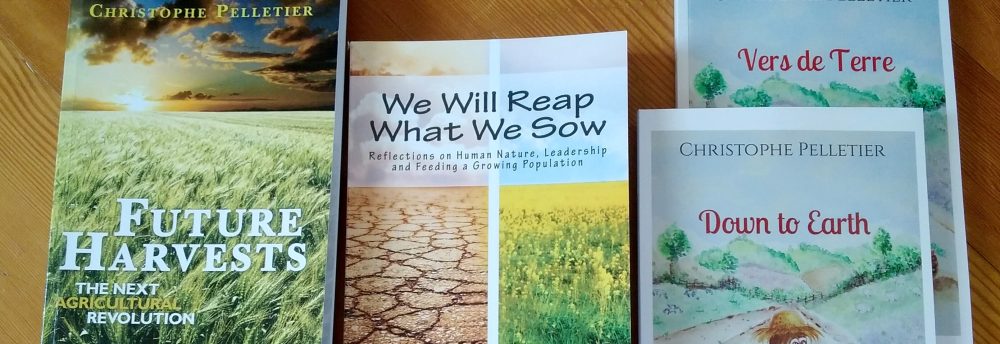
2) I have done presentations including the subject for many of my clients for many years and I even mentioned it in one of my poems about technologies from Down to Earth, my poetry book that I published in 2021;
3) it is just not me to jump in and follow the herd just for the sake of getting some attention.
It is just that I read a recent article, which triggered me to change my mind and get at the keyboard.
The article was about the result of research carried out by Harvard Business School, Reskilling in the Age of AI. The part that I found quite interesting was that according to this research, artificial intelligence was to reduce the gap between mediocre consultants and the “elite” consultants. The mediocre ones saw a performance boost of 43% thanks to AI, while the performance increase for the top consultants was much more modest. My spontaneous reaction was to conclude that businesses should either work only with top quality consultants or just eliminate the middleman when it is one of the mediocre ones and just make the switch to AI themselves, which is kind of what I hinted at in the one of my answers when I set up my FAQ section many years ago.
Another anecdote that shapes my views on AI and digitalization is what happens if there is a slight mistake in an online order. If the system does not recognize something in the information submitted, then we are dealing with artificial stubbornness, which is second to none, not even the “natural” one. I am sure many of you have experienced the frustration of dealing with an automatized package tracking system, and the agony of finding a real person who might be able to fix the problem.
Let’s face it, AI is still in its infancy and there is a whole world to open up in the future. As an illustration, I post in this article two slides taken from some of my presentations, which were not about AI as such, but in which I indicated in what respect the current automation in food and agriculture differs so much from the previous mechanization from the 20th century and earlier. The “old” automation was basically to replace human -and animal- labour and allow one person to perform physical tasks that had required much more individuals before. Mechanization was really all about adding “muscle” to the farmer and the worker, and sometimes to replace them, too.
The 21st century automation, although still adds muscle, is much more about adding a nervous system. Satellites, sensors of all sorts, management software, robotics, driverless vehicles and the many new technologies, when combined, actually mimic the nervous system as we know it. There are limbs, contact organs, senses and nerves that transport and transmit information that the brain (the intelligence centre) will process and send instructions back to the entire system to take action in the field, in the factory, in the logistics or in the store or restaurant. As the flow of data is essential for effective performance, it is clear that the synapses are of the utmost importance for this artificial nervous system. This why all the new technologies must be looked at from a system point of view and how they interact with one another. Developing technologies independently is a mistake, as it will miss many points.
So, we are building a nervous system, and since it is in its infancy, the way forward is really to treat it as an infant and follow the same process and the same steps that are required to develop a new human being and bring it up into a well-functioning grown-up. First, it is important to develop its cognitive abilities by exposing it to many experiences as possible, under serious supervision, of course. This will help the development of the right connections and the right amount in the nervous system. That is essential for AI to be able to function and deal with new and unknown situations and problems that need to be solved. When I was a student, one of my teachers had defined intelligence as the ability to cope and overcome situations never met before. I like that definition. As the “subject” develops further, it will need to learn more and more and, of course, the way to learn is to get a solid education, which means gathering knowledge, understanding how the knowledge connects together, and to be able to exercise critical thinking, therefore discerning what are true facts from what is raving nonsense. The learning process must be built on serious sources and there, too, serious supervision is needed. Just like with education, the system needs to be tested for progress and when difficulties arise, there must be proper monitoring and tutoring to help the “student” achieve success. The “subject” is still young and can still be subject to bad influences that might undermine its ability to identify the correct information and reject the nonsense, and thus perform properly. Really, developing AI looks a lot like raising a child all the way into adulthood.
The user also must take proper action to adapt and grow together with the nervous system. The artificial brain may be much faster at processing data that a human brain but humans using AI must be able to assess whether the outcome of the data processing makes sense or not. We must be able to spot if something in the functioning of the system is wrong, should that happen, in order to stop it from causing further errors and damage. If you use ChatGPT, to name a popular AI system, to write an essay and you do not proofread it for errors, both in content and form, then you expose yourself to possible unpleasant consequences. Automation and AI are to do work with us, not instead of us. Our roles will change, but just as it was not acceptable before, laziness (OK, let’s call it complacency) cannot be acceptable in the future, either.
Of course, like with any innovation, we must make a clear distinction between tool and gadget. So, what is the difference between the two? A tool performs a task, which has a clearly define objective and a clearly defined result. It must be effective and efficient. A gadget is just for fun and distraction. Tools evolve to get more useful. Gadgets do not, and disappear when another gadget that is more entertaining comes along.
Earlier, I was pinpointing the need to discern good sources of knowledge and information from nonsense. The saying “you are what you eat” is actually rather appropriate when it comes to AI in its current form. Indeed, the data AI is fed on will strongly influence what it produces.
In the food and agriculture production, supply and distribution chain, using AI should normally use reliable data, as the data should originate from a well-known and reliable source. Although the data can be quite voluminous, it is limited to these reliable sources, often the data of the producers themselves. Therefore, and as a tool, AI will be quite useful to tackle all the challenges that the sector is facing now and for the future. If the AI system that you use picks its data and information from an uncontrolled source, like the internet, you must realize that unless it has very solid safeguards to discriminate between truth and falsehoods, it will end up compiling the good, the bad and the ugly and thus further spread poison. Therefore, close scrutiny and monitoring is of the highest importance.
Further, here is a video on the subject that I posted on my YouTube Channel:
Copyright 2023 – Christophe Pelletier – The Food Futurist – The Happy Future Group Consulting Ltd.
The idea of writing a book about marketing in food and agriculture has been on my mind for quite a while. Yet, I have been struggling with the style I wanted to use. I started writing several times over, as could not find the right tone. I would not want to write “just another” marketing book. There are already hundreds of thousands of them, if not even possibly millions. Especially, I did not want to write a theoretical and abstract book. From my experience, that is the main weakness of so many of them. I now have finally found the tone and style that I believe will be the most effective. I have tested it in several of my recent assignments and the feedback I receive tells me that I have now found the right path. It will be straight-forward and plain language. There will be as few complicated terms as possible, perhaps even a book without four or five syllable words.
The project also comes from my past experiences with the topic. How many times have I been told that price is not really that important, while my experience has always been that price always comes in the discussion and plays a major role in the customer’s decision to buy or not? Price is important! Of course, it is! Saying otherwise is simply delusional. But the price is always brought in relation with what the perceived value of the product is. And this Is why the book will be built around the idea of value, of what that word means, how flexible and fluid it is, how it relates for what the customer wants and/or needs, and what added value is really about.
And since the book will deal with value, I will go one step further and address values, too, because the perceived value finds its roots in the set of values of the customer, and also because sharing common or similar values significantly increases the chances of making the sale.
My area of expertise, for as much as I have one, is food and agriculture. Therefore, the book will focus on these business areas. Perhaps, it could be extrapolated to all sectors just as easily, but I will not be as presumptuous as to think it can. Marketing food and agricultural products is a specific exercise, as this category has its very own idiosyncrasies. The readers -and the future- will determine if extrapolating to other sectors is a possibility. I am quite comfortable in food and agriculture and my niche is there. I do not have a need to overreach but, just as everything else I do, I will do what I do best where I do it best, at least to start.
In my work, I regularly meet with food producers who are always looking for better business and for ways to strengthen their future. They all ask me the same question: “Is there a market for this product?” That is why the book will have a clear practical angle (I wish to strongly insist on that aspect) aimed at food producers who want to sell in better markets and find better customers.
The theory on marketing will be limited to a strict minimum. Emphasis will be on avenues that will help the reader develop and implement an original new sales and business strategy, in particular how to close the deal with the customer.
I have already identified more than 30 topics to cover in this book. I have made some good progress but the road ahead is still long. I will keep you posted in the future as I will come closer to completion and reach some important milestones towards its final publication.
Copyright 2023 – Christophe Pelletier – The Food Futurist – The Happy Future Group Consulting Ltd.
Although I never really had made a specific logo for The Food Futurist, it seemed that the time had come for something that illustrates what I do and who I am in this occupation. I used some help from an artificial intelligence design program. It took many trials before I found this logo, which made me click.
So, here I proudly present you the new logo!
What does the logo show, you might ask? Several important aspects, actually:
From all the feedback I have received in the course of my life, it would appear that I have a brain that works rather well, fast and rationally.
It also appears that I have an unusual and amazing ability to connect the dots quickly and accurately.
It is simple and straightforward, as I am.
Thanks to the above, I set clear, realistic and workable visions of the future and I always look forward and challenge traditional thinking and opinions.
The logo emphasizes my “sixth sense” for foresight and the colors reinforce confidence as your trusted futurist, Advisor and strategist”.
Further, developing this logo made me think about the style and the content that I want to offer in the future and I believe that it will appear clearly rather soon. As the slogan mentions, I have devoted myself to the future of food and agriculture since 2009. Not only am I very proud of the products and services that I have provided during this period, I am also very proud of their lasting relevance, in particular of my books and blog. I am looking forward to keep delivering this same quality in the years to come.
You will find me in the real, the solid and the useful, not in the fantasies, the path of least resistance or the hype.
Looking forward to the future!
Yours truly, your humble servant.
Copyright 2021 – Christophe Pelletier – The Happy Future Group Consulting Ltd.
Listen here to a Chrome AI-generated podcast type playback of the original article
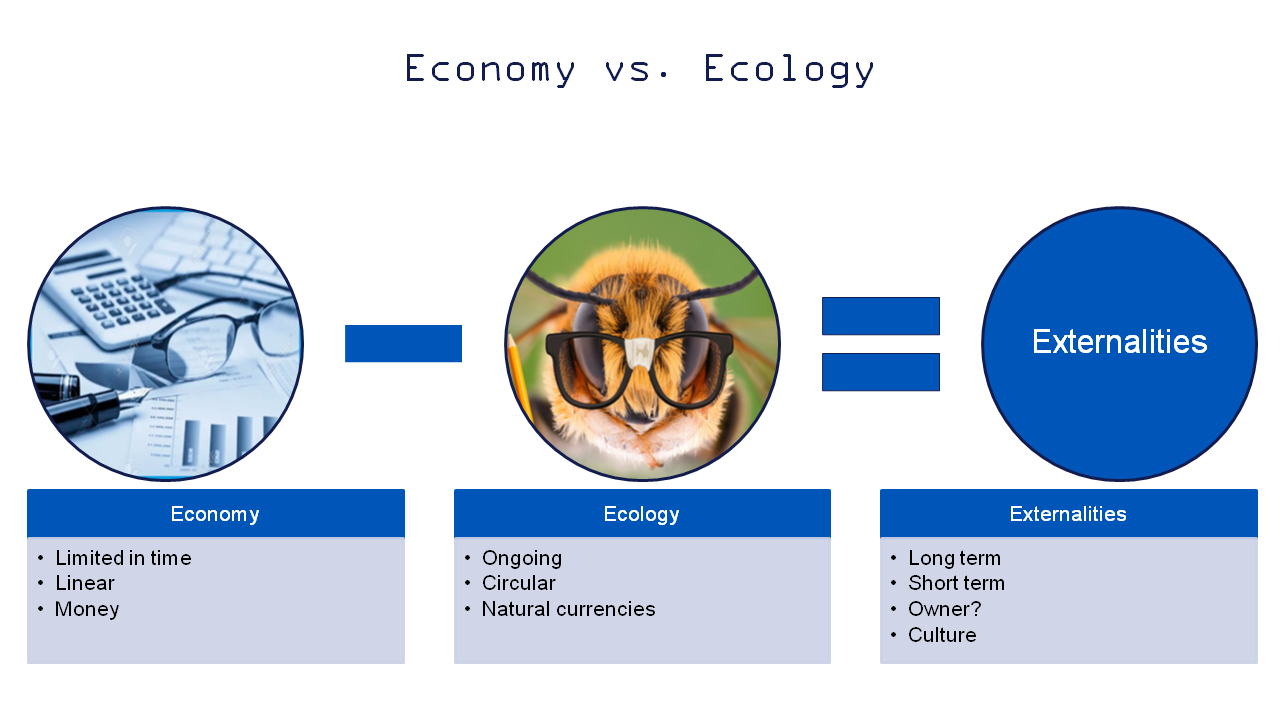
When it comes to sustainability, the debate always shifts to the respective weights of money, people and environment. As we all know, these three areas are always tricky to reconcile. Here, I am going to give my views on why that is. In fact, it is not that difficult to understand. It comes down to the concept of externalities that I have addressed many times in previous posts. You can see the list of all these posts at this link I am really amazed how absent this term of externalities is from conversations about sustainability and about the future, because externalities are the very cornerstones that will determine our future. Talking about sustainability without mentioning and digging into externalities is purely and simply a useless exercise. Externalities being the long-term effects of human activities, it really raises the issue of the me/here/now vs. the others/somewhere else/later. This simple statement sums up the dilemma about both future and sustainability. In my opinion, not talking about externalities when addressing sustainability and future comes down to not taking the topic very seriously. Another area of discussion that I do not hear enough is the idea of closing the loops. Our materialistic consumption society based on always more has grown by opening the loops and ignoring externalities. To have a future we must close the loops again. The discrepancy between the me/here/now and the others/somewhere else/later is another expression of that.
To clarify, just have a look at the picture below. I compare Nature’s accounting with man-made financial accounting. I believe it makes everything much clearer. The way humans have organized their financial accounting is about having a snapshot of the financial situation of an organization or of an individual. Since it is a snapshot it is limited in time. We look at the financial situation over a defined period (week, month, quarter or year). As it is a snapshot, it is frozen at a particular moment. A few minutes later, another snapshot would show a different financial situation. Everyone who has had to do some accounting knows that. We allocate things in certain ways, most of which are arbitrary and dealt with just to make sure the snapshot looks good. It is just like having a portrait taken. Accounting makes sure that the subject is showing its best profile and under the nicest light possible. But because of this moment frozen in time, man-made financial accounting is of a linear nature, which also fits very well, or at least accommodates itself quite well with a system in which the loops have been broken open. Financial accounting, as its names tells, is about money and money only. The social and human balance-sheet does not appear in there, and neither does the impact on the environment. They are externalities. They are matters that are neither limited in time, nor linear and which are way beyond money only. Just imagine how things would look different if instead of our current currencies, we all shared one same currency, which would be CO2. Just think what it might do for the way we internalize the environmental externalities.
That is what Nature kind of does. Our little accountant bee from the picture could tell us more about that. Nature’s accounting is not based on a snapshot, it is an ongoing process. It is not a photograph, but it is a movie! And a very long one that has no beginning and no end. What can be more circular than that? And to be this circular is must have closed loops all interacting with each other. That is how Nature works. Humans, on the contrary, look at accounting of organizations as independent units from each other. The interactions are not factored in. There is no comprehensive accounting for the entire system, which makes each organization focus only on itself and leaves the others deal with their own. Human accounting limits co-responsibility and collaboration on our long-term impacts.
Instead of practicing creative accounting, Nature’s loops just constantly rebalance themselves. Nature works according to the most fundamental market liberalism there is. If something is out of balance, it readjusts itself. If that means that some populations see their numbers being decimated, so be it. That is the price of rebalancing life with resources. It is brutal but it is highly sustainable. Nature’s does not print money, does not maintain an imbalance for the sake of not affecting populations. Nature does not play musical chairs with its economy, as we do. For example, in financial accounting, there is always the game of improving the working capital for the closing date of the fiscal year, one part of this being to postpone payments to suppliers for just after the end of the fiscal year, but try to get the customers to pay their bills before the end of that fiscal year. That way, the working capital is lower and the numbers look better. That is the beautiful portrait snapshot approach I mentioned earlier. What we do with working capital, we do with externalities, too. We try to pass the inconvenient hot potato to others. In man-made economy, we also fight “natural’ market forces as much as we can. And even liberal capitalistic countries who champion free-market economy do this. Just see how much money has been printed pumped and into the economy after the subprime crash of 2007-2008. Just see how much money has been printed and pumped into the economy to deal with Covid-19, just to try to keep the economy (herewith I mean the GDP) afloat as much as possible. Just also look at all the subsidies of all sorts to keep systems running while they have no future, and the food and agriculture sector is no stranger to that. In our consumption society system, we have done nothing else than subsidize activities that produce negative externalities, and we can read “subsidizing” as actually “rewarding”. While Nature rebalances to function at the lowest energy level possible, we fight the rebalancing with the highest energy level possible. Should we really be surprised that this cannot go on?
Actually, human economy and its financial accounting do not work in parallel with its ecological counterpart. All the money we print to support our gigantic consumption levels is nothing but a loan that we take at Nature’s bank. All that printed money is used to use (well deplete and burn mostly) natural resources, while we have not earned that money, which is actually the right to use these resources. On top of that (literally), with broken-open loops, we pile up mountains of waste with the resources we deplete. Breaking the loops is not one problem, but it consists of two problems. One is running out of useful resources, the other is accumulating waste that kills us. We do this for the “me, here and now” and just like we play with working capital, we play the exact same game between generations. The generations that have benefited from this world of abundance are playing musical chairs with the following generations. The former do not want to factor the externalities in their lifestyle and just pass them on to their children and grand children. This is why, in terms of environmental impact, we are using resources much faster than we should. The problem is that Nature’s patience is not unlimited (here, read “resilience” for “patience”). It is a matter of time before Nature’s is going to ask us to pay the interest. The boomers won’t pay the interest. They leave it to their offspring. Nobody wants to take ownership of the externalities. It has become part of our culture. It is only fair for the young ones to push back now. They have started realizing that they are going to be left with the bill to pay, possibly in a system where Nature’s approach to economy will be stronger than the man-made system.
My purpose is not to depress you, although we all know that we are running out of time and climatic events certainly are cause for perplexity, to put it mildly. There are not many ways to rebalance our environmental impact. The most important is to reduce waste, which means reducing consumption volumes, From the 3 Rs (Reduce, Reuse, and Recycle), Reduce is not popular because it means lower GDP and our politicians and economists freak out at that thought. At least, reuse and recycle leave some hope for GDP. Even the word Recession is unbearable. It is now called the R-word instead. As a society leader, if you cannot say the word recession and accept that it happens once in a while, because recessions are good, they are like slimming down after the excesses of Thanksgiving and Christmas, to get back in better shape, you have no place as a leader. Actually, you are a liability to society.
We are seeing more and more attempts to internalize the externalities. Unfortunately, they are always referred as taxes, which is another word that nobody wants to hear. So much for the quote “taxes are the price we pay for a civilized society”. Perhaps, it is no wonder that we see an increase in incivility. To make our world sustainable, which means having a future, we cannot keep the same economics as now. Then, we must change the economics. We must change the way profit is built up. We must change the way we organize taxes. Money always talks and people will always welcome change if they make more money. Considering the amount of money printed, as I mentioned above, we clearly have the ability to put money at work to solve the challenges that we are facing. Yet, everybody seems to wish that when the Covid-19 problem is behind us we can revert to where it was before the virus hit us. Why on earth should we revert to a system we know leads to disaster? There was a great opportunity for our leaders to organize a shift of economics for before and after the pandemic, by putting money at work to create a healthier economy. No, most of that money has gone to the stock markets instead. We are missing an opportunity to change economics. We are missing an opportunity to reward good behaviour while penalizing damaging activities. Money talks and rewards are even more important than penalties to get acceptance for change. People always manage to dodge penalties and they do not cooperate. Opposite to that, people love rewards and cannot get enough of them. Not only do not they dodge rewards, they actively look for more. Here is a sadly underused potential: more rewards for good behaviour! As we can see, the solution lies in our behaviour and how we want to deal with adversity. This is quite important to underline. Technology alone will not deliver much if we do not want to change. Those who say otherwise are just salespeople trying to make some bucks. If we think that technology will do the work for us, while we do not make efforts to succeed, like spoiled lazy brats waiting for their parents to clean up their bedrooms, we just as well can cut the charade right now and accept the fact that Nature will go on but without us. The planet will be fine, no need to feel self-important by claiming to save it. What we need to save it humanity and life.
Copyright 2021 – Christophe Pelletier – The Happy Future Group Consulting Ltd.
Listen here to a Chrome AI-generated podcast type playback of the original article
Grocery shopping has undergone deep changes over the last 100 years and, like anything else, it will do the same in the future. The current Covid-19 pandemic is contributing to this evolution. Regardless of whether it will be over soon or not, one thing is sure: it has forced us to make adjustments and in a way, the virus has just accelerated changes that were already in the works. Here is how I see what to expect.
First of all, Covid-19 has changed how we live, and therefore how we shop. Online retail was growing but then it became almost a necessity for grocery stores to jump on board and engage in online sales. It was not always smooth. It took time for many outlets to organize taking orders, preparing them and get the orders ready for pick-up or for delivery. There was a lack of staff. The staff was not trained properly and there were all sorts of logistics issues to fix. Without getting in details, stores have been able to get a better presence online and ensured a better and smoother service over time, and rightly so, because many people have discovered the convenience of shopping at the time of their choice, not having to drive to the store, not having to be in the herd, which was already a pain in the neck before the pandemic, and not having to wait in line to check out. It saves them time and stress. These are the main reasons why I expect online grocery sales to stay and grow further. The offering and the navigability of online stores will have to improve as for now, it is still a tedious experience. The execution of orders is still a challenging area. More staff is needed and at the moment, this part of the business is the busiest and currently the largest employment opportunity at Wal-Mart. Amazon has also hired large numbers of new staff. Yes, it takes time and manpower to fill orders. It is nothing new. I used to do that part at my parents butcher’s shop. I used to prepare orders and deliver them to the customers who required it. Of course, my parents’ store was a relatively small operation and our phone and my brain (and my legs and arms, too) were all it took to get things done. The volume of business of modern grocery store is such that it could just be a family thing. My point is that preparing orders and executing them is nothing new and actually not all that complicated, and it is a pillar of good customer care.
Here is where I see more changes in the future. Having to manage so many new people to fill order –or to be personal shoppers to put it in fancier words- is a complex task. Such staff is usually paid little, not particularly motivated and always looking for better job opportunities, not to mention they can get sick or absent. Of course, the numbers and he economics will have to adapt, but I believe that in the future, order filling staff will be replaced by robots, connected to order software. The robots will manage orders, prepare and pack them. There are already robot waiters in some restaurants, so it is not so far-fetched. The robots also will be connected with the warehouse and the inventory management software. They will re-order for the warehouse, ensure first in first out, eliminate loss and waste and know exactly where to pick what and complete the entire job much more efficiently than humans and that on a 24/7 basis, and not require being unionized. I believe that corporations will like that.
Another area where I see potential for change is the sharing of online platforms. French retailer Carrefour offered that possibility to small retailers who had to close because of the Covid -19 lockdown in France. Thus, small stores did not have to venture and spend on developing their own online presence, which could have been challenging, not to mention stressful considering the circumstances. Further, cashing in fees for a online platform can be a business, too. What Carrefour offered is in fact the same as large online retailers like Amazon and Alibaba have done for independent sellers for years now. It is also not all that different from an EBay type of concept. Sharing of online platform will be a way of making the jump for small stores and from, there they will decide whether to keep using such platforms or build their own.
Order pick-up will certainly be a solution of choice for quite some time. Home delivery will have to evolve further, simply because it can be costly, except for outlets that can offer free deliveries for a minimum purchase amount, which is already the case. Deliveries might also be carried out by driverless vehicles in the future, such as Kroger has been testing for some time. Of course, there is always the possibility for restaurant delivery organizations to make the move to help retailers. After all, many of them want to be listed on the stock market and that will mean the necessity for them to keep growing always more and that will mean going beyond restaurants as per today. Here, the key will be to drop their fees. What these organizations charge for meal deliveries is rather brutal for pop-and mom restaurants and volume will have to take over fee based on bill percentage.
Retail will evolve further and there is no shortage of possibilities. Although everyone claims to collect data and know their customers, I think that it is more something in the realm of talk than actual effective execution. I have loyalty cards but I never get any shopping advice. My shopping news is either through the generic flyer that I find in my mail box like all other shoppers. And if I take a look online to see what is attractive, I have the exact same online flyer, as the paper one, with absolutely nothing specific or special about my own particular needs. I thought they would know what I buy and don’t buy and help me accordingly, but no, none of that ever happens and I do not have the feeling that is in the works. Hello, retailers! One the most daunting thing that shoppers go through is to make the bloody weekly shopping list. What do we need? What are we going to eat? What do they have on ad for us? Should we buy at retailer A or retailer B? No answer to any of that ever comes my way. If your retailer sends you personal shopping lists and tips, specific nutrition and menu tips you are lucky, and I am not. But I doubt it because I have never met anyone who did get of shopping tips. Retailers like Amazon do give some shopping tips and online ads also appear when I browse on Internet, but as far as I am concerned, they tend to miss the mark about every time. Perhaps, my being a frugal person makes me one of those difficult individuals to influence and to get to buy stuff but I really think that shopping tips should be a lot more on target than they are. I also believe that to improve this situation, it would be much better to have a voluntary and active participation from the shoppers themselves by having them giving more inputs about their needs and wants, although this of course enters the slippery area of online privacy, but you aill have to admit that it is a lot easier to serve customers well when they are in a position of telling you what they are exactly looking for. And in these times of “Internet of Things” why not combine store information with producer information and process it in a virtual product information and shopping advice system where people can make choices based on their values, their needs and all relevant information they need to make their decision, in a totally transparent manner? With such a system, why not even include a virtual tour of farms and packing facilities and show people where their food comes from and how it is produced and by whom? It could be accessible at home, could make use of VR helmet and could be consulted at a convenient time, not in the stressful rush of the in-store shopping with others breathing in their necks, especially if shoppers do not wish to go inside the store again.
Yet, as I show in this picture below, data servers and supermarket aisles look surprisingly similar. Every purchase and consumption is a transaction that goes way beyond money and product. It is a transaction between data – and therefore lifestyle choice, personal choices and values – versus the price shoppers pay. Why not include it in the shopping experience, then? I believe the answer is in the area of business thinking. In spite of the many claims, it is still a primarily production-driven, volume-driven cost-obsessed model, and not enough of a service-minded customer-oriented value-obsessed model. Of course, there is no reason why this would not change and anyway, the former model I mention is pushing for some positive innovations, such as cashierless stores where you can come in buy and leave without going through the tedious checkout lines or the even so much more fun do-it-yourself checkout where half the people I see seem helplessly stuck unable to figure out which button to press.
With what I just described, one could easily wonder why to have large supermarkets anymore. Why should the corporation spend all that money in prime –therefore expensive- locations, with fancy stores with light and all sorts of amenities, while in the future, most of the shopping might actually be just a warehouse order filling activity. This is an even more relevant question for staple foods and undifferentiated commodities? Since commodities are really mostly about low cost, then retailers keep your costs down and focus on specialties and value for the store experience. I see several areas for which this would make sense. Non-perishables should be in the warehouse and not take much space in the shopping area real estate. But perishables are another game. First, they are perishable products and they have to receive special care to avoid loss and waste. Second, people like to use their senses to purchase perishables. They like to touch them, to see them and inspect them, and to smell them. Perishable shopping is still a highly sensory activity, and it quite personal. Some people like their meat lean and others prefer a marbled one. People like to take a look at the produce to make sure it is not damaged, bruised or blemished or that it is ripe. They like to make sure it is fresh. Some people like baked goods to be well-baked and others prefer when it is on the paler side. Color is an important factor. For all these reasons, leaving the choice to underpaid staff who do not know the customers and do not care overly for them is quite a bit risky in terms of customer satisfaction, and I am not even talking about cases of mistakes such as delivering bacon instead of the ordered pork tenderloin I heard of at the beginning of the pandemic and the early times of packing orders for curbside pick-up. No, perishables will require special attention and my guess is that personal service will be high on the list.
When it comes to produce, I expect another evolution. Produce is delicate and with too high waste along the supply chain and in the store. Local production may have its advantages in term of sustainability, in particular when it involves truck road transport, but it makes a lot of sense about freshness and waste reduction. Just like the fruit and veggies that I get from my garden, picking fresh ripe produce just on time makes a world of difference. Just ask my wife about how it tastes compared with what we used to buy from thousands of kilometers away. In such a quality approach of perishable retail, why not get them locally. Urbanisation push produce farmers further way and yet, there is an amazing acreage that can be used to grow produce in cities, and interestingly enough a lot of that acreage is on top of supermarket, malls and warehouses. So why not build greenhouses on top of the store and sell the produce superfresh downstairs?
If you have to point of sale, it is much easier than being an urban farmer looking for customers. The store is there, people come to buy all sorts of things, just add the produce from the roof farm. Actually that is what a number of retailers have already started. France’s Carrefour, again, is one of them, but Benelux’s Ahold Delhaize has been working on the same thing and I am sure other will come and offer freshly picked local (roof) lettuce, leafy greens and tomatoes and strawberries.
Quality of products and quality of service will be the top demands and the old concept of small butcher, baker, greengrocer store will be the answer, although with a modern touch and with help of technology. I expect future supermarkets to be just that. They will be markets, like in the old days and they will be super, as they will wow their customers with prime shopping environment, prime products and prime personal service. A side advantage of this will also be that it reduces the use of packaging and has the potential to require no plastic whatsoever. After all, the purpose of plastic packaging has been to replace human labour by allowing self-service.
Copyright 2021 – Christophe Pelletier – The Happy Future Group Consulting Ltd.
Listen here to a Chrome AI-generated podcast type playback of the original article
Here is a topic that I have started to address quite a long time ago, long before it got popular with the bobos. Actually, it became popular only after the mainstream media got knowledge of the UN FAO views on insects as a source of food for people in the future.
Yuk vs. Yum
The main thing I hear regularly about insects and worms is the “yuk” effect. Yuk is mostly a western countries’ issue. In Asia and Africa, insects and worms are actually quite popular. I can understand that crawlies might not look as appetizing as a steak, but I always like to bring some perspective by showing other foods considered delicacies in western countries that are not all that different from insects, such as lobster, shrimp or snails. People are willing to pay a steep price for those. There is a difference, though: the flesh ratio of lobster, shrimp, langoustines, snail, crab and similar creatures is much higher than that of crickets, for instance. It is also true that Westerners prefer meatiness, while many Asian cultures like crunchy and having to chew and suck the flesh out of the shell or off the bones. Nonetheless, insects are not all that bad. Worms are actually much meatier than insects and why would they not follow the path of snails. As you may know, I was born and raised in France, which is often viewed as a country of snail eaters. It is true to same extent, but here is some history about snails as food in France. First thing to realize is that snails were eaten commonly in times where other animal proteins were not abundant and expensive. Those who could not afford meat would look for alternatives. Snails were one option. Another was… guess… frogs found in ponds! But the French would not eat just any snail. After all, they were French and therefore discriminating about food.Two types of snails were popular because of their meatiness: the “Petit Gris” (Little Grey) and the Escargot de Bourgogne (Burgundy Snail), the latter being rather big and meaty. As you probably know, the British would be disgusted at the idea of eating snails (the “yuk” thing), until the wealthier decided that it was fashionable to eat “escargots” instead. Yes, it tastes much better when you say it in French. So maybe all that needs to happen is for the snobs, bobos and other hipsters to decide to eat exotic insects and worms in the language of their (the insects’ and worms’, not the snobs’) country of origin. And they already do but it is a small niche. I can find some insects around but the price per pound is even higher than caviar, so no thank you! That is what frustrates me about many of those start-ups. And understand me well, I am all for innovation and entrepreneurship. I believe money should be the reward for a job well done, not the end for just a promise that has not yet materialized. Despite all their nice claims to save the world, the environment and being so incredibly responsible about everything, they are actually interested primarily in trying to score financially and be sold to a large corporation that will be willing to overpay for their shares based often on a concept that still needs to prove itself, but after all why not. But to do that, they actually lock themselves in small niches in such a way that there are only two ways to move forward: one is to stick to high margin pricing and have little growth possibilities, the other is to slash the prices to get more volume moving but often transforming the specialty into a commodity. What other reason would there be to focus on Western markets that say “yuk!” while there is a huge potential in Asia and Africa but for lower margins? You guessed it: pleasing the shareholders who want sell their shares and cash in as soon as possible.
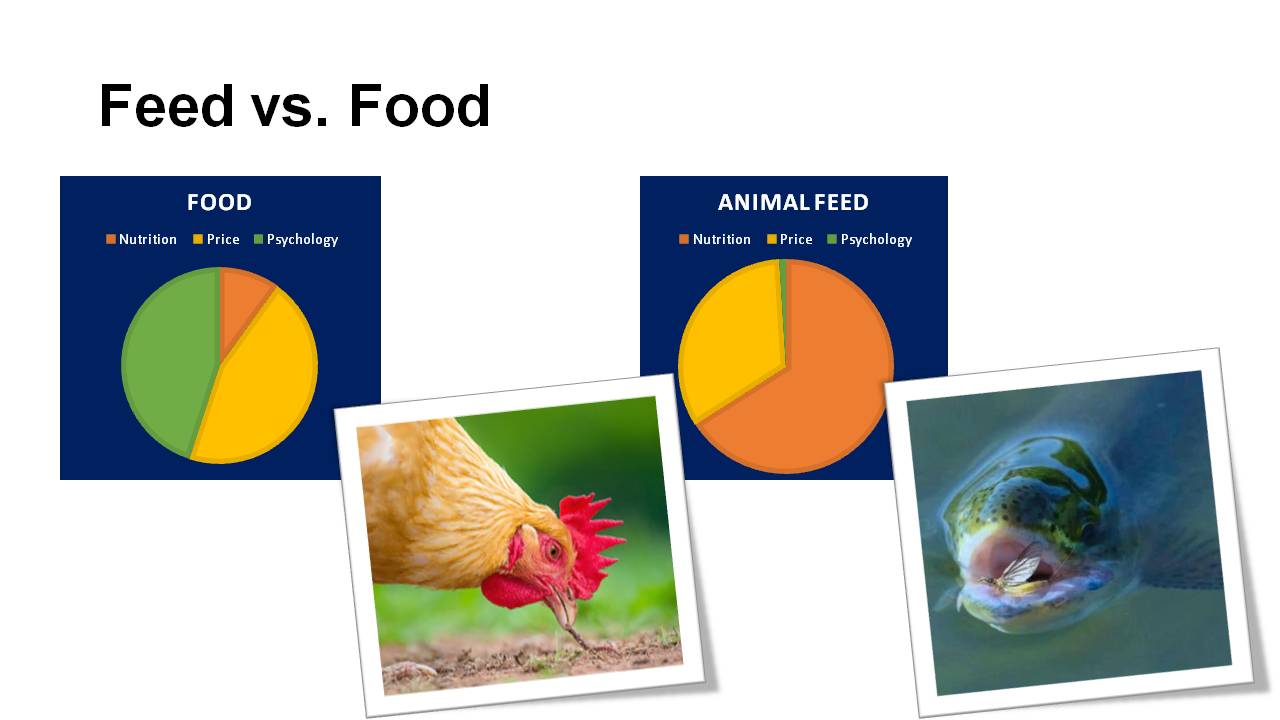
Anyway, human nutrition is only part of the equation. Just like snails were an alternative for lean times in France, the consumption of insects and worms in parts of today’s world are also an alternative to other animal protein too expensive to buy. You can bet that when given a choice, many insects and worm eaters will choose for a juicy steak. Human consumption of food is not all that much led by sound rational nutrition. If we were all rational with food we would 1) eat balanced meals, 2) we would not overeat day after day to get ourselves in debilitating diseases and 3) we would not waste some much food. So, we are not rational, and that is the main difference between human food and animal nutrition (except for pets, for which we have decided to introduce the same irrationality with the same consequences for our furry friends). Animal nutrition is all about meeting properly the nutritional needs of the animals, never let them overeat and not waste any feed because it just costs money to the farmer. Actually, animal nutrition should be an example for humans in many respects. The difference between humans and cows, pigs, chickens and fish is that the animals do not put any psychology in their food. They eat to live and they do not live to eat… mostly. This is why I have said for years that I think insects have their highest potential as an ingredient for animal feed, well, as long as the price is competitive with other alternatives.
Here are some clues why feeding insects and worms to animals makes perfect sense. First, here is some wisdom from anglers. What bait do they use when they go fishing for trout for instance? They use a decoy that looks like a fly, because they practice fly fishing, and they use the fly because fish eat flies, and other insects! It is just this simple. Fish feed producers are currently going this road. Another example is about a customer of mine when I used to work in the poultry business. He was from the UK and when the “mad cow” disease hit in the UK in 1996, discussions turned about eliminating meat and bone meal from animal feed, as the suspect reason of transmission was the use of contaminated meat and bone meal produced in rendering plants containing sheep infected with scrapie, a disease. Meat and bone meal was used because it has a high protein content, good nutritional value and it worked fine for many years. Nonetheless after the mad cow crisis, meat and bone meal had to be removed and my customer told me with a straight face (remember that he was the managing director of a poultry company) that there was no reason to put meat and bone meal in chicken feed because chickens are vegetarians. Isn’t that a disaster to have disconnected people from Nature (I wrote an article a long time ago about this topic)? Chickens are vegetarians. Yeah, right. Anyone who has seen chickens roaming around a farm yard will tell you that they eat worms and insects. They are not vegetarian at all. Actually, in spite of many claims of people opposed to animal farming and meat, it is difficult to find a species of monogastric (one-stomach species, like humans, pigs or poultry) that does not consume animal protein. Usually, all the species that they mention as being vegetarians are polygastrics (digestive tract consisting of several stomachs, like ruminants) which have the ability that monogastrics do not have to eat grass and other cellulose-rich materials and being able to transform them into meat and milk as I mentioned in my article about “cow farts”. Anyway, back to my friend (because we became good friends –we are still in touch from time to time after 20 years or so) from the UK and his vegetarian chickens, I replied that not only chicken do eat worms and insects but worms process dead material, kind of like a rendering plant. Well, that was a bit awkward and the real reason came up. It was much better to tell me that his customer would not want chicken meat from animals fed with meat and bone meal and that it was final, and that he needed me to go along with that. Although not quite rational, that was a better reason than the bogus vegetarian chicken argument. His customer, a leading UK retailer had strong views about animal feed. Among their arguments was that feeding ruminants, which are vegetarian from nature, with animal protein was comparable to cannibalism; or that using fish meal could be acceptable only the day they would see a cow grabbing a fish out of the water to eat it. Such arguments were partly emotional of course, but had some rooting in good old-fashioned common sense, which I would never blame anyone for using. So, use good common sense and also solid factual science to feed yourself. It is not mutually exclusive and it does not stop anyone from being a true gastronome. You can take me as an example of that, as it is another brand of mine, The Sensible Gourmet!
Copyright 2020 – Christophe Pelletier – The Happy Future Group Consulting Ltd.
Listen here to a Chrome AI-generated podcast type playback of the original article
As I explained in previous articles about protein, the future of animal farming looks rather good, actually. This does not mean that current productions systems are perfect. They are not, and many changes are necessary. Four drivers are going to make animal farming evolve towards systems that meet future requirements in term of environment, health, sustainability and consumer demands. They will not affect only farms, but the ways entire value chains are organized and even future flows of animal protein in international trade.
Two pillars of sustainability are externalities and the necessity to close the loops. Strangely enough, these two fundamental topics rarely ever get mentioned. Yet, they will define the future. I mentioned externalities quite a few times on this blog and if you are interested to read what I say about it, just do a search on the search window on the right side of this page. Basically, externalities are the long-term economic effects and in particular long-term costs of repairing the damage that any human activity causes. Closing the loops is simply following the basic principle that nothing ever disappears or get created, but that everything gets transformed. These two pillars of sustainability are going to force us to review how balanced -or not- productions systems are. Greenhouse gases and minerals balance from manure will force a change in location of animal productions, in regard to the location of production areas of ingredients for animal feed, feeding programs, logistics of both feed ingredients and animal products, in particular in terms of transport. Distance between markets will be only one part of the equation. Transportation systems will weigh even more. Will trade rely on road transport, rail or water ways? Different transportation systems have very different carbon footprints and this will affect the future of some industries depending on how they are organized and where they are located. It will also force countries to invest heavily in their infrastructure, which is another topic that is too often ignored and yet so critical for the future. Of course, infrastructure is not as sexy as tech start-ups and more importantly, it does not have the same appeal for investors. After all, infrastructure is an expense that benefits all, while the current thinking about money is more about individualising profits. Yet, infrastructure will have more impact than tech. Location will also be influenced by water availability, as water will become an increasingly influential aspect of sustainability. Just as an example, California has been struggling with water availability for decades. Yet, it keep sending water-rich produce to other regions, thus exporting its already scarce water. On top of that, California produces about a quarter of American agriculture. See the danger ahead? For the future, the economic paradigm will shift from “producing where it is the cheapest to do so” to “producing where it is the most sustainable to do so”. The main reason for the shift will be externalities as we will have no choice but internalizing the externalities (sounds fancy doesn’t it?… try to place that one in a cocktail party when you have a chance).
Location is one of the changes, but of course when it comes to greenhouse gases, there will be other solutions to reduce the impact. Feed programs are one, and gas capture from manure will be another one. Tech and innovation will play their roles in those areas. Markets will do to, and I expect manure to become a highly valued co-product, and not a by-product anymore. Just as manure is a side effect of intensification and high densities, so are diseases. Last year saw the huge outbreak of African swine fever in China, which so far has lead to the destruction of 25% of the world’s pigs. That is the perfect example of what can happen again. It is not the first outbreak. There have been other ones before of the same disease and of avian influenza. The risk of diseases and their huge cost will also contribute to a readjustment of location of animal production, in terms of production centers, in terms of density of farms and also of densities on the farms themselves. So will the prospect of possible transmission of diseases from animals to humans.
Next to such production issues, consumer demands will also change the way animal products are produced. The pressure for better animal welfare is increasing and will not weaken. It is just fair and it also makes a lot of economic sense. In my times in the pig industry, the poultry industry and in aquaculture, I did quite some research on the topic and the numbers spoke chapters. Treating animals with the proper respect pays off big time. Yet, I also faced a lot of resistance when I tried to show my conclusions by then. I guess that it did not fit in the thinking of the times. The future proved me right, though. The need for better animal welfare will also contribute to a change in production systems, housing and feeding in particular. Animal densities on farms will also be reduced. This trend is already taking place in Europe and there are more and more farming programs that go in this direction. And so do government policies. Along with animal welfare, environmental concerns from consumers will also push towards more “natural” methods of farming. Intensive animal husbandry is not going to disappear but its excesses will. The problem is that too many people tend to associate intensification with efficiency but it is only true to a point. When we reach that point, any incremental intensification does not lead to incremental efficiency anymore and the further we pass this point, efficiency actually decreases and externalities increase substantially. The future will be about finding the optimum between intensification, animal welfare, environmental impact and long-term effects. Next to that, as consumer markets mature, especially when people already eat more than they really need, demand shift from quantity to quality and we will see more and more quality programs appear. It will be good for consumers, for health, for the environment, for the animals during their life and for the profit margins of farmers.
As the graphs from my articles Cow farts, or quite a bit of hot air? and What’s ahead for plant-based foods? show, demand for animal products is expected to increase and a number of products will do quite well. As I mentioned in the same article, ruminants actually play a important role in the management of grasslands and I mentioned their importance for a healthy environment, I believe that responsible animal production systems will help mitigate climate change. Of course, this means that the necessary changes be carried out as I mentioned earlier on in this article. I also believe that animal productions will play an important role in economic development, especially in developing countries and in regions where the population is expected to increase the most. It is nice to expect that the urban population will increase, but it is essential for a prosperous future that we also make sure that people in rural areas can be prosperous and that we do not end up with a demographic desertification of regions that can contribute to a prosperous future. Just as animal productions, although they were intensive and have had a negative impact on the long term, have helped many European young farmers stay in their regions and make a decent living for themselves, it can play the same role in rural areas in developing countries. It is true that mistakes have been made in the past and grave ones. We cannot change the past, but we can learn form past mistakes and make sure not to make them again. Productions that I expect to be successful and popular as economic development tool are poultry (meat and eggs) and aquaculture. Poultry and chickens in particular have the advantage to have a short production cycle and this helps farmer getting a quick cash-flow, which is essential to limit the need for capital. Aquaculture can have the same advantage with fast-growing species but less with species that have a longer production cycle as capital requirements can be heavy, although this can be attractive to investors. Two big pluses for aquaculture are the strong deficit between supply and demand and the health aspect of aquaculture products. The world is quite short of healthy seafood.
I see many areas of success for certain types of animal productions and I have summed them up in the following illustration. In particular, I would like to emphasize is my expectation for the future to see a surge of grass-fed beef with special breeds in semi-intensive systems in which there will be a minimum amount of high energy feed and no hormones at all. For all productions, I expect to see more and more of old-fashioned “authentic” products and recipes, and also a lot of “happy animal” products to be marketed more aggressively than has been the case so far.
Copyright 2020 – Christophe Pelletier – The Happy Future Group Consulting Ltd.
 It is no secret that trust is eroding in many areas. It happens with politics, with traditional media and even with some social media outlets, and it happens with food producers, especially the larger companies. One of the challenges that many food and agriculture organizations have been facing for decades is the loss of trust from consumers. The reasons why are many. Some are justified and some are not. Regardless of that, the loss of trust is a challenge that is becoming more and more difficult to overcome. In my career, I have had to deal with this problem in many occasions, but I always found ways of breaking the vicious circle of mistrust. In my opinion, the difficulty for organizations is not so much that people distrust some food producers, as it is to find the right way of addressing the issue and of truly creating a connection for a further conversation. PR does not work all that much anymore, simply because about everyone knows how it sounds and spot the communication exercise in action, which further erodes trust. Also, the timing is too often wrong and it makes the connection much more difficult. As a practitioner of martial arts for many years, I also see attempts to regain trust much more as an exercise in strength as one in flexibility and agility, and that is usually a losing tactic.
 From what I have seen during my professional life, I believe that this is the kind of service that most organizations need. The number of strategic errors or implementation planning missteps that happen every day is there to prove that getting a second opinion is not a luxury, but in fact can prevent many costly mistakes.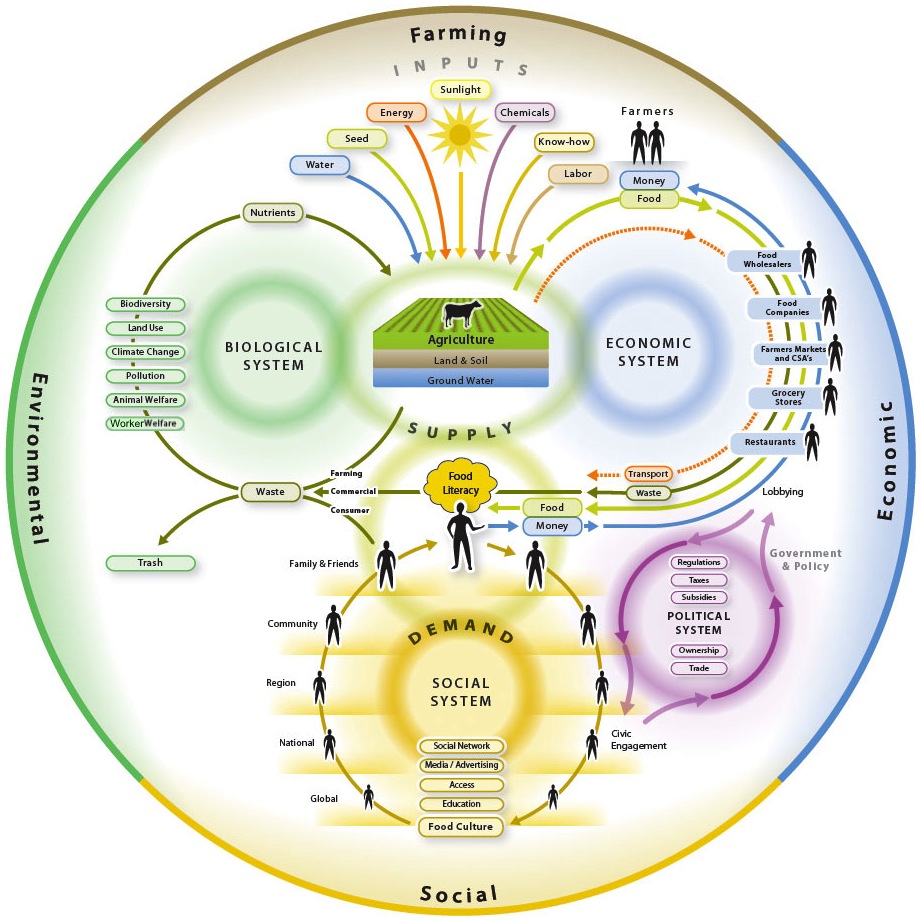






 The Food Futurist Solutions - Anticipate, Adapt, Succeed