255. Communication: Humanity and Authenticity make for Effective Conversations

As usual, listen here to a Chrome AI-generated podcast-type playback of this article:

The original non-AI generated article follows below:

A question that I get regularly is: “How to communicate effectively with the general public about food and agriculture?” My answer usually surprises the person who asked the question. I guess it is because it sounds simple. Yes, shouldn’t the answer to that question be a complicated one, preferably? Well, what I recommend has worked for me all my professional life, in which I also would include my coming from a butcher’s family and having interactions with customers in the shop or on the market when I was a kid.

My answer is: Start a conversation!

It surprises them, and that in turn always surprises me. Then, the following question I get is: “How do you start a conversation?” My usual answer to this seems to even puzzle them more: “Say hello and see what happens next!” Apparently, this often seems to sound like a scary idea. Don’t ask me why because I do not know. Yes, every good conversation begins with “Hello!”. I will continue with how the conversation can succeed later in this post. First, I would like to quickly review the issue of trust with the general public.
The general public has lost trust but there is hope

The issue of trust is not new, but it certainly has strongly deteriorated over the past decade, mostly because of all the disinformation and the weirdest nonsense that social media have helped to spread. For most people, it has become quite difficult, if not impossible, to sort out what is true and what is not, and who can be trusted and who cannot. The public does not trust anything or anyone anymore, be it politics, industry, business, non-profits, mainstream media and even social media. Let’s face it, they are right to think that way. All those parts of society have done an amazing job of losing credibility on an almost daily basis.

In the past, I posted an article and a YouTube video on the issue of trust, (see at bottom of this article) in which I indicated that trust is about safety and that any confusion creates fear. The good news is that an antidote exists for fear: hope.

The general public does not trust. In the case of food and agriculture, this applies particularly to entities that they cannot really identify with a person. The public really craves for humanity. Putting a human face on a farm or a business makes a huge difference. If the industry seems to be a faceless “thing”, they will not trust. Dehumanization is a trust killer, and not just in food and agriculture, but in all aspects of daily life.

Even though this sounds gloomy, it is not all lost. The public does not trust but it would love to know. They would really like to find someone who could explain to them how things truly are and whom they could trust. The large majority of the public are interested in hearing how food is produced and why it is produced the way it is. Many people are open to hear about how it is done. What they do not want to hear anymore is all the disinformation, the misinformation and all the communication lies from all sides. The members of the public have their opinions about food and agriculture. They have beliefs, which sometimes are correct and sometimes are incorrect. Beliefs are tricky. Much research has been done on beliefs and why people stick to them. One recurrent conclusion is that beliefs always trump facts and science. If you tell people a story that goes against their beliefs, their natural reaction will be to not believe you, even if what you tell is the truth and their beliefs are false. Beliefs give people structure and values. Taking the beliefs away feels to them like their world collapses, and they cannot have that. Probably, none of us, including me, can have that. So, if beliefs always trump facts, how to convince them of the truth if it is not what they believe?

Facts and science are the favorite approach of food and agriculture communication specialists. And for all my life, I have seen this approach fail over and over again. The reason? What I just wrote about beliefs vs. facts and science. It fails every time and yet, they keep doing it. Sounds absurd? Well, not so much so, because of what I just wrote about beliefs. Communication operatives believe that facts and science are what the public needs to know. You can show the communicators facts that prove that facts and science is the wrong approach, they will not believe you. And here it is: I have come full circle on the topic of beliefs vs. facts. But then, industry communication specialists will ask what they can talk about if they should not talk about facts and science.

The way to do it

The public wants to know but they do not trust anyone. That sounds like an impossible equation to solve. Not really. The fact that they do not trust anyone does not mean that they cannot get information. Actually, information is everywhere, especially with all of today’s tools. What they do, and the way they want to do it, is to search for the truth themselves. They do not want a guide, and that is quite an adventure. They will find all sorts of points of views and their opposites. So how can they choose the right -and truthful- sources?

I like to tell that getting trusted with communication is like dating. Who goes on a first date with a lengthy pack of slides to show all the facts about themselves, such as health records or bank statements? Some people probably do, but it does not seem like the way to go, does it? No, the first contact is just that. If you communicate about your activities, always assume that people are not necessarily interested in knowing everything all at once. Most probably have never heard of you and they want to get acquainted first, before going into details.

Rule #1: Do not be pushy or aggressive! Say hello and see how the conversation goes. The purpose is not to convince or win an argument. The purpose is to create a connection and generate interest. The convincing will come later. Just let the public know you exist, that you are interesting and that you are there if they want to ask you questions. Communication is much more effective when you answer questions. The reason is simple. The questions are precisely about what the public wants to know. If you tell a story without knowing if it is interesting to the audience, there is a good chance that you will not address what they want you to address.

Rule #2: Be likable! It is a quality that goes along with rule #1, but it is more than that. The success of communication is not about the amount of information but it is about the quality of the interaction. Effective communication is first and foremost about connecting. The public needs to like the communicator, because if they do not, there will be no second date. Then, it is game over. The public will go with someone else. It is interesting to note that industries generally never have any popular celebrity to communicate for them, while activist organizations can pull actors, singers, models and other rich and famous to speak for them. The life background of celebrities often explains why they are on the side of activists. There are usually good reasons and they have nothing directly to do with the issue, but that is another story that I might tell in a future post. Any way, long story short: likable people win the communication war.

Rule #3: Relax! What always strikes me is how Pavlovian communication often is. All it takes is a little attack, a little controversy and immediately, there comes the facts and science stuff again. Stay cool and think first if it is a battle worth being fought. Does it deserve a response? Most stuff on social media has a shelf life shorter than a mayfly. Choose your battles carefully and use your time and energy wisely. Often, silence is the most powerful weapon. Often, rabble rousing is just a way of getting visibility and get trendy by using you to do that very work, thanks to algorithms. Silence is kryptonite to people who crave attention. If a response is necessary, it is most powerful when it is short and concise. Repeating consistently the same message also works well. The message eventually gets through. No need for tangents.

Rule #4: Be confident! You know your stuff and that must be crystal clear for the audience. You are the expert, but always be humble. The public must be the ones who conclude that you are indeed the expert. It is always much more powerful to let the audience conclude than trying to tell them what they should think. Actually, the latter will kill any authority you are trying to build. Haven’t we all had bosses who had to always tell they were the bosses every time there was a disagreement? See the similarity? Remember, you are cool and relaxed. That makes people feel comfortable.

Rule #5: Be respectful, always! First be respectful of the public’s opinions. They have good reasons to think the way they think, even if they are wrong. These are their reasons, not yours. Make clear to the audience that you know their opinions and that you respect them. That will earn you respect, and that is the foundation for trust. In the process of connecting, it is also quite valuable to go through a number of agreements to disagree, all in full respect. It is impossible to agree with everyone all of the time. Just take your time and move one small agreement at a time, and say thank you for the good conversation. Make sure the public will be looking forward to a next conversation. Be human, that will make you likable.

The way not to do it

Error #1: Long technical stories. In this age of short attention span, the shorter the communication the better. So, keep it short! Besides, when it comes to make a point, short is much more powerful than long stories. Ideally, pictures are much more powerful than words.  They can carry many subliminal messages. This is why activists use the power of images and of associations so much. Unfortunately, the industry has a tendency to linger on with their facts. Long stories full of facts, science and beautiful busy charts work only when the industry speaks to the industry. That is preaching to the choir. The audience is already an ally. This is not communication with the general public. This kind of communication would work mostly with nerds, but that is not really the general public. Most people are not food and agriculture insiders. They do not have a specialized background in those areas. When flooded with technical information, most people will unplug and do something else. This kind of communication is not likable.

Error #2: The boring school teacher. The important thing to keep in mind about the public, especially younger generations, is the need for a strong dose of entertainment. They love it. Actually, they crave it. Communication and connection must feel like a game. It is learning by playing. It needs to include a playful element. This can be the nature of the dialogue or it can be the medium or platform used to communicate. The entertainment value will strongly impact the quality of the interaction. What does not work well is the opposite of entertainment: the boring lecture. It does not work because it is boring and because it feels like a lecture. It feels like “all work and no play” and that, as the saying goes, is dull. The feeling of lecture is always reminiscent of school. It makes the public members feel like there is a power distance. A sure way to create that distance is to start the conversation with “Did you know…?” For most people, this makes them feel like they are treated as ignorant and as inferior, and that does not create friends. Once again, it makes the communication perceived as not likable. Recently, in a presentation, I told an industry audience that boring technical communication makes them sound like PBS, while the public prefers to watch reality TV. The comparison is rather accurate. PBS is quite interesting if you set your mind on serious educative material. Personally, I always found that PBS had excellent programming, but that is just for a certain public at certain times. Having fun is important in life. The trick is to make educative material fun. That should be priority #1 for communicators.

Error #3: Denial. An important mistake not to make, that the industry makes time and time over, is to rush into denial. Don’t, especially if the issue is a complex one! It is much better to acknowledge that the issue is indeed one that floats around and that you are aware of it. The difference with upfront denial is that it does not sound defensive. Just that acknowledgment already defuses tension, which is important when you want to have a fruitful conversation. Tension kills a conversation because, when tense, people do not listen. They shift into Pavlovian mode. One word and there is the trigger for confrontation, instead of connection. Most of the fights around food and agriculture, or any industry or even opinions, is that nothing is really black and white. A lot of the differences of opinions are in the grey areas, in the nuance. Unfortunately, polarization does not like grey because grey and nuance undermine polarization. Yet, the debate needs nuance badly, and most of the general public knows that. The key for effective communication is to avoid the trap of polarization and shift into nuance, but well thought-out and solid nuance, that is.

Error #4: Being self-centered. Avoid, the tendency to talk about yourself or about only about your industry or company when dealing with controversy. When communicating, the most important person is the recipient. If you are a communicator, communication is never and never must be about you. Communication is a sales process. The public is the customer. The communicator sells a point of view, an opinion, an angle. For this very reason, communication must be market-oriented. Usually, communicators do not think nor act that way. Instead, they have a production-oriented approach. It does not work well. It is much more effective to communicate to the public about what the public is interested in than trying to push a message that does not align with their curiosity. This is why, just like a skilled salesperson does with a buyer, it is essential to start with hello and ask questions about what the “customer” is looking for. Do not talk about you, your company or your industry because that is not what the public wants to hear. Instead, find out what is important to them and come with an answer that meets their needs and show them why your point of view is valuable to them. Start by looking at the world from their perspective and then, let them see the world from yours. This creates empathy and mutual understanding. Take the time it deserves. Forcing the process will only work against you. Trust me, this approach is very likable and will deliver many dividends.

Error #5: The sound of PR. This is lethal for communication. Keep in mind that everybody knows how public relations sounds. They hear it all the time from businesses, from industries or from politicians. The sound of PR, with its techniques to twist facts, to say half truths and to spin reality is well-known. The sound of PR is what has destroyed trust in everything, as I mentioned at the beginning of this article. The public knows it and the public loathes it. So. forget the mechanics and the techniques that make you sound like a predictable robot. There is a chance that you are more transparent than you think. To be likable, use the very opposite of the technical stuff: humanity and authenticity. You will not believe how much you can achieve with them.

Further, if you are interested, I also have a playlist about communication on my YouTube channel:

Next week: Let’s not Take Food for Granted! Understanding Food Security this Holiday Season

Copyright 2025 – Christophe Pelletier – The Food Futurist – The Happy Future Group Consulting Ltd.
Like it or not, emotions come first when connecting with the public and consumers!

Listen here to a Chrome AI-generated podcast type playback of the original article

With this post, I am going to start a new format on this blog. Since a growing number of people now prefer videos or audio to reading, I will post here the videos that I shoot, accompanied by the transcript of the video. I will try to make the videos relatively short, so that they can fit within the current level of attention span of most readers and viewers. You will tell me if this has been a good idea. My videos will also take a slightly more opiniated tone that my previous works. You can see all of my past videos on my YouTube channel.


To launch this new format, here is a topic that I have presented at conferences before, and that has been well received. I explain why emotions come first when communicating with the public. I also explain that beliefs always trump facts and science and why it is essential to focus first on the emotions of consumers to have an effective connection and gaining the public’s trust.


You know in agriculture there is one topic that comes back regularly in the conversation and it is how to connect and how can we really get the consumers listen to us and every time.

I’ve been involved in those conversations and I met the same problem.

The problem is that the industry of course is basically production-driven. It’s a technical activity and they always go back to the science and to the facts. I always tell them: you know beliefs always trump facts; beliefs always trump science. If the facts you present, even if they’re totally true, but it goes against the beliefs of the people who listen to you, they will say: Nah, I don’t believe that and that’s it. And then, you do not succeed.

So, how can you really get the message across? And what I say all the time is you have to connect you must not focus only on communicating; you must connect. Not connecting like it is on social media, I follow you and you follow me. That’s not connecting just teenage dreams.

To me, connecting means that you have to really get at the same level; and when we deal with issues, especially resistance in agriculture, we basically deal with emotional issues. That’s always the thing: people are all emotions but [we bring up] “the science says” or “the facts are”

The problem is that when you deal with emotions, you cannot talk about science and facts; you cannot bring the discussion at a rational level as long as you have not basically helped the other person process their emotions as long as you have not connected at that emotional level.

There is one thing that I’ve written in my second book and I give an example. I say imagine you have a child who has a nightmare and he’s screaming. The parents are coming in the bedroom and say: ok, what’s going on? and the child is all screaming and he say: there is a green monster under my bed and he wants to eat me.

Then, I say, here is exactly what you must do and what you must not do. What good parents would do is, well, they take the child in their arms. They would try to comfort him; they try to make him feel safe, bring a feeling that, you know, we’re here for you, don’t worry. If the monster comes, then we’re going to deal with the monster and then you basically ask the kid: ok what happened exactly? Now where is the monster? where is the monster? and says it is under my bed.

OK, and then, bit by bit, through questions you help the child to get the story out, and then you’re going to go and have a look under the bed. First, you can say: OK I’m going to have a look under the bed, you stay here you’re safe here let me have a look!

And then you can say: OK, I don’t see anything. You can take a stick, you know, a broomstick and under the bed and the child will see that the broomstick passes through and through under the bed and there is nothing probably and then, bit by bit, you’re going to be able to bring the child. Even, if you want. you say OK let’s have a look together under the bed and then that’s how you bring basically that very high emotional situation into a more rational one, bit by bit and then the child is going to realize there is no green monster under the bed. Then he’s going to feel safer, but it’s very possible that he doesn’t want to go in in the bed, or you can say: OK we’re going to leave the light on, or okay you come and sleep with us tonight. And tomorrow, we’ll have a good look at that and we’ll make sure that you know there is no monster at all. That’s the right way to do things. It’s connecting at the emotional level and, bit by bit, know making the child realize that it was just mostly in his in his head and it’s not real.

What unfortunately in my opinion the industry in food agriculture but all industries do is basically say to the child: “well, science has demonstrated that there are no such thing as green monsters living under children’s beds and eating them, so go back to bed because there is no reason for you to worry!”

But when you do that well what’s going to happen well your child is going of course he’s going to scream and to not trust you anymore. What do you expect? If you treat the emotions of a child that way, he is not going to trust you anymore. Unfortunately, because it’s not just about children having nightmares, in the industry if we want to really connect with consumers, if we really want to regain that trust, we have to connect first at that emotional level and only once we have done that, and bit by bit brought the conversation bit by bit, bit by bit, back to more a rational level, then we will be able to pass our message.

But, if we want to fight emotions with science and with facts, [if it is about] the message of the industry versus the emotions of the public, you will never win, so forget it! Don’t spend your money on PR on communication if that’s what you want to do. No, you have to have a little bit of empathy and you have to really help the consumers understand what you’re doing. You have to basically take the fear away but you have to do it bit by bit, both at emotional level and at the rational level.

Copyright 2024 – Christophe Pelletier – The Food Futurist – the Happy Future Group Consulting Ltd.

Launching my YouTube channel

It was something that I have had on my mind for some time but I will admit I have been guilty of procrastination. In the past, I had placed some videos on a YouTube channel but I had not pursued that avenue. These videos are actually still there and you can find them in different areas of this website. Since I have no recollection of how to access  that old account and I have not been able to retrieve the necessary information, I have just decided to create a new one, called -you’ll never guess- “The Food Futurist”.

My purpose with this channel is to post short videos, of three to five minutes maximum, in which I will share my thoughts on whichever topic I will find useful. Of course, if anyone of you wishes me to address one particular subject, I will be happy to listen to your requests. My goal is primarily to provoke some thoughts from the viewers and have them reflect on some issues. It is meant to be entertaining, and hopefully informative as well. I am not interested in playing influencer.

You might wonder why am I doing this? I have several reasons:

  • I do keynote presentations on a regular basis. Therefore, a large part of my professional activities is about speaking. Sharing videos are just a logical step.
  • More and more, people prefer watching videos rather than reading. Perhaps, this is because watching is more convenient and requires less effort. Anyway, once again, videos are a logical step.
  • From my end, making short videos off the cuff requires less time for me than elaborating a written article. Also, since I am still in the process of writing the book on value marketing that I mentioned in a previous post, I can use a different form of communication with you.
  • Having my own channel will allow me to share my thoughts in a direct and (almost) uncut manner. It is more authentic and genuine. I have been regularly interviewed by media outlets since the beginning of this website (2009) and my works as “The Food Futurist”. I always found that exercise frustrating because the interviews last between half an hour and an hour but in the end, the journalists extract just a few sentences in their final articles. Then, most of what I said does not make it to their readers. The excerpts tend to miss context as they are isolated from the rest of what we discussed. Also, and perhaps the most frustrating is that usually the excerpts are not the most important and useful bits of what I told them. They are just the ones that resonate with the particular audience of that media outlet, and the interview ends up producing just a few catchy or trendy statements. At least with my own channel, I control the content, from producer to consumer.

Copyright 2023 – Christophe Pelletier – The  Food Futurist – The Happy Future Group Consulting Ltd.

What is the point of social media?

Or: What happened to good old conversation?

Perhaps you will find this a weird question but I have been wondering about this for quite some time. A couple of recent experiences bring me to write about this. What I did was to ask simple questions on postings from food companies on LinkedIn. One was from a US potato company claiming that “children’s palettes are becoming more adventurous” meaning that children are more inclined nowadays to try exotic flavours. So far so good. I just asked if the word should be palettes or palate, knowing well that the latter is the right spelling. They never replied nor even corrected the spelling error. That surely spelled quality to me… Another disappointing attempt to interaction was my asking a large US retailer what they charge for a delivery under a posting showing their new driverless vehicle delivery to consumers. I did not think that it would be a particularly challenging question since it is rather normal that potential customers ask for a quote. I get that all the time and that is the most normal thing in the world when you run a business. I did not get any reply but noticed some time later that their original posting had been removed and a new “immaculate” posting appeared. So, of course, if you want to treat me like that, I have no other choice than to rewrite the same question in the comment section of the new post. Finally someone –who is no employee of the retailer by the way- answered and told me $6 per delivery. I replied to him by saying thank you, because I have manners.

To me, social media seems to be just a one-way communication tool. Some would go as far as to call it narcissistic. Sometimes it is, sometimes it is not. As such, I do not see anything wrong about businesses telling their story and showing off a bit. If you want to sell, it is good to get out there and advertise. The problem is when there is no reply or just a standard reply, the kind you can sniff from further away than butterflies spot a mate because it is a clinical and impersonal message, almost like a robot just carries out what it programmed to do.

We live in a world where never ever before, there have been such amazing possibilities to connect and interact and yet, it seems to create mostly addictive bubble behaviour. It is almost like smart phones has become a combination of safety blanket, umbilical cord and excuse to ignore the other people around. I like to interact because I think that is what humans are supposed to do when they want to do something together. Unfortunately, I find it a lot more difficult than it was 10 or 15 years ago. Personally, I like LinkedIn. It helps me follow people, many of them have become good friends, and to know about their whereabouts and professional activities. I exchange messages with them once in a while to keep the connection literally alive and my experience is that my contacts and I always feel great about that. What I do not like on LinkedIn is getting requests to connect from people who do not know me and do not really care about me, either. The first thing I do is to send a message asking them to tell me about them and to get to know each other before I decide to actually complete the connection process. You probably guessed it; I hardly ever get a reaction and/or the slightest response. If someone wants me to connect, they’d better show a bit of interest and invest a few minutes of their lives. It is clear that the purpose of such requests is for the other party to look important by being in the league of 500+ contacts, not to mention those claiming to know millions of people. Yeah, I would like to ask them to name all of them by name. I do not have 500+ contacts on my profile but you can bet that I know them all. What is the point of having contacts you do not know and do not even try to get to know if you do not interact? Do you really think that anyone of them will care for you and help you? I think not, simply because those who play that game are just as self-centered as you.

I used to be on Twitter but I end up leaving. All I could see were people doing self-promotion and totally ignoring any interaction. The number of users that would follow me and unfollow me simply because I would follow them was ridiculous. I follow people when they have something interesting for me. If not, and I do not see any chance of that changing, I just do not want to overload my tweet feed with stuff of no use to me.  It is not that there is no interaction on social media. Of course, there is some but I do not find that it provides enough of that for me to spend time on those platforms and the quality of it is, well, variable. Instead of dialogue, what I see a lot are monologues that go parallel along each other, a bit like traffic separated by a median. This is particular true when it is about pro-this and anti-that communicating, and food and agriculture have quite a bit of those. The tribes clearly do not want to come to the negotiation table. They preach to the choir, which is great because nobody disagrees. Since there is no dislike button (great for social media platforms businesses but less so for honesty and integrity), they never have to know about those disagreeing, which is safe, especially since it seems that one of the characteristics of social media users is fragile ego and thin skin, you know the kind full of bottled anger and so much bile their skin turn orange. The logic of the tribes is that if you disagree with them, you not only have to be wrong, but you are evil and they hate you.

A few weeks ago, I was on a website looking for a recipe for spaghetti squash (delicious stuff by the way) and as I scrolled down the page, I got in the comment section and oh boy! Someone who was asking a simple question about whether you could bake the squash whole instead of cutting it in half, got insulted as he apparently his question proved he was an idiot to some. Then others defended him and the whole thread turned into a forum filled with mostly profanities and very little culinary advice. That is one of the problems I find with social media. The mob instinct and even lynching behaviour pops up really quickly because it is so easy to do it safely behind a computer and hiding behind an alias or being anonymous. And all it takes is as benign as a spaghetti squash recipe! It is a bit worrying.

Technology offers great possibilities but as I always say and have written in a number of occasions on this blog, it is only worth what the users make of it. I believe it is possible to discuss differences without immediately feeling threatened or under attack. Other people have the right to have their own opinions. But I also believe that a conversation, even about controversial topics must remain civil. Only bullies think that being polite is a sign of weakness. If you find them, ask them what happened to some of the bullies in my old school yard then they thought I was a polite kid. Similarly, I could tell you about some of the exchanges I have had online with anti-GMO bullies as well as pro-GMO bullies who could not stand to hear an objective take on the subject. I guess the Jiu-Jitsuka in me came up and the conversations ended up really quickly with the bullies being put back in their places in less than a sentence each time.

I have not mentioned Facebook yet, simply because I did not like their questionnaire before opening an account. I found they were way too curious. You will not find me on there and frankly, I see so much similar behaviours on Facebook as I see on the other social media. I can use my time better.

Perhaps, all those flaws are just teething problems and it will sort it itself out on the long-run. In the meantime, I will stick to my interest of good-old fashioned conversation. There is always something to learn from a good conversation. The flip side of that coin is that you will not learn if you do not engage in conversation. And how can you grow without learning? Just like you will not get to win the Olympic gold by refusing to do competition, suffer, lose and cry once in a while, being challenged and pushed back is what helps you improve and outperform others. It builds character and makes you a better person. And this is not just true for sports; it is true in all aspects of life, professionally as well as personally. I am always in for interaction when it is to make things better in a positive and constructive manner. You know where to find me (hint: contact page), that is if you wish.

© 2019 – Christophe Pelletier – The Happy Future Group Consulting Ltd.

Food fights will go on and it is a good thing

A funny thing happened to me when I moved from Europe to North America in 1999. In Europe, I was used to having demanding customers. Issues about how food is produced have been rather common during pretty much my whole life (I will turn 55 later this year so that you have an idea of how long it has been).

When I came to North America, I dealt with a completely different situation. I did not get some of those 30-page product specification documents from retailers, foodservice and manufacturers with all the do’s and don’ts of how to produce food. I just got some 30-page disclaimers and liability documents, for the customer to dodge any heat should there be a law suit some time down the road instead. Before, I left Europe, I remember my Managing Director from the poultry company I worked for telling me how lucky I was because “over there (North America), customers hardly ask anything, you just sell them what you produce”. I remember looking at him and thinking that it could not be possible. I was wrong and he was right. For as much as European consumers were picky on all things such as hormones, antibiotics, GMOs, animal welfare, feed composition and origin, North American consumers, and retailers as well, seemed totally uninterested about production methods. It was almost eerie and to be quite frank, it was boring, because I could not see any challenge. One of my American colleagues enjoyed telling that it was the way it was and that it would never change because that is how Americans are. I disagreed but it certainly appeared he was right for a few years. Things have changed now. The American consumer has become more demanding and the dynamics of the discussions have become quite similar to what I had known in Europe for decades. It is actually rather easy for me to “predict” the future as I am living in an ongoing déjà vu nowadays.

The debate about food has indeed evolved into food fights. If there is one thing that I always found remarkable in my professional life in the food and agriculture sector is the issue of the producer-consumer relationship. Maybe it comes from my family background, but I have never understood why the food industry is so defensive when challenged by consumers or any organizations. My father used to be a butcher and I spent quite a bit of time around the shop and with him on the markets. I discovered very early that customers would ask the weirdest things but that what matters is not the factual truth but whether they trust the supplier. If you cannot deal with that fact, I suggest you do something else than producing food. Food is loaded with emotions and that is that. If consumers were rational, there would not be any diversity in foods and other consumer goods. They always would do the right thing and would not pay attention to all the marketing efforts that support the world economy. If consumers were rational, I bet you that they would deconstruct any PR by spotting all biases. If consumers were rational, they would focus on nutrition only and they also would reject anything that is unsustainable. I have a feeling that a lot of people who resent consumers’ emotions would actually be out of business because they would deal with a much tougher audience than the current consumers. Be careful what you wish for. Further, it is also clear that those who criticize consumers for not being rational, are not rational themselves in their consumption patterns, either. Nobody is.

Last year, a book titled No more food fights hit the shelf. Considering the author is actually supporting the conventional agriculture and has a problem with consumers and activists who challenge the food system, it is actually ironic. It reminded me of the words of my Managing Director about the North American market. What could be better than the good old days when the agribusiness could push their products to lethargic consumers? It sure must have been a good time, but it is gone. The book’s author, just like the agriculture sector, does not want anybody questioning the food system. They don’t want anyone looking over their shoulders and find out the bad and the ugly, at the risk of not showing the good either. I do not understand the food producers’ reluctance. If you are proud of what you do and what you produce, as they claim, you are proud to show the world and to share that goodness. You are also willing to always improve and make your customers satisfied. In my opinion, the attitude is really more about being production-driven –or should I say production-centred- than market-driven. The difference is that the former is about oneself and the latter about others. That difference actually reflects quite well in term of whom consumers trust. They trust the latter group, but are very distrustful of the former. I can understand both attitudes because I have filled functions that were more oriented towards technical operation as well as commercial functions.

I started my professional life in a position in a technical and scientific field, which suited me well by then because I was a hard-nosed rational fellow with a tendency of not accepting unfounded non-sense. Then, by accident, I got myself involved in a commercial role, which opened me new doors, and my eyes, too. The successful experience led me to other commercial positions and the lessons that I had learned in my father’s shop, I rediscovered on a daily basis in the multinational company. There is a huge gap of perception of the customers between the different departments of a company. Very often this discrepancy is reflected in the dynamics of the sales and operations departments of a business. One wants to say yes and the other wants to say no.

Food fightPersonally, I find being challenged a very good thing that can happen to a producing company. I would agree that negative feedback is never pleasant, but even though the message can be rough, it is feedback after all. In this regard, it should be handled in the same way as customer complaints, the good kind of handling that is, not the denial kind. The latter is usually more of a reason for a customer to drop a supplier than the problem that occurred in the first place. Business, like it or not, is first of all about human interaction. Money is only a means to secure it. In the course of my career, I had to deal with “consumer resistance” in quite a few occasions, but what it put into motion brought me most interesting and rewarding experiences. They helped me to learn about business and to understand the complex dynamics of entire value chains faster than ever. They helped me grow and that experience has made me one of those who understand the ins and outs of marketing, production and management in a variety of discipline the best. I am thankful to my “difficult” customers forever.

The reason is simple. By being very demanding, customers forced us to be better than ever and be resourceful to find ways of both meeting their expectations and allow us to remain profitable. Quality only improves through pressure from customers and a competitive environment. It very rarely happens as the result of a voluntary decision, simply because there is a cost at first. In the case of my past professional experience, needless to say that adjusting to consumer demands was never an easy process internally. On the one hand, there was the source of the company’s revenue – in other words salaries – at stake, and on the other hand, the natural drive to keep production costs under control. The key was to not lose our focus on the one essential parameter: the margin. Margin management with market vision really delivered amazing results in such situations. Another essential point was to negotiate everything and always get something in return for any effort made on our part. I remember some very tense conversations with Marks & Spencer in the time the talks were about the removal of meat and bone meal from animal feed. We showed them the impact of their demand on our bottom line and made clear that if they helped out on the bottom line we would go along. Because we were offering top quality chicken, we were able to find an agreement. For as much as we could not afford to lose their business, they did not want to lose us as a supplier, either. The willingness to accept challenges from the market and the drive to always improve our products and service served us. We would not have been in a position to ask anything in return if we had produced a basic commodity. By aiming at being the best, we had a sustainable competitive advantage. Finally we were able to have them accept to buy more from us so that we could dilute the extra cost over a larger volume and have more efficient logistics. The result for us was actually more volume of above average margin products. The customer had to say goodbye to some suppliers who were not ready to go the extra mile for them, and we also said goodbye to customers who would not support us in the cost effort. In the end, a very tough challenge ended up in a strong long-term profitable win-win situation. We came out of a crisis that could potentially have destroyed us stronger and more respected than ever. This is only an example of a tough market challenge. I went through similar situations in the various sectors –feed, pig, poultry and aquaculture- in which I have worked. The added value got in the millions per year each time.

Food fights are good, but they work only by picking the right partners in the market. As a producer, you need to have customers and make the right choice to achieve this goal. As a consumer, you need to find a producer that listens to you and meet your expectation. They will be disagreements along the way, but in the end both parties can benefit, but it will not just fall on your lap. Fights are a part of life. On the first day of my last year in the Agricultural University, the head teacher had a short presentation. He said that life is about:

  • Learning
  • Creating

Those two points were very well received by the students. Of course, it fits quite nicely with a crowd of intellectuals. The third point was received by the chilliest silence I can remember. The third point was…

  • Fighting!

Yes fighting is an integral part of life. We all fight all the time. We fight with competitors, with other drivers, with customer service representatives, with sales people, with the tax man, with retailers, waiters. You name it and it you will find an example of fighting. So no more food fights? Forget it, it won’t happen. In my experience, the only reason why anyone asks for a fight to stop is when they are losing. In this case, if they are losing, it is more because of their refusal to listen to where the market is going than because of those bad irrational consumers. The smart food producers, big or small, have all made moves in the direction of consumers’s demands because they know that is where the growth and the future are.

Copyright 2016 – Christophe Pelletier – The Happy Future Group Consulting Ltd.

Fear mongering does not build a solid future

Since the drought in the US of this past summer and the strong price increase of agricultural commodities, agriculture has become a favorite topic in the media. As such, this would be really good if it were not for the (potential) disaster voyeurism. There is nothing like a flavor of end of the world in the works to get the attention of the readers. After all, this is good to fill advertising space and to promote a book.

Since I started to look at the future of food and farming, I have seen an evolution on how people look at the future of agriculture. When I started, I could hear statements about the need to have two (even three and four) Earths to meet demand. Interestingly, none of those who stated this impossibility neglected to pay attention to food losses, and they were only focusing on more production. When could passing a mop under an open tap be a sensible approach? If we really come to need more than one planet, then there is only one outcome. Since that second Earth does not exist, the surplus of people would have to die so that the world can meet the demand of the survivors. I agree that it is not a cheerful thought. However, Mao Tze Tung once considered that it could be acceptable that half of his people, the poor, would die of famine to allow the other half that could afford food to be able to meet its needs. Such a morbid thought is actually more common that one would admit, and in this world of political correctness, it is repressed voluntarily. That does not stop the fear mongers, though. They just not choose to sacrifice a group to save another one. They tell us that we are all going to face our demise. That is politically correct, I suppose. Personally, I do not consider that announcing disasters is constructive. Fear is a poor adviser, and it is certainly not the proper way to communicate about problems.

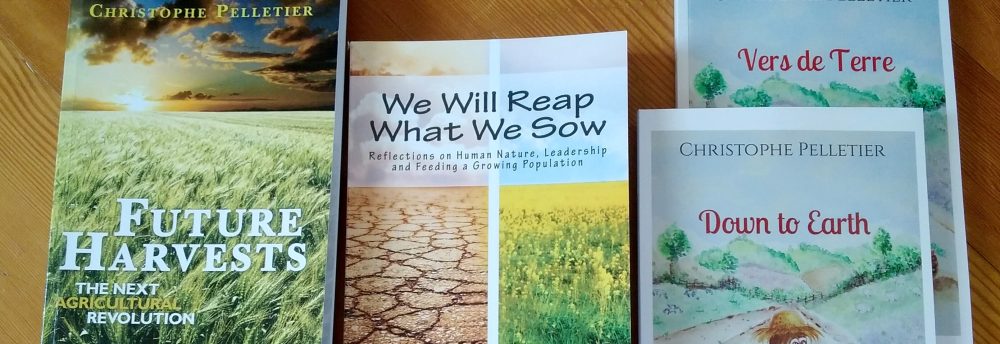
There is no shortage of doomsday thinkers out there. In We Will Reap What We Sow, I address the many challenges that the doomsday thinkers bring up. Instead of taking an apocalyptic approach like they do, I chose to initiate a positive  reflection about alternatives and solutions. Scaring people is too easy, especially when they are not experts in the field of agriculture. I am not a fan of the one-eyed being king in the land of the blind. I have 20/20 vision and I want to help others to also see with both eyes. In my book, I make clear that we will live with the consequences of our actions (hence the title), but I give many reasons for hope. It is more productive then despair.

In the realm of doom and gloom, I must admit that the Post Carbon Institute wins the prize. Among the other prophets of doom, Lester Brown currently fills the stage, especially since he is promoting his latest book. I had the chance to hear him speak some 14 years ago at an aquaculture conference. I must say that he is an excellent speaker and quite a charming man. Actually, he inspired me to venture into foresight and futurism. I really believe that his talents should be used to create positive momentum instead of sowing depressive thoughts in the population. Before the summer (before the US drought that is), he had stated in an interview that “the world is only one bad harvest away from a food crisis”. I have never subscribed to that point of view. The issue of feeding the world is much more complex than that. Well, we just have had a bad harvest and there is no more food crisis than last year. Prices of agricultural commodities have gone through the roof. Yet, there have not been any riots like in 2008. It is almost a wonder considering how much fear mongering has taken place in the mainstream media. They all came with scarier scenarios the one than the other. And thanks to social media, the news spreads even faster and further. In particular, Twitter is an amazing place to be in. Anything and everything gets tweeted, retweeted many times over without the slightest critical thinking. Their symbol should not be a bird. It should be a sheep. The top of uncritical maniacal tweeting was about the writer from Australia who spoke at a conference telling the audience that agriculture needs to produce 600 quadrillion calories a day. That was all over twitter. Wow, do you fancy that, 600 quadrillion? Yes, I have to admit it is a big number. I found is so big that I had to count on my fingers. Considering that the average human being needs about 2,000 calories a day (the FAO says 1,800, but let’s keep the calculation simple!), 600 quadrillion calories corresponds to the needs of 300 trillion people. That is about more than 40,000 (yes, forty thousand) times more than the current world population. With math like this, it should be no surprise that his book is titled the Coming Famine. Regardless of the title, I would agree that one Earth could not feed any number of people remotely close to 300 trillion, but we are not there yet. When I saw that number, I could not resist tweeting about the math, and the sheeple out there realized that the numbers did not add up.

That has not been the end of my tweeting against the fueling of fears about food and agriculture. Another tweet that caught my attention came from Graziano da Silva, Director General of the FAO (actually his staff) stating about food prices “This is not a crisis yet. We need to avoid “panic buying””, to which I replied that a good way to do this could be to stop talking about food crisis so often. What can be more of a boon to speculators in commodities than Twitter and its instant worldwide spreading of any rumor, information or myth that indeed can create panic? There is no better way to make food prices increase than by repeating exponentially that there might be food shortages, even though it is not the case. Interestingly enough, since then, the panic button seems to have been turned off at the FAO.

Fear mongering and doomsday thinking, although morbidly attractive, will not help build a solid future. Predicting terrible disasters without giving clear clues of how to prevent and overcome them is rather useless. Actually, it is counterproductive. Those who do not know the facts or are not in a position of doing something about the problem are going to feel demotivated and there is a chance that they will not try to care anymore. Those who actually contribute to solutions will not pay much attention, as it sounds like the kid who cried wolf to them, and might miss important information in the process. There are challenges ahead. Some of them are quite serious and difficult to overcome, but not impossible. I know that and I know them. And so do many others. However, the fact that the task ahead is challenging  is no reason to undermine anyone’s morale. The amount of knowledge and of tools at our disposal is quite amazing, and we probably have more than we need to fix things. What must change is our attitude. Rambling and whining about problems have never made any disappear. It is necessary to create positive momentum among the population(s), to show them that success is possible. To achieve this, it is important to avoid the opposite of fear mongering, which is blissful optimism. It is possible to feed the world, even when it reaches 9 billion people. It can be done with one Earth. A couple of years ago, I was one of the few who claimed that it could be done. By then I felt a bit lonely, as the main thinking sounded like it could not be achieved. Maybe my blog, books and presentations have contributed to change that. Those who have read me or listened to me seem to think that my positive and practical look on the issue have contributed to changing their mindset. The thought is nice, but it is not what counts. What really matters is that gradually, more people start to see beyond the myths and the catch phrases. Not everyone does. This summer, I heard about the “Great Global Food Crisis”. So far, I had heard only about the Global Food Crisis. Apparently, fear had increased by a notch or two.  Such expressions are non-sense. If the food crisis were to be global, there would be a food crisis everywhere around the globe. That is pretty much the definition. I do not see any food crisis in many countries. Actually, a study showed that the number of overweight people was on the rise in more and more countries. What is true is that there are local food crises. Unfortunately, for the populations that suffer from it, they are not caused by global food shortages as some like to make believe, but because of armed conflict and /or by poverty and lack of infrastructure. The number of undernourished people is actually decreasing as the FAO showed in their latest State of Food Insecurity 2012. To me, everything points at progress in the fight against hunger, even though negative climatic events affect agricultural production. But just for fun, let’s get back to the Great Crisis. If the food crisis were to be global, can it get any bigger than that? What does the adjective Great add? It adds nothing except the desire to scare. Let’s face it! Some people jobs depend on cultivating the idea that something goes wrong. It is their only purpose. Personally, I prefer those who roll up the sleeves and conceive, develop and execute solutions. These are the ones who make our future world a better place. It is too bad that they do not get as much attention from the media as the fear mongers. Of course, things that go well are not as sensational as disasters, but they are more valuable. They are the success stories that need to be told, so that others can learn from them. They are the success stories that must be told so that we all eventually can realize that building a solid future is possible. It is not easy as spreading fear, but it is much more productive and useful for present and future generations!

Copyright 2012 – The Happy Future Group Consulting Ltd.

The rise of the non-profits and how they shape food production

In the years before the current economic crisis, the non-profit sector was already creating more jobs than the for-profit sector. Last year, the total of all operating budgets of non-profit organizations passed the US$1 trillion mark. This makes non-profits the eighth economy in the world. This amazing number seems to have been rather unnoticed, yet it has quite some significance for the way economy might evolve in the future. They are a force to be reckoned with.

They are perceived as independent, although this is not necessarily the case, and this tends to give them a higher moral status, especially compared with the for-profit sector. As I had written in a previous article, nobody has the monopoly of morals, but non-profits have a PR advantage in this area. A part of their strength comes from the loss of trust in government, science, industry and politics by the general public. In the food and agriculture sector, the influence of non-profit organizations is growing, and it challenges the way food is produced.

Just like in the for-profit sector, the size of non-profits as well as the quality of their message varies. Similarly to many corporations, the integrity of some non-profits is questioned. However, in order to motivate individuals and organizations to donate money, they need to have and to keep enough credibility. Competition exists in the non-profit sector, too. Only the ones that do the best job can survive. Nonetheless, non-profits have been instrumental for many changes in food production. It is also clear that change and improvement comes only from being challenged. In this article, I just want to name a few examples of the power of non-profits and their ability to cause visible change.

First, here is an example as recent as last week. The HSUS (Humane Society of the United States) came out with video footage of what they called inhumane treatment of pigs at a Smithfield Foods pig farm. For those who may be unaware of who these two organizations are, the HSUS is a non-profit organization strongly opposed to intensive animal husbandry. They want to end factory farms. Smithfield is the world’s largest pig processor. The HSUS and the US meat industry are no friends. They have opposite views on animal husbandry and meat production. They accuse each other of the usual shortcomings and lies, as is the case between industry and its opponents. What I found quite interesting in this case, though, was the communication of Smithfield about the “crisis” on Twitter. Here, I can only speak about my perception, which was that Smithfield was quite nervous about this matter. Obviously, the HSUS scares them, and not just a little bit. The pork company came with numerous tweets about the problem, and in my opinion too many messages. As long as the investigation is not completed, any communication is unnecessary, and potentially confusing. I got confused to the point that I even wondered how they actually implement the procedures about animal welfare that I believe they have. They even communicated that they would have emergency audits from authorities in the field of animal behaviour and animal handling, such as Temple Grandin and Jennifer Woods, from Alberta, Canada. The farm is in Virginia. That sounds rather drastic if all procedures are in place and followed. The end of the story, at this day, is the report of the Virginia State vet, who did not notice any violation during his visit. There is no way of knowing whether something bad actually happened. The vet’s reports also mentions that the farm will have to be monitored, which makes sense in the context. Smithfield also communicated to have fired three employees for violation of animal welfare procedures, which tends to confirm that the HSUS had put their fingers on something true. Of course, the background of the story is that the HSUS finds that Smithfield does not make the move to banning gestation crates for sows fast enough, as the company had announced a few years ago. They compare Smithfield with other US hog producers who have already implemented change of husbandry systems. Regardless of this specific case, the reaction of the world’s largest pig producer tells me that the HSUS is going to win its battle to reform substantially the US meat industry. It will not happen overnight, but it is just a matter of years.

Another example, still in the pig sector, comes from The Netherlands. The largest supermarket chain, Albert Heijn, part of Ahold, the fourth largest retailer in the world, will sell only pork produced in animal friendly conditions, according to a protocol set up together with Vion, The Netherlands’s largest pork producer and Dierenbescherming, a non-profit organization dedicated to humane animal treatment. I remember when I used to work in the pig industry in the late 1980s in The Netherlands; Dierenbescherming was considered a rather extremist organization that supposedly did not get the realities of meat production. How things can change in 20 years!

Greenpeace is one of the most active organizations that try to change how food is produced. The agriculture lobby is not too enthusiastic about their actions, but Greenpeace gets things changed. They addressed the issue of beef production in Brazil and its relation to deforestation. They achieve more than the Brazilian government by reaching agreements with beef producers in a region where the “law of the gun” tends to prevail, but also mostly with the beef producers’ customers. The main fast food companies (McDonald’s, Burger King, etc…) and retailers like Wal-Mart have pledged not to buy beef that would be produced at the expense of deforestation. Be assured that something like this has quite some leverage. A similar situation has happened about the production of palm oil in Indonesia and Malaysia. Greenpeace’s action to save the orang-utans’ natural habitat has resulted in large users such as Nestle and Unilever to purchase only sustainable palm oil products. This has more impact than government action. I had mentioned a few weeks ago, the ranking for seafood sustainability by Greenpeace of retailers. Costco, which came last, first tried to contest the results. However, within a couple of weeks they reduced their seafood assortment from 15 to only seven, sustainable, species.

Another non-profit with influence on food production is World Wildlife Fund (WWF). They created in 1997, together with Unilever, the Marine Stewardship Council, which role is to set sustainability standards and conduct certification of fisheries. In 2009, the WWF created, together with the Dutch Sustainable Trade Initiative, the Aquaculture Stewardship Council, which has a similar mandate as the MSC, but for aquaculture.

Another typical example came with the wish list of a prominent seafood industry representative for 2011. On that list, he chastises environmental organizations for their negative and critical picturing of the seafood industry. Especially Greenpeace and the WWF are on his “bad guys” list. That is not surprising, but the irony is when he expresses his wish for further development of clean energies to stop the risks of pollution by oil spills and other contaminants. When it comes to other industries than his, he sounds very much to me like a Greenpeace and WWF supporter.

These are just a few examples, but they show without any doubt that the message of non-profit organizations has an audience, and with environmental issues becoming common media material, their influence will only increase. It is also clear that, more and more, retailers, foodservice and, to a lesser extent, consumer goods manufacturers are joining them. The businesses with direct contact with the consumers (aka the public) are leading this change, as I had mentioned in “The quiet revolution of food retailers”.

The next step that I foresee to enforce more transparency is the development of WikiLeaks-like activities that will make public confidential internal memos and other information not destined to publication. This will bring deep changes in the way food is produced. Of course, where there is change, there is resistance, too. The food industry’s reaction is normal in this process. The winners of tomorrow will be the companies that understand where the business environment is heading, and that will see the opportunities to implement change faster and better than their competitors.

Copyright 2010 – The Happy Future Group Consulting Ltd.

Swimming in circles – Part II: BC salmon farmers are proud!

In Swimming in circles, I was mentioning that salmon farmers should communicate more about their people, their work and the pride of doing what they do. My article had caught their attention, as I have several contacts and retweets and other things of the same nature. I do not know if my article is the cause, or if communicating pride was in the works anyway, but over the last few days, I have seen quite a number of messages and blogs on that very theme. Of course, this made me curious and I clicked on the links. The titles were clear: they are proud of being salmon farmers, but the text comes a bit short of communicating the passion. That is too bad. I had expected better.

I do not think that the message will reach the public this way. What the salmon farmers need to do is to come over here to Vancouver and talk to people in the street. Only by having personal contact, will they have a true chance of convincing the passers-by. One of the reasons why the environmentalists are successful is exactly because they go to the people to bring their message. They ask you in the street if you have a minute to talk about whatever it is they want to talk to you. The salmon superheroes that I was mentioning in that previous article of mine understand that communication is a contact sport. They went to the offices of the salmon farming companies in Campbell River to hand over the (super?) condoms, even if that meant having to deal with the company’s security officer.

I know to ideal spots in Vancouver for such interaction with the public about salmon farming. The first one is in Kitsilano, at the corner of 4th Avenue and Vine Street. There is the Capers Community Market (now owned by USA’s Whole Foods Market). This is a store selling many organic food items, sometimes for twice the price as at the Canadian Superstore, for the very same items. Environmentally conscious Kitsilano shoppers are quite eager to pay the voluntary eco-tax (Unless in their case it is the ego-tax. Not sure). Interesting details: the David Suzuki Foundation, a strong opponent of salmon farming in open nets, has its offices in the very same block as this store. Great way of killing two birds with one stone.

The second spot is the Fishermen Wharf, near Granville Island. Fishermen sell their catches there to the same ecgo-tax volunteers. The public is welcome there with a sign telling “Friends don’t let friends eat farmed salmon” and other similar “friendly” slogans. After all, fishermen are proud, too.

Swimming in circles

If there is a never-ending feud in the food industry, the one here in British Columbia (BC) about farmed salmon certainly should be put on top of the list. The fight between salmon farmers and environmentalists has been going on for as long as the industry has been around, and it looks as if it will keep lasting for a long time to come.

In previous articles, I have addressed some of my views about the poor perception of some areas of food production and the inability of the industry to connect. The BC salmon industry certainly seems to have difficulties to fight this battle.

I still do not quite understand why they have such a hard time. On the other hand, maybe I just do know too well why.

The controversy is much fiercer in BC than it is in other farmed salmon producing countries. Perhaps, this is because BC farms salmon in the only region where wild salmon is still quite abundant, and this region of the world is still a direct interface between wilderness and human activity.

Opponents of salmon farming came out last week with “superheroes” who were going to put things right of course. Here is their website. Clearly, some people have a lot of imagination. Another PR event was the release, also last week, by the salmon farming industry of a 30-minute video, titled Silver Harvest,  that would put things right of course. Here is the link to Silver Harvest. These two recent PR activities made me come to write the following lines.

I have not so much to say about the superheroes stunt, except that their creators are a bit short on sense of humor and of creativity. Captain Condom? Batman and Spider-Salmon? Come on, anyone can do better than that.  Since they are there to save the wild salmon, the least they could have done is to give the names of the wild Pacific salmon. I had expected Captain Sockeye, Lady Pink, King Chinook, Mighty Coho and Superchum instead. Unless they are stuck in teen years, they sound more like Halloween pranksters.

The industry video was announced with lots of fervor by industry tweets and I was curious to see if finally they would reach the hearts of the public. There, too, I ended disappointed. After a good start, a farmers’ crew sailing to the farms, I thought they would glorify the farmer’s job by showing a typical day at the farm. Not really. The video then focused about how many mistakes the industry made in the past, making me think that, after all, the industry opponents were right to be as active as they had been. I am not going to go in details about a number of statements that made me raise my eyebrows. I prefer to express here what I would like this industry to communicate, instead of the constant defensiveness, the constant reference to facts and science that do not interest the public. Is this video aimed at the public? I am not sure it is, and I am not sure it should be. Who are farmed salmon consumers? For BC farmed salmon, they are mostly North American consumers, and to a lesser extent Japanese and other Asian nationals. Are these consumers concerned about the type of containment system? Hardly. They hardly care where the fresh salmon they buy in stores comes from. With Chile’s ISA epidemics problem that about decimated their production, consumers shifted to Norwegian and BC farmed salmon massively without any further concerns. When Chile’s production returns to previous levels, they will switch back to Chilean salmon just as easily. One of the most important criteria for consumers is the price in the store. Most consumers have no idea how farmed salmon is produced. Only a tiny minority of consumers know, and those who allegedly care do not eat farmed salmon anyway.

I would have liked to see the video showing all the tasks carried out on a farm. I would have loved to see the camera follow a farmer explaining what viewers could see going on on-site, explaining them what they do and why they do it. I would have enjoyed seeing the pride of being a salmon farmer and of providing people with food. Farms employees are good people who want to do a good job that is meaningful to society. They should say very clearly once and for all that they do not accept to be stigmatized and ostracized. They are family people. They have kids to feed and to bring up. They must make clear that no group of society that has the monopoly of morals and ethics. They have to say that enough is enough, and that they deserve respect, even if some do not agree with what they do for a living. A couple of years ago, an email from one of the environmentalists stated that “it is so much fun to torment the salmon farmers”. Harassment is not a sign of superior intelligence. Salmon farmers must also state that if people have ideas to improve production while also ensuring economic activity, they are open to suggestions, but that only constructive and productive criticism is acceptable. The public would understand that.

I wish the video had shown all the steps of production from the egg to the delivery to the final consumers. The content would have been similar, but it would have told an enthusiastic story that could have ended with a group of friends having a blast at a barbecue party with some farmed salmon on the grill. They could have addressed the very same topics but, instead of vague statements of being sustainable, responsible, etc…, well the usual politically correct stuff, they had the opportunity with Silver Harvest to show specifically the precise actions that they have taken, and demonstrate the improvements they made. Thus, the viewers would have seen firsthand the daily activities that ensure that the fish they produce indeed meet all the standards that they claim to use. That does not really happen in Silver Harvest. Instead, I got to listen to a list of topics without real cohesiveness between each other and the announced purpose of the video. People do not like to be told how they should think. They love to come to the conclusions themselves. They do not like being lectured. The public is not stupid, just ignorant. After all, no group has the monopoly of knowledge and science. In Silver Harvest, the speaker who, in my view, would reach the public’s hearts is Richard Harry, President of the Aboriginal Aquaculture Association. He made such a clear and strong plea for the communities that depend so much on aquaculture for their livelihoods.

Too few consumers have a chance to visit a salmon farm, especially considering how far away from farms they live. The camera could have been their eyes. Most people with whom I have talked about farmed salmon in Vancouver simply tell me that they know nothing about salmon farming, but they hear “things”. I always enjoy telling them how farmed salmon is produced, about the good things as well as the areas for improvement. After such a conversation, they usually look at the issue with a different perspective. They are interested in learning more, but they need to know that they can trust the one telling them the story.

Talking spontaneously from the heart about one’s passion is what reaches and wins others’ hearts the best.

Copyright 2010 – The Happy Future Group Consulting Ltd.

How to attract people to food production?

With the population increase, food production becomes an increasingly strategic activity. Yet, the food sector does not seem to have the appeal it deserves, and attracting new people appears to be a challenging task.

In countries where the percentage of the active population in agriculture is low, many young people simply have never had any exposure to food production. Their food knowledge is limited to their visits to the local supermarket. Since one can love only what one knows, this seriously restricts the number of potential candidates. In a previous article, “Who will be the farmers of the future?“, I had already asked the question of who would be the farmers of the future. To get the attention of the youth, the food sector needs to become more visible and more approachable. There is a need for more interaction between education and visits to farms and food processors. As I mentioned in “Nutrition basics should be taught in school”, such activities should be part of the normal curriculum. Understanding food is understanding Nature, and understanding Nature is understanding who we are. Food, together with water and air, is the one thing that we cannot live without. This should make clear beyond any doubt how important food production and food supply are for the future of our species.

To attract new people to the food sector, it is also quite important to tell what kind of jobs this sector has to offer. These jobs need to be not only interesting, but they also must offer the candidates the prospect of competitive income, long-term opportunities, and a perceived positive social status. Many students have no idea about the amazing diversity of jobs that agriculture (including aquaculture) and food production have to offer. This is what both the sector and the schools must communicate. Just to name a few and in no particular order, here are some of the possibilities: farming, processing, logistics, planning, sales, marketing, trade, operations, procurement, quality, customer service, IT, banking and finance, nutrition (both animal and human), agronomy, animal husbandry, genetics, microbiology, biochemistry, soil science, ecology, climatology, equipment, machinery, fertilizers, irrigation, consumer products, retail, research, education, plant protection, communication and PR, legal, management, knowledge transfer, innovation, politics, services, etc…  Now, you may breathe again!

All these types of activities offer possibilities for work that can be both local and international. These jobs can be indoor or outdoor occupations. Employers are both small and large businesses. Jobs are available in industries, in government agencies, in not-for-profit organizations. Agriculture and food are about life science, and life science is about life. Not many economic sectors can offer such a broad choice of professions.

This said, getting more students in the field of food production will require relentless communication about the present situation as well as about future perspectives. It is necessary for colleges and universities to envision the future. Educating students today must help making them operational for the challenges of the future. Education is nothing less than developing the human resources that will increase the prosperity, the stability and the dynamics of the society of tomorrow. Attracting new students goes further than just agriculture and food production at large. Within food production, every sector also competes to attract new people. Some healthy competition should benefit the whole food chain.

Clearly, there is a need to identify future trends, future challenges and future needs to produce better food and more food. This will require a practical approach. Identify future needs is not an intellectual exercise. It is about providing people with food on a daily basis for the years to come. Identifying future challenges is a team effort between education, research, farmers, businesses and governments. All must work together to create a more secure future. If we want to avoid suboptimal solutions, there cannot be walls between the links of the food production chain.

In my opinion, the most effective way to work towards developing the proper curriculum and attracting students for the jobs of the future is to have a market-driven approach. The question is not only what type of jobs will be needed, but also where will they be needed? To be effective in this process, it is necessary to develop a vision of the things to come for the coming 10 to 20 years, which is the purpose of The Food Futurist (see mission statement). In our fast-changing world, today already belongs to the past. Developing a curriculum on current issues will not prepare students properly for their professional lives, and neither will it serve society properly. Only by identifying what skills will be needed is it possible to offer the best job perspectives for future food professionals, and being able to overcome future challenges. And feeding 9 billion people by 2050 is quite an objective! Identifying the challenges of the future indicates where the best job opportunities are. The action plans to develop tomorrow’s curricula will depend greatly on geographic location. Clearly, India will face with very different demographic, environmental and economic situations than North America, Europe or Brazil will. However, when it comes to food, we will become even more globally interdependent than we are today. This offers many opportunities to train people for work abroad, too.

As my head teacher in Animal Production, the late Julien Coléou, taught us in the first lesson of our final year at the Institut National Agronomique Paris-Grignon: “To live is to learn, to create and to fight”. When it comes being prepared for the future, these three pillars of life all need to be on the curriculum.

Copyright 2010 – The Happy Future Group Consulting Ltd.