The math and the myth

No, this is not one of those “are in a boat” riddles. Those who have read my articles or my book know that I like to bring some perspective by crunching numbers and double checking statements that seem beyond any discussion.

During National Agriculture Week held last week in the US, one of such statements popped up in most of the social media dedicated to agriculture: In 2010, one US farmer provided on average for the needs of 155 people, while in 1960 this number was only 26!

Of course, if you follow social media, you know that, immediately, the partisans, mostly in the Midwest, spread the good news as fast and as much as they could. To them, this number of 155 is the best proof that large-scale industrial technology and mechanization driven agriculture is the best there is, and US farmers are the best in the world! So that the world knows it this time!

That is clear. Or is it really? Then let’s look at the numbers a little closer and do some math.

Knowing that China became the first export destination of US agricultural goods since only last month, finally passing Canada and its gigantic 35-million population, I had some doubts.

First, one statistic that is not mentioned in the 155 per farmer is the total number of farms. This number dropped from 4 million in 1960 to 2.2 million in the latest (of 2007) census mentioned on the USDA website. Going from 26 to 155 would have been very impressive if the number of farmers had been stable, but this is not the case.

In 1960, 4 mio x 26 = 104 million people fed.

In 2010, and by keeping the number of 2.2 million farms, the calculation is 2.2 mio x 155 = 341 million people fed.

Instead of increasing 6-fold (155/26) as the fans try to make believe, the actual improvement of US agricultural production has increased only 3.3 times. Over a period of 50 years, this represents an average year-on-year increase of people fed by US agriculture of only 2.4%. It is higher than the average year-on-year increase of the world population over the same period, but it is not stellar, either. As an indication for comparison, the world’s food production has increased by 3% year-on-year over the same period.

This becomes interesting when comparing with other parts of the world. I choose India, because, it is often presented, especially in the Anglo-Saxon press, as a country that does not tackle agriculture properly. According to those articles, India should be a lot more like the US, going big and industrial, instead of keeping their large rural population.

India has 1.2 billion inhabitants, and statistics indicate that 200 million people are malnourished. This implies that 1 billion people are fed reasonably. Now, let’s compare another number that rarely appears in analyses. The population density of India is 10 times higher than the American population density. This means that if the US had the same population density as India, there would be 3 billion Americans, and only 341 million of them would have food. In such conditions, they would not eat much meat, they would not suffer from obesity and they certainly would think twice before growing food to feed their cars. If India had the population density of the US, there would be only 120 million Indians. India would probably be the largest food exporter in the world.

Maybe this comparison is not the best to make. After all, the Indian diet is rather different from the American one, and India still needs imports to feed its people. Let’s try something that is closer to America in terms of eating situation: the EU.

There rarely passes a day by without some article from a US industrial agriculture supporter that criticizes Europeans to resist the American model, especially GMO crops. According to the biased pundits, Europe is losing ground because of this shortsighted stubbornness. There again, some math can help. Once again, the population density will provide us with insight. If the US had the population density of the EU, there would be 1.1 billion Americans. Once again, that is much higher than the 341 million that US farmers can feed. As far as the EU is concerned, the region is self-sufficient, and in most European countries, the yearly per capita consumption of meat is close to 100 kg. There is no food security problem in the EU. In this case, we are not comparing meat eaters and vegetarians. Just as it looked that India was doing not such a bad job at feeding its people, the EU actually delivers a nice and enviable performance.

The math shows us that the number of people fed by one farmer is not a good indicator of the actual performance of the national agriculture. I would compare it with bragging about the number of horsepower in one’s car engine without looking at how far that car can take you. Gas mileage is more important. In the case of the US, the 155 only indicates that there are very few farmers, and that they have to manage very large farms. It is not an indicator of yields. Bigger, more intensive or more technology do not necessarily mean more efficient. It has to be the right size, the optimal level of intensification and the proper use of the right type of technology.

A much more relevant number is the number of people that one hectare (or one acre) of land can feed. With this indicator, the performance of the US is average. The key is the yield. In the case of wheat, which is grown in most regions, the yield in the EU varies between 6 and 9 tons per hectare, depending on the country. In the US, the yield is of only 3 tons/hectare, which also happens to be the world average.

What the math really shows is that the world is very diverse. It is diverse from demographic, economic, sociocultural, climatic, agricultural points of view. Agriculture is not mechanics. It must consider all these parameters and be adapted to the specific environment to meet food demand optimally. There is no universal model, and there does not need to be any. We simply must focus on producing high yields in a sustainable manner, meaning that this performance can be repeated indefinitely for the generations to come. To grow food, we need good seeds, fertile soil , proper financial resources and skilled farmers!

Copyright 2011 – The Happy Future Group Consulting Ltd.

The fertilizer of the future?

Among the many challenges that the agriculture of the future faces, soil fertility ranks high on the list of priorities.

Originally, most farms were mixed. They had land to grow crops and they had animals for milk, eggs and meat. Markets were mostly local, and food was consumed in the villages and towns near the farms. Food waste was fed to farm animals; the manure produced was mixed with straw and returned to the fields where the crops had been grown. Over time, farming has evolved. Agriculture has become much larger scale, global and specialized. This evolution has been driven by the use of oil, mechanization, and by the development of mineral fertilizers.

That model, which has been greatly based on cheap energy and resources, needs to be looked at critically as the economic environment changes. Energy is no longer cheap and, like oil, the resources used for the production of fertilizers have been depleted. New solutions are required to be able to produce optimally.

The production of nitrogen fertilizers requires a lot of energy. According to estimates, it uses 5% of the world’s natural gas production, and half the fossil fuels used in agriculture. Because nitrogen is quite mobile when dissolved, as this happens when it rains, a large amount of these high-energy-consumption compounds are lost. An estimated 50% of the nitrogen spread on crops leaches through the soil. It ends up in the water system. The reserves of phosphates, another important mineral fertilizer, are facing depletion. This might happen in 20 years from now. With the development of precision agriculture, the waste of minerals can be reduced. With the development of satellite imaging indicating the mineral status of a field, and the local variations within the field, it has become possible for farmers to bring just the right amount of the right mineral at the right time and at the right place. This follows somehow a similar thinking as fertilizing plants in hydroponics operations where crops are produced without soil and fed a mineral solution drop by drop.

A consequence of the specialization between crop farms and intensive animal farms is the rupture of the organic matter cycle. Large monoculture farms have suffered soil erosion because of a lack of organic matter, among other reasons. In soils, the presence of organic matter increases moisture retention, increases minerals retention and enhances the multiplication of microorganisms. All these characteristics disappear when the quantity of organic matter decreases. A solution to alleviate this problem is the practice of no-tillage together with leaving vegetal debris turn into organic matter to enrich the soil. This has helped restore the content of organic matter in the soil, although one can wonder if this practice has only positive effects. Tillage helps eliminating weeds. It also helps break the superficial structure of the soil, which can develop a hard crust, depending on the precipitations and the clay content of the soil. Possibly, in the future the use of superficial tillage could become the norm. Deep tillage, as it has been carried out when agriculture became mechanized, has the disadvantage of diluting the thin layer of organic matter in a much deepen layer of soil. This dilution seriously reduces the moisture and mineral retention capacity of soils, thus contributing to erosion as well, even in organic matter-rich soils.

The removal of farm animals from specialized crop farms requires the systematic use of mineral fertilizers because farmers do not have access to manure and the minerals it contains, even though most of these minerals originate from the crops farms.

At the other end of this interrupted cycle of manure, intensive animal farms do not suffer a lack of organic matter and minerals. They have the opposite problem. They have too much of it, and not enough acreage, if any, where to spread it. This leads to accumulation of manure and other related problems, such as stench, high concentrations of minerals in the soil and eventually in the waterways and drinking water reserves.

Since nothing is lost, what has happened to the minerals from fields and from fertilizers? They have been transferred to other places via the global trade of agricultural commodities. Many of these commodities are used to produce animal feed. Phosphate in European pig manure may come from Asian manioc farms. Therefore, the best way to find out where the minerals are is to look at where intensive animal husbandry farms are. As mentioned earlier, nitrogen is washed away into the water system because of its mobility. Unlike nitrogen, phosphates are not mobile in the soil. They will accumulate, which also leads to a loss of soil fertility, eventually. The other area of concentrations of these minerals is in city sewers, and in the soil of slums. Since the purpose of agriculture is to produce food, and since consumers are increasingly concentrated in urban centers, the exportation of minerals is actually gathering momentum out of rural areas.

In the future, we are going to see a new look at fertilization. The economics of agriculture will change. This is inevitable, because the cost of inputs will increase. This will be a direct consequence of the increase of the price of oil, and of the depletion of phosphates reserves. This change of economics will drive renewed interest for manure, and for sewage. These sources will become attractive and competitive, as they contain large amounts of minerals directly available. Because of their nature, they have a high content of organic matter. One of the most efficient ways to remove nitrates from water is to grow plants with it. One of the main sources of phosphates will be manure.

There is little indication that the human population will return to the land, but animal farms can be moved rather easily. After all, they already are segregated from vegetal production. The increased need for manure will call for a relocation of animal productions. In an expensive-energy economy, having the “fertilizer factory” on site, or at least much closer than today makes a lot of sense. This is especially true because manure contains a lot of water, although there are substantial differences between productions. Transporting water is expensive. Mixing crops and animal productions again on farms will also allow the inclusion of vegetal debris together again with the feces and urine, producing a higher dry matter content, with limited transport costs between the field and the “fertilizer factory”. Regardless of the size of the farms, I expect to see a relocation of animal production units on agricultural land. They will be spread more evenly in the landscape than today. This will decrease the density of farm animals in currently high-density areas to levels that will allow a better control of environmental issues, as well as reduce partly the risks of transmission of animal diseases. Animal production units will reappear in areas where they had disappeared because of the fertilizer that they will provide.

This evolution will also come together with a new approach of manure storage and treatment. Open-air lagoons like those that we know today will simply cease to exist. The changed economics of energy will make the capture of gases financially attractive. Manure storage units will be covered; the biogas will be collected to be used for energy purpose, for the farm and the local communities. The solid and the liquid fractions of the manure will be processed and transformed to provide organic matter and the fertilizing minerals necessary for crop production. The location of the “manure units” will be influenced by the type of animal production, and therefore by the physical quality of the manure. There will be a logistic optimization of manure collection to the crop farms. It will be based on efficiency and optimization of resources. Therefore, the new farm structure will be efficient, as much financially as environmentally. Similarly, open-ocean fish farms that currently do not collect the feces will see the financial value in recuperating the fish waste and sell it. In cities, there will be an increasing interest to recycle the sewage. The purpose will be to recuperate the organic matter and the minerals it contains. A similar approach for human waste will apply as for animal production units as I described above. This will also be integrated in the future approach of urban farming, as it will provide the necessary nutrients for an efficient urban food production. It will be a source of revenue to the cities.

In rural areas and in urban areas, organic matter and fertilizing minerals will become strategic activities. They will serve the purpose of feeding sustainably the world population.

Copyright 2011 – The Happy Future Group Consulting Ltd.

SeaAgra Seafood and The Food Futurist team up for consulting of seafood projects

Vancouver, 9 March 2011

SeaAgra and The Food Futurist will cooperate to offer consulting services to their customers involved in the seafood industry. By combining their pool of expertise in the field of sales, marketing, processing, quality, supply chain, business management and strategy, the new partnership will focus on actively helping execute the development of market-driven seafood projects.

The ultimate objective will be to develop viable value chains between producers and seafood buyers by matching the best partners together and by removing all unnecessary costs in the chain. Thus, the maximum value is distributed between the links of the chain. The focus will be on market-driven strategy, efficiency and optimization, sustainable projects, business organization, setting up long-term win-win partnerships, and fostering customer service. The results for the customers will be a stronger market position, improved financial results and a clear and focused future.

”A synergy of talent is what makes this partnership special. Different expertises, different experiences, and a wealth of knowledge, combined with a common focus will allow us to offer a service that is unparalleled” says SeaAgra’s Joe Collins.

About SeaAgra Seafood

Sea Agra Seafood Brokerage Ltd. commenced operations in 1992, initially as a fresh farmed salmon brokerage company servicing small and medium sized salmon farms. Since inception, the company’s product line has expanded to include fresh wild salmon, wild B.C. caught ground fish, farmed steelhead, sablefish and salmon.
We have since expanded to include the purchase of niche wild and farmed seafood products for re-sale to our highly discerning customers. Our team offers an unrivalled combination of 95 years of experience in the seafood industry and brings a genuine passion for what they do to our business.
Honesty, integrity and a keen understanding of the inner workings of our industry converge to form the basis of our approach to business. We have earned an outstanding reputation in the seafood industry in part because we treat the products we sell as if they were our own. This approach keeps our customers coming back year after year for our fresh and irresistibly delicious seafood.
SeaAgra services fresh seafood markets across North America and other major consumption countries.


I am very enthusiastic about the cooperation with SeaAgra. I have known the owners of SeaAgra, Ralph Shaw and Joe Collins, for many years. When I was in the salmon business, Joe was part of my team, and Ralph was one of our customers. They contacted me last year for a project. We did a superb job under a very tight deadline, and we have received praise from third parties who have read the report since then. Our work has been much appreciated. This has led us to pursue this partnership further. The combination of talents with the great chemistry between us generates a positive energy. We will add tremendous value to the customers. Our concept goes beyond simply advising, it ensures the successful execution of the projects!

This partnership will also allow us to explore scenarios for the future of seafood and develop marketing strategies for new species, such as barramundi, cobia and other high-end specialties.

Christophe Pelletier

An Interview with The Food Futurist: 100 Answers about the Future of Agriculture

Following up on the recent publication of the report “100 Questions of Importance for the Future of Global Agriculture” by a group of experts from all over the world under the lead of Jules Pretty of the University of Essex in the United Kingdom, I wanted to react candidly and spontaneously on every of these 100 questions.

Since giving extensive answers would represent several months, if not years, of work for a single individual, I chose for the interview format. I gave myself just a couple of minutes to say what came to my mind.

The result is this document: 100 Answers – An interview with the Food Futurist

I hope it will be as enjoyable for you to read as it was for me to write. I hope that it will trigger reactions, as this is more a first attempt to initiate a forum discussion.

The questions were quite interesting. However, I missed a few elements tat I believe to be quite important in the challenge of feeding a population of nine billion by 2050. The initial report did not raise enough questions about the issue of water. Water is essential to agriculture, and the challenge of accessing enough water is even more urgent and more critical than improving food availability. Similarly, the initial report did not reflect much on urban farming. Estimates of today’s urban food production are of 15-20% of the total world food production. Considering that about 50% of the population lives in cities, this means that 30-40% of all the food consumed in cities is produced in urban centers. This is far from negligible. As the urban population is expected to double by 2050, urban farming will be an essential part of our food supply. I had also expected more attention to aquaculture, which is the fastest growing food production.

The initial report focuses more on production aspects and systems than it does focus on the human factor. Population increase, distribution and especially the quality of leadership will be crucial for the way food security strategies can be set up. As I mention in one of my answers, our future will be as bright as our leaders.

Writing this document, and reacting to questions asked by highly qualified experts, was a good way of assessing the book “Future Harvests” that I published in August 2010. I was quite happy to see that the book addresses all the concerns of the thinkers and policymakers.

I wish you happy reading.

Feeding nine billion is an exercise in leadership

In a previous article, “Hunger is about more than just food production”, I showed how much more potential we have to feed the world than we commonly think. However, having the potential to do so does not mean that we will do it. Human nature has the habit of fluctuating between its best and its worst. Therefore, whether we will actually feed nine billion is far from done. In this article, I am going to reflect to what it would take to be successful at making it happen.

In my book, Future Harvests, I present the six principles that are critical to meet future food demand successfully: Sustainability, Innovation, Market Orientation, Pragmatism, Leadership and Efficiency. I had regrouped these principles under the acronym SIMPLE. While I was writing the book, I always came back to the same observation: success or failure to feed nine billion simply depends on us all. Someone needs to set the course and create the conditions to take the proper actions. The world needs leaders that will make food production potential the reality by 2050.

The job description is, interestingly enough, rather reminiscent of food production and genetics. In order to express the full potential of its genes, an organism needs the proper environment. This is exactly the role of the future leaders. They must create the conditions that will allow farmers to produce efficiently, yet sustainably.

The starting point will be about making the right decisions for both the long term as for the short term. We must preserve the potential to produce for future generations, but we must not forget to provide for today as well. Proper leadership will need to take into account the interest of many different groups and manage a balanced approach between money, people and environment. For sure, future leadership will be a balancing act. This will be easier to achieve if the leaders can sell the world their plan, which means that they must have one.

Leaders come from all layers of society. They are in government, in industry, in non-profit organizations, they are independent farmers, or they come from non-food related occupations. Adequate food supply is the very fundament of societies. Where there is hunger, there is no prosperity. Without food, there is not life, and just as importantly, without water there is no food. Developing food security is not an option; it is probably the most important policy sector of any society. This is something that we must not take lightly, even in rich countries where we seem to take food for granted. Things may change.

What story do our leaders need to tell and execute? The points that I raised in the article mentioned at the very beginning are a good place to start. The scandal of food waste, because it really is a scandal, must be dealt with and fixed. In developing countries, this is caused by a lack of infrastructure. It is only a matter of money. If world leaders have the will to get that money at work, it will happen. For some reason, they do not do it. Maybe it is a sign that things are not that critical after all. Compared with the amounts of money thrown at financial bailouts and stimuli of all sorts, the cost of infrastructure development looks ridiculously insignificant. Such projects would actually create jobs and increase the wealth of the populations where it takes place. This would not be artificial GDP boosting, but actual poverty reduction and increased food availability. In rich countries, food waste happens at the consumer end. What leaders of these countries need to communicate is a sense of responsibility. Wasting food is simply immoral, just like any other waste. If we take the example of nitrogen, the waste by leaching is estimated at about half the nitrogen spread on crops. This is huge and very damaging for two reasons. One is that the nitrogen ends up in the drinking water making it harmful, especially for pregnant women and infants. The other is that the production of nitrogen fertilizers uses half the world’s agriculture natural gas consumption. Efficiency is not a luxury, but it is a necessity. When efficiency increases, the amount of waste decreases. This works towards a higher sustainability, too. Food waste is one thing, but food consumption excesses or unbalanced eating habits are another area of work for our leaders. Eating more food than one needs is not only detrimental for that person’s health, it is also food that is less available to others. This pushes food prices up, too.

The effectiveness of leaders depends on their ability to communicate and get the message over to their dependants. Changing habits and infusing a sense of solidarity and responsibility requires patience, communication and proper education programs. Defining vague objectives or using hollow populist slogans and expressions will have no effect. Only charismatic leaders with strong convictions about what ensures the future of their people, even if it means sacrifices, will be able to bring such a change. It is not easy to do when your country is not on the verge of a terrible crisis. An interesting example about unilateral leadership is the decision of the Chinese government to slow down the number of new car registrations. They consider that there are enough cars. Getting a licence plate will be difficult in the future. In 2008, they decided to ban the use of disposable plastic bags in supermarkets, thus saving an estimated 100 billion bags and the equivalent of 37 million barrels of oil per year. Similarly, China is now the world leader in renewable energies. What actions did the Western democracies take about new car sales and supermarket plastic bags? When children died because of tainted milk, the Chinese authorities arrested all the people involved, and even executed two persons. Of course, the use of melamine in the milk was intentional, making the case extreme. However, in the West, I do not recall anyone being arrested or considered personally liable after deaths by food poisoning. My point is not to demand imprisonment of CEOs as a standard operating procedure, but I am sure that if executives of food companies felt that they could be personally liable for food poisoning, the precautionary principle would apply much more systematically. Leaders need to make understand that doing something wrong comes with consequences. Although there is much to say about China’s political system, one must admit that not having to think in terms of elections every four years and not having political campaign funded by any industry of NGO of any sort can help politicians focus on the long-term, too. Maybe the fact that China is plagued with so much pollution in the air, in the water and in the soils also makes the issue more acute for the leaders to resolve.

If the stick is one option to make people do what is right, the carrot is, at the very least, as important. Nothing stimulates people more than being rewarded for doing a good job. People are at their best when they know that others appreciate what they do, and that what they do makes the world a better place. Then, they do not see their occupations as “have to” activities, but as “want to” ones. Subsidies, bonuses, tax credits are all motivating tools to make people do the better thing, but the key is to have incentives that meet the goals without having harmful side effects.

Leaders also need to be innovators. Considering how fast our world changes, and the quantity of new knowledge made available about on a daily basis, many new possibilities will be available to solve old problems. Innovation is the child of human genius and, to cope with future challenges, creativity and adaptability will be major assets. It is the leaders’ role to foster innovation, yet by keeping in mind all long-term implications.

The ideal leader would have the qualities described by Plato in “The Republic”. Although it is an ideal, having committed leaders matching his description would increase our odds of success.

Copyright 2011 – The Happy Future Group Consulting Ltd.

Food, Inc. or just the description of America?

A couple of days ago, I watched the documentary Food, Inc. Although the underlying theme is that the four large US corporations that dominate food would try to keep the American consumers ignorant of their activities, I saw this documentary much more as a review of the US society over the past 60-70 years.

As usual with this kind of documentaries, there is a mix of commentaries with pictures without presenting anything specific about the relation between the text and the images. The chicken farmer from Pennsylvania is angry, but it is not clear exactly at what. She removes dead chickens, but we do not hear what the cause of death is. To me, with my experience in chicken production, it seems that her chicken house is in very poor shape, and I am not sure about her level of commitment and overall technical performance. The Tyson grower seems quite a bit happier than the lady chicken farmer who ends up being terminated by Perdue. Unfortunately, the crew cannot film inside his chicken house and we never hear to know exactly why, but the commentary tends to imply that Tyson wants to hide something. Unfortunately as well, no representative from the large food companies mentioned wished to be interviewed, and that creates the impression that they want to conceal something. The chapter about the staff policies of meat companies is quite interesting. If this seems a surprise for the journalists, it was not for me. In Europe, we knew 20 years ago how harsh contracts were for farmers and plant staff. This is the product of free job market mechanism with a slight reminder of a certain thinking about labour force in the old south. Certain things simply die hard. John Steibeck’s Grapes of Wrath had shown several decades ago how agricultural labor force could be exploited. The reminder that meat packing plant workers used to have decent wages is an indicator of two things. One is a reflection of the disappearance of the American middle class in the manufacturing sector, and the other is that meat plants would purely and simply suffer tremendous financial losses if they had to reset wages the way they used to be. There might be some concerns about their financial long-term sustainability. They are not ready to cope with production cost increases, and they can hardly reduce personnel costs much anymore.

The family of four that lives on a diet of fast food is also a typical example. They do not have time to cook, and that justifies eating only burgers with fries and pop. The fast food meal for four comes down to almost US$ 3.00 per person. You can make a healthy meal for that money. The luxury meal that I prepared for my spouse on Christmas Eve was hardly more expensive than this. For that family, like for many American households, money is tight and they need to do the best out of a limited budget. The filmed visit to the supermarket tends to focus too much on the broccoli at US$1.29/lb. That price would be too high. That is possible, but there is more than broccoli to choose from. Potatoes, rice, carrots, beans, cabbage or onions are much cheaper than broccoli, and by combining them, it is possible to prepare quickly a healthy nutritious diet, including some meat. The mom works long hours and has no time to prepare diner. I accept that, but the teenage girl could do that to help her mother. My parents also worked long hours, and dinner was not before 9 pm. This is why I learned how to cook. When there is a will, there is a way. Then, we learn that the parents suffer of diabetes. This is not really a surprise considering such a crazy diet, and this problem is spreading to more and more American families. When you add the medication costs to the price of the fast food meals, preparing a healthy meal as I described above is really the best deal in all respects. In the land of individualism, where people are expected to take charge of their destinies, it is a bit strong to reduce the discussion to the agribusiness having “altered” foods, thus presenting this family as victims. I disagree with this. They made a choice, which may be the most convenient, but not the wisest. The alternative certainly requires some effort, and that may be difficult to handle. The blaming game, which is even more popular than baseball in the US is not leading anywhere. Most of all, why do they have to order pop with their burgers? They can cut their calorie count by filling bottles with tap water. Making sandwiches is easy and quick, too. This is a lot cheaper and a lot healthier, and it does not require much work at all. Last year, I had written an article in which I was showing the similarities of human behaviour and how we produce food. Food, Inc. makes this comparison quite vivid.

Then, the documentary shifts to food safety and presents some footage of meat processing plants. That is certainly a very important item in the US, where the number of recalls for bacterial contamination is simply astronomical. I found this part very interesting because in my many years in the meat, poultry and fish businesses, I have spent several years in close contact and even supervised plant operations as well. What this movie from 2009 showed gave me the same impression that I got the first time I came to the US in 1998, and toured what was by then one of the largest chicken processing plants in the country, in Alabama. Americans certainly love everything big, just like the calorie count of their meals. They love huge complicated plants where the molecules (chlorine by then in that particular chicken plant that smelled more like a swimming pool than anything else, and ammonia in the case of the plant featured in the movie) are supposed to do the work. Unfortunately, with such layouts, visual control is rather difficult as it appears in the documentary. When a plant is such a thick forest of pipes, chains and rotating parts, not only is it very difficult to see what is happening, but it is the best amusement park you can imagine for bacteria. They have so many niches where they can settle and grow in peace. The more complex the layout gets, the more difficult it is to sanitize the plant. The hamburger factory has installed cameras and management claims that this helps them to control what is going on in the several plants they own over the country. My view on meat processing plant supervision is that it has to be done in an ongoing manner, online, with the supervisor being on the plant floor, not sitting in his office. I doubt that cameras will eliminate food contamination issues. Moreover, online quality control requires motivated staff, which also requires proper wages and benefits. Food safety is less a technology matter than it is a matter of management and motivation of staff. Another important element that I noticed is that the boss of the hamburger plant describes himself as a mechanic. I had expected him to see himself as a food producer who wants most of all to offer safe food to consumers. I did not hear that statement. I also would have liked to see him eat some of his ammonia-marinated burgers. I am a meat lover, but I really do not need that on my plate. When I think that, in The Netherlands, we were not even allowed to use chlorine in the slaughterhouse water… We had to work on eliminating the causes of the problem instead of applying never-ending layers of technology band-aid. And we did significantly reduce the causes!

Then, the documentary presents the “natural farmer”, Joel Salatin of Polyface Farms. He certainly is very successful, but by his own admission, he has no plans is growing much more than he currently is. If there is more demand than he can supply, that will be the customers’ problem. By looking at his chicken slaughter installation and system, I doubt that he can supply much volume, but we never got to hear how big his business is. He is a niche producer, and his customers appreciate him, since one of them claims it to be worth driving 5 hours to get to his shop. That is 10 hours drive including the way back. One can wonder if the footprint of that food is all that great when it comes into the consumer’s home. How many of such farmers are necessary to meet consumer demand? And what is the price of the food they sell? Could this feed the family of four on a very tight budget that eats from the fast food drive-through? The movie never answers these questions.

The story of Stonyfield Farm yogurt was cause for more optimism. They offer the organic alternative. According to the CEO of the company, they are the third yogurt brand in the US and the most profitable one. This is a success story. They sell to Wal-Mart and fit in the retailer strategy towards more sustainable food. It also shows that organic has long passed the stage of hippie small-scale and that is a rational modern business, which the industrial agribusiness tends to refuse to see. The one thing that was missing about this story, though, was how the farmers who supply the milk perform financially.

Probably, the scariest part of Food, Inc. was the one about the lobbying and the politics. In the material country, this is no surprise. This does not make it any less scary, though. Since winning elections is about how much money candidates have in their “war chests”, the actual vote ballot is a banknote. The ones with the most bank notes have the most power. Reality is less idealistic than the idea of a “government of the people, by the people and for the people”. The system seems to have evolved to somehow reminiscent of an aristocracy structure. The US is a republic, but maybe a little less of a democracy after all. The money power is not only political, but in society where suing is a lifestyle, justice tends to favour the richer ones, simply because the poor cannot offer the fight very long. This power of money through lobby and lawmaking might not be as strong as one think, though, Last year, an oil lobby backed-Republican Senator of Arizona wanted to pass a bill to kill solar energy in the state. A Chinese company, Suntech Power, had plans to open a solar panel factory in Arizona (a Chinese company opening a manufacturing facility in the US. That is interesting is it not?) If this bill had passed, they would have lost the business. What did they do? They threatened to stop the project and kill the jobs. Do you know what happened? The Republican Senator did not proceed with his plans. Maybe China will help eliminate the negative effects of lobbies. Nonetheless, for now, lobbies are still active and powerful.

Then the conclusion of the documentary comes in a rush. Buy local, from the farmer’s markets. This is nice, but millions of households cannot afford that food. Moreover, production is not even remotely close to meeting the national food demand. You can vote three times a day to choose the food system. Americans voted a long time ago to have instant gratification, and they chose for the consumption society. Never things would have evolved to what they are if consumers had rejected it from the start. Nobody forced Americans to drive to a fast food restaurant and stay seated inside their cars to eat. Nobody forces them to drink pop, eat potato chips or candy bars, to think that the right size for a steak is 9 oz., to pour ketchup on everything, just as they did not have to spend more then they earned and dig themselves in huge debt.  I do not consume any of those items, yet my self-esteem is good, though.Freedom requires a bit of will power. Freedom of choice does not imply that one should not resist temptation. The American consumer’s behaviour has been a boon for the industry. Nothing is better than consumers who just consume without asking questions. Fortunately, this is now changing gradually. Americans realize that consumer goods producers have looked at them in a similar way as the livestock in feedlots, passive and submissive. Unlike what the makers of Food Inc. may say, all Americans are responsible of the society they have. The industry is, of course. But consumers are just as much. In order to change, consumers are going to realize what role they have played in the consumption society. They can vote, but the US is one of the countries with the lowest turnout at elections. The ones who choose not to express themselves just miss an opportunity to change things. Most Americans have lost faith in their politicians. Yet, there is a democratic force that can, and in my opinion, will restore true democracy. This force is the food retail, with Wal-Mart as the leader. They do not wait for politicians to make laws when it comes about food should be produced. They do not care much about the games played in Washington, DC. They just listen to the people and they offer the workable solutions to meet these wishes. Unlike politicians, they do not set their objectives for the next four years. Wal-Mart has already done more about sustainability of food supply than lawmakers have. Earlier, they had decided not to sell milk from cows injected with growth hormone. Yesterday, they announced their decision to make healthier food affordable to their customers. They represent such a purchasing power that they can force their suppliers to change their practices and their purchasing strategies, enforcing the change all the way back in the supply chain to the seed producers. Be assured that the food industry will do what the retail tells it to do, because without the retail, they are out of business. Their purchasing power is so much larger than the one of the people buying on farmers markets. People should cast their vote and give power of attorney to the retailers. Really, the food retail is just one step away of enforcing change on antibiotics, hormones, animal welfare and GMOs; even if the politicians have not made up their minds. Just compare the size, financially and in jobs, of Wal-Mart and Monsanto. Who is the true giant?

Altogether, I found that the movie was raising good questions, but it was not giving much hope for a quick change, either. This is a weakness, just as the lack of specifics of the pictures. They need to make a sequel in which they will show how things can change for the best, make food affordable and farming sustainable, and how they see the US making the transition. I missed that. The documentary is not as specific to the food industry as it seems. A similar movie with a similar commentary could be made on about every industrial sector of the US, from energy to electronics, telecommunications, the car industry, the banks or the pharmaceutical industry.

Copyright 2011 – The Happy Future Group Consulting Ltd.
The rise of the non-profits and how they shape food production

In the years before the current economic crisis, the non-profit sector was already creating more jobs than the for-profit sector. Last year, the total of all operating budgets of non-profit organizations passed the US$1 trillion mark. This makes non-profits the eighth economy in the world. This amazing number seems to have been rather unnoticed, yet it has quite some significance for the way economy might evolve in the future. They are a force to be reckoned with.

They are perceived as independent, although this is not necessarily the case, and this tends to give them a higher moral status, especially compared with the for-profit sector. As I had written in a previous article, nobody has the monopoly of morals, but non-profits have a PR advantage in this area. A part of their strength comes from the loss of trust in government, science, industry and politics by the general public. In the food and agriculture sector, the influence of non-profit organizations is growing, and it challenges the way food is produced.

Just like in the for-profit sector, the size of non-profits as well as the quality of their message varies. Similarly to many corporations, the integrity of some non-profits is questioned. However, in order to motivate individuals and organizations to donate money, they need to have and to keep enough credibility. Competition exists in the non-profit sector, too. Only the ones that do the best job can survive. Nonetheless, non-profits have been instrumental for many changes in food production. It is also clear that change and improvement comes only from being challenged. In this article, I just want to name a few examples of the power of non-profits and their ability to cause visible change.

First, here is an example as recent as last week. The HSUS (Humane Society of the United States) came out with video footage of what they called inhumane treatment of pigs at a Smithfield Foods pig farm. For those who may be unaware of who these two organizations are, the HSUS is a non-profit organization strongly opposed to intensive animal husbandry. They want to end factory farms. Smithfield is the world’s largest pig processor. The HSUS and the US meat industry are no friends. They have opposite views on animal husbandry and meat production. They accuse each other of the usual shortcomings and lies, as is the case between industry and its opponents. What I found quite interesting in this case, though, was the communication of Smithfield about the “crisis” on Twitter. Here, I can only speak about my perception, which was that Smithfield was quite nervous about this matter. Obviously, the HSUS scares them, and not just a little bit. The pork company came with numerous tweets about the problem, and in my opinion too many messages. As long as the investigation is not completed, any communication is unnecessary, and potentially confusing. I got confused to the point that I even wondered how they actually implement the procedures about animal welfare that I believe they have. They even communicated that they would have emergency audits from authorities in the field of animal behaviour and animal handling, such as Temple Grandin and Jennifer Woods, from Alberta, Canada. The farm is in Virginia. That sounds rather drastic if all procedures are in place and followed. The end of the story, at this day, is the report of the Virginia State vet, who did not notice any violation during his visit. There is no way of knowing whether something bad actually happened. The vet’s reports also mentions that the farm will have to be monitored, which makes sense in the context. Smithfield also communicated to have fired three employees for violation of animal welfare procedures, which tends to confirm that the HSUS had put their fingers on something true. Of course, the background of the story is that the HSUS finds that Smithfield does not make the move to banning gestation crates for sows fast enough, as the company had announced a few years ago. They compare Smithfield with other US hog producers who have already implemented change of husbandry systems. Regardless of this specific case, the reaction of the world’s largest pig producer tells me that the HSUS is going to win its battle to reform substantially the US meat industry. It will not happen overnight, but it is just a matter of years.

Another example, still in the pig sector, comes from The Netherlands. The largest supermarket chain, Albert Heijn, part of Ahold, the fourth largest retailer in the world, will sell only pork produced in animal friendly conditions, according to a protocol set up together with Vion, The Netherlands’s largest pork producer and Dierenbescherming, a non-profit organization dedicated to humane animal treatment. I remember when I used to work in the pig industry in the late 1980s in The Netherlands; Dierenbescherming was considered a rather extremist organization that supposedly did not get the realities of meat production. How things can change in 20 years!

Greenpeace is one of the most active organizations that try to change how food is produced. The agriculture lobby is not too enthusiastic about their actions, but Greenpeace gets things changed. They addressed the issue of beef production in Brazil and its relation to deforestation. They achieve more than the Brazilian government by reaching agreements with beef producers in a region where the “law of the gun” tends to prevail, but also mostly with the beef producers’ customers. The main fast food companies (McDonald’s, Burger King, etc…) and retailers like Wal-Mart have pledged not to buy beef that would be produced at the expense of deforestation. Be assured that something like this has quite some leverage. A similar situation has happened about the production of palm oil in Indonesia and Malaysia. Greenpeace’s action to save the orang-utans’ natural habitat has resulted in large users such as Nestle and Unilever to purchase only sustainable palm oil products. This has more impact than government action. I had mentioned a few weeks ago, the ranking for seafood sustainability by Greenpeace of retailers. Costco, which came last, first tried to contest the results. However, within a couple of weeks they reduced their seafood assortment from 15 to only seven, sustainable, species.

Another non-profit with influence on food production is World Wildlife Fund (WWF). They created in 1997, together with Unilever, the Marine Stewardship Council, which role is to set sustainability standards and conduct certification of fisheries. In 2009, the WWF created, together with the Dutch Sustainable Trade Initiative, the Aquaculture Stewardship Council, which has a similar mandate as the MSC, but for aquaculture.

Another typical example came with the wish list of a prominent seafood industry representative for 2011. On that list, he chastises environmental organizations for their negative and critical picturing of the seafood industry. Especially Greenpeace and the WWF are on his “bad guys” list. That is not surprising, but the irony is when he expresses his wish for further development of clean energies to stop the risks of pollution by oil spills and other contaminants. When it comes to other industries than his, he sounds very much to me like a Greenpeace and WWF supporter.

These are just a few examples, but they show without any doubt that the message of non-profit organizations has an audience, and with environmental issues becoming common media material, their influence will only increase. It is also clear that, more and more, retailers, foodservice and, to a lesser extent, consumer goods manufacturers are joining them. The businesses with direct contact with the consumers (aka the public) are leading this change, as I had mentioned in “The quiet revolution of food retailers”.

The next step that I foresee to enforce more transparency is the development of WikiLeaks-like activities that will make public confidential internal memos and other information not destined to publication. This will bring deep changes in the way food is produced. Of course, where there is change, there is resistance, too. The food industry’s reaction is normal in this process. The winners of tomorrow will be the companies that understand where the business environment is heading, and that will see the opportunities to implement change faster and better than their competitors.

Copyright 2010 – The Happy Future Group Consulting Ltd.

The locavore’s dilemma

There is a growing trend, or at least a growing noise in favour of eating locally produced food. The “locavores” as they are called, claim that 100-mile food is the way to a more sustainable agriculture and consumption. Is this approach realistic and could it be the model for the future?

This movement is rather popular here in Vancouver, British Columbia. The laid-back residents who support the local food paradigm certainly love their cup of coffee and their beer. Wait a minute! There is no coffee plantation anywhere around here. There is not much barley produced around Vancouver, either. Life should be possible without these two beverages, should not it? The disappearance of coffee –and tea- from our households will make the lack of sugar beets less painful. This is good because sugar beets are not produced in the region. At least, there is no shortage of water.

But this is not all. There is no cocoa plantation around here, and believe me, there are many people who are addicted to chocolate. British Columbia does not produce citrus or other warm climate fruit. If we are to become locavores, we must say goodbye to orange juice, to lemons, to bananas. Even the so popular sushi must disappear because of the lack of rice. There are no rice fields in this area, and neither are there wheat fields. The Asian population certainly would have a hard time eliminating rice from their diet. The lack of wheat means no flour; and no flour means no bread, no pastries, and no cookies. The carbohydrate supply is going to be tough. If we must consume local, our lifestyle is going to change dramatically. Potatoes and cabbage is the way of the future. But before going all local food, the local locavores must realize that British Columbia produces only 48% of all the food its inhabitants consume. One out of two locavores would have to starve. Going exclusively local would also affect deeply the source of animal protein. Most of the animal feed is made of ingredients that come for much farther than 100 miles. The chickens and eggs would become less available. Farmed salmon, BC’s largest agricultural export could not use the type of feed they currently use, as fishmeal and fish oil come from Peru and vegetal oil comes from farms located far away. There would go many jobs with very little alternatives. If we look beyond food, other agricultural products such as cotton and wool would not be an option anymore. Cars would disappear, because the main component of tires, rubber, is not produced under this climate. The 100-mile rule will solve traffic problems. If local consumption is the rule for food, should not it be the rule for everything as well? China would probably have different views about this. Not only would their manufacturing collapse, but also if they have to produce food within 100 miles of the consumer, they would have to give up importing agricultural commodities. For them, a true locavore system would mean famine. The same would be true here in British Columbia. When people are hungry, they are not so picky about the distance from the producing farm.

The problem with concepts such as local consumption is that the basic idea has some value, but the idea quickly evolves into an ideology, and ideologies tend to make their followers stop thinking pragmatically. Today, the idea of eating locally in a place like Vancouver is possible because supply easily meets demand, thanks to the 3,000-mile foods. This is ironical. If the distance to market has to be within 100 miles, farmers in low population density areas, such as many regions of North America, South America and Central Europe, would have a different type of problem. They would produce an abundance of food, but because there are not enough people to consume it locally, the law of supply and demand tells us that the price of agricultural commodities would plummet, food would stay in storage and farmers would go out of business, while people in China, and in British Columbia, would suffer hunger. Clearly, the 100-mile diet needs some amendments.

Intuitively, it sounds logical that locally produced food has a lower carbon footprint than food that comes from 2,000 to 10,000 miles away. However, this is only partly true. The mean of transportation affects the carbon footprint. The environmental impact of transport is much higher for road transport than it is for rail transport, which is also higher than water transport. The type of transport also depends on the type of commodity brought to market. Perishables need to reach consumers as quickly as possible for shelf life reasons, while dry goods, such as for instance grains and oilseeds do not face the same kind of deadline. The quality of the logistics is also crucial to reduce the carbon footprint. A fully loaded truck is much more efficient than a local truck dropping small quantities in many places, thus driving around most of the time with empty space in the trailer.

The emphasis should not be so much on local as it should be about the search for efficient and low environmental impact. More than the distance from the farm to the consumer, it would be more useful to provide consumers with information about the actual carbon footprint of the products they buy. They would have the possibility to make the right choices. Retailers, too, would be able to make decisions about their sourcing strategies. Clean products and clean producers need to be rewarded for doing a good job. Here in Vancouver, local food products are more expensive than similar offerings from California, Mexico, Ecuador or Chile. How do you convince families with a tight budget to spend more for local products that look pretty much the same? This problem needs to be addressed. Currently, farmers markets are much about marketing. They sell the experience as much as their production methods. Only a wealthy minority can afford to buy on these markets. The prices are not based on production costs plus farmers income. They are as high as possible, because the farmers can ask these prices. The wealthy city dwellers are willing to pay a substantial premium above what they can buy from the local supermarket. In this relation farmer-consumer, the price bargaining does not take place. If these farmers were to try to sell to a grocery retail chain, they would never get the prices they get from the consumers who will not haggle about the price. This is why more farmers try to sell directly to consumers: they make more money that way. However, this might change in the future. A number of retailers are working towards offering “farmers market” products into their store. This already makes market farmers nervous.

Is local production for local markets the way of the future? My answer is that it partly will be and it partly will not. I do expect a shift of the location of production for perishables. Consumer habits will change, too. In the West, consumers have been spoiled. They can eat anything from anywhere at any time of the year. This luxury probably will not be affordable for long anymore. The superfluous will naturally be eliminated.

As the economics of energy, and therefore of food, will change, producers will increasingly locate their operations closer to cities; and even inside cities. Urban farming is a growing activity. Although it started mostly in poor neighbourhoods as a way of having a small patch of land for personal consumption, more sophisticated and efficient systems are being developed. My expectation is that production, and consumption, of vegetables and fragile fruit (for instance strawberries) will gradually become more integrated in the urban landscape than they are now. I also think that we will see animal productions, such as fresh dairy, poultry meat and eggs relocate closer to consumer markets. An interesting development is aquaponics, the combination of greenhouse produce with fish production in tanks. The production of non-perishables will not relocate. It does not have to. What will probably change is the transportation infrastructure in many areas where these commodities are produced.  This is good news for coffee drinkers and chocolate addicts. After all, transport of commodities over long distance is not just the result of cheap oil. The Silk Road and the spice trade by the Dutch took place before mankind even knew about oil. Trade has always been a force of progress for humanity. It helps an increasing number of people to have access to goods that make their lives better. The rules of trade may not always be fair, but like all human activities, it is a work in progress. Limiting our food supply to 100 miles would be a regression. Subsistence agriculture has not demonstrated that it could feed the world. Most of the people suffering of hunger live in subsistence agriculture areas.

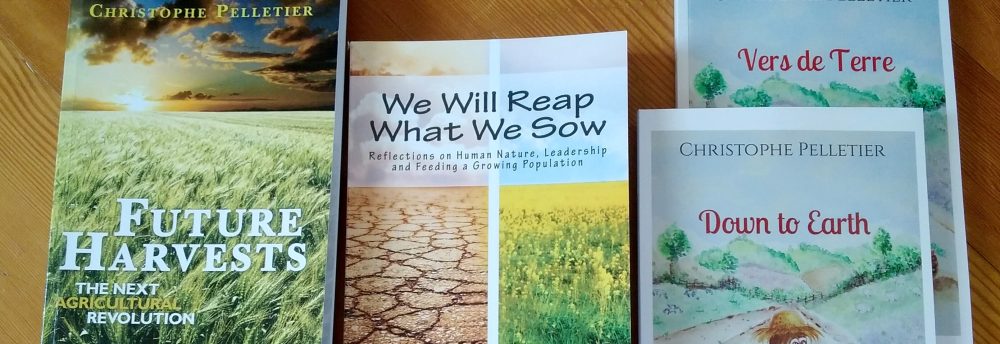
(This topic is one of the many that are presented and discussed in my second book, We Will reap What We Sow)

For more on similar topics, please visit my other website The Sensible Gourmet

Copyright 2010 – The Happy Future Group Consulting Ltd.

Helping farmers produce better

Meeting food demand depends for a large part on the ability of farmers to produce adequate quantities of the food products of the right quality. To achieve such an objective, farmers depend on their business partners. To feed an increasing world population, helping farmers succeed is not an option; it is a necessity.

There is no argument against producing better. A market-driven and more efficient production reduces the amount of waste, and it increases the amount of food available for consumers. It reduces the impact on the environment and it actually reduces the cost of production. However, it is important to realize that actions to produce better often are investments, as the effect is not always immediate.

From a value chain point of view, efficient production starts with high-quality ingredients. If the world wants farmers to produce higher volumes, they must have access to good genetics. Seeds that have the potential to deliver high yields, or farm animals that can produce and grow fast, while using feed and water efficiently, are an absolute necessity. Genetics and agriculture must also take genetic diversity and sustainability into account, but with poor genetics, farmers will not be able to meet food demand, and they will not be financially viable for the long-term. Vision and proper strategy are the elements to deal with this dilemma.

Farming inputs, such fertilizers, pesticides, herbicides and animal feed, must help plants, and farm animals, to express as much of their genetic potential as possible. Suppliers can play a very important role in helping farmers use the proper products in the right amounts, in the right place, and at the right time. The same principle applies for food processors and distributors. It is their role to help farmers deliver what the market needs when it needs it. They must encourage this by rewarding financially the farmers who do things right. This is in the interest of all the parties involved. Farmers make more money with their products. Processors get products that are more efficient to process, thus saving on costs. Distributors gain market share because they offer the right product to their customers, thus increasing customer satisfaction, appeal and loyalty. The advantage of doing things right is that it becomes more difficult for business partners to switch to a competitor. By being the best partner in business, the need for complicated contractual and legal agreements becomes a little less relevant. It is about loyalty and mutual security.

To achieve this kind of ideal situation requires a lot of effort, commitment and communication. Market needs must be translated in clear product specifications. The knowledge on how to be able to meet the required standards needs the proper channels to be transferred to farmers. Access to information has become much easier with the development of communication tools such as Internet and cell phones. Smart phones are helping further, and now farmers, anywhere in the world, have much faster access to market and technical information than by the past. This helps them make faster and better decisions. However, better technologies and better communication tools are not enough. Extension services are crucial. In my book, Future Harvests, several examples show how positive this is for food production. One is the policy of the Ugandan government that resulted in a boom in rice production, making the country a net exporter of rice. The second example is about the extension services of a food corporation, McCain Foods, in India, that helped farmers produce a better quality of potatoes, meeting market requirements, and earning substantially more this way. Another illustration of the positive effect of knowledge transfer is about the farming leader in Burkina Faso who helped increase food production with simple techniques, and stopped the exodus of population. Proper education and on-going training is part of the food production of the future. The human factor in knowledge transfer is as important as ever. Only people can know what the specific situation of a farmer is. Knowing the farmer is the best way to help them set up plans and strategies to improve their technical and financial performance. A farmer being independent business owners, their main concern is to generate enough revenue to stay in business, and to offer a decent standard of living and a secure future for their families. Helping them in these objectives is the way to get their attention and loyalty. Extension services need to offer the most effective solutions by taking into account the level of skills of the farmers, as well as their financial situation. Some farmers can afford and use high-tech solutions easily. Others may have money, but lack the skills to use certain techniques or technologies. Others may be technically savvy, but may lack the money. Extension service people are the ones who can help farmers make the best choices. They also must assist farmers to get the proper financing if this is the limiting factor, for as long as the money would used to deliver the proper return.

As Cicero stated, “The sinews of war are… endless money”. This tends to be overlooked by many who talk about increasing food production. If farmers do not have access to enough money to be able to produce the food the world needs, they simply will not. Developing agriculture requires serious investments, either from individuals or from governments. Asian and Arab countries know this and this is why they spent massive amounts of money in African and Asian countries, and even in Brazil and Argentina. If farmers cannot buy the basics to produce efficiently, they will have poor harvests. If farmers cannot be profitable, they will stop farming. This is important to realize that being a farmer must be attractive financially, too, if we want to motivate the next generation to be in agriculture. Money is important, but just for food production, more is not necessarily better. To get good results, we must ensure to have the right amount of money at the right time at the right place for the right purpose. The money must be aimed at producing for the market. Financing agriculture is about meeting food demand, not to produce blindly. Just like there is a need for efficient market-driven precision agriculture, the future of agriculture financing must evolve to efficient food-market-driven precision financing.

Copyright 2010 – The Happy Future Group Consulting Ltd.

The quiet revolution of food retailers

While many debates continue in the political and “parapolitical” world about many aspects of food production systems and the impact of human activity on the environment, retailers lead a quiet revolution. Without making the headlines, they gradually change the way their suppliers will do business in the years to come.

Such an evolution is certainly welcome, especially in a time where important decisions need to be made. Political leaders seem unable to reach any agreement on environmental issues, as the world could see at the late Climate Summit of Copenhagen. In the food sector, there are many discussions going on about sustainability and genetic engineering, to name the two hottest items, but the political class does not seem to generate clear and concrete action plans.

Just like what happened in the 1990s about food safety in Europe, retailers are taking the initiative to create momentum on the current issues. The problems that plagued the food industry in Europe, such as salmonella in poultry, the mad cow disease, or the dioxin in Belgian fat for chicken feed showed a number of weaknesses that needed to be addressed. In the case of BSE, UK retailers did not wait for British or European legislation to demand meat and bone meal-free feed for farm animals. As I was working for a company supplying the UK market with chicken meat, I can testify that these were dramatic times. Tough decisions had to be made on a very short notice that had serious financial consequences. By then, a couple of reasons made the retailers took the lead. First, the inability of the government to prevent and tackle the issues was creating a bit of a vacuum on leadership. Consumer confidence in their institutions was fading, and retailers were the only ones, true or not, perceived to take the proper actions to protect the public. The second reason was the fact that many retailers had their own private labels. In this case, the problem was not the supplier’s problem anymore because the supermarket chain could have risked serious PR damage if a food safety issues would have been associated with their brand.

This time, retailers are again in the position where they can present themselves as the consumers’ champions. Legislation is slow to move and make significant decisions. The involvement of interest groups adds to the infighting and delays decision-making.

To prepare for the future, they already have come out with plans and communication on how and where they want the food they sell to be produced, and they try to offer a choice to consumers. By doing so, the most active among them are setting new standards, and forcing the whole production and supply chain to think about the things to come.

In previous blog posts, I have mentioned some of such initiatives, and in Future Harvests, I described the increasing leadership role of food retail in agricultural practices.

In particular, I mentioned the carbon footprint labelling on dairy products by Tesco, Wal-Mart’s Sustainability Index questionnaire to suppliers, and the seafood sustainability programs of many retailers. Marks & Spencer started their Plan A in 2007 with the objective of making their business more sustainable. To achieve this, they are involving their suppliers and the farmers producing for them to carry out the changes that M&S finds necessary for a better future.

More recently, new initiatives indicate that retailers are pursuing further on such initiatives. Wal-Mart came last week with their plan for sustainable agriculture. In the UK, Sainsbury let know last week that they were committing GBP40 million to invest in farming. Earlier this week, Carrefour unveiled their “Reared without GMO” program. In their stores in France, they will sell 300 food items labelled as being GMO-free, to offer consumer a choice based on transparent information. If Carrefour ventures into this, one can be sure that they do so because they already know that this will be good for their business. By gaining market share, it is very likely that their competitors will soon react by issuing similar programs. The EU Commission may be struggling to figure out how to deal with GMOs, but Carrefour says “Let the consumers tell us!” Vox populi, vox dei!

Of course, such initiatives do not please everyone. Today, I could read in a blog for a US magazine backed by the meat industry some interesting reactions about Carrefour’s new plan. Some readers were bringing up the typical arguments. Meat would be so expensive in Europe. Well, meat is quite affordable in France, even without GMOs, so think again! The other argument was about freedom of choice: people should be able to eat what they want. By labelling its food item, Carrefour does just that. French consumers are free to buy at Carrefour or somewhere else, and they have the right to choose what label they prefer. The freedom of choice is ironic coming from the US meat lobby, since American consumers do not have that freedom. Reared with GMOs is pretty much the only choice in the US. For now, that is. However, it is interesting to see on Carrefour’s press release that the pictures of fish, chicken and pork chops are exactly the same, regardless of whether they would be grown with or without GMOs.

In the 1990s, British and European consumers, and retailers, were challenging food industry practices because they were worried about their health and about the lack of transparency about food. Nowadays, in the USA, consumers are increasingly suspicious of their agribusiness, because they are worried about their health and the lack of transparency of the industry. Beef recalls because of E. coli, egg recalls because  of salmonella, spinach contaminated with manure are in the news on a (too) regular basis. They are also increasingly aware, and suspicious, of the relations between interest groups and their government agencies, and how this influences decisions on what they eat.

Retailers are now saying that they are not waiting for politicians to make decisions. They have defined their vision, they know what they want, and they are passing the message on to the suppliers. What would happen in agribusiness USA if Wal-Mart took a similar approach as Carrefour?

Copyright 2010 – The Happy Future Group Consulting Ltd.