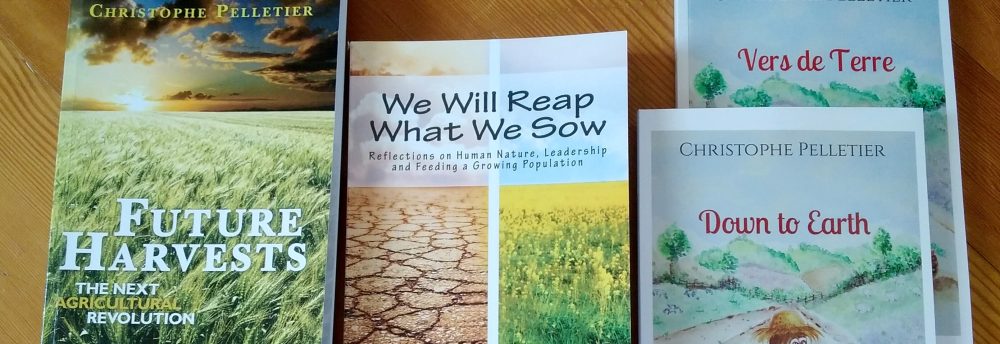
What a game changer my book is!

Future Harvests has been published less than two weeks ago, and it is going to change my company rather profoundly.

What started as a blog on the side of The Happy Future Group Consulting Ltd. is now about to become the very core of my business.

Not only the book sales are already higher than I would have thought, the book is creating much interest for my other activities. The book has already been shipped not only to Canada or the USA, but also as far as South America, Asia and Europe. This is truly amazing.

The reactions to the announcement of the book’s publication have been amazingly enthusiastic and they made me feel like I had just produced something that many were waiting for. This is both very rewarding and very humbling, because working on solutions for future food supply to an increasing world population is a huge task. Since the publication, people with whom I never had contact before, from all around the world, have approached me, thanking me for having engaged in this venture.

New contacts are asking me to participate in conferences and to organize workshops and seminars for them. The CBC (Canadian Broadcasting Corporation) is interested in having me on one of their programs. Of course, the concrete discussions are still to come, but I have to admit that my Food Futurist is now showing incredible potential.

The part on policy making and strategy is getting more attention, too. This activity has the potential to become a solid business that will need to involve more people in my organization. I have already started to develop a plan for this. I can see interest coming from companies, professional associations and governments, not only in Western countries, but in many emerging countries, such as in South America, Southeast Asia, India, or Russia to name a few.

The first step that results from all of the above is for me to formalize the Food Futurist further into a more structured activity than it has been so far. This has started with my defining and posting the mission on all the business pages of the website. The mission is “To help our clients challenge today’s certainties, shape the future, and manage the transition with a targeted and practical action plan for the coming 10 years and beyond”.

The following step is going to be to develop business around this mission and the principle expressed in Future Harvests.

If you are interested in this, please do not hesitate to contact me. Talking is cheap. If you know people who would be interested, please pass it on to them.

As Humphrey Bogart’s character said in the movie Casablanca, “I think this is the beginning of a beautiful friendship”.
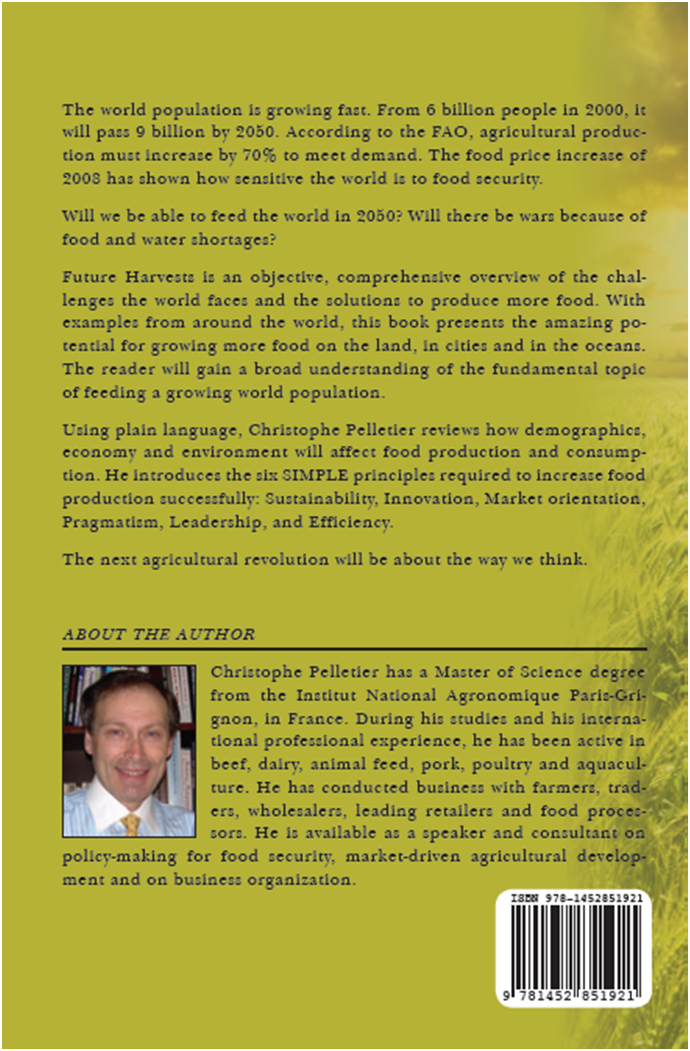
Future Harvests – A preview of the book

My book, Future Harvests, is expected to be published before the end of August.

Here is a preview to give you a flavor of the content.

For a full view, please click on the thumbnails.


Here is a sample containing the table of contents and the preface of the book:


For the video trailers, please visit my YouTube channel.

Future Harvests – The book is coming soon!


The editing of my book “Future Harvests – The next agricultural revolution” is about completed. All that is left to do is developing the cover and start the publishing.

I have already received orders, even before the book is out. That is quite a good sign. And a great surprise for me.

If you wish to be updated automatically when the book is published, just subscribe in the sidebar window on the right.

To describe the topics addressed, I have posted three short promotional videos on YouTube. In previous articles (The fun of writing this book and The next agricultural revolution), I had already given an idea about the content of the book.

Video #1: The Fundamentals (duration 2:37) – Introduction to the background and fundamental principles mentioned in the book “Future Harvests – The next agricultural revolution” to achieve food security for 9 billion people in 2050. Topics such as demographics, the shift in economic power, the control of food  and food security strategies are reviewed. Sustainability, innovation, efficient market driven food production and strong leadership are required.

or click here if video does not appear

Video #2: The Actions (duration 2:12) – A short review of some of the actions mentioned in the book to achieve the objectives. Solving the water challenge, finding new land for production, urban farming, hydroponics, farming the desert, rebuilding fisheries and developing aquaculture further are all possibilities.

or click here if video does not appear

Video #3: The Questions (duration 3:08) – A sample of some of the questions raised in the book. They cover technology, land deals in Africa, improving yields, restoring soil fertility, change in consumer needs, organic farming, risks of conflicts, biofuels or meat are some of the topics presented.

or click here if video does not appear

If you know someone who could be interested by the topics on this page, please pass it on!

German agriculture Minister says “Eat less meat!”

Ilse Aigner made that statement during the “Green Week” held in Berlin early January, one of the largest shows about food and agriculture in the world.

This is quite remarkable to hear a Minister of Agriculture making such a statement, based on the recommendation of the German Nutrition Society that indicates that 300 to 600 grams (that is about 11 to 22 ounces for our American friends, who usually consume this amount in less than two meals…) of meat per capita per week is enough for a person to cover their nutritional needs. Yet, her statement was linked to environmental concerns, since it is fashionable to blame meat production for climate change issues.

From a nutritional point of view, this recommendation is correct. That is all we need. That is less than most of us want, but that is a very different topic. I had addressed this, mentioning that 30 kg per capita per year (equals 600 g per week) was plenty,  in my earlier posting “The future price of meat and fish: up” a few months ago,. I also mentioned that if we ate only what we need, the West would free a quantity of meat large enough to feed a population as large as China’s.

It is unlikely that the Minister’s statement will change consumption patterns any time soon, but the future price of animal protein will. Considering the feed conversion ratio of farm animals and the increased competition between human consumption, animal feed industry needs and biofuels, the production cost of meat will increase. Feed is the main cost in those productions. Further, the amount of water required by farm animals and the manure issues that still linger with intensive animal husbandry, will add to the price pressure.

There is no need to become vegetarians, but the days of gluttony are numbered.

Copyright 2010 – The Happy Future Group Consulting Ltd.

World meat consumption up by 21.3% between 2005 and 2015

According to research from GIRA, meat consumption will increase by 21.3% during the period 2005-2015. Two third of the increase will take place in China only!

Poultry and pork show the strongest increase.
Poultry will increase with 24 million tonnes to 105 million tonnes (+29.6%).
Pork will increase with 21 million tonnes to 125 million tonnes (+20.2%).
Beef will increase with 8 million tonnes to 70 million tonnes (+12.9).

Reducing waste works – The example of Hormel Foods

Hormel Foods issued a press release yesterday about their packaging waste reduction program, and the amount of packaging material that they saved is simply impressive. Reduction covers cartons, paper sleeves, thinner glass jars, plastic trays or shrink-wrap.

Not only this program has a direct effect on the packaging of Hormel products, but it indirectly also saves a lot of resources, such as a significant reduction of paper fiber, less trailers on the road using fuel and less petroleum for plastics of all sorts.

The only detail that do not mention in their press release is the money savings. You can be sure that they would not go through all this effort if it was not bringing significant savings.

Economy meets environment and vice-versa. This only proves that common sense and a clearly defined strategy deliver positive results.

Yes you can! You just need to want to!

Click here for the complete press release from Hormel Foods

Getting closer to lab meat

Dutch researchers have extracted cells from a live pig and put them in a broth derived from the blood of animal fetuses. After the cell have multiplied, the researchers have obtained a mass of muscle tissue.

The texture is obviously not what they are looking for, but they are optimistic about the possibilities.  They have not tasted it, but I think they should have, just to show that they believe in the quality of the meat. Nonetheless, they expect that such meat could be on the market within 5 years.

This project is backed by the Dutch government and by Stegeman, a Dutch subsidiary of Sara Lee that produces sausages and deli products.

After all, if such meat goes into processing, grinding and soaking, the physical properties of the meat do not have to match “true” meat, and it could be a good alternative to meat from a slaughtered pig. A cost analysis will be necessary to see if this indeed has a future. Moreover, it is quite interesting to see this project backed by the government of a country that produces and exports a lot of agricultural products.

Click here to read the article from Meat International

Uruguay, the quiet leader in beef?

Here is an interesting article about how Uruguay works towards a healthier future.

Not only does the country invests a lot in renewable energy but it works in improving its beef, too.

Uruguay’s  100%-traceable, hormone-free, grass-fed beef farming is offering many answers to the concerns of today’s consumers, and the system rewards the farmers doing the right thing, too! Read the article at http://www.benzinga.com/36898/hamburgers-in-montevideo

Not the largest producer, but certainly among the smartest.

Study on waste production in meat and fish supply chains

A study to determine how much waste is produced in the meat and fish supply chains has been initiated in the UK by the Waste and Resources Action Program (aka WRAP) and Envirowise. The goal is to help reduce waste and save money.

To read the article from fis.com, please go to http://fis.com/fis/worldnews/worldnews.asp?l=e&ndb=1&id=34467

This confirms the issue I mentioned in my article “More action needed on food waste

Humans and robots will work closely together in meat and poultry plants

The level of automation in processing plants have increased continuously over the years and the statement made above makes some sense.
This article from MeatPoultry.com reports of an interview with Jeff Burnstein, president of the Robotics Industries Association. Although there is no specific details of things, if any, that may come, other examples in other food industry can be an indicator of future possibilities.
Something to follow on.