Food prices, one year later – Some lessons

According to the data gathered by the FAO, global food prices are on the decline. They have been so for some time. However, this good news does not seem to make the headlines. Reassuring news does not score with the mainstream media. What a difference with the past year during which all of a sudden they discovered that food might not be taken for granted after all! What have we not heard and read by then. The most absurd theories and pseudo-analyses have been spread around by some who know nothing better than copying and pasting the internet without exercizing the slightest sense of critical thinking. Of course, the fear mongers got plenty of publicity while they really did not contribute to anything productive, as I had described in a previous article (Fear mongering does not build a strong future).

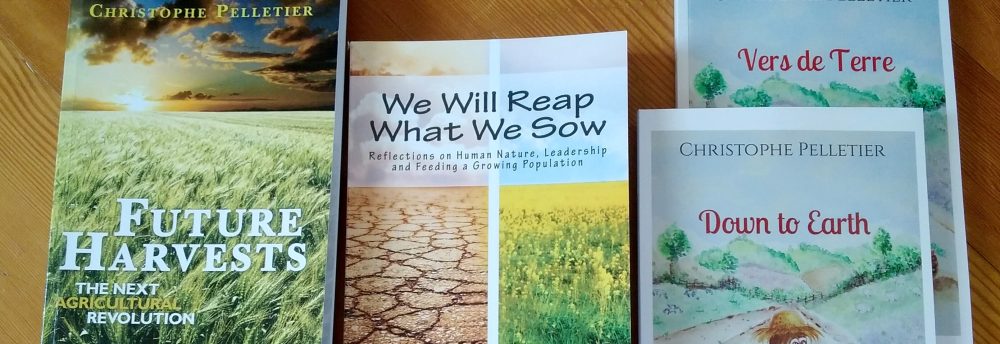
What a difference a year makes! And that is a very good thing. It shows that agriculture and farmers are much more resilient and have much greater potential than some want to make believe. That confirms what I have always claimed and that I relentlessly repeat in my presentations and publications. I have lost the count of how many times I have been told that “Christophe, you are quite the optimist”, in particular about the content of Future Harvests. Frankly, I do not think that I am particularly optimistic. Actually, I can see many reasons why we will face serious crises along the way to meeting the goals of feeding a growing population. That warning is the message behind We Will Reap What We Sow. I see human nature and in particular our leadership, as serious reasons for temporary failures. But if I do not consider myself as an optimist, I definitely have a positive attitude. I truly believe we can manage and overcome future challenges, because I crunched the numbers and I have demonstrated in my literature and my talks that feeding 9 billion people in a sustainable manner is quite possible. It is possible, but it is not a given. There is work ahead. That makes it interesting and exciting.

Next to the potential and the future development that can make us overcome the coming challenges, I am also a firm believer of market forces. Market fluctuations trigger action and reaction. Nothing like high prices and solid profits get food producers increase production. Similarly, nothing like poor financial results have the ability to tamper any desire to increase production. The so-called invisible hand works. Sometimes, it holds a carrot. Sometimes, it holds a stick. It makes things move in the right direction. Over the past year, I have presented during a number of events how market forces would influence prices in different sectors in the years to come. By looking at it from the consumer demand end and by going back in the production and supply chain, I showed how the different actors would react to their own particular situations. So far, my predictions have come true, the reactions of retailers, food service, animal protein producers, crop farmers and input suppliers have been as expected. The drop in global food prices is one of these predictions. Those who attended some of my presentations know what I mean. For the others, here is a link to a video showing an excerpt my talk about the dynamics of future agricultural markets that will illustrate what I am writing about.

The past year contains many lessons. Some of them are about us, and some of them are about how to look at the future. The main lesson is probably that the situation of food and agriculture cannot be looked at in a simplistic manner and can certainly not be described or commented with scary slogans. The population is growing but so is agricultural production. The famine that is supposedly around the corner is far from happening. In a year time, the world population has increased by a few dozen million people, who on average tend to eat more food, and in particular meat. Yet, supply is able to meet demand better this year than last year, as global food prices and grain stocks indicate. Another lesson is that even though severe climatic events affect food supply negatively, there is no reason to panic. The fact that last year a severe drought depleted production numbers in one of the essential producing countries, the USA, the system was able to absorb the shock. There has been no food riot in 2012 like in 2008. The reason needs to be looked at what products were the most affected.  Supply of basic food stables remained in balance with demand. There was no particular shortage of bread or rice in sight. The commodities that were affected were business to business products, destined to the animal feed and the corn ethanol industries. Another lesson is that even though the prices of 2012 did not lead to riots, climatic events are a serious threat and need to be factored in future supply and demand scenarios to build enough of a buffer to reduce the risks of supply disruption. Another area that requires more attention is the regulation of financial markets, and in particular the regulatory aspects. It is clear that derivatives amplify market price fluctuations. By deciding who is allowed to be active on the markets of agricultural commodities and for which quantities, the functioning of markets can be more representative of the physical reality. In particular, the participation of players who have no physical production or supply functions in the food and agriculture need to be taken under strict scrutiny. As it is important to have fair market rules for a proper functioning of markets, it will be also useful to look at the functioning of crop insurance. Last year’s drought in the US cost insurance companies much money, while it appeared that US crop farmers ended up the season with the second highest profit level on record. No one will argue that farmers need to be protected from such unpredictable events.  Insurance should guarantee them a minimum income so that their future would not depend from forces out of their control. That is just fair. Opposite to that, it sounds beyond normal that, thanks to other contributors, farmers could go through such a drought without hardly feeling the slightest pinch in the wallet.

After the past year, am I still an “optimist”? Yes, I do believe that farmers will meet demand in the future. For all the reasons above, I am convinced as ever that the potential is largely there and that the world can absorb tough years. But I would attach a warning to my optimism. It is not because it can be done that it will be done. It is necessary to keep thinking ahead, to come with innovative ideas, products and services to be able to plan and forecast better, to make better and faster decisions. It is also essential to pass knowledge and information better and faster, and to choose the attitude of helping others succeed before one’s particular interest. Our societies have succeeded by acting together. Nobody will be able to do it all alone. Providing help and support will be critical for success, just as much as asking for them will be. It also becomes crucial to be able to look beyond one’s area of business and to connect the dots even – or maybe actually in particular – with events and activities that have, at least apparently, several degrees of separation with agriculture in order to anticipate, adapt and be prosperous. That is the core of what I do, and I can only encourage you to take the same approach.

As markets ease, it will be quite tempting to drop the guard. In my opinion, this would be a serious mistake. The time things seem to be under control is the right time to prepare for the future and to do some foresight. Markets will change again as the bargaining power of the different links of the chain will shift. Be assured that there will be some severe price hikes again. My best guess is within five years from now. Those who will do this exercise will have a strong advantage over those who will procrastinate.

Copyright 2013 – The Happy Future Group Consulting Ltd.
Adapting our thinking to the future – part 2

At the end of part 1 of this article, I had mentioned how our elders used to make progress by blending the modern with the traditional. It is quite important to keep this way of looking at our life environment quite alive. How we evolved to where we are today determines very much why we have the current possibilities available. They are the direct result of our history. Whether we like it or not, our future has its roots in our past. The art is to improve what we have, and to improve, we need to learn from the mistakes of the past. Rejecting solutions for the simple reason that they are old-fashioned or not based on science is really excluding diversity, while diversity is the fuel of progress. Reducing diversity comes down to reducing options to move forward. As someone who looks toward the future and tries to find out what is likely to come as well as what is desirable to create, I find this balance between past and future especially interesting. I often am surprised to see how many people are actually busy reinventing the wheel, while they think that they are busy innovating. Many projects and research that I see taking place have actually already been carried out in some way either in another place or in another industry. I regularly have to tell some of my contacts about similar projects that took place years and sometimes even decades ago. This is why I always insist on the need to be curious. For the future, curiosity is an asset. I could never urge anyone enough to have an open mind for anything that happens anywhere and in any industry. Maybe, I am doing some sort of transfer about this and I wished others would be as curious and eager to learn as I am, but this is so helpful to foresee the changes to come, that anyone who is interested in the future should be wired like that. Unfortunately, I find most people to not be really curious. They seem to be interested in what will serve them directly in the short term, but much less for what may serve others now but also in the future. Until someone can tell me that it is better to limit one’s perception and understanding of the world and of its possibilities, I will keep being curious and open-minded.

People really need to expand their horizons. Not only is it useful to be prepared for the future, the main reason is that it is incredibly fun to learn to know new things and new people. For the sake of humanity, it is time to open up towards others. The attitude of future business will not be about pushing new products and services to others, but to have a “what can I do for you “ and “how can I help you” mindset. The business of the future is the one that delivers solutions. In the future, successful products will be at least as much about the service included as it is about the actual physical product. This is what circular thinking will deliver. In a future where others are really what matters the most, the social perception will also change. “Old boys clubs” (which are nowadays just as much girls clubs) and other clans are not really the most dynamic organizations. There is no doubt that they are incredibly comfortable, because they are basically made out of clones. Everyone thinks the same, shares the same values, comes from the same university or social group, lives in the same country or region, has the same feeling of importance, and looks to the outsiders just as such: outsiders. There is a lack of diversity; therefore there is a lack of progress. A new interesting development that, to me, shows the quality of networks has appeared recently on LinkedIn. They visualize how much of your network belong to which organizations. I recently have seen some of the apparently very social individuals that have close to 40% of their network linked to only one company, and the second organization in his network only 1%. To me, that does not spell open network. And I thought that the main organization in my LinkedIn network was already high at 5%. Personally, I prefer by far those who have a balanced distribution of their networks. The chances are much higher that people who have a more balanced distribution of their networks have been exposed to more diversified experiences, and are likely to be more open and more flexible to different or challenging ideas. For a successful future, we must not think in terms of networks, but we all should be interconnected in the same one that would be the complete integration and interaction of all the ones that exist. My customers have demonstrated this to me. About all of my business has come from my being on the web with this blog and my books. They caught my customers’ attention who decided to get in contact with me. None of them knew me personally beforehand. The result has been business. Actually, I have not prospected once for the Food Futurist services. I just found a way of being visible beyond any limitation of network boundaries. The Food Futurist has become part of that global web.

One of the main differences between nowadays and yesterday lies in how intricate our world has become. In the past, things used to be more compartmented. Today, the whole world has opened. Knowledge travels fast and is accessible from almost anywhere on the planet. The level of interaction between industries and technologies is much higher now than it used to be. Most innovation that will help progress in food and agriculture in the future will not originate from the food and agriculture community, but from many different fields such as robotics, nanotechnologies, telecommunications, software development or medicine, just to give a few examples. Although technology will definitely play a major role in improving what we do, it will be important to not see technology as a panacea with dictatorial tendencies. I always underline the importance of the balance that we must maintain between technology and steering human nature for the best. In the end, technology is only as good and useful as the way we use and master it. Just take the example of gun powder. When the Chinese started to use it, they made fireworks for entertainment purposes. The “white man” chose to use it to kill others. Clearly, a similar technology used with different philosophies of life will serve different purposes. This is still true with today’s technology and it will be true with tomorrow’s. It will depend on the leadership. Technology needs to pass the test of morals and ethics, unless we accept that it might serve to be used against us. Technology and leadership go together, just like science and philosophy do. It is important to not forget it. If curiosity is an asset for the future, clearly, so is having a critical mind for the reasons just presented. It is essential to keep control on what we do and that we address concerns. Of course, this may delay some valuable financial objectives for some, but the quality of the future will depend on us doing the right things. The debate that results from critical thinking may be time-consuming, but open debate is an integral part of the democratic process. Open debates protect us from going back to dark ages. Looking back how what such ages have caused in human history, and unfortunately still do in some parts of the world, the need to learn from the past is clearly essential for a prosperous future.

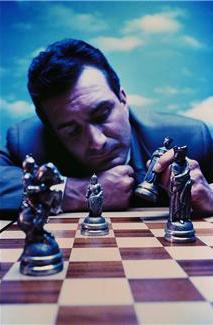
Thinking ahead like a chess playerOther advantages of critical thinking are that it stimulates reflection and is a source of ideas. It is also important to make clear that critical thinking is not about criticizing but about questioning. Sterile boring criticism is just as useless for our future as not thinking at all. Let’s face it, critical thinking is not easy. It requires emotional distance. It is about accepting that what we may have believed appears to be wrong, or that they are better ways and beliefs. To be a good critical thinker, one needs to have enough confidence to overcome disappointment and to accept to change the course. Not that many people are willing to deal with such challenges. Yet, if we want to prepare for a prosperous future, we will have to accept that exercise, because, the future will be quite different, and in particular our interaction with our environment and the world will change and evolve further. Critical thinking actually requires a rather Zen mindset. One needs to have the calm and openness to observe and listen before speaking. One needs to accept being wrong as the debate that arises from the exercise will also show the value of other people’s points of views. Critical thinking is an exercise in humility. Humility is a highly valuable, yet often neglected quality. Yet, it is essential to be humble when thinking about the future. The challenges are quite serious and dealing with natural forces that may or may not be about to unleash upon us will not be an easy task. We will need to understand our relationship with Nature and accept the idea that, in spite of all our cool technologies, we are vulnerable and mortal. One of the arts of future thinking will be about pushing the system while knowing where the limits are that we must not transgress. That is what sustainability really is about. We really do not want to open Mother Nature’ Pandora’s Box. To be equipped properly to face the future, we need leaders that will think like chess players. We need leaders in all areas of society that can understand how the consequences of their decisions and of their vision will trickle down through the system. They must be able to foresee what may happen when they make their moves. Many already hardly can foresee what comes next. Those we need are the ones who can visualize what happens two, three, four and more degrees ahead, so that they can adjust their choices and already develop alternatives before troubles arise. A good plan A always includes a plan B, and preferably even a plan C. Plans that lack alternatives are not plans, they are merely wish lists.

Copyright 2013 – The Happy Future Group Consulting Ltd.

Dealing with complexity

Looking at the future of food and farming goes far beyond agriculture. It comes down to looking at the future of humankind. Balancing future supply and demand of food is an exercise that includes many disciplines and dimensions, probably more so than any other human economic activity. Anything that affects life and its level of prosperity must be taken into account. Feeding the world is not just a matter of production. Of course, the ability to produce and to keep producing enough food is paramount, but there is more to it than that. The consumption side is just as important. Demand will depend on the diet, which also depends on how much money people have available to pay for food.

Total future food demand is a combination of which foods and food groups people in the various regions of the world will buy and eat. This is a function of demographic, economic, cultural, religious and ethical factors. If future demand is about consuming according to the nutritional needs of a human being, clearly the situation will be different than if people demand twice as many calories and protein as the actual nutritional needs. The relative share of animal products in the total diet will also change the situation in terms of production and of production systems. Food production must adjust to the demand and do its best to meet it, but not at all costs. Therefore, it is essential to optimize food production at the global level so that the largest quantity of food can be produced at the lowest environmental cost. At the local level, production depends of course on natural conditions, but also on economic, political and cultural conditions as well. This may be the most profound change that we must deal with: feeding the world of the future is a global exercise. As more and more people worldwide have more and more money to spend on food, demand is now global, and therefore production plans must also be global. The times of producing food simply for the own people and exporting surpluses is over. Markets will now react to any event that will affect production or consumption somewhere else. Borders do not make this shift in thinking easy. It is always tempting to think that having one’s house in order is enough, but it is not. What happens in other countries on the other side of the world will affect us just as well. Why is that? Just one word to explain it: markets. There used to be a time, not so distant when if there was a drought in Russia, China or Brazil, markets would not react as strongly, and anyway not so much in the media, as we have seen over the past few years. This was the case because only a minority of the world was consuming large quantities and that minority did not have competition. Now the competition is wide open. Markets will keep reacting on this and the relative price levels of various foods will influence how much of what is consumed and where. We will see eating habits change because of this economical aspect of food supply.

At the same time, food production is also adapting to a changing environment, and to face its future challenges. The amount of new developments in technology, access to information and knowledge and in decision-making tools is amazing. Innovation is flourishing everywhere to solve environmental issues, to cope with new energy and water situations. The dominant themes are the reduction waste of all sorts, as well food as agricultural inputs and by-products, and the prevention of the release of harmful contaminants. Innovation is developing towards better and more efficient systems that must ensure the future continuity of food production and, at the same time, keeping food affordable for consumers. Interestingly enough, many innovations that will be useful for agriculture do not originate from the food sector. Food producers will need to be curious and look beyond the field to prepare for the farming of the future.

Clearly, the number of factors affecting both consumption and supply are many. To add to the complexity, many of these factors are not of an agricultural nature. Many of them originate from the population, its activities and its needs for all sorts of goods. I mentioned earlier that what happens in one region affects others, but the natural resources markets, such as energy, metals and minerals, that must meet demand for non-food consumer goods also affects agriculture and its production costs. Although many see rising costs first as a threat, I tend to welcome them, as they always stimulate innovative solutions to increase efficiency and reduce waste. Two examples show that it works. One is the car market in the USA that shifted from gas-guzzlers to high gas mileage vehicles since gas at the pump became much more expensive than it was only 5 years ago. The second one is food markets. Had you heard as much about food prices, food security or food waste before the food price hikes of 2008 and 2012?

In my work, I always try to make my clients and audiences aware of how everything that has to do with food is interconnected with many other sectors, and how economic, demographic and political events are linked to food security or how they might affect it in the future. That is an underlying them in my books.

Even, within the food and farming sectors, organizations do not realize enough how their future will be influenced by other food productions and vice-versa. I always get reactions of surprise at the magnitude of the interconnection and the interdependence with these factors, and how they affect their activities indirectly. It is a normal reaction, as most people tend to focus on what has a direct connection with their activities. After all, that is why I do what I do: to help them see and decipher this complexity, and understand what actions to take to adapt and prosper. I never shy away from show the complexity. My audience needs to get a flavor of the any dimensions and many layers involved. However, I always take a practical approach and show them that complexity is not the same as complicated. Deconstructing the complexity actually works well to show the many levels of actions there are. It helps my clients connect the dots between their activities and what will affect them and how. It gives them a level of confidence in how to deal with the future and take action. I also like to warn against oversimplifying, which is another tendency that I observe from time to time. The mainstream media is rather good at that. But I also get questions that sound like those who ask hope that I have a magic wand and will be able to give them a foolproof recipe for success. That simply does not exist.  If preparing the future were easy, nobody would even talk about it. It would be done. It it was easy, I guess many of the organizations that have been involved in agricultural development and food aid for decades would have already succeeded, and they would not exist anymore. Yet, they still have to keep up with their work.

Feeding the world is work in progress. Developing the right actions is complex, but not as complicated as it sounds. However, the true difficulty is in the execution, and in particular bringing other stakeholders with different agendas and different views on board to contribute to the success.

Copyright 2013 – The Happy Future Group Consulting Ltd.

Thinking of a better agriculture in a better world

Recently, I joined a group on LinkedIn called “Future of Agriculture”. One of the discussion topics, which caught my attention, was “What’s your dream for the world with agriculture as a theme?” Of course, this is quite a broad topic. I decided I would write here my thoughts about the discussion as concisely as possible. Therefore, here is what I believe is important for the agriculture of the future.

Agriculture must provide food today and tomorrow. Keeping the potential to feed the world for future generations is not an option; it is a necessity. Agriculture must produce in a sustainable manner. It must meet both the demand for food, but also be able to continue meeting future demand. It must take all necessary actions to ensure there will be enough water, enough soil, enough organic matter and enough nutrients to keep producing. It must also make sure that it does not contaminate the water and the soil. Agriculture must be sustainable from an environmental point of view, but it also must prove sustainable financially and socially. Without agriculture, there cannot be prosperous societies. To have agriculture, the world needs farmers. Farming must be an attractive occupation that allows those who practice it to make a decent living. This is more important today and in the future than it has ever been before.

Future food production must be innovative. Innovation is essential to solve current and future problems. It is the main trait of the human genius. Finding new ways of doing a better job and meeting all the future needs is a must if humanity wants to succeed in feeding its growing population. However, innovation is not the same as high-tech. Innovations do not need to be complicated and expensive. Innovation must integrate science, experience, common sense and practicality. Innovation does not oppose the past and the present or the future. It comes for the search of the best of all worlds. Innovation is useful only when it solves actual problems. It is not a doctrine of its own. The purpose of innovation is not about R&D for the sake of new products that help boost sales of those who market them. Its primary purpose is really about helping others succeed. Innovation must start from the market. What does the customer need to do a better job? The answer will be much more successful and better accepted if it starts from the market end, instead of being pushed onto the customers. This leads me to the next point: the necessity of being market-oriented.

Market orientation is the best approach for any type of business activity. It is true for R&D, but it is true for farming, too. Developing and producing by investing large amounts of money are much more effective and cost-efficient when the markets and the infrastructure are there. Offering what customers need has a much higher level of success than trying to convince buyers who are not very interested. The prices and the margins are always higher in a pull strategy. Market orientation also means that the infrastructure to bring the goods to the final users exists and that it actually works. One of the main scandals in today’s agriculture supply chain is the postharvest losses. It is outrageous that food that has been produced at the high cost of money, labor, water, energy, inputs and the farmers’ time rots in the fields or in deficient storage while it is good for consumption. It is the responsibility of all partners in production, supply chain and government to co-operate by organizing operations, so that food reaches those who need it.

The agriculture of the future needs to be developed in a pragmatic manner. There is no fix-it-all agricultural system. Food production depends on climate, landscape, soil types, water availability, need for sustainability, land rights, as well as the cultural, social, economic and political environment. The types of crops and animal production will depend on these factors. If systems cannot always be transferred from one place to another, knowledge and skills can be. Human intelligence and sharing is what spread progress. If farmers and all players in food production must be pragmatic and choose among the arsenal of tools and techniques what fits best in a particular situation, there are no boundaries in helping others to succeed. The energy must be spent to level up performance, not on defending a system for ideological or mercantile reasons. If the agriculture of the future succeeds, all of humanity will succeed. If it fails, humanity will have to deal with unrest, riots, hunger and possibly wars. Pragmatism is what will help the farmers of the future optimize food production around the world by making decisions that are in the best interest of all the partners from farm to table. Pragmatism is also what will deliver the highest financial return for them. However, for pragmatism to beat partisanship, bias and short-term interests, outstanding leadership will be paramount.

The leaders of the future will identify the right actions and execute them. They will cut the rhetoric and focus on delivering result on all fronts: financial, social and environmental. They will crystallize the energies around the objectives that serve all on the short term and on the long term. This will not be an easy task as the reasons to choose the path of least resistance are many. It will take courage, vision and the ability to convince the opposition. In history, great leaders have always sacrificed their personal interests, their personal safety and comfort for the good of the group. Such leaders are rare, but they exist, at all levels of society. They need to rise and improve the way we currently do things. They will succeed only if the average person is willing to make the right changes, too. This is not an easy task, either, but the alternative is even worse. The great leaders of the future will show the rest of us how things can be. They will give others the courage to implement the change and make them believe in the future. They will have to lead by example. They will have to reconcile instead of dividing and polarizing. When it comes to food production, they will not only help develop an efficient and sustainable agriculture, but they also will make sure that consumers change their eating habits where it is needed. They will help educate consumers about proper nutrition and moderation, while keeping food a positive experience, as well for the senses as for it social purpose. They will ensure that proper nutrition protects the health of their people. They also will give agriculture its rightful place in society and ensure that producing food is a respected and attractive occupation. They will take all actions to help food producers to succeed. They will reconcile urban and rural areas. They will make sure that people understand where food comes from and what it takes to feed for prosperity. They will work against waste.

Every waste is a loss of efficiency. With a population of 9 billion coming in the next few decades, waste will not be an option anymore. As the number of people increases and their needs have to be filled, the margin for error will shrink. The consequences of 9 billion behaving badly will be much worse that when there were only 3 billion people on Earth doing that. Every waste of resources will be quite costly, financially, socially and environmentally. The only way to reduce waste will be by being more efficient.  This will be true for food, as well as for water, for energy, for agricultural inputs, for soil, for organic matter and for biodiversity. Preserving and replenishing will protect humanity from a situation of depleting resources, which is where it is currently heading. The consumption and depletion society has no future. Future food production and consumption must be aimed at maintaining and preserving the potential of agriculture.

Those who are familiar with my work know that sustainability, innovation, market orientation, pragmatism, leadership and efficiency are the 6 principles that I had gathered under the acronym of SIMPLE in my first book, Future Harvests. In my second book, We Will Reap What We Sow, I developed and discussed the characteristics of proper leadership and the vision required to rethink food and farming to succeed in the future.

Even if future solutions need to be adapted to their specific local situations, these 6 principles apply everywhere and need to be implemented in a concerted manner by all regions.

Copyright 2012 – The Happy Future Group Consulting Ltd.

Rio+20, Riots+30?

The Rio+20 conference is over. Announced with much publicity, accompanied with many tactically timed media articles and other conferences about sustainability, it has been the occasion for many to demonstrate their apparent concern about the future of the planet. A couple of weeks after the conference, the excitement has faded away, and the tweets that were so abundant on the subject have become rare. This is rather symptomatic of the current behavior of short attention span. Much has been written about Rio+20 and the dominant conclusion is that it has not achieved much, as expected.

For obvious reasons, I followed the part about agriculture and food security with special attention. Since I did not expect anything, I was not disappointed. To me, this conference has left me with the impression that the world leaders are resigned. The text was written before they would meet and it was far from bold. I read it and I could only shake my head. To me it looked like a very politically correct list of commitments that would fit nicely in typical New Year’s resolutions. The principles and statements mentioned in the text are noble but who can seriously think that effective action will follow? Just like world peace, everybody will agree on the principle of a sustainable livable planet where hunger does not exist. The reality is different. Human nature is not that noble and our many flaws hinder us to achieve such goals. In We Will Reap What We Sow, I wrote among others a chapter dedicated to the human weaknesses and how they affect our ability to deliver what we all secretly want. In the book, I also discuss how we can overcome these weaknesses and work toward a successful change. The theme of Rio+20 was “The future we want”. It was not clear to me who we might be, and whether it should be about wanting. Is what we want the same as what we need? The theme should have been “The future we need”. That would have been more precise and more relevant.

I also followed the webcasts dedicated to food and agriculture of the conference, and they disappointed me. I would have loved to see people clearly expressing their frustration about the resistance our world faces to go in the right direction. I would have expected strong calls on the leaders for effective action. I would have expected to see clear action points with clear and non-negotiable deadlines. I would have expected clarity about who should be responsible to do what. I did not get these. Instead, I saw some well-rehearsed PowerPoint presentations carried out by speakers who were rather satisfied with the work of their countries or organizations and who sounded like they found that at least their contribution was excellent and so would it be in the future. I am always suspicious when I hear people justifying themselves while nobody is asking for justifications. I believe that the overwhelming majority of people who work in agriculture to produce more and better food in a better manner do a good job. Most people go to work with the desire to do something good. Such presentations did not add much to the objectives of producing more food in a sustainable manner.

What would I have liked to see happening at the Rio+20 conference, you might ask? Very simple: I would have liked to see people arguing quite vividly and even getting angry, even leaving the negotiation room and slamming the door. This would have been the sign that the right questions had been asked. Considering the complexity of growing more food and at the same time maintain the potential of agriculture to keep producing for generations to come, difficult issues and really annoying questions are inevitable. I really would have liked to see the likes of a Nikita Khrushchev who in the UN took off his shoe to bang it on his desk in the 60s. Although his behavior was somehow out of line and by today’s political correctness standards totally unthinkable, it would be good to have leaders engaging in robust arguments. After all, if the survival of humanity is indeed at stake, this would be a cheap price to pay. Instead of that, the leaders came only to pay lip service, show up on the group picture and went back home knowing that the conference did not address the issues as it should have. At least everybody felt good about a text that was not threatening for anyone, that did not ask for any significant sacrifice and thus life can go on. As soon as they left the building, they returned to business as usual. All the principles listed in the text are correct as such. The only problem is that it is written as if the UN expects world leaders to become altruistic, long-term oriented and good-hearted. It is a bit naive. They are politicians! Yes, in a perfect world, there is no doubt that the world would feed itself sustainably, just as it would not cause climatic change and there would be no poor and hungry people, either. In a perfect world, there would be no need for the UN or the FAO.

What can happen if the economic model derails and collapses if it does not make the right choices to become sustainable? That is not very difficult to figure out. A number of events from the last few years can give us some clues. The riots that took place when the price of food increased sharply in 2008, affecting the lives of many people in developing countries, show that food will play a crucial role for the stability of many regions. It will not take much for such riots to happen again. Because of the economic crisis, a number of heads of states in democratic countries have been defeated during recent elections. The people clearly asked for a different leadership. In Arab countries, a similar demand has been met through social unrest, riots and near civil wars, and the process is still ongoing. The people asked for a different leadership. The intensity of the economic crisis has actually been reduced substantially by the massive printing of money and the large amounts of debts that many countries have had to issue to keep their economies from stopping abruptly. If money printing has softened the short-term impact of the financial meltdown, it also will lengthen its duration quite significantly. Considering the amount of debt and the demographics of Western countries, it will take generations before the debt can be paid back entirely, if that ever even happens. To restore a sound ratio of debt on GDP, most of these countries would actually need a new baby boom to ensure a growth that matches the challenges. Of course, another approach could be to allow immigration numbers to increase strongly, but that does not seem to be on any of these countries’ plans. Moreover, a growth based on the same economic model of consumption society does not appear sustainable and before the right numbers would be met, one can wonder if our species would have survived.

I often tell that the difference between the effects of the financial, the social and the environmental parts of the economy manifest at different speed. Anyone can follow share prices live on the stock market, anyone can follow his/her bank account on a second-by-second if desiring to do so. Social consequences can take months or longer to manifest, and environmental effects can take decades to manifest. The financial crisis has been the result of postponing actions to ensure that the money world could be sustainable. It is still far from being there and the financial crisis is not over, but at least there was the possibility to print money and to emit debt. That entertains the illusion. When it comes to environmental sustainability, our leaders are also postponing actions to ensure that our physical world be sustainable. The main difference is that there is no printing of Nature possible. Printing of wheat, rice, beans or other essential food items is not an option. If we lose the ability to produce enough, there will be fights for food. That is inevitable.

An unsustainable economic model, and in particular an unsustainable agriculture, will result in shortages, not just local but everywhere and anywhere to some extent. It will result in large numbers of people left with few options to survive. Some cultures might deal with it in more orderly manner than others might, but overall, the result will be social unrest that could have the potential to turn into riots and probably even into regional conflicts. A quick look at the world map gives an idea of where it can happen and the potential risks. The Rio+20 conference should have presented prospective scenarios of what will happen if we do not act properly and timely, and it should have asked the leaders on solutions. Leaving a conference handling such a sensitive and complex problem without a genuine brainstorming and a solid and courageous action plan made by the leaders for the world in order to preserve peace and stability comes short of leadership.

Considering the pace of economic, social and environmental change, this was the least that should have been done. Are we going to wait another 20 years for the following conference? Will it be as lame as this one? Will the result of Rio+20 be Riots+30, or +40? I tend to think so more and more. I am increasingly convinced that only a really scary crisis affecting the rich will shake the lethargy. I think that political change will come from the street before it comes from leaders who have apparently already given up. In the food and agriculture sectors, I also expect salvation to come from the ones who are the most involved in production: the farmers, the food producers and the food distributors, simply because their livelihoods will depend directly on an agriculture that is sustainable. Politicians will only follow later, when they and their constituents become food insecure.

Copyright 2012 – The Happy Future Group Consulting Ltd.

The Sustainability Dilemma

Although almost everyone seems to agree that our world needs to be sustainable (what is the alternative anyway?), making it happen seems much more challenging. The good intentions have difficulties to turn into action. The reason is simple. To make human activities sustainable, we will need to accept some serious trade-offs. That is where it hurts. There is the dilemma. Are we willing to change and sacrifice on the superfluous today to have a bright future, or do we want to keep instant gratification as the way of life and risk to lose it all later? Even though the answer to this question is obvious, it is only human to choose the short term. The issue in the background is one of change, not so much one of a choice about sustainability. To understand why this is so, one needs to realize that fear of change is not about change. It is about the fear of loss. This fear is even stronger when there is little certainty about what will come next.

Making the move towards sustainability presents many short-term challenges. There is a lot of money at stake, but this is not just about the financial aspects of the economy. There is a social cost, too. Changing the economic model into a sustainable one means that many jobs will be threatened. In these times of economic hardships, the fear of unemployment and of the social unrest that would result from it is reason for many politicians to be reluctant to take drastic action. They also think about their jobs. Sustainability is about the long term. It is about later and somewhere else. On the contrary, personal consequences of the change are here and now. There is no need to look any further to understand why there is resistance and inertia. In the debate about sustainability, shortcomings appear in several areas.

A first area is the lack of strong vision from the leaders about which alternative to offer to the current consumption society. Actually, consumption society is not an accurate description. The purpose is not so much about consumption as it is about buying stuff, use them or not, throw them away and buy new stuff instead. Clearly, with more people having more disposable income, this is going to hit a wall. As more people want to have a piece of the shrinking pie, and as finite resources deplete gradually, excessive consumption and waste are not going to last for much longer. It is simple math and it is common sense. Supply and demand will readjust markets by sending prices up. High prices will make consumption slow down, and so will the world economy. Regardless of which one between market forces or the environment will cause the current system to collapse, the economic model will change. The time has come to bring a clear vision for an alternative system. The alternative must ensure that the economy is prosperous, that people have work that pays well enough for them to cover their needs and to ensure that human societies can have a future for generations to come. Until this day, nobody has come with a vision and a road map that make the change acceptable here and now. This is why all international conferences lead to little action. As long as this is the case, the only thing that will force a change in attitude is a major crisis in which the wealthy are at risk of losing what they have. As long as crises touch only the poor and the powerless, nothing really changes, unfortunately.

A second area of weakness is the lack of collaborative action. Every group of stakeholders look at its interest first, while the proper approach would have to be altruistic and empathic. This is another case of the here and now vs. the elsewhere and later. If we want to succeed, it is necessary to transcend differences and borders. We need to find ways of going beyond simple accountability, and impose co-responsibility. This is much easier said than done.

A third area to address is the numbers. In the end, it is about money and jobs. Actions to make the world sustainable must also work financially. If change is not sustainable financially, change will not happen. If businesses go bankrupt and if people are at risk of losing their livelihoods, they will not go for the change. The new economic model needs to consider this. The transition towards a better world needs to consider it, too. The externalities need to be internalized in some way, but the new model must be robust as well, otherwise all efforts would be for nothing.

A fourth area is about definitions. What is sustainability? How can we monitor and measure all human activities to know which ones are within sustainable limits and which ones have no future? How and where to draw the line, and how to enforce it? In the case of agriculture, every particular activity has its own specific impact. Depending on the nature of the environment, the nature of the impact and the range of sustainability vary, too. Monitoring must be tailor-made to each particular situation.

A fifth area is the consumer’s behavior. It is impossible to address sustainability without addressing consumption habits, and in particular excessive consumption and waste. As long as consumers will not eliminate the use of products that have an unsustainable effect on the environment, very little will improve. Putting the emphasis on production only is not enough. Production methods certainly can improve, but a substantial share of the damage is the result of consumers wanting more of what is not so good. Consumers are the largest group of influence. They are the people. What and how they consume is democracy in action. Businesses and governments follow their lead to quite some extent. When the majority chooses for a different economic model, things will change fast, but for now, the majority is still choosing for the old model.

Whether our world will move towards sustainability or choose a more hazardous way depends on us all. It depends on how we want to solve the dilemma that we face. The choice is not easy, but it is essential. There are many questions still unanswered, simply because they have not been asked. These important questions are mostly of a practical nature. They are more about how to make the system work not only environmentally and socially, but also financially. If businesses tend to focus mostly on financial aspects, environmental and social movement tend to neglect it too much. Like everything else in life and nature, it is about balance.

In my latest book, We Will Reap What We Sow, I address in much more details many of these questions and discuss the value of possible alternatives in relation with our future ability to feed a growing population.

Copyright 2012 – The Happy Future Group Consulting Ltd.

Q&A on We Will Reap What We Sow on twitter

I will be available to answer any questions about my new book We Will Reap What We Sow on twitter. I believe this could be a good way to interact in a concise manner with readers.

The participants will have to include the hashtag #WWRWWS on their tweets to be noticed.

This will take place over three days, with two sessions of one hour each day.

The dates and times are June 13 – 14 – 15 2012 at:

  • 2.00 pm EST = 7.00 pm in England = 8.00 pm in Western Europe
  • 7.00 pm EST = noon in Sydney, Australia = 7.30 am in Mumbai

It is also possible to ask questions outside of these times, but I will answer them only when I am available again.

When externalities cannot be externalized anymore

Externalities are costs, or benefits, that are not included in the price charged for a product. If a cost is not included in the price, it represents a negative externality. If a benefit is not included, the externality is positive. The concept of externality is particularly important to determine whether an activity is sustainable. For instance, if an industrial activity pollutes and causes harm, there will be consequences, and costs. As it takes many years for environmental problems to become obvious, the cost of repairing the damage caused by pollution is not included in the cost of the goods produced by the industrial activity in question. However, there will be a day when it there will be no alternative but to clean the damage. That cost is the externality.

Every activity that pollutes without cleaning the contaminants is a negative externality. Everything that damages physically the environment and undermines the sustainability of food production is a negative externality. Every activity that depletes essential resources for the production of food is a negative externality. In this highly industrialized world, the consequences of economic and human activities, slowly add up. Nature’s resilience makes it possible for damage to remain unnoticed for quite some time. However, the ability of Nature to repair the damage shrinks, as the damage is continuous and exceeds Nature’s ability to cope with the problem. As the population increases, the level of human and economic activities intensifies further. There will come a time when Nature simply cannot handle the damage and repair it in a timely manner anymore. The buffer will be full. When this happens, the effect of negative externalities will manifest immediately, and it will include the cumulated damage over decades as well. It will feel like not paying the bills for a long time and then having all belongings repossessed. Humanity will feel stripped and highly vulnerable. The advisory services company KPMG published a report in 2012 stating that if companies had to pay for the environmental cost of their production, it would cost them an average 41% of their corporate earnings. These costs are currently not included in the pricing. That is how high negative externalities can be. Looking at it from the other way, companies would still deliver 59% of their current earnings. Repairing the damage and still generate profits shows that sustainability is financially achievable. On average, the profits would only be lower, but the impact would vary substantially between companies. Businesses that create high negative externalities will show much bigger drops in profits, than business that do the right thing. The only ones who would have to get over some disappointment would be Wall Street investors and all those who chase capital gains on company shares. The world could live with that. Investors should put their money only in companies that actually have a future.

All the fossil fuels that humans burn are gone forever. It is not renewable. All the water that farmers use for food production and exported away from the production region is gone forever. Exporters in arid regions will have no choice than disappear, produce only for the local markets, or if that is economically sensible, import water from surplus regions. All the minerals that are used as fertilizers and that are exported from the fields in the form of leaching or in the form of agricultural commodities are gone forever. New supplies produced either with non-renewable energy sources or from mines that are slowly depleting must replace the loss. Organic matter that is lost from soils must be replaced, or it will be gone forever. Soil that is lost through erosion and climate is gone forever, unless new soil is brought back on the land or very long-lasting repair techniques are applied. Every gene that is lost is lost forever and might be missing dearly. Every species that goes extinct is gone forever, as well as its role in the ecosystem. Every molecule of greenhouse gas that goes into the atmosphere is gone out of human control forever. It might bring a heavy cost in the future.

Since everything that becomes rarer also becomes more expensive, the externalities are going to weigh on the economics of food and agriculture, as well as in any other activity. There will be an oil price for which the current machines will be too expensive to operate, and for perishables to be too costly to truck with fossil fuels over long distances. The economics of water will change the purpose of farming in arid regions. It will alter the agricultural policies and force farmers to innovate new irrigation techniques. The economics of minerals and organic matter will change the location of animal farms and manure containment systems. No minerals will be lost. Manure will become a competitive fertilizer, as chemical fertilizers will become much more expensive to produce. The logistics of manure will change and the location of animal farms will change to allow an optimal cost efficiency of raw material for feed and access to fertilizing elements and organic matter. Farms will not have to be mixed, but the agricultural landscape will restore an integration of crop farms with animal farms.  Agriculture will be sustainable only if completes all the cycles. In the past decades, the cycles of minerals, of organic matter and of water have been open. Food has been produced in one place, and then moved over long distances and the waste and surpluses have accumulated somewhere else, while the original production areas were slowly depleting. New systems and new organization will work on closing the cycles again to bring back what agriculture needs to function. The economics of energy will change the chemical industry and its products. Everything will aim at using as little primary resources as possible and maximize the efficiency of inputs by both bringing entirely new products and application techniques. It will be true for energy, water, fertilizers, chemicals, medicines. The new focus will be about using just what is needed when it is needed and only in the dose that is needed, and no more than that. It will be all about precision agriculture, precision animal husbandry, precision packing, precision manufacturing, precision processing and precision logistics.

When externalities manifest immediately, there will not be the time discrepancy between financial results and environmental results. There will be no excuse anymore to say that there is no evidence of consequences. There will be no possibility of creating the confusion, either. When pushed to the limits of its resilience, Nature will bring the financial and the environmental at the same timeline. It will be stressful. Doing the right thing environmentally, or in other words, producing sustainably, will be the best, and only, short-term strategy for financial sustainability.

Copyright 2012 – The Happy Future Group Consulting Ltd

Just for fun, a bit of science fiction

One of the issues that I regularly raise during my presentations is the one of the farmers of the future. As about everywhere in the world, the average age of farmers is increasing, this brings the question of who will take over and what effect it will have on the future of agriculture and future production systems.

One topic that generates interest from audiences is the possibility of having farming robots. Surprisingly, the same intrigued enthusiasm comes from audiences that have a bias against industrial large-scale agriculture. Yet, the prospect of robots roaming the fields does not seem to be a cause for concern.

Because of the lack of interest by the youth to take over farms, the Japanese are actively working on setting up farms that could be run by robots, instead of humans. In many other countries the aging farming population with the limited interest from younger people to become farmers, also linked to the rising price of agricultural land, raises the question of how big farms might become, and how to manage them.

Currently, the many developments in the field of robotics, of satellite applications, of field sensors and of computer programs make a futuristic picture of farming become more realistic.

With the expected rise of the cost of energy and of the price of all compounds made with massive use of fossil fuels, precision agriculture is the future. The name of the game will be zero-waste. Future economics will not allow for wasting energy, water or fertilizers or any other input. It will be imperative to get the most out of the least, not just simply producing more with less.

The use of satellites to map fields and indicate the variation of the content of fertilizing elements in the soil is already a reality. The use of GPS for harvest is now common with modern equipment. We are really only one step away from having computers processing all this data and operating fertilizer spreaders by automatically regulating the distribution of fertilizer on the field, based on the soil scan assessment. This will avoid overuse of fertilizer in zones that already contain enough nutrients. With the expected exhaustion of phosphate mines, and the large variation of phosphate contents in soil, it will pay off.

We are also only one step away from having tractors, harvesters and other agricultural equipment doing the fieldwork without drivers. A company in Iowa is already developing such a technology by linking the position of a tractor to the harvester via GPS. Such an approach makes the use of human operators less of a need than it used to be. This would allow farmers to manage much larger areas from one remote location. Their role would become more one of process controller, monitoring and steering the fieldwork by ways of cameras and remote control. This also would require less physical work, thus allowing aging farmers to manage at least as much production as they would have at a younger age. This would become even more of a possibility, as farming robots would be developed to replace humans for the physically more demanding activities.

Developments in the area of sensors also offer many possibilities in terms of farm and risk management. The ability of monitoring variations of temperature, humidity, plant growth, the presence of diseases, fungi and other pests in real-time would help make use of resources much more efficiently. Current developments of biosensors used in food packaging are amazing. Some of such sensors have the ability to turn fluorescent in presence of food pathogens. They can help prevent risks of food poising. Sensors help to detect undesirable “visitors”. Sensors also would help farmers detect potential threats at an earlier stage, even before they actually become visible by the human eye. This would allow starting treatment before problems could take proportions that would threaten production. This has the potential to help farmers produce more optimally, and to produce higher yields than they would otherwise. Linking such sensors to devices that can release the necessary amounts of water, nutrients, pesticides and possibly herbicides would help produce quite efficiently, and would reduce the use of inputs. This would help reduce waste, work towards more sustainable farming methods and reduce the use of chemicals, as they would be used only at the right time, at the right place and in the right quantities, instead of being applied systematically to the whole fields, including areas where they are not needed. The use of airplanes to spread chemicals could be eliminated, which would also reduce the use of fossil fuels. Instead of airplanes, it is possible to envision the use of drones that would have a “patrolling” function to detect anomalies or the extension of pests in the fields. By bringing the huge amount of data that these robots, sensors and drones would produce, fields would be monitored on a 24/7 basis and decision-making would be faster than today. Corrective action could be implemented automatically just as well.

By adding more monitoring functions and developing ecological modeling, this futuristic approach would be a way of managing the interaction between the crop itself, which is the purpose of food production, and the need to manage the ecosystem surrounding the fields, to ensure that production is carried out in an environmentally sustainable manner. Monitoring living organisms in and outside the fields would help optimizing production. The farmer would know the status of soil organisms, mostly worms, insects and microorganisms. He would be able to deal with pests in a targeted manner, almost in a similar way as the images of surgical strikes that we can see in the news. Mapping the extent of weeds through such devices would also allow their control in a targeted manner and with minimal use of potentially harmful compounds. The emphasis would be about control and management, not on killing out everything that seems a threat.

Further, monitoring fields as described above would support the environmental steward’s role of farmers, while making it easier to execute as well. Farmers would be informed timely about production effects on groundwater quality and possible residues in the soil and the crops.

Of course, all of the above sounds like a bit of science fiction, but considering the amazing innovations taking place in the all the areas mentioned, together with the constant miniaturization of devices and the increased processing abilities of computers, it might not be as far-fetched as it may sound today. Although many of these developments are not taking place in the agriculture sector as such, they are real and happening faster than one could imagine. Farming in 50 years from now will probably look different from it does today.

Copyright 2011 – The Happy Future Group Consulting Ltd.

Food security in Paradise

Many Hawaiian residents express their concern about their dependence on food that comes from far away. Actually, there are more and more conferences and workshops about the topic of food security for Hawaii. With this in mind, I went to the Big Island of Hawaii for a vacation last April. I certainly would recommend to everyone to do the same if they ever have the chance.

Since Hawaii is part of the USA, food security will be guaranteed from the mainland. However, looking at the situation as if Hawaii was an independent country makes the debate about food dependence from other
regions quite interesting. The Islands of the State of Hawaii are isolated, as they lay in the middle of the Pacific Ocean, thousands of miles away from any significant continental mass.

During my stay, I was reminded about food security and environmental issues in several occasions. On Earth Day, I came across an event that was interesting in many regards. Apart from the more militant speeches about mostly the big bad oil, and the fact that “Lady Green” touched me with a sunflower, I spent some time engaging in conversations with a number of exhibitors, from government organizations to renewable energy systems (solar makes a lot of sense in Hawaii to me). One booth where I spent more time was
the one of the University of Hawaii’s Pacific Aquaculture& Coastal Resources Center. There, I had a good conversation with PACRC’s Director Kevin Hopkins, a very knowledgeable man with extensive experience in aquaculture, not only in the USA, but also in Asian and African countries. Thanks to him, I got a better idea of the challenge to integrate a sustainable aquaculture in the Hawaiian environment. Living in Vancouver, BC, and having worked in the salmon farming industry, this is not a new topic for me. Aquaculture faces similar concerns in both places.

Click on picture to enlarge

With this in mind, I continued my vacation. At the Kaloko-Honokohau Historic Park, I found a sign showing a comparison of food security between today and 300 years ago. By then, there were 150,000 inhabitants on the Big Island of Hawaii, 100% of the food was produced on the island, 0% was imported, and they were producing 300,000-500,000 lbs. of fish in stone fishponds. Today, for a similar population, only 18% of the food is produced locally, and the Kaloko fishponds do not produce any fish at all (see picture). Of course, these numbers do not take the number of tourists to feed into account. Moreover, the current food consumption per capita is probably substantially richer in calories than 300 years ago, too. However, this history could be a good basis for more constructive discussions about aquaculture. Clearly, aquaculture was a traditional way of improving food security for ancient Hawaiians. The old fishponds were made of walls built with the volcanic rocks, and the fish was passing though a gate made of vertical bars. The small fish could enter, but as they grew bigger, they were unable to pass the gates and leave. This system made me think of a hybrid form of closed containment. In BC, where many discussions are about producing salmon on land, the Hawaiian fishponds are actually a quasi-closed containment on the seabed. It does not require all the land-based infrastructure and equipment, as is the case for land-based closed containment systems. What I saw at this park tells me that the useful could meet the historical, cultural and the modern just to help develop a responsible and productive aquaculture to increase food self-sufficiency for Hawaii. In a region where the ocean space available is as vast as this is the case around Hawaii, I am convinced that there have to be plenty of locations where aquaculture can be conducted without harming the environment, and there have to be more than enough adequate production techniques to do it right.

In the same park, there were remnants of pits in which rocks were set up in many individual planters. In these planters, called mala’ai, the ancient Hawaiians used to grow food plants. This is an ingenious system, because in that area, the fields are covered by lava. There is no soil to be used for open field crops, such as wheat, for instance. On the other hand, there would be plenty of acreage to set up such planters. This would be labor intensive, though.

At the Kaimu-Kalapana black sand beach, I read on a sign that ancient Hawaiians used to harvest seaweed and that apparently, their methods were sustainable. It is only after commercial harvesting by European settlers started that the seaweed quantities plummeted because of excessive harvest volumes. Just like for fish production, researchers from all sides should work on restoring such a seaweed production in a sustainable manner. This example, like all other examples of unsustainable human practices, simply demonstrates that we must produce or harvest what we can, instead of trying to produce or harvest always more while ignoring the signals that we are passing a breaking point.

I spent time only on the Big Island, and I did not visit the other islands. Probably, I do not have the whole picture, especially considering that more than two-thirds of Hawaii’s population lives in the State capital, Honolulu. According to the latest US population census, Hawaii’s total population is of about 1.3 million people, out of which more than 900,000 live in Honolulu. To get a more accurate picture of how much food needs to be produced to meet demand, it is necessary to add the visitors. Per year, the number of visitors is about 7.4 million people, who stay on average 9.15 days. This number expressed in average outside visitors staying in Hawaii per year is 7.4 x 9.15 / 365 = 186,000 people. To simplify, I will estimate the number of mouths to feed at 1.5 million.

For the Hawaiians concerned by the food security or, better said, the low food self-sufficiency of their state (less than 15 %!), what are the possibilities?

Just like in most of the rest of the USA, the local food movement is growing. More and more people are trying to grow some food on their balconies. Of course, this will not be enough to reverse the situation, but it will contribute. Farmers’ markets are gaining in popularity, and I have to say rightly so. Unlike what I am used to in my neighborhood, the food sold on the farmers markets that I came across on the Big Island offer many affordable and actually cheaper foods than in the large supermarket chains. At the farmers markets, I could notice that many more generic vegetables such as onions, tomatoes or bell peppers were shipped from the West Coast of continental US, mainly Washington State. On the other hand, I found quite interesting to notice that the big retailers are also trying to source local products. I only visited a Wal-Mart and a Safeway. From what I have been told, the selling of local products at their outlets is a recent change.

This is interesting, because these retailers will try to be able to source larger volumes, and they actually maybe in a position to stimulate more local food, agriculture and aquaculture production.

The quality of the local food is quite good, although when on vacation everything tends to taste better for some reason. Although I am not much of a beef eater, I was tempted by a “Hawaiian” local grass-fed beef burger recipe, and I have to admit this was the best burger that I ever tasted. It was so good that we went back to the same pub the next evening and I had another burger, while my spouse had a steak. Her steak was simply stunning. And the price was actually cheaper than similar generic beef dishes here in Vancouver.

When it comes to justifying more local food production, I have seen very interesting numbers about the amount of money that Hawaiians spend on food, and therefore to producers outside of their state. According to the same studies, local production would also result in more local jobs. However, I would not develop a plan based on such numbers, not because I doubt them, but because the business must be financially viable as well. I find all the reports that I have read too general or too academic for my liking. Moreover, I am not convinced that the politicians are committed to take the necessary steps to increase food self-sufficiency in Hawaii. They give it quite some lip service, but I miss signs that this topic might be on top of their priority list.

Personally, my first step to see what needs to be done would be to look at how many farms are required to produce what is needed: how many eggs, how much milk, how many chickens, how many pigs, how much fish, how many fruit and vegetables, how much wheat, rice, potatoes, and so on. Once I would have identified the size of the local market for all the food items, I would calculate how many farms are needed to meet that demand. After all, there cannot be food security if there are not enough farms.

For instance, every 10 kg consumption per capita of chicken meat means a production volume of 1.5 million x 10 kg = 15 million kg of chicken. As a chicken weighs about 2 kg, this would correspond to 7.5 million chickens per year. With an average of six flocks per year in a chicken house, this would mean a production capacity of 1.250 million places. This represents about 60 chicken houses. Depending on the size of the farm, my guess would be that 10 to 20 farms are necessary to cover a consumption of 10 kg per capita per year. If consumption were 40 kg per capita per year, Hawaii would potentially need up to 80 farms. Do they have the farmers and the locations for all of them? That is what I would like to determine.

Similarly, in the case of marine fish farms, every 10 kg consumption per capita per year of fish requires 15 million kg of fish, or close to 30,000 tons of live fish. If we were to imagine the containment system from Hawaii Oceanic Technology that I mentioned in “High-tech fish farm”, it almost could be produced on one farm. Of course, it would not be wise to put all the eggs in the same basket. If production volumes were comparable to a salmon farm, the 30,000 tons could require 10 farming sites. This is just theoretic in order to give an idea of the production space needed. There would be different species produced, but the calculation method remains the same for each of them.

With such an approach, for all the relevant food products, it can appear very quickly if being self-sufficient for the various food items is realistic or desirable.

The final exercise, which is also the most important, is the business plan per farm, to assess the viability of the individual projects. Even local, food production must be competitive. The example of Hawaiian sugar cane shows that this is not necessarily the case.

Next to farmers, food producers and market outlets, the Hawaiian government can stimulate more local production if it wishes to do so by setting the appropriate policies. Developing such a thorough review of how to reduce food dependency on outside sources in a market-driven and viable manner for the long term would be quite enjoyable to carry out in paradise!

Copyright 2011 – The Happy Future Group Consulting Ltd.