Thinking of a better agriculture in a better world

Recently, I joined a group on LinkedIn called “Future of Agriculture”. One of the discussion topics, which caught my attention, was “What’s your dream for the world with agriculture as a theme?” Of course, this is quite a broad topic. I decided I would write here my thoughts about the discussion as concisely as possible. Therefore, here is what I believe is important for the agriculture of the future.

Agriculture must provide food today and tomorrow. Keeping the potential to feed the world for future generations is not an option; it is a necessity. Agriculture must produce in a sustainable manner. It must meet both the demand for food, but also be able to continue meeting future demand. It must take all necessary actions to ensure there will be enough water, enough soil, enough organic matter and enough nutrients to keep producing. It must also make sure that it does not contaminate the water and the soil. Agriculture must be sustainable from an environmental point of view, but it also must prove sustainable financially and socially. Without agriculture, there cannot be prosperous societies. To have agriculture, the world needs farmers. Farming must be an attractive occupation that allows those who practice it to make a decent living. This is more important today and in the future than it has ever been before.

Future food production must be innovative. Innovation is essential to solve current and future problems. It is the main trait of the human genius. Finding new ways of doing a better job and meeting all the future needs is a must if humanity wants to succeed in feeding its growing population. However, innovation is not the same as high-tech. Innovations do not need to be complicated and expensive. Innovation must integrate science, experience, common sense and practicality. Innovation does not oppose the past and the present or the future. It comes for the search of the best of all worlds. Innovation is useful only when it solves actual problems. It is not a doctrine of its own. The purpose of innovation is not about R&D for the sake of new products that help boost sales of those who market them. Its primary purpose is really about helping others succeed. Innovation must start from the market. What does the customer need to do a better job? The answer will be much more successful and better accepted if it starts from the market end, instead of being pushed onto the customers. This leads me to the next point: the necessity of being market-oriented.

Market orientation is the best approach for any type of business activity. It is true for R&D, but it is true for farming, too. Developing and producing by investing large amounts of money are much more effective and cost-efficient when the markets and the infrastructure are there. Offering what customers need has a much higher level of success than trying to convince buyers who are not very interested. The prices and the margins are always higher in a pull strategy. Market orientation also means that the infrastructure to bring the goods to the final users exists and that it actually works. One of the main scandals in today’s agriculture supply chain is the postharvest losses. It is outrageous that food that has been produced at the high cost of money, labor, water, energy, inputs and the farmers’ time rots in the fields or in deficient storage while it is good for consumption. It is the responsibility of all partners in production, supply chain and government to co-operate by organizing operations, so that food reaches those who need it.

The agriculture of the future needs to be developed in a pragmatic manner. There is no fix-it-all agricultural system. Food production depends on climate, landscape, soil types, water availability, need for sustainability, land rights, as well as the cultural, social, economic and political environment. The types of crops and animal production will depend on these factors. If systems cannot always be transferred from one place to another, knowledge and skills can be. Human intelligence and sharing is what spread progress. If farmers and all players in food production must be pragmatic and choose among the arsenal of tools and techniques what fits best in a particular situation, there are no boundaries in helping others to succeed. The energy must be spent to level up performance, not on defending a system for ideological or mercantile reasons. If the agriculture of the future succeeds, all of humanity will succeed. If it fails, humanity will have to deal with unrest, riots, hunger and possibly wars. Pragmatism is what will help the farmers of the future optimize food production around the world by making decisions that are in the best interest of all the partners from farm to table. Pragmatism is also what will deliver the highest financial return for them. However, for pragmatism to beat partisanship, bias and short-term interests, outstanding leadership will be paramount.

The leaders of the future will identify the right actions and execute them. They will cut the rhetoric and focus on delivering result on all fronts: financial, social and environmental. They will crystallize the energies around the objectives that serve all on the short term and on the long term. This will not be an easy task as the reasons to choose the path of least resistance are many. It will take courage, vision and the ability to convince the opposition. In history, great leaders have always sacrificed their personal interests, their personal safety and comfort for the good of the group. Such leaders are rare, but they exist, at all levels of society. They need to rise and improve the way we currently do things. They will succeed only if the average person is willing to make the right changes, too. This is not an easy task, either, but the alternative is even worse. The great leaders of the future will show the rest of us how things can be. They will give others the courage to implement the change and make them believe in the future. They will have to lead by example. They will have to reconcile instead of dividing and polarizing. When it comes to food production, they will not only help develop an efficient and sustainable agriculture, but they also will make sure that consumers change their eating habits where it is needed. They will help educate consumers about proper nutrition and moderation, while keeping food a positive experience, as well for the senses as for it social purpose. They will ensure that proper nutrition protects the health of their people. They also will give agriculture its rightful place in society and ensure that producing food is a respected and attractive occupation. They will take all actions to help food producers to succeed. They will reconcile urban and rural areas. They will make sure that people understand where food comes from and what it takes to feed for prosperity. They will work against waste.

Every waste is a loss of efficiency. With a population of 9 billion coming in the next few decades, waste will not be an option anymore. As the number of people increases and their needs have to be filled, the margin for error will shrink. The consequences of 9 billion behaving badly will be much worse that when there were only 3 billion people on Earth doing that. Every waste of resources will be quite costly, financially, socially and environmentally. The only way to reduce waste will be by being more efficient.  This will be true for food, as well as for water, for energy, for agricultural inputs, for soil, for organic matter and for biodiversity. Preserving and replenishing will protect humanity from a situation of depleting resources, which is where it is currently heading. The consumption and depletion society has no future. Future food production and consumption must be aimed at maintaining and preserving the potential of agriculture.

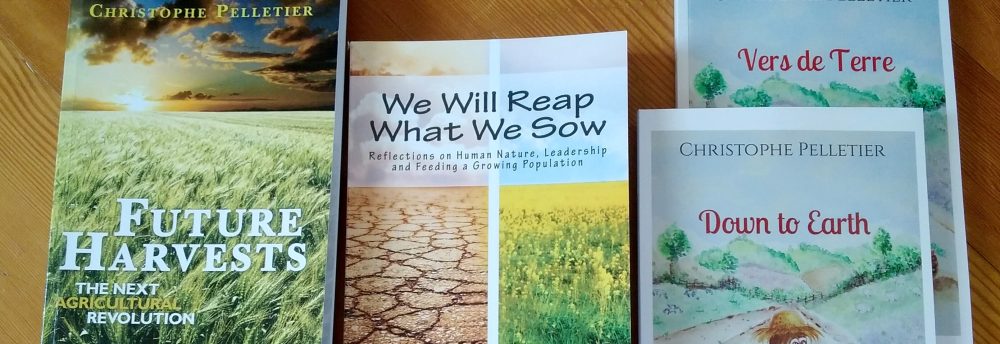
Those who are familiar with my work know that sustainability, innovation, market orientation, pragmatism, leadership and efficiency are the 6 principles that I had gathered under the acronym of SIMPLE in my first book, Future Harvests. In my second book, We Will Reap What We Sow, I developed and discussed the characteristics of proper leadership and the vision required to rethink food and farming to succeed in the future.

Even if future solutions need to be adapted to their specific local situations, these 6 principles apply everywhere and need to be implemented in a concerted manner by all regions.

Copyright 2012 – The Happy Future Group Consulting Ltd.

Rio+20, Riots+30?

The Rio+20 conference is over. Announced with much publicity, accompanied with many tactically timed media articles and other conferences about sustainability, it has been the occasion for many to demonstrate their apparent concern about the future of the planet. A couple of weeks after the conference, the excitement has faded away, and the tweets that were so abundant on the subject have become rare. This is rather symptomatic of the current behavior of short attention span. Much has been written about Rio+20 and the dominant conclusion is that it has not achieved much, as expected.

For obvious reasons, I followed the part about agriculture and food security with special attention. Since I did not expect anything, I was not disappointed. To me, this conference has left me with the impression that the world leaders are resigned. The text was written before they would meet and it was far from bold. I read it and I could only shake my head. To me it looked like a very politically correct list of commitments that would fit nicely in typical New Year’s resolutions. The principles and statements mentioned in the text are noble but who can seriously think that effective action will follow? Just like world peace, everybody will agree on the principle of a sustainable livable planet where hunger does not exist. The reality is different. Human nature is not that noble and our many flaws hinder us to achieve such goals. In We Will Reap What We Sow, I wrote among others a chapter dedicated to the human weaknesses and how they affect our ability to deliver what we all secretly want. In the book, I also discuss how we can overcome these weaknesses and work toward a successful change. The theme of Rio+20 was “The future we want”. It was not clear to me who we might be, and whether it should be about wanting. Is what we want the same as what we need? The theme should have been “The future we need”. That would have been more precise and more relevant.

I also followed the webcasts dedicated to food and agriculture of the conference, and they disappointed me. I would have loved to see people clearly expressing their frustration about the resistance our world faces to go in the right direction. I would have expected strong calls on the leaders for effective action. I would have expected to see clear action points with clear and non-negotiable deadlines. I would have expected clarity about who should be responsible to do what. I did not get these. Instead, I saw some well-rehearsed PowerPoint presentations carried out by speakers who were rather satisfied with the work of their countries or organizations and who sounded like they found that at least their contribution was excellent and so would it be in the future. I am always suspicious when I hear people justifying themselves while nobody is asking for justifications. I believe that the overwhelming majority of people who work in agriculture to produce more and better food in a better manner do a good job. Most people go to work with the desire to do something good. Such presentations did not add much to the objectives of producing more food in a sustainable manner.

What would I have liked to see happening at the Rio+20 conference, you might ask? Very simple: I would have liked to see people arguing quite vividly and even getting angry, even leaving the negotiation room and slamming the door. This would have been the sign that the right questions had been asked. Considering the complexity of growing more food and at the same time maintain the potential of agriculture to keep producing for generations to come, difficult issues and really annoying questions are inevitable. I really would have liked to see the likes of a Nikita Khrushchev who in the UN took off his shoe to bang it on his desk in the 60s. Although his behavior was somehow out of line and by today’s political correctness standards totally unthinkable, it would be good to have leaders engaging in robust arguments. After all, if the survival of humanity is indeed at stake, this would be a cheap price to pay. Instead of that, the leaders came only to pay lip service, show up on the group picture and went back home knowing that the conference did not address the issues as it should have. At least everybody felt good about a text that was not threatening for anyone, that did not ask for any significant sacrifice and thus life can go on. As soon as they left the building, they returned to business as usual. All the principles listed in the text are correct as such. The only problem is that it is written as if the UN expects world leaders to become altruistic, long-term oriented and good-hearted. It is a bit naive. They are politicians! Yes, in a perfect world, there is no doubt that the world would feed itself sustainably, just as it would not cause climatic change and there would be no poor and hungry people, either. In a perfect world, there would be no need for the UN or the FAO.

What can happen if the economic model derails and collapses if it does not make the right choices to become sustainable? That is not very difficult to figure out. A number of events from the last few years can give us some clues. The riots that took place when the price of food increased sharply in 2008, affecting the lives of many people in developing countries, show that food will play a crucial role for the stability of many regions. It will not take much for such riots to happen again. Because of the economic crisis, a number of heads of states in democratic countries have been defeated during recent elections. The people clearly asked for a different leadership. In Arab countries, a similar demand has been met through social unrest, riots and near civil wars, and the process is still ongoing. The people asked for a different leadership. The intensity of the economic crisis has actually been reduced substantially by the massive printing of money and the large amounts of debts that many countries have had to issue to keep their economies from stopping abruptly. If money printing has softened the short-term impact of the financial meltdown, it also will lengthen its duration quite significantly. Considering the amount of debt and the demographics of Western countries, it will take generations before the debt can be paid back entirely, if that ever even happens. To restore a sound ratio of debt on GDP, most of these countries would actually need a new baby boom to ensure a growth that matches the challenges. Of course, another approach could be to allow immigration numbers to increase strongly, but that does not seem to be on any of these countries’ plans. Moreover, a growth based on the same economic model of consumption society does not appear sustainable and before the right numbers would be met, one can wonder if our species would have survived.

I often tell that the difference between the effects of the financial, the social and the environmental parts of the economy manifest at different speed. Anyone can follow share prices live on the stock market, anyone can follow his/her bank account on a second-by-second if desiring to do so. Social consequences can take months or longer to manifest, and environmental effects can take decades to manifest. The financial crisis has been the result of postponing actions to ensure that the money world could be sustainable. It is still far from being there and the financial crisis is not over, but at least there was the possibility to print money and to emit debt. That entertains the illusion. When it comes to environmental sustainability, our leaders are also postponing actions to ensure that our physical world be sustainable. The main difference is that there is no printing of Nature possible. Printing of wheat, rice, beans or other essential food items is not an option. If we lose the ability to produce enough, there will be fights for food. That is inevitable.

An unsustainable economic model, and in particular an unsustainable agriculture, will result in shortages, not just local but everywhere and anywhere to some extent. It will result in large numbers of people left with few options to survive. Some cultures might deal with it in more orderly manner than others might, but overall, the result will be social unrest that could have the potential to turn into riots and probably even into regional conflicts. A quick look at the world map gives an idea of where it can happen and the potential risks. The Rio+20 conference should have presented prospective scenarios of what will happen if we do not act properly and timely, and it should have asked the leaders on solutions. Leaving a conference handling such a sensitive and complex problem without a genuine brainstorming and a solid and courageous action plan made by the leaders for the world in order to preserve peace and stability comes short of leadership.

Considering the pace of economic, social and environmental change, this was the least that should have been done. Are we going to wait another 20 years for the following conference? Will it be as lame as this one? Will the result of Rio+20 be Riots+30, or +40? I tend to think so more and more. I am increasingly convinced that only a really scary crisis affecting the rich will shake the lethargy. I think that political change will come from the street before it comes from leaders who have apparently already given up. In the food and agriculture sectors, I also expect salvation to come from the ones who are the most involved in production: the farmers, the food producers and the food distributors, simply because their livelihoods will depend directly on an agriculture that is sustainable. Politicians will only follow later, when they and their constituents become food insecure.

Copyright 2012 – The Happy Future Group Consulting Ltd.

The Sustainability Dilemma

Although almost everyone seems to agree that our world needs to be sustainable (what is the alternative anyway?), making it happen seems much more challenging. The good intentions have difficulties to turn into action. The reason is simple. To make human activities sustainable, we will need to accept some serious trade-offs. That is where it hurts. There is the dilemma. Are we willing to change and sacrifice on the superfluous today to have a bright future, or do we want to keep instant gratification as the way of life and risk to lose it all later? Even though the answer to this question is obvious, it is only human to choose the short term. The issue in the background is one of change, not so much one of a choice about sustainability. To understand why this is so, one needs to realize that fear of change is not about change. It is about the fear of loss. This fear is even stronger when there is little certainty about what will come next.

Making the move towards sustainability presents many short-term challenges. There is a lot of money at stake, but this is not just about the financial aspects of the economy. There is a social cost, too. Changing the economic model into a sustainable one means that many jobs will be threatened. In these times of economic hardships, the fear of unemployment and of the social unrest that would result from it is reason for many politicians to be reluctant to take drastic action. They also think about their jobs. Sustainability is about the long term. It is about later and somewhere else. On the contrary, personal consequences of the change are here and now. There is no need to look any further to understand why there is resistance and inertia. In the debate about sustainability, shortcomings appear in several areas.

A first area is the lack of strong vision from the leaders about which alternative to offer to the current consumption society. Actually, consumption society is not an accurate description. The purpose is not so much about consumption as it is about buying stuff, use them or not, throw them away and buy new stuff instead. Clearly, with more people having more disposable income, this is going to hit a wall. As more people want to have a piece of the shrinking pie, and as finite resources deplete gradually, excessive consumption and waste are not going to last for much longer. It is simple math and it is common sense. Supply and demand will readjust markets by sending prices up. High prices will make consumption slow down, and so will the world economy. Regardless of which one between market forces or the environment will cause the current system to collapse, the economic model will change. The time has come to bring a clear vision for an alternative system. The alternative must ensure that the economy is prosperous, that people have work that pays well enough for them to cover their needs and to ensure that human societies can have a future for generations to come. Until this day, nobody has come with a vision and a road map that make the change acceptable here and now. This is why all international conferences lead to little action. As long as this is the case, the only thing that will force a change in attitude is a major crisis in which the wealthy are at risk of losing what they have. As long as crises touch only the poor and the powerless, nothing really changes, unfortunately.

A second area of weakness is the lack of collaborative action. Every group of stakeholders look at its interest first, while the proper approach would have to be altruistic and empathic. This is another case of the here and now vs. the elsewhere and later. If we want to succeed, it is necessary to transcend differences and borders. We need to find ways of going beyond simple accountability, and impose co-responsibility. This is much easier said than done.

A third area to address is the numbers. In the end, it is about money and jobs. Actions to make the world sustainable must also work financially. If change is not sustainable financially, change will not happen. If businesses go bankrupt and if people are at risk of losing their livelihoods, they will not go for the change. The new economic model needs to consider this. The transition towards a better world needs to consider it, too. The externalities need to be internalized in some way, but the new model must be robust as well, otherwise all efforts would be for nothing.

A fourth area is about definitions. What is sustainability? How can we monitor and measure all human activities to know which ones are within sustainable limits and which ones have no future? How and where to draw the line, and how to enforce it? In the case of agriculture, every particular activity has its own specific impact. Depending on the nature of the environment, the nature of the impact and the range of sustainability vary, too. Monitoring must be tailor-made to each particular situation.

A fifth area is the consumer’s behavior. It is impossible to address sustainability without addressing consumption habits, and in particular excessive consumption and waste. As long as consumers will not eliminate the use of products that have an unsustainable effect on the environment, very little will improve. Putting the emphasis on production only is not enough. Production methods certainly can improve, but a substantial share of the damage is the result of consumers wanting more of what is not so good. Consumers are the largest group of influence. They are the people. What and how they consume is democracy in action. Businesses and governments follow their lead to quite some extent. When the majority chooses for a different economic model, things will change fast, but for now, the majority is still choosing for the old model.

Whether our world will move towards sustainability or choose a more hazardous way depends on us all. It depends on how we want to solve the dilemma that we face. The choice is not easy, but it is essential. There are many questions still unanswered, simply because they have not been asked. These important questions are mostly of a practical nature. They are more about how to make the system work not only environmentally and socially, but also financially. If businesses tend to focus mostly on financial aspects, environmental and social movement tend to neglect it too much. Like everything else in life and nature, it is about balance.

In my latest book, We Will Reap What We Sow, I address in much more details many of these questions and discuss the value of possible alternatives in relation with our future ability to feed a growing population.

Copyright 2012 – The Happy Future Group Consulting Ltd.

When externalities cannot be externalized anymore

Externalities are costs, or benefits, that are not included in the price charged for a product. If a cost is not included in the price, it represents a negative externality. If a benefit is not included, the externality is positive. The concept of externality is particularly important to determine whether an activity is sustainable. For instance, if an industrial activity pollutes and causes harm, there will be consequences, and costs. As it takes many years for environmental problems to become obvious, the cost of repairing the damage caused by pollution is not included in the cost of the goods produced by the industrial activity in question. However, there will be a day when it there will be no alternative but to clean the damage. That cost is the externality.

Every activity that pollutes without cleaning the contaminants is a negative externality. Everything that damages physically the environment and undermines the sustainability of food production is a negative externality. Every activity that depletes essential resources for the production of food is a negative externality. In this highly industrialized world, the consequences of economic and human activities, slowly add up. Nature’s resilience makes it possible for damage to remain unnoticed for quite some time. However, the ability of Nature to repair the damage shrinks, as the damage is continuous and exceeds Nature’s ability to cope with the problem. As the population increases, the level of human and economic activities intensifies further. There will come a time when Nature simply cannot handle the damage and repair it in a timely manner anymore. The buffer will be full. When this happens, the effect of negative externalities will manifest immediately, and it will include the cumulated damage over decades as well. It will feel like not paying the bills for a long time and then having all belongings repossessed. Humanity will feel stripped and highly vulnerable. The advisory services company KPMG published a report in 2012 stating that if companies had to pay for the environmental cost of their production, it would cost them an average 41% of their corporate earnings. These costs are currently not included in the pricing. That is how high negative externalities can be. Looking at it from the other way, companies would still deliver 59% of their current earnings. Repairing the damage and still generate profits shows that sustainability is financially achievable. On average, the profits would only be lower, but the impact would vary substantially between companies. Businesses that create high negative externalities will show much bigger drops in profits, than business that do the right thing. The only ones who would have to get over some disappointment would be Wall Street investors and all those who chase capital gains on company shares. The world could live with that. Investors should put their money only in companies that actually have a future.

All the fossil fuels that humans burn are gone forever. It is not renewable. All the water that farmers use for food production and exported away from the production region is gone forever. Exporters in arid regions will have no choice than disappear, produce only for the local markets, or if that is economically sensible, import water from surplus regions. All the minerals that are used as fertilizers and that are exported from the fields in the form of leaching or in the form of agricultural commodities are gone forever. New supplies produced either with non-renewable energy sources or from mines that are slowly depleting must replace the loss. Organic matter that is lost from soils must be replaced, or it will be gone forever. Soil that is lost through erosion and climate is gone forever, unless new soil is brought back on the land or very long-lasting repair techniques are applied. Every gene that is lost is lost forever and might be missing dearly. Every species that goes extinct is gone forever, as well as its role in the ecosystem. Every molecule of greenhouse gas that goes into the atmosphere is gone out of human control forever. It might bring a heavy cost in the future.

Since everything that becomes rarer also becomes more expensive, the externalities are going to weigh on the economics of food and agriculture, as well as in any other activity. There will be an oil price for which the current machines will be too expensive to operate, and for perishables to be too costly to truck with fossil fuels over long distances. The economics of water will change the purpose of farming in arid regions. It will alter the agricultural policies and force farmers to innovate new irrigation techniques. The economics of minerals and organic matter will change the location of animal farms and manure containment systems. No minerals will be lost. Manure will become a competitive fertilizer, as chemical fertilizers will become much more expensive to produce. The logistics of manure will change and the location of animal farms will change to allow an optimal cost efficiency of raw material for feed and access to fertilizing elements and organic matter. Farms will not have to be mixed, but the agricultural landscape will restore an integration of crop farms with animal farms.  Agriculture will be sustainable only if completes all the cycles. In the past decades, the cycles of minerals, of organic matter and of water have been open. Food has been produced in one place, and then moved over long distances and the waste and surpluses have accumulated somewhere else, while the original production areas were slowly depleting. New systems and new organization will work on closing the cycles again to bring back what agriculture needs to function. The economics of energy will change the chemical industry and its products. Everything will aim at using as little primary resources as possible and maximize the efficiency of inputs by both bringing entirely new products and application techniques. It will be true for energy, water, fertilizers, chemicals, medicines. The new focus will be about using just what is needed when it is needed and only in the dose that is needed, and no more than that. It will be all about precision agriculture, precision animal husbandry, precision packing, precision manufacturing, precision processing and precision logistics.

When externalities manifest immediately, there will not be the time discrepancy between financial results and environmental results. There will be no excuse anymore to say that there is no evidence of consequences. There will be no possibility of creating the confusion, either. When pushed to the limits of its resilience, Nature will bring the financial and the environmental at the same timeline. It will be stressful. Doing the right thing environmentally, or in other words, producing sustainably, will be the best, and only, short-term strategy for financial sustainability.

Copyright 2012 – The Happy Future Group Consulting Ltd

Just for fun, a bit of science fiction

One of the issues that I regularly raise during my presentations is the one of the farmers of the future. As about everywhere in the world, the average age of farmers is increasing, this brings the question of who will take over and what effect it will have on the future of agriculture and future production systems.

One topic that generates interest from audiences is the possibility of having farming robots. Surprisingly, the same intrigued enthusiasm comes from audiences that have a bias against industrial large-scale agriculture. Yet, the prospect of robots roaming the fields does not seem to be a cause for concern.

Because of the lack of interest by the youth to take over farms, the Japanese are actively working on setting up farms that could be run by robots, instead of humans. In many other countries the aging farming population with the limited interest from younger people to become farmers, also linked to the rising price of agricultural land, raises the question of how big farms might become, and how to manage them.

Currently, the many developments in the field of robotics, of satellite applications, of field sensors and of computer programs make a futuristic picture of farming become more realistic.

With the expected rise of the cost of energy and of the price of all compounds made with massive use of fossil fuels, precision agriculture is the future. The name of the game will be zero-waste. Future economics will not allow for wasting energy, water or fertilizers or any other input. It will be imperative to get the most out of the least, not just simply producing more with less.

The use of satellites to map fields and indicate the variation of the content of fertilizing elements in the soil is already a reality. The use of GPS for harvest is now common with modern equipment. We are really only one step away from having computers processing all this data and operating fertilizer spreaders by automatically regulating the distribution of fertilizer on the field, based on the soil scan assessment. This will avoid overuse of fertilizer in zones that already contain enough nutrients. With the expected exhaustion of phosphate mines, and the large variation of phosphate contents in soil, it will pay off.

We are also only one step away from having tractors, harvesters and other agricultural equipment doing the fieldwork without drivers. A company in Iowa is already developing such a technology by linking the position of a tractor to the harvester via GPS. Such an approach makes the use of human operators less of a need than it used to be. This would allow farmers to manage much larger areas from one remote location. Their role would become more one of process controller, monitoring and steering the fieldwork by ways of cameras and remote control. This also would require less physical work, thus allowing aging farmers to manage at least as much production as they would have at a younger age. This would become even more of a possibility, as farming robots would be developed to replace humans for the physically more demanding activities.

Developments in the area of sensors also offer many possibilities in terms of farm and risk management. The ability of monitoring variations of temperature, humidity, plant growth, the presence of diseases, fungi and other pests in real-time would help make use of resources much more efficiently. Current developments of biosensors used in food packaging are amazing. Some of such sensors have the ability to turn fluorescent in presence of food pathogens. They can help prevent risks of food poising. Sensors help to detect undesirable “visitors”. Sensors also would help farmers detect potential threats at an earlier stage, even before they actually become visible by the human eye. This would allow starting treatment before problems could take proportions that would threaten production. This has the potential to help farmers produce more optimally, and to produce higher yields than they would otherwise. Linking such sensors to devices that can release the necessary amounts of water, nutrients, pesticides and possibly herbicides would help produce quite efficiently, and would reduce the use of inputs. This would help reduce waste, work towards more sustainable farming methods and reduce the use of chemicals, as they would be used only at the right time, at the right place and in the right quantities, instead of being applied systematically to the whole fields, including areas where they are not needed. The use of airplanes to spread chemicals could be eliminated, which would also reduce the use of fossil fuels. Instead of airplanes, it is possible to envision the use of drones that would have a “patrolling” function to detect anomalies or the extension of pests in the fields. By bringing the huge amount of data that these robots, sensors and drones would produce, fields would be monitored on a 24/7 basis and decision-making would be faster than today. Corrective action could be implemented automatically just as well.

By adding more monitoring functions and developing ecological modeling, this futuristic approach would be a way of managing the interaction between the crop itself, which is the purpose of food production, and the need to manage the ecosystem surrounding the fields, to ensure that production is carried out in an environmentally sustainable manner. Monitoring living organisms in and outside the fields would help optimizing production. The farmer would know the status of soil organisms, mostly worms, insects and microorganisms. He would be able to deal with pests in a targeted manner, almost in a similar way as the images of surgical strikes that we can see in the news. Mapping the extent of weeds through such devices would also allow their control in a targeted manner and with minimal use of potentially harmful compounds. The emphasis would be about control and management, not on killing out everything that seems a threat.

Further, monitoring fields as described above would support the environmental steward’s role of farmers, while making it easier to execute as well. Farmers would be informed timely about production effects on groundwater quality and possible residues in the soil and the crops.

Of course, all of the above sounds like a bit of science fiction, but considering the amazing innovations taking place in the all the areas mentioned, together with the constant miniaturization of devices and the increased processing abilities of computers, it might not be as far-fetched as it may sound today. Although many of these developments are not taking place in the agriculture sector as such, they are real and happening faster than one could imagine. Farming in 50 years from now will probably look different from it does today.

Copyright 2011 – The Happy Future Group Consulting Ltd.

No shortage of action points for the future

The path to feeding the growing world population and to preserve agriculture’s ability to provide adequate volumes is paved with many challenges. Leaders will have to show how to resolve the many issues food production is facing or will face in the coming decades, and how to create a viable future.

As the population increases, the need for energy increases, too. Oil reserves are finite and new oilfields are becoming more and more difficult and expensive to exploit. It is only logical that oil will become more and more expensive in the future. This will call for more fuel-efficient equipment and vehicles. At the same time, oil that is more expensive also means that the relative price for alternative energy sources will become more competitive. In March 2011, an analyst from the bank HSBC published a report announcing that oil will no longer be available in 2060. In its future projections, the International Energy Agency (IEA) describes our energy sources as more diverse than they are now. They also mention that oil will not be the main source of energy anymore. Natural gas will take over. We should expect some significant changes in the way agriculture uses energy, the type of machinery that farmers will use and how future logistics will be organized.

The change of economics in energy will affect fertilizers, too. Especially, the production of nitrogen fertilizers uses large amounts of fossil fuel, essentially natural gas. On average, half of the nitrogen spread on fields is lost because of leaching. We can expect the focus to be on efficiency and on strategies of applications that are more efficient. This is already happening with precision agriculture techniques. Next to this, the focus of the fertilizer industry should be on developing nitrogen fertilizers that are less sensitive to leaching. Imagine a nitrogen fertilizer that may cost twice the price of the current ones, but for which there is no loss. Farmers would use only half the quantities that they currently do. The money to spend would be the same, but the use of fossil fuel to produce the fertilizer would be much less. There would be an environmental advantage to do so.

In the area of environmental issues, climate change needs to be addressed more effectively than it has been so far. Regardless whether people believe in it, or believe it is caused by human activity or it is only a natural phenomenon, the number of severe climatic events is reason to consider counter measures, just in case. The debate should not be about whether climate change is real or not. It is not about who may be responsible for it. True leaders take care of their people, and in this case, they should at least come with scenarios, contingency plans and emergency preparedness plans. That is the least we must expect from those in position of power and responsibility. In this case, the saying “the failure of the preparation is the preparation of failure” takes all its meaning.

Linked to climate to some extent, and a precious resource in all cases, water needs to be managed properly and carefully. For instance, all major river systems in Asia depend on Himalayan glaciers. If the glaciers were to disappear, which is a possibility, the source of water that sustains 2.5 billion people would be depleted, even if water used for agriculture also comes from other sources, the monsoon especially. The consequences would be catastrophic. Further, as agriculture uses 70% of all fresh water resources, growing food production will require more efficient water usage techniques. The focus must be on efficiency and on reduction of waste of water resources. Such objectives will require substantial financial resources and solid planning.

In the area of waste, food losses must be reduced as much and as diligently as possible. The moral issue of food being thrown away by the wealthy is obvious. The wealthy are not just in developed countries. In emerging countries, similar behavior is appearing. It is interesting to know that the Indian government is considering fines for those who discard edible food. It is even more interesting to notice that in Western countries where the percentage of food thrown away is the highest, governments are not investigating this possibility of fines. The other food waste scandal is the post-harvest losses. The food is produced. It is edible, but because of a lack of proper infrastructure, it is left to rot. What a waste of seeds, land, water, money, labor and all other necessary inputs. I have mentioned this problem in previous articles, as I have shown that the financial return to fix the problem is actually high and quick. There is plenty of work in this area for leaders. The first step to succeed in this is to recognize that no organization can fix this on its own. There is a need for collaborative leadership, because all the stakeholders in the food chains must participate, and they all will reap the financial benefits of fixing post-harvest problems.

Food production is not a hobby. It is of the utmost importance for the stability and the prosperity of societies. Well-fed and happy people do not riot. The need to improve infrastructure and logistics is obvious. Food must be brought to those who need it. A proper transportation infrastructure is necessary. The choice of transportation methods has consequences for the cost of food supply, and for the environmental cost as well. Road transport is relatively expensive and produces the highest amounts of greenhouse gases. Rail transport is already much better, and barge transport even better. The distance between production areas and consumption centers also needs to be looked at, together with the efficiency of logistics. Optimization will be the name of the game. Completing the cycle of food and organic matter will become even more important than today, as the world population is expected to concentrate further into urban centers. As humans are at the end of the food chain, many nutrients and organic matter accumulates where the human settlements are. These nutrients, as well as the organic matter, will have to be brought back to the land. This is essential if we want to maintain soil fertility. As phosphates mines are gradually running out, sewage and manure are going to play a pivotal role in soil fertility management. The concentration of the population in urban centers, together with the change of economics in energy, will require a very different look on economic zoning, and in urban planning in particular.

Special attention will be necessary to inform and educate consumers to eat better. Overconsumption, and the health problems that result from it, is already becoming a time bomb. Overweight is not only a Western problem. The same trend is appearing in many developing countries as well. Overweight is on the rise all over the world. The number of obesity cases in China, and even in some African countries, is increasing. The cost of fixing health is high, and it will be even more so in countries with an aging population, as age-related ailment add up to eating-habits-related problems. Healthy societies are more productive and cost less to maintain.

As the economy grows, and wealth increases in more and more countries, diets are changing. Consumers shift from carbohydrate-based meals to a higher consumption of animal products, as well as fruit and vegetables. The “meat question” will not go away. Since it takes more than one kg of feed to produce one kg of animal product, increasing animal production puts even more pressure to produce the adequate volumes of food. The question that will arise is how many animals can we -or should we- keep to produce animal protein, and what species should they be? Levels of production, and of demand, will result in price trends that will regulate production volumes to some extent, but government intervention to set production and consumption quotas cannot be excluded, either.

Similar questions will arise about biofuel production, especially the type of biofuel produced. There will be debates about moral, economic, social and practical aspects of biofuels. The consequences on the price of food and animal feed are not negligible. The function of subsidies in the production of biofuels adds to this debate and there are strongly divergent points of view between the various stakeholders.

One of the most important issues in the discussion about feeding the increasing world population is food affordability. Producing more, and producing enough, is not enough. The food produced must be affordable, too. When this is not the case, people cannot eat, and this is the main reason for malnourishment. To make food affordable, food production must be efficient. The costs of production need to be kept under control to avoid either food inflation and/or farmers bankruptcies.

In agriculture, just like in any other human activity, money always talks. Money is a powerful incentive, and when used properly, it is a powerful driver for improvement. Strategic use of financial incentive is part of policies. To meet the future challenges, leaders will have to develop the right kind of incentives. The focus will have to be on efficiency, on long-term continuity of production potential as well as on short-term performance. The financial incentives can be subsidies. Although the debates tend to make believe subsidies are all bad, there are good and useful subsidies. Another area of incentives to think about is the type of bonuses paid to executives. Just imagine what would happen if, instead of just profit, the carbon footprint per $1000 of sales was factored in the bonus? Gas emissions would be high on the priority of management teams.

If the way executives are paid matters, the type of financial structure of businesses could influence the way they operate, too. Now, it may sound surprising, but in the future, expect the question whether food companies should be listed on the stock exchange to arise. Short-term focus on the share price can be quite distracting from the long-term necessities. If we find that elected officials are short-term-oriented because elections take place every four or five years, how short-term quarterly financial results to the stock markets influence CEOs? The pressure by investors on companies’ Executive Boards to deliver value is high. They expect some results within a relatively short period, while what happens to the companies, their employees and long-term effect on the environment after they took their profits is irrelevant to them. This brings the question of the functioning of financial markets as a whole. What derivatives are acceptable? Who should be allowed to have access to which ones? What quantity could they be allowed to buy and sell? Many questions will arise more and more loudly every time food prices will jump up again the future, and as social unrest may result from it.

To prepare the future, it is important to prepare the generations of the future. Education will play a critical role in the success of societies. Only by helping future generations to have access to knowledge, to develop skills and to train to fill in the jobs of the future, will countries develop a strong middle class. Thanks to education, people can get better paying jobs. This allows them to buy adequate quantities of food for themselves and their families. Education is an investment to fight poverty and hunger. In the agricultural sector, it will be important to attract more young people to work in the food and agricultural sector. In many countries, farmers are getting old and replacement is scarce.

These are just a few of the issues that the current and future leadership will have to solve, if we want the feed and preserve the world. There will be many discussions about which systems are the best suited to ensure prosperity and stability. The respective roles of governments, businesses, non-profits and of the people will certainly be reviewed with scrutiny.

During the writing of Future Harvests, it became obvious to me how crucial the role of leadership is for our chances of success. In the course of a number of assignments with my company, this observation has grown even stronger.

For these reasons, I have decided to start writing another book focused on the role of leadership to develop long-term development of food production and food supply. It will be a reflection about the tough calls that leaders need to make. The final objective is to ensure viable food production systems and proper infrastructure, while ensuring the continuity of food supply in the long-term, through a successful interaction between all stakeholders.

Tentatively, the publication date is fixed for the summer or the fall of 2012.

Copyright 2011 – The Happy Future Group Consulting Ltd.

Food security in Paradise

Many Hawaiian residents express their concern about their dependence on food that comes from far away. Actually, there are more and more conferences and workshops about the topic of food security for Hawaii. With this in mind, I went to the Big Island of Hawaii for a vacation last April. I certainly would recommend to everyone to do the same if they ever have the chance.

Since Hawaii is part of the USA, food security will be guaranteed from the mainland. However, looking at the situation as if Hawaii was an independent country makes the debate about food dependence from other
regions quite interesting. The Islands of the State of Hawaii are isolated, as they lay in the middle of the Pacific Ocean, thousands of miles away from any significant continental mass.

During my stay, I was reminded about food security and environmental issues in several occasions. On Earth Day, I came across an event that was interesting in many regards. Apart from the more militant speeches about mostly the big bad oil, and the fact that “Lady Green” touched me with a sunflower, I spent some time engaging in conversations with a number of exhibitors, from government organizations to renewable energy systems (solar makes a lot of sense in Hawaii to me). One booth where I spent more time was
the one of the University of Hawaii’s Pacific Aquaculture& Coastal Resources Center. There, I had a good conversation with PACRC’s Director Kevin Hopkins, a very knowledgeable man with extensive experience in aquaculture, not only in the USA, but also in Asian and African countries. Thanks to him, I got a better idea of the challenge to integrate a sustainable aquaculture in the Hawaiian environment. Living in Vancouver, BC, and having worked in the salmon farming industry, this is not a new topic for me. Aquaculture faces similar concerns in both places.

Click on picture to enlarge

With this in mind, I continued my vacation. At the Kaloko-Honokohau Historic Park, I found a sign showing a comparison of food security between today and 300 years ago. By then, there were 150,000 inhabitants on the Big Island of Hawaii, 100% of the food was produced on the island, 0% was imported, and they were producing 300,000-500,000 lbs. of fish in stone fishponds. Today, for a similar population, only 18% of the food is produced locally, and the Kaloko fishponds do not produce any fish at all (see picture). Of course, these numbers do not take the number of tourists to feed into account. Moreover, the current food consumption per capita is probably substantially richer in calories than 300 years ago, too. However, this history could be a good basis for more constructive discussions about aquaculture. Clearly, aquaculture was a traditional way of improving food security for ancient Hawaiians. The old fishponds were made of walls built with the volcanic rocks, and the fish was passing though a gate made of vertical bars. The small fish could enter, but as they grew bigger, they were unable to pass the gates and leave. This system made me think of a hybrid form of closed containment. In BC, where many discussions are about producing salmon on land, the Hawaiian fishponds are actually a quasi-closed containment on the seabed. It does not require all the land-based infrastructure and equipment, as is the case for land-based closed containment systems. What I saw at this park tells me that the useful could meet the historical, cultural and the modern just to help develop a responsible and productive aquaculture to increase food self-sufficiency for Hawaii. In a region where the ocean space available is as vast as this is the case around Hawaii, I am convinced that there have to be plenty of locations where aquaculture can be conducted without harming the environment, and there have to be more than enough adequate production techniques to do it right.

In the same park, there were remnants of pits in which rocks were set up in many individual planters. In these planters, called mala’ai, the ancient Hawaiians used to grow food plants. This is an ingenious system, because in that area, the fields are covered by lava. There is no soil to be used for open field crops, such as wheat, for instance. On the other hand, there would be plenty of acreage to set up such planters. This would be labor intensive, though.

At the Kaimu-Kalapana black sand beach, I read on a sign that ancient Hawaiians used to harvest seaweed and that apparently, their methods were sustainable. It is only after commercial harvesting by European settlers started that the seaweed quantities plummeted because of excessive harvest volumes. Just like for fish production, researchers from all sides should work on restoring such a seaweed production in a sustainable manner. This example, like all other examples of unsustainable human practices, simply demonstrates that we must produce or harvest what we can, instead of trying to produce or harvest always more while ignoring the signals that we are passing a breaking point.

I spent time only on the Big Island, and I did not visit the other islands. Probably, I do not have the whole picture, especially considering that more than two-thirds of Hawaii’s population lives in the State capital, Honolulu. According to the latest US population census, Hawaii’s total population is of about 1.3 million people, out of which more than 900,000 live in Honolulu. To get a more accurate picture of how much food needs to be produced to meet demand, it is necessary to add the visitors. Per year, the number of visitors is about 7.4 million people, who stay on average 9.15 days. This number expressed in average outside visitors staying in Hawaii per year is 7.4 x 9.15 / 365 = 186,000 people. To simplify, I will estimate the number of mouths to feed at 1.5 million.

For the Hawaiians concerned by the food security or, better said, the low food self-sufficiency of their state (less than 15 %!), what are the possibilities?

Just like in most of the rest of the USA, the local food movement is growing. More and more people are trying to grow some food on their balconies. Of course, this will not be enough to reverse the situation, but it will contribute. Farmers’ markets are gaining in popularity, and I have to say rightly so. Unlike what I am used to in my neighborhood, the food sold on the farmers markets that I came across on the Big Island offer many affordable and actually cheaper foods than in the large supermarket chains. At the farmers markets, I could notice that many more generic vegetables such as onions, tomatoes or bell peppers were shipped from the West Coast of continental US, mainly Washington State. On the other hand, I found quite interesting to notice that the big retailers are also trying to source local products. I only visited a Wal-Mart and a Safeway. From what I have been told, the selling of local products at their outlets is a recent change.

This is interesting, because these retailers will try to be able to source larger volumes, and they actually maybe in a position to stimulate more local food, agriculture and aquaculture production.

The quality of the local food is quite good, although when on vacation everything tends to taste better for some reason. Although I am not much of a beef eater, I was tempted by a “Hawaiian” local grass-fed beef burger recipe, and I have to admit this was the best burger that I ever tasted. It was so good that we went back to the same pub the next evening and I had another burger, while my spouse had a steak. Her steak was simply stunning. And the price was actually cheaper than similar generic beef dishes here in Vancouver.

When it comes to justifying more local food production, I have seen very interesting numbers about the amount of money that Hawaiians spend on food, and therefore to producers outside of their state. According to the same studies, local production would also result in more local jobs. However, I would not develop a plan based on such numbers, not because I doubt them, but because the business must be financially viable as well. I find all the reports that I have read too general or too academic for my liking. Moreover, I am not convinced that the politicians are committed to take the necessary steps to increase food self-sufficiency in Hawaii. They give it quite some lip service, but I miss signs that this topic might be on top of their priority list.

Personally, my first step to see what needs to be done would be to look at how many farms are required to produce what is needed: how many eggs, how much milk, how many chickens, how many pigs, how much fish, how many fruit and vegetables, how much wheat, rice, potatoes, and so on. Once I would have identified the size of the local market for all the food items, I would calculate how many farms are needed to meet that demand. After all, there cannot be food security if there are not enough farms.

For instance, every 10 kg consumption per capita of chicken meat means a production volume of 1.5 million x 10 kg = 15 million kg of chicken. As a chicken weighs about 2 kg, this would correspond to 7.5 million chickens per year. With an average of six flocks per year in a chicken house, this would mean a production capacity of 1.250 million places. This represents about 60 chicken houses. Depending on the size of the farm, my guess would be that 10 to 20 farms are necessary to cover a consumption of 10 kg per capita per year. If consumption were 40 kg per capita per year, Hawaii would potentially need up to 80 farms. Do they have the farmers and the locations for all of them? That is what I would like to determine.

Similarly, in the case of marine fish farms, every 10 kg consumption per capita per year of fish requires 15 million kg of fish, or close to 30,000 tons of live fish. If we were to imagine the containment system from Hawaii Oceanic Technology that I mentioned in “High-tech fish farm”, it almost could be produced on one farm. Of course, it would not be wise to put all the eggs in the same basket. If production volumes were comparable to a salmon farm, the 30,000 tons could require 10 farming sites. This is just theoretic in order to give an idea of the production space needed. There would be different species produced, but the calculation method remains the same for each of them.

With such an approach, for all the relevant food products, it can appear very quickly if being self-sufficient for the various food items is realistic or desirable.

The final exercise, which is also the most important, is the business plan per farm, to assess the viability of the individual projects. Even local, food production must be competitive. The example of Hawaiian sugar cane shows that this is not necessarily the case.

Next to farmers, food producers and market outlets, the Hawaiian government can stimulate more local production if it wishes to do so by setting the appropriate policies. Developing such a thorough review of how to reduce food dependency on outside sources in a market-driven and viable manner for the long term would be quite enjoyable to carry out in paradise!

Copyright 2011 – The Happy Future Group Consulting Ltd.

What a waste!

Nobody can have missed it. The hot topic of the past month was the so-called global food crisis. If you believe the media, the conventional ones as well as the social media, we are facing food shortages. For those who follow my articles, it will be no surprise that I am inclined to challenge such statements.

When 40% of all the food produced is wasted and lost, it is not possible to talk about food shortages. As I had explained in “Hunger is about more than just food production”, there is plenty of potential to increase food availability. Currently, and with this extremely sloppy 40% food waste, the world agriculture feeds quite reasonably six billion people. Unfortunately, this is not the case for one billion hungry people. By eliminating the waste, we could supply enough food to feed nine billion people. Not in 2050, but today already! That is not ideology or political agenda. It is simple math. Interestingly enough, the amount of the 40% food waste corresponds with the 70% more food the FAO says we should produce to feed nine billion. The more food we will save, the less we will need to push production up.

Unfortunately, the food waste issue receives little attention in the media. This is surprising because there would be some sensational articles to write about it. A little bit of guilt here, a little bit of horror there. That should sell some newspaper or get people watching TV. If this does not happen, it is probably because the food situation is not dire. From time to time, I receive requests from journalists. Sadly, the stories that interest them have to be scary, such as doomsday scenarios including food shortages and the imminence of food riots everywhere, to be followed of course by World War III. I do not do that. Other type of topics that journalists love is science fiction stuff, such as meat artificially grown in labs and anything related with high-tech, or freaky stuff like eating insects and worms.

The food crisis was not so about shortages. If it had been the case, we would have seen pictures of people fighting for food. It did not happen. Actually, it is a price crisis. The price increase of commodities futures results from the depreciation of the dollar (as I was predicting in “The danger of a weakening US dollar”), and the strategy of what the financial media likes to call hedging against inflation. The later is really smart stuff, as investors rush into buying commodities to hedge against potential future inflation. The high demand for commodities results in price increase. That is the best guarantee to get inflation. Brilliant!

The media attention has been interesting to follow, though. Every newspaper wanted to have a piece about the subject. And they really published a lot. Everyone became a food security expert, from restaurant critics, to balcony gardeners and other economy reporters. Depending on the sources they wanted to use, the sponsors, and of course their paying audience, everybody could find about anything and everything about the subject. Some made a bit of sense, but many reports were sadly erroneous.

For some pundit, we are just one bad harvest away from a global food crisis. That was true 10,000 years ago, that was true just before the Irish famine, and it will be true as long as farmers do not control the weather. Is that worth receiving coverage? For many, it has been an opportunity to push their respective agendas. For some, the only way is high-tech big agriculture. Hmm is that so? For others, only small-scale organic farming will save us. Hmm again. For others, eating meat is responsible for all the problems. Did I say hmmm already?

In this frenzy of food apocalypse reporting,  I simply have not seen one article dedicated to food waste, just like I have not seen any sensible research about how the price of commodities is set, either. When the total market for financial derivatives is US$ 600 trillion, while the world GDP is only US$ 60 trillion, something is a little out of balance, would not you think? The daily trading volumes of commodities largely exceeds the actual physical daily consumption of these commodities. Are all the traders only adding costs in the food chain?

However, let’s come back to the waste part. What the math I presented at the beginning of this article shows, is that the future is not so much about producing more, but about producing better and smarter, consuming better and smarter, and organizing the supply chain more effectively to ensure that food indeed reaches consumers.

The waste issue is rather simple to sum up. In rich countries, and also increasingly among the wealthier in emerging countries, the food waste occurs at the consumer end of the chain. In developing countries, the waste occurs at the post-harvest level. Food rots before it had a chance to reach consumers. In these countries, food losses are the result of an insufficient infrastructure. Another area of major food waste is fisheries. Because of (ironically) highly efficient trawlers, many fish species, as well as large quantities of edible fish are lost as they are crushed in fishing nets

Retailers are working on improving their part. For instance, Wal-Mart has initiated a large program to offer food to food banks, as part of their zero-waste strategy. European retailers did something similar several years ago. Consumers must do their part, too. Throwing food away is inexcusable for people who have refrigerators at home. People need to get some basics of household management. When I was a kid, there were classes about this at school, but it disappeared somewhere in the 1960s. Throwing away food is bad economics. Although nobody would think of throwing away coins and bank notes in the garbage, throwing away food is exactly that. That money could be used for better purposes.  Throwing food in the garbage, or as I have recently read in a local paper here in Vancouver throwing it in the toilet pot, is pretty much an immoral act, especially when so many lack food. Of course, not throwing away food in North America will not solve hunger in Africa, but there are other consequences to think about. Producing food requires a lot of energy (for production of fertilizers, for transport, for agriculture machines, packing plants etc..) and water. Wasting food means that the water and energy have been used for nothing! It is pure waste. Some may think that this is not relevant in Europe or North America. Do not be so sure, because for instance California is struggling with water scarcity, while exporting its water to other regions in the form of produce and other perishables. The gas emissions created for the wasted food will have been for nothing. Not wasting food actually reduces the environmental impact of agriculture, and this particular impact is the consumers’ responsibility. They need to know about this, because their behaviour influences the quality of the environment.

In rich countries, there is no food shortage, but we could use more leadership in informing and educating consumers to do the right thing. This is not only a matter for retailers or food service, but for all levels of the society. Rising awareness about the cost of wasting food should be on the agenda of all community leaders. Schools, parents, religious and political leaders should all address this topic in their respective circles. Food waste is where economics meet morals.

The post-harvest losses in developing countries are also both about economy and morals. The moral part is about their populations who already have so many difficulties to afford enough food, while almost half of it rots because of poor storage and infrastructure. The economic part is about the waste beyond the food losses. In many developing countries, water is scarce and most of them use large amounts of this water to irrigate food crops. Many developing countries already struggle to have clean drinking water, yet almost half the water used for irrigation is wasted together with the food. This is not acceptable, morally and economically. Moreover, some governments subsidise water for farmers to irrigate. Yet half of these subsidies are wasted with the food. Some governments also need to subsidize food for low-income families and to counter food inflation, simply to allow their people to buy food. If food availability were about to almost double by fixing the infrastructure, this would have some very positive consequences. Today, close to half the food receives zero money for revenue, while the production costs have been made to produce all of it, the eaten food as well as the wasted food. By eliminating the post-harvests losses, the currently lost quantities would create revenue that is currently missing. Considering the volumes of food involved, the total amount of new revenue generated in all these countries would be astronomic. Everybody would win. Retailers and wholesalers would increase their sales substantially. Farmers would make more money. Storage companies would have a business. Transport companies would have more business as there would be much more food to bring to market. More food available would also mean less inflationary pressure on food prices. This new activities would create jobs. This would help more people have a better income and be able to afford food a bit more easily. Governments would not have to spend as much money to subsidize food. A population that eats better would not be as tempted into social unrest as a hungry mob. At the production level, less food waste would mean less waste of water, energy and inputs. This would alleviate water problems, and increase the efficiency of the use of energy. All of this has a positive impact on the environment. According to the FAO, the cost of fixing the post-harvest losses in developing countries is about US$81 billion. Considering the quantities of extra food involved available “almost for free” since it has already been produced, the US$81 billion sound like a bargain. Indeed, agriculture represents 5.8% of the world GDP (source: CIA Factbook), or roughly US$ 3.5 trillion! Therefore, saying that post-harvest losses must be in the neighborhood of US$ 1 trillion is probably conservative. One would expect to see the payback time for infrastructure investments to be rather short. Someone needs to crunch the numbers, to take the lead and to show to all parties involved what their advantage will be. I certainly would be happy to do that. All actors of the food chain will have to participate, private sector as well as public sector. The return will be high in all respects, financially of course, especially once the current social and environmental externalities will be eliminated as the result of an efficient supply chain.

Copyright 2011 – The Happy Future Group Consulting Ltd.

The math and the myth

No, this is not one of those “are in a boat” riddles. Those who have read my articles or my book know that I like to bring some perspective by crunching numbers and double checking statements that seem beyond any discussion.

During National Agriculture Week held last week in the US, one of such statements popped up in most of the social media dedicated to agriculture: In 2010, one US farmer provided on average for the needs of 155 people, while in 1960 this number was only 26!

Of course, if you follow social media, you know that, immediately, the partisans, mostly in the Midwest, spread the good news as fast and as much as they could. To them, this number of 155 is the best proof that large-scale industrial technology and mechanization driven agriculture is the best there is, and US farmers are the best in the world! So that the world knows it this time!

That is clear. Or is it really? Then let’s look at the numbers a little closer and do some math.

Knowing that China became the first export destination of US agricultural goods since only last month, finally passing Canada and its gigantic 35-million population, I had some doubts.

First, one statistic that is not mentioned in the 155 per farmer is the total number of farms. This number dropped from 4 million in 1960 to 2.2 million in the latest (of 2007) census mentioned on the USDA website. Going from 26 to 155 would have been very impressive if the number of farmers had been stable, but this is not the case.

In 1960, 4 mio x 26 = 104 million people fed.

In 2010, and by keeping the number of 2.2 million farms, the calculation is 2.2 mio x 155 = 341 million people fed.

Instead of increasing 6-fold (155/26) as the fans try to make believe, the actual improvement of US agricultural production has increased only 3.3 times. Over a period of 50 years, this represents an average year-on-year increase of people fed by US agriculture of only 2.4%. It is higher than the average year-on-year increase of the world population over the same period, but it is not stellar, either. As an indication for comparison, the world’s food production has increased by 3% year-on-year over the same period.

This becomes interesting when comparing with other parts of the world. I choose India, because, it is often presented, especially in the Anglo-Saxon press, as a country that does not tackle agriculture properly. According to those articles, India should be a lot more like the US, going big and industrial, instead of keeping their large rural population.

India has 1.2 billion inhabitants, and statistics indicate that 200 million people are malnourished. This implies that 1 billion people are fed reasonably. Now, let’s compare another number that rarely appears in analyses. The population density of India is 10 times higher than the American population density. This means that if the US had the same population density as India, there would be 3 billion Americans, and only 341 million of them would have food. In such conditions, they would not eat much meat, they would not suffer from obesity and they certainly would think twice before growing food to feed their cars. If India had the population density of the US, there would be only 120 million Indians. India would probably be the largest food exporter in the world.

Maybe this comparison is not the best to make. After all, the Indian diet is rather different from the American one, and India still needs imports to feed its people. Let’s try something that is closer to America in terms of eating situation: the EU.

There rarely passes a day by without some article from a US industrial agriculture supporter that criticizes Europeans to resist the American model, especially GMO crops. According to the biased pundits, Europe is losing ground because of this shortsighted stubbornness. There again, some math can help. Once again, the population density will provide us with insight. If the US had the population density of the EU, there would be 1.1 billion Americans. Once again, that is much higher than the 341 million that US farmers can feed. As far as the EU is concerned, the region is self-sufficient, and in most European countries, the yearly per capita consumption of meat is close to 100 kg. There is no food security problem in the EU. In this case, we are not comparing meat eaters and vegetarians. Just as it looked that India was doing not such a bad job at feeding its people, the EU actually delivers a nice and enviable performance.

The math shows us that the number of people fed by one farmer is not a good indicator of the actual performance of the national agriculture. I would compare it with bragging about the number of horsepower in one’s car engine without looking at how far that car can take you. Gas mileage is more important. In the case of the US, the 155 only indicates that there are very few farmers, and that they have to manage very large farms. It is not an indicator of yields. Bigger, more intensive or more technology do not necessarily mean more efficient. It has to be the right size, the optimal level of intensification and the proper use of the right type of technology.

A much more relevant number is the number of people that one hectare (or one acre) of land can feed. With this indicator, the performance of the US is average. The key is the yield. In the case of wheat, which is grown in most regions, the yield in the EU varies between 6 and 9 tons per hectare, depending on the country. In the US, the yield is of only 3 tons/hectare, which also happens to be the world average.

What the math really shows is that the world is very diverse. It is diverse from demographic, economic, sociocultural, climatic, agricultural points of view. Agriculture is not mechanics. It must consider all these parameters and be adapted to the specific environment to meet food demand optimally. There is no universal model, and there does not need to be any. We simply must focus on producing high yields in a sustainable manner, meaning that this performance can be repeated indefinitely for the generations to come. To grow food, we need good seeds, fertile soil , proper financial resources and skilled farmers!

Copyright 2011 – The Happy Future Group Consulting Ltd.

The fertilizer of the future?

Among the many challenges that the agriculture of the future faces, soil fertility ranks high on the list of priorities.

Originally, most farms were mixed. They had land to grow crops and they had animals for milk, eggs and meat. Markets were mostly local, and food was consumed in the villages and towns near the farms. Food waste was fed to farm animals; the manure produced was mixed with straw and returned to the fields where the crops had been grown. Over time, farming has evolved. Agriculture has become much larger scale, global and specialized. This evolution has been driven by the use of oil, mechanization, and by the development of mineral fertilizers.

That model, which has been greatly based on cheap energy and resources, needs to be looked at critically as the economic environment changes. Energy is no longer cheap and, like oil, the resources used for the production of fertilizers have been depleted. New solutions are required to be able to produce optimally.

The production of nitrogen fertilizers requires a lot of energy. According to estimates, it uses 5% of the world’s natural gas production, and half the fossil fuels used in agriculture. Because nitrogen is quite mobile when dissolved, as this happens when it rains, a large amount of these high-energy-consumption compounds are lost. An estimated 50% of the nitrogen spread on crops leaches through the soil. It ends up in the water system. The reserves of phosphates, another important mineral fertilizer, are facing depletion. This might happen in 20 years from now. With the development of precision agriculture, the waste of minerals can be reduced. With the development of satellite imaging indicating the mineral status of a field, and the local variations within the field, it has become possible for farmers to bring just the right amount of the right mineral at the right time and at the right place. This follows somehow a similar thinking as fertilizing plants in hydroponics operations where crops are produced without soil and fed a mineral solution drop by drop.

A consequence of the specialization between crop farms and intensive animal farms is the rupture of the organic matter cycle. Large monoculture farms have suffered soil erosion because of a lack of organic matter, among other reasons. In soils, the presence of organic matter increases moisture retention, increases minerals retention and enhances the multiplication of microorganisms. All these characteristics disappear when the quantity of organic matter decreases. A solution to alleviate this problem is the practice of no-tillage together with leaving vegetal debris turn into organic matter to enrich the soil. This has helped restore the content of organic matter in the soil, although one can wonder if this practice has only positive effects. Tillage helps eliminating weeds. It also helps break the superficial structure of the soil, which can develop a hard crust, depending on the precipitations and the clay content of the soil. Possibly, in the future the use of superficial tillage could become the norm. Deep tillage, as it has been carried out when agriculture became mechanized, has the disadvantage of diluting the thin layer of organic matter in a much deepen layer of soil. This dilution seriously reduces the moisture and mineral retention capacity of soils, thus contributing to erosion as well, even in organic matter-rich soils.

The removal of farm animals from specialized crop farms requires the systematic use of mineral fertilizers because farmers do not have access to manure and the minerals it contains, even though most of these minerals originate from the crops farms.

At the other end of this interrupted cycle of manure, intensive animal farms do not suffer a lack of organic matter and minerals. They have the opposite problem. They have too much of it, and not enough acreage, if any, where to spread it. This leads to accumulation of manure and other related problems, such as stench, high concentrations of minerals in the soil and eventually in the waterways and drinking water reserves.

Since nothing is lost, what has happened to the minerals from fields and from fertilizers? They have been transferred to other places via the global trade of agricultural commodities. Many of these commodities are used to produce animal feed. Phosphate in European pig manure may come from Asian manioc farms. Therefore, the best way to find out where the minerals are is to look at where intensive animal husbandry farms are. As mentioned earlier, nitrogen is washed away into the water system because of its mobility. Unlike nitrogen, phosphates are not mobile in the soil. They will accumulate, which also leads to a loss of soil fertility, eventually. The other area of concentrations of these minerals is in city sewers, and in the soil of slums. Since the purpose of agriculture is to produce food, and since consumers are increasingly concentrated in urban centers, the exportation of minerals is actually gathering momentum out of rural areas.

In the future, we are going to see a new look at fertilization. The economics of agriculture will change. This is inevitable, because the cost of inputs will increase. This will be a direct consequence of the increase of the price of oil, and of the depletion of phosphates reserves. This change of economics will drive renewed interest for manure, and for sewage. These sources will become attractive and competitive, as they contain large amounts of minerals directly available. Because of their nature, they have a high content of organic matter. One of the most efficient ways to remove nitrates from water is to grow plants with it. One of the main sources of phosphates will be manure.

There is little indication that the human population will return to the land, but animal farms can be moved rather easily. After all, they already are segregated from vegetal production. The increased need for manure will call for a relocation of animal productions. In an expensive-energy economy, having the “fertilizer factory” on site, or at least much closer than today makes a lot of sense. This is especially true because manure contains a lot of water, although there are substantial differences between productions. Transporting water is expensive. Mixing crops and animal productions again on farms will also allow the inclusion of vegetal debris together again with the feces and urine, producing a higher dry matter content, with limited transport costs between the field and the “fertilizer factory”. Regardless of the size of the farms, I expect to see a relocation of animal production units on agricultural land. They will be spread more evenly in the landscape than today. This will decrease the density of farm animals in currently high-density areas to levels that will allow a better control of environmental issues, as well as reduce partly the risks of transmission of animal diseases. Animal production units will reappear in areas where they had disappeared because of the fertilizer that they will provide.

This evolution will also come together with a new approach of manure storage and treatment. Open-air lagoons like those that we know today will simply cease to exist. The changed economics of energy will make the capture of gases financially attractive. Manure storage units will be covered; the biogas will be collected to be used for energy purpose, for the farm and the local communities. The solid and the liquid fractions of the manure will be processed and transformed to provide organic matter and the fertilizing minerals necessary for crop production. The location of the “manure units” will be influenced by the type of animal production, and therefore by the physical quality of the manure. There will be a logistic optimization of manure collection to the crop farms. It will be based on efficiency and optimization of resources. Therefore, the new farm structure will be efficient, as much financially as environmentally. Similarly, open-ocean fish farms that currently do not collect the feces will see the financial value in recuperating the fish waste and sell it. In cities, there will be an increasing interest to recycle the sewage. The purpose will be to recuperate the organic matter and the minerals it contains. A similar approach for human waste will apply as for animal production units as I described above. This will also be integrated in the future approach of urban farming, as it will provide the necessary nutrients for an efficient urban food production. It will be a source of revenue to the cities.

In rural areas and in urban areas, organic matter and fertilizing minerals will become strategic activities. They will serve the purpose of feeding sustainably the world population.

Copyright 2011 – The Happy Future Group Consulting Ltd.