China is evolving – A look towards future consequences

Aside

Recently, interesting economic news has come from the Empire of the Middle. On the one hand, financial markets reacted worried on the softening of the Chinese economy, but on the other hand they reacted rather positively about the first corporate debt default allowed in the country. To me, all of the above is good news. If financial markets get a bit nervous for a few days, then so be it! It cannot be a complete surprise that at some point the growth of the Chinese economy would slow down. Double-digit growth cannot last forever, and growth cannot keep going on a straight line without some corrections along the way. If markets are worried about a growth of 5% for China, then how will they react when China lands into a recession, as it surely will happen at some time?

Personally, I find China’s performance over the last 30 years quite impressive to say the least. I am old enough to have seen dramatic changes about that country. When I was a kid, all the news from China was rather sad. There was a chronic situation of near-famine, and what I heard then, true or not, was that the Chinese had only one bowl of rice per person for a whole day. The Great Leap Forward and the Cultural Revolution directed by Mao Zedong did not exactly spelled prosperity, by far not. After the arrival of Deng Xiaoping, things changed and a new direction took place, which had led the country to where it is today. Pragmatism took over from blind dogma. Deng Xiaoping’s quote “It doesn’t matter whether the cat is black or white, as long as it catches mice” summed it up nicely. I have to admit that I was still rather young and did not pay much attention to what happened in China. That came later during my professional life. In the early 1990s, the price of wheat increased, and this became cause for concern in the poultry industry, in which I was working by then. I remember a conversation with one of my customers. We came to the conclusion that China had decided to feed its people, and that was the sign of a new era. Since that day, I have followed with much interest the evolution of China, and until this day it has not stopped fascinating me.

Bringing a country of 1.5 billion people in 30 years from hunger to the world’s largest economy is no small deed. Western economies with a much lower population should know, since they struggle to provide enough jobs to their populations, which in many cases would fit in only one of the large Chinese cities. Chinese leaders have shown a remarkable pragmatic approach in the way they have carried out this change. They have performed an impressive balancing act to stay in power through economic development that allowed the population to not have enough reason to start a revolution, which is the only way to change a government when there are no elections. Feeding their people was definitely a sound strategy to achieve the double objective of power continuation and increasing prosperity. However, this economic success has come at a high price. China suffers from major environmental damage, and the rest of the world also undergoes the consequences. This is where the news of the past few days sends some interesting signals about the future. China is now entering a phase of optimization. Growth is not anymore just about more, but it is about better. Phase one, providing for the basic needs seems on its way to completion. Now, focusing on the quality of future growth becomes necessary, as keeping the course of the previous decades would probably soon lead to make the country hardly liveable. But allowing the pace of growth to slow down in order to get the time to improve the situation and clean some of the damage is not the only sign that shows that Chinese leaders have the confidence that the country has achieved a level of economic prosperity sufficient to absorb this slowdown. The recent debt default of the solar panel company Chaori shows that China has decided to stop to protect business from failure, as until this case, various levels of government would guarantee the debt. The message seems to be that the economy is strong enough to take such hits. This is a strong signal that China will no longer bail out businesses and that they will let market forces select the winners and the losers. That is quite the move toward liberalism. A number of Western countries do not appear this bold, lately. In the same area of a changed economic philosophy, China is also currently allowing market forces to regulate the value of its currency, which is currently weakening, even though Western countries have always put pressure on China to re-evaluate the Yuan. The ability to persevere on long-term objective and not let outsiders interfere more than necessary is one of the quality of the Chinese that I like particularly. They do what is good for China and do not allow foreigners to undermine they progress. They run their economy with the same resilience and determination as they did with the Long March. Personally, I like the approach of the Chinese leaders. They are smart, focused and pragmatic. The new generation of entrepreneurs and executive also shows these good qualities. I also am quite impressed by the enthusiasm and curiosity of young Chinese students. They have the momentum on their side and it feeds their desire to succeed.

As I mentioned earlier, a couple of decades ago China decided to feed its people, mostly to avoid social unrest that could get out of control. In the area of food security, China has, like in the rest of its economy, achieved impressive results, but at a high cost, too. I believe that part of the current shift in economic philosophy can be looked at from the perspective of Maslow’s pyramid of needs. The objective number one for China has been to meet the basic needs: food, shelter, safety. Although there is still a part of the population living in poverty, the basic needs, from a collective point of view, are more or less met, as the majority of the population has now entered the middle class or better and the rest seems to follow in that direction. In the first phase, it is clear that environmental damage was under little scrutiny, as the end justified the means. After all, hungry people are not picky about what they eat, if it means surviving. In the today’s Chinese society, just eating what is available is no longer the only priority. Once the basic needs are met, the emotional takes gradually over from the biological. Consumers start to think and to question. It is not anymore about surviving today only, but about living in the future. The population is expressing its discontent of the quality of life and against the environmental recklessness of businesses more and more often. If food was used to be considered a potential source of unrest, now the problem has shifted to air and water. Heavy air pollution, contaminated water and the sight of thousands of dead pigs floating in the river that flows through Shanghai, as was the case a few months ago, are no longer tolerated by the population.
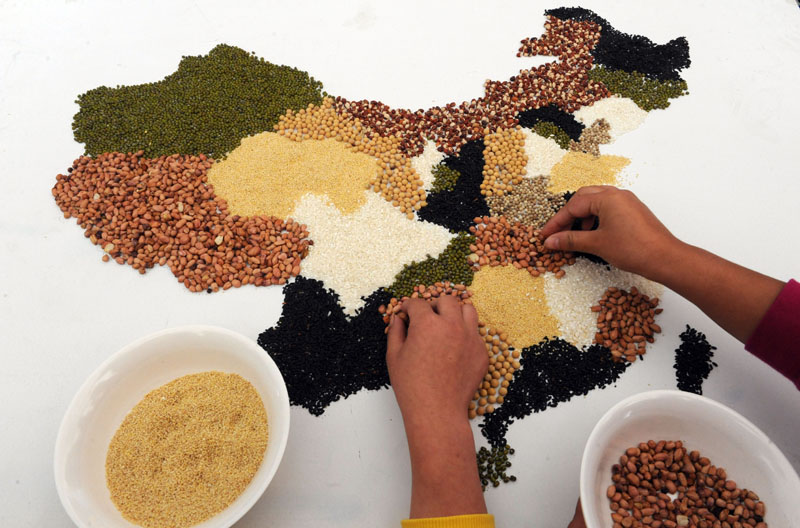
China Food Map (Photo: Zhang Yanlin/Asianewsphoto)The phase of optimization is also going to take place in food and agriculture. The situation about corn is a good indicator. Until 2012, China was self-sufficient for corn. With the increasing demand for meat as a result of economic improvement of the population, China has now become a net importer. The type of demand for the various food groups, together with the environmental toll of pursuing the objective of food self-sufficiency has reached its limits. It is important to acknowledge the performance of the Chinese agriculture, though. Even is the cost of achieving food security is high, one needs to remember that China is the world’s largest producer of rice, wheat, pork, eggs, fruit and vegetables, and cotton. It is the second largest producer of corn, behind the US. Considering the size of the country, being the main producer for all those commodities is quite an achievement. Yet China, announced last February that it was changing its objective, and that grain self-sufficiency was no longer sacred. It makes very good sense. The long term is as important as the present. China needs to work hard now to protect and restore its soils and its fresh water. On other area where the country can also achieve substantial results is by fixing post-harvest losses. Infrastructure will be developed further. Optimization of the food value chains will also take place, largely in the form of a consolidation of businesses. The seed sector will be interesting to follow in this regard, as many small seed producers will either disappear or be absorbed by larger entities. Considering the crucial role of genetics for crop yield, this rationalization of the sector should also contribute to a further improvement of the Chinese agriculture.

With land purchases abroad, world agricultural production up, international trade and a more astute food stocks strategy, China does not need to try to produce all its food itself. The bulk of the basic needs is covered. Now, it is time to optimize and repair without having to fear shortages. The focus is going to be more on waste reduction and efficiency than before. It definitely will be about doing more with less, to use a commonly used expression. An example of this tightening of standards is the so-called Green Fence for the recycling goods that China imports. Now the recycling materials need to be cleaned to enter the country. China simply does not want to use its energy and water resources. They want the waste producers to do that in their own countries. That is wise.

Another area for optimization is food safety and food quality. In a previous article , I wrote about a strategic shift towards speeding up the learning curve to meet higher standards. The shift from quantity to quality is a reflection of the pyramid of needs. When people have enough to eat, as is the case in large Chinese urban centers, they start to look at how food is produced and question what they do not like. Food security is for most no longer a worry, as the alarming rise in overweight and diabetes shows. When food security is no longer a worry, the focus shifts to food safety. That is quite normal.

My expectation is that China is no longer in the logic of just copying and producing cheap low quality. Although this reputation is still quite alive in Western countries, in my opinion it is incorrect. But after all, similar prejudices lived long about Japan, too, until the time that Americans realized that Japanese goods were of a better quality and Japanese companies were better run than their domestic counterparts. We will see the same thing about China. Some people will wake up too late. The Chinese are quite awake. Don’t worry for them.

Although the food industry, like all industries, resents criticism, it is actually the sign of a developed society. Basic standards do not satisfy anymore. People look for the something extra, and that is where opportunities arise. Those who listen to consumers and offer them what they want increase their chances of capturing the high-margin market positions. Let’s face it; markets for undifferentiated commodities are attractive mostly because of the large volumes they represent. In China, too, health and environment will be the drivers of future food supply. This will definitely offer good possibilities in the future. The Chinese will also take a look at their diet, and the per capita consumption of meat, just like economic growth, will not keep increasing forever. In the same way as it did in Western countries, it will reach a plateau, probably in 10 years from now, and later will gradually decline, for the same reasons as it is doing in the West, and also because the population of China is expected to decrease to 1.4 billion by 2050 and to 1.1 billion by 2100. That decrease represents a lot of consumers. It will be important to notice this change of trend on time. When consumption of certain food items in Western countries reached that plateau, most companies did not anticipate it. As usual in such situations, denial is the first reaction. First the change of trend is considered a temporary hiccup. Investments to increase capacity have often been made on the expectation of continuous growth, causing an overcapacity of production, and the production capacity needs to be used fully to be economically efficient. This creates a lack of flexibility and all producers enter the difficult times with the same cost profitability concerns. When the stagnation appears to last, producers like to think that indeed there will be a consolidation of the sector, but they usually all seem to think that they will weather the storm and will not be affected. Of course, it never works that way. Bad things do not happen only happen to others. Then, the crisis follows and usually a vigorous restructuring takes place. I have seen this many times and it is amazing to see how history repeats itself. There is no doubt that when food consumption will have reached its top, the same mechanism will show. This time, the problem will be quite robust, though. To supply China, production volumes will be much higher than previous similar scenarios of stagnation in the various Western regions. Further, just as much any marginal increment of consumption per capita multiplied by 1.5 billion means large volumes, any decrease of consumption will represent significant pain. This point is not here, yet. There are years of growth for most food groups ahead, but it is time to start thinking, and especially start planning, about a change of strategy. When the plateau appears, differentiation will become the main theme, and niches will be the place to be. Considering that the Chinese culture is long-term oriented and that relationships are a fundamental element of business in China, I would recommend starting paving the path for this shift sooner than later. After all, 10 years pass quite fast.

Copyright 2014 – The Happy Future Group Consulting Ltd.

Tree oils can fuel economic development by integrating different agricultural activities

Over the past few years, agriculture has been a hot center of attention and rightly so. In my line of work, I am always interested in finding new and innovative ways of growing production more efficiently, more sustainably and in a way that offers viable jobs and attractive livelihoods. Recently, I got acquainted with Mr. Sreenivas Ghatty, from India, and Dr. John Wightman, from Australia. They both are involved in the production of tree oils for the production of a renewable alternative to diesel oil. Mr. Ghatty founded Tree Oils India Ltd and owns a plantation of 3,000 oil trees. Dr. Wightman is actively promoting the development of similar projects in Australia, USA, Africa and South Asia. The story of the tree oil interested me right away for several reasons. First, it reminded me of the Sahara Forest Project that I had mentioned in Future Harvests, but with this difference that the tree oils projects are already there. Secondly, and more importantly, it is a great example of a project that can generate many economic activities, while filling an environmental and social function by calling upon a collaborative approach like what I discussed in We Will Reap What We Sow. As several projects have already reached the production stage, the gentlemen have the numbers to present a case to interested investors.

Seven year old Pongamia trees at the TOIL (Tree Oils India Ltd) R&D farm

Seven year old Pongamia trees at the TOIL (Tree Oils India Ltd) R&D farm

In India and Australia, the species farmed is Pongamia. It is an indigenous tree to India that used to provide oils for various applications, of which fuel. However, with the rise of cheap fossil fuels, its use regressed to some extent but in the second half of the 20th century, the Mumbai commodity market traded one million tonnes of Pongamia oil per year. The purpose of this production is to develop land that would otherwise have no agricultural use, because of the arid climate. Some of the current projects are aimed at using waste lands around former mines, as is already the case in some parts of Queensland in Australia. It is a way of regenerating a landscape and agricultural production by fixing carbon and producing a renewable fuel that emits less greenhouse gases than fossil fuel. Pongamia is a rustic species that is well-suited in such regions. To understand what this production can create, it is important to put it in a broader context than oil alone, and that is why I find it particularly interesting.

It takes the Pongamia tree four years to start producing its oil-rich seeds and once in production, it will keep producing at a steady level for a hundred years or more. To give an idea of the production potential, a conservative yield estimate that Mr. Ghatty and Dr. Wightman gave me was of 1,000 liters per acre of Pongamia plantation. Although the harvest is not all year-round, the seeds can easily be stored and the oil production capacity can be organized evenly all through the year to optimize the oil production capacity. The oil is suitable for diesel engines without any particular further refining. The oil provides a source of fuel to run the farms and when acreage is large enough, it could cover the needs of local communities, too. The by-products from the oil production, such as the seed cake that is of good agronomic value, can be used as a fertilizer or mulch to return to the land, and thus enrich it as production goes. They can also be used as fodder for cattle, as a complement for other feed sources.

Pigeonpea growing between rows of 3 yr old Pongamia trees on the TOIL farm

Pigeonpea growing between rows of 3 yr old Pongamia trees on the TOIL farm

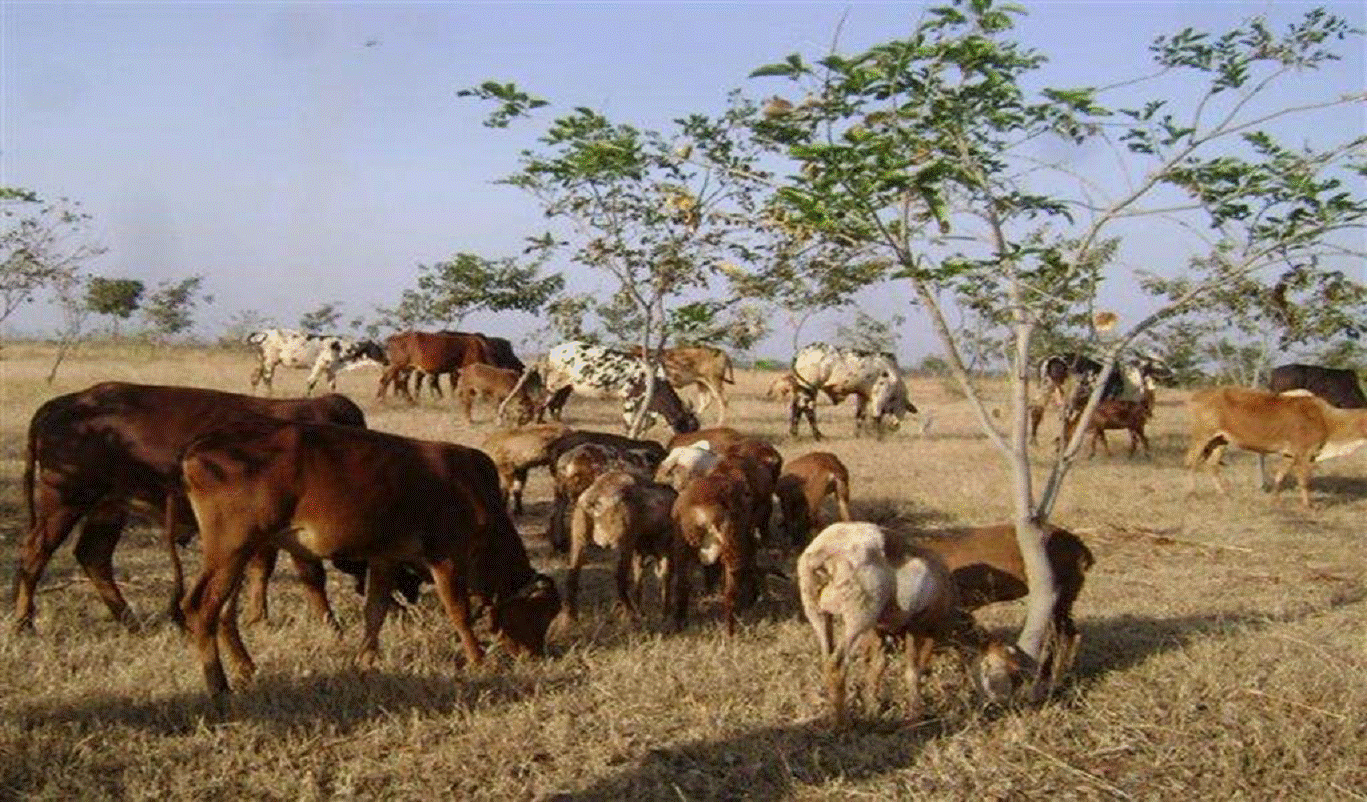
Next to storing oil in its seed, Pongamia is a tree legume, and therefore it can fix nitrogen and help enrich the soil where it grows. It also has nematicide and fungicide qualities. Pongamia production can be the basis for a multi-level and complex agricultural activity. With its agronomic qualities, Pongamia is quite suitable for an agro-forestry production system. The combination of the shade provided by the trees with soil enrichment by nitrogen fixing and seed cake fertilizer and the moisture retention that results from these new local conditions creates a suitable environment for the production of vegetal crops for food production. For instance, on the Tree Oils India Ltd farm, they grow pigeonpea between the Pongamia rows. Further development of optimal combination and rotation of crops will be enhanced as the system will enrich itself over time. It is also possible to combine the tree plantation with extensive grazing cattle. The Pongamia plantation helps the production of grass and in return the cattle fertilize the soil with manure.

Agro-forestry can be combined with extensive cattle grazing to restore soil and agriculture potential

Agro-forestry can be combined with extensive cattle grazing to restore soil and agriculture potential

The combination of the various possible productions also offers different possibilities of cooperation. Not all activities need to be done by the same farmer. There is always the possibility to offer land for use for vegetal crops or grazing. The partners can decide of which form the cooperation can work, between ownership, renting, sharing of land or of harvest or any other form that can create a harmonious cohabitation. Such different possibilities allow the integration of local rural communities to access production potential as the plantation creates the condition and the potential for both vegetal and animal productions such as meat, milk or wool. By generating different farming activities, the Pongamia production has the potential to create several agricultural value chains for all the productions involved as well as processing, storage and marketing. It can have a snowball effect beyond simply agriculture. When the local communities develop livelihoods, they also will need access to other products and services to function. The combination of all these activities allows creating sustainable production systems, as all the products and by-products can be used locally and thus, closing the loops. However, the system does not have to be a closed one. Productions can be used locally or sent to markets elsewhere, and the same is true for inputs, but integrating all the activities allows monitoring and managing the production systems in a sustainable manner. Closing loops is a key phrase in regard to such integrated production systems. In this case, the loops cover carbon, nutrients, moisture and organic matter.

Oil press used for Pongamia oil production in India (TOIL R&D project)

Oil press used for Pongamia oil production in India (TOIL R&D project)

Like many economic development projects, a leading project is necessary to create the necessary momentum upon which other activities can connect and grow along. Pongamia production has this potential but as always for such projects, the need for investment is critical in the early stages. It must start somewhere and the return is not immediate. There is always a chance to take. Because it takes several years for the Pongamia tree to enter production, the early years do not generate revenue from oil, and only the crops generate income. However after the trees start producing, income increases substantially. Over a period of ten year after planting the trees on the plantation, the return allows farmers to have a good income. Economic development requires long-term commitment from the shareholders. As many activities and also economic benefits are the objectives, all stakeholders that can benefit in the long term should also be shareholders. Success cannot be the responsibility of the plantation investor alone. When stakeholders are shareholders, they become owners of the project as well; and owners are more determined than spectators to turn a project into a success. Many jobs can be created in farming, in different activities of oil processing, logistics, trade, and in the different activities of the different value chains that can spin off from Pongamia. It is also not just a matter for businesses only, but governments also would benefit. More economic activity means more taxes down the road, as well as less need for financial support of rural communities once they can generate a solid local economy.Every project would have to adjust to the local conditions. If the projects in India and Australia are developed on mining grounds, other regions may offer different types of land for development. The available land might decide the size of the plantations and the production volumes. From there, each project will have to list the potential other activities that can be combined with the plantations, and how many jobs in which activities may be created. By reviewing the entire production potential with the socio-economic potential, it will give clarity to the different stakeholders of what their individual return would be. Then, they can determine how big a share of the project they want or how much they can contribute to the development of such integrated activities. If, for now, tree oil projects are more advanced in India and in particular in Australia, they certainly could be quite instrumental to help develop economic development in particular in arid parts of Africa. It is possible as a number of success stories with agro-forestry have already demonstrated there. This type of integrated agriculture has good potential to recreate productive vegetal landscape in former deforestation areas like for instance in Brazil.

If you wish to know more about Pongamia oil, feel free to contact Dr. John Wightman or Mr. Sreenivas Ghatty

(Photos: courtesy of Mr. Sreenivas Ghatty and Dr. John Wightman)

A couple of billion reasons why Africa is a priority for the future

More than three years ago, I had posted on this blog the list of the 16 most populated countries in the world by then. It helped put things in perspective in today’s world, but looking ahead, another table is more useful. Here is the list of the 16 most populated countries in 2050 and 2100 according to the UN.

2010

Country

Population

(millions)

% of world population

World

6,794


China

1,337

19.6

India

1,180

17.3

USA

309

4.5

Indonesia

231

3.4

Brazil

193

2.8

Pakistan

169

2.5

Bangladesh

162

2.4

Nigeria

155

2.3

Russia

142

2.1

Japan

128

1.9

Mexico

108

1.6

Philippines

92

1.4

Vietnam

86

1.3

Germany

82

1.2

Ethiopia

79

1.2

Egypt

78

1.2

Top   16

4,531

66.7

2050

Country

Population

(millions)

% of world population


      9,551


India

1,620

17.0

China

1,385

14.5

Nigeria

440

4.6

USA

401

4.2

Indonesia

321

3.4

Pakistan

271

2.8

Brazil

231

2.4

Bangladesh

202

2.1

Ethiopia

188

2.0

Philippines

157

1.6

Mexico

156

1.6

RD   Congo

155

1.6

Tanzania

129

1.4

Egypt

122

1.3

Russia

121

1.3

Japan

108

1.1

 Top   16

6,007

62.9

2100

Country

Population

(millions)

% of world population

        10,854  
India

1,547

14.3

China

1,086

10.0

Nigeria

914

8.4

USA

462

4.3

Indonesia

315

2.9

Tanzania

276

2.5

Pakistan

263

2.4

DR   Congo

262

2.4

Ethiopia

243

2.2

Uganda

205

1.9

Nigeria

204

1.9

Brazil

195

1.8

Philippines

188

1.7

Bangladesh

182

1.7

Kenya

160

1.5

Mexico

140

1.3

 Top   16

6,642

61.2

Immediately, some interesting information appears. China is already reaching a plateau and it will decline later. Most of Asia will have reached its peak of population by mid-century. India’s population is going to keep growing in the coming decades and with regards to food security, the country has still lots of work ahead. However, with the growth of its middle class, the situation should improve gradually in the future. The continent that will see the strongest population growth is Africa. Between now and the end of the century, eight countries will account to over half of the world’s population increase from currently 7.2 billion to 10.9 billion, with six of these countries being on the African continent. These eight countries are Nigeria, India, Tanzania, the Democratic Republic of Congo, Niger, Uganda, Ethiopia and the USA. It is worth noticing that the population of Nigeria will pass the population of the USA before mid-century. For a country the size of Texas, the challenge is huge, especially considering the current political instability. Other small countries such as Tanzania and Uganda are going have to cope with a very strong population increase.

The challenge for Africa is clear. Most of the countries with a strong population increase are poor countries that already have serious difficulties to feed themselves. African agriculture has not followed the pace of other regions in terms of productivity and yields. Many rural communities are poor and can hardly subsist. The flip side Africa having lagged in agricultural development is that it has huge potential to increase its food production. At the beginning of the current decade, the FAO estimated the area of unexploited arable land in Africa to be roughly the size of continental USA. By increasing acreage in production with higher yields, there is plenty of room to increase production volumes to sufficient levels. Food production is the not the only problem. To solve hunger, these countries must eliminate poverty. People who have enough money to buy food are not hungry. Only the poor are. And to have enough money, one needs a decent paying job. For the future of Africa, employment is really where the battle will be won or lost. Between now and the end of the century, Africa will have to create 600 million new jobs, and to get jobs, people need to have the proper education and training. They also need to be healthy. As the expectation is that most of the population will be living in cities, another challenging goal will be to build these urban centers and all the necessary infrastructure to move the goods and the people. Such megacities will also need to be food secure and urban planning will need to take food distribution and food production into account. Education, health care, construction, infrastructure, jobs, food and agriculture… This sounds like building an entire continent doesn’t it? And that is exactly what it is. Expect Africa to be a huge construction site! Action must be taken and properly phased out over the next nine decades. If the challenges are many, so are the opportunities and the benefits in the long term.

So what does it take to make this happen? The answer to this question is rather simple. The implementation and proper execution is less so. It will take money, and a lot of it. There is plenty of that, though. The Central bankers of developed countries did not have to think too long to start printing a couple of trillion dollars, emitting bonds and doing the quantitative easing as needed to save the financial sector when the system was imploding in 2008 and since then. Building Africa would not require more money than that. If there has ever been a need for Keynesian economics, the Africa of the coming decades is it! Not only the money pumped in the system would allow projects to happen, but it will be the basis to create the many jobs that will be required to build all that is needed. The challenge for Africans is to have and to provide the training required to qualify for the jobs come.

To rise from its current situation, the task is somehow comparable to rebuilding Europe after World War II. Both the Europeans and the Americans who provided financial help by then can tell the Africans what a great period of prosperity followed for them. Africa needs a Marshall plan of its own, but it also must convince the rest of the world that it will put the money at work. And that is where the second crucial component of success – or failure – resides: leadership. Africa needs strong visionary leadership with integrity that will not only make things happen, but also will keep the energies focused on a long-term effort. Another eighty-six years to complete it all before the end of the century will not be too many. Africa will have to bring forward a new generation of leaders that will follow a course that is quite different from the one many of their predecessors followed. Encouraging investors will require fighting corruption, starting with a leadership by example. Corruption is a theme that I hear regularly from businesses that would like to engage in Africa, but that feel reluctant to do so for that very reason. Endeavours may be risky, but they have the potential to be quite rewarding for those who will dare and have the patience to wait to reap the fruits. As for anything else anywhere else, there will be success stories and some failures, but that is the way the world goes. It will be important to factor in disappointments and a percentage of mistakes and failures to assess the true future return. One thing is sure: searching for a quick return is probably not the best strategy over there.

Africa is diverse. The challenges will vary per country and so will the quality of the leadership. I expect the political geography of Africa to change between now and 2100 (actually much earlier than that). Borders are inherited from the independence from the colonial power and they do not always reflect a good partition for the future. Sometimes this may happen peacefully and sometimes unfortunately not. Note that I never said it will be easy. Nonetheless, the continent must move forward and the countries must develop their economies.

Although it will not be simple, I am optimistic about future changes in Africa. In my limited dealings with young professionals from Africa, I can say that this new generation is highly motivated and keen to succeed. In my contacts, I have many bright, smart and well-educated young African professionals in the field of food and agriculture. I enjoy their energy and desire to change the course of the future. They have travelled and they know quite a bit about food production in other places. They push relentlessly to bring new dynamics and I do believe that they will make good things happen. But they will need all the help and support to have access to the right resources and knowledge to succeed.

For some reason, since I started the Food Futurist, I have always considered that Africa will be playing an important role in the future of food and agriculture. I have believed immediately in its potential and I have never been shy about it. This has sometimes created interesting situations such surprise or disbelief from my audiences and clients. I guess I was a little early with my predictions, but I have had the pleasure to hear some of them who looked at me as if I had a sunstroke who now advocate in favour of Africa’s food and agriculture potential. It just took them a year or two to come to the same conclusion. I guess the first part of my work has been done. Now, I really would like to be involved with organizations that want to build solid pragmatic market-oriented food production in Africa.

Copyright 2013 – The Happy Future Group Consulting Ltd.

Launching the Seeds of Leadership mentoring program

Contact with young professionals who are starting their careers is always special. They are eager to learn and have a fresh look on the world of food and agriculture. Personally, I find this particularly vivid with young people from developing countries. I truly enjoy their energy, their enthusiasm and especially how they do not take what I say at face value. I have always appreciated people who dare to challenge, who want to go to the bottom of things and who keep a critical mind.

As I also wanted to find a way of giving back just for the pleasure of it, I gradually came to the idea of creating my own modest free mentoring program.  So, there it is. I have called it “Seeds of Leadership”. It is open to anyone who has less than three years of experience from anywhere in the world. In my opinion, mentoring young professionals from the sector is an important part of helping shape the future of food and agriculture.

For more details, just go to the Seeds of Leadership page.

If you know candidates for whom this program would be useful, please send me a recommendation for him/her as described on the page mentioned above.

SoL logo

Why now may be the best time to work on the future of food and farming

Now is the right time to look forwardAlthough agricultural commodities markets have recently calmed down, the past few years have been turbulent. The result has been an increased attention for the world’s food supply and demand. Even in food secure regions, it is quite important to not take food security for granted, as it is always a work in progress. In this regard, the stress on agricultural markets and the recent price hikes have been a good thing. They have forced many to take a closer look at the situation and to start reflecting about the things to come. I have been among the ones who started earlier than most others, for two reasons. Firstly, it was obvious that meeting the demand of a strongly growing population would bring some challenges. There was no need for a crisis to figure that out. Secondly, I did not find analyses that connected the dots beyond the particular interests, the particular regions or the particular business areas of those who produced research and documents about the subject. This is why I have developed my foresight activities for food and agriculture and published the two books. The first, Future Harvests, answers the question of whether we can feed the future population and the second, We Will Reap What We Sow, reflects on how our future behavior towards consumption, together with the quality of our leadership, will decide whether the future will be prosper or gloomy. Those of you who read them know what the answers are and why.

Although the period of tensed markets helped bring valuable attention to the food issue, it has produced more quantity than quality about what should be next. Between those who announced the end of days and those who see it only as an opportunity to use fear to stop others from thinking, there has been little structural long-term thinking. Both groups play on short-term fear to push agendas that serve mostly only themselves. The future cannot be selfish; it will be about helping others succeed. Profit is only a by-product of sound decisions. Those who will foresee the actual needs of the future will make lots of it in the long term. The others, although they might score in the short term, will not win the race. In food and agriculture, foreseeing the future and defining winning strategies are complex activities. I say complex, but I do not say complicated. Ironically, the more thorough the analysis, the less complicated it comes out. When done well and communicated properly, there is no reason why others would not be willing to build a successful future. The complexity comes from the many levels involved in food security. The interactions between natural conditions with the political, economic and cultural environments, together with the many – and often divergent – interests of the players of food value chains are difficult to reconcile. But this is not all. The fact that food production systems and consumption behavior are also influenced by many other sectors competing with agriculture for resources adds to the complexity. The issue is not just about production techniques, new technologies or functioning of markets. Other societal issues play a role, too. The quality of a society and as a result of the people of which it consists will play a role. Health, education and on-going training are very important components of how we will manage the future. Each of the “blocks” I just presented are complex in themselves, simply because they deal with life and keeping the dynamics of life running harmoniously is no easy task. On top of that, the fact that these different blocks, depending on how they individually function, interact with each other and affect the performance of the others, it is clear that we need to look at the issue of feeding the world in a comprehensive manner. We need to identify and integrate all these elements in the analysis to determine the proper action to take. It would be quite convenient if future actions depended only of what directly affect a particular sector. Unfortunately, limiting the thinking to one degree of separation is not enough, by far.

In my years of the Food Futurist, I have had the opportunity to notice that the multidimensional nature of the issue is the one that seems the most difficult for most organizations to fathom. There is no shortage of reports or publications about the future of this or that. However, although they clearly are of excellent quality and the result of hard work, many of them miss the dot connecting part. They focus on the area of interest but tend to neglect the bigger picture. It is only natural that organizations look at the future from the angle of how it will affect them. Yet, nobody should investigate the future from a self-centered kind of production-driven manner. This tends to produce a self-serving strategy that will not prepare those organizations to deal with what will come from the higher degrees of separation. The here and now is nice, but to thrive, they must focus at least as much on the elsewhere and later. I must say that I also have dealt with organizations that do have this comprehensive approach. I found that they had several qualities in common with each other (and with me to some extent): serenity, a rather positive and optimistic outlook on the future, and the quiet confidence that we can overcome the challenges.

Yet, even these “better” organizations still need to go further than they have in preparing the future. Their comprehensive understanding on all the factors that will influence the future needs to go to the next level. All organizations, those with the comprehensive outlook on the future as well as those who carried out the exercise in a less deep manner must translate their understanding of the future in specific strategies and effective execution. In many cases, this is still missing. Organizations must let go of the past by not assuming that past, present and future are linked in a linear manner. That way of thinking is still dominant and, considering the magnitude and the nature of the changes to come, it will not be the best approach to be successful in the future. Another important aspect to take in consideration is to clearly identify in advance what the effect of their actions will be on the rest of us. The latter will be a prerequisite for a prosperous future. It is amazing to see that most plans have no plan B. Without a plan B, a plan is pretty much not a plan. There cannot be only one strategy. There has to be an arsenal of options. What must stand fast, though, is the final outcome. Building a strong future is also about being prepared for the unexpected and to adapt accordingly to succeed. Such an approach would also show that their future actions are taken in with responsibility in mind.

The current times of agricultural markets calming down and readjusting to more reasonable and realistic prices are, more than any other, ideal to focus on how to proceed to build the future of food and farming. As grain prices have slowed down and the animal protein sector is improving financial results, everybody is in a more serene mode. The white noise from the media and the fear mongers has faded for now. Everyone can hear him/herself think again. That is quite a good thing. However, this is no time to lay back or become complacent. Such a serene environment will not last. The population keeps on increasing. Meat and poultry producers will resume production increase as demand for their products is among the fastest growing of all foods. With grain and oilseeds prices less attractive, the incentive to push for more production will also slow down. It will not take a genius to figure out that demand for animal feed will grow faster than production of feed ingredients once again. Lately, Asians have also hoarded agricultural commodities to have stocks at hand, but as availability of commodities increases, they will get more relaxed about it. For all these reasons, agricultural prices are going to go up again, hurting animal protein producers again and sending agricultural markets up as investors and speculators will see their chance for quick money. Let’s also be sure that there will be some climatic event somewhere sometime that will also join the party to add on the stress. When the different parts of the food value chain do not plan ahead globally to ensure a balance between supply and demand, such cycles persist and crises come back. It probably will be a couple of years (my guess is three to five) before we face a similar crisis again. This is why the time to act is now by developing solid plans, engaging in the right partnerships and collaborate closely and intensely to work on the future of food and farming. I mentioned earlier that analyzing what will happen in the future and to prepare for it is complex, the exercise is actually easier than it sounds. It is only a Herculean task for those who want to solve all the world’s problems on their own. One simple trick is to see the big picture but to define what the realistic contribution of the organization to the whole problem actually can be. Another one is to ask for help and support, and thus engage others on the right path. The contribution can be products, services or collaboration. Nobody will fix the situation alone, and nobody should think in such terms. The essence is to act and make others act in the right direction. Communication towards others is quite important as it helps other organizations to determine their respective objectives. In this regard, conferences and events about the theme of the future of food and farming are quite useful. I have participated to quite a few already. Sometimes, I wish they were more focused on what it means for the partners and the audience than what it means for those organizing such events, though. It is clear that many of such events have a marketing and/or image purpose, but that too can only be a by-product. The most important is the added value to the attendants and what they can use practically in their own operations from what they heard at the events. At least, that is my philosophy and how I approach such speaking engagements. Too often, participants present their offering, such as new products for instance, but so far I have not heard anyone ask what I think is the most important question and the key to success: What do you need from me or from other partners to succeed? There are too many conferences about the future of agriculture that do not even include a farmer among the speakers! The customers are the ones who know best what they need from others to do a better job in the future. Let them speak out!

As far as I am concerned, I have now started to work on my third book, the topic of which will be about strategic foresight for food and farming. It will be about anticipating the changes that will come as well as the changes that must take place with the main purpose of presenting adequate strategies to adapt and to prosper. It will review the future evolution of the different productions, the different links of the entire food value chain from DNA to consumer. It will present strategies for and between stakeholders in the different regions of the world, as they face different challenges and conditions, with the objective of showing how it can work for all. I believe it will be a welcome follow-up to the previous two ones, which had already paved the way to show options a building a prosperous and viable future for all, here and now as well as elsewhere and later.

Copyright 2013 – The Happy Future Group Consulting Ltd.
Bright future for The Food Futurist

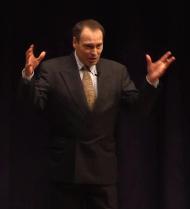
Christophe Pelletier speaking - Pic Talk03-4As another year is soon to end, it is a good time to look back and reflect on the future direction to take. Just as I repeatedly advise my clients and audiences to look forward, identify the changes to come and to adapt timely, it is a useful exercise that I carry out for my own business as well on a continuous basis. For the Food Futurist, 2013 has been a great year. The amount of business has grown strongly and the work of the past years is fully delivering its fruits. Venturing in a new area and starting from scratch has been quite the thrill, especially considering how much time it takes to get visibility, recognition and a solid reputation when the business is about mostly about what is in the owner’s brain and how that brain functions. My literature and the positive word of mouth have helped growing the business without me bothering organizations with cold calls or mailings. My clients have found me or heard about me in one way or another; and one thing leading to another, they decided to hire me for their projects and events. All assignments have run successfully with satisfied customers, all being very reputable and professional organizations.

I am quite optimistic about the further growth of The Food Futurist. The motivation now for me is to keep the strong momentum going and to grow further. As this business is growing, I am getting more “hungry”, too. I love what I do, maybe even more so than anything else I have done before; and the more business comes my way, the more fun I have and share with others. In my work, I always insist on the power of helping others succeed. Therefore, it is going my turn to ask a little bit of help from my friends to reach my goals. If my work can add value to you or to organizations or events that you know, please do not hesitate to contact me or have them do the same. I am always open to new ideas, I am quite approachable and I always reply to serious requests.

So what do I want to achieve in the next year?

  • An average of 1 to 2 speaking engagements and/or seminars a month
  • Between 3 and 5 small projects (max. 100 hours each)
  • Getting 1 or 2 large projects (around 500 hours each) in the areas of strategic foresight and strategic business development are well-manageable numbers for a whole year
  • Getting 2 or 3 positions of advisor on boards of organizations with focus on strategic foresight activities

So, all it would take is probably less than two dozen new interested contacts. Considering the number of events and projects of all sorts out there, that should be achievable.

Next to the usual topics of innovation, sustainability, leadership and market orientation, I would like to do more seminars on niche marketing, effective reconnecting of producers and consumers and, last but not least, reach the youth to get them interested in food and agriculture. In terms of sectors of activities, I would love to be more involved with animal protein producers, retailers and food service operators than I am today as, for different reasons, future changes are going particularly important for these them.

So far, my client base is in North America and Europe. I want to grow further in these two regions, but I would like to gradually expand it in other regions as well. I would like clients from other countries to be more familiar with my work and my vision of the future of food and farming. The list of the regions that I have in mind is rather long. Actually, it covers the whole world. Because of their current and future strategic importance, Australia, New Zealand, Brazil, Argentina, the Black Sea region, India, China and Arab countries are high on my wish list. But I would like to get a chance to also present how the math works with market orientation and waste reduction, and how it opens the door to huge business opportunities for Africa, India, Southeast Asia and South America in particular.

Ideally, the number of assignments outside of North America/EU that I would like per region is as follows:

  • India: at least 1
  • Russia/Ukraine/Kazakhstan: at least 1
  • Latin America: at least 1
  • South East Asia: at least 1
  • China: at least 1
  • Australia/New Zealand/Pacific: at least 1
  • Sub-Saharan Africa: at least 1
  • North Africa/Middle East: at least 1

If you are interested or if you know an organization that would be interested, please do not hesitate to contact me. To reward those who will bring me leads to assignments, I am willing to pay you a finder’s fee.

Looking forward to hearing from you or from the contacts you will send to me.

Food prices, one year later – Some lessons

According to the data gathered by the FAO, global food prices are on the decline. They have been so for some time. However, this good news does not seem to make the headlines. Reassuring news does not score with the mainstream media. What a difference with the past year during which all of a sudden they discovered that food might not be taken for granted after all! What have we not heard and read by then. The most absurd theories and pseudo-analyses have been spread around by some who know nothing better than copying and pasting the internet without exercizing the slightest sense of critical thinking. Of course, the fear mongers got plenty of publicity while they really did not contribute to anything productive, as I had described in a previous article (Fear mongering does not build a strong future).

What a difference a year makes! And that is a very good thing. It shows that agriculture and farmers are much more resilient and have much greater potential than some want to make believe. That confirms what I have always claimed and that I relentlessly repeat in my presentations and publications. I have lost the count of how many times I have been told that “Christophe, you are quite the optimist”, in particular about the content of Future Harvests. Frankly, I do not think that I am particularly optimistic. Actually, I can see many reasons why we will face serious crises along the way to meeting the goals of feeding a growing population. That warning is the message behind We Will Reap What We Sow. I see human nature and in particular our leadership, as serious reasons for temporary failures. But if I do not consider myself as an optimist, I definitely have a positive attitude. I truly believe we can manage and overcome future challenges, because I crunched the numbers and I have demonstrated in my literature and my talks that feeding 9 billion people in a sustainable manner is quite possible. It is possible, but it is not a given. There is work ahead. That makes it interesting and exciting.

Next to the potential and the future development that can make us overcome the coming challenges, I am also a firm believer of market forces. Market fluctuations trigger action and reaction. Nothing like high prices and solid profits get food producers increase production. Similarly, nothing like poor financial results have the ability to tamper any desire to increase production. The so-called invisible hand works. Sometimes, it holds a carrot. Sometimes, it holds a stick. It makes things move in the right direction. Over the past year, I have presented during a number of events how market forces would influence prices in different sectors in the years to come. By looking at it from the consumer demand end and by going back in the production and supply chain, I showed how the different actors would react to their own particular situations. So far, my predictions have come true, the reactions of retailers, food service, animal protein producers, crop farmers and input suppliers have been as expected. The drop in global food prices is one of these predictions. Those who attended some of my presentations know what I mean. For the others, here is a link to a video showing an excerpt my talk about the dynamics of future agricultural markets that will illustrate what I am writing about.

The past year contains many lessons. Some of them are about us, and some of them are about how to look at the future. The main lesson is probably that the situation of food and agriculture cannot be looked at in a simplistic manner and can certainly not be described or commented with scary slogans. The population is growing but so is agricultural production. The famine that is supposedly around the corner is far from happening. In a year time, the world population has increased by a few dozen million people, who on average tend to eat more food, and in particular meat. Yet, supply is able to meet demand better this year than last year, as global food prices and grain stocks indicate. Another lesson is that even though severe climatic events affect food supply negatively, there is no reason to panic. The fact that last year a severe drought depleted production numbers in one of the essential producing countries, the USA, the system was able to absorb the shock. There has been no food riot in 2012 like in 2008. The reason needs to be looked at what products were the most affected.  Supply of basic food stables remained in balance with demand. There was no particular shortage of bread or rice in sight. The commodities that were affected were business to business products, destined to the animal feed and the corn ethanol industries. Another lesson is that even though the prices of 2012 did not lead to riots, climatic events are a serious threat and need to be factored in future supply and demand scenarios to build enough of a buffer to reduce the risks of supply disruption. Another area that requires more attention is the regulation of financial markets, and in particular the regulatory aspects. It is clear that derivatives amplify market price fluctuations. By deciding who is allowed to be active on the markets of agricultural commodities and for which quantities, the functioning of markets can be more representative of the physical reality. In particular, the participation of players who have no physical production or supply functions in the food and agriculture need to be taken under strict scrutiny. As it is important to have fair market rules for a proper functioning of markets, it will be also useful to look at the functioning of crop insurance. Last year’s drought in the US cost insurance companies much money, while it appeared that US crop farmers ended up the season with the second highest profit level on record. No one will argue that farmers need to be protected from such unpredictable events.  Insurance should guarantee them a minimum income so that their future would not depend from forces out of their control. That is just fair. Opposite to that, it sounds beyond normal that, thanks to other contributors, farmers could go through such a drought without hardly feeling the slightest pinch in the wallet.

After the past year, am I still an “optimist”? Yes, I do believe that farmers will meet demand in the future. For all the reasons above, I am convinced as ever that the potential is largely there and that the world can absorb tough years. But I would attach a warning to my optimism. It is not because it can be done that it will be done. It is necessary to keep thinking ahead, to come with innovative ideas, products and services to be able to plan and forecast better, to make better and faster decisions. It is also essential to pass knowledge and information better and faster, and to choose the attitude of helping others succeed before one’s particular interest. Our societies have succeeded by acting together. Nobody will be able to do it all alone. Providing help and support will be critical for success, just as much as asking for them will be. It also becomes crucial to be able to look beyond one’s area of business and to connect the dots even – or maybe actually in particular – with events and activities that have, at least apparently, several degrees of separation with agriculture in order to anticipate, adapt and be prosperous. That is the core of what I do, and I can only encourage you to take the same approach.

As markets ease, it will be quite tempting to drop the guard. In my opinion, this would be a serious mistake. The time things seem to be under control is the right time to prepare for the future and to do some foresight. Markets will change again as the bargaining power of the different links of the chain will shift. Be assured that there will be some severe price hikes again. My best guess is within five years from now. Those who will do this exercise will have a strong advantage over those who will procrastinate.

Copyright 2013 – The Happy Future Group Consulting Ltd.

Beyond the merger Shuanghui-Smithfield

Last May, when the Chinese company Shuanghui announced it was buying Smithfield Foods, the world’s largest pork producer, I was very curious to read about reactions to the news, in particular from the US. The takeover did not surprise me. In my second book, We Will Reap What We Sow, I already told my expectation that the geography of corporations would change, following the shift of economic power around the world. I predicted that the new emerging powers would take over some of today’s agribusiness beacons, and hinted that eventually, headquarters of large corporations would also move to locations closer to the bulk of consumption. The Smithfield takeover quite fits in this scenario. My interest in the reaction of Americans came from some of my earlier speaking engagements. At the beginning of my activities with The Food Futurist, I presented in several occasions how the rise of the Asian middle class would affect markets. In particular the magnitude of the Chinese market always put things in perspective. When I showed my audiences how much volume an increase of 10 kg per capita per year of beef, pork and chicken would represent, there was usually a silence of surprise. Then, when I told that the evolution is not just about volume but also about the choice of cuts, that instead of being complementary to Western consumption by buying low quality cuts, the Chinese market would become a direct competitor for the same pieces of meat, the surprise usually turned into annoyed denial. The price of the meat that Americans would buy would be set by the consumers in Beijing and Shanghai at least as much as by those in New York or Los Angeles? That’s bold, isn’t it? I could understand the reactions. After all, the coming situation would mean the end of the undisputed dominance of American stomachs (and to some extent, their minds as well). The highest bidder will get the best product. It is not just a hunch about the future. It is the here and now. There are already examples of that in the seafood sector, where the top quality products are shipped to China instead of ending on French tables as it used to be, simply because the Chinese buyers are willing to pay more than the French to get the product, probably because they still make very good money at those prices.

However, many reactions from the US have been the ones I expected. I could find outrage at the idea that a Chinese company could dare buy an American one. I do not remember seeing such opposition when Brazilian meat companies would buy Western ones, but after all Brazil is not perceived (yet) as a contender to the US supremacy as China is. That would explain the double standards, I suppose. There were the extreme reactions such as those who decided and claimed they would not eat meat from Smithfield because, according to their simplistic conclusions, their pork would sink to the quality standard of what they think Chinese products are. Well, no… because applicable food standards in the US would still be those of the USDA and not from the Chinese government. How simplistic they may sound, such reactions are not from average Joe. They come from comments posted on professional meat magazines for which readers need to subscribe. The world is changing, but some still hope the old status quo will prevail. Good luck with that!

Yes, there will be competition for the attractive cuts of meat. Actually, it will shape the coming couple of decades of global agriculture, and of agricultural markets. Prices will depend on the ability to forecast and align production and consumption of animal products with commodities for animal feed. There is much work needed in that area. Those who attended my presentations in which I mention the dynamics of future markets know what I mean.

But there are more lessons from the Shuanghui-Smithfield merger, beyond the simple competition for the carcases and the geography of purchasing power. It sends a clear signal that the Chinese market is evolving towards more quality. The local suppliers want to be able to provide the market of the increasing affluent Asian middle class with the same standards as Western markets, which I have been also indicating as a growing trend both in my writings as in my presentations. Purchasing a company such as Smithfield offers Shuanghui the possibility to speed up the learning curve towards a better pork quality by also buying the processes and procedures that already exist in the production units in North America and Europe. Such a move is going to have interesting ripple effects. Normally, it should give Shuanghui a competitive advantage, as they should learn and implement better procedures faster and better than their Chinese competitors. This will give them a strong position in the urban centers, at least in the short term. In the long term, the side effect is that their competitors will also work harder at raising their own standards and improve food quality in China. This will also indirectly serve the Chinese governments by having market forces working in the same direction as government regulations to achieve better food standards. Finally, it will benefit the Chinese consumers, as they will be able to buy better quality foods. As they became wealthier, Chinese consumers have also become more critical and aware of environmental and food safety issues. They will not accept the current situation anymore and they want the same top quality as the Westerners. After all, the income in large Chinese urban center is quite similar to the one of Westerners. Why should they settle for less? And in the future, we will see the same trend growing in other emerging countries. That is where the best opportunities will arise in the coming decades.

Copyright 2013 – The Happy Future Group Consulting Ltd.

Adapting our thinking to the future – part 2

At the end of part 1 of this article, I had mentioned how our elders used to make progress by blending the modern with the traditional. It is quite important to keep this way of looking at our life environment quite alive. How we evolved to where we are today determines very much why we have the current possibilities available. They are the direct result of our history. Whether we like it or not, our future has its roots in our past. The art is to improve what we have, and to improve, we need to learn from the mistakes of the past. Rejecting solutions for the simple reason that they are old-fashioned or not based on science is really excluding diversity, while diversity is the fuel of progress. Reducing diversity comes down to reducing options to move forward. As someone who looks toward the future and tries to find out what is likely to come as well as what is desirable to create, I find this balance between past and future especially interesting. I often am surprised to see how many people are actually busy reinventing the wheel, while they think that they are busy innovating. Many projects and research that I see taking place have actually already been carried out in some way either in another place or in another industry. I regularly have to tell some of my contacts about similar projects that took place years and sometimes even decades ago. This is why I always insist on the need to be curious. For the future, curiosity is an asset. I could never urge anyone enough to have an open mind for anything that happens anywhere and in any industry. Maybe, I am doing some sort of transfer about this and I wished others would be as curious and eager to learn as I am, but this is so helpful to foresee the changes to come, that anyone who is interested in the future should be wired like that. Unfortunately, I find most people to not be really curious. They seem to be interested in what will serve them directly in the short term, but much less for what may serve others now but also in the future. Until someone can tell me that it is better to limit one’s perception and understanding of the world and of its possibilities, I will keep being curious and open-minded.

People really need to expand their horizons. Not only is it useful to be prepared for the future, the main reason is that it is incredibly fun to learn to know new things and new people. For the sake of humanity, it is time to open up towards others. The attitude of future business will not be about pushing new products and services to others, but to have a “what can I do for you “ and “how can I help you” mindset. The business of the future is the one that delivers solutions. In the future, successful products will be at least as much about the service included as it is about the actual physical product. This is what circular thinking will deliver. In a future where others are really what matters the most, the social perception will also change. “Old boys clubs” (which are nowadays just as much girls clubs) and other clans are not really the most dynamic organizations. There is no doubt that they are incredibly comfortable, because they are basically made out of clones. Everyone thinks the same, shares the same values, comes from the same university or social group, lives in the same country or region, has the same feeling of importance, and looks to the outsiders just as such: outsiders. There is a lack of diversity; therefore there is a lack of progress. A new interesting development that, to me, shows the quality of networks has appeared recently on LinkedIn. They visualize how much of your network belong to which organizations. I recently have seen some of the apparently very social individuals that have close to 40% of their network linked to only one company, and the second organization in his network only 1%. To me, that does not spell open network. And I thought that the main organization in my LinkedIn network was already high at 5%. Personally, I prefer by far those who have a balanced distribution of their networks. The chances are much higher that people who have a more balanced distribution of their networks have been exposed to more diversified experiences, and are likely to be more open and more flexible to different or challenging ideas. For a successful future, we must not think in terms of networks, but we all should be interconnected in the same one that would be the complete integration and interaction of all the ones that exist. My customers have demonstrated this to me. About all of my business has come from my being on the web with this blog and my books. They caught my customers’ attention who decided to get in contact with me. None of them knew me personally beforehand. The result has been business. Actually, I have not prospected once for the Food Futurist services. I just found a way of being visible beyond any limitation of network boundaries. The Food Futurist has become part of that global web.

One of the main differences between nowadays and yesterday lies in how intricate our world has become. In the past, things used to be more compartmented. Today, the whole world has opened. Knowledge travels fast and is accessible from almost anywhere on the planet. The level of interaction between industries and technologies is much higher now than it used to be. Most innovation that will help progress in food and agriculture in the future will not originate from the food and agriculture community, but from many different fields such as robotics, nanotechnologies, telecommunications, software development or medicine, just to give a few examples. Although technology will definitely play a major role in improving what we do, it will be important to not see technology as a panacea with dictatorial tendencies. I always underline the importance of the balance that we must maintain between technology and steering human nature for the best. In the end, technology is only as good and useful as the way we use and master it. Just take the example of gun powder. When the Chinese started to use it, they made fireworks for entertainment purposes. The “white man” chose to use it to kill others. Clearly, a similar technology used with different philosophies of life will serve different purposes. This is still true with today’s technology and it will be true with tomorrow’s. It will depend on the leadership. Technology needs to pass the test of morals and ethics, unless we accept that it might serve to be used against us. Technology and leadership go together, just like science and philosophy do. It is important to not forget it. If curiosity is an asset for the future, clearly, so is having a critical mind for the reasons just presented. It is essential to keep control on what we do and that we address concerns. Of course, this may delay some valuable financial objectives for some, but the quality of the future will depend on us doing the right things. The debate that results from critical thinking may be time-consuming, but open debate is an integral part of the democratic process. Open debates protect us from going back to dark ages. Looking back how what such ages have caused in human history, and unfortunately still do in some parts of the world, the need to learn from the past is clearly essential for a prosperous future.

Thinking ahead like a chess playerOther advantages of critical thinking are that it stimulates reflection and is a source of ideas. It is also important to make clear that critical thinking is not about criticizing but about questioning. Sterile boring criticism is just as useless for our future as not thinking at all. Let’s face it, critical thinking is not easy. It requires emotional distance. It is about accepting that what we may have believed appears to be wrong, or that they are better ways and beliefs. To be a good critical thinker, one needs to have enough confidence to overcome disappointment and to accept to change the course. Not that many people are willing to deal with such challenges. Yet, if we want to prepare for a prosperous future, we will have to accept that exercise, because, the future will be quite different, and in particular our interaction with our environment and the world will change and evolve further. Critical thinking actually requires a rather Zen mindset. One needs to have the calm and openness to observe and listen before speaking. One needs to accept being wrong as the debate that arises from the exercise will also show the value of other people’s points of views. Critical thinking is an exercise in humility. Humility is a highly valuable, yet often neglected quality. Yet, it is essential to be humble when thinking about the future. The challenges are quite serious and dealing with natural forces that may or may not be about to unleash upon us will not be an easy task. We will need to understand our relationship with Nature and accept the idea that, in spite of all our cool technologies, we are vulnerable and mortal. One of the arts of future thinking will be about pushing the system while knowing where the limits are that we must not transgress. That is what sustainability really is about. We really do not want to open Mother Nature’ Pandora’s Box. To be equipped properly to face the future, we need leaders that will think like chess players. We need leaders in all areas of society that can understand how the consequences of their decisions and of their vision will trickle down through the system. They must be able to foresee what may happen when they make their moves. Many already hardly can foresee what comes next. Those we need are the ones who can visualize what happens two, three, four and more degrees ahead, so that they can adjust their choices and already develop alternatives before troubles arise. A good plan A always includes a plan B, and preferably even a plan C. Plans that lack alternatives are not plans, they are merely wish lists.

Copyright 2013 – The Happy Future Group Consulting Ltd.

Adapting our thinking to the future – part 1

Everybody will agree that the coming decades are presenting many new challenges. Never before have we faced such a population growth and demand for about everything, food and water being the most essential. The difference between success and failure will reside mostly in our attitude towards change and our willingness to adapt to a different new situation. For obvious reasons, the economic model of mass consumption and resources depletion that generates a mindboggling amount of waste is coming to an end one way or another. A new system needs to come and will come. Whether it will be the easy way or the hard way really depends on us all and in particular on our leaders. I like to tell that our future will be only as bright as our leaders. It is a bit of a joke, but not quite.

The circular will look linear when approached from the right angle

What does need to change in our thinking and attitude, then? In a finite world, we must understand that always more is not sustainable. This is especially true when several billion people are thinking of having the same consumption lifestyle as developed countries have had over the past 60 years or so. The pie is not big enough to allow that kind of party (and neither is the bakery that must produce the pie). This is where we seem to be stuck in our thinking. We have learnt to think linear in the past several decades. It can go only in one direction, and it has to be up, doesn’t it? God forbid of anything going down. In the field of farming when I hear the linear argument, I like to mention two things. The first one is that if farming stats must go linear, there should not be any farm left in developed countries in the not so distant future, and the same should happen in developing countries, too, just a bit later. No farm means no food. Apparently, that does not seem acceptable. There goes a crack in the linear thinking. My second argument against thinking blindly linear is that in biology and in population dynamics, there are no linear functions. All curves are curbed in some way. There are bell curves, sigmoid curves, exponential and logarithmic curves, just to name a few. None of them are linear. If we want to plan our relation with our environment in a prosperous manner, we need to leave the linear thinking and start thinking curbed, and the curve that fits the ability to renew indefinitely our access to essential resources best is the circle. Circular thinking is the never-ending linear. That is just as much of a thinking revolution as moving away from the concept of a flat earth to embrace the idea of a spherical one, or to fathom the curbed space. Shifting from linear thinking to circular thinking simply means a shift in thinking from always more to always enough. All it means is that we need to change our ways, but it certainly does not mean the end of the world. It would only mean the end of a world. With a growing population, circular thinking actually presents a lot of business opportunities, especially considering that the alternative is going nowhere eventually. There is no doubt that those who will catch these opportunities will be the winners of tomorrow.

Such a change in thinking also results in rethinking the meaning of growth. Currently, growth, and the GDP as its favorite indicator, means mostly volume and consumption. Actually consumption is probably not the correct world to describe our societies. Buying is a more correct one. Producers want consumers to buy. Consuming in this process is really optional. What counts is the act of purchasing over and over again. We think of growth as quantitative growth. Future growth will have to be a qualitative growth. With so many new people who will need employment in the decades to come, it will be crucial that future growth will have to fill a positive social role. Similarly, to have a livable planet, the future will have to contribute positively to maintaining a healthy environment. Social and environmental responsibility will become the standard. There is no escaping this. Well, that is with the angle of building a prosperous future. If not, chaos is always a possibility.

One of the most visible consequences of a growth model based essentially on quantity and mass purchasing is waste. As consumption goods became cheaper credit became easier and disposable income increased, consuming has become about buying and throwing away. The mountains of garbage in landfills around the world should be a reminder, although we seem to have located them far away from the eyes of the wealthy and in the backyard of the poor. Quite convenient. This way, consumers could forget about the consequences of their actions… and keep on buying and throwing away. Although this happens for all consumer goods, this is especially immoral when it comes to food in a world where about a billion people do not have enough to eat. It is immoral, simply because food means the difference between life and death, and wasting food is indirectly contributing to the death of others. It is also immoral because food waste is also the waste of all the inputs used for the production of food, be it water, energy or money. Waste is an indicator of the level of efficiency. Highly efficient systems generate little or no waste. Inefficient systems generate a lot of it. I will let you judge how efficient you think we are. Waste is also an indicator of our attitude. It is not just about morals, but also about discipline. Our societies waste a lot, because we still are much too lenient with ourselves, and also because in many cases the financial incentives to do the right thing are sadly lacking. We choose the path of least resistance.

As life became easier in a number of countries, people have started to lose some essential reflexes for survival. It is not necessary to go all that much back in time to see the change. My parents, grandparents and ancestors grew up in times that were not of plenty, simply because there was no consumption society, and incidentally there was the occasional war. People would not waste anything not so much out of morals, but because they simply could not afford it. Yes, mass wasting is the fruit of luxury. My elders would not waste and they were very skilled at circular thinking. They knew that nothing is created or lost, but that everything is transformed. As resources were not plenty, the right answer was to show plenty of resourcefulness. This is how things were by then.

To take the example of food waste, they would make sure that leftovers would be on the table the next day. They would most certainly not end up in the garbage. They would feed the pigs with what they could not eat themselves. Actually, they were turning low value products such as potato peels in high value protein in the form of pork. When I was in the agricultural university, my animal nutrition teacher once told a joke that I have never forgotten, especially considering that I have spent a substantial part of my professional life in animal production. He told us that modern animal husbandry was the art of turning high value protein into cheap fat. Not quite untrue, and so much the contrast with the pork made out of table scraps. This contrast is very much present in the ongoing debate about meat production systems.

We can find many answers for the future by looking at the past. In our current times of science-based facts obsession, many seem to look down at words such as experience, wisdom and philosophy. This is not wise. Our elders might not have known all the scientific background of what they were doing, but they knew what was best for them to survive. They knew how to manage a finite world of finite resources to sustain themselves. Passing on that knowledge, experience and wisdom was an essential part of survival. There was no conflict between modernity and that knowledge, experience and wisdom. They integrated the new and the old to build a better world. Although, there is still a lot of work to eradicate poverty, let’s not forget that the result has been the emergence of prosperous societies in which a record number of people are living now.

(Part 2 of this topic will be published soon)

Copyright 2013 – The Happy Future Group Consulting Ltd.