The locavore’s dilemma

There is a growing trend, or at least a growing noise in favour of eating locally produced food. The “locavores” as they are called, claim that 100-mile food is the way to a more sustainable agriculture and consumption. Is this approach realistic and could it be the model for the future?

This movement is rather popular here in Vancouver, British Columbia. The laid-back residents who support the local food paradigm certainly love their cup of coffee and their beer. Wait a minute! There is no coffee plantation anywhere around here. There is not much barley produced around Vancouver, either. Life should be possible without these two beverages, should not it? The disappearance of coffee –and tea- from our households will make the lack of sugar beets less painful. This is good because sugar beets are not produced in the region. At least, there is no shortage of water.

But this is not all. There is no cocoa plantation around here, and believe me, there are many people who are addicted to chocolate. British Columbia does not produce citrus or other warm climate fruit. If we are to become locavores, we must say goodbye to orange juice, to lemons, to bananas. Even the so popular sushi must disappear because of the lack of rice. There are no rice fields in this area, and neither are there wheat fields. The Asian population certainly would have a hard time eliminating rice from their diet. The lack of wheat means no flour; and no flour means no bread, no pastries, and no cookies. The carbohydrate supply is going to be tough. If we must consume local, our lifestyle is going to change dramatically. Potatoes and cabbage is the way of the future. But before going all local food, the local locavores must realize that British Columbia produces only 48% of all the food its inhabitants consume. One out of two locavores would have to starve. Going exclusively local would also affect deeply the source of animal protein. Most of the animal feed is made of ingredients that come for much farther than 100 miles. The chickens and eggs would become less available. Farmed salmon, BC’s largest agricultural export could not use the type of feed they currently use, as fishmeal and fish oil come from Peru and vegetal oil comes from farms located far away. There would go many jobs with very little alternatives. If we look beyond food, other agricultural products such as cotton and wool would not be an option anymore. Cars would disappear, because the main component of tires, rubber, is not produced under this climate. The 100-mile rule will solve traffic problems. If local consumption is the rule for food, should not it be the rule for everything as well? China would probably have different views about this. Not only would their manufacturing collapse, but also if they have to produce food within 100 miles of the consumer, they would have to give up importing agricultural commodities. For them, a true locavore system would mean famine. The same would be true here in British Columbia. When people are hungry, they are not so picky about the distance from the producing farm.

The problem with concepts such as local consumption is that the basic idea has some value, but the idea quickly evolves into an ideology, and ideologies tend to make their followers stop thinking pragmatically. Today, the idea of eating locally in a place like Vancouver is possible because supply easily meets demand, thanks to the 3,000-mile foods. This is ironical. If the distance to market has to be within 100 miles, farmers in low population density areas, such as many regions of North America, South America and Central Europe, would have a different type of problem. They would produce an abundance of food, but because there are not enough people to consume it locally, the law of supply and demand tells us that the price of agricultural commodities would plummet, food would stay in storage and farmers would go out of business, while people in China, and in British Columbia, would suffer hunger. Clearly, the 100-mile diet needs some amendments.

Intuitively, it sounds logical that locally produced food has a lower carbon footprint than food that comes from 2,000 to 10,000 miles away. However, this is only partly true. The mean of transportation affects the carbon footprint. The environmental impact of transport is much higher for road transport than it is for rail transport, which is also higher than water transport. The type of transport also depends on the type of commodity brought to market. Perishables need to reach consumers as quickly as possible for shelf life reasons, while dry goods, such as for instance grains and oilseeds do not face the same kind of deadline. The quality of the logistics is also crucial to reduce the carbon footprint. A fully loaded truck is much more efficient than a local truck dropping small quantities in many places, thus driving around most of the time with empty space in the trailer.

The emphasis should not be so much on local as it should be about the search for efficient and low environmental impact. More than the distance from the farm to the consumer, it would be more useful to provide consumers with information about the actual carbon footprint of the products they buy. They would have the possibility to make the right choices. Retailers, too, would be able to make decisions about their sourcing strategies. Clean products and clean producers need to be rewarded for doing a good job. Here in Vancouver, local food products are more expensive than similar offerings from California, Mexico, Ecuador or Chile. How do you convince families with a tight budget to spend more for local products that look pretty much the same? This problem needs to be addressed. Currently, farmers markets are much about marketing. They sell the experience as much as their production methods. Only a wealthy minority can afford to buy on these markets. The prices are not based on production costs plus farmers income. They are as high as possible, because the farmers can ask these prices. The wealthy city dwellers are willing to pay a substantial premium above what they can buy from the local supermarket. In this relation farmer-consumer, the price bargaining does not take place. If these farmers were to try to sell to a grocery retail chain, they would never get the prices they get from the consumers who will not haggle about the price. This is why more farmers try to sell directly to consumers: they make more money that way. However, this might change in the future. A number of retailers are working towards offering “farmers market” products into their store. This already makes market farmers nervous.

Is local production for local markets the way of the future? My answer is that it partly will be and it partly will not. I do expect a shift of the location of production for perishables. Consumer habits will change, too. In the West, consumers have been spoiled. They can eat anything from anywhere at any time of the year. This luxury probably will not be affordable for long anymore. The superfluous will naturally be eliminated.

As the economics of energy, and therefore of food, will change, producers will increasingly locate their operations closer to cities; and even inside cities. Urban farming is a growing activity. Although it started mostly in poor neighbourhoods as a way of having a small patch of land for personal consumption, more sophisticated and efficient systems are being developed. My expectation is that production, and consumption, of vegetables and fragile fruit (for instance strawberries) will gradually become more integrated in the urban landscape than they are now. I also think that we will see animal productions, such as fresh dairy, poultry meat and eggs relocate closer to consumer markets. An interesting development is aquaponics, the combination of greenhouse produce with fish production in tanks. The production of non-perishables will not relocate. It does not have to. What will probably change is the transportation infrastructure in many areas where these commodities are produced.  This is good news for coffee drinkers and chocolate addicts. After all, transport of commodities over long distance is not just the result of cheap oil. The Silk Road and the spice trade by the Dutch took place before mankind even knew about oil. Trade has always been a force of progress for humanity. It helps an increasing number of people to have access to goods that make their lives better. The rules of trade may not always be fair, but like all human activities, it is a work in progress. Limiting our food supply to 100 miles would be a regression. Subsistence agriculture has not demonstrated that it could feed the world. Most of the people suffering of hunger live in subsistence agriculture areas.

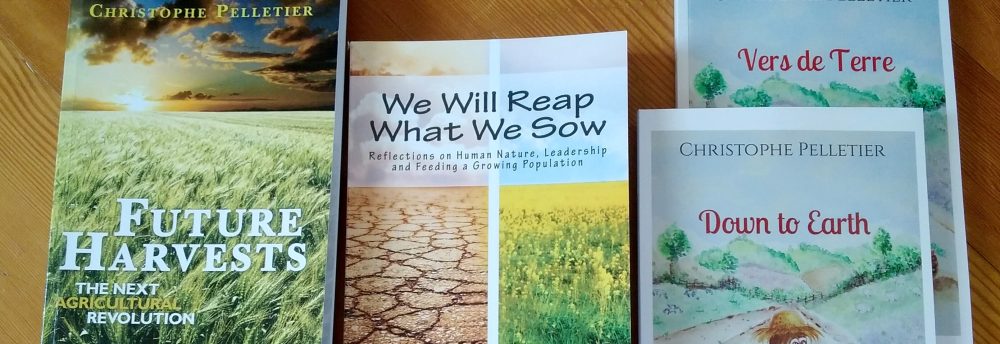
(This topic is one of the many that are presented and discussed in my second book, We Will reap What We Sow)

For more on similar topics, please visit my other website The Sensible Gourmet

Copyright 2010 – The Happy Future Group Consulting Ltd.

Helping farmers produce better

Meeting food demand depends for a large part on the ability of farmers to produce adequate quantities of the food products of the right quality. To achieve such an objective, farmers depend on their business partners. To feed an increasing world population, helping farmers succeed is not an option; it is a necessity.

There is no argument against producing better. A market-driven and more efficient production reduces the amount of waste, and it increases the amount of food available for consumers. It reduces the impact on the environment and it actually reduces the cost of production. However, it is important to realize that actions to produce better often are investments, as the effect is not always immediate.

From a value chain point of view, efficient production starts with high-quality ingredients. If the world wants farmers to produce higher volumes, they must have access to good genetics. Seeds that have the potential to deliver high yields, or farm animals that can produce and grow fast, while using feed and water efficiently, are an absolute necessity. Genetics and agriculture must also take genetic diversity and sustainability into account, but with poor genetics, farmers will not be able to meet food demand, and they will not be financially viable for the long-term. Vision and proper strategy are the elements to deal with this dilemma.

Farming inputs, such fertilizers, pesticides, herbicides and animal feed, must help plants, and farm animals, to express as much of their genetic potential as possible. Suppliers can play a very important role in helping farmers use the proper products in the right amounts, in the right place, and at the right time. The same principle applies for food processors and distributors. It is their role to help farmers deliver what the market needs when it needs it. They must encourage this by rewarding financially the farmers who do things right. This is in the interest of all the parties involved. Farmers make more money with their products. Processors get products that are more efficient to process, thus saving on costs. Distributors gain market share because they offer the right product to their customers, thus increasing customer satisfaction, appeal and loyalty. The advantage of doing things right is that it becomes more difficult for business partners to switch to a competitor. By being the best partner in business, the need for complicated contractual and legal agreements becomes a little less relevant. It is about loyalty and mutual security.

To achieve this kind of ideal situation requires a lot of effort, commitment and communication. Market needs must be translated in clear product specifications. The knowledge on how to be able to meet the required standards needs the proper channels to be transferred to farmers. Access to information has become much easier with the development of communication tools such as Internet and cell phones. Smart phones are helping further, and now farmers, anywhere in the world, have much faster access to market and technical information than by the past. This helps them make faster and better decisions. However, better technologies and better communication tools are not enough. Extension services are crucial. In my book, Future Harvests, several examples show how positive this is for food production. One is the policy of the Ugandan government that resulted in a boom in rice production, making the country a net exporter of rice. The second example is about the extension services of a food corporation, McCain Foods, in India, that helped farmers produce a better quality of potatoes, meeting market requirements, and earning substantially more this way. Another illustration of the positive effect of knowledge transfer is about the farming leader in Burkina Faso who helped increase food production with simple techniques, and stopped the exodus of population. Proper education and on-going training is part of the food production of the future. The human factor in knowledge transfer is as important as ever. Only people can know what the specific situation of a farmer is. Knowing the farmer is the best way to help them set up plans and strategies to improve their technical and financial performance. A farmer being independent business owners, their main concern is to generate enough revenue to stay in business, and to offer a decent standard of living and a secure future for their families. Helping them in these objectives is the way to get their attention and loyalty. Extension services need to offer the most effective solutions by taking into account the level of skills of the farmers, as well as their financial situation. Some farmers can afford and use high-tech solutions easily. Others may have money, but lack the skills to use certain techniques or technologies. Others may be technically savvy, but may lack the money. Extension service people are the ones who can help farmers make the best choices. They also must assist farmers to get the proper financing if this is the limiting factor, for as long as the money would used to deliver the proper return.

As Cicero stated, “The sinews of war are… endless money”. This tends to be overlooked by many who talk about increasing food production. If farmers do not have access to enough money to be able to produce the food the world needs, they simply will not. Developing agriculture requires serious investments, either from individuals or from governments. Asian and Arab countries know this and this is why they spent massive amounts of money in African and Asian countries, and even in Brazil and Argentina. If farmers cannot buy the basics to produce efficiently, they will have poor harvests. If farmers cannot be profitable, they will stop farming. This is important to realize that being a farmer must be attractive financially, too, if we want to motivate the next generation to be in agriculture. Money is important, but just for food production, more is not necessarily better. To get good results, we must ensure to have the right amount of money at the right time at the right place for the right purpose. The money must be aimed at producing for the market. Financing agriculture is about meeting food demand, not to produce blindly. Just like there is a need for efficient market-driven precision agriculture, the future of agriculture financing must evolve to efficient food-market-driven precision financing.

Copyright 2010 – The Happy Future Group Consulting Ltd.

Swimming in circles

If there is a never-ending feud in the food industry, the one here in British Columbia (BC) about farmed salmon certainly should be put on top of the list. The fight between salmon farmers and environmentalists has been going on for as long as the industry has been around, and it looks as if it will keep lasting for a long time to come.
In previous articles, I have addressed some of my views about the poor perception of some areas of food production and the inability of the industry to connect. The BC salmon industry certainly seems to have difficulties to fight this battle.

I still do not quite understand why they have such a hard time. On the other hand, maybe I just do know too well why.

The controversy is much fiercer in BC than it is in other farmed salmon producing countries. Perhaps, this is because BC farms salmon in the only region where wild salmon is still quite abundant, and this region of the world is still a direct interface between wilderness and human activity.

Opponents of salmon farming came out last week with “superheroes” who were going to put things right of course. Here is their website. Clearly, some people have a lot of imagination. Another PR event was the release, also last week, by the salmon farming industry of a 30-minute video, titled Silver Harvest,  that would put things right of course. Here is the link to Silver Harvest. These two recent PR activities made me come to write the following lines.

I have not so much to say about the superheroes stunt, except that their creators are a bit short on sense of humor and of creativity. Captain Condom? Batman and Spider-Salmon? Come on, anyone can do better than that.  Since they are there to save the wild salmon, the least they could have done is to give the names of the wild Pacific salmon. I had expected Captain Sockeye, Lady Pink, King Chinook, Mighty Coho and Superchum instead. Unless they are stuck in teen years, they sound more like Halloween pranksters.

The industry video was announced with lots of fervor by industry tweets and I was curious to see if finally they would reach the hearts of the public. There, too, I ended disappointed. After a good start, a farmers’ crew sailing to the farms, I thought they would glorify the farmer’s job by showing a typical day at the farm. Not really. The video then focused about how many mistakes the industry made in the past, making me think that, after all, the industry opponents were right to be as active as they had been. I am not going to go in details about a number of statements that made me raise my eyebrows. I prefer to express here what I would like this industry to communicate, instead of the constant defensiveness, the constant reference to facts and science that do not interest the public. Is this video aimed at the public? I am not sure it is, and I am not sure it should be. Who are farmed salmon consumers? For BC farmed salmon, they are mostly North American consumers, and to a lesser extent Japanese and other Asian nationals. Are these consumers concerned about the type of containment system? Hardly. They hardly care where the fresh salmon they buy in stores comes from. With Chile’s ISA epidemics problem that about decimated their production, consumers shifted to Norwegian and BC farmed salmon massively without any further concerns. When Chile’s production returns to previous levels, they will switch back to Chilean salmon just as easily. One of the most important criteria for consumers is the price in the store. Most consumers have no idea how farmed salmon is produced. Only a tiny minority of consumers know, and those who allegedly care do not eat farmed salmon anyway.

I would have liked to see the video showing all the tasks carried out on a farm. I would have loved to see the camera follow a farmer explaining what viewers could see going on on-site, explaining them what they do and why they do it. I would have enjoyed seeing the pride of being a salmon farmer and of providing people with food. Farms employees are good people who want to do a good job that is meaningful to society. They should say very clearly once and for all that they do not accept to be stigmatized and ostracized. They are family people. They have kids to feed and to bring up. They must make clear that no group of society that has the monopoly of morals and ethics. They have to say that enough is enough, and that they deserve respect, even if some do not agree with what they do for a living. A couple of years ago, an email from one of the environmentalists stated that “it is so much fun to torment the salmon farmers”. Harassment is not a sign of superior intelligence. Salmon farmers must also state that if people have ideas to improve production while also ensuring economic activity, they are open to suggestions, but that only constructive and productive criticism is acceptable. The public would understand that.

I wish the video had shown all the steps of production from the egg to the delivery to the final consumers. The content would have been similar, but it would have told an enthusiastic story that could have ended with a group of friends having a blast at a barbecue party with some farmed salmon on the grill. They could have addressed the very same topics but, instead of vague statements of being sustainable, responsible, etc…, well the usual politically correct stuff, they had the opportunity with Silver Harvest to show specifically the precise actions that they have taken, and demonstrate the improvements they made. Thus, the viewers would have seen firsthand the daily activities that ensure that the fish they produce indeed meet all the standards that they claim to use. That does not really happen in Silver Harvest. Instead, I got to listen to a list of topics without real cohesiveness between each other and the announced purpose of the video. People do not like to be told how they should think. They love to come to the conclusions themselves. They do not like being lectured. The public is not stupid, just ignorant. After all, no group has the monopoly of knowledge and science. In Silver Harvest, the speaker who, in my view, would reach the public’s hearts is Richard Harry, President of the Aboriginal Aquaculture Association. He made such a clear and strong plea for the communities that depend so much on aquaculture for their livelihoods.

Too few consumers have a chance to visit a salmon farm, especially considering how far away from farms they live. The camera could have been their eyes. Most people with whom I have talked about farmed salmon in Vancouver simply tell me that they know nothing about salmon farming, but they hear “things”. I always enjoy telling them how farmed salmon is produced, about the good things as well as the areas for improvement. After such a conversation, they usually look at the issue with a different perspective. They are interested in learning more, but they need to know that they can trust the one telling them the story.

Talking spontaneously from the heart about one’s passion is what reaches and wins others’ hearts the best.

Copyright 2010 – The Happy Future Group Consulting Ltd.

Follow the water!

Without water, there is no agriculture, there is no food, and there is no life. It is obvious, and yet the water question is too often neglected. The quantity and the quality of water available are absolutely crucial for the future production of food. It will influence where and what type of food we can produce. It will define food security and world politics. Since 70% of fresh water use is for agricultural purposes, it is clear that water will soon be power.

The need to preserve water and use it efficiently is going to be one of the main challenges to overcome for the decades to come. This will stimulate innovation and the development of new technologies and new techniques.

Field sensors that measure the level of humidity in the air and in the soil connected with “crop per drop” irrigation systems can allow the distribution of the right amount of water at the right time, thus saving waste through evaporation and drainage. The selection of plant varieties will focus more and more on water efficiency. Drought-resistant plants that can thrive in arid conditions are in the works. For instance, a trial on wheat in Australia has delivered promising results, as the yield was 25% higher than non drought-resistant varieties. Researchers, through hybridization and genetic engineering, are working to develop varieties that can use less water and produce similar yields as per today. Although high tech may bring solutions, other methods deliver good results, too. Agro forestry, the production of crops under a cover of trees seems to help farmers achieve satisfying results in the Sahel region. The foliage of the trees helps reduce evaporation from the soil. Combined with proper techniques to apply organic matter and fertilizing elements, farmers can create better conditions for plants to grow.

Another field of research is the development of alternatives to traditional desalination, which is very demanding in energy. Transforming seawater into fresh water for the production of food is not simple, and it is expensive. The technology is here.  Israel has used it for decades. Currently in the United Arab Emirates, a project of floating islands covered with solar panels to provide the energy to desalinate seawater is being developed. This system has the advantage to produce both fresh water, which is precious in desert countries and clean energy at the same time. A project, called The Sahara Forest Project aiming at producing food in the desert is currently in the works. It combines solar energy, modern biomass production and a type of greenhouse, built by the Seawater Greenhouse company, that helps the humidity produce by the plants to condensate.

In many countries, the problem is not so much physical scarcity of water as it is a lack of proper infrastructure to collect, pump and irrigate efficiently. The population density contributes to the problem, because the more people, the less for each of them. In many countries, for instance in India, the equipment is old, inadequate and poorly maintained, because of a lack of finance of governments and farmers. The result is a waste of water resources, and a suboptimal production. Another area that has potential for improvement is the collection and the storage of rainwater. A large quantity of water runs off and is not available for food production because there are not enough containers, if any. Developing and improving storage infrastructure will definitely help farmers to produce more food.

If the availability of water is important, so is its quality. In China, the situation is a lack of both, because of the heavy pollution of many streams and rivers. In many areas, the water is there, but it cannot be used, as it is fit neither for human consumption nor for agricultural production.

The respective situation of countries about water availability will determine their ability to feed their own people or not. In Arab countries, irrigation has led to a high level of salinity and it has depleted drinking water reserves. Saudi Arabia, for instance, has now abandoned its policy of increasing food production to become be self-sufficient. Saudis are actively purchasing land in African and Asian countries to meet their food needs. China and India, that represent about 40% of the world population, are following a similar approach and invest heavily to help develop land in Africa. In countries where drinking water is scarce, there are discussions about the need of not exporting, as export of food is actually water export as well.

If a number of countries face a water shortage, others have a different situation. This is the case for large areas of North America and South America. Especially Brazil disposes of large water reserves. Together with a favourable climate, Brazil has many advantages to produce food, especially animal protein. According to Osler Desouzart of OD Consulting, the production of 1 kg of beef requires 16,000 litres of water, while it takes 6,000 litres for 1 kg of pork and only 2,800 litres for a kg of chicken. This shows why Brazil has been gaining market share in beef and poultry. It indicates that intensive animal production will be more challenging in countries where water is not as abundant. This also tends to show that poultry will be the most successful type of land animal production. The US and Canada have large water reserves, although there are also clear regional differences. The South West of the US becoming increasingly arid, and one can wonder if California, that currently produces most of the fruit and vegetables for the North American continent, will be able to keep its production levels. It is likely that fresh produce will be gradually produced closer, even inside, the large urban centers in the northeast as well. Considering the emphasis on water preservation, it is also interesting to note that before the housing crisis in the US, the most irrigated type of plant production were lawns, using three times as much water as US corn. Food recalls are another source of water waste, especially meat and eggs recalls. From the numbers presented above, it is easy to see how much water is lost when dozens of tons of animal products must be destroyed, not to mention the huge food waste that this represents.

When it comes to food and water, aquaculture offers interesting possibilities for the efficient production of protein. Fish produced in the ocean do not consume freshwater. This saves large amounts that can be used for other purposes. However, one of the challenges for the fast-growing aquaculture industry will be to be able to source feed ingredients that do not directly compete with other farm animals and direct human consumption. Land-based aquaculture is developing the very interesting concept of aquaponics, which is a combination of fish production in tanks combined with the production of vegetables indoors. The system recycles the water used for the fish tank, and helps fertilize the plants with fish waste. This is a very water–efficient system that can help produce large amounts of food on a small area, making it fit for urban farming units.

Copyright 2010 – The Happy Future Group Consulting Ltd.

The danger of a weakening US dollar

The global economic situation is still fragile, and one of the symptoms is the nervousness about currencies. All it takes is a rumor to see a particular currency drop within minutes. The actions taken by central banks during the financial crisis have consequences. The amount of debt and the ability, or inability, of individual countries to manage the situation will influence the relative strengths of all currencies.

One currency has a special status. Because of the economic and political influence of the USA since World War II, the US dollar is the currency for most commodities. This special status also influences the actions of financial markets. Since the stock market plunge of October 2008, investors have become cautious. The value of stocks and commodities does not follow fundamentals anymore. A lot of cash has left the markets and, more than before, the active players in the market place their bets for short-term returns. Most transactions are computer-generated. Software programmers have developed algorithms that allow computers to make transactions based on technical analysis within a millisecond. This maybe a technological beauty, but such programs do not analyze data. They act mechanically, in a very sophisticated manner of course, but mechanically nonetheless. When it would have taken half an hour for traders to panic, the computer can now deliver the same result in less time than it takes to blink. When you add to this that investors, and especially speculators, borrow large sums of money to play with derivatives instead of doing so with the actual assets, the consequences for the real economy may be rather high.

Considering the amount of debt that the Federal Reserve Bank has issued, also known as the amount of money they printed, the burden for both taxpayers and the American economy is heavy, and will remain that way for a long time. The bank crisis is not over. Unpaid mortgages and foreclosures will keep on weighing on the health of the financial sector for quite some time.

The low interest rate may help the American economy to some extent, but the key for a true economic recovery will be job creation. So far, the unemployment situation does not seem to present much improvement anytime soon. To consume, Americans need to make money. With the tightening of credit conditions, they now have started to save money again, instead of spending it at the mall. Before the crisis, on average, Americans were spending 105% of their income, thanks to credit cards and loans based on their theoretical home equity, which supposedly would only go up. Retail accounted for 70% of the GDP. Clearly, this model will not come back. All of the above explains why the US dollar will weaken over the long-term. To alleviate this trend, the USA should increase interest rates, but in the current situation this probably would stop the recovery. The USA are somehow stuck.

Lately, it looks like most of the trends in stocks and commodities prices are linked to the relative strength or weakness of the US dollar. Commodities have become currencies. When the US dollar drops, the price of stocks and commodities goes up, and vice-versa when the currency drops. The logic behind this is simple. Investors are interested in protecting the value of their capital. Instead of owning actual dollars, they prefer to own assets. This is why the demand for materials, oil and agricultural commodities is firm. By switching from cash to finite resources, investors want to ensure that they will, at the very least, be protected from the erosion of the currency. Most of the demand is not for the real commodities, though, but for futures contracts. By borrowing money, they can buy even more of such investment vehicles than they normally would, or should. The higher demand for commodities results in an increasing price, in US dollars that is. Since they buy as the US dollar weakens, they will get more dollars back when they sell, although with the potential depreciation, this might not be an actual profit, but at least it is not a loss.

What may be the consequences for food prices? We have had a flavor of what a run on commodities can do in 2008. This time, the level of leverage will be lower than by then, because investors will not be able to access loans as much and as easily as they could prior to the financial crisis. Nonetheless, increased demand for oil futures contracts together with an increased demand for agricultural commodities futures contracts will result in food inflation. Ironically, the most vulnerable country for this are the USA themselves, because the price inflation will be in US dollars, and that is the only currency that they have. Food inflation will put more stress on the income of Americans, and depending on the level of inflation, this can bring the country back into a recession. Considering the importance of the US economy, the whole world would suffer the consequences.

Food inflation will hit globally, because the demand on paper will be higher than the physical demand, and because, the focus will be in the price expressed in US dollars only. The exchange rate between other currencies with the US dollar will not be taken into account immediately. This will happen when consumers start to offer enough resistance. The resistance can be less consumption of consumer goods in rich countries, but it can be riots and violence in poor countries. Although food inflation has not hit consumers too much, yet, the high price of animal feed ingredients is already a concern for companies involved in animal productions. Processors will face a dilemma between a decrease of margins and the need to fill their plants at full capacity to keep costs down. Their margins and the farmers’ margins will be under pressure, because the retailers will resist price increases as long as they can. Another area of margin pressure for farmers will come from the price of inputs, fertilizers in particular. If the rumor, based on paper contracts, turns into the idea that demand for agricultural production is really increasing sharply, suppliers will hike their prices as soon as they can. If farmers get higher prices for their products, they also will pay much more for their inputs.

Reactions to food inflation will be the strongest in Asia. The situation is already sensitive, and the share of food in the household budgets is still relatively high, especially compared with Western countries. For many people, food is already difficult to afford. The situation is such that the Indian government is considering offering subsidized grains to 75% of the population. This represents about 800 million people. This is roughly the combined population of the EU, USA, Canada, Australia and New Zealand together!

What happens with currencies, stocks and commodities exchange markets will have direct as well as indirect consequences. We all need to follow the developments, because we all will feel the consequences in our wallets, eventually.

Copyright 2010 – The Happy Future Group Consulting Ltd.

The quiet revolution of food retailers

While many debates continue in the political and “parapolitical” world about many aspects of food production systems and the impact of human activity on the environment, retailers lead a quiet revolution. Without making the headlines, they gradually change the way their suppliers will do business in the years to come.

Such an evolution is certainly welcome, especially in a time where important decisions need to be made. Political leaders seem unable to reach any agreement on environmental issues, as the world could see at the late Climate Summit of Copenhagen. In the food sector, there are many discussions going on about sustainability and genetic engineering, to name the two hottest items, but the political class does not seem to generate clear and concrete action plans.

Just like what happened in the 1990s about food safety in Europe, retailers are taking the initiative to create momentum on the current issues. The problems that plagued the food industry in Europe, such as salmonella in poultry, the mad cow disease, or the dioxin in Belgian fat for chicken feed showed a number of weaknesses that needed to be addressed. In the case of BSE, UK retailers did not wait for British or European legislation to demand meat and bone meal-free feed for farm animals. As I was working for a company supplying the UK market with chicken meat, I can testify that these were dramatic times. Tough decisions had to be made on a very short notice that had serious financial consequences. By then, a couple of reasons made the retailers took the lead. First, the inability of the government to prevent and tackle the issues was creating a bit of a vacuum on leadership. Consumer confidence in their institutions was fading, and retailers were the only ones, true or not, perceived to take the proper actions to protect the public. The second reason was the fact that many retailers had their own private labels. In this case, the problem was not the supplier’s problem anymore because the supermarket chain could have risked serious PR damage if a food safety issues would have been associated with their brand.

This time, retailers are again in the position where they can present themselves as the consumers’ champions. Legislation is slow to move and make significant decisions. The involvement of interest groups adds to the infighting and delays decision-making.

To prepare for the future, they already have come out with plans and communication on how and where they want the food they sell to be produced, and they try to offer a choice to consumers. By doing so, the most active among them are setting new standards, and forcing the whole production and supply chain to think about the things to come.

In previous blog posts, I have mentioned some of such initiatives, and in Future Harvests, I described the increasing leadership role of food retail in agricultural practices.

In particular, I mentioned the carbon footprint labelling on dairy products by Tesco, Wal-Mart’s Sustainability Index questionnaire to suppliers, and the seafood sustainability programs of many retailers. Marks & Spencer started their Plan A in 2007 with the objective of making their business more sustainable. To achieve this, they are involving their suppliers and the farmers producing for them to carry out the changes that M&S finds necessary for a better future.

More recently, new initiatives indicate that retailers are pursuing further on such initiatives. Wal-Mart came last week with their plan for sustainable agriculture. In the UK, Sainsbury let know last week that they were committing GBP40 million to invest in farming. Earlier this week, Carrefour unveiled their “Reared without GMO” program. In their stores in France, they will sell 300 food items labelled as being GMO-free, to offer consumer a choice based on transparent information. If Carrefour ventures into this, one can be sure that they do so because they already know that this will be good for their business. By gaining market share, it is very likely that their competitors will soon react by issuing similar programs. The EU Commission may be struggling to figure out how to deal with GMOs, but Carrefour says “Let the consumers tell us!” Vox populi, vox dei!

Of course, such initiatives do not please everyone. Today, I could read in a blog for a US magazine backed by the meat industry some interesting reactions about Carrefour’s new plan. Some readers were bringing up the typical arguments. Meat would be so expensive in Europe. Well, meat is quite affordable in France, even without GMOs, so think again! The other argument was about freedom of choice: people should be able to eat what they want. By labelling its food item, Carrefour does just that. French consumers are free to buy at Carrefour or somewhere else, and they have the right to choose what label they prefer. The freedom of choice is ironic coming from the US meat lobby, since American consumers do not have that freedom. Reared with GMOs is pretty much the only choice in the US. For now, that is. However, it is interesting to see on Carrefour’s press release that the pictures of fish, chicken and pork chops are exactly the same, regardless of whether they would be grown with or without GMOs.

In the 1990s, British and European consumers, and retailers, were challenging food industry practices because they were worried about their health and about the lack of transparency about food. Nowadays, in the USA, consumers are increasingly suspicious of their agribusiness, because they are worried about their health and the lack of transparency of the industry. Beef recalls because of E. coli, egg recalls because  of salmonella, spinach contaminated with manure are in the news on a (too) regular basis. They are also increasingly aware, and suspicious, of the relations between interest groups and their government agencies, and how this influences decisions on what they eat.

Retailers are now saying that they are not waiting for politicians to make decisions. They have defined their vision, they know what they want, and they are passing the message on to the suppliers. What would happen in agribusiness USA if Wal-Mart took a similar approach as Carrefour?

Copyright 2010 – The Happy Future Group Consulting Ltd.

Consumers shape food production systems

Although it is tempting to think that food production systems are created by agribusiness, they depend greatly on the choices and the attitude of consumers and society. For humans, food is not just about nutrition, but it is loaded with a high emotional content.

Consumer choices are highly irrational. To demonstrate this, here are some examples.

When the mad cow disease, or BSE, hit the UK in 1996, beef consumption dropped, but the behavior of consumers was odd. A leading retailer put British beef on sale at 50% off the normal price. They had their best weekend sales ever by then. When asked why they had bought beef, while there were concerns about health risks, some consumers gave answers such as “At that price it is worth taking the risk” or, even better, “ I will freeze it and eat it once the mad cow crisis is over”! At the same time, customers’ visits to the leading fast food chain drop sharply and beef burgers were not in demand, although their beef was from the Netherlands, a country free of BSE by then.

In Europe, mostly in France, consumers used to demand veal to be white. Not slightly pink, just plain white. To achieve this, calves were fed a milk powder diet, which kept them anemic. Yet, at some point, consumers denounced this technique as being against proper treatment of animals. The demand of white meat with a normal diet could not be reconciled. It took years before consumers finally understood that veal was supposed to be pink.

For most customers, white eggs are perceived as being from intensive cage production, while brown eggs are perceived as being more “natural”. Everyone with knowledge of the industry knows that the color of the shell has nothing to do with the nutritional quality of the egg. The belief that the egg color indicates a difference persists, though.

Some blind tests carried out between “industrial” and free-range chicken meat carried out in the Netherlands in the 1980s showed interesting results. When consumers were not told which was which, they could not clearly taste a difference, while when they knew which meat was from which production system, they overwhelmingly gave the preference to the free-range chicken.

Here, in Vancouver, there is a strong trend towards organic foods produced locally. Farmers markets flourish and the environmentally conscious consumers choose to buy their “natural” food on these markets. Ironically, many of them drive in their gas-guzzling SUVs to go there. So much for caring for the environment.

Who, with a rational mind, would choose to eat junk? Yet, junk food is quite a popular item in North America, and it has been a growing trend in many European and emerging countries as well.

In the case of tobacco, not a food, but an agricultural product nonetheless, the warning on the package is quite clear. Yet, some people decide to smoke.

The list could continue and I am sure that everyone has more examples of irrational behavior. Consumer demand (both the rational kind as the irrational one) determines what farmers and food companies produce and sell. In this regard, consumers also share a responsibility in what is produced, how it is produced, where it is produced and how it is distributed to them. Blaming retail or the agribusiness alone for the kind food systems that are in place is unfair.

Of course, it would be interesting to imagine what people would eat if they were rational, and what impact on our food production this would have. A rational diet would follow proper nutritional recommendation, and to this extent would follow the same principles as those used in animal nutrition. However, this would not have to be as boring a diet as what animals are fed. A rational diet does not need to be a ration. After, the human genius that is cooking would help prepare delicious rational meals. It would be like having the best of both worlds. The emotional, social and hedonistic functions of food would remain. The key would be about balance and moderation. If people were eating rationally, there would not be any diet-related illnesses. There would not be obesity. There also would be a lot less food waste. This would improve the level of sustainability of agriculture.

Will consumers become more rational in the future? I do not think so, but I believe that they will become better informed and more critical over time. Especially with the rise of social media, information circulates much faster and trends can gather momentum faster than in the past. More programs for healthier eating are currently running and action is taking place at many levels. In particular, schools are a place where much can be achieved. One can wonder how long the “lunch money and self-service system” will last. Having schools placing vending machines selling items that are highly unbalanced foods and leaving the decision over to kids to decide what they want to eat was of course a disaster waiting to happen. I cannot believe that anyone would expect kids to consciously making the choice of spending their lunch money on broccoli and mineral water. Kids will choose what they like best, not what is best for their health. They need adults for guidance.

Attitude towards food is changing all over the world. Currently, I can see two major trends growing. One is taking place in North America and the other is happening in emerging countries.

In North America, consumers are waking up and starting to question the way their food is produced. This is a major change compared with their attitude until a few years ago. When I moved to this part of the world in 1999, I was amazed by how easy consumers, and retailers, were for the food industry. Consumers simply seemed to consume without trying to know about production methods. Hormones, antibiotics or GMOs (genetically modified organisms) seemed to be accepted. This was a sharp contrast with what I had known in Europe, where all of the above was meeting strong resistance from consumers and retailers. What I currently see happening currently in North America reminds me strongly of what I had seen happen in Europe 20 to 30 years ago. The similarities are almost disturbing. Consumers are losing trust in government agencies, and retailers seem to be the ones to champion food quality, traceability and production methods. This will have much more profound consequences in the way food is produced in the USA and in Canada than the agribusiness seem to realize, or is willing to admit. The population is aging, the generations are changing and the values about food are shifting. The current opposition is not a short-term fad. Consumers will make different choices. Some food producers see that and are already adapting, but many producers still seem to think that opposition will pass. I believe that they are in for a surprise. The expressed plan of Wal-Mart to buy more from small and mid-size farms, to reduce waste, and to develop sustainable sources of agricultural products is a very clear signal that business is changing!

In emerging countries, consumers are changing their eating habits, too, but for a different reason. They now have better wages and more disposable income. The previous “”subsistence” diet made of mostly grain, such as rice, wheat or corn, are now including more animal protein, as well as fruit and vegetables. In these countries, consumers are not overly critical of their food production and distribution systems, but issues that arose in developed countries affect the way food is produced, especially in the area of food safety. These consumers probably would like to experience the same level of food security and affordability of food as in the West over the past 5 decades, but the growing population, and the financial markets will temper this trend. Food prices will be firm at best and they are more likely to increase in the future on an ongoing basis.

There is no doubt in my mind that consumers and retailers are increasingly going to put the emphasis on sustainability, health, food safety and transparency. This may sometimes lead to conflicting objectives with the need to produce more food globally. This does not need to be a problem, but this is why the world needs strong leaders to show the way towards meeting both the objectives of better food and of more food.

Copyright 2010 – The Happy Future Group Consulting Ltd.

How to attract people to food production?

With the population increase, food production becomes an increasingly strategic activity. Yet, the food sector does not seem to have the appeal it deserves, and attracting new people appears to be a challenging task.

In countries where the percentage of the active population in agriculture is low, many young people simply have never had any exposure to food production. Their food knowledge is limited to their visits to the local supermarket. Since one can love only what one knows, this seriously restricts the number of potential candidates. In a previous article, “Who will be the farmers of the future?“, I had already asked the question of who would be the farmers of the future. To get the attention of the youth, the food sector needs to become more visible and more approachable. There is a need for more interaction between education and visits to farms and food processors. As I mentioned in “Nutrition basics should be taught in school”, such activities should be part of the normal curriculum. Understanding food is understanding Nature, and understanding Nature is understanding who we are. Food, together with water and air, is the one thing that we cannot live without. This should make clear beyond any doubt how important food production and food supply are for the future of our species.

To attract new people to the food sector, it is also quite important to tell what kind of jobs this sector has to offer. These jobs need to be not only interesting, but they also must offer the candidates the prospect of competitive income, long-term opportunities, and a perceived positive social status. Many students have no idea about the amazing diversity of jobs that agriculture (including aquaculture) and food production have to offer. This is what both the sector and the schools must communicate. Just to name a few and in no particular order, here are some of the possibilities: farming, processing, logistics, planning, sales, marketing, trade, operations, procurement, quality, customer service, IT, banking and finance, nutrition (both animal and human), agronomy, animal husbandry, genetics, microbiology, biochemistry, soil science, ecology, climatology, equipment, machinery, fertilizers, irrigation, consumer products, retail, research, education, plant protection, communication and PR, legal, management, knowledge transfer, innovation, politics, services, etc…  Now, you may breathe again!

All these types of activities offer possibilities for work that can be both local and international. These jobs can be indoor or outdoor occupations. Employers are both small and large businesses. Jobs are available in industries, in government agencies, in not-for-profit organizations. Agriculture and food are about life science, and life science is about life. Not many economic sectors can offer such a broad choice of professions.

This said, getting more students in the field of food production will require relentless communication about the present situation as well as about future perspectives. It is necessary for colleges and universities to envision the future. Educating students today must help making them operational for the challenges of the future. Education is nothing less than developing the human resources that will increase the prosperity, the stability and the dynamics of the society of tomorrow. Attracting new students goes further than just agriculture and food production at large. Within food production, every sector also competes to attract new people. Some healthy competition should benefit the whole food chain.

Clearly, there is a need to identify future trends, future challenges and future needs to produce better food and more food. This will require a practical approach. Identify future needs is not an intellectual exercise. It is about providing people with food on a daily basis for the years to come. Identifying future challenges is a team effort between education, research, farmers, businesses and governments. All must work together to create a more secure future. If we want to avoid suboptimal solutions, there cannot be walls between the links of the food production chain.

In my opinion, the most effective way to work towards developing the proper curriculum and attracting students for the jobs of the future is to have a market-driven approach. The question is not only what type of jobs will be needed, but also where will they be needed? To be effective in this process, it is necessary to develop a vision of the things to come for the coming 10 to 20 years, which is the purpose of The Food Futurist (see mission statement). In our fast-changing world, today already belongs to the past. Developing a curriculum on current issues will not prepare students properly for their professional lives, and neither will it serve society properly. Only by identifying what skills will be needed is it possible to offer the best job perspectives for future food professionals, and being able to overcome future challenges. And feeding 9 billion people by 2050 is quite an objective! Identifying the challenges of the future indicates where the best job opportunities are. The action plans to develop tomorrow’s curricula will depend greatly on geographic location. Clearly, India will face with very different demographic, environmental and economic situations than North America, Europe or Brazil will. However, when it comes to food, we will become even more globally interdependent than we are today. This offers many opportunities to train people for work abroad, too.

As my head teacher in Animal Production, the late Julien Coléou, taught us in the first lesson of our final year at the Institut National Agronomique Paris-Grignon: “To live is to learn, to create and to fight”. When it comes being prepared for the future, these three pillars of life all need to be on the curriculum.

Copyright 2010 – The Happy Future Group Consulting Ltd.

The importance of values in value chains

When it comes to looking for partnerships as part of a value chain, one area tends to be neglected. Usually, business people will develop their business plan properly, identify their market and their source of supplies, and make sure that the math is solid. Beyond the numbers, there is always the human factor that will play a role. Every company, therefore every partner in the chain has its own specific culture. This is important to realize, because when cultures, and values, do not match, the relationship will always bring some hardships at some point.

This is not a simple problem to solve, and usually, only few potential partners share your values. It is also important to realize that the word “values” does not necessarily imply good ethics and honesty. After all, hyenas move in packs. Sometimes, the partner that can help grow your business the fastest might not be the right one for the long-term, but it might be the best choice for now.

Depending on in which region of the world you do business, the sense of time, sometimes even of urgency, can vary a lot. For instance, North Americans tend to want to start business immediately, while the Japanese will take all the time they need to find out whom they do business with, and build enough of confidence in their potential partner before starting business. In the land of the rising sun, it can take several years before the first transaction takes place.

What are the risks of a mismatch of values? It can have serious consequences, depending on how much of your business is engaged with the “wrong” partner. It can range from dissatisfaction about the profitability of your business, constant disagreements and tensions with your business partner, to your being ripped off. One thing is sure: there will never be complete trust and loyalty when values are not aligned.

Several years ago, I developed a quantitative system to evaluate the value of a business partnership. It is rather simple in its design and very powerful in its implementation. It helps identify the strengths and the weakness of the business relationship, and it is an amazing to tool to use to address potentially damaging issues over time, and create clarity for future dealings. By realigning values, both business partners can develop a plan of action and look beyond the price negotiations alone.

Copyright 2010 – The Happy Future Group Consulting Ltd.

Regaining the consumer’s trust

I read many blogs, articles and opinions about food on a regular basis. Yesterday, I came across an interesting blog post on Meatingplace.com. Yvonne Vizzier Thaxton, an authority in the US poultry industry, wrote the article, titled “Consumer trust” after she found out about a survey carried out by the Center for Food Integrity. Basically, the survey concluded that as farms were growing in size, consumers started to wonder if they still had the same values, and although small farms still have the public opinion’s trust, large-scale farms are looked at with suspicion.

That article brought me to think about trust, how it works, and what to do to win it back once it has been lost.

Instead of trying to figure out which group of the population to influence, as the author suggests, I prefer to go back to the basics. If I stop trusting someone, what would he/she have to do to convince me that he/she is trustworthy again? The empathic exercise is a much better way to find out what might work or not. In my opinion, that is exactly what the food sector should do first, instead of pushing the same message without much success.

First, people stops trusting when they are disappointed, when they feel betrayed or when they feel unsafe. By finding out which one of the above caused the loss of trust, and what more specific reasons made the public change their minds, the food sector will already make huge progress.

The second thing to keep in mind is regaining trust is even much more difficult than winning it in the first place. The baggage will stay in the way for a long time. Therefore, a lot of patience is required. There will be no quick fix. A cute video clip, well-thought press releases will not be enough. Far from it. Trust is not something that can be forced, it must be earned. Trust is the result of consistent and positive behavior that benefits the other party.

Once people have lost trust, per definition, they do not believe anything they hear from the distrusted party. In fact, they will hardly listen. Therefore, words will have little impact, unless they go along with actions that confirm that the message is true. If the food industry does not want to change and hopes that communication will be enough to change the public’s mind, nothing will change. When you want someone to prove to you that he/she is reliable, you want to see tangible proof that something is changing in your favor. The most powerful communication tool that really works for regaining trust is the non-verbal communication. The distrusted one must sweat to win trust back. This does not take away that verbal communication must continue. It will keep the relationship alive, but it will not be the critical part for turning around the situation.

Here is just an example to illustrate this. The US meat and poultry sector has undergone many recall procedures about bacterial contamination over the years, and at this day, this problem seems to continue. The industry takes measures to solve the problem, because such recalls are very costly, but as long as there will not be an obvious change in food safety, and recalls keep on happening, consumers will keep doubting how their meat is produced.

Food suppliers have no other choice than to listen to the consumers. The customer is always king. The customer is always right, even when he/she is wrong. A lot of this is about perception. Here is an example of the above. Last June, Greenpeace came with a ranking of Canadian retailers about their seafood procurement, and in particular about their sustainability score on seafood. Costco scored poorly, and their first reaction was to dismiss Greenpeace’s assessment, by basically saying that they are professionals who know what they do, and that they do not really need advice from Greenpeace. Yet, a few weeks later, Costco reorganized its seafood assortment from 15 species back to seven sustainably produced seafood species. That is successful non-verbal communication.

Regaining the consumers’ trust will require transparency, integrity, honesty, a lot of patience and communication, and most of all action towards change that meet the market’s demand. This does not mean that all consumers wishes can be met. After all, life is a continuous negotiation. Food producers and the public need to meet somewhere halfway. Market-driven always trumps production-driven.

Copyright 2010 – The Happy Future Group Consulting Ltd.