Why we are not solving the climate challenge

The latest report on climate change published last week was not cheerful. Instead of making progress towards the goals, it appears that we are off course and actually deviating further away. None of the G20 countries will achieve their goals. The world has had plenty of notice and time to act, but clearly success is further away than before, but probably less so than next year and the years after. Why is it so difficult to do the right thing, then? Well, there are a number of reasons for this and this does not bode well. Here they are, in no particular order.

Reason #1: We are not scared, yet

Whenever a devastating climatic event hits us, it is not really perceived as a threat for those who have not been affected. Like any dramatic piece of news, people read about it, think how terrible it is for a few moments and then move on and forget. It is a bit like car accidents. Everyone thinks that it won’t happen to them. Even if you are a good driver, you never know when a bad one will cross your path, and it is the exact same thing with climate. The consequences do not stay within the borders of the countries that produce emissions. It takes only one bad neighbour to spoil it for everybody. The consequences go all over to the neighbours just as well. In my book We Will Reap What We Sow, I addressed the denial and procrastination by making a comparison with Pharaoh in the movie The Ten Commandments by saying that the leaders of the world may pay attention when their first born will be killed in such a natural disaster and just like in the movie, they might grieve for some time and then decide to taunt fate again. I believe that is exactly where we are heading.

Next to that, as long as insurances are willing to cover the damage, a false illusion of protection will still exist. Be assured that if insurers decided to not cover climate change related damages, the debate would change rather quickly. Last summer, there was a wildfire rather close to my place. It was the second year on a row that the region had been hit by forest fires. I can tell you that this time, considering the location and the direction and strength of the wind, I was seriously worried. We were lucky and the fires were eventually contained. We had to breathe very smoky air for weeks and our air quality was worse than Beijing or Delhi, though. In my opinion, we should be a bit more scared by what is going on than we currently are.

It is difficult to scare people by talking about just a couple of degrees in 80 years from now. Presented in those terms, it sounds benign. That, too, is part of the procrastination problem. We need to hear where there is going to be devastation, how big it will be and how much it will cost. If the problem is big and serious, it must sound that way.

Reason #2: We have no real vision for a different, better world

It is nice to look at alternative energies and all sorts of innovations, but they will not happen unless the numbers (meaning the $$$) work out well. That is the problem. Technically, everything is possible. We could replace fossil fuels rather quickly but the economics as stated today do not stimulate change. To change the economics, it would be nice to start by stopping subsidizing the disaster, but we do not do that. The problem with climate a change and economics is that there is a simple reality: it will cost money and we all will have to pay a share. The worst part about this is that the longer we wait to invest in our future, the more expensive it will get.

But beyond the boring money concerns, what we need is a vision of our future world. How will it look like? How will people be able to have a decent standard of living (oops, money matters again)? What are the jobs of the future and which ones will disappear? Will it be a safe or dangerous world? There are many questions to answer if we want to create good will for change. There is no such thing as fear of change as such. Fear of change is actually the fear of loss. What I might lose is the primary concern. To alleviate this concern, clear and reliable vision is a prerequisite, and we do not have any at this moment. There is too much focus on problems and not enough on solutions. Without a vision that speaks to people, there is no reason why they should get excited about change.

Reason #3: There is no plan

Since there is no clear and strong vision, there cannot be a plan. When it comes to climate change, all we hear is an abstract-sounding target of limiting temperature increase to 2 degrees maximum, even though it sounds specific. What does that mean concretely for our daily lives, starting today? Who is supposed to do what and by when? All the climate agreements have been non-binding, which means that, in terms of determination, they compare with the average person’s New Year’s resolutions. It is obvious why the agreements are non-binding. If they were, there is not one single country who would commit. Countries have goals. It almost sounds like a plan, except that the goals are not really specific. Indeed, which sectors of society, business, governments and non-governmental organizations are supposed to do what? Does any industry have goals to achieve? Not really. Look at the car industry. Since the economy runs better, they have decided to stop the production of small cars and focus on larger cars, mostly SUVs and trucks, which consume more fuel  than the smaller sedans. Why? Just because the profit margin on larger vehicles is higher. At least, during the Great Recession of 2008 and the following years, when gas prices were much higher and the economy was hurting, sales of small economical cars were out performing the big gas guzzlers. Maybe economic hardship is what is needed to fix the problem. We just never really learn, it seems. Let’s face it, we have no plan and everybody does what is in his/her best interest, or just suits them best, on the short term.

If we and all the leaders in all sectors of society had a plan, there would be clear instructions about what is required from us. Nobody is giving instructions to people like me about how I should and could reduce my environmental footprint. There is a lot of PR and marketing, though, but the underlying message from businesses is really the same as before: buy as much goods as you can from me. It is all about volume, while the solution is to replace volume to shift from always more to always enough.

The most important part of the plan would be the transition plan. Setting targets without defining all the concrete practical steps and how to measure progress is rather pointless. How do we get from situation A to situation B? How long does it take and how do we ensure progress? Let me know if you know because I do not see anything of the kind.

Reason #4: There is no collective coordination

Besides the goals, a good plan would indicate clearly what the respective responsibilities are of all organizations and individuals. It would be clear what the contribution of each entity needs to be. This is essential for a plan and in particular for the transition plan. Since we are all in this together, success is about team work. Everybody must be motivated, must believe it is the right thing to do and participate. How many of you have received clear goals and a mandate to participate?

Yes, we can fix the problem. We did fix the hole in the ozone layer, didn’t we? We also fixed acid rains, didn’t we? How did we do that? Simply by defining very clear and specific goals and allocating them clearly. The team knew what to do, who had to do what… and they did it. Regarding climate change, we are just 25 years late. Countries reject the blame on each other instead of finding good agreements on how to fairly solve the problems and help each other out of trouble.

Reason #5: We prefer to blame than to fix

As I mentioned earlier, emissions from one country travel all around the Earth. Eventually, we all own and share all emissions, not just the ones we create. We are collectively responsible and the problem can be solved only collectively. That is tricky in a world where individualism spreads everywhere. The result is that we focus much more on who is to blame than on fixing the problem. We have limited time to fix the problem, but once it is fixed, we will have ample time to figure out who was to blame if we think it is a useful way to spend time.

Let’s face it, everyone who indulges in the consumption society is to blame, but of course, as Jean Paul Sartre wrote “Hell is the others”. Unfortunately, we have created a society in which we all feel so entitled to pretty much everything; we have lost the sense of what the value of things really is. Our entire economic system is about more for me here and now. Of course, changing this philosophy will not be easy because to fix the problem is going about to give up something and that is tough. Of course, we can choose not to act and Mother Nature is going to fix it for us. I suspect that then all the consumption aficionados will turn to their mother (nature) and say angrily that is it not fair and that they hate her. That is always how it goes when mommy decide to clean the little one’s messy bedroom. So who will fix it:  we or Mother Nature? The choice is ours.

Reason #6: Short term prevails

This is a basic human nature trait. The short-term always comes first, before the long-term. It is certainly interesting to try to bring a message of responsibility about future generations but the human animal is not wired that way. Only very few people are truly altruistic and have the willingness to give up their own interest. The only way to get people to have a balanced approach between the short term and the long term is by creating a trade off that is worth it. Here, the key word is trade. If we want people to give some of their short-term comfort for future generations, we must give them something in return. Give and take is a very basic human characteristic, too. So what can we trade off? Let’s not be naive, what will work is always something of a material nature, in particular money. As time runs out, there is not much time for cute negotiations. We are going to have to bribe the current generations to do something for the future ones. It is just that simple. Of course, somebody is going to have to pay for it. My guess is that it will be all of us, present and future. There is no real alternative to that, and it is time we all realize this it is what it is going to be.

Reason #7: Lame leadership

I wish I did not have to say that, but it is truly part of the problem. Our leaders are not really leading when it comes to climate change. As I mentioned earlier, they have not presented a vision of where our world is going and how our lives, private and professional, will be in the coming decades. They have no detailed specific plan to transition to the future and they do not have the gut to enforce change. They mostly give lip service. I understand that. When you have to face elections every so many years, you do not want to upset the voters. You do not want to put their jobs at risk and you do not want to cause a recession or worse. That, too, is very human. But the job of governing is not about trying to please all the time. Just as there is a difference between being friends and being parents, there is a difference between being a head of state and being a demagogue. In exceptional times, tough decisions come with the territory. As a leader, if you cannot take the heat, get out of the kitchen! Being a leader is first of all to take good care of your followers so that they can make it to the destination. Communication is a crucial part of leadership, especially when it comes to change. A leader must explain what must change, how it must change and what it will take to succeed. There is never enough communication about change. It is the only way of making it sink in the people’s minds. They have to get acquainted with the idea and they also must be part of the conversation to develop a sense of ownership of where things are going. About the climate change issue, the communication has been insufficient by far. This lack of communication is largely responsible for the lack of trust in politicians and why the people think their leadership is disconnected with the reality of their daily lives and concerns. Leaders must reassure people. Instead, they too often worry them. Other important thing to mention is that every society has the leaders it deserves.

Reason #8: There are powerful opponents

Not everybody is pleased with the potential change that the climate change challenges are calling for. This is the main reason why they work hard to discredit the scientists who report about their findings. As I said earlier, fear of change is really about fear of loss and the climate change deniers are no different than the average man about that, even when they happen to be millionaires or higher. What are they afraid to lose? Well, it is always about the same: money. Either because they would have to accept higher costs of operation or possibly seeing their business die or simply lose their jobs and livelihoods. I can understand such a fear when the person in question could lose his/her job and not find employment easily and land into financial hardship. I find it much more difficult to understand that from billionaires who have nothing to worry about in terms of financial security. Actually, I would expect from true captain of industries that they see opportunities in new business activities and venture into them for both their benefit and society’s. Perhaps, it depends if they are billionaires by hard work or just by birth.

Reason #9: We are addicted to materialism

The so-called consumption society has been acting like a drug dealer in a way. Most people are so hooked on buying stuff that they can’t stop. The banks have contributed greatly to the problem but lending money too easily so that people who cannot afford stuff can go to the mall and buy just like the rest. The flip side of this addiction is that withdrawal is not easy. Everything is about tempting the client. It is not just businesses that lure consumers but peer pressure joins into pushing people into buying more stuff. Perhaps, it is easy for me to say this because I must have some sort of a temptation resistance gene. Marketing leaves me completely cold and I buy something only if I need it, not because someone wants to sell it to me. My wife calls me a minimalist. I am not sure what that means but maybe I am. All I know is that I live happily and I do not have any creditor breathing in my neck. Along with this personality trait of mine, I also have no problem making sacrifices if needed. I can wait to buy something. In a way, my motto could be “if you don’t need it don’t buy it/if you can’t afford it, don’t buy it”.

About climate change, sacrifice will be part of the game one way or another. I believe that it will be quite useful to realize that life cannot be about instant gratification all the time and that happiness can be found through many other ways than through buying “stuff”. Of course, such an approach is going to conflict with our dominant economic model.

Reason #10: The economy and financial system is all about growth

All our economy revolves around always more. In a finite world, it is just a matter of time before such a model comes to an end. In biology, there is a distinction between growth and development. And it is a very important distinction.  I believe that when it comes to economy and finance, the distinction between the two terms has blurred out and it might very well be the root of a misunderstanding that might prove very costly in the future. I am all for development, but I have mixed feelings about growth. As an example, I would mention an animated graph that has been circulating recently on social media about the variation of GDP per country between 1961 and 2017. It is a cute animation, but I do not find it all that interesting because the GDP depends for a part of the size of the population. A graph showing the GDP per capita would have been a better indication of the wealth of the inhabitants of the different countries, although an average does not say much about distribution. I also would have preferred to see a graph showing the distribution of that wealth with the people of the countries, as this would be a good indication of whether the countries takes good care of their people or not. I also would have liked to see the graph with the ratio debt/GDP and deficit/GDP. I suspect those graphs would have told very interesting stories. For a country, the GDP is just the same as what the sales revenue is for a business. It is not a particularly good indicator of the profit or of cash-flow.

Growth is also the magic word for stock markets, and in particular of the share price. Since the entire financial system is locked in stocks directly and indirectly, any stock market crash will affect everyone, because even people who do not own stocks depend on the markets (just think of how deep in stocks some pension plans are).

This is why the climate is tricky to handle because if company stocks from environmentally damaging companies or industries crash, the entire system can potentially implode. The best way to prevent this would be to have a plan, and in particular a transition plan ready so that company could transition smoothly and thus avert a market crash, but we haven’t got that. As we all know, there is a lot of short-term activity on stock markets and there, too, short-term prevails over long-term. Speaking of short term, CEOs have to present their results quarterly to financial analysts. Compare that with elections only every 4 or 5 years!

Reason #11: We are increasingly disconnected from Nature

This is a consequence of how our societies and economies have evolved since the first Industrial Revolution. Today’s most obvious consequences are mass production and mass consumption, which relocated human populations from rural and agricultural areas into urban centers and the trend, continues. There are a couple of generations who have never really been in much contact with Nature. Surveys for city people about where they think food comes from are always revealing. In particular, with animal products, it is amazing to see how many people do not make a connection between eggs and hens or between milk and cows, or even between a live animal and its meat. I strongly believe that when we lose the connection with nature, we also lose a sense of where we come from and what we are about. If we do not understand how Nature works, it is difficult to respect it and when we do not understand our biological nature, we also lose respect for life. Unfortunately, we look at ourselves less and less as biological entities and more and more as legal entities. This trend worries me.

In a way, the so-called primitive societies (which I am less and less sure that they were that primitive at all) had a strong respect and fear for the forces of Nature. The term Mother Nature that I have used above is reminiscent from this respect and fear. We would not mess with it because we understood that we could be punished. Once the connection with Nature fades, the punishment part fades too. Then, we are just too happy to take and not give back and this is a serious mistake. Sustainability and circular economy are all about giving back so that the cycle can continue. This part we tend to have forgotten and this is why we shifted away from always enough to always more and that we will have to revert to the original concept because always more is not sustainable but always enough is. Here is your challenge!

Reason #12: We put too much faith in technology

Understand me well, I am all for technology and innovation. That said, technology is only as good as how we use it. I have mentioned in earlier articles how important this subtle distinction is. I am convinced that as of today we already have all the technology we need to mitigate climate change and have happy lives. So, why don’t we solve the problem? Once again the magic word is: money. For many of these technological solutions, the economics do not favour them, but favour the current destructive system. A part of the problem is in the allocation of where subsidies go. We encourage non-sustainable systems to survive while we do not reward enough sustainable solutions. Another important aspect of whether technology can help us overcome the challenges lies in our behaviour and that is independent of technology. Technology can only help us if we want to help ourselves first. Keeping our same bad habits of wasting and overconsumption and hoping that some new technology is going to clean the mess for us without us having to make any effort of any sort is completely delusional, not to say completely immature. There cannot be any solution if we do not change ourselves. I could paraphrase both Einstein’s quote saying that insanity is doing the same thing and expecting a different result and Ghandi’s saying that we must be the change we want to see.

Copyright 2018 – Christophe Pelletier – The Happy Future Group Consulting Ltd.

Almost nine years of The Food Futurist and a new approach

Time flies by. It feels like I started this blog yesterday. Yet, next April, it will be nine years ago that I started to write some random thoughts without any much other purpose that put them in writing. I had not thought that what was coming next would be as successful as it has been. So let’s review quickly a bit what has happened in the past nine years and where it will head in the future.

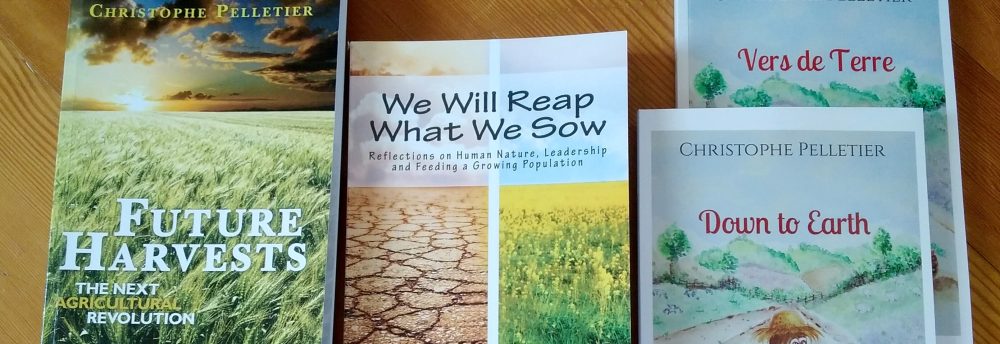
First, it is good to remember that nine years ago the world was experiencing a major economic crisis and commodity prices were at their high. As a result many people were concerned that agriculture would not be able to adjust production to meet future demand. The topic of the future of food and agriculture was rather hot. For this reason, interest for my articles was growing as I was posting more of them. This led me to expand and compile my material. My first book, Future Harvests, was born and published. To my surprise, the book sales exceeding my expectations and my name started to circulate. Customers started to come to me. It is remarkable in a way that I never had to prospect for customers. The interest for the topic and for my work led me to publish my second book, We Will Reap What We Sow.

The rather modest blog has delivered. I did many presentations and participated to many conferences internationally. I have been interviewed many times by both mainstream media as specialized media from a number of countries. My articles and books seem to have found their ways in high schools and university in many countries, too. Customers came to me to have my views on what is coming and appreciated my approach. The outcome has been very positive. Personally, beyond the assignments, I am quite happy to see that my predictions have been accurate and that I could see future developments earlier than others. This is why and how I truly add value to my customers. This sense of anticipation is a complete part of who I am. It has always been. I have no idea where this intuition and sort of sixth sense comes from but it is there and quite real.

On the other side of these positives, I have to admit that I am a little disappointed, in a relative manner though. If I can be proud to be ahead of the pack and see things earlier than most people, it also means that they do not anticipate the changes and the opportunities to come as well as they should and could. I find this worrying especially in the case of large organizations, be it corporations, governments or NGOs, because considering the resources that they have, I should be irrelevant and the one to be left behind. On my FAQ page I give a couple of examples about the FAO, but I could make a much longer list of similar cases. Believe you me, if I had their resources, I would be a rocket launcher. Another source of disappointment, although not to common fortunately, has been those who clearly felt threatened by the knowledge I was sharing with their organizations. It was truly amazing to see that particular global corporate senior executive, in charge of group of almost 100 strategists from all over the world, monopolizing the microphone for an endless attempt to show he knew more than I did anyway. I don’t know if he did and I don’t care but it was an awkward situation and quite a few of his employees were exchange looks with me showing the same kind of awkwardness I was experiencing. There have been other occurrences of people who simply do not want to have an open mind because they have difficulties with disruptive change coming their way. They can cling to the present but they won’t last. Pity because all the predictions I presented them have now materialized. As I said, such negative experiences have been rare and I never quite understand why any organization would want to hire someone like me if all I could tell was stuff they already know. Where would be my added value then? They should have been happy that I was presenting them a new vision of the future and should welcome the opportunities that they offer.

Change happens everywhere and for everyone. That is true for me, too. This is why the time has come for me to rethink my role as The Food Futurist. For how accurate my predictions may have been, as time goes by, more and more people have become aware of things to come. I do not see the point for me to keep on telling the same stories over and over again. The added value fades over time and I do not like to be in the herd.

The first change that I want to implement is a shift from the likely future towards the desirable future. So far, I have been focusing more on the rational and factual aspects of the future and the changes happening. This more analytical approach is somehow easier in the sense that people are, believe it or not, rather predictable. History tends to repeat itself. By shifting to the desirable future, I will be able to bring more of my own vision and in particular pinpoint the absurdities of our current systems and why keeping on doing more of the same, although in a slightly different packaging, will result in the same results.

Bringing in my personal opinion instead of rationalizing the dynamics of change will also allow me to focus more on philosophical, and possibly, political aspects of the future. It is my strong conviction that when it comes to the future of food and agriculture, there is a strong imbalance between the technological aspects and the human aspects, the latter being gravely neglected and if we do not change our attitude about this, there will be negative consequences. The future of humankind is really about humans. Unfortunately, we do not think enough about the future in human terms. I will explore this further. Forecasting the future of technology is easy. What everyone talks about nowadays is what I have talked about years before. Only those who sleep haven’t read or heard about all the tech possibilities. Time for me to go beyond what everyone can find online easily. I won’t add value to you and to myself by settling in the herd and talking about same stuff as dozens others do. Anyone with half a brain can do a Google search and write a book about future technologies. There is all you can find. There is the realistic and the fantasy just as well. What does it matter, since the future is later? Technologies that will not deliver will be forgotten and for technologies that deliver results, it will be easy to say “told you so”.

My goal will be to develop a vision that is centered on human prosperity and happiness. It must be clear that I do not intend to neglect new technologies because future tech developments will affect our lives. Instead of looking at the future from a futuristic point of view, I will do that from a quality of life point of view and look at the practical consequences of change, even more so than I have done so far. I wish to engage in a reflection process more than simply play futurist/consultant because the latter too easy and the former hardly anyone really does. I like to be ahead and I like to be different.

In the future, I might talk less about food and agriculture specifically and more about big picture and connecting the dots between food and agriculture and all the other dimensions. My philosophy in life and in business is simple. Everything I do, I do not do for my personal glory. I could care less about that. What I do is for you, for my customers and help others expand their horizons and think more. The thinking part is becoming more and more of a necessity, especially in a world where everything seems to be aimed at distracting people from thinking too much (having a brain and using might be subversive you know) or simply inhibiting them from thinking thanks to political correctness which is no different in its purpose and functioning as a thought police and insidious form of dictatorship.

For the future of this blog and of my work, there will be more love and more tough love. I will be more direct and outspoken. I will challenge leaders, because they really need to be challenged. I won’t do this in an aggressive manner but I will pinpoint the weaknesses and demand higher standards. The “me here and now” leads only to disaster. I will bring more of “the others somewhere else and later as well”.

Copyright 2018 Christophe Pelletier – The Happy Future Group Consulting Ltd.

Perhaps the ultimate challenge

There certainly is no lack of challenges on the path to feeding a growing world population, but a successful future does not just stop with food volumes. Beyond quantity, it is necessary to ensure that people eat balanced diets. Of course, this is true for those who are food insecure and need help to be able to access more food, but it just as true for the overweight and the obese. The health cost to society is high and is so the cost to the environment. Although excess calories end up as body fat and not in landfills, overweight and obesity should be looked at as food waste nonetheless. After all, body fat is food that has been produced but not consumed for any useful purpose. The problem is only getting bigger as rates of obesity are increasing among the population of emerging countries and are reaching alarming levels. It is not a Western countries’ problem anymore. It is a global one. There is no one particular cause to explain this trend, but it is a combination of lifestyle, example at home and education about the basics of nutrition. We are what we eat and we eat what we are. Diets are undoubtedly a reflection of society and its values.

One of the drivers of today’s economies is growth and too often this concept is restricted to quantitative growth. We must be honest and recognize that our food and agriculture systems still are greatly production driven. Although the idea of a market-driven approach is widely spread, the practice seems to differ, and it looks like it is only translated in marketing-driven instead, always with an underlying production-driven thinking. About all food sector and companies always look for ways to sell more volume. There is competition within any particular industry, but also between industries. For example, in the animal protein sector, poultry, pork, beef and fish are always trying to get a higher stomach share at the expense of one another. Usually, the main decision factor for consumer to make their purchase is the relative price of one type of protein versus the others.

The main message that consumers receive every day is: eat more of this or more of that. Then, it is only normal that they do just that. Why expect any other behaviour? The result is a value system of always more, without really thinking about how it all adds up, while it should be about always enough. Overconsumption leads to waste and to unbalanced diets. Waste is the number one enemy of sustainability, and educating the public about proper diet is actually an important weapon in fighting waste, but it is a difficult one. Although good habits are generally not any more difficult to adopt than bad habits, it seems that the latter group is more attractive. Changing eating habits is all about education. It starts at home and in school. Actually, it is rather easy to learn about the proper ratios between protein, fats and carbohydrates –both fast and slow ones- that are needed in a balanced diet. Information is everywhere, but unfortunately, the lack of education and therefore knowledge about nutrition results in many consumers having no idea how to read labels and how to compose proper meals. If our lifestyles and our needs have undergone major changes over the past five or six decades, physiology of digestion and nutritional metabolism have not changed much at all over the tens of thousands of years that humans have been roaming the planet. It would seem obvious that such an essential element of life should be common knowledge, but it is not. An interesting experiment is to ask people at random what the nutritional needs of an average human being are. Usually, people have an idea about how many calories a person should eat on a daily basis. When it comes to how many grams of protein and even more so fat, then the faces tend to turn blank. Another even more interesting experiment is to ask the same question to people working in food and agriculture. Just go ask how many calories, how many grams of protein and fat. It is an eye opener.

It is possible to make consumer behaviour change from harmful to healthy. There are lessons to be learned from the example of tobacco. To change, consumers need the proper incentives, but the bottom line is that people change only if they perceive the change to be an improvement. Since eating habits rest on powerful psychological triggers, the difficulty is in finding the right triggers and creating a perception of reward. Food producers have a critical role to play in this transformation, and it has to be a collective and collaborative effort with all other stakeholders as well.

Copyright 2017 – Christophe Pelletier – The Happy Future Group Consulting Ltd.

Critical thinking in a world of fake news

Nothing seems to be more in the news lately than the concept of fake news. The issue of fake news is a great example of how technology in the wrong hands can create a lot of confusion and damage. Internet and social media are great tools that can serve the larger good if used with discernment, but they are so powerful that human nature can also express its darker sides in just as an effective manner. In We Will Reap what We Sow, my second book published in 2012, I explored how leadership and human nature could influence the future of food and agriculture. In one chapter, I was warning that the global digital village would follow the same dynamics as the regular physical little village, but with the potency of the speed of light. The Twitter and fake news mania that we are currently witnessing with the recently elected new world leader unfortunately illustrates my comparison. In the traditional village everyone would know about everything about everyone else and there would be no shortage of rumours and gossips. In the 7-billion people village, the exact same is happening. The difference is the reach and the speed at which it spreads. Human gullibility does not depend on the size of the population. The flip side of this medal is that distrust is spreading at the same pace. Paranoia becomes the counterpart of gullibility. Everything that does not please must be fake, right?

Over the years, the public trust in governments, corporations and more recently science and journalism has been only fading. Opposite to that, people have a blind trust in what they find on Internet, Facebook and other social media, as shows how swiftly and easily they share nonsense that becomes the new truth. The village dynamics create a new type of clans and tribes that rest on their own sets of beliefs and, more worryingly, their rejection of the other tribes’ beliefs. It feels like we are regressing into digital feudalism where the truth does not matter, even if it could mean self-destruction. If you have any doubt about the reborn tribalism, there is a social media engagement platform called trib.al. If you still have doubts , check the following picture I found on Twitter.tribe

Why approach the future of food and agriculture in such terms? The future is not about tribes. It is about collaboration and cooperation between ALL stakeholders regardless of their particular views on the subject. That is the beauty of democracy. Collaboration has always brought prosperity. Tribalism has only resulted in chaos, as we can see every day, unfortunately.

In the food and agriculture sector, controversies have been around for quite some time and there are new ones coming all the time. In the sector, we have been dealing with many opinions, ranging from criticism to plain fake news. And let’s face it there has been some of that on both sides. The food fights have been lingering too much on problems and positions and not enough on solutions and cooperation. How to revert from tribalism to universalism in a world stuck between tribalism and paranoia? It is not easy but it is not impossible, either.

critical-thinking

Interesting chart I found on kariecolgy.blogspot.com

In my opinion, the solution is critical thinking. It feels too often that at some point in time, common sense has disappeared and that choosing a set of beliefs is more important than finding the truth. One of the reasons may be that tribalism is more comfortable and less threatening than being proven wrong. Whichever the reasons may be, it is time to reinstate common sense and its twin: critical thinking. Humanity will only progress and solve the many future challenges only by accepting reality and rejecting delusion. It might not be as comfortable in the short-term but it is the only way. If we do not want to see the problems as they are and choose for safe before sorry, it is highly likely that we will end exactly that: sorry. To reinstate critical thinking, it is essential to also make the distinction between critical thinking and criticism. Too often, these two are confused for one another. It is a mistake. Critical thinking is about taking nothing at face value and double checking the facts. It is the search for errors in the thought process to develop a better one. Criticism is only the first step of this process and it generally is received as negative, and sticks there. Critical thinking starts with positive attitude.

There is great value in challenging and being challenged. It stimulates thinking and more and better ideas pop up because of that. This is only a problem if what counts most is whose ideas these are, but ego is rarely of factor of progress. No athlete will ever win the Olympics if he/she is not challenged by competitors, and the competition for being the best is what pushes them to push their limits always further. The role of critical thinking in the process of making progress and improving ourselves and the world around us is just that: forcing us to push our limits and be better. Half truths, or worse fake facts, actually keep us from improving, as they divert our energy in the wrong direction. I am lucky that in my Alma Mater, one of my teachers taught us critical thinking. He was passionate enough to turn me into a fan and, although it sometimes landed me in arguments, it helped me, my staff and my customers achieve more than we would have otherwise. For the future’s sake, let’s practice critical thinking and encourage others to do the same!

Copyright 2017 – Christophe Pelletier – The Happy Future Group Consulting Ltd.

Who’s afraid of Brexit?

Brexit is a hot item. I am asked regularly what I think about it and I have to admit it is rather difficult to answer with any kind of certainty today. I hear and read all sorts of points of views and their opposites. The financial markets sent their messages and legions of experts have given their opinions but I see two main forces in what they tell us. The first thing is a lot of subjectivity. Most predictions I read seem to be more the result of spite, particular agendas or wishful thinking. It sometimes sounds more like what the pundits would like to happen to the UK and to the EU than the result of a solid analysis. The fluctuations of the Pound Sterling are also more the result of a lack of clarity than of a long-term view, but that is how financial markets work. Uncertainty opens the door to all sorts of rumours and speculations. When the crystal glass is too blurry, everyone develops his/her own scenario, which of course adds to the confusion, the uncertainty and the nervousness.

The only way to dissipate uncertainty is for political and business leaders to come out and say clearly what they are going to do and how. They also must explain what will change and that includes the good, the bad and the ugly. Brexit is about change and change always brings fear, which is really the fear of loss, as gains are usually never perceived as threats. The missing bit in the Brexit issue is the lack of clarity and communication about what the political leaders will do. Even the date of initiating the process seems rather fluid, not to mention those who say that it will not happen after all. As long as clarity and determination seem to still be missing, confusion will prevail. I believe that the situation remains vague simply because the leaders do not have a clear idea themselves of what to do with that referendum outcome they did not expect and therefore never really thought about what the next step should be. Just imagine what the reactions would be if the UK had the Euro as a currency and were part of the Schengen area…

road-for-the-ukWill the UK face an economic crisis or a recession? Maybe but maybe not. That would not be the first time and eventually the UK has always recovered. I do not see why this would be any different. I remember when Black Wednesday took place in 1992. By then, I was in charge of the UK market for a Dutch poultry processing plant. The UK was the main destination of breast fillets, our most expensive product and overnight the company turn-over was headed to a major nosedive. The Brexit excitement of today feels nothing like the panic of then. Regardless of how stressful it was, the Black Wednesday situation delivered some good lessons in term of business strategy that I am sure would be beneficial in today’s situation.
The first lesson for us by then was that having many of our eggs in the same basket was quite risky. The exchange rate and the law of supply and demand showed us that less attractive national markets became more attractive and we developed breast fillets sales outside of the UK, while the UK was more competitive outside of its borders. Markets dynamics changed but life went on. One of the most important functions of a sales department is to generate alternatives all the time. No alternative means there is no choice but to accept what the other party offers. The second lesson may be the most important. We had a good marketing strategy. We served the most demanding segment in terms of quality and we offered top-notch service. This made us the last suppliers our customers would want to eliminate and it gave us a solid leverage to renegotiate deals and compensate the loss due to the exchange rate. They wanted our product because it was supporting their business and they would not want to throw that value away. The third lesson is a correlation of the second one. We had chosen a specialized and growing market. By being market-oriented we were able to stay in demand and weather short-term market volatility much better than many of our undifferentiated competitors, both from the UK and the EU.

Because I have seen the benefit of a market-oriented value marketing approach, I can only recommend it as a choice in regards with Brexit. Even in a changing environment, if you have what the market wants, the market will want you. Crises are useful. They help eliminate businesses that are not adapted and not adaptable. The key is to find the customers with a future and help them to be so by delivering them superior value.

Copyright 2016 – Christophe Pelletier – The Happy Future Group Consulting Ltd.

Nature will reshape food value chains

The recent climatic events, in particular droughts, have attracted more attention on future challenges for food production, and rightly so. Unfortunately, the mainstream media cannot help presenting the as all gloom and doom. Certainly, there are very serious reasons for concerns, but solutions can be found. I wish the media would present more examples of positive actions to face and overcome the challenges.

It is not easy to deal with a changing environment, especially when it is impossible to predict accurately what the change will be. Predictions about temperature increases are useful but they are quite insufficient. An increase of 2 degrees on average will be different if the standard deviation is 1 degree or if it is 20 degrees. Other factors such as hours of sunlight and precipitations (including their nature, frequency and intensity) will impact agriculture at least as much as average temperatures. Changing climatic conditions will not only affect plant growth and development, but they will change the ecology of weeds and pests as well and that needs to be factored in future forecasts and models

Nature will reshape food value chainsA special attention on water is necessary. Without water, there is no life. Unfortunately, over the past few decades, wasting natural resources has been a bit of a way of life. The issue of food waste has finally received the attention it deserves, but the waste is not just about food. It is about all the inputs such as water, energy, money, time, and fertilizers. Water is still wasted in large quantities. Just compare how many liters a human being needs to drink compared by the amount of water that is flushed in bathrooms every day. Before the housing crash of 2008 a study in the US had estimated that lawn watering used three times as much water as the entire national corn production. But the issue of water is not just about waste. It is also about preserving water reserves. The late example of the drought in California illustrate what water scarcity may mean for food value chains. California is not only a major agriculture power house, but it exports a large part of the production outside of the state’s borders. The issue of water scarcity and the dwindling level of the Colorado River are not new for Californian agriculture. It has been known for a couple of decades that problems were coming. California produces a lot of water-rich fresh produce by means of irrigation. It actually has been exporting its water in the form of lettuce, spinach, melons, strawberries and citrus far away to places from where the water will never return to California. The water loop has been broken wide open and that is why, among other reasons, the system is not sustainable. If California can no longer supply its current markets, it will have to rethink its target markets. At the same time, other regions, that may not be competitive with California today, because externalities are never included in the cost of production, will eventually take over and replace the Golden State as suppliers for some productions. Unfortunately for the future, California is not the only region with a water problem. Saudi Arabia changed its food security policy a couple of years ago as the country leaders realized that trying to produce all its food would lead to a severe depletion of its available drinking water reserves. Instead of pursuing food self-sufficiency at all costs, the country chose to find other supply sources through international trade and through the purchase of farmland in foreign countries. The examples of California and Saudi Arabia demonstrate how natural –and demographic- conditions shape food value chains. The issue of water is not just about produce. Animal productions require usually more water than vegetal ones. In the future, water availability will surely affect where which kind of animal products are produced. New regions will arise and old traditional ones may review their strategies from volume-driven to higher margin specialty animal products market opportunities because of environmental constraints.

Climate change and water scarcity show how international trade can actually contribute to food security when done responsibly and with long-term vision. The prevailing model of producing where it is cheapest to produce without taking into account negative environmental externalities is facing its own contradiction and demise. The next model will be to produce not only where it is the cheapest to produce but where it is sustainable to do so. When water runs out, it is no longer possible to ignore the externalities of a production. When water becomes scarce, it gets more expensive. The law of supply and demand commands. When inputs get more expensive, several things happen. The economic model shifts. Priorities and externalities change, too. At first, producers try to find ways to increase efficiency and eliminate waste. The benefits outweigh the additional costs. Uncertainty stimulates innovation. New systems, or sometimes old ones that found a second youth, replace the current ones. If that does not work well enough, then producers start considering producing something else to ensure the continuity of their operation and find new business.

It is not the first time that our natural environment changes. Finding successful solutions to deal with it really are about our ability to adapt and to preserve our future, as it has been the case in the past. The challenges may be of a magnitude like never before, but so are our knowledge, our technical abilities and the tools present and future.

From an agricultural point of view, adapting to a new environment is about finding the type of production that thrives under new conditions. It may mean different areas of production for some species. In North America, there is already a shift for corn. Iowa has traditionally the main grower, but the corn production area is now expanding north. Minnesota is now producing more corn than in the past and so are the Canadian Prairies. Similarly, the production area for soybean is shifting north. Minnesota is growing an increasing volume of soybean and even in the province of Manitoba in Canada, soybean production attempts have been carried out since a few years.  It is the result of better production conditions and the development of new varieties that can adapt to new less favorable climatic conditions. Because of the local supply for soybean, the development of aquaculture with local soybean products for fish feed is now considered a long-term possibility in Minnesota among others. In Europe, corn production regions also saw a shift to the north for corn during the 1970-80s thanks to the development of new varieties, which largely contributed to the growth of dairy production in these new areas through the widespread use of corn silage. For the future, there is no doubt that genetics will contribute again to ensure food security. There is currently a lot of work done to develop varieties that can withstand droughts, floods or soil salinity. The ability to know the complete genome of species, to spot genes through gene markers, to be able to create new varieties that are less sensitive to diseases help speed up the development of crops that can thrive under future conditions. The recent developments in synthetic biology are quite interesting. Research conducted at the IRRI (International Rice Research Institute) on the development of rice varieties that can have a higher photosynthesis efficiency and thus higher yields could open new perspective for a more productive and more sustainable production.

Next to the development of better and more adapted seeds and genetic material, the development of new technologies that I described in a previous article will bring a number of effective solutions as well. In particular the rise of precision agriculture is certainly quite promising. The ability to deliver to the crops exactly what they need when they need it at the right time and at the right place in the right quantity will help reduce the environmental impact of agriculture while offering the possibility of delivering higher yields. Similarly, in animal production, there still is room to improve feed efficiency. It can happen through further genetic improvement, the use of more efficient feed ingredients and feed composition and through better farm management. The latter is definitely an essential facet of a better future for food production. Better and updated skills for food producers will help being more efficient, more productive and more sustainable at the same time.

An area that is often forgotten when it comes to the future of food is the functioning of markets. If demand for certain products, and in particular animal products, increases faster than supply, price will go up and there will differential increases between the different types of products. As most consumers, unlike what marketers sometimes tend to make believe, still choose what they eat depending on the price of foods, there will be shifts. Some productions will thrive while others will struggle.

As prices still will be an essential driver of the location of the various vegetal and animal productions, markets and environmental constraints will increasingly have a joint effect. In the future, the dominant economic model of producing where it is the cheapest to produce will evolve. As the pressure on water supplies, soil conditions and pollution issues will keep increasing, the model will include an increasing share of negative externalities. They are the long-term costs that are never factored in the production costs but that will affect future production economics. Externalities are the hidden side of sustainability and they will determine the future map of agriculture, as it will no longer be possible to ignore them. Choices will have to be made between short-term financial performance and the long-term ability of various regions to be able to produce, and to keep producing, the volumes and the quality specifications that are needed by the different food markets of the future.

A friend of mine told me a couple of years ago after a trip to Asia how she could see from the plane the large plantations of palm oil trees, and how they had replaced the jungle. She described her impression as the view resembled the strategic game of Risk to her. Yes, climate change and water availability in particular, will reshape food value chains because agriculture, regardless of it scale, is a strategic activity. It is about life and death. It is about peace and war. Future strategies for both global commodities as well as for local food value chains will integrate Nature’s new deal of precious resources and conditions of productions. Together with the geography of future consumption markets, world agriculture will readjust, relocate and the Earth will look different once again.

Copyright 2015 – Christophe Pelletier – The Happy Future Group Consulting Ltd.

Maybe a different approach of climate change conferences would help

The climate conference COP20 has ended in Lima. As usual, there was lots of hype and fear mongering beforehand. Then, after lots of false hope press releases and fun hobnobbing, the conclusion was exactly the same as usual and as expected: a few vague statements meaning about nothing and no agreement except the one to meet next year in Paris, because having to cancel two weeks in the City of Light… oh la la quel malheur!

As COP20 indicates, that was the 20th time that such a conference was organized, and that was the 20th time that the outcome and conclusion were so predictable. One can wonder why it is so difficult to make significant progress. Is there really a problem? If so, why is this charade going on and what do the world leaders waiting for. Well, maybe it is just because they have no vision for an alternative economic model. That could be a problem, indeed.

This repetitive failure is frustrating. Sometimes, I think that the conference participants should be locked in the conference center with no air conditioning (or maybe on at full blast is another option) and only 80% of the food and water necessary to make it through the duration of the event. It might be more stimulating. But I admit this is not a politically correct proposition. As an alternative I give you here an excerpt of my second book, We Will Reap What We Sow that I published in 2012. In this excerpt, I had written some of my thoughts about how to do it differently.

Here it is:

“The reason behind the resistance and the denial of climate change is actually very mundane. It is about money. Climate change is an incremental process. It takes years to show significant effects. Opposite to this, the effect of tougher legislation is immediate. The negative impact on costs and on jobs manifests quickly. The negative short-term impact is even more sensitive in a time of economic hardship. In such conditions, it becomes more difficult to gain acceptance for long-term sacrifices while there is no viable alternative to generate at least an equivalent profit and employment in the short term. Of course, subsidies can alleviate the pain and make the transition acceptable, but they are difficult to justify in times when government deficits take alarming proportions everywhere around the world.

The path of least resistance and the preference of the short-term prevail. The leaders choose not to be courageous. Such a conclusion is common, and it is a simplistic one. Is the failure to take courageous decisions only the responsibility of the leaders? To answer this question, one must wonder how many people in polluting industries would accept to sacrifice their jobs, their livelihoods to save the next generation. If there is no viable alternative, the answer will be a loud “No!” without the shadow of a doubt. Similarly, one can wonder if consumers would be willing to stop buying products that contribute to climate change. Would they give up their cars and switch to bicycles? Unless the alternative would be much more painful, it is likely that they would answer “No!” to that question, too. In the current economic model based on consumption, asking people to cut back on consumer goods to live lives that are more frugal would cause a deep recession.

Such a proposal will never receive the support of the political and business deciders, even if it would keep the world livable for the coming generations. The truth is that everybody is responsible for the problem, not just the leaders. Everybody enjoys the convenience and the comfort created by mass consumption. Very few would be willing to give it up voluntarily. The lack of political will, as it is called, showed by the world leaders is only a reflection of the collective inertia. While many people are contributing to the problem, nobody feels responsible for it. It is always someone else’s fault. Climate change can be seen as an illustration of Jean Paul Sartre’s quote “Hell is other people”. It is difficult to hope to see a solution to the problem as long as nobody is willing to acknowledge responsibility and take action so drastic that others will feel compelled to follow the example. The world leaders skillfully dodge their opportunity to state whether they think climate change is a problem or not. It would be nice to hear from the different countries how they feel about the issue. It would also make it easier to understand why they act the way they do. Climate change is a problem or it is not a problem. The leaders who think that climate change is not a problem should say so. Those who think it is should do the same. Of course, those who would state that it is a problem will have to develop their plan to show what they want to do about it.

Failure to do so would look strange. Another reason why talks about climate change make so little progress is the lack of vision for the future. The international conferences try to address greenhouse gases emissions without addressing the economic model of the consumption society at the same time. In such a model, where people are supposed to buy more and more goods that are cheaper and cheaper, that are made and delivered with massive amounts of energy and natural resources, there is simply no climate-friendly alternative. There will probably never be any climate-friendly alternative in the future, either. There is no point in being hypocritical and in trying to make believe that the economy can grow forever. It is not possible to increase the use of finite resources in a finite system indefinitely. It is physically impossible, but it is possible to deny it.

In this case, humanity will reap what it will have sowed. However, it is possible to debate and find out where the point of no return is. Even if some countries have higher emissions than others do, pointing fingers at them is not productive. Greenhouse gases emissions may be produced locally, but their effects extend much farther than the national borders. The solutions must be global and developed by all countries as a team. They need to have a vision and a plan to reduce the effects globally. As different sources of energy have different effects on the level of greenhouse gases emitted, the focus should be more on how to produce the required energy than on where the problem originates. The conferences should offer brainstorming sessions about solutions and concrete funding measures for cleaner energy production. The approach should be one of a global contest to offer systems that solve the problem. It would be interesting to change the discussion from one focusing on by how much which country should reduce greenhouse gases emissions into one focusing on developing a vision for energy production, both quantitative as qualitative. The next step is how to produce the amount of energy needed in the future while producing this energy below a global limit that all parties must define. Since money plays a central role in political decisions, it could be a good idea to organize a different type of conference. This time, the participants would have to present all the scenarios that would be possible if they did not consider the short-term economic consequences. It would be stimulating to hear how the problem can be solved from a technical point of view. The solutions would have to review all the possibilities for all industries, starting by the most polluting, to produce more with fewer emissions. Once this part would be completed, the next question would have to address how much these scenarios would cost, and to elaborate a plan that would fund the winning solutions. Nowadays, economic decisions seem to be based on the too-big-to-fail-bailout concept. Then, why not apply the same approach to humanity and climate? Pumping as much money as necessary to ensure the transition in order to create the energy production of the future and save humanity from much costlier consequences sounds reasonable. It would be interesting to compare it with the amount of money printed and the amount of debt created to alleviate the effect of the Great Recession of 2008 that still lingers in many regions today.”

Copyright 2014 – Christophe Pelletier – The Happy Future Group Consulting Ltd.


Precision is the future of agriculture and our future

By the end of last July, the InfoAg conference took place in St Louis, Missouri. Matt Waits, CEO of SST Software, a conference sponsor, introduced me before my presentation titled “Beyond the Farm of the Future”. In his brief introduction he told the audience that he strongly believes that precision agriculture is the future of agriculture. His statement resonated quite positively with me. I see only advantages in making agriculture more precise. Just for starters, per definition the opposite of precision agriculture would be an imprecise agriculture. That is already reason enough to become a supporter of precision agriculture.

The first reason why a precise agriculture is the way to go is the necessity to manage finite resources more efficiently. Precision agriculture means sustainability. The philosophy behind precision agriculture is to use only what is needed where it is needed when it is needed in the mount that is needed by crops. In practical terms, this means that every molecule of input in agricultural production has to be transformed into food and not end up in the environment. Precision agriculture reduces waste. When I was writing my first book on the future of agriculture in 2009, the estimated worldwide amount of nitrogen loss due to leaching was of about 50%. The example of nitrogen shows what reducing waste can mean. In an ideal world where nitrogen would be used much more efficiently, it could be possible theoretically to use only half of the nitrogen we have been using, or in other terms, the current amount of nitrogen used should help produce twice as much food. Considering that the FAO claims that between 2010 and 2050, agricultural output should increase by 70%, it means that in an ideally precise agriculture, the world could meet the demand for agricultural products by using 15% less nitrogen than it did in 2010, theoretically. Also considering that the production of chemical nitrogen fertilizers represents about half the use of fossil fuels in agriculture, the positive impact on the carbon footprint of agriculture would be substantial. Similar calculations can be done on other inputs, such as water and crop protection products. By bringing just the right quantities at the right time at the right place, the consumption of water and chemicals will be reduced substantially, too. As recent droughts have reminded us how precious water is, precision watering is also becoming more important than ever. Water is precious, but in many cases, its price has not emphasized this enough. The main reason for wasting is always the result of economics. If inputs appear cheap, the low price is always implicitly perceived as a sign of abundance and of negligible value. Such a perception goes against the reflex of sustainability. Our elders did not waste anything (candle bits, soap bits, socks, you name it). They were frugal simply because the cost of replacement was too high, and at least was higher than the cost of repairing and saving. When a government subsidies inputs to make them cheaper, the users end up wasting much more. It is sad because such subsidies always have a well-meant starting point. The idea is to make it affordable to poor farmers so that they can increase their production. The result is when the less poor ones get the subsidies, they do not see the new price as affordable anymore but they see it as cheap instead. Managing for sustainability really is about managing the fine line between affordable and cheap. That is not easy, because the difference is not just about the price of inputs; it is also about the financial situation of the subsidy’s recipient. Subsidies should not be aimed at just price, but at more at efficient use of inputs and should be based on achievable yields. If governments wish to spend money, it should not result in farmers overusing and wasting water and production inputs. That is counterproductive. These governments, which often are in developing countries where resources are scarce and access to inputs difficult, had better spend money on helping farmers being more precise. The math is simple: efficiency is the ratio output/input, and the difference between what comes out and what got in the field in the first place is what is wasted – or lost. A precise agriculture reduces the waste, and therefore increases the ratio. This means that precision is the way toward increased efficiency.

As I mention developing countries, here is another important point to bring up: precision agriculture is not just for large farms but can be implemented everywhere. The development of precision agriculture goes parallel with the development of new technologies. At first, it would seem that such technologies are too expensive for small and/or poor farmers. If the point of view were to be that every farmer should own all the precision equipment, the answer is: yes, it is only for the large and wealthy, but looking at precision agriculture from that angle would be rather dull. Satellite imagery, drones, sensors, robots and other big data software can also be shared. In the era of the cloud and social media which are all about sharing, so can new technologies. Just like ownership of agricultural machine has also been shared through equipment coops for instance, so can these new devices. After all, it does not matter so much who owns them, as long as those who need it to do a good job can have access to them. Mobile communications have changed how farmers everywhere can get the latest information on markets. Smart phones have become affordable to the point that there are about as many mobile phones as people on the planet. Similarly to mobile communications, precision agriculture will also become more affordable in the future. If precision agriculture tools can monitor, map and help make fast decisions on farms of tens – and even hundreds – of thousand acres, they just as well can look after an area of the same size even if it is divided between many farms. It is just a matter of management and coordination between farmers. In poorer regions, it could very well be that the authorities be the owner of the equipment and proactively communicate with farmers through extension services to help the groups of farms manage the region efficiently for higher output. Such tools will help developing agriculture, in a sustainable manner. The benefits will be many. It will help increase farmers revenues, create economic activity, enhance social stability and help reduce the waste of water, energy and all other inputs. It will pay off in the long run and actually probably in the not-so-long run at all. Agricultural development requires financing and investments. Precision agriculture is in my opinion a very good place to put money at work.

In the future, the key for these technologies will be to also help see the bigger picture, not just the field and not just production data. The potential for applications and interfaces seems almost endless. By connecting all the devices and allowing sharing information of all events taking place on farms, these technologies are going to help reconcile the interests of all stakeholders much more effectively than it has been the case in the past. By monitoring production parameters as well as environmental parameters, proactive action will help anticipate instead of reacting. Actions will be targeted timely. One of the difficulties to manage sustainability is one of timelines. It is possible to monitor financial performance on a second to second basis, even faster actually, in the case of financial markets where algorithms can execute millions of transactions in less than a second. Environmental impact does not manifest immediately. It takes decades to notice the impact of a particular type of activity. With this time discrepancy between financial performance and environmental performance, it is only logical that money has trumped environment, even though there is a price to pay some day. That is the dilemma of externalities: how to factor such externalities when the exact cost is unknown. The future generations of technologies to monitor and map agriculture and environment will bring solutions. Once the focus widens from the field to the level of regions, countries and the entire planet, then it is possible to envision monitoring systems for all resources, environmental impact of agriculture and production output. It is only logical to expect dynamic information systems that could look like Google Earth, but with many editions, such as, the aquifer status edition, the nutrient edition, the crop yield edition, the soil erosion/restoration edition, the pest edition, the contaminants edition, and so on and so on. With such dynamic systems, it will be possible to not only monitor but to also produce simulations and test different scenarios. It would become possible to have an idea of how long resources can last, depending on different production techniques. It could be possible to make estimates and develop policies to adapt agriculture timely and ensure that future practices will maintain sustainable production systems. With such tools, precision agriculture, it will possible to develop worldwide policies and strategies to coordinate agricultural production. It also will help make markets much more transparent, as such dynamic systems would take into account consumption demand, worldwide stocks and production updates. Such transparency will reduce risks of speculation as the system would present a continuous update on the most likely scenario. Let’s face it! The computers will eventually replace the market places or agricultural commodities.

I agree with Matt Waits, precision agriculture will be the agriculture of the future. I also believe that the technologies that agriculture will use will play a role at a much larger scale and beyond just agriculture to shape the way we deal with our planet and our societies. Precision agriculture will play a crucial role in ensuring food security and prosperity.

Copyright 2014 – The Happy Future Group Consulting Ltd.

Future rhymes with infrastructure

In all the talk about feeding 9 billion people by 2050, the issue of infrastructure receives too little attention. In my opinion, this is a mistake. Of course, building, repairing and maintaining roads, railways, bridges, waterways or warehouses may not appear as sexy as fantasizing about robots, drones and machines that exchange information, or fancy marketing concepts, but infrastructure is really the lifeblood of future food security. For as much as I enjoy presenting a futuristic vision of food and farming and talk about market niches of the future, I also find essential to remind my clients about the practical implications of future development for their very concrete daily activities. Infrastructure is definitely one of the important topics. Considering how much attention the topic of producing more to meet future demand has received over the past couple of years, and considering the good prices for agricultural commodities of the past few years, it is only normal that production volumes have been on the rise. It may sound obvious that logistics should grow in parallel with production volumes to be able to keep moving products. Unfortunately, when it comes to the big picture, the supply chain seems to be overlooked to some extent. One of the problems is that the agricultural world is still very much production-driven, and so is all the talk about the future of farming. As I presented in Future Harvests, there are plenty of possibilities to supply the world with more food. Although there will be challenges to overcome, the potential is there to meet the demand of 9 billion, and even for the 11 billion that the UN is forecasting for 2100. However, the key is to be able to bring the food to the consumers, and that is where action is badly needed. Post-harvest losses may be the clearest example of how important infrastructure is. Worldwide, the estimate is that about 20% of all the food that is produced is lost on the fields or between the farms and the consumers because of a deficient infrastructure. In particular, the lack of proper storage results in food that rots or gets spoilt by mold or vermin. The problem is especially serious for perishables. In particular in the case of produce, which is fragile and contains a lot of water, post-harvest losses may exceed 50% of the total production, as for instance it has been observed in India and Africa. Post-harvest losses also occur with non-perishables. In China, it has been estimated that the amount of wheat loss during transport because of a poor infrastructure amounts to the quantity that Canada exports. Since Canada is the world’s second largest exporter of wheat, this shows the magnitude of the problem. Brazil, which is one of the world’s agriculture powerhouses, also suffers from infrastructure issues. Most of the transport of agricultural commodities takes place on roads that are far from being well-paved. The result is twofold. Firstly, the poor road conditions cause the loss of significant amounts of grains between production areas and export terminals. Secondly, since road transport is the main way of transporting agricultural products, the cost of transport and the resulting carbon footprint of food supply are both higher than they could and should be if there were enough railroads and waterways to bring products to markets. A couple of years ago, I read a report about the comparison of the carbon footprint of beef production between countries and one of the surprising conclusions was that Brazil scored relatively high. Although the survey needed to be taken with a critical mind, the infrastructure situation of Brazil certainly was one of the reasons for its high footprint. The good news about Brazil is that the country recently launched an ambitious plan of $200 billion to fix its infrastructure. As its economy grows, this will be essential to secure the future. Infrastructure development is not just a matter for developing countries, though. In Canada, the shortage of rail capacity for grain transport has recently become an issue, as record crop volumes have difficulties to reach their destination. Not only is this a logistical problem, but it highlights the lack of forward thinking and of communication within the entire supply chain. Over the past few years there have been more than enough conferences in which many experts insist on the necessity to increase production, in particular though yields. The high prices of agricultural commodities of the past few years have been great incentives for farmers to do exactly that. And they certainly have delivered. Did some not pay attention? Perhaps. Unfortunately, the post-harvest links of the chain have not adjusted on time. This will be true for the US agriculture, too. American farmers are working hard on increasing yields and export possibilities are good on the long-term, but they will have to keep the ability to move enough volume to the final markets. Roads, railways and waterways need not only some revamping but also need to develop further to adjust with future volumes. In spite of all the talks about improving the American infrastructure during the deepest of the economic crisis following the financial disaster of 2008, not all that much has been done, really. Transportation infrastructure, as well as the energy grid, still needs some serious refreshment. Like anywhere else in the world, a healthy infrastructure will be the basis for a sustained economic prosperity. Beside the volume implications, a well-organized infrastructure also contributes to lower costs and improves the competitiveness of the value chains that benefit from it. In my opinion, there cannot be long-term prosperity or successful economic development without an adequate infrastructure. For the future, another area that is going to require solid planning and vision is the population boom that will take place in urban centers of Asia and Africa. Many of the mega-cities that will emerge in the coming 40 to 50 years hardly exist, yet. Nonetheless, they are coming. Urban planning that will address the challenges of these megalopolises is one thing, but organizing the supply of food, water and all other essential from production centers is another. The “unfortunate” thing about infrastructure is that it is a long-term investment. It is money that needs to be spent to get the economy flowing. The return is long-term. If done well, the positive financial return lies in economic development, more and better jobs and more people having more money to pay for goods and services as well as for taxes that can be used to ensure a good maintenance of the infrastructure. One of the issues is of course who finance infrastructure. Many stakeholders benefit from a good infrastructure. As I show in We Will Reap What We Sow, the FAO estimated the annual cost of fixing post-harvest problems in developing countries at $83 billion. Doing so provides so many upsides for all stakeholders from farms, businesses and government that the return for the entire system is actually higher than the $83 billion, and my calculation is quite conservative and cautious to say the least. There is more than enough money to fix the problem. What is $83 billion compared with the amounts spent since 2008 to bail out banks, to print money as massively as it has been done and to rescue the European countries that were in serious financial trouble? It is a drop in the ocean! Yet, fixing post-harvest losses is a painfully slow process. It is a matter of taking the right decision. How long will we accept not only to waste that food, but also all the water, the energy resources, the time and the money that have been used to produce it in the first place? Among the many projects that I have carried out, I would like to present one briefly here because it illustrates the importance of infrastructure. When I came to Canada, the previous management had signed an agreement with a First Nation community of the North Coast of British Columbia for the production of farmed salmon. When I inherited the project, I took a look at the agreement and I remember sending a memo of a page and a half that was actually a list of questions that had all to do with infrastructure. In a nutshell, how to transport fresh fish and deliver customers at least twice a week on the West Coast of the US from a remote island with no road connection, only a ferry every other week and highly unpredictable sea conditions? It was mostly unpredictable in the sense that the number of days the barge of some transport company involved in the project and run by someone who would prove later to be rather unreliable would be stuck for undetermined amount of time between that island and Vancouver where the dispatch center to our customers was. By then, nobody among those who shaped the agreement had the slightest clue about what answers to give to my questions. In the end, it all worked out fine and our customers never missed a delivery of fresh salmon. What it took was for yours truly to dive in the scrum and enjoy some Wild West type of action to get it all together, to bring materials in and send products and waste southbound using a tiny barge and connect with trucks on some unpaved wilderness road through the mountain ranges. By the way, 14 years later today and the unit is still running. That project could be a textbook case of why infrastructure is so important both to bring in stuff and take product away to consumers markets. Every time I hear or read about the need for farmers to have access to markets and of post-harvest losses in developing countries, I can totally relate to the complexity of how to set it all up. Producing without having the possibility to bring to customers is not economic development. It is economic suicide. In a business, be it a farm, a store or a manufacturing plant or any other, one rule is always true. And that is that money comes only from one end of the business: from sales. To get there, the business needs customers that they can actually serve properly in order to get paid and to retain them, because in the end, the customers are the ones who must pay for all the expenses of the business. It sounds obvious and yet it is forgotten too often. I am a strong advocate of a market-driven approach. The term market-driven already implies the value of infrastructure, as to be market-driven a proper and reliable supply chain is necessary. The other major advantage of being market-driven is that selling is easier because market-driven businesses offer what the market wants. Business is easier when all one has to do is to produce what is already sold. On the other end of the spectrum, production-driven is quite the opposite. It is the best recipe to end up painfully pushing production volumes at slashed margins and being depended on others to decide of the future of your business. For having been a market-oriented person in production-driven industries, I have seen the value of the market-driven approach. It requires a different mindset. It is about stepping out of the commodity markets rats’ race, and it is about implementing the necessary changes to deliver customers what they want while asking the price that you need. For the future, developing the agriculture of the future and being able to feed the world population will be about understanding the markets, finding the right customers and having the required infrastructure to bring to them, wherever and how far or close-by they may be, what they need. In my opinion, all agricultural development projects must start from the market end and be built backwards into adequate production volumes and structures. The organizations involved in such projects must bring in the marketing and the supply chain expertise to give local farmers the highest chances of success. All the technical and knowledge support is essential, too but they have to be aimed at supporting the implementation of the sales plan.

Copyright 2014 – The Happy Future Group Consulting Ltd.

China is evolving – A look towards future consequences

Aside

Recently, interesting economic news has come from the Empire of the Middle. On the one hand, financial markets reacted worried on the softening of the Chinese economy, but on the other hand they reacted rather positively about the first corporate debt default allowed in the country. To me, all of the above is good news. If financial markets get a bit nervous for a few days, then so be it! It cannot be a complete surprise that at some point the growth of the Chinese economy would slow down. Double-digit growth cannot last forever, and growth cannot keep going on a straight line without some corrections along the way. If markets are worried about a growth of 5% for China, then how will they react when China lands into a recession, as it surely will happen at some time?

Personally, I find China’s performance over the last 30 years quite impressive to say the least. I am old enough to have seen dramatic changes about that country. When I was a kid, all the news from China was rather sad. There was a chronic situation of near-famine, and what I heard then, true or not, was that the Chinese had only one bowl of rice per person for a whole day. The Great Leap Forward and the Cultural Revolution directed by Mao Zedong did not exactly spelled prosperity, by far not. After the arrival of Deng Xiaoping, things changed and a new direction took place, which had led the country to where it is today. Pragmatism took over from blind dogma. Deng Xiaoping’s quote “It doesn’t matter whether the cat is black or white, as long as it catches mice” summed it up nicely. I have to admit that I was still rather young and did not pay much attention to what happened in China. That came later during my professional life. In the early 1990s, the price of wheat increased, and this became cause for concern in the poultry industry, in which I was working by then. I remember a conversation with one of my customers. We came to the conclusion that China had decided to feed its people, and that was the sign of a new era. Since that day, I have followed with much interest the evolution of China, and until this day it has not stopped fascinating me.

Bringing a country of 1.5 billion people in 30 years from hunger to the world’s largest economy is no small deed. Western economies with a much lower population should know, since they struggle to provide enough jobs to their populations, which in many cases would fit in only one of the large Chinese cities. Chinese leaders have shown a remarkable pragmatic approach in the way they have carried out this change. They have performed an impressive balancing act to stay in power through economic development that allowed the population to not have enough reason to start a revolution, which is the only way to change a government when there are no elections. Feeding their people was definitely a sound strategy to achieve the double objective of power continuation and increasing prosperity. However, this economic success has come at a high price. China suffers from major environmental damage, and the rest of the world also undergoes the consequences. This is where the news of the past few days sends some interesting signals about the future. China is now entering a phase of optimization. Growth is not anymore just about more, but it is about better. Phase one, providing for the basic needs seems on its way to completion. Now, focusing on the quality of future growth becomes necessary, as keeping the course of the previous decades would probably soon lead to make the country hardly liveable. But allowing the pace of growth to slow down in order to get the time to improve the situation and clean some of the damage is not the only sign that shows that Chinese leaders have the confidence that the country has achieved a level of economic prosperity sufficient to absorb this slowdown. The recent debt default of the solar panel company Chaori shows that China has decided to stop to protect business from failure, as until this case, various levels of government would guarantee the debt. The message seems to be that the economy is strong enough to take such hits. This is a strong signal that China will no longer bail out businesses and that they will let market forces select the winners and the losers. That is quite the move toward liberalism. A number of Western countries do not appear this bold, lately. In the same area of a changed economic philosophy, China is also currently allowing market forces to regulate the value of its currency, which is currently weakening, even though Western countries have always put pressure on China to re-evaluate the Yuan. The ability to persevere on long-term objective and not let outsiders interfere more than necessary is one of the quality of the Chinese that I like particularly. They do what is good for China and do not allow foreigners to undermine they progress. They run their economy with the same resilience and determination as they did with the Long March. Personally, I like the approach of the Chinese leaders. They are smart, focused and pragmatic. The new generation of entrepreneurs and executive also shows these good qualities. I also am quite impressed by the enthusiasm and curiosity of young Chinese students. They have the momentum on their side and it feeds their desire to succeed.

As I mentioned earlier, a couple of decades ago China decided to feed its people, mostly to avoid social unrest that could get out of control. In the area of food security, China has, like in the rest of its economy, achieved impressive results, but at a high cost, too. I believe that part of the current shift in economic philosophy can be looked at from the perspective of Maslow’s pyramid of needs. The objective number one for China has been to meet the basic needs: food, shelter, safety. Although there is still a part of the population living in poverty, the basic needs, from a collective point of view, are more or less met, as the majority of the population has now entered the middle class or better and the rest seems to follow in that direction. In the first phase, it is clear that environmental damage was under little scrutiny, as the end justified the means. After all, hungry people are not picky about what they eat, if it means surviving. In the today’s Chinese society, just eating what is available is no longer the only priority. Once the basic needs are met, the emotional takes gradually over from the biological. Consumers start to think and to question. It is not anymore about surviving today only, but about living in the future. The population is expressing its discontent of the quality of life and against the environmental recklessness of businesses more and more often. If food was used to be considered a potential source of unrest, now the problem has shifted to air and water. Heavy air pollution, contaminated water and the sight of thousands of dead pigs floating in the river that flows through Shanghai, as was the case a few months ago, are no longer tolerated by the population.

China Food Map (Photo: Zhang Yanlin/Asianewsphoto)The phase of optimization is also going to take place in food and agriculture. The situation about corn is a good indicator. Until 2012, China was self-sufficient for corn. With the increasing demand for meat as a result of economic improvement of the population, China has now become a net importer. The type of demand for the various food groups, together with the environmental toll of pursuing the objective of food self-sufficiency has reached its limits. It is important to acknowledge the performance of the Chinese agriculture, though. Even is the cost of achieving food security is high, one needs to remember that China is the world’s largest producer of rice, wheat, pork, eggs, fruit and vegetables, and cotton. It is the second largest producer of corn, behind the US. Considering the size of the country, being the main producer for all those commodities is quite an achievement. Yet China, announced last February that it was changing its objective, and that grain self-sufficiency was no longer sacred. It makes very good sense. The long term is as important as the present. China needs to work hard now to protect and restore its soils and its fresh water. On other area where the country can also achieve substantial results is by fixing post-harvest losses. Infrastructure will be developed further. Optimization of the food value chains will also take place, largely in the form of a consolidation of businesses. The seed sector will be interesting to follow in this regard, as many small seed producers will either disappear or be absorbed by larger entities. Considering the crucial role of genetics for crop yield, this rationalization of the sector should also contribute to a further improvement of the Chinese agriculture.

With land purchases abroad, world agricultural production up, international trade and a more astute food stocks strategy, China does not need to try to produce all its food itself. The bulk of the basic needs is covered. Now, it is time to optimize and repair without having to fear shortages. The focus is going to be more on waste reduction and efficiency than before. It definitely will be about doing more with less, to use a commonly used expression. An example of this tightening of standards is the so-called Green Fence for the recycling goods that China imports. Now the recycling materials need to be cleaned to enter the country. China simply does not want to use its energy and water resources. They want the waste producers to do that in their own countries. That is wise.

Another area for optimization is food safety and food quality. In a previous article , I wrote about a strategic shift towards speeding up the learning curve to meet higher standards. The shift from quantity to quality is a reflection of the pyramid of needs. When people have enough to eat, as is the case in large Chinese urban centers, they start to look at how food is produced and question what they do not like. Food security is for most no longer a worry, as the alarming rise in overweight and diabetes shows. When food security is no longer a worry, the focus shifts to food safety. That is quite normal.

My expectation is that China is no longer in the logic of just copying and producing cheap low quality. Although this reputation is still quite alive in Western countries, in my opinion it is incorrect. But after all, similar prejudices lived long about Japan, too, until the time that Americans realized that Japanese goods were of a better quality and Japanese companies were better run than their domestic counterparts. We will see the same thing about China. Some people will wake up too late. The Chinese are quite awake. Don’t worry for them.

Although the food industry, like all industries, resents criticism, it is actually the sign of a developed society. Basic standards do not satisfy anymore. People look for the something extra, and that is where opportunities arise. Those who listen to consumers and offer them what they want increase their chances of capturing the high-margin market positions. Let’s face it; markets for undifferentiated commodities are attractive mostly because of the large volumes they represent. In China, too, health and environment will be the drivers of future food supply. This will definitely offer good possibilities in the future. The Chinese will also take a look at their diet, and the per capita consumption of meat, just like economic growth, will not keep increasing forever. In the same way as it did in Western countries, it will reach a plateau, probably in 10 years from now, and later will gradually decline, for the same reasons as it is doing in the West, and also because the population of China is expected to decrease to 1.4 billion by 2050 and to 1.1 billion by 2100. That decrease represents a lot of consumers. It will be important to notice this change of trend on time. When consumption of certain food items in Western countries reached that plateau, most companies did not anticipate it. As usual in such situations, denial is the first reaction. First the change of trend is considered a temporary hiccup. Investments to increase capacity have often been made on the expectation of continuous growth, causing an overcapacity of production, and the production capacity needs to be used fully to be economically efficient. This creates a lack of flexibility and all producers enter the difficult times with the same cost profitability concerns. When the stagnation appears to last, producers like to think that indeed there will be a consolidation of the sector, but they usually all seem to think that they will weather the storm and will not be affected. Of course, it never works that way. Bad things do not happen only happen to others. Then, the crisis follows and usually a vigorous restructuring takes place. I have seen this many times and it is amazing to see how history repeats itself. There is no doubt that when food consumption will have reached its top, the same mechanism will show. This time, the problem will be quite robust, though. To supply China, production volumes will be much higher than previous similar scenarios of stagnation in the various Western regions. Further, just as much any marginal increment of consumption per capita multiplied by 1.5 billion means large volumes, any decrease of consumption will represent significant pain. This point is not here, yet. There are years of growth for most food groups ahead, but it is time to start thinking, and especially start planning, about a change of strategy. When the plateau appears, differentiation will become the main theme, and niches will be the place to be. Considering that the Chinese culture is long-term oriented and that relationships are a fundamental element of business in China, I would recommend starting paving the path for this shift sooner than later. After all, 10 years pass quite fast.

Copyright 2014 – The Happy Future Group Consulting Ltd.