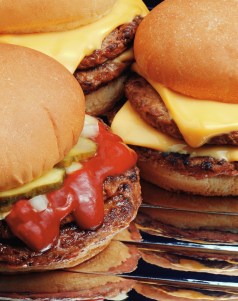
German agriculture Minister says “Eat less meat!”

Ilse Aigner made that statement during the “Green Week” held in Berlin early January, one of the largest shows about food and agriculture in the world.

This is quite remarkable to hear a Minister of Agriculture making such a statement, based on the recommendation of the German Nutrition Society that indicates that 300 to 600 grams (that is about 11 to 22 ounces for our American friends, who usually consume this amount in less than two meals…) of meat per capita per week is enough for a person to cover their nutritional needs. Yet, her statement was linked to environmental concerns, since it is fashionable to blame meat production for climate change issues.

From a nutritional point of view, this recommendation is correct. That is all we need. That is less than most of us want, but that is a very different topic. I had addressed this, mentioning that 30 kg per capita per year (equals 600 g per week) was plenty,  in my earlier posting “The future price of meat and fish: up” a few months ago,. I also mentioned that if we ate only what we need, the West would free a quantity of meat large enough to feed a population as large as China’s.

It is unlikely that the Minister’s statement will change consumption patterns any time soon, but the future price of animal protein will. Considering the feed conversion ratio of farm animals and the increased competition between human consumption, animal feed industry needs and biofuels, the production cost of meat will increase. Feed is the main cost in those productions. Further, the amount of water required by farm animals and the manure issues that still linger with intensive animal husbandry, will add to the price pressure.

There is no need to become vegetarians, but the days of gluttony are numbered.

Copyright 2010 – The Happy Future Group Consulting Ltd.

Aquaculture: the solution to feed 9 billion people?

Last week, BioScience published an article based on the research of a group of researchers from the CSIC (Consejo Superior de Investigaciones Científicas), the Spanish High Council for Scientific Research.

They present their views on the potential of marine aquaculture to provide enough food for the growing world population. The authors of the report do not see fisheries as a significant option anymore, as the wild fish stocks are depleted, and the amount of time to replenish the stocks will be too long for fisheries to be able to meet the needs of the population. Aquaculture has gradually compensated the demand for fish that fisheries were not able to supply, and half of the seafood consumed today already originate from aquaculture. It is the fastest growing food supply activity and the projections for future growth are very strong. The researchers think that marine aquaculture could multiply its production by a factor 20 by 2050 and thus would play a major role in providing the world population with animal protein.

They bring up some interesting facts about agriculture and land animal farming. For instance, it takes 10 times more water per calorie to produce meat than it does to produce grains. Further, animal meat products represent only 3.5% of food production, but they consume 45% of the water used in agriculture. Considering demand for meat is expected to increase by 21% between 2005 and 2015, and will keep on increasing, this will only exacerbate this situation.

Another point that this group raises is the global nitrogen-use efficiency in animal productions. According to their sources, it is slightly more than 10% for land animals (5% for beef and 15% for pork), which makes their production a major source of nitrogen inputs to the environment. In contrast, marine animals have much greater nitrogen-use efficiency, at about 20% for shrimp and 30% for fish. Therefore, marine aquaculture culture releases two to three times less nitrogen to the environment than livestock production does.

From an environmental point of view, the idea of shifting the production of animal protein from the land where it uses scarce resources such as land and water, to the ocean where space and water are no limitations anymore sounds very sensible. From a nutritional point of view, replacing meat and dairy by seafood that is rich in healthy components such as omega-3 fatty acids is quite attractive, too.

They also notice that the land available for agriculture is shrinking, due to soil degradation and urbanism. Further, there is a growing scarcity of fresh water and increased competition for water as well. Therefore, activities on land do not offer the potential to grow all that much more food to feed the growing population. Even freshwater aquaculture faces these limitations. Freshwater aquaculture currently 57% of total aquaculture, therefore there is an untapped potential with marine aquaculture, as it does not use fresh water.

Of course, the main challenge to execute such a development of marine aquaculture production is to find the proper quality and quantity of feed. The researchers do not see the use of fishmeal and fish oil as an option anymore as they predict that the species used to make these products will not be able in sufficient quantities. Replacement by protein and oils from agriculture crops is an option for the short-term, but as aquaculture volumes would increase, the competition for these ingredients with meat production will make them too expensive, and for the reasons explained above, depending on land agriculture to feed marine species will face crop production limitations. Therefore, they prefer to envision a total new approach of aquaculture feeds, and recommend developing a new feed chain based on aquatic ingredients, such planktons, microalgae and seaweed. This approach makes sense, but the time lines to develop such a supply source and the cost of production of such an “aquatic” feed still need to be investigated. Several “seaweed farms” in production in China show interesting results and they seem to promise a strong potential of production for feed.

Another development that they expect is offshore aquaculture. Aquaculture operations located in coastal areas, although they are easier to access and generally in quieter waters, are very often located in zones where there are local issues to deal with, such as interaction with wild fish or recreational activities. Moving offshore can reduce these issues.

As you can see, developing the future of aquaculture is not simply a matter of growing fish in pens, but it requires a broader thinking that includes not only the oceans but agriculture on land, too. The future of food will require from us the ability to manage the whole planet!

Copyright 2010 – The Happy Future Group Consulting Ltd.
World meat consumption up by 21.3% between 2005 and 2015

According to research from GIRA, meat consumption will increase by 21.3% during the period 2005-2015. Two third of the increase will take place in China only!

Poultry and pork show the strongest increase.
Poultry will increase with 24 million tonnes to 105 million tonnes (+29.6%).
Pork will increase with 21 million tonnes to 125 million tonnes (+20.2%).
Beef will increase with 8 million tonnes to 70 million tonnes (+12.9).

Reducing waste works – The example of Hormel Foods

Hormel Foods issued a press release yesterday about their packaging waste reduction program, and the amount of packaging material that they saved is simply impressive. Reduction covers cartons, paper sleeves, thinner glass jars, plastic trays or shrink-wrap.

Not only this program has a direct effect on the packaging of Hormel products, but it indirectly also saves a lot of resources, such as a significant reduction of paper fiber, less trailers on the road using fuel and less petroleum for plastics of all sorts.

The only detail that do not mention in their press release is the money savings. You can be sure that they would not go through all this effort if it was not bringing significant savings.

Economy meets environment and vice-versa. This only proves that common sense and a clearly defined strategy deliver positive results.

Yes you can! You just need to want to!

Click here for the complete press release from Hormel Foods

Getting closer to lab meat

Dutch researchers have extracted cells from a live pig and put them in a broth derived from the blood of animal fetuses. After the cell have multiplied, the researchers have obtained a mass of muscle tissue.

The texture is obviously not what they are looking for, but they are optimistic about the possibilities.  They have not tasted it, but I think they should have, just to show that they believe in the quality of the meat. Nonetheless, they expect that such meat could be on the market within 5 years.

This project is backed by the Dutch government and by Stegeman, a Dutch subsidiary of Sara Lee that produces sausages and deli products.

After all, if such meat goes into processing, grinding and soaking, the physical properties of the meat do not have to match “true” meat, and it could be a good alternative to meat from a slaughtered pig. A cost analysis will be necessary to see if this indeed has a future. Moreover, it is quite interesting to see this project backed by the government of a country that produces and exports a lot of agricultural products.

Click here to read the article from Meat International

Study on waste production in meat and fish supply chains

A study to determine how much waste is produced in the meat and fish supply chains has been initiated in the UK by the Waste and Resources Action Program (aka WRAP) and Envirowise. The goal is to help reduce waste and save money.

To read the article from fis.com, please go to http://fis.com/fis/worldnews/worldnews.asp?l=e&ndb=1&id=34467

This confirms the issue I mentioned in my article “More action needed on food waste

Humans and robots will work closely together in meat and poultry plants

The level of automation in processing plants have increased continuously over the years and the statement made above makes some sense.
This article from MeatPoultry.com reports of an interview with Jeff Burnstein, president of the Robotics Industries Association. Although there is no specific details of things, if any, that may come, other examples in other food industry can be an indicator of future possibilities.
Something to follow on.

Feeding the world in 2050 – FAO coming summit

This question seems to keep many people busy, and this article sums up a number of conclusions drawn by the FAO about the subject.

The information that I find the most interesting is their estimate of the percentage of the world population living in cities, moving up from 49% today to 70% by 2050. Expressed in number of people living in rural areas, this means a drop from roughly 3.2 billion people today to roughly 2.9 billion people in 2050, or around 10% less! This clearly indicates that the future of food supply is not with small farms, but that large units will have to do most of the work in order to feed everyone.

When it comes to their estimate of a necessary increase of 70% of agricultural production to meet the food demand, I have some reservations about their expectations. I doubt that with such a tight supply, people will eat as much meat and animal products as they claim. I believe that money will talk and meat being more expensive that they expect, the diet will probably include relatively more vegetal products and relatively less meat than the numbers that they present.

As I showed at the end of my previous article titled “Price of fish and meat: up”, a healthy readjustment of the Western diet will free a lot of food to feed many more people. As per today, we already are much closer, theoretically, to be able to feed these 9 billion people than we think. I say theoretically because the main problems are:

  1. Guaranteeing access to food through proper infrastructure, which in large part rests on the shoulders of politicians, and
  2. Ensuring that people have enough money to pay for food.

For those who claim that we need three or even four Earths to deal with the problem, clearly, their assumptions are based on having the whole world on the American diet, but that will not happen. We have only one Earth and that will not change. Other things will, though.

Health and environment as growing drivers of food production

Health concerns will gain more importance in the future in the decision process of consumers when they buy their food.
More and more, we can hear and read about concerns and even rejection of the current production systems. Although this bad publicity is not always based on the most objective facts, it has been able to find a growing audience.

It must be true, it was in the newspaper

It must be true, it was in the newspaper

Since most consumers have little or no knowledge of agriculture and food, their only source of information is in the popular media. On the other side of the discussion, the agri-food industry is not getting through, because its message tends to be too defensive and too technical. Unfortunately for the industry, errors from the past (for example, the use of DDT) or cases from other industries (for example, tobacco) contribute to cast a shadow on its credibility. As I wrote my previous article “Less controversy thanks to transparency”, the agribusiness will achieve much more by opening up and having consumers visit their premises so that they can tell what they saw. They must organize more Open House days.

Therefore, for now, consumers have a certain perception of how food is produced, and it is not so relevant to argue whether this perception is correct or not. Perception simply is reality, and consumers act according to what they believe is true.
A little bit of this...There is a growing concern about environmental and health aspects of food production. About the environment, you can list very diverse things such as the depletion of wild fish stocks in the oceans, the interaction between aquaculture and wild fish stocks, manure and smell of intensive animal husbandry and impact of manure on soils and drinking water, deforestation of rainforest for ranching of beef or about growing GMOs (Genetically Modified Organisms). On the health side, consumers worry about food poisoning due to bacteria, such as E. Coli, listeria, campylobacter and salmonella, but also about residues of pesticides or antibiotics, as well as they worry about the use of hormones in animal productions. As the discussions get more animated in the US about the reform of health care and the cost of obesity, more and more people are wondering about whether the fast food diet is a proper one. Next to this, animal welfare is a growing concern by more and more consumers.
The answer to many of these worries has started to appear in the last few years with the growth of the organic market segment. When we see the growth and the performance of a retailer such as Whole Foods, there is no doubt that organic foods have a growing audience.

The concerns about the environment are forcing retailers, food service and businesses involved in the production chain of food to make changes. Some of the actions they have taken can be seen as marketing or PR, but they also have become mainstream. Just a look at how many restaurant and supermarket chains have already implemented sustainable seafood programs indicates how serious this change in consumer attitude is. Fast food chains are also actively working on reducing their environmental impact and set standards on where they source their meat, based on environmental concerns, such as no beef from ranches deforesting the Brazilian rainforest.
In the past, we have seen some examples of production methods that had to be abandoned, simply because no solution to cope with environmental problems could be found. This has been the case in The Netherlands where the level of intensification caused such manure surpluses and risks of animal disease to such a point that after many years of looking for viable technical solutions in vain, the government decided that the size of the national herds had to be reduced.
Similarly to what happened in Europe over the last decade, we can expect that much stricter rules in the use of antibiotics will be applied, and I expect a similar trend to a progressive elimination of the use of hormones in animal husbandry. About animal welfare, there should not be any surprise the day that only husbandry systems that allow enough “recreation” area for animals will be allowed. All of the above is going to have an impact on how and where food is produced. Systems will become less intensive, and progressively we will see more techniques to improve efficiency to compensate.

Past Food?

Past Food?

As I also had mentioned in another article (Future price of fish and meat: up), it is simple logic that with more people to feed, food is going to become more expensive. However, the relative prices of various food products also need to go along their relative health benefits. Today, it looks like only wealthy people can afford a healthy diet, as the price of “good” food is substantially higher than the price of what makes a nutritionally unbalanced meal. This clearly does not work in the direction of a healthier population at large.

The way consumers think will define the way we eat and produce our food. Many changes in consumption patterns, in production systems and in product offering are under way. I will get back later with more details on what my views are on this.

Copyright 2009 The Happy Future Group Consulting Ltd.
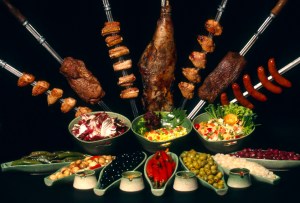
CNN: In-vitro meat – Would lab-burgers be better for us and the planet?

Quite the future!Here is an article I found on CNN about in-vitro meat. Of course at this stage there is no way of knowing whether this has a future or not.

There are some interesting arguments brought up in this article, that can make some think that in-vitro meat is a possible alternative. Yet, they do not mention anything about the cost of producing meat in such conditions, but my guess is that it will not be cheap, and certainly not cheaper than the lesser meat cuts it is supposed to replace; and the production cost of in-vitro meat is probably its main challenge for future marketing purposes.

My view is that animal protein will become much more expensive in the future (see my previous article “The future price of meat and fish: up”), and that Westerners do not need to eat as much meat as they currently do, anyway.

The irony is that in-vitro meat has the support of some environmentalists, while it depicts a situation where humans would almost not be in touch with nature anymore when it comes to meat. So much for natural food!

I will leave it up to you to decide what to think.