Dealing with complexity

Looking at the future of food and farming goes far beyond agriculture. It comes down to looking at the future of humankind. Balancing future supply and demand of food is an exercise that includes many disciplines and dimensions, probably more so than any other human economic activity. Anything that affects life and its level of prosperity must be taken into account. Feeding the world is not just a matter of production. Of course, the ability to produce and to keep producing enough food is paramount, but there is more to it than that. The consumption side is just as important. Demand will depend on the diet, which also depends on how much money people have available to pay for food.

Total future food demand is a combination of which foods and food groups people in the various regions of the world will buy and eat. This is a function of demographic, economic, cultural, religious and ethical factors. If future demand is about consuming according to the nutritional needs of a human being, clearly the situation will be different than if people demand twice as many calories and protein as the actual nutritional needs. The relative share of animal products in the total diet will also change the situation in terms of production and of production systems. Food production must adjust to the demand and do its best to meet it, but not at all costs. Therefore, it is essential to optimize food production at the global level so that the largest quantity of food can be produced at the lowest environmental cost. At the local level, production depends of course on natural conditions, but also on economic, political and cultural conditions as well. This may be the most profound change that we must deal with: feeding the world of the future is a global exercise. As more and more people worldwide have more and more money to spend on food, demand is now global, and therefore production plans must also be global. The times of producing food simply for the own people and exporting surpluses is over. Markets will now react to any event that will affect production or consumption somewhere else. Borders do not make this shift in thinking easy. It is always tempting to think that having one’s house in order is enough, but it is not. What happens in other countries on the other side of the world will affect us just as well. Why is that? Just one word to explain it: markets. There used to be a time, not so distant when if there was a drought in Russia, China or Brazil, markets would not react as strongly, and anyway not so much in the media, as we have seen over the past few years. This was the case because only a minority of the world was consuming large quantities and that minority did not have competition. Now the competition is wide open. Markets will keep reacting on this and the relative price levels of various foods will influence how much of what is consumed and where. We will see eating habits change because of this economical aspect of food supply.

At the same time, food production is also adapting to a changing environment, and to face its future challenges. The amount of new developments in technology, access to information and knowledge and in decision-making tools is amazing. Innovation is flourishing everywhere to solve environmental issues, to cope with new energy and water situations. The dominant themes are the reduction waste of all sorts, as well food as agricultural inputs and by-products, and the prevention of the release of harmful contaminants. Innovation is developing towards better and more efficient systems that must ensure the future continuity of food production and, at the same time, keeping food affordable for consumers. Interestingly enough, many innovations that will be useful for agriculture do not originate from the food sector. Food producers will need to be curious and look beyond the field to prepare for the farming of the future.

Clearly, the number of factors affecting both consumption and supply are many. To add to the complexity, many of these factors are not of an agricultural nature. Many of them originate from the population, its activities and its needs for all sorts of goods. I mentioned earlier that what happens in one region affects others, but the natural resources markets, such as energy, metals and minerals, that must meet demand for non-food consumer goods also affects agriculture and its production costs. Although many see rising costs first as a threat, I tend to welcome them, as they always stimulate innovative solutions to increase efficiency and reduce waste. Two examples show that it works. One is the car market in the USA that shifted from gas-guzzlers to high gas mileage vehicles since gas at the pump became much more expensive than it was only 5 years ago. The second one is food markets. Had you heard as much about food prices, food security or food waste before the food price hikes of 2008 and 2012?

In my work, I always try to make my clients and audiences aware of how everything that has to do with food is interconnected with many other sectors, and how economic, demographic and political events are linked to food security or how they might affect it in the future. That is an underlying them in my books.

Even, within the food and farming sectors, organizations do not realize enough how their future will be influenced by other food productions and vice-versa. I always get reactions of surprise at the magnitude of the interconnection and the interdependence with these factors, and how they affect their activities indirectly. It is a normal reaction, as most people tend to focus on what has a direct connection with their activities. After all, that is why I do what I do: to help them see and decipher this complexity, and understand what actions to take to adapt and prosper. I never shy away from show the complexity. My audience needs to get a flavor of the any dimensions and many layers involved. However, I always take a practical approach and show them that complexity is not the same as complicated. Deconstructing the complexity actually works well to show the many levels of actions there are. It helps my clients connect the dots between their activities and what will affect them and how. It gives them a level of confidence in how to deal with the future and take action. I also like to warn against oversimplifying, which is another tendency that I observe from time to time. The mainstream media is rather good at that. But I also get questions that sound like those who ask hope that I have a magic wand and will be able to give them a foolproof recipe for success. That simply does not exist.  If preparing the future were easy, nobody would even talk about it. It would be done. It it was easy, I guess many of the organizations that have been involved in agricultural development and food aid for decades would have already succeeded, and they would not exist anymore. Yet, they still have to keep up with their work.

Feeding the world is work in progress. Developing the right actions is complex, but not as complicated as it sounds. However, the true difficulty is in the execution, and in particular bringing other stakeholders with different agendas and different views on board to contribute to the success.

Copyright 2013 – The Happy Future Group Consulting Ltd.

Thinking of a better agriculture in a better world

Recently, I joined a group on LinkedIn called “Future of Agriculture”. One of the discussion topics, which caught my attention, was “What’s your dream for the world with agriculture as a theme?” Of course, this is quite a broad topic. I decided I would write here my thoughts about the discussion as concisely as possible. Therefore, here is what I believe is important for the agriculture of the future.

Agriculture must provide food today and tomorrow. Keeping the potential to feed the world for future generations is not an option; it is a necessity. Agriculture must produce in a sustainable manner. It must meet both the demand for food, but also be able to continue meeting future demand. It must take all necessary actions to ensure there will be enough water, enough soil, enough organic matter and enough nutrients to keep producing. It must also make sure that it does not contaminate the water and the soil. Agriculture must be sustainable from an environmental point of view, but it also must prove sustainable financially and socially. Without agriculture, there cannot be prosperous societies. To have agriculture, the world needs farmers. Farming must be an attractive occupation that allows those who practice it to make a decent living. This is more important today and in the future than it has ever been before.

Future food production must be innovative. Innovation is essential to solve current and future problems. It is the main trait of the human genius. Finding new ways of doing a better job and meeting all the future needs is a must if humanity wants to succeed in feeding its growing population. However, innovation is not the same as high-tech. Innovations do not need to be complicated and expensive. Innovation must integrate science, experience, common sense and practicality. Innovation does not oppose the past and the present or the future. It comes for the search of the best of all worlds. Innovation is useful only when it solves actual problems. It is not a doctrine of its own. The purpose of innovation is not about R&D for the sake of new products that help boost sales of those who market them. Its primary purpose is really about helping others succeed. Innovation must start from the market. What does the customer need to do a better job? The answer will be much more successful and better accepted if it starts from the market end, instead of being pushed onto the customers. This leads me to the next point: the necessity of being market-oriented.

Market orientation is the best approach for any type of business activity. It is true for R&D, but it is true for farming, too. Developing and producing by investing large amounts of money are much more effective and cost-efficient when the markets and the infrastructure are there. Offering what customers need has a much higher level of success than trying to convince buyers who are not very interested. The prices and the margins are always higher in a pull strategy. Market orientation also means that the infrastructure to bring the goods to the final users exists and that it actually works. One of the main scandals in today’s agriculture supply chain is the postharvest losses. It is outrageous that food that has been produced at the high cost of money, labor, water, energy, inputs and the farmers’ time rots in the fields or in deficient storage while it is good for consumption. It is the responsibility of all partners in production, supply chain and government to co-operate by organizing operations, so that food reaches those who need it.

The agriculture of the future needs to be developed in a pragmatic manner. There is no fix-it-all agricultural system. Food production depends on climate, landscape, soil types, water availability, need for sustainability, land rights, as well as the cultural, social, economic and political environment. The types of crops and animal production will depend on these factors. If systems cannot always be transferred from one place to another, knowledge and skills can be. Human intelligence and sharing is what spread progress. If farmers and all players in food production must be pragmatic and choose among the arsenal of tools and techniques what fits best in a particular situation, there are no boundaries in helping others to succeed. The energy must be spent to level up performance, not on defending a system for ideological or mercantile reasons. If the agriculture of the future succeeds, all of humanity will succeed. If it fails, humanity will have to deal with unrest, riots, hunger and possibly wars. Pragmatism is what will help the farmers of the future optimize food production around the world by making decisions that are in the best interest of all the partners from farm to table. Pragmatism is also what will deliver the highest financial return for them. However, for pragmatism to beat partisanship, bias and short-term interests, outstanding leadership will be paramount.

The leaders of the future will identify the right actions and execute them. They will cut the rhetoric and focus on delivering result on all fronts: financial, social and environmental. They will crystallize the energies around the objectives that serve all on the short term and on the long term. This will not be an easy task as the reasons to choose the path of least resistance are many. It will take courage, vision and the ability to convince the opposition. In history, great leaders have always sacrificed their personal interests, their personal safety and comfort for the good of the group. Such leaders are rare, but they exist, at all levels of society. They need to rise and improve the way we currently do things. They will succeed only if the average person is willing to make the right changes, too. This is not an easy task, either, but the alternative is even worse. The great leaders of the future will show the rest of us how things can be. They will give others the courage to implement the change and make them believe in the future. They will have to lead by example. They will have to reconcile instead of dividing and polarizing. When it comes to food production, they will not only help develop an efficient and sustainable agriculture, but they also will make sure that consumers change their eating habits where it is needed. They will help educate consumers about proper nutrition and moderation, while keeping food a positive experience, as well for the senses as for it social purpose. They will ensure that proper nutrition protects the health of their people. They also will give agriculture its rightful place in society and ensure that producing food is a respected and attractive occupation. They will take all actions to help food producers to succeed. They will reconcile urban and rural areas. They will make sure that people understand where food comes from and what it takes to feed for prosperity. They will work against waste.

Every waste is a loss of efficiency. With a population of 9 billion coming in the next few decades, waste will not be an option anymore. As the number of people increases and their needs have to be filled, the margin for error will shrink. The consequences of 9 billion behaving badly will be much worse that when there were only 3 billion people on Earth doing that. Every waste of resources will be quite costly, financially, socially and environmentally. The only way to reduce waste will be by being more efficient.  This will be true for food, as well as for water, for energy, for agricultural inputs, for soil, for organic matter and for biodiversity. Preserving and replenishing will protect humanity from a situation of depleting resources, which is where it is currently heading. The consumption and depletion society has no future. Future food production and consumption must be aimed at maintaining and preserving the potential of agriculture.

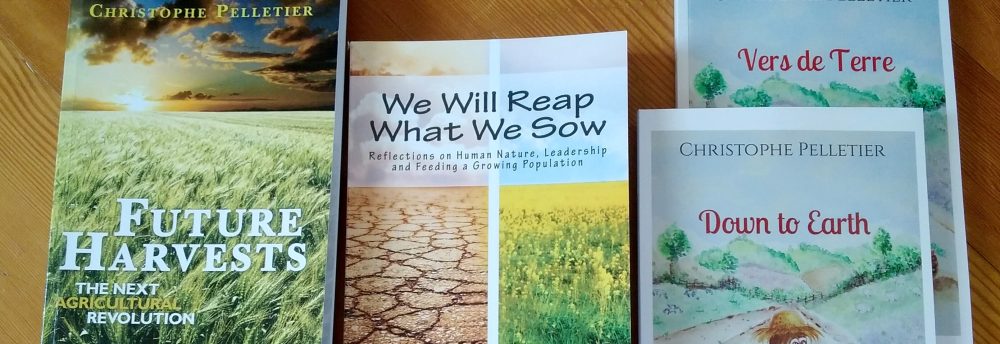
Those who are familiar with my work know that sustainability, innovation, market orientation, pragmatism, leadership and efficiency are the 6 principles that I had gathered under the acronym of SIMPLE in my first book, Future Harvests. In my second book, We Will Reap What We Sow, I developed and discussed the characteristics of proper leadership and the vision required to rethink food and farming to succeed in the future.

Even if future solutions need to be adapted to their specific local situations, these 6 principles apply everywhere and need to be implemented in a concerted manner by all regions.

Copyright 2012 – The Happy Future Group Consulting Ltd.

The Sustainability Dilemma

Although almost everyone seems to agree that our world needs to be sustainable (what is the alternative anyway?), making it happen seems much more challenging. The good intentions have difficulties to turn into action. The reason is simple. To make human activities sustainable, we will need to accept some serious trade-offs. That is where it hurts. There is the dilemma. Are we willing to change and sacrifice on the superfluous today to have a bright future, or do we want to keep instant gratification as the way of life and risk to lose it all later? Even though the answer to this question is obvious, it is only human to choose the short term. The issue in the background is one of change, not so much one of a choice about sustainability. To understand why this is so, one needs to realize that fear of change is not about change. It is about the fear of loss. This fear is even stronger when there is little certainty about what will come next.

Making the move towards sustainability presents many short-term challenges. There is a lot of money at stake, but this is not just about the financial aspects of the economy. There is a social cost, too. Changing the economic model into a sustainable one means that many jobs will be threatened. In these times of economic hardships, the fear of unemployment and of the social unrest that would result from it is reason for many politicians to be reluctant to take drastic action. They also think about their jobs. Sustainability is about the long term. It is about later and somewhere else. On the contrary, personal consequences of the change are here and now. There is no need to look any further to understand why there is resistance and inertia. In the debate about sustainability, shortcomings appear in several areas.

A first area is the lack of strong vision from the leaders about which alternative to offer to the current consumption society. Actually, consumption society is not an accurate description. The purpose is not so much about consumption as it is about buying stuff, use them or not, throw them away and buy new stuff instead. Clearly, with more people having more disposable income, this is going to hit a wall. As more people want to have a piece of the shrinking pie, and as finite resources deplete gradually, excessive consumption and waste are not going to last for much longer. It is simple math and it is common sense. Supply and demand will readjust markets by sending prices up. High prices will make consumption slow down, and so will the world economy. Regardless of which one between market forces or the environment will cause the current system to collapse, the economic model will change. The time has come to bring a clear vision for an alternative system. The alternative must ensure that the economy is prosperous, that people have work that pays well enough for them to cover their needs and to ensure that human societies can have a future for generations to come. Until this day, nobody has come with a vision and a road map that make the change acceptable here and now. This is why all international conferences lead to little action. As long as this is the case, the only thing that will force a change in attitude is a major crisis in which the wealthy are at risk of losing what they have. As long as crises touch only the poor and the powerless, nothing really changes, unfortunately.

A second area of weakness is the lack of collaborative action. Every group of stakeholders look at its interest first, while the proper approach would have to be altruistic and empathic. This is another case of the here and now vs. the elsewhere and later. If we want to succeed, it is necessary to transcend differences and borders. We need to find ways of going beyond simple accountability, and impose co-responsibility. This is much easier said than done.

A third area to address is the numbers. In the end, it is about money and jobs. Actions to make the world sustainable must also work financially. If change is not sustainable financially, change will not happen. If businesses go bankrupt and if people are at risk of losing their livelihoods, they will not go for the change. The new economic model needs to consider this. The transition towards a better world needs to consider it, too. The externalities need to be internalized in some way, but the new model must be robust as well, otherwise all efforts would be for nothing.

A fourth area is about definitions. What is sustainability? How can we monitor and measure all human activities to know which ones are within sustainable limits and which ones have no future? How and where to draw the line, and how to enforce it? In the case of agriculture, every particular activity has its own specific impact. Depending on the nature of the environment, the nature of the impact and the range of sustainability vary, too. Monitoring must be tailor-made to each particular situation.

A fifth area is the consumer’s behavior. It is impossible to address sustainability without addressing consumption habits, and in particular excessive consumption and waste. As long as consumers will not eliminate the use of products that have an unsustainable effect on the environment, very little will improve. Putting the emphasis on production only is not enough. Production methods certainly can improve, but a substantial share of the damage is the result of consumers wanting more of what is not so good. Consumers are the largest group of influence. They are the people. What and how they consume is democracy in action. Businesses and governments follow their lead to quite some extent. When the majority chooses for a different economic model, things will change fast, but for now, the majority is still choosing for the old model.

Whether our world will move towards sustainability or choose a more hazardous way depends on us all. It depends on how we want to solve the dilemma that we face. The choice is not easy, but it is essential. There are many questions still unanswered, simply because they have not been asked. These important questions are mostly of a practical nature. They are more about how to make the system work not only environmentally and socially, but also financially. If businesses tend to focus mostly on financial aspects, environmental and social movement tend to neglect it too much. Like everything else in life and nature, it is about balance.

In my latest book, We Will Reap What We Sow, I address in much more details many of these questions and discuss the value of possible alternatives in relation with our future ability to feed a growing population.

Copyright 2012 – The Happy Future Group Consulting Ltd.

When externalities cannot be externalized anymore

Externalities are costs, or benefits, that are not included in the price charged for a product. If a cost is not included in the price, it represents a negative externality. If a benefit is not included, the externality is positive. The concept of externality is particularly important to determine whether an activity is sustainable. For instance, if an industrial activity pollutes and causes harm, there will be consequences, and costs. As it takes many years for environmental problems to become obvious, the cost of repairing the damage caused by pollution is not included in the cost of the goods produced by the industrial activity in question. However, there will be a day when it there will be no alternative but to clean the damage. That cost is the externality.

Every activity that pollutes without cleaning the contaminants is a negative externality. Everything that damages physically the environment and undermines the sustainability of food production is a negative externality. Every activity that depletes essential resources for the production of food is a negative externality. In this highly industrialized world, the consequences of economic and human activities, slowly add up. Nature’s resilience makes it possible for damage to remain unnoticed for quite some time. However, the ability of Nature to repair the damage shrinks, as the damage is continuous and exceeds Nature’s ability to cope with the problem. As the population increases, the level of human and economic activities intensifies further. There will come a time when Nature simply cannot handle the damage and repair it in a timely manner anymore. The buffer will be full. When this happens, the effect of negative externalities will manifest immediately, and it will include the cumulated damage over decades as well. It will feel like not paying the bills for a long time and then having all belongings repossessed. Humanity will feel stripped and highly vulnerable. The advisory services company KPMG published a report in 2012 stating that if companies had to pay for the environmental cost of their production, it would cost them an average 41% of their corporate earnings. These costs are currently not included in the pricing. That is how high negative externalities can be. Looking at it from the other way, companies would still deliver 59% of their current earnings. Repairing the damage and still generate profits shows that sustainability is financially achievable. On average, the profits would only be lower, but the impact would vary substantially between companies. Businesses that create high negative externalities will show much bigger drops in profits, than business that do the right thing. The only ones who would have to get over some disappointment would be Wall Street investors and all those who chase capital gains on company shares. The world could live with that. Investors should put their money only in companies that actually have a future.

All the fossil fuels that humans burn are gone forever. It is not renewable. All the water that farmers use for food production and exported away from the production region is gone forever. Exporters in arid regions will have no choice than disappear, produce only for the local markets, or if that is economically sensible, import water from surplus regions. All the minerals that are used as fertilizers and that are exported from the fields in the form of leaching or in the form of agricultural commodities are gone forever. New supplies produced either with non-renewable energy sources or from mines that are slowly depleting must replace the loss. Organic matter that is lost from soils must be replaced, or it will be gone forever. Soil that is lost through erosion and climate is gone forever, unless new soil is brought back on the land or very long-lasting repair techniques are applied. Every gene that is lost is lost forever and might be missing dearly. Every species that goes extinct is gone forever, as well as its role in the ecosystem. Every molecule of greenhouse gas that goes into the atmosphere is gone out of human control forever. It might bring a heavy cost in the future.

Since everything that becomes rarer also becomes more expensive, the externalities are going to weigh on the economics of food and agriculture, as well as in any other activity. There will be an oil price for which the current machines will be too expensive to operate, and for perishables to be too costly to truck with fossil fuels over long distances. The economics of water will change the purpose of farming in arid regions. It will alter the agricultural policies and force farmers to innovate new irrigation techniques. The economics of minerals and organic matter will change the location of animal farms and manure containment systems. No minerals will be lost. Manure will become a competitive fertilizer, as chemical fertilizers will become much more expensive to produce. The logistics of manure will change and the location of animal farms will change to allow an optimal cost efficiency of raw material for feed and access to fertilizing elements and organic matter. Farms will not have to be mixed, but the agricultural landscape will restore an integration of crop farms with animal farms.  Agriculture will be sustainable only if completes all the cycles. In the past decades, the cycles of minerals, of organic matter and of water have been open. Food has been produced in one place, and then moved over long distances and the waste and surpluses have accumulated somewhere else, while the original production areas were slowly depleting. New systems and new organization will work on closing the cycles again to bring back what agriculture needs to function. The economics of energy will change the chemical industry and its products. Everything will aim at using as little primary resources as possible and maximize the efficiency of inputs by both bringing entirely new products and application techniques. It will be true for energy, water, fertilizers, chemicals, medicines. The new focus will be about using just what is needed when it is needed and only in the dose that is needed, and no more than that. It will be all about precision agriculture, precision animal husbandry, precision packing, precision manufacturing, precision processing and precision logistics.

When externalities manifest immediately, there will not be the time discrepancy between financial results and environmental results. There will be no excuse anymore to say that there is no evidence of consequences. There will be no possibility of creating the confusion, either. When pushed to the limits of its resilience, Nature will bring the financial and the environmental at the same timeline. It will be stressful. Doing the right thing environmentally, or in other words, producing sustainably, will be the best, and only, short-term strategy for financial sustainability.

Copyright 2012 – The Happy Future Group Consulting Ltd

The fertilizer of the future?

Among the many challenges that the agriculture of the future faces, soil fertility ranks high on the list of priorities.

Originally, most farms were mixed. They had land to grow crops and they had animals for milk, eggs and meat. Markets were mostly local, and food was consumed in the villages and towns near the farms. Food waste was fed to farm animals; the manure produced was mixed with straw and returned to the fields where the crops had been grown. Over time, farming has evolved. Agriculture has become much larger scale, global and specialized. This evolution has been driven by the use of oil, mechanization, and by the development of mineral fertilizers.

That model, which has been greatly based on cheap energy and resources, needs to be looked at critically as the economic environment changes. Energy is no longer cheap and, like oil, the resources used for the production of fertilizers have been depleted. New solutions are required to be able to produce optimally.

The production of nitrogen fertilizers requires a lot of energy. According to estimates, it uses 5% of the world’s natural gas production, and half the fossil fuels used in agriculture. Because nitrogen is quite mobile when dissolved, as this happens when it rains, a large amount of these high-energy-consumption compounds are lost. An estimated 50% of the nitrogen spread on crops leaches through the soil. It ends up in the water system. The reserves of phosphates, another important mineral fertilizer, are facing depletion. This might happen in 20 years from now. With the development of precision agriculture, the waste of minerals can be reduced. With the development of satellite imaging indicating the mineral status of a field, and the local variations within the field, it has become possible for farmers to bring just the right amount of the right mineral at the right time and at the right place. This follows somehow a similar thinking as fertilizing plants in hydroponics operations where crops are produced without soil and fed a mineral solution drop by drop.

A consequence of the specialization between crop farms and intensive animal farms is the rupture of the organic matter cycle. Large monoculture farms have suffered soil erosion because of a lack of organic matter, among other reasons. In soils, the presence of organic matter increases moisture retention, increases minerals retention and enhances the multiplication of microorganisms. All these characteristics disappear when the quantity of organic matter decreases. A solution to alleviate this problem is the practice of no-tillage together with leaving vegetal debris turn into organic matter to enrich the soil. This has helped restore the content of organic matter in the soil, although one can wonder if this practice has only positive effects. Tillage helps eliminating weeds. It also helps break the superficial structure of the soil, which can develop a hard crust, depending on the precipitations and the clay content of the soil. Possibly, in the future the use of superficial tillage could become the norm. Deep tillage, as it has been carried out when agriculture became mechanized, has the disadvantage of diluting the thin layer of organic matter in a much deepen layer of soil. This dilution seriously reduces the moisture and mineral retention capacity of soils, thus contributing to erosion as well, even in organic matter-rich soils.

The removal of farm animals from specialized crop farms requires the systematic use of mineral fertilizers because farmers do not have access to manure and the minerals it contains, even though most of these minerals originate from the crops farms.

At the other end of this interrupted cycle of manure, intensive animal farms do not suffer a lack of organic matter and minerals. They have the opposite problem. They have too much of it, and not enough acreage, if any, where to spread it. This leads to accumulation of manure and other related problems, such as stench, high concentrations of minerals in the soil and eventually in the waterways and drinking water reserves.

Since nothing is lost, what has happened to the minerals from fields and from fertilizers? They have been transferred to other places via the global trade of agricultural commodities. Many of these commodities are used to produce animal feed. Phosphate in European pig manure may come from Asian manioc farms. Therefore, the best way to find out where the minerals are is to look at where intensive animal husbandry farms are. As mentioned earlier, nitrogen is washed away into the water system because of its mobility. Unlike nitrogen, phosphates are not mobile in the soil. They will accumulate, which also leads to a loss of soil fertility, eventually. The other area of concentrations of these minerals is in city sewers, and in the soil of slums. Since the purpose of agriculture is to produce food, and since consumers are increasingly concentrated in urban centers, the exportation of minerals is actually gathering momentum out of rural areas.

In the future, we are going to see a new look at fertilization. The economics of agriculture will change. This is inevitable, because the cost of inputs will increase. This will be a direct consequence of the increase of the price of oil, and of the depletion of phosphates reserves. This change of economics will drive renewed interest for manure, and for sewage. These sources will become attractive and competitive, as they contain large amounts of minerals directly available. Because of their nature, they have a high content of organic matter. One of the most efficient ways to remove nitrates from water is to grow plants with it. One of the main sources of phosphates will be manure.

There is little indication that the human population will return to the land, but animal farms can be moved rather easily. After all, they already are segregated from vegetal production. The increased need for manure will call for a relocation of animal productions. In an expensive-energy economy, having the “fertilizer factory” on site, or at least much closer than today makes a lot of sense. This is especially true because manure contains a lot of water, although there are substantial differences between productions. Transporting water is expensive. Mixing crops and animal productions again on farms will also allow the inclusion of vegetal debris together again with the feces and urine, producing a higher dry matter content, with limited transport costs between the field and the “fertilizer factory”. Regardless of the size of the farms, I expect to see a relocation of animal production units on agricultural land. They will be spread more evenly in the landscape than today. This will decrease the density of farm animals in currently high-density areas to levels that will allow a better control of environmental issues, as well as reduce partly the risks of transmission of animal diseases. Animal production units will reappear in areas where they had disappeared because of the fertilizer that they will provide.

This evolution will also come together with a new approach of manure storage and treatment. Open-air lagoons like those that we know today will simply cease to exist. The changed economics of energy will make the capture of gases financially attractive. Manure storage units will be covered; the biogas will be collected to be used for energy purpose, for the farm and the local communities. The solid and the liquid fractions of the manure will be processed and transformed to provide organic matter and the fertilizing minerals necessary for crop production. The location of the “manure units” will be influenced by the type of animal production, and therefore by the physical quality of the manure. There will be a logistic optimization of manure collection to the crop farms. It will be based on efficiency and optimization of resources. Therefore, the new farm structure will be efficient, as much financially as environmentally. Similarly, open-ocean fish farms that currently do not collect the feces will see the financial value in recuperating the fish waste and sell it. In cities, there will be an increasing interest to recycle the sewage. The purpose will be to recuperate the organic matter and the minerals it contains. A similar approach for human waste will apply as for animal production units as I described above. This will also be integrated in the future approach of urban farming, as it will provide the necessary nutrients for an efficient urban food production. It will be a source of revenue to the cities.

In rural areas and in urban areas, organic matter and fertilizing minerals will become strategic activities. They will serve the purpose of feeding sustainably the world population.

Copyright 2011 – The Happy Future Group Consulting Ltd.

The locavore’s dilemma

There is a growing trend, or at least a growing noise in favour of eating locally produced food. The “locavores” as they are called, claim that 100-mile food is the way to a more sustainable agriculture and consumption. Is this approach realistic and could it be the model for the future?

This movement is rather popular here in Vancouver, British Columbia. The laid-back residents who support the local food paradigm certainly love their cup of coffee and their beer. Wait a minute! There is no coffee plantation anywhere around here. There is not much barley produced around Vancouver, either. Life should be possible without these two beverages, should not it? The disappearance of coffee –and tea- from our households will make the lack of sugar beets less painful. This is good because sugar beets are not produced in the region. At least, there is no shortage of water.

But this is not all. There is no cocoa plantation around here, and believe me, there are many people who are addicted to chocolate. British Columbia does not produce citrus or other warm climate fruit. If we are to become locavores, we must say goodbye to orange juice, to lemons, to bananas. Even the so popular sushi must disappear because of the lack of rice. There are no rice fields in this area, and neither are there wheat fields. The Asian population certainly would have a hard time eliminating rice from their diet. The lack of wheat means no flour; and no flour means no bread, no pastries, and no cookies. The carbohydrate supply is going to be tough. If we must consume local, our lifestyle is going to change dramatically. Potatoes and cabbage is the way of the future. But before going all local food, the local locavores must realize that British Columbia produces only 48% of all the food its inhabitants consume. One out of two locavores would have to starve. Going exclusively local would also affect deeply the source of animal protein. Most of the animal feed is made of ingredients that come for much farther than 100 miles. The chickens and eggs would become less available. Farmed salmon, BC’s largest agricultural export could not use the type of feed they currently use, as fishmeal and fish oil come from Peru and vegetal oil comes from farms located far away. There would go many jobs with very little alternatives. If we look beyond food, other agricultural products such as cotton and wool would not be an option anymore. Cars would disappear, because the main component of tires, rubber, is not produced under this climate. The 100-mile rule will solve traffic problems. If local consumption is the rule for food, should not it be the rule for everything as well? China would probably have different views about this. Not only would their manufacturing collapse, but also if they have to produce food within 100 miles of the consumer, they would have to give up importing agricultural commodities. For them, a true locavore system would mean famine. The same would be true here in British Columbia. When people are hungry, they are not so picky about the distance from the producing farm.

The problem with concepts such as local consumption is that the basic idea has some value, but the idea quickly evolves into an ideology, and ideologies tend to make their followers stop thinking pragmatically. Today, the idea of eating locally in a place like Vancouver is possible because supply easily meets demand, thanks to the 3,000-mile foods. This is ironical. If the distance to market has to be within 100 miles, farmers in low population density areas, such as many regions of North America, South America and Central Europe, would have a different type of problem. They would produce an abundance of food, but because there are not enough people to consume it locally, the law of supply and demand tells us that the price of agricultural commodities would plummet, food would stay in storage and farmers would go out of business, while people in China, and in British Columbia, would suffer hunger. Clearly, the 100-mile diet needs some amendments.

Intuitively, it sounds logical that locally produced food has a lower carbon footprint than food that comes from 2,000 to 10,000 miles away. However, this is only partly true. The mean of transportation affects the carbon footprint. The environmental impact of transport is much higher for road transport than it is for rail transport, which is also higher than water transport. The type of transport also depends on the type of commodity brought to market. Perishables need to reach consumers as quickly as possible for shelf life reasons, while dry goods, such as for instance grains and oilseeds do not face the same kind of deadline. The quality of the logistics is also crucial to reduce the carbon footprint. A fully loaded truck is much more efficient than a local truck dropping small quantities in many places, thus driving around most of the time with empty space in the trailer.

The emphasis should not be so much on local as it should be about the search for efficient and low environmental impact. More than the distance from the farm to the consumer, it would be more useful to provide consumers with information about the actual carbon footprint of the products they buy. They would have the possibility to make the right choices. Retailers, too, would be able to make decisions about their sourcing strategies. Clean products and clean producers need to be rewarded for doing a good job. Here in Vancouver, local food products are more expensive than similar offerings from California, Mexico, Ecuador or Chile. How do you convince families with a tight budget to spend more for local products that look pretty much the same? This problem needs to be addressed. Currently, farmers markets are much about marketing. They sell the experience as much as their production methods. Only a wealthy minority can afford to buy on these markets. The prices are not based on production costs plus farmers income. They are as high as possible, because the farmers can ask these prices. The wealthy city dwellers are willing to pay a substantial premium above what they can buy from the local supermarket. In this relation farmer-consumer, the price bargaining does not take place. If these farmers were to try to sell to a grocery retail chain, they would never get the prices they get from the consumers who will not haggle about the price. This is why more farmers try to sell directly to consumers: they make more money that way. However, this might change in the future. A number of retailers are working towards offering “farmers market” products into their store. This already makes market farmers nervous.

Is local production for local markets the way of the future? My answer is that it partly will be and it partly will not. I do expect a shift of the location of production for perishables. Consumer habits will change, too. In the West, consumers have been spoiled. They can eat anything from anywhere at any time of the year. This luxury probably will not be affordable for long anymore. The superfluous will naturally be eliminated.

As the economics of energy, and therefore of food, will change, producers will increasingly locate their operations closer to cities; and even inside cities. Urban farming is a growing activity. Although it started mostly in poor neighbourhoods as a way of having a small patch of land for personal consumption, more sophisticated and efficient systems are being developed. My expectation is that production, and consumption, of vegetables and fragile fruit (for instance strawberries) will gradually become more integrated in the urban landscape than they are now. I also think that we will see animal productions, such as fresh dairy, poultry meat and eggs relocate closer to consumer markets. An interesting development is aquaponics, the combination of greenhouse produce with fish production in tanks. The production of non-perishables will not relocate. It does not have to. What will probably change is the transportation infrastructure in many areas where these commodities are produced.  This is good news for coffee drinkers and chocolate addicts. After all, transport of commodities over long distance is not just the result of cheap oil. The Silk Road and the spice trade by the Dutch took place before mankind even knew about oil. Trade has always been a force of progress for humanity. It helps an increasing number of people to have access to goods that make their lives better. The rules of trade may not always be fair, but like all human activities, it is a work in progress. Limiting our food supply to 100 miles would be a regression. Subsistence agriculture has not demonstrated that it could feed the world. Most of the people suffering of hunger live in subsistence agriculture areas.

(This topic is one of the many that are presented and discussed in my second book, We Will reap What We Sow)

For more on similar topics, please visit my other website The Sensible Gourmet

Copyright 2010 – The Happy Future Group Consulting Ltd.

Consumers shape food production systems

Although it is tempting to think that food production systems are created by agribusiness, they depend greatly on the choices and the attitude of consumers and society. For humans, food is not just about nutrition, but it is loaded with a high emotional content.

Consumer choices are highly irrational. To demonstrate this, here are some examples.

When the mad cow disease, or BSE, hit the UK in 1996, beef consumption dropped, but the behavior of consumers was odd. A leading retailer put British beef on sale at 50% off the normal price. They had their best weekend sales ever by then. When asked why they had bought beef, while there were concerns about health risks, some consumers gave answers such as “At that price it is worth taking the risk” or, even better, “ I will freeze it and eat it once the mad cow crisis is over”! At the same time, customers’ visits to the leading fast food chain drop sharply and beef burgers were not in demand, although their beef was from the Netherlands, a country free of BSE by then.

In Europe, mostly in France, consumers used to demand veal to be white. Not slightly pink, just plain white. To achieve this, calves were fed a milk powder diet, which kept them anemic. Yet, at some point, consumers denounced this technique as being against proper treatment of animals. The demand of white meat with a normal diet could not be reconciled. It took years before consumers finally understood that veal was supposed to be pink.

For most customers, white eggs are perceived as being from intensive cage production, while brown eggs are perceived as being more “natural”. Everyone with knowledge of the industry knows that the color of the shell has nothing to do with the nutritional quality of the egg. The belief that the egg color indicates a difference persists, though.

Some blind tests carried out between “industrial” and free-range chicken meat carried out in the Netherlands in the 1980s showed interesting results. When consumers were not told which was which, they could not clearly taste a difference, while when they knew which meat was from which production system, they overwhelmingly gave the preference to the free-range chicken.

Here, in Vancouver, there is a strong trend towards organic foods produced locally. Farmers markets flourish and the environmentally conscious consumers choose to buy their “natural” food on these markets. Ironically, many of them drive in their gas-guzzling SUVs to go there. So much for caring for the environment.

Who, with a rational mind, would choose to eat junk? Yet, junk food is quite a popular item in North America, and it has been a growing trend in many European and emerging countries as well.

In the case of tobacco, not a food, but an agricultural product nonetheless, the warning on the package is quite clear. Yet, some people decide to smoke.

The list could continue and I am sure that everyone has more examples of irrational behavior. Consumer demand (both the rational kind as the irrational one) determines what farmers and food companies produce and sell. In this regard, consumers also share a responsibility in what is produced, how it is produced, where it is produced and how it is distributed to them. Blaming retail or the agribusiness alone for the kind food systems that are in place is unfair.

Of course, it would be interesting to imagine what people would eat if they were rational, and what impact on our food production this would have. A rational diet would follow proper nutritional recommendation, and to this extent would follow the same principles as those used in animal nutrition. However, this would not have to be as boring a diet as what animals are fed. A rational diet does not need to be a ration. After, the human genius that is cooking would help prepare delicious rational meals. It would be like having the best of both worlds. The emotional, social and hedonistic functions of food would remain. The key would be about balance and moderation. If people were eating rationally, there would not be any diet-related illnesses. There would not be obesity. There also would be a lot less food waste. This would improve the level of sustainability of agriculture.

Will consumers become more rational in the future? I do not think so, but I believe that they will become better informed and more critical over time. Especially with the rise of social media, information circulates much faster and trends can gather momentum faster than in the past. More programs for healthier eating are currently running and action is taking place at many levels. In particular, schools are a place where much can be achieved. One can wonder how long the “lunch money and self-service system” will last. Having schools placing vending machines selling items that are highly unbalanced foods and leaving the decision over to kids to decide what they want to eat was of course a disaster waiting to happen. I cannot believe that anyone would expect kids to consciously making the choice of spending their lunch money on broccoli and mineral water. Kids will choose what they like best, not what is best for their health. They need adults for guidance.

Attitude towards food is changing all over the world. Currently, I can see two major trends growing. One is taking place in North America and the other is happening in emerging countries.

In North America, consumers are waking up and starting to question the way their food is produced. This is a major change compared with their attitude until a few years ago. When I moved to this part of the world in 1999, I was amazed by how easy consumers, and retailers, were for the food industry. Consumers simply seemed to consume without trying to know about production methods. Hormones, antibiotics or GMOs (genetically modified organisms) seemed to be accepted. This was a sharp contrast with what I had known in Europe, where all of the above was meeting strong resistance from consumers and retailers. What I currently see happening currently in North America reminds me strongly of what I had seen happen in Europe 20 to 30 years ago. The similarities are almost disturbing. Consumers are losing trust in government agencies, and retailers seem to be the ones to champion food quality, traceability and production methods. This will have much more profound consequences in the way food is produced in the USA and in Canada than the agribusiness seem to realize, or is willing to admit. The population is aging, the generations are changing and the values about food are shifting. The current opposition is not a short-term fad. Consumers will make different choices. Some food producers see that and are already adapting, but many producers still seem to think that opposition will pass. I believe that they are in for a surprise. The expressed plan of Wal-Mart to buy more from small and mid-size farms, to reduce waste, and to develop sustainable sources of agricultural products is a very clear signal that business is changing!

In emerging countries, consumers are changing their eating habits, too, but for a different reason. They now have better wages and more disposable income. The previous “”subsistence” diet made of mostly grain, such as rice, wheat or corn, are now including more animal protein, as well as fruit and vegetables. In these countries, consumers are not overly critical of their food production and distribution systems, but issues that arose in developed countries affect the way food is produced, especially in the area of food safety. These consumers probably would like to experience the same level of food security and affordability of food as in the West over the past 5 decades, but the growing population, and the financial markets will temper this trend. Food prices will be firm at best and they are more likely to increase in the future on an ongoing basis.

There is no doubt in my mind that consumers and retailers are increasingly going to put the emphasis on sustainability, health, food safety and transparency. This may sometimes lead to conflicting objectives with the need to produce more food globally. This does not need to be a problem, but this is why the world needs strong leaders to show the way towards meeting both the objectives of better food and of more food.

Copyright 2010 – The Happy Future Group Consulting Ltd.

What if agricultural subsidies were a good thing?

Over the past decades, agricultural subsidies have received an increasingly bad publicity, especially as a major part of the WTO Doha round of negotiations is aimed at removing them.

Yet, with an increasing world population and the need for more food production, one can wonder whether agricultural subsidies really are a problem. History has shown that subsidies can be a very effective way of boosting production. For instance, subsidies have been a major element for the European Union to increase its agricultural production in the decades following WWII. To show how effectively money talks, you just need to see how financial incentives have made European vintners pull off vines, then replant them pretty much at the same place later. Subsidies have encouraged Spanish farmers to plant many more olive trees than the olive market needed. Subsidies work. When people are paid to do something, they usually do it quite willingly.

The true problem with subsidies is to have a cost-effective system. Subsidies must help produce what is needed. They are only a means and they must not become an end. Subsidies also need to deliver the right incentive to be effective. Too often, they have adverse effects because they do not encourage the right behaviour. An example of subsidy that seemed to aim at the right action and yet did not deliver proper results is the subsidy on agricultural inputs by the Indian government. They subsidize fertilizers with the idea that, this way, fertilizers would be more affordable for farmers and therefore the farmers would be able to increase their yields. As such, this is not a bad idea, but the practice showed a different outcome. Farmers with little or no money were still not able to buy enough fertilizers, and richer farmers just bought and used more fertilizer than necessary. The result has been an over fertilization in some areas and an insufficient fertilization in other regions, as I explained in more details in my book, Future Harvests.

For subsidies, too, quality must come before quantity.

Subsidies must be a part of a comprehensive plan towards the essential goal: feeding more people. They must be part of a market-driven approach, and they should not to entertain a production-driven system. Subsidies, or should I call them government support, take many forms and many names, from straight subsidies to grants, “market support mechanisms”, “export enhancement programs” or specific tax regime for farmers, etc… There is quite a bit of semantics involved. Perhaps the stigma on subsidies comes from their being granted by governments. Aren’t private investments just another type of subsidies? After all, that money aims at encouraging more production. The main difference is about the kind of return. Private investors look for a capital return, while governments look for a societal return.

A positive example of effective money incentive linked to a comprehensive approach that involved government and private companies is the rice production boost in Uganda (which I also present in Future Harvests). This effective policy helped increase production 2.5 times and turned Uganda from an importing rice country to a net exporter within 4 years!

I believe that the main bone of contention about subsidies is the competition on markets. Every player involved on world markets, either importers or exporters wants 1) to have the best conditions to compete against others and 2) wants to make conditions for others to compete as difficult as possible. The untold story is that many countries would like others to cut their subsidies while keeping (some of) their own. Only the competitor’s subsidies are unfair. Moreover, addressing subsidies is not enough. At the same time as subsidies, all import restrictions, such as anti-dumping tariffs or import duties should be looked at, as they are blatant attempts to skew the competitive positions.

The issue is not really aimed at developing a comprehensive plan to feed the world. The Doha round started in 2001, but since then, we have had the food riots of 2008 and the spectre of further food inflation. This, too, should be taken into account.

Considering how critical financing is for farmers, and that many farmers (more than half in the USA) need a second job to make ends meet, some form of financial support is generally very useful. Also, let’s not forget that we will need farmers for the future and agriculture needs to be an attractive profession if we want to have the people that we need to produce all the food!

Copyright 2010 – The Happy Future Group Consulting Ltd.

Since we cannot beat Nature…

It is convenient to paraphrase the saying “if you cannot beat them, join them”. This applies to our dealing with Nature just as well.

As a species, we have been very successful in conquering our environment and exterminating what threatens us. Actually, we have been successful up to a certain point. The very success that generated the current pace in human population increase brings the next challenge. Sustainability is just as much about the population increase as about how we use the resources. In 1950, there were “only” 2.5 billion humans on Earth. Compared with almost 7 billion today and the expected 9 billion in 2050, it sounds almost like a desert. How does this relate to sustainability? When 2.5 billion people behaved badly, from an environmental point of view, it had consequences, but there was room and time to correct the situation. When 7 or even 9 billion people consume, possibly waste precious resources, damage the environment and pollute beyond what is acceptable, the consequences are a lot more serious and a lot faster to hit back at us.

Sustainability is not just about production techniques, but it is at least as much about our attitude. Sustainability is even more a moral and behavioral necessity than one of a technological nature. The natural instinct when facing a problem is to look for the fastest and easiest way of solving it. This preference of the present tends to make us forget about the long-term effects of our actions. This behavior also tends to ignore how Nature works.

The first rule to remember is that Nature simply does not care whether we exist or not. Nature was there long before us, and it will be there after us, too. The calls to “save the planet” are in fact calls to save humanity. Nature is an open field where evolving life forms compete and fill the spaces left available. This is also what mankind has done since the beginning of its existence: compete, fight and conquer new habitats.

Nature does not care whether a particular species goes extinct. Only some people do. When a species disappears, others compete to take over the vacuum left, and life goes on. Nature is all about creating balances between species. This is why when a species’ population grows fast because of favorable conditions, it always becomes victim of its success. Even insects deplete food resources beyond what could have sustained them. When the food is gone, they simply die by the millions. As far as Nature is concerned, if climate changes, if the nitrate content of drinking water is too high, if soil is eroded, it does not matter. Let the best species win!

This ability of Nature to constantly adjust to changes in populations of life forms also explains why our efforts to kill threats in agriculture and food production will never be quite successful. Farmers may kill lots of pests and weeds thanks to chemicals, pharmaceuticals and now genetically engineered crops, they also create a vacuum for others or better organism to conquer. This is why we face antibiotic-resistant bacteria or herbicide-resistant weeds. This is simply the result of natural selection and evolution happening right before our eyes. Organisms mutate constantly and when a trait helps them survive some of our techniques and products, they thrive. The problem for us is that if forces us to find more specific treatment products as we go on, and this is getting more and more difficult. Are we going to have to fight ever increasingly resistant and strong superbugs, super bacteria and super weeds? If so, we are facing an uphill battle, because we are always at least one step behind new mutations and natural selection. It is not impossible for us to keep the upper hand, though, but the margin of error when looking for solutions will become thinner and thinner.

To stay ahead of the game, farmers and all the people involved in food production need to thinks like ecologists. Science and technology will be the basis for progress, but thinking only like chemists is too limiting. Managing ecosystems is one of the underlying principles of sustainability in food production. We will succeed only by understanding the big picture and thinking like chess players, and anticipate what the several following moves will be, as well from Nature’s side as from ours. We cannot make Nature checkmate, but Nature can do that to us.

The secret ingredient is long-term responsible thinking, even if this goes against the short-term interests of shareholders.

Copyright 2010 – The Happy Future Group Consulting Ltd.

Let’s not confuse efficiency and intensification!

Although it may sound like a bit of semantics, the difference between these two terms is quite important when it comes to agriculture and food production.

Let's not confuse efficiency and intensification!Since WWII, much progress has been made to increase food production, such as genetic improvement, production techniques and mechanization, use of fertilizers, chemicals and pharmaceuticals, the development of animal nutrition, and of course government incentives. This has resulted in our ability to produce more efficiently and face a previous doubling of the world population. It has helped reduce costs and made food more affordable to more, although unfortunately not to all.

The main driver behind this evolution has been to shift from a mostly labor intensive food production to a mostly capital intensive one, and this why it had to become intensive. The labor force moved to urban centers where they could find jobs in manufacturing and later in services. Thanks to mechanization, less people were needed to work on farms. This has led to a sharp drop of the population active in agriculture from above 50% of all actives to less than 5% in Western countries within 30 years. Moreover, as the standard of living increased, labor costs increased and made a labor-intensive approach too expensive to fit in the type of society that we created, and the only, apparent, solution has been to further intensify and mechanize.

The strong development of manufacturing that went along with the rise of the consumption society increased the standard of living and the disposable income. In the same time, in constant currency, food became relatively cheaper and much more affordable. This led to a change of diet from mostly starch-based to protein-based, and we have seen recently a similar trend in emerging countries.

Clearly, all of this has improved the quality of life, maybe a little too much too fast though. Intensification has brought its share of problems as well, as it always does with progress. For instance, I can mention soil erosion and loss of organic matter, soil fertility and ground water quality affected by manure (especially minerals) surpluses, reduced genetic diversity and possibly lessened resistance to diseases, to name a few. Of course, for each of the problems, we come with a solution mostly based on technology, which usually fits in and reinforces intensification.
Unfortunately, Nature does not work that simply. All it needs is time to process and eliminate problems through its cycles in the soil and in the water. Nature can handle quite a lot, but it can handle only that much. This is where the difference between intensification and efficiency becomes obvious.

Intensification tends to continuously load and overload the system, which is why we hear so much talk about sustainable agriculture nowadays. Food production cannot be sustainable if it does not allow its natural environment to process and eliminate the contaminants. Similarly, Nature cannot replenish on its own what we take out, unless we create the conditions for this.

Efficiency, on the other hand, integrates performance and sustainability. It allows having a high production, not so much by using massive amounts of water, fertilizer, energy or other production inputs, but by using them when needed where need and just as much as needed. This way, we can grow plants or animals with the minimum amount of waste and respect the ecosystem. Efficiency also comes from optimization, and to this extent, efficiency and intensification go hand in hand, up to that particular point when any incremental input does not produce more in the same proportion. More importantly, once we produce beyond the optimum, we take the chance of creating a stress. This is very clear in animal production, when densities exceed a certain point, the animals’ organism defence becomes weak and makes them vulnerable to diseases.

Copyright 2009 The Happy Future Group Consulting Ltd.