Why now may be the best time to work on the future of food and farming

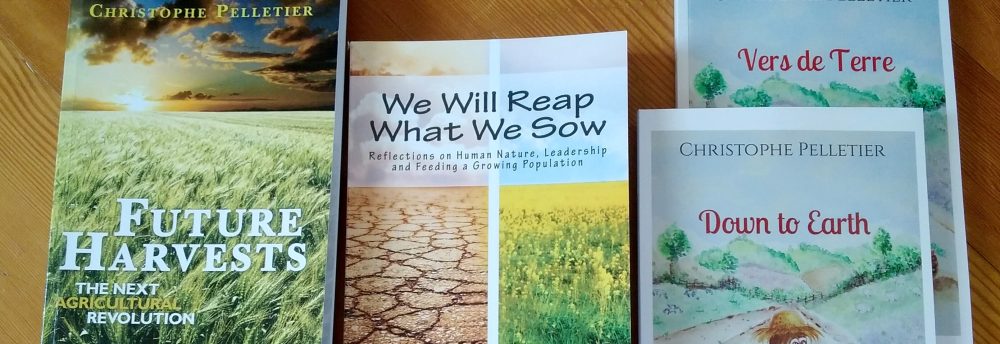
Now is the right time to look forwardAlthough agricultural commodities markets have recently calmed down, the past few years have been turbulent. The result has been an increased attention for the world’s food supply and demand. Even in food secure regions, it is quite important to not take food security for granted, as it is always a work in progress. In this regard, the stress on agricultural markets and the recent price hikes have been a good thing. They have forced many to take a closer look at the situation and to start reflecting about the things to come. I have been among the ones who started earlier than most others, for two reasons. Firstly, it was obvious that meeting the demand of a strongly growing population would bring some challenges. There was no need for a crisis to figure that out. Secondly, I did not find analyses that connected the dots beyond the particular interests, the particular regions or the particular business areas of those who produced research and documents about the subject. This is why I have developed my foresight activities for food and agriculture and published the two books. The first, Future Harvests, answers the question of whether we can feed the future population and the second, We Will Reap What We Sow, reflects on how our future behavior towards consumption, together with the quality of our leadership, will decide whether the future will be prosper or gloomy. Those of you who read them know what the answers are and why.

Although the period of tensed markets helped bring valuable attention to the food issue, it has produced more quantity than quality about what should be next. Between those who announced the end of days and those who see it only as an opportunity to use fear to stop others from thinking, there has been little structural long-term thinking. Both groups play on short-term fear to push agendas that serve mostly only themselves. The future cannot be selfish; it will be about helping others succeed. Profit is only a by-product of sound decisions. Those who will foresee the actual needs of the future will make lots of it in the long term. The others, although they might score in the short term, will not win the race. In food and agriculture, foreseeing the future and defining winning strategies are complex activities. I say complex, but I do not say complicated. Ironically, the more thorough the analysis, the less complicated it comes out. When done well and communicated properly, there is no reason why others would not be willing to build a successful future. The complexity comes from the many levels involved in food security. The interactions between natural conditions with the political, economic and cultural environments, together with the many – and often divergent – interests of the players of food value chains are difficult to reconcile. But this is not all. The fact that food production systems and consumption behavior are also influenced by many other sectors competing with agriculture for resources adds to the complexity. The issue is not just about production techniques, new technologies or functioning of markets. Other societal issues play a role, too. The quality of a society and as a result of the people of which it consists will play a role. Health, education and on-going training are very important components of how we will manage the future. Each of the “blocks” I just presented are complex in themselves, simply because they deal with life and keeping the dynamics of life running harmoniously is no easy task. On top of that, the fact that these different blocks, depending on how they individually function, interact with each other and affect the performance of the others, it is clear that we need to look at the issue of feeding the world in a comprehensive manner. We need to identify and integrate all these elements in the analysis to determine the proper action to take. It would be quite convenient if future actions depended only of what directly affect a particular sector. Unfortunately, limiting the thinking to one degree of separation is not enough, by far.

In my years of the Food Futurist, I have had the opportunity to notice that the multidimensional nature of the issue is the one that seems the most difficult for most organizations to fathom. There is no shortage of reports or publications about the future of this or that. However, although they clearly are of excellent quality and the result of hard work, many of them miss the dot connecting part. They focus on the area of interest but tend to neglect the bigger picture. It is only natural that organizations look at the future from the angle of how it will affect them. Yet, nobody should investigate the future from a self-centered kind of production-driven manner. This tends to produce a self-serving strategy that will not prepare those organizations to deal with what will come from the higher degrees of separation. The here and now is nice, but to thrive, they must focus at least as much on the elsewhere and later. I must say that I also have dealt with organizations that do have this comprehensive approach. I found that they had several qualities in common with each other (and with me to some extent): serenity, a rather positive and optimistic outlook on the future, and the quiet confidence that we can overcome the challenges.

Yet, even these “better” organizations still need to go further than they have in preparing the future. Their comprehensive understanding on all the factors that will influence the future needs to go to the next level. All organizations, those with the comprehensive outlook on the future as well as those who carried out the exercise in a less deep manner must translate their understanding of the future in specific strategies and effective execution. In many cases, this is still missing. Organizations must let go of the past by not assuming that past, present and future are linked in a linear manner. That way of thinking is still dominant and, considering the magnitude and the nature of the changes to come, it will not be the best approach to be successful in the future. Another important aspect to take in consideration is to clearly identify in advance what the effect of their actions will be on the rest of us. The latter will be a prerequisite for a prosperous future. It is amazing to see that most plans have no plan B. Without a plan B, a plan is pretty much not a plan. There cannot be only one strategy. There has to be an arsenal of options. What must stand fast, though, is the final outcome. Building a strong future is also about being prepared for the unexpected and to adapt accordingly to succeed. Such an approach would also show that their future actions are taken in with responsibility in mind.

The current times of agricultural markets calming down and readjusting to more reasonable and realistic prices are, more than any other, ideal to focus on how to proceed to build the future of food and farming. As grain prices have slowed down and the animal protein sector is improving financial results, everybody is in a more serene mode. The white noise from the media and the fear mongers has faded for now. Everyone can hear him/herself think again. That is quite a good thing. However, this is no time to lay back or become complacent. Such a serene environment will not last. The population keeps on increasing. Meat and poultry producers will resume production increase as demand for their products is among the fastest growing of all foods. With grain and oilseeds prices less attractive, the incentive to push for more production will also slow down. It will not take a genius to figure out that demand for animal feed will grow faster than production of feed ingredients once again. Lately, Asians have also hoarded agricultural commodities to have stocks at hand, but as availability of commodities increases, they will get more relaxed about it. For all these reasons, agricultural prices are going to go up again, hurting animal protein producers again and sending agricultural markets up as investors and speculators will see their chance for quick money. Let’s also be sure that there will be some climatic event somewhere sometime that will also join the party to add on the stress. When the different parts of the food value chain do not plan ahead globally to ensure a balance between supply and demand, such cycles persist and crises come back. It probably will be a couple of years (my guess is three to five) before we face a similar crisis again. This is why the time to act is now by developing solid plans, engaging in the right partnerships and collaborate closely and intensely to work on the future of food and farming. I mentioned earlier that analyzing what will happen in the future and to prepare for it is complex, the exercise is actually easier than it sounds. It is only a Herculean task for those who want to solve all the world’s problems on their own. One simple trick is to see the big picture but to define what the realistic contribution of the organization to the whole problem actually can be. Another one is to ask for help and support, and thus engage others on the right path. The contribution can be products, services or collaboration. Nobody will fix the situation alone, and nobody should think in such terms. The essence is to act and make others act in the right direction. Communication towards others is quite important as it helps other organizations to determine their respective objectives. In this regard, conferences and events about the theme of the future of food and farming are quite useful. I have participated to quite a few already. Sometimes, I wish they were more focused on what it means for the partners and the audience than what it means for those organizing such events, though. It is clear that many of such events have a marketing and/or image purpose, but that too can only be a by-product. The most important is the added value to the attendants and what they can use practically in their own operations from what they heard at the events. At least, that is my philosophy and how I approach such speaking engagements. Too often, participants present their offering, such as new products for instance, but so far I have not heard anyone ask what I think is the most important question and the key to success: What do you need from me or from other partners to succeed? There are too many conferences about the future of agriculture that do not even include a farmer among the speakers! The customers are the ones who know best what they need from others to do a better job in the future. Let them speak out!

As far as I am concerned, I have now started to work on my third book, the topic of which will be about strategic foresight for food and farming. It will be about anticipating the changes that will come as well as the changes that must take place with the main purpose of presenting adequate strategies to adapt and to prosper. It will review the future evolution of the different productions, the different links of the entire food value chain from DNA to consumer. It will present strategies for and between stakeholders in the different regions of the world, as they face different challenges and conditions, with the objective of showing how it can work for all. I believe it will be a welcome follow-up to the previous two ones, which had already paved the way to show options a building a prosperous and viable future for all, here and now as well as elsewhere and later.

Copyright 2013 – The Happy Future Group Consulting Ltd.

Food prices, one year later – Some lessons

According to the data gathered by the FAO, global food prices are on the decline. They have been so for some time. However, this good news does not seem to make the headlines. Reassuring news does not score with the mainstream media. What a difference with the past year during which all of a sudden they discovered that food might not be taken for granted after all! What have we not heard and read by then. The most absurd theories and pseudo-analyses have been spread around by some who know nothing better than copying and pasting the internet without exercizing the slightest sense of critical thinking. Of course, the fear mongers got plenty of publicity while they really did not contribute to anything productive, as I had described in a previous article (Fear mongering does not build a strong future).

What a difference a year makes! And that is a very good thing. It shows that agriculture and farmers are much more resilient and have much greater potential than some want to make believe. That confirms what I have always claimed and that I relentlessly repeat in my presentations and publications. I have lost the count of how many times I have been told that “Christophe, you are quite the optimist”, in particular about the content of Future Harvests. Frankly, I do not think that I am particularly optimistic. Actually, I can see many reasons why we will face serious crises along the way to meeting the goals of feeding a growing population. That warning is the message behind We Will Reap What We Sow. I see human nature and in particular our leadership, as serious reasons for temporary failures. But if I do not consider myself as an optimist, I definitely have a positive attitude. I truly believe we can manage and overcome future challenges, because I crunched the numbers and I have demonstrated in my literature and my talks that feeding 9 billion people in a sustainable manner is quite possible. It is possible, but it is not a given. There is work ahead. That makes it interesting and exciting.

Next to the potential and the future development that can make us overcome the coming challenges, I am also a firm believer of market forces. Market fluctuations trigger action and reaction. Nothing like high prices and solid profits get food producers increase production. Similarly, nothing like poor financial results have the ability to tamper any desire to increase production. The so-called invisible hand works. Sometimes, it holds a carrot. Sometimes, it holds a stick. It makes things move in the right direction. Over the past year, I have presented during a number of events how market forces would influence prices in different sectors in the years to come. By looking at it from the consumer demand end and by going back in the production and supply chain, I showed how the different actors would react to their own particular situations. So far, my predictions have come true, the reactions of retailers, food service, animal protein producers, crop farmers and input suppliers have been as expected. The drop in global food prices is one of these predictions. Those who attended some of my presentations know what I mean. For the others, here is a link to a video showing an excerpt my talk about the dynamics of future agricultural markets that will illustrate what I am writing about.

The past year contains many lessons. Some of them are about us, and some of them are about how to look at the future. The main lesson is probably that the situation of food and agriculture cannot be looked at in a simplistic manner and can certainly not be described or commented with scary slogans. The population is growing but so is agricultural production. The famine that is supposedly around the corner is far from happening. In a year time, the world population has increased by a few dozen million people, who on average tend to eat more food, and in particular meat. Yet, supply is able to meet demand better this year than last year, as global food prices and grain stocks indicate. Another lesson is that even though severe climatic events affect food supply negatively, there is no reason to panic. The fact that last year a severe drought depleted production numbers in one of the essential producing countries, the USA, the system was able to absorb the shock. There has been no food riot in 2012 like in 2008. The reason needs to be looked at what products were the most affected.  Supply of basic food stables remained in balance with demand. There was no particular shortage of bread or rice in sight. The commodities that were affected were business to business products, destined to the animal feed and the corn ethanol industries. Another lesson is that even though the prices of 2012 did not lead to riots, climatic events are a serious threat and need to be factored in future supply and demand scenarios to build enough of a buffer to reduce the risks of supply disruption. Another area that requires more attention is the regulation of financial markets, and in particular the regulatory aspects. It is clear that derivatives amplify market price fluctuations. By deciding who is allowed to be active on the markets of agricultural commodities and for which quantities, the functioning of markets can be more representative of the physical reality. In particular, the participation of players who have no physical production or supply functions in the food and agriculture need to be taken under strict scrutiny. As it is important to have fair market rules for a proper functioning of markets, it will be also useful to look at the functioning of crop insurance. Last year’s drought in the US cost insurance companies much money, while it appeared that US crop farmers ended up the season with the second highest profit level on record. No one will argue that farmers need to be protected from such unpredictable events.  Insurance should guarantee them a minimum income so that their future would not depend from forces out of their control. That is just fair. Opposite to that, it sounds beyond normal that, thanks to other contributors, farmers could go through such a drought without hardly feeling the slightest pinch in the wallet.

After the past year, am I still an “optimist”? Yes, I do believe that farmers will meet demand in the future. For all the reasons above, I am convinced as ever that the potential is largely there and that the world can absorb tough years. But I would attach a warning to my optimism. It is not because it can be done that it will be done. It is necessary to keep thinking ahead, to come with innovative ideas, products and services to be able to plan and forecast better, to make better and faster decisions. It is also essential to pass knowledge and information better and faster, and to choose the attitude of helping others succeed before one’s particular interest. Our societies have succeeded by acting together. Nobody will be able to do it all alone. Providing help and support will be critical for success, just as much as asking for them will be. It also becomes crucial to be able to look beyond one’s area of business and to connect the dots even – or maybe actually in particular – with events and activities that have, at least apparently, several degrees of separation with agriculture in order to anticipate, adapt and be prosperous. That is the core of what I do, and I can only encourage you to take the same approach.

As markets ease, it will be quite tempting to drop the guard. In my opinion, this would be a serious mistake. The time things seem to be under control is the right time to prepare for the future and to do some foresight. Markets will change again as the bargaining power of the different links of the chain will shift. Be assured that there will be some severe price hikes again. My best guess is within five years from now. Those who will do this exercise will have a strong advantage over those who will procrastinate.

Copyright 2013 – The Happy Future Group Consulting Ltd.

Dealing with complexity

Looking at the future of food and farming goes far beyond agriculture. It comes down to looking at the future of humankind. Balancing future supply and demand of food is an exercise that includes many disciplines and dimensions, probably more so than any other human economic activity. Anything that affects life and its level of prosperity must be taken into account. Feeding the world is not just a matter of production. Of course, the ability to produce and to keep producing enough food is paramount, but there is more to it than that. The consumption side is just as important. Demand will depend on the diet, which also depends on how much money people have available to pay for food.

Total future food demand is a combination of which foods and food groups people in the various regions of the world will buy and eat. This is a function of demographic, economic, cultural, religious and ethical factors. If future demand is about consuming according to the nutritional needs of a human being, clearly the situation will be different than if people demand twice as many calories and protein as the actual nutritional needs. The relative share of animal products in the total diet will also change the situation in terms of production and of production systems. Food production must adjust to the demand and do its best to meet it, but not at all costs. Therefore, it is essential to optimize food production at the global level so that the largest quantity of food can be produced at the lowest environmental cost. At the local level, production depends of course on natural conditions, but also on economic, political and cultural conditions as well. This may be the most profound change that we must deal with: feeding the world of the future is a global exercise. As more and more people worldwide have more and more money to spend on food, demand is now global, and therefore production plans must also be global. The times of producing food simply for the own people and exporting surpluses is over. Markets will now react to any event that will affect production or consumption somewhere else. Borders do not make this shift in thinking easy. It is always tempting to think that having one’s house in order is enough, but it is not. What happens in other countries on the other side of the world will affect us just as well. Why is that? Just one word to explain it: markets. There used to be a time, not so distant when if there was a drought in Russia, China or Brazil, markets would not react as strongly, and anyway not so much in the media, as we have seen over the past few years. This was the case because only a minority of the world was consuming large quantities and that minority did not have competition. Now the competition is wide open. Markets will keep reacting on this and the relative price levels of various foods will influence how much of what is consumed and where. We will see eating habits change because of this economical aspect of food supply.

At the same time, food production is also adapting to a changing environment, and to face its future challenges. The amount of new developments in technology, access to information and knowledge and in decision-making tools is amazing. Innovation is flourishing everywhere to solve environmental issues, to cope with new energy and water situations. The dominant themes are the reduction waste of all sorts, as well food as agricultural inputs and by-products, and the prevention of the release of harmful contaminants. Innovation is developing towards better and more efficient systems that must ensure the future continuity of food production and, at the same time, keeping food affordable for consumers. Interestingly enough, many innovations that will be useful for agriculture do not originate from the food sector. Food producers will need to be curious and look beyond the field to prepare for the farming of the future.

Clearly, the number of factors affecting both consumption and supply are many. To add to the complexity, many of these factors are not of an agricultural nature. Many of them originate from the population, its activities and its needs for all sorts of goods. I mentioned earlier that what happens in one region affects others, but the natural resources markets, such as energy, metals and minerals, that must meet demand for non-food consumer goods also affects agriculture and its production costs. Although many see rising costs first as a threat, I tend to welcome them, as they always stimulate innovative solutions to increase efficiency and reduce waste. Two examples show that it works. One is the car market in the USA that shifted from gas-guzzlers to high gas mileage vehicles since gas at the pump became much more expensive than it was only 5 years ago. The second one is food markets. Had you heard as much about food prices, food security or food waste before the food price hikes of 2008 and 2012?

In my work, I always try to make my clients and audiences aware of how everything that has to do with food is interconnected with many other sectors, and how economic, demographic and political events are linked to food security or how they might affect it in the future. That is an underlying them in my books.

Even, within the food and farming sectors, organizations do not realize enough how their future will be influenced by other food productions and vice-versa. I always get reactions of surprise at the magnitude of the interconnection and the interdependence with these factors, and how they affect their activities indirectly. It is a normal reaction, as most people tend to focus on what has a direct connection with their activities. After all, that is why I do what I do: to help them see and decipher this complexity, and understand what actions to take to adapt and prosper. I never shy away from show the complexity. My audience needs to get a flavor of the any dimensions and many layers involved. However, I always take a practical approach and show them that complexity is not the same as complicated. Deconstructing the complexity actually works well to show the many levels of actions there are. It helps my clients connect the dots between their activities and what will affect them and how. It gives them a level of confidence in how to deal with the future and take action. I also like to warn against oversimplifying, which is another tendency that I observe from time to time. The mainstream media is rather good at that. But I also get questions that sound like those who ask hope that I have a magic wand and will be able to give them a foolproof recipe for success. That simply does not exist.  If preparing the future were easy, nobody would even talk about it. It would be done. It it was easy, I guess many of the organizations that have been involved in agricultural development and food aid for decades would have already succeeded, and they would not exist anymore. Yet, they still have to keep up with their work.

Feeding the world is work in progress. Developing the right actions is complex, but not as complicated as it sounds. However, the true difficulty is in the execution, and in particular bringing other stakeholders with different agendas and different views on board to contribute to the success.

Copyright 2013 – The Happy Future Group Consulting Ltd.

Fear mongering does not build a solid future

Since the drought in the US of this past summer and the strong price increase of agricultural commodities, agriculture has become a favorite topic in the media. As such, this would be really good if it were not for the (potential) disaster voyeurism. There is nothing like a flavor of end of the world in the works to get the attention of the readers. After all, this is good to fill advertising space and to promote a book.

Since I started to look at the future of food and farming, I have seen an evolution on how people look at the future of agriculture. When I started, I could hear statements about the need to have two (even three and four) Earths to meet demand. Interestingly, none of those who stated this impossibility neglected to pay attention to food losses, and they were only focusing on more production. When could passing a mop under an open tap be a sensible approach? If we really come to need more than one planet, then there is only one outcome. Since that second Earth does not exist, the surplus of people would have to die so that the world can meet the demand of the survivors. I agree that it is not a cheerful thought. However, Mao Tze Tung once considered that it could be acceptable that half of his people, the poor, would die of famine to allow the other half that could afford food to be able to meet its needs. Such a morbid thought is actually more common that one would admit, and in this world of political correctness, it is repressed voluntarily. That does not stop the fear mongers, though. They just not choose to sacrifice a group to save another one. They tell us that we are all going to face our demise. That is politically correct, I suppose. Personally, I do not consider that announcing disasters is constructive. Fear is a poor adviser, and it is certainly not the proper way to communicate about problems.

There is no shortage of doomsday thinkers out there. In We Will Reap What We Sow, I address the many challenges that the doomsday thinkers bring up. Instead of taking an apocalyptic approach like they do, I chose to initiate a positive  reflection about alternatives and solutions. Scaring people is too easy, especially when they are not experts in the field of agriculture. I am not a fan of the one-eyed being king in the land of the blind. I have 20/20 vision and I want to help others to also see with both eyes. In my book, I make clear that we will live with the consequences of our actions (hence the title), but I give many reasons for hope. It is more productive then despair.

In the realm of doom and gloom, I must admit that the Post Carbon Institute wins the prize. Among the other prophets of doom, Lester Brown currently fills the stage, especially since he is promoting his latest book. I had the chance to hear him speak some 14 years ago at an aquaculture conference. I must say that he is an excellent speaker and quite a charming man. Actually, he inspired me to venture into foresight and futurism. I really believe that his talents should be used to create positive momentum instead of sowing depressive thoughts in the population. Before the summer (before the US drought that is), he had stated in an interview that “the world is only one bad harvest away from a food crisis”. I have never subscribed to that point of view. The issue of feeding the world is much more complex than that. Well, we just have had a bad harvest and there is no more food crisis than last year. Prices of agricultural commodities have gone through the roof. Yet, there have not been any riots like in 2008. It is almost a wonder considering how much fear mongering has taken place in the mainstream media. They all came with scarier scenarios the one than the other. And thanks to social media, the news spreads even faster and further. In particular, Twitter is an amazing place to be in. Anything and everything gets tweeted, retweeted many times over without the slightest critical thinking. Their symbol should not be a bird. It should be a sheep. The top of uncritical maniacal tweeting was about the writer from Australia who spoke at a conference telling the audience that agriculture needs to produce 600 quadrillion calories a day. That was all over twitter. Wow, do you fancy that, 600 quadrillion? Yes, I have to admit it is a big number. I found is so big that I had to count on my fingers. Considering that the average human being needs about 2,000 calories a day (the FAO says 1,800, but let’s keep the calculation simple!), 600 quadrillion calories corresponds to the needs of 300 trillion people. That is about more than 40,000 (yes, forty thousand) times more than the current world population. With math like this, it should be no surprise that his book is titled the Coming Famine. Regardless of the title, I would agree that one Earth could not feed any number of people remotely close to 300 trillion, but we are not there yet. When I saw that number, I could not resist tweeting about the math, and the sheeple out there realized that the numbers did not add up.

That has not been the end of my tweeting against the fueling of fears about food and agriculture. Another tweet that caught my attention came from Graziano da Silva, Director General of the FAO (actually his staff) stating about food prices “This is not a crisis yet. We need to avoid “panic buying””, to which I replied that a good way to do this could be to stop talking about food crisis so often. What can be more of a boon to speculators in commodities than Twitter and its instant worldwide spreading of any rumor, information or myth that indeed can create panic? There is no better way to make food prices increase than by repeating exponentially that there might be food shortages, even though it is not the case. Interestingly enough, since then, the panic button seems to have been turned off at the FAO.

Fear mongering and doomsday thinking, although morbidly attractive, will not help build a solid future. Predicting terrible disasters without giving clear clues of how to prevent and overcome them is rather useless. Actually, it is counterproductive. Those who do not know the facts or are not in a position of doing something about the problem are going to feel demotivated and there is a chance that they will not try to care anymore. Those who actually contribute to solutions will not pay much attention, as it sounds like the kid who cried wolf to them, and might miss important information in the process. There are challenges ahead. Some of them are quite serious and difficult to overcome, but not impossible. I know that and I know them. And so do many others. However, the fact that the task ahead is challenging  is no reason to undermine anyone’s morale. The amount of knowledge and of tools at our disposal is quite amazing, and we probably have more than we need to fix things. What must change is our attitude. Rambling and whining about problems have never made any disappear. It is necessary to create positive momentum among the population(s), to show them that success is possible. To achieve this, it is important to avoid the opposite of fear mongering, which is blissful optimism. It is possible to feed the world, even when it reaches 9 billion people. It can be done with one Earth. A couple of years ago, I was one of the few who claimed that it could be done. By then I felt a bit lonely, as the main thinking sounded like it could not be achieved. Maybe my blog, books and presentations have contributed to change that. Those who have read me or listened to me seem to think that my positive and practical look on the issue have contributed to changing their mindset. The thought is nice, but it is not what counts. What really matters is that gradually, more people start to see beyond the myths and the catch phrases. Not everyone does. This summer, I heard about the “Great Global Food Crisis”. So far, I had heard only about the Global Food Crisis. Apparently, fear had increased by a notch or two.  Such expressions are non-sense. If the food crisis were to be global, there would be a food crisis everywhere around the globe. That is pretty much the definition. I do not see any food crisis in many countries. Actually, a study showed that the number of overweight people was on the rise in more and more countries. What is true is that there are local food crises. Unfortunately, for the populations that suffer from it, they are not caused by global food shortages as some like to make believe, but because of armed conflict and /or by poverty and lack of infrastructure. The number of undernourished people is actually decreasing as the FAO showed in their latest State of Food Insecurity 2012. To me, everything points at progress in the fight against hunger, even though negative climatic events affect agricultural production. But just for fun, let’s get back to the Great Crisis. If the food crisis were to be global, can it get any bigger than that? What does the adjective Great add? It adds nothing except the desire to scare. Let’s face it! Some people jobs depend on cultivating the idea that something goes wrong. It is their only purpose. Personally, I prefer those who roll up the sleeves and conceive, develop and execute solutions. These are the ones who make our future world a better place. It is too bad that they do not get as much attention from the media as the fear mongers. Of course, things that go well are not as sensational as disasters, but they are more valuable. They are the success stories that need to be told, so that others can learn from them. They are the success stories that must be told so that we all eventually can realize that building a solid future is possible. It is not easy as spreading fear, but it is much more productive and useful for present and future generations!

Copyright 2012 – The Happy Future Group Consulting Ltd.

Thinking of a better agriculture in a better world

Recently, I joined a group on LinkedIn called “Future of Agriculture”. One of the discussion topics, which caught my attention, was “What’s your dream for the world with agriculture as a theme?” Of course, this is quite a broad topic. I decided I would write here my thoughts about the discussion as concisely as possible. Therefore, here is what I believe is important for the agriculture of the future.

Agriculture must provide food today and tomorrow. Keeping the potential to feed the world for future generations is not an option; it is a necessity. Agriculture must produce in a sustainable manner. It must meet both the demand for food, but also be able to continue meeting future demand. It must take all necessary actions to ensure there will be enough water, enough soil, enough organic matter and enough nutrients to keep producing. It must also make sure that it does not contaminate the water and the soil. Agriculture must be sustainable from an environmental point of view, but it also must prove sustainable financially and socially. Without agriculture, there cannot be prosperous societies. To have agriculture, the world needs farmers. Farming must be an attractive occupation that allows those who practice it to make a decent living. This is more important today and in the future than it has ever been before.

Future food production must be innovative. Innovation is essential to solve current and future problems. It is the main trait of the human genius. Finding new ways of doing a better job and meeting all the future needs is a must if humanity wants to succeed in feeding its growing population. However, innovation is not the same as high-tech. Innovations do not need to be complicated and expensive. Innovation must integrate science, experience, common sense and practicality. Innovation does not oppose the past and the present or the future. It comes for the search of the best of all worlds. Innovation is useful only when it solves actual problems. It is not a doctrine of its own. The purpose of innovation is not about R&D for the sake of new products that help boost sales of those who market them. Its primary purpose is really about helping others succeed. Innovation must start from the market. What does the customer need to do a better job? The answer will be much more successful and better accepted if it starts from the market end, instead of being pushed onto the customers. This leads me to the next point: the necessity of being market-oriented.

Market orientation is the best approach for any type of business activity. It is true for R&D, but it is true for farming, too. Developing and producing by investing large amounts of money are much more effective and cost-efficient when the markets and the infrastructure are there. Offering what customers need has a much higher level of success than trying to convince buyers who are not very interested. The prices and the margins are always higher in a pull strategy. Market orientation also means that the infrastructure to bring the goods to the final users exists and that it actually works. One of the main scandals in today’s agriculture supply chain is the postharvest losses. It is outrageous that food that has been produced at the high cost of money, labor, water, energy, inputs and the farmers’ time rots in the fields or in deficient storage while it is good for consumption. It is the responsibility of all partners in production, supply chain and government to co-operate by organizing operations, so that food reaches those who need it.

The agriculture of the future needs to be developed in a pragmatic manner. There is no fix-it-all agricultural system. Food production depends on climate, landscape, soil types, water availability, need for sustainability, land rights, as well as the cultural, social, economic and political environment. The types of crops and animal production will depend on these factors. If systems cannot always be transferred from one place to another, knowledge and skills can be. Human intelligence and sharing is what spread progress. If farmers and all players in food production must be pragmatic and choose among the arsenal of tools and techniques what fits best in a particular situation, there are no boundaries in helping others to succeed. The energy must be spent to level up performance, not on defending a system for ideological or mercantile reasons. If the agriculture of the future succeeds, all of humanity will succeed. If it fails, humanity will have to deal with unrest, riots, hunger and possibly wars. Pragmatism is what will help the farmers of the future optimize food production around the world by making decisions that are in the best interest of all the partners from farm to table. Pragmatism is also what will deliver the highest financial return for them. However, for pragmatism to beat partisanship, bias and short-term interests, outstanding leadership will be paramount.

The leaders of the future will identify the right actions and execute them. They will cut the rhetoric and focus on delivering result on all fronts: financial, social and environmental. They will crystallize the energies around the objectives that serve all on the short term and on the long term. This will not be an easy task as the reasons to choose the path of least resistance are many. It will take courage, vision and the ability to convince the opposition. In history, great leaders have always sacrificed their personal interests, their personal safety and comfort for the good of the group. Such leaders are rare, but they exist, at all levels of society. They need to rise and improve the way we currently do things. They will succeed only if the average person is willing to make the right changes, too. This is not an easy task, either, but the alternative is even worse. The great leaders of the future will show the rest of us how things can be. They will give others the courage to implement the change and make them believe in the future. They will have to lead by example. They will have to reconcile instead of dividing and polarizing. When it comes to food production, they will not only help develop an efficient and sustainable agriculture, but they also will make sure that consumers change their eating habits where it is needed. They will help educate consumers about proper nutrition and moderation, while keeping food a positive experience, as well for the senses as for it social purpose. They will ensure that proper nutrition protects the health of their people. They also will give agriculture its rightful place in society and ensure that producing food is a respected and attractive occupation. They will take all actions to help food producers to succeed. They will reconcile urban and rural areas. They will make sure that people understand where food comes from and what it takes to feed for prosperity. They will work against waste.

Every waste is a loss of efficiency. With a population of 9 billion coming in the next few decades, waste will not be an option anymore. As the number of people increases and their needs have to be filled, the margin for error will shrink. The consequences of 9 billion behaving badly will be much worse that when there were only 3 billion people on Earth doing that. Every waste of resources will be quite costly, financially, socially and environmentally. The only way to reduce waste will be by being more efficient.  This will be true for food, as well as for water, for energy, for agricultural inputs, for soil, for organic matter and for biodiversity. Preserving and replenishing will protect humanity from a situation of depleting resources, which is where it is currently heading. The consumption and depletion society has no future. Future food production and consumption must be aimed at maintaining and preserving the potential of agriculture.

Those who are familiar with my work know that sustainability, innovation, market orientation, pragmatism, leadership and efficiency are the 6 principles that I had gathered under the acronym of SIMPLE in my first book, Future Harvests. In my second book, We Will Reap What We Sow, I developed and discussed the characteristics of proper leadership and the vision required to rethink food and farming to succeed in the future.

Even if future solutions need to be adapted to their specific local situations, these 6 principles apply everywhere and need to be implemented in a concerted manner by all regions.

Copyright 2012 – The Happy Future Group Consulting Ltd.

Rio+20, Riots+30?

The Rio+20 conference is over. Announced with much publicity, accompanied with many tactically timed media articles and other conferences about sustainability, it has been the occasion for many to demonstrate their apparent concern about the future of the planet. A couple of weeks after the conference, the excitement has faded away, and the tweets that were so abundant on the subject have become rare. This is rather symptomatic of the current behavior of short attention span. Much has been written about Rio+20 and the dominant conclusion is that it has not achieved much, as expected.

For obvious reasons, I followed the part about agriculture and food security with special attention. Since I did not expect anything, I was not disappointed. To me, this conference has left me with the impression that the world leaders are resigned. The text was written before they would meet and it was far from bold. I read it and I could only shake my head. To me it looked like a very politically correct list of commitments that would fit nicely in typical New Year’s resolutions. The principles and statements mentioned in the text are noble but who can seriously think that effective action will follow? Just like world peace, everybody will agree on the principle of a sustainable livable planet where hunger does not exist. The reality is different. Human nature is not that noble and our many flaws hinder us to achieve such goals. In We Will Reap What We Sow, I wrote among others a chapter dedicated to the human weaknesses and how they affect our ability to deliver what we all secretly want. In the book, I also discuss how we can overcome these weaknesses and work toward a successful change. The theme of Rio+20 was “The future we want”. It was not clear to me who we might be, and whether it should be about wanting. Is what we want the same as what we need? The theme should have been “The future we need”. That would have been more precise and more relevant.

I also followed the webcasts dedicated to food and agriculture of the conference, and they disappointed me. I would have loved to see people clearly expressing their frustration about the resistance our world faces to go in the right direction. I would have expected strong calls on the leaders for effective action. I would have expected to see clear action points with clear and non-negotiable deadlines. I would have expected clarity about who should be responsible to do what. I did not get these. Instead, I saw some well-rehearsed PowerPoint presentations carried out by speakers who were rather satisfied with the work of their countries or organizations and who sounded like they found that at least their contribution was excellent and so would it be in the future. I am always suspicious when I hear people justifying themselves while nobody is asking for justifications. I believe that the overwhelming majority of people who work in agriculture to produce more and better food in a better manner do a good job. Most people go to work with the desire to do something good. Such presentations did not add much to the objectives of producing more food in a sustainable manner.

What would I have liked to see happening at the Rio+20 conference, you might ask? Very simple: I would have liked to see people arguing quite vividly and even getting angry, even leaving the negotiation room and slamming the door. This would have been the sign that the right questions had been asked. Considering the complexity of growing more food and at the same time maintain the potential of agriculture to keep producing for generations to come, difficult issues and really annoying questions are inevitable. I really would have liked to see the likes of a Nikita Khrushchev who in the UN took off his shoe to bang it on his desk in the 60s. Although his behavior was somehow out of line and by today’s political correctness standards totally unthinkable, it would be good to have leaders engaging in robust arguments. After all, if the survival of humanity is indeed at stake, this would be a cheap price to pay. Instead of that, the leaders came only to pay lip service, show up on the group picture and went back home knowing that the conference did not address the issues as it should have. At least everybody felt good about a text that was not threatening for anyone, that did not ask for any significant sacrifice and thus life can go on. As soon as they left the building, they returned to business as usual. All the principles listed in the text are correct as such. The only problem is that it is written as if the UN expects world leaders to become altruistic, long-term oriented and good-hearted. It is a bit naive. They are politicians! Yes, in a perfect world, there is no doubt that the world would feed itself sustainably, just as it would not cause climatic change and there would be no poor and hungry people, either. In a perfect world, there would be no need for the UN or the FAO.

What can happen if the economic model derails and collapses if it does not make the right choices to become sustainable? That is not very difficult to figure out. A number of events from the last few years can give us some clues. The riots that took place when the price of food increased sharply in 2008, affecting the lives of many people in developing countries, show that food will play a crucial role for the stability of many regions. It will not take much for such riots to happen again. Because of the economic crisis, a number of heads of states in democratic countries have been defeated during recent elections. The people clearly asked for a different leadership. In Arab countries, a similar demand has been met through social unrest, riots and near civil wars, and the process is still ongoing. The people asked for a different leadership. The intensity of the economic crisis has actually been reduced substantially by the massive printing of money and the large amounts of debts that many countries have had to issue to keep their economies from stopping abruptly. If money printing has softened the short-term impact of the financial meltdown, it also will lengthen its duration quite significantly. Considering the amount of debt and the demographics of Western countries, it will take generations before the debt can be paid back entirely, if that ever even happens. To restore a sound ratio of debt on GDP, most of these countries would actually need a new baby boom to ensure a growth that matches the challenges. Of course, another approach could be to allow immigration numbers to increase strongly, but that does not seem to be on any of these countries’ plans. Moreover, a growth based on the same economic model of consumption society does not appear sustainable and before the right numbers would be met, one can wonder if our species would have survived.

I often tell that the difference between the effects of the financial, the social and the environmental parts of the economy manifest at different speed. Anyone can follow share prices live on the stock market, anyone can follow his/her bank account on a second-by-second if desiring to do so. Social consequences can take months or longer to manifest, and environmental effects can take decades to manifest. The financial crisis has been the result of postponing actions to ensure that the money world could be sustainable. It is still far from being there and the financial crisis is not over, but at least there was the possibility to print money and to emit debt. That entertains the illusion. When it comes to environmental sustainability, our leaders are also postponing actions to ensure that our physical world be sustainable. The main difference is that there is no printing of Nature possible. Printing of wheat, rice, beans or other essential food items is not an option. If we lose the ability to produce enough, there will be fights for food. That is inevitable.

An unsustainable economic model, and in particular an unsustainable agriculture, will result in shortages, not just local but everywhere and anywhere to some extent. It will result in large numbers of people left with few options to survive. Some cultures might deal with it in more orderly manner than others might, but overall, the result will be social unrest that could have the potential to turn into riots and probably even into regional conflicts. A quick look at the world map gives an idea of where it can happen and the potential risks. The Rio+20 conference should have presented prospective scenarios of what will happen if we do not act properly and timely, and it should have asked the leaders on solutions. Leaving a conference handling such a sensitive and complex problem without a genuine brainstorming and a solid and courageous action plan made by the leaders for the world in order to preserve peace and stability comes short of leadership.

Considering the pace of economic, social and environmental change, this was the least that should have been done. Are we going to wait another 20 years for the following conference? Will it be as lame as this one? Will the result of Rio+20 be Riots+30, or +40? I tend to think so more and more. I am increasingly convinced that only a really scary crisis affecting the rich will shake the lethargy. I think that political change will come from the street before it comes from leaders who have apparently already given up. In the food and agriculture sectors, I also expect salvation to come from the ones who are the most involved in production: the farmers, the food producers and the food distributors, simply because their livelihoods will depend directly on an agriculture that is sustainable. Politicians will only follow later, when they and their constituents become food insecure.

Copyright 2012 – The Happy Future Group Consulting Ltd.

Q&A on We Will Reap What We Sow on twitter

I will be available to answer any questions about my new book We Will Reap What We Sow on twitter. I believe this could be a good way to interact in a concise manner with readers.

The participants will have to include the hashtag #WWRWWS on their tweets to be noticed.

This will take place over three days, with two sessions of one hour each day.

The dates and times are June 13 – 14 – 15 2012 at:

  • 2.00 pm EST = 7.00 pm in England = 8.00 pm in Western Europe
  • 7.00 pm EST = noon in Sydney, Australia = 7.30 am in Mumbai

It is also possible to ask questions outside of these times, but I will answer them only when I am available again.

The Food Futurist is three years old

And what exciting three years these have been!

The reason for me to start The Food Futurist was my frustration about getting clear answers on the ability of agriculture to produce sustainably and to keep meeting future demand. Unlike today, there were not many articles about feeding the world by 2050, simply because food was cheap and the world seemed to experience a never-ending economic boom. Things changed and a couple of food price increases got the attention of many who did not pay attention, while they should have. The few organizations that were addressing the topic did not publish anything satisfactory to me. The doom and gloom messages of we need two Earths (three or even four for some) did not really bring any useful response.

This is why I started this blog. I wanted to write down some of my thoughts and sort out the information that I could find. At the beginning, I had no master plan about what it could become. Then, I started to see the traffic on this website grow by the day. I realized that the future of food and agriculture mattered to many people, and that happened all around the world. This led me to write Future Harvests in the winter and spring of 2010. At that stage, it felt a little lonely, in the sense that my investigations did not support many of the mainstream thinking. Very quickly, it became very clear to me that hunger was about much more than just food production. I also could deduct from numbers that the world already produced enough to feed 9 billion with a sufficient and balanced diet, even 40 years before the mythic year of 2050. When I make that statement, I can see eyebrows rise. This fact still is little known, even within a number of organizations involved in food and agriculture. I am always surprised by their surprise. The good news is that, nowadays, more and more people and reporters bring it up. Feeding the world gets easier once some myths fall. In an article, I had indicated that world agriculture has the potential to feed 12 billion. Needless to say that I was pleased to read that same number on the FAO website a few months later.

What I discovered was the scandal of food waste, the relative lack of action to fix it, while the numbers show that it is quite feasible and not that expensive at all. By then, the issue was a matter within rather confidential circles. The economic crisis, especially in the USA, has opened the eyes of the aberrant behavior of consumers in rich countries. Considering that 30% of food is lost and wasted, this issue could not stay under the radar. I have raised it every time I could, and I hope it contributed somehow to an increased awareness of the problem.

Similarly, through my preliminary research, it became obvious to me how large the potential of Africa is for food production. A couple of years ago, I was one of the few who were claiming that Africa could and should feed itself, as well as it has the potential to become a net exporter. I got the same risen eyebrows and skeptical looks from my interlocutors. By then, reports about Africa were about all the usual negative stories. The only story about African agriculture was the so-called land grab, with the emphasis on making it a neo-colonialism. None of the articles I could read even bothered estimating the potential of food production. For the sake of rejecting this neo-colonialism, the only stance was apparently to consider the status quo, poverty and hunger, the better choice. How pathetic was that? A couple of years later, everyone is talking enthusiastically about the great potential of Africa, and how much the world needs it. My words in Future Harvests were “what happens in Africa will affect us all, for better or worse”. I am glad that more and more people see this. Nowadays, there is a lot of enthusiasm about Africa. To that, I would warn that there also still are many challenges to overcome.

To me, what made Future Harvests different from other publications was the fact that it was comprehensive and non-partisan. In particular, the comprehensive character of Future Harvests makes the book a cut above from other publications. Usually, reports, articles and books about the topic of feeding a growing population are focusing on a particular area or with a particular bias to try to influence the thinking about future decisions. There is none of this in Future Harvests. I looked at all areas, the land, the desert, the cities and the oceans. As many systems are no longer workable for the future, I reviewed many innovations to see if there were alternatives. The section of Future Harvests dedicated to innovation presents an abundance and diversity of ideas being developed. It is not exhaustive because the list would be too long. My purpose was to give an idea about the resourcefulness available to fix problems. Those who read the book confirmed that such creativity gives a lot of hope. In the book, I also emphasized the need for pragmatism. Too many articles try to advocate for either big large-scale industrial agriculture or for all natural, small-scale subsistence-like farming. None of them is a universal answer. Anyone with knowledge of agriculture knows that farmers must adapt to their natural, political, social and economic environments. The right production systems derived from a harmonious balance between these components. Dogmatism is rigid and rigidity is an impediment to the ability to adapt.

Hope is certainly better than the doom and gloom people out there. It is sad to read sometimes how negative they are. It feels like they are trying to demotivate people who have positive energy, for God knows what purpose really. One rather famous expert in the field of environment and agriculture, who actually has been an inspiration for me to get in this food and agriculture foresight business has become a disappointment to me. Statements such as “we are only one poor harvest away from a food crisis” or “the urban poor will be the most affected by high food prices” do not tell anything that anyone with half a brain already knows. Everyone can push to an open door. It does not take an expert. However, the media love this kind of depressing and scary stuff.

Now, The Food Futurist has reached its third anniversary. This work has brought me a lot of satisfaction. Future Harvests sold nicely, although I hardly advertised for it. I have done work for large organizations in the field of food and agriculture about the topic of the future, and the demand keeps coming in. The interesting part is that I really do not advertise at all, except for what I write on this website. My customers appreciate much more than the knowledge I bring. They like the fresh angle from which I look at the subject. My being independent is conducive to candid discussions without the tension that some of the controversies in food and agriculture usually cause. We review what is best for the future. The criticism is positive and always focuses on developing viable solutions.

Three years after I started writing and speaking about the future of food and agriculture, every newspaper is publishing a story on the topic, every company or non-profit in the food sector is posting a YouTube video about it. Unfortunately, most of them are rather incomplete and tend to repeat the common myths. Many of them, not all of them, seriously overlook the number of dots that need to be connected, and the complexity of the entire system. The risk is that we might end up barking at the wrong trees and address problems sub-optimally because of that. Anyway, they bring the issue to a larger audience. That is what counts the most. It is also very humbling to see groups of a couple of hundreds of scholars and experts from all over the world spend a couple of years to publish reports on the subject, and to see that, so far, I have not forgotten anything in my books.

Since I like to be ahead of the pack instead of following it, I am bringing out more material. Soon, I will publish my next book “We Will Reap What We Sow”. This book will focus on two areas that are rather neglected, yet essential to succeed in balancing food demand and supply. They are human nature and leadership. Human nature’s little flaws make it a fascinating subject, while they certainly raise reasonable concerns about humanity’s ability to do the right thing. Leadership has the role to alleviate these flaws. It has the duty to make society function properly by enforcing the values that ensure long-term sustainable prosperity. The book mixes number crunching and rational elements with a more philosophical reflection on how humans can work together to produce the food they need, while at the same time maintaining the capacity to do so for the generations to come. Diets, functioning of markets, influence of prices on people’s decisions are all presented in We Will Reap What We Sow. As the title suggests, the book indicates clearly that, although we are free to make the decisions that are best for us, we cannot escape the consequences of our actions. In these three years, I have gathered so much material and knowledge, that I will publish soon a third book which will be a quick overview of which parts have potential for which food production. Tomorrow’s powerful nations are the ones that have something the world needs, and food is one of these things. That will be the theme of that last book.

When externalities cannot be externalized anymore

Externalities are costs, or benefits, that are not included in the price charged for a product. If a cost is not included in the price, it represents a negative externality. If a benefit is not included, the externality is positive. The concept of externality is particularly important to determine whether an activity is sustainable. For instance, if an industrial activity pollutes and causes harm, there will be consequences, and costs. As it takes many years for environmental problems to become obvious, the cost of repairing the damage caused by pollution is not included in the cost of the goods produced by the industrial activity in question. However, there will be a day when it there will be no alternative but to clean the damage. That cost is the externality.

Every activity that pollutes without cleaning the contaminants is a negative externality. Everything that damages physically the environment and undermines the sustainability of food production is a negative externality. Every activity that depletes essential resources for the production of food is a negative externality. In this highly industrialized world, the consequences of economic and human activities, slowly add up. Nature’s resilience makes it possible for damage to remain unnoticed for quite some time. However, the ability of Nature to repair the damage shrinks, as the damage is continuous and exceeds Nature’s ability to cope with the problem. As the population increases, the level of human and economic activities intensifies further. There will come a time when Nature simply cannot handle the damage and repair it in a timely manner anymore. The buffer will be full. When this happens, the effect of negative externalities will manifest immediately, and it will include the cumulated damage over decades as well. It will feel like not paying the bills for a long time and then having all belongings repossessed. Humanity will feel stripped and highly vulnerable. The advisory services company KPMG published a report in 2012 stating that if companies had to pay for the environmental cost of their production, it would cost them an average 41% of their corporate earnings. These costs are currently not included in the pricing. That is how high negative externalities can be. Looking at it from the other way, companies would still deliver 59% of their current earnings. Repairing the damage and still generate profits shows that sustainability is financially achievable. On average, the profits would only be lower, but the impact would vary substantially between companies. Businesses that create high negative externalities will show much bigger drops in profits, than business that do the right thing. The only ones who would have to get over some disappointment would be Wall Street investors and all those who chase capital gains on company shares. The world could live with that. Investors should put their money only in companies that actually have a future.

All the fossil fuels that humans burn are gone forever. It is not renewable. All the water that farmers use for food production and exported away from the production region is gone forever. Exporters in arid regions will have no choice than disappear, produce only for the local markets, or if that is economically sensible, import water from surplus regions. All the minerals that are used as fertilizers and that are exported from the fields in the form of leaching or in the form of agricultural commodities are gone forever. New supplies produced either with non-renewable energy sources or from mines that are slowly depleting must replace the loss. Organic matter that is lost from soils must be replaced, or it will be gone forever. Soil that is lost through erosion and climate is gone forever, unless new soil is brought back on the land or very long-lasting repair techniques are applied. Every gene that is lost is lost forever and might be missing dearly. Every species that goes extinct is gone forever, as well as its role in the ecosystem. Every molecule of greenhouse gas that goes into the atmosphere is gone out of human control forever. It might bring a heavy cost in the future.

Since everything that becomes rarer also becomes more expensive, the externalities are going to weigh on the economics of food and agriculture, as well as in any other activity. There will be an oil price for which the current machines will be too expensive to operate, and for perishables to be too costly to truck with fossil fuels over long distances. The economics of water will change the purpose of farming in arid regions. It will alter the agricultural policies and force farmers to innovate new irrigation techniques. The economics of minerals and organic matter will change the location of animal farms and manure containment systems. No minerals will be lost. Manure will become a competitive fertilizer, as chemical fertilizers will become much more expensive to produce. The logistics of manure will change and the location of animal farms will change to allow an optimal cost efficiency of raw material for feed and access to fertilizing elements and organic matter. Farms will not have to be mixed, but the agricultural landscape will restore an integration of crop farms with animal farms.  Agriculture will be sustainable only if completes all the cycles. In the past decades, the cycles of minerals, of organic matter and of water have been open. Food has been produced in one place, and then moved over long distances and the waste and surpluses have accumulated somewhere else, while the original production areas were slowly depleting. New systems and new organization will work on closing the cycles again to bring back what agriculture needs to function. The economics of energy will change the chemical industry and its products. Everything will aim at using as little primary resources as possible and maximize the efficiency of inputs by both bringing entirely new products and application techniques. It will be true for energy, water, fertilizers, chemicals, medicines. The new focus will be about using just what is needed when it is needed and only in the dose that is needed, and no more than that. It will be all about precision agriculture, precision animal husbandry, precision packing, precision manufacturing, precision processing and precision logistics.

When externalities manifest immediately, there will not be the time discrepancy between financial results and environmental results. There will be no excuse anymore to say that there is no evidence of consequences. There will be no possibility of creating the confusion, either. When pushed to the limits of its resilience, Nature will bring the financial and the environmental at the same timeline. It will be stressful. Doing the right thing environmentally, or in other words, producing sustainably, will be the best, and only, short-term strategy for financial sustainability.

Copyright 2012 – The Happy Future Group Consulting Ltd

We Will Reap What We Sow, my next book

“We Will Reap What We Sow” is the tentative title of my next book, which I have started writing. My first book, Future Harvests, focused understanding the challenges to meet the food demand of an increasing world population, before it became trendy in the media. Future Harvests also indicated which principles would be helpful to overcome these challenges. The book also presented the many areas where food production and food supply can be improved and optimized. In the conclusion, I wrote the following sentences:

The answer to “Can we feed nine billion people by 2050?” is “Yes!” Will we feed nine billion people by 2050? That is a different question! It will all depend on everyone’s attitude.

“We Will Reap What We Sow” will focus on the human factor. Indeed, our attitude and the way we deal with problems will play an essential role in future decisions. The consequences of these decisions will shape our future world. Success or failure depends mostly on us. The current level of technology, combined with the amazing developments that we can expect in the coming decades, is not the limiting factor. Our ability to act for the common good will determine our fate.

For those who have read Future Harvests, this next book will be a useful sequel focusing on human nature, behavior and leadership. The book will start where Future Harvests ended. This new book will review the interaction between human population, and their leaders, with all other aspects that contribute to food production and prosperity of societies. Those who will not have read Future Harvests will it a stimulating ground for discussion, and hopefully a reason to read my first book, too. Anyway, they still have enough time to order Future Harvests and read it before We Will Reap What We Sow is published.

“We Will Reap What We Sow” will address the major questions that need to be answered, and discuss the pros and cons of the different points of views. It will indicate what the most likely consequences of the different scenarios might be. Human nature being what it is, the book will also focus on how to develop positive incentives and reduce the possibility of negative stimuli. There will be a balanced discussion between economic, scientific, philosophical, and moral parameters; and how they contribute in building prosperity. The book will be an exercise in foresight.

The book will also focus on leadership. It will review what expectations of leaders will be. How leaders can help humankind overcome the fear of change and make the transition to a more food secure world. Dealing with change will be a major part of building the future world. Just as much has changed over the past decades, much will change in the future. The coming changes are beyond what most of us can imagine. Yet, it will happen. We had better accept it and prepare to adapt.

Unlike most of the articles published recently about the seventh billion human on Earth, “We Will Reap What We Sow” will not look for sensationalism. Doing that is quite easy, but not productive. Just like Future Harvests, it will explore the possibilities. It will focus on solutions, not on problems. There is no point of mongering fear. Leaders are there to help people dare and succeed, not to hide afraid or give up hope. The task ahead is not easy, but it is not impossible. Only by realizing the benefits for all of responsible and collaborative action, will humanity ensure its future food security.