
Curiosity: it’s where the future starts

The challenges ahead are bigger than ever before, and be assured that they will bigger in the future. The good news is that progress and new developments in science and technology are bigger and faster than ever, too. From a technical point of view, I would dare to say that the solutions to the challenges already exist or are very close. Often, the problem is that these solutions are not immediately economically viable. In such a fast-changing world, curiosity is undoubtedly one of the most desirable qualities to adapt timely and find new ways of running the business.

Perhaps, it is because a lot of my work is about finding as much information and gathering as much knowledge as possible about all sorts of technologies, facts, systems, science and experiences that I find curiosity quite natural. Perhaps it is also because I have a curious nature. In my daily activities, I find that people are relatively not curious enough. I also can see that the ones who have that quality are always ahead of the pack. What is really amazing is how much is already out there. The trick is to find it and to know about it. Often, the information originates from very different business sectors or comes from other parts of the world or is available in a different language. I can see regularly a lot of organizations busy reinventing the wheel, going through the pain of setting up research and spending vast amounts of time, money and resources to find out results that are already available and that they could have taken over and adjusted to their particular situations. Curiosity can deliver huge savings.

Curiosity is quite time consuming. That is a fact and its main drawback. This may be the reason why it does not happen enough. The quest does not always deliver, although for those who have a proper strategy, the yield is quite good. Curiosity, for a business, cannot be a random activity. It has to be structured and carried out with discipline. There is quite a similarity between curiosity and access to food. There are those who know where to find the tasty mushrooms in the woods and those who get lost in the forest. It is the same thing when going out there to find knowledge. Some are talented and find it often and fast and others just wander endlessly without spotting anything significant. Just as it is important to know the right spots to find food when hunting and gathering, there are some places where the good knowledge is. As with food, it is important to know the supplier and know the origin of the knowledge. To pursue the comparison with mushrooms, some knowledge is good and some can be toxic. The supply chain is just as important, especially considering how fast and far social media can replicate and distribute information. When it comes to knowledge, the reliability, seriousness and quality of the sources is of utmost importance. A discerning knowledge consumer must be critical about what they find. A solid critical sense is of the utmost importance. Regardless of whether the knowledge is found through a hunting/gathering activity or comes from a knowledge farm, it is essential to double-check its validity. The packaging can be deceiving.

Next to focused curiosity activities, it is also important to encourage what I would call open curiosity, in which there is no particular objective but just letting new findings lead to new discoveries. There is no business discipline involved. It more often research you would do in your free time. One piece of information generates interest to know more and you just follow. It is similar to a child-like exploration in which each answer triggers the next “why?” question. It is pure learning. There is no way to tell when or even whether the new learned knowledge will be useful, but there is no such thing as too much knowledge. The trick is to be able to retrieve it when it is needed.

Another important aspect of curiosity is to link experience to knowledge. Usually, knowledge is the result of certain protocols. The knowledge itself takes its full dimension and value only through the use we make of it. Some people make good use and others do not. When gathering new knowledge, it is essential to also learn about the lessons from the experience of those who used it. Why did certain things work in certain conditions and others did not? Which factors influenced the outcome and how would different conditions or a different environment affect the outcome? Getting the big picture is a very important part of curiosity. Expanding the scope and seeing how the pieces of the puzzle come together are the foundation of future successful strategy and adaptation.

Curiosity is a great asset when it comes to face and prepare the future. It is not the whole story, though. Food and agriculture are not intellectual exercises. They must deliver concrete products and results. It is nice to be curious but what do you do with that? The answer to this question is quite simple: action.

According to the saying, knowledge is power. Knowledge is true power only when it is active and circulates. Knowledge that remains in a brain or in a drawer is not very useful for the greater good. The first step that I advise curious people to do is to share what they learn. It is even easier today with the Internet, and there is a lot of knowledge out there. By sharing, I do not mean simply copy and paste or click the share button. Before sharing, it is essential to make sure that what you share is quality. There is too much information that is spread on social media while clearly not critically reviewed, not to say not even read, as it is quite often the case. The mindset here is a mix of enthusiasm, critical thinking and practical service orientation. The knowledge must be correct and the message must come over. It also must be useful to the recipients. It must connect to their needs and add value to them. The final result has to be better food through more efficient and sustainable systems that are financially viable. In the food and agriculture sector, it must lead to always more collaboration and knowledge transfer in all directions within the entire value chain. Often, the weakness of communication is that it stays too long in the same circle and other links, consumers in particular, are kept too long out of the loop. It results too often in misunderstanding, distrust and erroneous perception.

Through collaboration and brainstorming, curiosity helps create a more accurate and achievable vision of the future, on which action can further be carried out to shape the future. From this angle, it makes no doubt that collaboration between all stakeholders is an ongoing process. This is especially true with technology. There are new developments all the time and it certainly takes a curious mind to be able to keep up with novelties. It actually takes many curious minds, considering how huge the quantity of knowledge and information is. It also takes minds that can connect all the dots, and also connect with each other. Although time consuming, the back and forth collaboration, together with ongoing feedback about performance and new demands, allows all links of the chain to know better what the objectives are and how to foster ongoing improvement. As many new technological developments come from outside the food and agriculture sectors, I believe it is critical that the food producers be proactive in the development of technologies and applications, but stating clearly what they expect from technology suppliers and tell them what they expect from them. It is never too early to let them know what your problems, limitations and/or objectives are, so that they can work on it as soon as possible. Being proactive will help speed up the development of the right products, systems and applications.

In this process, leadership is of the essence. Leadership is essential to create the right dynamics to make knowledge transfer happen, fast and well. The role of leaders here is to make knowledge transfer attractive and stimulating for others, so that more stakeholders participate in the development of innovation. The more pressure they will be on suppliers to bring better solutions to the food sector, the higher the chances it happens, indeed. Leaders must also foster connections and networking across the disciplines, even or actually especially with partners outside of the food and agriculture sector. A vision that includes the bigger picture will have more chances of stimulating the cross-discipline and cross-sector collaboration. At the same time, it is crucial to stay practical. The goal is to produce food, and that must be in the minds of all participants.

Curiosity is really the starting point. It feeds an entire chain of ideas and decisions that are the basis for improvement. There is no doubt that fortune favors the bold. In the never-ending quest towards better foods and better agricultural practices, such a process becomes an illustration of “the best way to predict the future is to create it”. This saying may have not been so true as today. Progress and food security depend on it.


Copyright 2016 – Christophe Pelletier – The Happy Future Group Consulting Ltd.

Future implications and consequences of the ChemChina-Syngenta deal

The purchase of Syngenta by ChemChina did not go unnoticed. Many commentators are trying to see all sorts of reasons and all sorts of consequences, mostly depending on whether there are pro or anti GMO (Genetically Modified Organisms). When it comes to China, the best approach in my opinion is to look at it in a very pragmatic manner, simply because the Chinese have been quite pragmatic over the years. Their approach of food and agriculture is the same as for all other economic activity. It is dictated by the need for the government to ensure social stability or at least prevent social unrest. They will do what is good for China, meaning what is good for the Chinese government. It is not aimed at pleasing any other country or the financial markets. They still follow the principle express by Deng Xiao Ping: “It does not matter whether the cat is black or white as long as it catches mice”.

In both Future Harvests and We Will Reap What We Sow, I was announcing such a move, simply because it makes sense when looking at the economic and demographic changes the world is going through. The purchase of Syngenta is a very good move for China because it kills several birds with the same stone.

The Chinese seed sector was –and still is- fragmented and far from effective. By bringing a heavy weight company like Syngenta in their market, they will establish a much stronger seeds and genetic business to meet the challenges of the future. Syngenta brings expertise that will help China speed up the learning curve and create a critical mass of production that will be able to meet some serious volumes. It will stimulate further consolidation in China and also stimulate innovation and progress for other Chinese seed producers, if they want to stay in business. I read many derogatory comments about China’s quality approach. It is amazing how many people are stuck in clichés from the past. China is improving in many areas and quality is one of them. There is a generation of entrepreneurs who are quite bright and competent leading businesses. It is quite clear to me that Syngenta is and will be a quality player in the future, under Chinese leadership. Those who think this deal is bad news for Syngenta’s employees will be disappointed. I believe the contrary. They will get many more challenges to tackle and their jobs will be more focused than they were before or would have been if it had been bought by a North American company.

The purchase of Syngenta sends a clear message that China wants to be in control of its seeds. By buying such production assets, China will not have to go on the market, or at least will be much less dependent, to buy seeds from outside. It will strengthen China’s bargaining position towards other seed suppliers. Thus, China will be in charge of strategic choices that are good for China’s agriculture instead of having to choose from suppliers who do not have China’s long-term food security at heart or who would try to impose their conditions to China.

Regarding the topic of GMO, the purchase of Syngenta certainly offers China access to the technology, but it is not the main reason for the purchase. What it does though, is to offer China the option of using genetic engineering technology if they consider it useful. If they choose to do so, they will approach the use of the technology as a resource that supports their food security goals only and they will develop the products they actually need, not the products other suppliers would want to sell them. Whether China will use GMO is up to China and nobody else. Trying to see the Syngenta purchase as a sign of China’s attitude towards GMO is in my opinion wishful thinking more than anything else. When it comes to seeds, they will not look at the cat’s color. They will focus on having one that catches mice.

Further towards the future, the Syngenta purchase will have other long-term effects, and outside of China, too. China will be a significant seed producer and supplier. With an organization like Syngenta, there is no reason why they should limit business to China. I expect to see China playing a much more important role in the seed market outside of its borders. In particular, I expect to see China eye the huge African seed market. China has been active for decades in Africa and contributes to many economic development projects. China does not interfere with African politics but focuses on how it can help Africa developing and playing a future role for China. Considering the potential of African agriculture and its significance for China’s future food security, the new Syngenta should be instrumental for future progress of agriculture in Africa. A side effect of such a strategy would reshuffle the cards of the world seed market and bring a new and different equilibrium. There is quite a bit of activity on the mergers’ side. Syngenta had been the object of interest from other potential buyers, especially Monsanto. DuPont and Dow already brought their agriculture activities’ together. BASF seems to be looking at reshaping its activities. Further consolidation and mergers will take place in the coming months and years. What will be the next big merger? I can think of two possible ones: BASF and Bayer or BASF and Monsanto. I also see the possibility of Monsanto not being considered a purchase candidate at all by anyone.

Copyright 2016 – Christophe Pelletier – The Happy Future Group Consulting Ltd.
Nature will reshape food value chains

The recent climatic events, in particular droughts, have attracted more attention on future challenges for food production, and rightly so. Unfortunately, the mainstream media cannot help presenting the as all gloom and doom. Certainly, there are very serious reasons for concerns, but solutions can be found. I wish the media would present more examples of positive actions to face and overcome the challenges.

It is not easy to deal with a changing environment, especially when it is impossible to predict accurately what the change will be. Predictions about temperature increases are useful but they are quite insufficient. An increase of 2 degrees on average will be different if the standard deviation is 1 degree or if it is 20 degrees. Other factors such as hours of sunlight and precipitations (including their nature, frequency and intensity) will impact agriculture at least as much as average temperatures. Changing climatic conditions will not only affect plant growth and development, but they will change the ecology of weeds and pests as well and that needs to be factored in future forecasts and models

Nature will reshape food value chainsA special attention on water is necessary. Without water, there is no life. Unfortunately, over the past few decades, wasting natural resources has been a bit of a way of life. The issue of food waste has finally received the attention it deserves, but the waste is not just about food. It is about all the inputs such as water, energy, money, time, and fertilizers. Water is still wasted in large quantities. Just compare how many liters a human being needs to drink compared by the amount of water that is flushed in bathrooms every day. Before the housing crash of 2008 a study in the US had estimated that lawn watering used three times as much water as the entire national corn production. But the issue of water is not just about waste. It is also about preserving water reserves. The late example of the drought in California illustrate what water scarcity may mean for food value chains. California is not only a major agriculture power house, but it exports a large part of the production outside of the state’s borders. The issue of water scarcity and the dwindling level of the Colorado River are not new for Californian agriculture. It has been known for a couple of decades that problems were coming. California produces a lot of water-rich fresh produce by means of irrigation. It actually has been exporting its water in the form of lettuce, spinach, melons, strawberries and citrus far away to places from where the water will never return to California. The water loop has been broken wide open and that is why, among other reasons, the system is not sustainable. If California can no longer supply its current markets, it will have to rethink its target markets. At the same time, other regions, that may not be competitive with California today, because externalities are never included in the cost of production, will eventually take over and replace the Golden State as suppliers for some productions. Unfortunately for the future, California is not the only region with a water problem. Saudi Arabia changed its food security policy a couple of years ago as the country leaders realized that trying to produce all its food would lead to a severe depletion of its available drinking water reserves. Instead of pursuing food self-sufficiency at all costs, the country chose to find other supply sources through international trade and through the purchase of farmland in foreign countries. The examples of California and Saudi Arabia demonstrate how natural –and demographic- conditions shape food value chains. The issue of water is not just about produce. Animal productions require usually more water than vegetal ones. In the future, water availability will surely affect where which kind of animal products are produced. New regions will arise and old traditional ones may review their strategies from volume-driven to higher margin specialty animal products market opportunities because of environmental constraints.

Climate change and water scarcity show how international trade can actually contribute to food security when done responsibly and with long-term vision. The prevailing model of producing where it is cheapest to produce without taking into account negative environmental externalities is facing its own contradiction and demise. The next model will be to produce not only where it is the cheapest to produce but where it is sustainable to do so. When water runs out, it is no longer possible to ignore the externalities of a production. When water becomes scarce, it gets more expensive. The law of supply and demand commands. When inputs get more expensive, several things happen. The economic model shifts. Priorities and externalities change, too. At first, producers try to find ways to increase efficiency and eliminate waste. The benefits outweigh the additional costs. Uncertainty stimulates innovation. New systems, or sometimes old ones that found a second youth, replace the current ones. If that does not work well enough, then producers start considering producing something else to ensure the continuity of their operation and find new business.

It is not the first time that our natural environment changes. Finding successful solutions to deal with it really are about our ability to adapt and to preserve our future, as it has been the case in the past. The challenges may be of a magnitude like never before, but so are our knowledge, our technical abilities and the tools present and future.

From an agricultural point of view, adapting to a new environment is about finding the type of production that thrives under new conditions. It may mean different areas of production for some species. In North America, there is already a shift for corn. Iowa has traditionally the main grower, but the corn production area is now expanding north. Minnesota is now producing more corn than in the past and so are the Canadian Prairies. Similarly, the production area for soybean is shifting north. Minnesota is growing an increasing volume of soybean and even in the province of Manitoba in Canada, soybean production attempts have been carried out since a few years.  It is the result of better production conditions and the development of new varieties that can adapt to new less favorable climatic conditions. Because of the local supply for soybean, the development of aquaculture with local soybean products for fish feed is now considered a long-term possibility in Minnesota among others. In Europe, corn production regions also saw a shift to the north for corn during the 1970-80s thanks to the development of new varieties, which largely contributed to the growth of dairy production in these new areas through the widespread use of corn silage. For the future, there is no doubt that genetics will contribute again to ensure food security. There is currently a lot of work done to develop varieties that can withstand droughts, floods or soil salinity. The ability to know the complete genome of species, to spot genes through gene markers, to be able to create new varieties that are less sensitive to diseases help speed up the development of crops that can thrive under future conditions. The recent developments in synthetic biology are quite interesting. Research conducted at the IRRI (International Rice Research Institute) on the development of rice varieties that can have a higher photosynthesis efficiency and thus higher yields could open new perspective for a more productive and more sustainable production.

Next to the development of better and more adapted seeds and genetic material, the development of new technologies that I described in a previous article will bring a number of effective solutions as well. In particular the rise of precision agriculture is certainly quite promising. The ability to deliver to the crops exactly what they need when they need it at the right time and at the right place in the right quantity will help reduce the environmental impact of agriculture while offering the possibility of delivering higher yields. Similarly, in animal production, there still is room to improve feed efficiency. It can happen through further genetic improvement, the use of more efficient feed ingredients and feed composition and through better farm management. The latter is definitely an essential facet of a better future for food production. Better and updated skills for food producers will help being more efficient, more productive and more sustainable at the same time.

An area that is often forgotten when it comes to the future of food is the functioning of markets. If demand for certain products, and in particular animal products, increases faster than supply, price will go up and there will differential increases between the different types of products. As most consumers, unlike what marketers sometimes tend to make believe, still choose what they eat depending on the price of foods, there will be shifts. Some productions will thrive while others will struggle.

As prices still will be an essential driver of the location of the various vegetal and animal productions, markets and environmental constraints will increasingly have a joint effect. In the future, the dominant economic model of producing where it is the cheapest to produce will evolve. As the pressure on water supplies, soil conditions and pollution issues will keep increasing, the model will include an increasing share of negative externalities. They are the long-term costs that are never factored in the production costs but that will affect future production economics. Externalities are the hidden side of sustainability and they will determine the future map of agriculture, as it will no longer be possible to ignore them. Choices will have to be made between short-term financial performance and the long-term ability of various regions to be able to produce, and to keep producing, the volumes and the quality specifications that are needed by the different food markets of the future.

A friend of mine told me a couple of years ago after a trip to Asia how she could see from the plane the large plantations of palm oil trees, and how they had replaced the jungle. She described her impression as the view resembled the strategic game of Risk to her. Yes, climate change and water availability in particular, will reshape food value chains because agriculture, regardless of it scale, is a strategic activity. It is about life and death. It is about peace and war. Future strategies for both global commodities as well as for local food value chains will integrate Nature’s new deal of precious resources and conditions of productions. Together with the geography of future consumption markets, world agriculture will readjust, relocate and the Earth will look different once again.

Copyright 2015 – Christophe Pelletier – The Happy Future Group Consulting Ltd.

How can insects be a part of future food security?

Since the FAO published a report in May 2013 presenting insects as a possible source of food to meet future protein demand, the topic has become quite popular in the mainstream media. I wrote an article about this (Insects on the menu) in May 2010, in which I was giving some of my thoughts. I still think along the same lines.

In the last few weeks, I bumped into the insect story several times, purely by coincidence. I believe insects can play a role but I am getting a bit frustrated by the lack of specifics in all the talk about insects and worms.

Apparently insects would present many performance advantages compared with traditional meat productions. Aaron Dossey did a presentation at the IFT15 symposium organized by the Institute of Food Technologists. Here are the advantages of insects he mentioned as reported in the article from Science Daily of July 14 2015:

  1. Efficiency. They use less land, water, feed, energy and other resources than livestock.
  2. Environmentally friendly/clean. Insects create fewer greenhouse gases and are not contaminated with pesticides. They also do not have any hormones in their bodies.
  3. Prolific. They reproduce quickly so they can replace depleted resources.
  4. Biodiverse. There are millions of insect species, so it is easy to find a match to a location’s need.
  5. Nutritious. They have protein and Omega 3s, a class of essential fatty acids that help lower cholesterol.

All of this is nice but…

  1. How efficient? How much less land, water, feed and energy and other resources?
  2. Environmentally friendly as long as they do not massively invade it. How many fewer greenhouse gases? No hormones at all, really? Of course insects contain hormones. They are necessary for their physiology and development. So which hormones was he referring to?
  3. Yes they are prolific, which raises the issue of what would happen if insects escape from farms in large numbers. They are prolific but they are tiny, so it takes huge numbers to match the weight of a cow or pig or even a chicken. The real question to answer is how many tonnes of insect protein can a farm produce compared with other animal productions? What should be the size of an insect farm and how many farms should there be to meet future demand. Also what feed will the bugs eat to grow?
  4. Biodiversity may be nice, but what species would be production worthy when it comes to the mass production of volumes that would be comparable with other productions?
  5. They are not the only food sources of omega-3

Unless someone can quantify the above, the story remains rhetoric. If insects are to become a large-scale production along the lines of other animal proteins, it is necessary to single out the species that will be the most efficient, technically and economically. It is also necessary to sketch the design and the magnitude of farms. There are a number of companies that have been venturing in the insect business but most of them are tiny, in the grand scheme of world food security. Aaron Dossey’s company produces 25,000 lbs of insect powder per year. That is 12 tonnes, and he does not sell them to the hungry of Asia and Africa. Compared with the world average meat consumption per capita per year, 12 tonnes of meat represents the yearly consumption of 250 to 300 people. If insects represented 1% of the world average meat consumption per person, his production would feed only 25,000 to 30,000 people, or less than 0.0005%! Clearly, even to cover 1% of the average animal protein need as it is on average per today, the magnitude of the challenge to set up a significant production is huge. The other challenge to overcome is to make insect production economically competitive, be it for human consumption of for animal feed purposes. Most businesses offering insect products today are operating in a small niche, just because there is little industrial production. The dominant part of the insects and worms consumed are picked in nature by those who eat them, as those animals are usually consumed when there is a seasonal shortage of other protein sources. The niche businesses sell their insect products at prices that even many people in wealthy country could not afford on a frequent basis. The insect products are offered to consumers at prices reaching several hundreds of dollars per pound.  Presenting such foods as helping the world feeding itself, which means mostly helping the world’s poorest to be able to afford nutritious food is at best delusional if not even plain cynical. Insects and worms can be contributors to future food security only if they are affordable and competitive against the other meat sorts. That cannot happen if they are limited to the treat sector.

Another aspect of insects as food is their attractiveness, or lack of it. Insects and worms are much more common in Asia and Africa, where the largest part of the world population is and will be in the future. In Western countries, insects and worms are perceived as repugnant by most people. In terms of marketing, it would make more sense to focus on the Asian and African markets instead of trying to convince Westerners to eat lots of insects, just because of the respective levels of acceptance.

However, there is communication to do and lessons to learn from the past. I would name two. First, escargots, which are so popular under their French name, are an expensive item on menus. Escargots are never sold as “snails” because that sounds gross for most people. Everything sounds tastier in French. Try presenting insects under a French names and the Anglo-Saxon population might be more tempted. Snails used to be, just like insects and worms in Africa and Asia today, food that the French were going to pick on walls after a rain in times of food shortages. My second example is lobster. Lobster used to be considered a bottom feeder that was only for the poor, and so it was. Clearly, the image of lobster has changed a lot. The other lesson about lobster, and I would add shrimp, langoustine and many other ugly crustaceans, is that there are expensive delicacies that actually look a lot like insects, and they are actually rather close to insects in their body structures.

When it comes to human consumption, I wonder whether people will still be tempted to eat bugs if the economic situation keeps on improving in Asia and Africa. Not that long ago, China was in situation of near famine. Anything that contained protein was food. They were roasted rats for sell. In France, during the privations of World War II, rats – and cats- were used to replace pork in many deli specialties. There is a big difference between having to and wanting to. Has rat meat consumption increased in China since the economic boom? Do the French since WWII ended have been asking their butcher for rat pâté? I may be wrong, but I really think that when people, wherever in the world, have the choice, they will go for a juicy steak or some chicken before looking for bugs.

Then, there is the possibility of using insects and worms for animal feed. The advantage of animals compared with humans is that they eat to satisfy their hunger, but there is no psychological side to what is in animal feed, at least from the animal perspective. A trial to feed live insects to chickens just started in The Netherlands. It will be interesting to see the results. What I am wondering about this trial is why use live insects instead of dead ones. When I worked in animal husbandry, one of the things farmers worked on preventing was the possible invasion of insects in the houses, in particular because of the damage to insulation material. Further, I hope they make sure the insects will not escape, and that at least, should that happen, they are not using species that could cause damage in the neighbourhood. Also, I hope that the insects chosen have been screened on the health safety in terms of passing on diseases. Especially, after all the problems caused over the past years by avian flu and contamination by migratory birds, one can never be too cautious.

So what will be a good production system for large-scale production? I do not know yet, and I cannot find much information on how insect husbandry of the future may look like. However, I remember a TV program I saw some 25-30 years ago on the Dutch channel VPRO. I am not sure about the title of the program, but here is what it was about. The documentary was presenting an old fellow living as a hermit somewhere in the wild. He was using meat offal from his farm animals to attract flies, by storing them in a large tank. The flies were colonising the offal and bones and used them to lay their eggs. Later, the maggots hatched and when he found they were large and ripe enough, the hermit harvested the maggots and boiled them in a large caldron. He used that mass of cooked maggots as feed for his pigs and so he recycled the carcasses leftovers of the previous batch of pigs to produce the next one. I found that it was a pretty smart feeding and recycling system. Perhaps, it could be a solution for the future. In his system there was no waste. Of course, it sounds a bit like a porcine version of the movie Soylent Green.

For as much as I can see potential for insects and worms, I also see a huge lack of number crunching and comparative trials to figure out which species to produce and in which productions systems to provide an abundant and affordable of safe insect and worm food for both consumers and environment worldwide. The generality talk about bugs is cheap and does not help me envision how insects would play a prominent role in feeding the future.

Maybe a different approach of climate change conferences would help

The climate conference COP20 has ended in Lima. As usual, there was lots of hype and fear mongering beforehand. Then, after lots of false hope press releases and fun hobnobbing, the conclusion was exactly the same as usual and as expected: a few vague statements meaning about nothing and no agreement except the one to meet next year in Paris, because having to cancel two weeks in the City of Light… oh la la quel malheur!

As COP20 indicates, that was the 20th time that such a conference was organized, and that was the 20th time that the outcome and conclusion were so predictable. One can wonder why it is so difficult to make significant progress. Is there really a problem? If so, why is this charade going on and what do the world leaders waiting for. Well, maybe it is just because they have no vision for an alternative economic model. That could be a problem, indeed.

This repetitive failure is frustrating. Sometimes, I think that the conference participants should be locked in the conference center with no air conditioning (or maybe on at full blast is another option) and only 80% of the food and water necessary to make it through the duration of the event. It might be more stimulating. But I admit this is not a politically correct proposition. As an alternative I give you here an excerpt of my second book, We Will Reap What We Sow that I published in 2012. In this excerpt, I had written some of my thoughts about how to do it differently.

Here it is:

“The reason behind the resistance and the denial of climate change is actually very mundane. It is about money. Climate change is an incremental process. It takes years to show significant effects. Opposite to this, the effect of tougher legislation is immediate. The negative impact on costs and on jobs manifests quickly. The negative short-term impact is even more sensitive in a time of economic hardship. In such conditions, it becomes more difficult to gain acceptance for long-term sacrifices while there is no viable alternative to generate at least an equivalent profit and employment in the short term. Of course, subsidies can alleviate the pain and make the transition acceptable, but they are difficult to justify in times when government deficits take alarming proportions everywhere around the world.

The path of least resistance and the preference of the short-term prevail. The leaders choose not to be courageous. Such a conclusion is common, and it is a simplistic one. Is the failure to take courageous decisions only the responsibility of the leaders? To answer this question, one must wonder how many people in polluting industries would accept to sacrifice their jobs, their livelihoods to save the next generation. If there is no viable alternative, the answer will be a loud “No!” without the shadow of a doubt. Similarly, one can wonder if consumers would be willing to stop buying products that contribute to climate change. Would they give up their cars and switch to bicycles? Unless the alternative would be much more painful, it is likely that they would answer “No!” to that question, too. In the current economic model based on consumption, asking people to cut back on consumer goods to live lives that are more frugal would cause a deep recession.

Such a proposal will never receive the support of the political and business deciders, even if it would keep the world livable for the coming generations. The truth is that everybody is responsible for the problem, not just the leaders. Everybody enjoys the convenience and the comfort created by mass consumption. Very few would be willing to give it up voluntarily. The lack of political will, as it is called, showed by the world leaders is only a reflection of the collective inertia. While many people are contributing to the problem, nobody feels responsible for it. It is always someone else’s fault. Climate change can be seen as an illustration of Jean Paul Sartre’s quote “Hell is other people”. It is difficult to hope to see a solution to the problem as long as nobody is willing to acknowledge responsibility and take action so drastic that others will feel compelled to follow the example. The world leaders skillfully dodge their opportunity to state whether they think climate change is a problem or not. It would be nice to hear from the different countries how they feel about the issue. It would also make it easier to understand why they act the way they do. Climate change is a problem or it is not a problem. The leaders who think that climate change is not a problem should say so. Those who think it is should do the same. Of course, those who would state that it is a problem will have to develop their plan to show what they want to do about it.

Failure to do so would look strange. Another reason why talks about climate change make so little progress is the lack of vision for the future. The international conferences try to address greenhouse gases emissions without addressing the economic model of the consumption society at the same time. In such a model, where people are supposed to buy more and more goods that are cheaper and cheaper, that are made and delivered with massive amounts of energy and natural resources, there is simply no climate-friendly alternative. There will probably never be any climate-friendly alternative in the future, either. There is no point in being hypocritical and in trying to make believe that the economy can grow forever. It is not possible to increase the use of finite resources in a finite system indefinitely. It is physically impossible, but it is possible to deny it.

In this case, humanity will reap what it will have sowed. However, it is possible to debate and find out where the point of no return is. Even if some countries have higher emissions than others do, pointing fingers at them is not productive. Greenhouse gases emissions may be produced locally, but their effects extend much farther than the national borders. The solutions must be global and developed by all countries as a team. They need to have a vision and a plan to reduce the effects globally. As different sources of energy have different effects on the level of greenhouse gases emitted, the focus should be more on how to produce the required energy than on where the problem originates. The conferences should offer brainstorming sessions about solutions and concrete funding measures for cleaner energy production. The approach should be one of a global contest to offer systems that solve the problem. It would be interesting to change the discussion from one focusing on by how much which country should reduce greenhouse gases emissions into one focusing on developing a vision for energy production, both quantitative as qualitative. The next step is how to produce the amount of energy needed in the future while producing this energy below a global limit that all parties must define. Since money plays a central role in political decisions, it could be a good idea to organize a different type of conference. This time, the participants would have to present all the scenarios that would be possible if they did not consider the short-term economic consequences. It would be stimulating to hear how the problem can be solved from a technical point of view. The solutions would have to review all the possibilities for all industries, starting by the most polluting, to produce more with fewer emissions. Once this part would be completed, the next question would have to address how much these scenarios would cost, and to elaborate a plan that would fund the winning solutions. Nowadays, economic decisions seem to be based on the too-big-to-fail-bailout concept. Then, why not apply the same approach to humanity and climate? Pumping as much money as necessary to ensure the transition in order to create the energy production of the future and save humanity from much costlier consequences sounds reasonable. It would be interesting to compare it with the amount of money printed and the amount of debt created to alleviate the effect of the Great Recession of 2008 that still lingers in many regions today.”

Copyright 2014 – Christophe Pelletier – The Happy Future Group Consulting Ltd.


Precision is the future of agriculture and our future

By the end of last July, the InfoAg conference took place in St Louis, Missouri. Matt Waits, CEO of SST Software, a conference sponsor, introduced me before my presentation titled “Beyond the Farm of the Future”. In his brief introduction he told the audience that he strongly believes that precision agriculture is the future of agriculture. His statement resonated quite positively with me. I see only advantages in making agriculture more precise. Just for starters, per definition the opposite of precision agriculture would be an imprecise agriculture. That is already reason enough to become a supporter of precision agriculture.

The first reason why a precise agriculture is the way to go is the necessity to manage finite resources more efficiently. Precision agriculture means sustainability. The philosophy behind precision agriculture is to use only what is needed where it is needed when it is needed in the mount that is needed by crops. In practical terms, this means that every molecule of input in agricultural production has to be transformed into food and not end up in the environment. Precision agriculture reduces waste. When I was writing my first book on the future of agriculture in 2009, the estimated worldwide amount of nitrogen loss due to leaching was of about 50%. The example of nitrogen shows what reducing waste can mean. In an ideal world where nitrogen would be used much more efficiently, it could be possible theoretically to use only half of the nitrogen we have been using, or in other terms, the current amount of nitrogen used should help produce twice as much food. Considering that the FAO claims that between 2010 and 2050, agricultural output should increase by 70%, it means that in an ideally precise agriculture, the world could meet the demand for agricultural products by using 15% less nitrogen than it did in 2010, theoretically. Also considering that the production of chemical nitrogen fertilizers represents about half the use of fossil fuels in agriculture, the positive impact on the carbon footprint of agriculture would be substantial. Similar calculations can be done on other inputs, such as water and crop protection products. By bringing just the right quantities at the right time at the right place, the consumption of water and chemicals will be reduced substantially, too. As recent droughts have reminded us how precious water is, precision watering is also becoming more important than ever. Water is precious, but in many cases, its price has not emphasized this enough. The main reason for wasting is always the result of economics. If inputs appear cheap, the low price is always implicitly perceived as a sign of abundance and of negligible value. Such a perception goes against the reflex of sustainability. Our elders did not waste anything (candle bits, soap bits, socks, you name it). They were frugal simply because the cost of replacement was too high, and at least was higher than the cost of repairing and saving. When a government subsidies inputs to make them cheaper, the users end up wasting much more. It is sad because such subsidies always have a well-meant starting point. The idea is to make it affordable to poor farmers so that they can increase their production. The result is when the less poor ones get the subsidies, they do not see the new price as affordable anymore but they see it as cheap instead. Managing for sustainability really is about managing the fine line between affordable and cheap. That is not easy, because the difference is not just about the price of inputs; it is also about the financial situation of the subsidy’s recipient. Subsidies should not be aimed at just price, but at more at efficient use of inputs and should be based on achievable yields. If governments wish to spend money, it should not result in farmers overusing and wasting water and production inputs. That is counterproductive. These governments, which often are in developing countries where resources are scarce and access to inputs difficult, had better spend money on helping farmers being more precise. The math is simple: efficiency is the ratio output/input, and the difference between what comes out and what got in the field in the first place is what is wasted – or lost. A precise agriculture reduces the waste, and therefore increases the ratio. This means that precision is the way toward increased efficiency.

As I mention developing countries, here is another important point to bring up: precision agriculture is not just for large farms but can be implemented everywhere. The development of precision agriculture goes parallel with the development of new technologies. At first, it would seem that such technologies are too expensive for small and/or poor farmers. If the point of view were to be that every farmer should own all the precision equipment, the answer is: yes, it is only for the large and wealthy, but looking at precision agriculture from that angle would be rather dull. Satellite imagery, drones, sensors, robots and other big data software can also be shared. In the era of the cloud and social media which are all about sharing, so can new technologies. Just like ownership of agricultural machine has also been shared through equipment coops for instance, so can these new devices. After all, it does not matter so much who owns them, as long as those who need it to do a good job can have access to them. Mobile communications have changed how farmers everywhere can get the latest information on markets. Smart phones have become affordable to the point that there are about as many mobile phones as people on the planet. Similarly to mobile communications, precision agriculture will also become more affordable in the future. If precision agriculture tools can monitor, map and help make fast decisions on farms of tens – and even hundreds – of thousand acres, they just as well can look after an area of the same size even if it is divided between many farms. It is just a matter of management and coordination between farmers. In poorer regions, it could very well be that the authorities be the owner of the equipment and proactively communicate with farmers through extension services to help the groups of farms manage the region efficiently for higher output. Such tools will help developing agriculture, in a sustainable manner. The benefits will be many. It will help increase farmers revenues, create economic activity, enhance social stability and help reduce the waste of water, energy and all other inputs. It will pay off in the long run and actually probably in the not-so-long run at all. Agricultural development requires financing and investments. Precision agriculture is in my opinion a very good place to put money at work.

In the future, the key for these technologies will be to also help see the bigger picture, not just the field and not just production data. The potential for applications and interfaces seems almost endless. By connecting all the devices and allowing sharing information of all events taking place on farms, these technologies are going to help reconcile the interests of all stakeholders much more effectively than it has been the case in the past. By monitoring production parameters as well as environmental parameters, proactive action will help anticipate instead of reacting. Actions will be targeted timely. One of the difficulties to manage sustainability is one of timelines. It is possible to monitor financial performance on a second to second basis, even faster actually, in the case of financial markets where algorithms can execute millions of transactions in less than a second. Environmental impact does not manifest immediately. It takes decades to notice the impact of a particular type of activity. With this time discrepancy between financial performance and environmental performance, it is only logical that money has trumped environment, even though there is a price to pay some day. That is the dilemma of externalities: how to factor such externalities when the exact cost is unknown. The future generations of technologies to monitor and map agriculture and environment will bring solutions. Once the focus widens from the field to the level of regions, countries and the entire planet, then it is possible to envision monitoring systems for all resources, environmental impact of agriculture and production output. It is only logical to expect dynamic information systems that could look like Google Earth, but with many editions, such as, the aquifer status edition, the nutrient edition, the crop yield edition, the soil erosion/restoration edition, the pest edition, the contaminants edition, and so on and so on. With such dynamic systems, it will be possible to not only monitor but to also produce simulations and test different scenarios. It would become possible to have an idea of how long resources can last, depending on different production techniques. It could be possible to make estimates and develop policies to adapt agriculture timely and ensure that future practices will maintain sustainable production systems. With such tools, precision agriculture, it will possible to develop worldwide policies and strategies to coordinate agricultural production. It also will help make markets much more transparent, as such dynamic systems would take into account consumption demand, worldwide stocks and production updates. Such transparency will reduce risks of speculation as the system would present a continuous update on the most likely scenario. Let’s face it! The computers will eventually replace the market places or agricultural commodities.

I agree with Matt Waits, precision agriculture will be the agriculture of the future. I also believe that the technologies that agriculture will use will play a role at a much larger scale and beyond just agriculture to shape the way we deal with our planet and our societies. Precision agriculture will play a crucial role in ensuring food security and prosperity.

Copyright 2014 – The Happy Future Group Consulting Ltd.

Future rhymes with infrastructure

In all the talk about feeding 9 billion people by 2050, the issue of infrastructure receives too little attention. In my opinion, this is a mistake. Of course, building, repairing and maintaining roads, railways, bridges, waterways or warehouses may not appear as sexy as fantasizing about robots, drones and machines that exchange information, or fancy marketing concepts, but infrastructure is really the lifeblood of future food security. For as much as I enjoy presenting a futuristic vision of food and farming and talk about market niches of the future, I also find essential to remind my clients about the practical implications of future development for their very concrete daily activities. Infrastructure is definitely one of the important topics. Considering how much attention the topic of producing more to meet future demand has received over the past couple of years, and considering the good prices for agricultural commodities of the past few years, it is only normal that production volumes have been on the rise. It may sound obvious that logistics should grow in parallel with production volumes to be able to keep moving products. Unfortunately, when it comes to the big picture, the supply chain seems to be overlooked to some extent. One of the problems is that the agricultural world is still very much production-driven, and so is all the talk about the future of farming. As I presented in Future Harvests, there are plenty of possibilities to supply the world with more food. Although there will be challenges to overcome, the potential is there to meet the demand of 9 billion, and even for the 11 billion that the UN is forecasting for 2100. However, the key is to be able to bring the food to the consumers, and that is where action is badly needed. Post-harvest losses may be the clearest example of how important infrastructure is. Worldwide, the estimate is that about 20% of all the food that is produced is lost on the fields or between the farms and the consumers because of a deficient infrastructure. In particular, the lack of proper storage results in food that rots or gets spoilt by mold or vermin. The problem is especially serious for perishables. In particular in the case of produce, which is fragile and contains a lot of water, post-harvest losses may exceed 50% of the total production, as for instance it has been observed in India and Africa. Post-harvest losses also occur with non-perishables. In China, it has been estimated that the amount of wheat loss during transport because of a poor infrastructure amounts to the quantity that Canada exports. Since Canada is the world’s second largest exporter of wheat, this shows the magnitude of the problem. Brazil, which is one of the world’s agriculture powerhouses, also suffers from infrastructure issues. Most of the transport of agricultural commodities takes place on roads that are far from being well-paved. The result is twofold. Firstly, the poor road conditions cause the loss of significant amounts of grains between production areas and export terminals. Secondly, since road transport is the main way of transporting agricultural products, the cost of transport and the resulting carbon footprint of food supply are both higher than they could and should be if there were enough railroads and waterways to bring products to markets. A couple of years ago, I read a report about the comparison of the carbon footprint of beef production between countries and one of the surprising conclusions was that Brazil scored relatively high. Although the survey needed to be taken with a critical mind, the infrastructure situation of Brazil certainly was one of the reasons for its high footprint. The good news about Brazil is that the country recently launched an ambitious plan of $200 billion to fix its infrastructure. As its economy grows, this will be essential to secure the future. Infrastructure development is not just a matter for developing countries, though. In Canada, the shortage of rail capacity for grain transport has recently become an issue, as record crop volumes have difficulties to reach their destination. Not only is this a logistical problem, but it highlights the lack of forward thinking and of communication within the entire supply chain. Over the past few years there have been more than enough conferences in which many experts insist on the necessity to increase production, in particular though yields. The high prices of agricultural commodities of the past few years have been great incentives for farmers to do exactly that. And they certainly have delivered. Did some not pay attention? Perhaps. Unfortunately, the post-harvest links of the chain have not adjusted on time. This will be true for the US agriculture, too. American farmers are working hard on increasing yields and export possibilities are good on the long-term, but they will have to keep the ability to move enough volume to the final markets. Roads, railways and waterways need not only some revamping but also need to develop further to adjust with future volumes. In spite of all the talks about improving the American infrastructure during the deepest of the economic crisis following the financial disaster of 2008, not all that much has been done, really. Transportation infrastructure, as well as the energy grid, still needs some serious refreshment. Like anywhere else in the world, a healthy infrastructure will be the basis for a sustained economic prosperity. Beside the volume implications, a well-organized infrastructure also contributes to lower costs and improves the competitiveness of the value chains that benefit from it. In my opinion, there cannot be long-term prosperity or successful economic development without an adequate infrastructure. For the future, another area that is going to require solid planning and vision is the population boom that will take place in urban centers of Asia and Africa. Many of the mega-cities that will emerge in the coming 40 to 50 years hardly exist, yet. Nonetheless, they are coming. Urban planning that will address the challenges of these megalopolises is one thing, but organizing the supply of food, water and all other essential from production centers is another. The “unfortunate” thing about infrastructure is that it is a long-term investment. It is money that needs to be spent to get the economy flowing. The return is long-term. If done well, the positive financial return lies in economic development, more and better jobs and more people having more money to pay for goods and services as well as for taxes that can be used to ensure a good maintenance of the infrastructure. One of the issues is of course who finance infrastructure. Many stakeholders benefit from a good infrastructure. As I show in We Will Reap What We Sow, the FAO estimated the annual cost of fixing post-harvest problems in developing countries at $83 billion. Doing so provides so many upsides for all stakeholders from farms, businesses and government that the return for the entire system is actually higher than the $83 billion, and my calculation is quite conservative and cautious to say the least. There is more than enough money to fix the problem. What is $83 billion compared with the amounts spent since 2008 to bail out banks, to print money as massively as it has been done and to rescue the European countries that were in serious financial trouble? It is a drop in the ocean! Yet, fixing post-harvest losses is a painfully slow process. It is a matter of taking the right decision. How long will we accept not only to waste that food, but also all the water, the energy resources, the time and the money that have been used to produce it in the first place? Among the many projects that I have carried out, I would like to present one briefly here because it illustrates the importance of infrastructure. When I came to Canada, the previous management had signed an agreement with a First Nation community of the North Coast of British Columbia for the production of farmed salmon. When I inherited the project, I took a look at the agreement and I remember sending a memo of a page and a half that was actually a list of questions that had all to do with infrastructure. In a nutshell, how to transport fresh fish and deliver customers at least twice a week on the West Coast of the US from a remote island with no road connection, only a ferry every other week and highly unpredictable sea conditions? It was mostly unpredictable in the sense that the number of days the barge of some transport company involved in the project and run by someone who would prove later to be rather unreliable would be stuck for undetermined amount of time between that island and Vancouver where the dispatch center to our customers was. By then, nobody among those who shaped the agreement had the slightest clue about what answers to give to my questions. In the end, it all worked out fine and our customers never missed a delivery of fresh salmon. What it took was for yours truly to dive in the scrum and enjoy some Wild West type of action to get it all together, to bring materials in and send products and waste southbound using a tiny barge and connect with trucks on some unpaved wilderness road through the mountain ranges. By the way, 14 years later today and the unit is still running. That project could be a textbook case of why infrastructure is so important both to bring in stuff and take product away to consumers markets. Every time I hear or read about the need for farmers to have access to markets and of post-harvest losses in developing countries, I can totally relate to the complexity of how to set it all up. Producing without having the possibility to bring to customers is not economic development. It is economic suicide. In a business, be it a farm, a store or a manufacturing plant or any other, one rule is always true. And that is that money comes only from one end of the business: from sales. To get there, the business needs customers that they can actually serve properly in order to get paid and to retain them, because in the end, the customers are the ones who must pay for all the expenses of the business. It sounds obvious and yet it is forgotten too often. I am a strong advocate of a market-driven approach. The term market-driven already implies the value of infrastructure, as to be market-driven a proper and reliable supply chain is necessary. The other major advantage of being market-driven is that selling is easier because market-driven businesses offer what the market wants. Business is easier when all one has to do is to produce what is already sold. On the other end of the spectrum, production-driven is quite the opposite. It is the best recipe to end up painfully pushing production volumes at slashed margins and being depended on others to decide of the future of your business. For having been a market-oriented person in production-driven industries, I have seen the value of the market-driven approach. It requires a different mindset. It is about stepping out of the commodity markets rats’ race, and it is about implementing the necessary changes to deliver customers what they want while asking the price that you need. For the future, developing the agriculture of the future and being able to feed the world population will be about understanding the markets, finding the right customers and having the required infrastructure to bring to them, wherever and how far or close-by they may be, what they need. In my opinion, all agricultural development projects must start from the market end and be built backwards into adequate production volumes and structures. The organizations involved in such projects must bring in the marketing and the supply chain expertise to give local farmers the highest chances of success. All the technical and knowledge support is essential, too but they have to be aimed at supporting the implementation of the sales plan.

Copyright 2014 – The Happy Future Group Consulting Ltd.

China is evolving – A look towards future consequences

Aside

Recently, interesting economic news has come from the Empire of the Middle. On the one hand, financial markets reacted worried on the softening of the Chinese economy, but on the other hand they reacted rather positively about the first corporate debt default allowed in the country. To me, all of the above is good news. If financial markets get a bit nervous for a few days, then so be it! It cannot be a complete surprise that at some point the growth of the Chinese economy would slow down. Double-digit growth cannot last forever, and growth cannot keep going on a straight line without some corrections along the way. If markets are worried about a growth of 5% for China, then how will they react when China lands into a recession, as it surely will happen at some time?

Personally, I find China’s performance over the last 30 years quite impressive to say the least. I am old enough to have seen dramatic changes about that country. When I was a kid, all the news from China was rather sad. There was a chronic situation of near-famine, and what I heard then, true or not, was that the Chinese had only one bowl of rice per person for a whole day. The Great Leap Forward and the Cultural Revolution directed by Mao Zedong did not exactly spelled prosperity, by far not. After the arrival of Deng Xiaoping, things changed and a new direction took place, which had led the country to where it is today. Pragmatism took over from blind dogma. Deng Xiaoping’s quote “It doesn’t matter whether the cat is black or white, as long as it catches mice” summed it up nicely. I have to admit that I was still rather young and did not pay much attention to what happened in China. That came later during my professional life. In the early 1990s, the price of wheat increased, and this became cause for concern in the poultry industry, in which I was working by then. I remember a conversation with one of my customers. We came to the conclusion that China had decided to feed its people, and that was the sign of a new era. Since that day, I have followed with much interest the evolution of China, and until this day it has not stopped fascinating me.

Bringing a country of 1.5 billion people in 30 years from hunger to the world’s largest economy is no small deed. Western economies with a much lower population should know, since they struggle to provide enough jobs to their populations, which in many cases would fit in only one of the large Chinese cities. Chinese leaders have shown a remarkable pragmatic approach in the way they have carried out this change. They have performed an impressive balancing act to stay in power through economic development that allowed the population to not have enough reason to start a revolution, which is the only way to change a government when there are no elections. Feeding their people was definitely a sound strategy to achieve the double objective of power continuation and increasing prosperity. However, this economic success has come at a high price. China suffers from major environmental damage, and the rest of the world also undergoes the consequences. This is where the news of the past few days sends some interesting signals about the future. China is now entering a phase of optimization. Growth is not anymore just about more, but it is about better. Phase one, providing for the basic needs seems on its way to completion. Now, focusing on the quality of future growth becomes necessary, as keeping the course of the previous decades would probably soon lead to make the country hardly liveable. But allowing the pace of growth to slow down in order to get the time to improve the situation and clean some of the damage is not the only sign that shows that Chinese leaders have the confidence that the country has achieved a level of economic prosperity sufficient to absorb this slowdown. The recent debt default of the solar panel company Chaori shows that China has decided to stop to protect business from failure, as until this case, various levels of government would guarantee the debt. The message seems to be that the economy is strong enough to take such hits. This is a strong signal that China will no longer bail out businesses and that they will let market forces select the winners and the losers. That is quite the move toward liberalism. A number of Western countries do not appear this bold, lately. In the same area of a changed economic philosophy, China is also currently allowing market forces to regulate the value of its currency, which is currently weakening, even though Western countries have always put pressure on China to re-evaluate the Yuan. The ability to persevere on long-term objective and not let outsiders interfere more than necessary is one of the quality of the Chinese that I like particularly. They do what is good for China and do not allow foreigners to undermine they progress. They run their economy with the same resilience and determination as they did with the Long March. Personally, I like the approach of the Chinese leaders. They are smart, focused and pragmatic. The new generation of entrepreneurs and executive also shows these good qualities. I also am quite impressed by the enthusiasm and curiosity of young Chinese students. They have the momentum on their side and it feeds their desire to succeed.

As I mentioned earlier, a couple of decades ago China decided to feed its people, mostly to avoid social unrest that could get out of control. In the area of food security, China has, like in the rest of its economy, achieved impressive results, but at a high cost, too. I believe that part of the current shift in economic philosophy can be looked at from the perspective of Maslow’s pyramid of needs. The objective number one for China has been to meet the basic needs: food, shelter, safety. Although there is still a part of the population living in poverty, the basic needs, from a collective point of view, are more or less met, as the majority of the population has now entered the middle class or better and the rest seems to follow in that direction. In the first phase, it is clear that environmental damage was under little scrutiny, as the end justified the means. After all, hungry people are not picky about what they eat, if it means surviving. In the today’s Chinese society, just eating what is available is no longer the only priority. Once the basic needs are met, the emotional takes gradually over from the biological. Consumers start to think and to question. It is not anymore about surviving today only, but about living in the future. The population is expressing its discontent of the quality of life and against the environmental recklessness of businesses more and more often. If food was used to be considered a potential source of unrest, now the problem has shifted to air and water. Heavy air pollution, contaminated water and the sight of thousands of dead pigs floating in the river that flows through Shanghai, as was the case a few months ago, are no longer tolerated by the population.

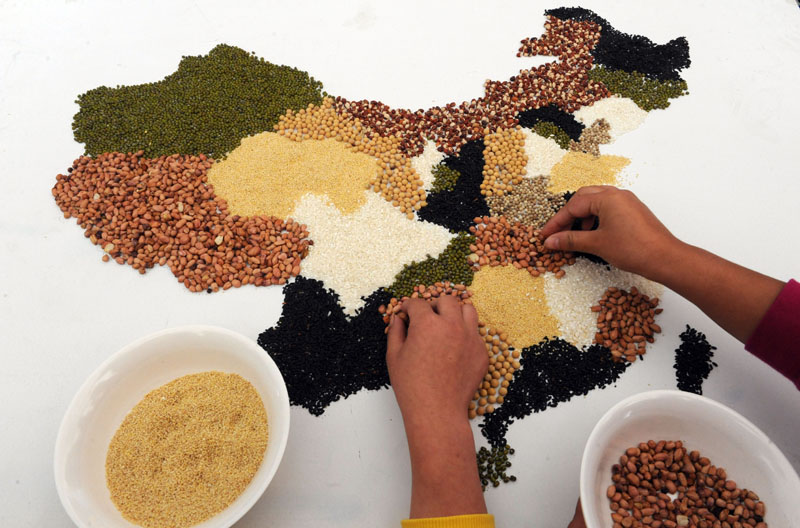
China Food Map (Photo: Zhang Yanlin/Asianewsphoto)The phase of optimization is also going to take place in food and agriculture. The situation about corn is a good indicator. Until 2012, China was self-sufficient for corn. With the increasing demand for meat as a result of economic improvement of the population, China has now become a net importer. The type of demand for the various food groups, together with the environmental toll of pursuing the objective of food self-sufficiency has reached its limits. It is important to acknowledge the performance of the Chinese agriculture, though. Even is the cost of achieving food security is high, one needs to remember that China is the world’s largest producer of rice, wheat, pork, eggs, fruit and vegetables, and cotton. It is the second largest producer of corn, behind the US. Considering the size of the country, being the main producer for all those commodities is quite an achievement. Yet China, announced last February that it was changing its objective, and that grain self-sufficiency was no longer sacred. It makes very good sense. The long term is as important as the present. China needs to work hard now to protect and restore its soils and its fresh water. On other area where the country can also achieve substantial results is by fixing post-harvest losses. Infrastructure will be developed further. Optimization of the food value chains will also take place, largely in the form of a consolidation of businesses. The seed sector will be interesting to follow in this regard, as many small seed producers will either disappear or be absorbed by larger entities. Considering the crucial role of genetics for crop yield, this rationalization of the sector should also contribute to a further improvement of the Chinese agriculture.

With land purchases abroad, world agricultural production up, international trade and a more astute food stocks strategy, China does not need to try to produce all its food itself. The bulk of the basic needs is covered. Now, it is time to optimize and repair without having to fear shortages. The focus is going to be more on waste reduction and efficiency than before. It definitely will be about doing more with less, to use a commonly used expression. An example of this tightening of standards is the so-called Green Fence for the recycling goods that China imports. Now the recycling materials need to be cleaned to enter the country. China simply does not want to use its energy and water resources. They want the waste producers to do that in their own countries. That is wise.

Another area for optimization is food safety and food quality. In a previous article , I wrote about a strategic shift towards speeding up the learning curve to meet higher standards. The shift from quantity to quality is a reflection of the pyramid of needs. When people have enough to eat, as is the case in large Chinese urban centers, they start to look at how food is produced and question what they do not like. Food security is for most no longer a worry, as the alarming rise in overweight and diabetes shows. When food security is no longer a worry, the focus shifts to food safety. That is quite normal.

My expectation is that China is no longer in the logic of just copying and producing cheap low quality. Although this reputation is still quite alive in Western countries, in my opinion it is incorrect. But after all, similar prejudices lived long about Japan, too, until the time that Americans realized that Japanese goods were of a better quality and Japanese companies were better run than their domestic counterparts. We will see the same thing about China. Some people will wake up too late. The Chinese are quite awake. Don’t worry for them.

Although the food industry, like all industries, resents criticism, it is actually the sign of a developed society. Basic standards do not satisfy anymore. People look for the something extra, and that is where opportunities arise. Those who listen to consumers and offer them what they want increase their chances of capturing the high-margin market positions. Let’s face it; markets for undifferentiated commodities are attractive mostly because of the large volumes they represent. In China, too, health and environment will be the drivers of future food supply. This will definitely offer good possibilities in the future. The Chinese will also take a look at their diet, and the per capita consumption of meat, just like economic growth, will not keep increasing forever. In the same way as it did in Western countries, it will reach a plateau, probably in 10 years from now, and later will gradually decline, for the same reasons as it is doing in the West, and also because the population of China is expected to decrease to 1.4 billion by 2050 and to 1.1 billion by 2100. That decrease represents a lot of consumers. It will be important to notice this change of trend on time. When consumption of certain food items in Western countries reached that plateau, most companies did not anticipate it. As usual in such situations, denial is the first reaction. First the change of trend is considered a temporary hiccup. Investments to increase capacity have often been made on the expectation of continuous growth, causing an overcapacity of production, and the production capacity needs to be used fully to be economically efficient. This creates a lack of flexibility and all producers enter the difficult times with the same cost profitability concerns. When the stagnation appears to last, producers like to think that indeed there will be a consolidation of the sector, but they usually all seem to think that they will weather the storm and will not be affected. Of course, it never works that way. Bad things do not happen only happen to others. Then, the crisis follows and usually a vigorous restructuring takes place. I have seen this many times and it is amazing to see how history repeats itself. There is no doubt that when food consumption will have reached its top, the same mechanism will show. This time, the problem will be quite robust, though. To supply China, production volumes will be much higher than previous similar scenarios of stagnation in the various Western regions. Further, just as much any marginal increment of consumption per capita multiplied by 1.5 billion means large volumes, any decrease of consumption will represent significant pain. This point is not here, yet. There are years of growth for most food groups ahead, but it is time to start thinking, and especially start planning, about a change of strategy. When the plateau appears, differentiation will become the main theme, and niches will be the place to be. Considering that the Chinese culture is long-term oriented and that relationships are a fundamental element of business in China, I would recommend starting paving the path for this shift sooner than later. After all, 10 years pass quite fast.

Copyright 2014 – The Happy Future Group Consulting Ltd.

A couple of billion reasons why Africa is a priority for the future

More than three years ago, I had posted on this blog the list of the 16 most populated countries in the world by then. It helped put things in perspective in today’s world, but looking ahead, another table is more useful. Here is the list of the 16 most populated countries in 2050 and 2100 according to the UN.

2010

Country

Population

(millions)

% of world population

World

6,794


China

1,337

19.6

India

1,180

17.3

USA

309

4.5

Indonesia

231

3.4

Brazil

193

2.8

Pakistan

169

2.5

Bangladesh

162

2.4

Nigeria

155

2.3

Russia

142

2.1

Japan

128

1.9

Mexico

108

1.6

Philippines

92

1.4

Vietnam

86

1.3

Germany

82

1.2

Ethiopia

79

1.2

Egypt

78

1.2

Top   16

4,531

66.7

2050

Country

Population

(millions)

% of world population


      9,551


India

1,620

17.0

China

1,385

14.5

Nigeria

440

4.6

USA

401

4.2

Indonesia

321

3.4

Pakistan

271

2.8

Brazil

231

2.4

Bangladesh

202

2.1

Ethiopia

188

2.0

Philippines

157

1.6

Mexico

156

1.6

RD   Congo

155

1.6

Tanzania

129

1.4

Egypt

122

1.3

Russia

121

1.3

Japan

108

1.1

 Top   16

6,007

62.9

2100

Country

Population

(millions)

% of world population

        10,854  
India

1,547

14.3

China

1,086

10.0

Nigeria

914

8.4

USA

462

4.3

Indonesia

315

2.9

Tanzania

276

2.5

Pakistan

263

2.4

DR   Congo

262

2.4

Ethiopia

243

2.2

Uganda

205

1.9

Nigeria

204

1.9

Brazil

195

1.8

Philippines

188

1.7

Bangladesh

182

1.7

Kenya

160

1.5

Mexico

140

1.3

 Top   16

6,642

61.2

Immediately, some interesting information appears. China is already reaching a plateau and it will decline later. Most of Asia will have reached its peak of population by mid-century. India’s population is going to keep growing in the coming decades and with regards to food security, the country has still lots of work ahead. However, with the growth of its middle class, the situation should improve gradually in the future. The continent that will see the strongest population growth is Africa. Between now and the end of the century, eight countries will account to over half of the world’s population increase from currently 7.2 billion to 10.9 billion, with six of these countries being on the African continent. These eight countries are Nigeria, India, Tanzania, the Democratic Republic of Congo, Niger, Uganda, Ethiopia and the USA. It is worth noticing that the population of Nigeria will pass the population of the USA before mid-century. For a country the size of Texas, the challenge is huge, especially considering the current political instability. Other small countries such as Tanzania and Uganda are going have to cope with a very strong population increase.

The challenge for Africa is clear. Most of the countries with a strong population increase are poor countries that already have serious difficulties to feed themselves. African agriculture has not followed the pace of other regions in terms of productivity and yields. Many rural communities are poor and can hardly subsist. The flip side Africa having lagged in agricultural development is that it has huge potential to increase its food production. At the beginning of the current decade, the FAO estimated the area of unexploited arable land in Africa to be roughly the size of continental USA. By increasing acreage in production with higher yields, there is plenty of room to increase production volumes to sufficient levels. Food production is the not the only problem. To solve hunger, these countries must eliminate poverty. People who have enough money to buy food are not hungry. Only the poor are. And to have enough money, one needs a decent paying job. For the future of Africa, employment is really where the battle will be won or lost. Between now and the end of the century, Africa will have to create 600 million new jobs, and to get jobs, people need to have the proper education and training. They also need to be healthy. As the expectation is that most of the population will be living in cities, another challenging goal will be to build these urban centers and all the necessary infrastructure to move the goods and the people. Such megacities will also need to be food secure and urban planning will need to take food distribution and food production into account. Education, health care, construction, infrastructure, jobs, food and agriculture… This sounds like building an entire continent doesn’t it? And that is exactly what it is. Expect Africa to be a huge construction site! Action must be taken and properly phased out over the next nine decades. If the challenges are many, so are the opportunities and the benefits in the long term.

So what does it take to make this happen? The answer to this question is rather simple. The implementation and proper execution is less so. It will take money, and a lot of it. There is plenty of that, though. The Central bankers of developed countries did not have to think too long to start printing a couple of trillion dollars, emitting bonds and doing the quantitative easing as needed to save the financial sector when the system was imploding in 2008 and since then. Building Africa would not require more money than that. If there has ever been a need for Keynesian economics, the Africa of the coming decades is it! Not only the money pumped in the system would allow projects to happen, but it will be the basis to create the many jobs that will be required to build all that is needed. The challenge for Africans is to have and to provide the training required to qualify for the jobs come.

To rise from its current situation, the task is somehow comparable to rebuilding Europe after World War II. Both the Europeans and the Americans who provided financial help by then can tell the Africans what a great period of prosperity followed for them. Africa needs a Marshall plan of its own, but it also must convince the rest of the world that it will put the money at work. And that is where the second crucial component of success – or failure – resides: leadership. Africa needs strong visionary leadership with integrity that will not only make things happen, but also will keep the energies focused on a long-term effort. Another eighty-six years to complete it all before the end of the century will not be too many. Africa will have to bring forward a new generation of leaders that will follow a course that is quite different from the one many of their predecessors followed. Encouraging investors will require fighting corruption, starting with a leadership by example. Corruption is a theme that I hear regularly from businesses that would like to engage in Africa, but that feel reluctant to do so for that very reason. Endeavours may be risky, but they have the potential to be quite rewarding for those who will dare and have the patience to wait to reap the fruits. As for anything else anywhere else, there will be success stories and some failures, but that is the way the world goes. It will be important to factor in disappointments and a percentage of mistakes and failures to assess the true future return. One thing is sure: searching for a quick return is probably not the best strategy over there.

Africa is diverse. The challenges will vary per country and so will the quality of the leadership. I expect the political geography of Africa to change between now and 2100 (actually much earlier than that). Borders are inherited from the independence from the colonial power and they do not always reflect a good partition for the future. Sometimes this may happen peacefully and sometimes unfortunately not. Note that I never said it will be easy. Nonetheless, the continent must move forward and the countries must develop their economies.

Although it will not be simple, I am optimistic about future changes in Africa. In my limited dealings with young professionals from Africa, I can say that this new generation is highly motivated and keen to succeed. In my contacts, I have many bright, smart and well-educated young African professionals in the field of food and agriculture. I enjoy their energy and desire to change the course of the future. They have travelled and they know quite a bit about food production in other places. They push relentlessly to bring new dynamics and I do believe that they will make good things happen. But they will need all the help and support to have access to the right resources and knowledge to succeed.

For some reason, since I started the Food Futurist, I have always considered that Africa will be playing an important role in the future of food and agriculture. I have believed immediately in its potential and I have never been shy about it. This has sometimes created interesting situations such surprise or disbelief from my audiences and clients. I guess I was a little early with my predictions, but I have had the pleasure to hear some of them who looked at me as if I had a sunstroke who now advocate in favour of Africa’s food and agriculture potential. It just took them a year or two to come to the same conclusion. I guess the first part of my work has been done. Now, I really would like to be involved with organizations that want to build solid pragmatic market-oriented food production in Africa.

Copyright 2013 – The Happy Future Group Consulting Ltd.

Launching the Seeds of Leadership mentoring program

Contact with young professionals who are starting their careers is always special. They are eager to learn and have a fresh look on the world of food and agriculture. Personally, I find this particularly vivid with young people from developing countries. I truly enjoy their energy, their enthusiasm and especially how they do not take what I say at face value. I have always appreciated people who dare to challenge, who want to go to the bottom of things and who keep a critical mind.

As I also wanted to find a way of giving back just for the pleasure of it, I gradually came to the idea of creating my own modest free mentoring program.  So, there it is. I have called it “Seeds of Leadership”. It is open to anyone who has less than three years of experience from anywhere in the world. In my opinion, mentoring young professionals from the sector is an important part of helping shape the future of food and agriculture.

For more details, just go to the Seeds of Leadership page.

If you know candidates for whom this program would be useful, please send me a recommendation for him/her as described on the page mentioned above.

SoL logo