Launching the Seeds of Leadership mentoring program

Contact with young professionals who are starting their careers is always special. They are eager to learn and have a fresh look on the world of food and agriculture. Personally, I find this particularly vivid with young people from developing countries. I truly enjoy their energy, their enthusiasm and especially how they do not take what I say at face value. I have always appreciated people who dare to challenge, who want to go to the bottom of things and who keep a critical mind.

As I also wanted to find a way of giving back just for the pleasure of it, I gradually came to the idea of creating my own modest free mentoring program.  So, there it is. I have called it “Seeds of Leadership”. It is open to anyone who has less than three years of experience from anywhere in the world. In my opinion, mentoring young professionals from the sector is an important part of helping shape the future of food and agriculture.

For more details, just go to the Seeds of Leadership page.

If you know candidates for whom this program would be useful, please send me a recommendation for him/her as described on the page mentioned above.

SoL logo

Why now may be the best time to work on the future of food and farming

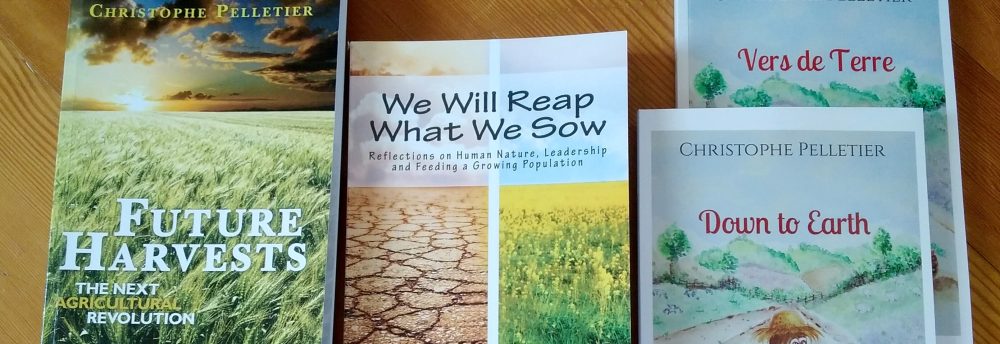
Now is the right time to look forwardAlthough agricultural commodities markets have recently calmed down, the past few years have been turbulent. The result has been an increased attention for the world’s food supply and demand. Even in food secure regions, it is quite important to not take food security for granted, as it is always a work in progress. In this regard, the stress on agricultural markets and the recent price hikes have been a good thing. They have forced many to take a closer look at the situation and to start reflecting about the things to come. I have been among the ones who started earlier than most others, for two reasons. Firstly, it was obvious that meeting the demand of a strongly growing population would bring some challenges. There was no need for a crisis to figure that out. Secondly, I did not find analyses that connected the dots beyond the particular interests, the particular regions or the particular business areas of those who produced research and documents about the subject. This is why I have developed my foresight activities for food and agriculture and published the two books. The first, Future Harvests, answers the question of whether we can feed the future population and the second, We Will Reap What We Sow, reflects on how our future behavior towards consumption, together with the quality of our leadership, will decide whether the future will be prosper or gloomy. Those of you who read them know what the answers are and why.

Although the period of tensed markets helped bring valuable attention to the food issue, it has produced more quantity than quality about what should be next. Between those who announced the end of days and those who see it only as an opportunity to use fear to stop others from thinking, there has been little structural long-term thinking. Both groups play on short-term fear to push agendas that serve mostly only themselves. The future cannot be selfish; it will be about helping others succeed. Profit is only a by-product of sound decisions. Those who will foresee the actual needs of the future will make lots of it in the long term. The others, although they might score in the short term, will not win the race. In food and agriculture, foreseeing the future and defining winning strategies are complex activities. I say complex, but I do not say complicated. Ironically, the more thorough the analysis, the less complicated it comes out. When done well and communicated properly, there is no reason why others would not be willing to build a successful future. The complexity comes from the many levels involved in food security. The interactions between natural conditions with the political, economic and cultural environments, together with the many – and often divergent – interests of the players of food value chains are difficult to reconcile. But this is not all. The fact that food production systems and consumption behavior are also influenced by many other sectors competing with agriculture for resources adds to the complexity. The issue is not just about production techniques, new technologies or functioning of markets. Other societal issues play a role, too. The quality of a society and as a result of the people of which it consists will play a role. Health, education and on-going training are very important components of how we will manage the future. Each of the “blocks” I just presented are complex in themselves, simply because they deal with life and keeping the dynamics of life running harmoniously is no easy task. On top of that, the fact that these different blocks, depending on how they individually function, interact with each other and affect the performance of the others, it is clear that we need to look at the issue of feeding the world in a comprehensive manner. We need to identify and integrate all these elements in the analysis to determine the proper action to take. It would be quite convenient if future actions depended only of what directly affect a particular sector. Unfortunately, limiting the thinking to one degree of separation is not enough, by far.

In my years of the Food Futurist, I have had the opportunity to notice that the multidimensional nature of the issue is the one that seems the most difficult for most organizations to fathom. There is no shortage of reports or publications about the future of this or that. However, although they clearly are of excellent quality and the result of hard work, many of them miss the dot connecting part. They focus on the area of interest but tend to neglect the bigger picture. It is only natural that organizations look at the future from the angle of how it will affect them. Yet, nobody should investigate the future from a self-centered kind of production-driven manner. This tends to produce a self-serving strategy that will not prepare those organizations to deal with what will come from the higher degrees of separation. The here and now is nice, but to thrive, they must focus at least as much on the elsewhere and later. I must say that I also have dealt with organizations that do have this comprehensive approach. I found that they had several qualities in common with each other (and with me to some extent): serenity, a rather positive and optimistic outlook on the future, and the quiet confidence that we can overcome the challenges.

Yet, even these “better” organizations still need to go further than they have in preparing the future. Their comprehensive understanding on all the factors that will influence the future needs to go to the next level. All organizations, those with the comprehensive outlook on the future as well as those who carried out the exercise in a less deep manner must translate their understanding of the future in specific strategies and effective execution. In many cases, this is still missing. Organizations must let go of the past by not assuming that past, present and future are linked in a linear manner. That way of thinking is still dominant and, considering the magnitude and the nature of the changes to come, it will not be the best approach to be successful in the future. Another important aspect to take in consideration is to clearly identify in advance what the effect of their actions will be on the rest of us. The latter will be a prerequisite for a prosperous future. It is amazing to see that most plans have no plan B. Without a plan B, a plan is pretty much not a plan. There cannot be only one strategy. There has to be an arsenal of options. What must stand fast, though, is the final outcome. Building a strong future is also about being prepared for the unexpected and to adapt accordingly to succeed. Such an approach would also show that their future actions are taken in with responsibility in mind.

The current times of agricultural markets calming down and readjusting to more reasonable and realistic prices are, more than any other, ideal to focus on how to proceed to build the future of food and farming. As grain prices have slowed down and the animal protein sector is improving financial results, everybody is in a more serene mode. The white noise from the media and the fear mongers has faded for now. Everyone can hear him/herself think again. That is quite a good thing. However, this is no time to lay back or become complacent. Such a serene environment will not last. The population keeps on increasing. Meat and poultry producers will resume production increase as demand for their products is among the fastest growing of all foods. With grain and oilseeds prices less attractive, the incentive to push for more production will also slow down. It will not take a genius to figure out that demand for animal feed will grow faster than production of feed ingredients once again. Lately, Asians have also hoarded agricultural commodities to have stocks at hand, but as availability of commodities increases, they will get more relaxed about it. For all these reasons, agricultural prices are going to go up again, hurting animal protein producers again and sending agricultural markets up as investors and speculators will see their chance for quick money. Let’s also be sure that there will be some climatic event somewhere sometime that will also join the party to add on the stress. When the different parts of the food value chain do not plan ahead globally to ensure a balance between supply and demand, such cycles persist and crises come back. It probably will be a couple of years (my guess is three to five) before we face a similar crisis again. This is why the time to act is now by developing solid plans, engaging in the right partnerships and collaborate closely and intensely to work on the future of food and farming. I mentioned earlier that analyzing what will happen in the future and to prepare for it is complex, the exercise is actually easier than it sounds. It is only a Herculean task for those who want to solve all the world’s problems on their own. One simple trick is to see the big picture but to define what the realistic contribution of the organization to the whole problem actually can be. Another one is to ask for help and support, and thus engage others on the right path. The contribution can be products, services or collaboration. Nobody will fix the situation alone, and nobody should think in such terms. The essence is to act and make others act in the right direction. Communication towards others is quite important as it helps other organizations to determine their respective objectives. In this regard, conferences and events about the theme of the future of food and farming are quite useful. I have participated to quite a few already. Sometimes, I wish they were more focused on what it means for the partners and the audience than what it means for those organizing such events, though. It is clear that many of such events have a marketing and/or image purpose, but that too can only be a by-product. The most important is the added value to the attendants and what they can use practically in their own operations from what they heard at the events. At least, that is my philosophy and how I approach such speaking engagements. Too often, participants present their offering, such as new products for instance, but so far I have not heard anyone ask what I think is the most important question and the key to success: What do you need from me or from other partners to succeed? There are too many conferences about the future of agriculture that do not even include a farmer among the speakers! The customers are the ones who know best what they need from others to do a better job in the future. Let them speak out!

As far as I am concerned, I have now started to work on my third book, the topic of which will be about strategic foresight for food and farming. It will be about anticipating the changes that will come as well as the changes that must take place with the main purpose of presenting adequate strategies to adapt and to prosper. It will review the future evolution of the different productions, the different links of the entire food value chain from DNA to consumer. It will present strategies for and between stakeholders in the different regions of the world, as they face different challenges and conditions, with the objective of showing how it can work for all. I believe it will be a welcome follow-up to the previous two ones, which had already paved the way to show options a building a prosperous and viable future for all, here and now as well as elsewhere and later.

Copyright 2013 – The Happy Future Group Consulting Ltd.
Food prices, one year later – Some lessons

According to the data gathered by the FAO, global food prices are on the decline. They have been so for some time. However, this good news does not seem to make the headlines. Reassuring news does not score with the mainstream media. What a difference with the past year during which all of a sudden they discovered that food might not be taken for granted after all! What have we not heard and read by then. The most absurd theories and pseudo-analyses have been spread around by some who know nothing better than copying and pasting the internet without exercizing the slightest sense of critical thinking. Of course, the fear mongers got plenty of publicity while they really did not contribute to anything productive, as I had described in a previous article (Fear mongering does not build a strong future).

What a difference a year makes! And that is a very good thing. It shows that agriculture and farmers are much more resilient and have much greater potential than some want to make believe. That confirms what I have always claimed and that I relentlessly repeat in my presentations and publications. I have lost the count of how many times I have been told that “Christophe, you are quite the optimist”, in particular about the content of Future Harvests. Frankly, I do not think that I am particularly optimistic. Actually, I can see many reasons why we will face serious crises along the way to meeting the goals of feeding a growing population. That warning is the message behind We Will Reap What We Sow. I see human nature and in particular our leadership, as serious reasons for temporary failures. But if I do not consider myself as an optimist, I definitely have a positive attitude. I truly believe we can manage and overcome future challenges, because I crunched the numbers and I have demonstrated in my literature and my talks that feeding 9 billion people in a sustainable manner is quite possible. It is possible, but it is not a given. There is work ahead. That makes it interesting and exciting.

Next to the potential and the future development that can make us overcome the coming challenges, I am also a firm believer of market forces. Market fluctuations trigger action and reaction. Nothing like high prices and solid profits get food producers increase production. Similarly, nothing like poor financial results have the ability to tamper any desire to increase production. The so-called invisible hand works. Sometimes, it holds a carrot. Sometimes, it holds a stick. It makes things move in the right direction. Over the past year, I have presented during a number of events how market forces would influence prices in different sectors in the years to come. By looking at it from the consumer demand end and by going back in the production and supply chain, I showed how the different actors would react to their own particular situations. So far, my predictions have come true, the reactions of retailers, food service, animal protein producers, crop farmers and input suppliers have been as expected. The drop in global food prices is one of these predictions. Those who attended some of my presentations know what I mean. For the others, here is a link to a video showing an excerpt my talk about the dynamics of future agricultural markets that will illustrate what I am writing about.

The past year contains many lessons. Some of them are about us, and some of them are about how to look at the future. The main lesson is probably that the situation of food and agriculture cannot be looked at in a simplistic manner and can certainly not be described or commented with scary slogans. The population is growing but so is agricultural production. The famine that is supposedly around the corner is far from happening. In a year time, the world population has increased by a few dozen million people, who on average tend to eat more food, and in particular meat. Yet, supply is able to meet demand better this year than last year, as global food prices and grain stocks indicate. Another lesson is that even though severe climatic events affect food supply negatively, there is no reason to panic. The fact that last year a severe drought depleted production numbers in one of the essential producing countries, the USA, the system was able to absorb the shock. There has been no food riot in 2012 like in 2008. The reason needs to be looked at what products were the most affected.  Supply of basic food stables remained in balance with demand. There was no particular shortage of bread or rice in sight. The commodities that were affected were business to business products, destined to the animal feed and the corn ethanol industries. Another lesson is that even though the prices of 2012 did not lead to riots, climatic events are a serious threat and need to be factored in future supply and demand scenarios to build enough of a buffer to reduce the risks of supply disruption. Another area that requires more attention is the regulation of financial markets, and in particular the regulatory aspects. It is clear that derivatives amplify market price fluctuations. By deciding who is allowed to be active on the markets of agricultural commodities and for which quantities, the functioning of markets can be more representative of the physical reality. In particular, the participation of players who have no physical production or supply functions in the food and agriculture need to be taken under strict scrutiny. As it is important to have fair market rules for a proper functioning of markets, it will be also useful to look at the functioning of crop insurance. Last year’s drought in the US cost insurance companies much money, while it appeared that US crop farmers ended up the season with the second highest profit level on record. No one will argue that farmers need to be protected from such unpredictable events.  Insurance should guarantee them a minimum income so that their future would not depend from forces out of their control. That is just fair. Opposite to that, it sounds beyond normal that, thanks to other contributors, farmers could go through such a drought without hardly feeling the slightest pinch in the wallet.

After the past year, am I still an “optimist”? Yes, I do believe that farmers will meet demand in the future. For all the reasons above, I am convinced as ever that the potential is largely there and that the world can absorb tough years. But I would attach a warning to my optimism. It is not because it can be done that it will be done. It is necessary to keep thinking ahead, to come with innovative ideas, products and services to be able to plan and forecast better, to make better and faster decisions. It is also essential to pass knowledge and information better and faster, and to choose the attitude of helping others succeed before one’s particular interest. Our societies have succeeded by acting together. Nobody will be able to do it all alone. Providing help and support will be critical for success, just as much as asking for them will be. It also becomes crucial to be able to look beyond one’s area of business and to connect the dots even – or maybe actually in particular – with events and activities that have, at least apparently, several degrees of separation with agriculture in order to anticipate, adapt and be prosperous. That is the core of what I do, and I can only encourage you to take the same approach.

As markets ease, it will be quite tempting to drop the guard. In my opinion, this would be a serious mistake. The time things seem to be under control is the right time to prepare for the future and to do some foresight. Markets will change again as the bargaining power of the different links of the chain will shift. Be assured that there will be some severe price hikes again. My best guess is within five years from now. Those who will do this exercise will have a strong advantage over those who will procrastinate.

Copyright 2013 – The Happy Future Group Consulting Ltd.

Adapting our thinking to the future – part 2

At the end of part 1 of this article, I had mentioned how our elders used to make progress by blending the modern with the traditional. It is quite important to keep this way of looking at our life environment quite alive. How we evolved to where we are today determines very much why we have the current possibilities available. They are the direct result of our history. Whether we like it or not, our future has its roots in our past. The art is to improve what we have, and to improve, we need to learn from the mistakes of the past. Rejecting solutions for the simple reason that they are old-fashioned or not based on science is really excluding diversity, while diversity is the fuel of progress. Reducing diversity comes down to reducing options to move forward. As someone who looks toward the future and tries to find out what is likely to come as well as what is desirable to create, I find this balance between past and future especially interesting. I often am surprised to see how many people are actually busy reinventing the wheel, while they think that they are busy innovating. Many projects and research that I see taking place have actually already been carried out in some way either in another place or in another industry. I regularly have to tell some of my contacts about similar projects that took place years and sometimes even decades ago. This is why I always insist on the need to be curious. For the future, curiosity is an asset. I could never urge anyone enough to have an open mind for anything that happens anywhere and in any industry. Maybe, I am doing some sort of transfer about this and I wished others would be as curious and eager to learn as I am, but this is so helpful to foresee the changes to come, that anyone who is interested in the future should be wired like that. Unfortunately, I find most people to not be really curious. They seem to be interested in what will serve them directly in the short term, but much less for what may serve others now but also in the future. Until someone can tell me that it is better to limit one’s perception and understanding of the world and of its possibilities, I will keep being curious and open-minded.

People really need to expand their horizons. Not only is it useful to be prepared for the future, the main reason is that it is incredibly fun to learn to know new things and new people. For the sake of humanity, it is time to open up towards others. The attitude of future business will not be about pushing new products and services to others, but to have a “what can I do for you “ and “how can I help you” mindset. The business of the future is the one that delivers solutions. In the future, successful products will be at least as much about the service included as it is about the actual physical product. This is what circular thinking will deliver. In a future where others are really what matters the most, the social perception will also change. “Old boys clubs” (which are nowadays just as much girls clubs) and other clans are not really the most dynamic organizations. There is no doubt that they are incredibly comfortable, because they are basically made out of clones. Everyone thinks the same, shares the same values, comes from the same university or social group, lives in the same country or region, has the same feeling of importance, and looks to the outsiders just as such: outsiders. There is a lack of diversity; therefore there is a lack of progress. A new interesting development that, to me, shows the quality of networks has appeared recently on LinkedIn. They visualize how much of your network belong to which organizations. I recently have seen some of the apparently very social individuals that have close to 40% of their network linked to only one company, and the second organization in his network only 1%. To me, that does not spell open network. And I thought that the main organization in my LinkedIn network was already high at 5%. Personally, I prefer by far those who have a balanced distribution of their networks. The chances are much higher that people who have a more balanced distribution of their networks have been exposed to more diversified experiences, and are likely to be more open and more flexible to different or challenging ideas. For a successful future, we must not think in terms of networks, but we all should be interconnected in the same one that would be the complete integration and interaction of all the ones that exist. My customers have demonstrated this to me. About all of my business has come from my being on the web with this blog and my books. They caught my customers’ attention who decided to get in contact with me. None of them knew me personally beforehand. The result has been business. Actually, I have not prospected once for the Food Futurist services. I just found a way of being visible beyond any limitation of network boundaries. The Food Futurist has become part of that global web.

One of the main differences between nowadays and yesterday lies in how intricate our world has become. In the past, things used to be more compartmented. Today, the whole world has opened. Knowledge travels fast and is accessible from almost anywhere on the planet. The level of interaction between industries and technologies is much higher now than it used to be. Most innovation that will help progress in food and agriculture in the future will not originate from the food and agriculture community, but from many different fields such as robotics, nanotechnologies, telecommunications, software development or medicine, just to give a few examples. Although technology will definitely play a major role in improving what we do, it will be important to not see technology as a panacea with dictatorial tendencies. I always underline the importance of the balance that we must maintain between technology and steering human nature for the best. In the end, technology is only as good and useful as the way we use and master it. Just take the example of gun powder. When the Chinese started to use it, they made fireworks for entertainment purposes. The “white man” chose to use it to kill others. Clearly, a similar technology used with different philosophies of life will serve different purposes. This is still true with today’s technology and it will be true with tomorrow’s. It will depend on the leadership. Technology needs to pass the test of morals and ethics, unless we accept that it might serve to be used against us. Technology and leadership go together, just like science and philosophy do. It is important to not forget it. If curiosity is an asset for the future, clearly, so is having a critical mind for the reasons just presented. It is essential to keep control on what we do and that we address concerns. Of course, this may delay some valuable financial objectives for some, but the quality of the future will depend on us doing the right things. The debate that results from critical thinking may be time-consuming, but open debate is an integral part of the democratic process. Open debates protect us from going back to dark ages. Looking back how what such ages have caused in human history, and unfortunately still do in some parts of the world, the need to learn from the past is clearly essential for a prosperous future.

Thinking ahead like a chess playerOther advantages of critical thinking are that it stimulates reflection and is a source of ideas. It is also important to make clear that critical thinking is not about criticizing but about questioning. Sterile boring criticism is just as useless for our future as not thinking at all. Let’s face it, critical thinking is not easy. It requires emotional distance. It is about accepting that what we may have believed appears to be wrong, or that they are better ways and beliefs. To be a good critical thinker, one needs to have enough confidence to overcome disappointment and to accept to change the course. Not that many people are willing to deal with such challenges. Yet, if we want to prepare for a prosperous future, we will have to accept that exercise, because, the future will be quite different, and in particular our interaction with our environment and the world will change and evolve further. Critical thinking actually requires a rather Zen mindset. One needs to have the calm and openness to observe and listen before speaking. One needs to accept being wrong as the debate that arises from the exercise will also show the value of other people’s points of views. Critical thinking is an exercise in humility. Humility is a highly valuable, yet often neglected quality. Yet, it is essential to be humble when thinking about the future. The challenges are quite serious and dealing with natural forces that may or may not be about to unleash upon us will not be an easy task. We will need to understand our relationship with Nature and accept the idea that, in spite of all our cool technologies, we are vulnerable and mortal. One of the arts of future thinking will be about pushing the system while knowing where the limits are that we must not transgress. That is what sustainability really is about. We really do not want to open Mother Nature’ Pandora’s Box. To be equipped properly to face the future, we need leaders that will think like chess players. We need leaders in all areas of society that can understand how the consequences of their decisions and of their vision will trickle down through the system. They must be able to foresee what may happen when they make their moves. Many already hardly can foresee what comes next. Those we need are the ones who can visualize what happens two, three, four and more degrees ahead, so that they can adjust their choices and already develop alternatives before troubles arise. A good plan A always includes a plan B, and preferably even a plan C. Plans that lack alternatives are not plans, they are merely wish lists.

Copyright 2013 – The Happy Future Group Consulting Ltd.

Adapting our thinking to the future – part 1

Everybody will agree that the coming decades are presenting many new challenges. Never before have we faced such a population growth and demand for about everything, food and water being the most essential. The difference between success and failure will reside mostly in our attitude towards change and our willingness to adapt to a different new situation. For obvious reasons, the economic model of mass consumption and resources depletion that generates a mindboggling amount of waste is coming to an end one way or another. A new system needs to come and will come. Whether it will be the easy way or the hard way really depends on us all and in particular on our leaders. I like to tell that our future will be only as bright as our leaders. It is a bit of a joke, but not quite.

The circular will look linear when approached from the right angle

What does need to change in our thinking and attitude, then? In a finite world, we must understand that always more is not sustainable. This is especially true when several billion people are thinking of having the same consumption lifestyle as developed countries have had over the past 60 years or so. The pie is not big enough to allow that kind of party (and neither is the bakery that must produce the pie). This is where we seem to be stuck in our thinking. We have learnt to think linear in the past several decades. It can go only in one direction, and it has to be up, doesn’t it? God forbid of anything going down. In the field of farming when I hear the linear argument, I like to mention two things. The first one is that if farming stats must go linear, there should not be any farm left in developed countries in the not so distant future, and the same should happen in developing countries, too, just a bit later. No farm means no food. Apparently, that does not seem acceptable. There goes a crack in the linear thinking. My second argument against thinking blindly linear is that in biology and in population dynamics, there are no linear functions. All curves are curbed in some way. There are bell curves, sigmoid curves, exponential and logarithmic curves, just to name a few. None of them are linear. If we want to plan our relation with our environment in a prosperous manner, we need to leave the linear thinking and start thinking curbed, and the curve that fits the ability to renew indefinitely our access to essential resources best is the circle. Circular thinking is the never-ending linear. That is just as much of a thinking revolution as moving away from the concept of a flat earth to embrace the idea of a spherical one, or to fathom the curbed space. Shifting from linear thinking to circular thinking simply means a shift in thinking from always more to always enough. All it means is that we need to change our ways, but it certainly does not mean the end of the world. It would only mean the end of a world. With a growing population, circular thinking actually presents a lot of business opportunities, especially considering that the alternative is going nowhere eventually. There is no doubt that those who will catch these opportunities will be the winners of tomorrow.

Such a change in thinking also results in rethinking the meaning of growth. Currently, growth, and the GDP as its favorite indicator, means mostly volume and consumption. Actually consumption is probably not the correct world to describe our societies. Buying is a more correct one. Producers want consumers to buy. Consuming in this process is really optional. What counts is the act of purchasing over and over again. We think of growth as quantitative growth. Future growth will have to be a qualitative growth. With so many new people who will need employment in the decades to come, it will be crucial that future growth will have to fill a positive social role. Similarly, to have a livable planet, the future will have to contribute positively to maintaining a healthy environment. Social and environmental responsibility will become the standard. There is no escaping this. Well, that is with the angle of building a prosperous future. If not, chaos is always a possibility.

One of the most visible consequences of a growth model based essentially on quantity and mass purchasing is waste. As consumption goods became cheaper credit became easier and disposable income increased, consuming has become about buying and throwing away. The mountains of garbage in landfills around the world should be a reminder, although we seem to have located them far away from the eyes of the wealthy and in the backyard of the poor. Quite convenient. This way, consumers could forget about the consequences of their actions… and keep on buying and throwing away. Although this happens for all consumer goods, this is especially immoral when it comes to food in a world where about a billion people do not have enough to eat. It is immoral, simply because food means the difference between life and death, and wasting food is indirectly contributing to the death of others. It is also immoral because food waste is also the waste of all the inputs used for the production of food, be it water, energy or money. Waste is an indicator of the level of efficiency. Highly efficient systems generate little or no waste. Inefficient systems generate a lot of it. I will let you judge how efficient you think we are. Waste is also an indicator of our attitude. It is not just about morals, but also about discipline. Our societies waste a lot, because we still are much too lenient with ourselves, and also because in many cases the financial incentives to do the right thing are sadly lacking. We choose the path of least resistance.

As life became easier in a number of countries, people have started to lose some essential reflexes for survival. It is not necessary to go all that much back in time to see the change. My parents, grandparents and ancestors grew up in times that were not of plenty, simply because there was no consumption society, and incidentally there was the occasional war. People would not waste anything not so much out of morals, but because they simply could not afford it. Yes, mass wasting is the fruit of luxury. My elders would not waste and they were very skilled at circular thinking. They knew that nothing is created or lost, but that everything is transformed. As resources were not plenty, the right answer was to show plenty of resourcefulness. This is how things were by then.

To take the example of food waste, they would make sure that leftovers would be on the table the next day. They would most certainly not end up in the garbage. They would feed the pigs with what they could not eat themselves. Actually, they were turning low value products such as potato peels in high value protein in the form of pork. When I was in the agricultural university, my animal nutrition teacher once told a joke that I have never forgotten, especially considering that I have spent a substantial part of my professional life in animal production. He told us that modern animal husbandry was the art of turning high value protein into cheap fat. Not quite untrue, and so much the contrast with the pork made out of table scraps. This contrast is very much present in the ongoing debate about meat production systems.

We can find many answers for the future by looking at the past. In our current times of science-based facts obsession, many seem to look down at words such as experience, wisdom and philosophy. This is not wise. Our elders might not have known all the scientific background of what they were doing, but they knew what was best for them to survive. They knew how to manage a finite world of finite resources to sustain themselves. Passing on that knowledge, experience and wisdom was an essential part of survival. There was no conflict between modernity and that knowledge, experience and wisdom. They integrated the new and the old to build a better world. Although, there is still a lot of work to eradicate poverty, let’s not forget that the result has been the emergence of prosperous societies in which a record number of people are living now.

(Part 2 of this topic will be published soon)

Copyright 2013 – The Happy Future Group Consulting Ltd.

Finding your niche

One of the most common questions I get from my clients and audiences is how to find better markets. Regardless of whether I am addressing crop farmers in the Canadian prairies, food companies in the US, seafood producers in Ireland or local farmers here in British Columbia, the need to escape the undifferentiated commodity market is close to universal.

In my opinion, there is a simple reason for this. I usually explain it by joking about commodity markets being 95% price and 5% psychology, while niche markets are 95% psychology and 5% price. Of course, the percentages must not be taken literally. My point is that for commodities, since all the physical qualities of the offerings are similar, the (almost) only decision factor to choose between suppliers is price. All other arguments do not weigh much. For producers, this is often frustrating because it is a cold-hearted process in which the market decides. They feel that they have no control about the price setting, which is true for the most part. Although futures markets are there to help farmers limit the price risk, the lack of control in the actual price setting contributes to uncertainty, especially for producers in region with a relatively high production costs. In many developing countries, the disconnection between farmers and the markets presents similarities with the above. The lack of access together with the lack of control is a major impediment for the development of strong and successful farming operations.

Then, is niche marketing the way to go? Before answering this, it is useful to take a closer look at what a successful niche is about. Probably the best way to visualize it is to look at it from Maslow’s pyramid of needs, and look at which gradients we can define as we climb up the pyramid.

Niche &MaslowClick on the picture to view enlarged chart

The first one that comes to mind is that the bottom of the pyramid represent the need for generic cheap commodities and the top the exclusive luxury niches. The second one is directly derived from the previous one and from the content of the pyramid. It is the amount of emotion and psychology involved in the customer’s choice. This means that the level of quality also must increase as we go up the pyramid. Similarly, the level, and the quality, of service are also more important, as the target group lies higher in the pyramid. These differences clearly mean different way to conduct business. A solid niche is difficult to enter. If it is not, then many followers will rush into it, commoditize it and destroy it in no time. The difficulty can have very different reasons. It can be technical. It can be organizational. It can be commercial. It can be a matter of logistics or of planning. Whichever the reason may be, the message is clear for the producers: they must have the specific know-how to serve the niche well. They need to have the right set and the right combination of skills in-house. If done well, the development of a niche will also result in higher and more predictable margins, as well in the short term as in the long term. This has a lot of value to food producers, because they can plan ahead much better. Another important aspect of a solid niche is its growth potential. A good niche will grow. Of course, it will not become a commodity market, but that is what the producers want to avoid. If the niche has no growth potential, then as a producer you will be stuck and will need to find other solutions somewhere else for your business. This is why a niche has to be market-driven. There is no way that a production-driven approach will develop a niche successfully in the long term. It might work for a while, but putting production first will weaken the concept eventually.  Good niche management requires a deep connection between the producer and the customers. Developing a niche is not a marketing gimmick. It is not wrapping the old product or service in a new packaging. It is easy to make claims about sustainability, social responsibility or other concerns of consumers, but a good niche is not about the superficial stuff. It is about mutual dependence and shared value. To succeed in niche business, producers must be passionate about what they offer. They must believe in their vision, in their product and in their customers. They must commit to them and engage in a true partnership. If this is not the case or if it is not mutual, the honeymoon will be short-lived. Beyond the common vision and goals, what really counts is to speak the same language. Speaking the language of the customer is not enough. A good niche is one where customers want to buy from you, not having you hounding them for more sales. Good niche marketing rests on collaborative planning with the customers.

Although the comparison with Maslow’s pyramid of needs is useful, it is also important to realize that it does not necessarily means that a niche be tiny. Niche marketing is not the same as local and/or micro business. Especially in a world where purchasing power is evolving and where a huge middle-class with increasing disposable income, as well as a growing upper-class, are rising in populated emerging countries, niches may actually be quite large in comparison with the traditional Western markets.

Because there is such a need for niche developement, I am offering a specific program here at my company to help producers who want to walk the niche path. In my professional life, I have had many jobs and projects that were about getting away from the undifferentiated market and develop specialty markets that generate higher margins. The reason is that the production units where in countries with so-called uncompetitive production costs. Despite that, I successfully turned around difficult situations by setting up adequate strategies that capitalized on the strengths of the businesses and took them away from their areas of weakness.

Developing successful niches takes time and perseverance. For instance, it took me three years to get the poultry company I was working for to be approved as a supplier to Marks & Spencer. It also took some painful human resources decisions to turn around the sales activities I inherited in Germany. It took a lot of energy to lead for change here in British Columbia in an organization that was all about production and with no marketing skills, just as it took a lot of energy to convince the market that our new strategy would work (focusing on Chinook salmon instead of Atlantic Salmon) because many tried before and finally gave up. Yet, we did it and in half the time from what was stated in our supposedly very ambitious plan, and both the company and the customers benefited greatly from this move. I must also state clearly that to achieve such outcomes, I had set up teams with the mix of the right skills and talents to execute my vision. Nobody can do everything alone. That is valid for yours truly just as well. I am quite thankful for the great people who joined me in these endeavours and made it happen.

The difficulty to enter the niche protects you from the competition, but you also must pass the hurdle yourself. This means that you need to have the capacity to be stronger than your competitors. If you are not, realize that you will have difficulties to stay in business anyway.

Copyright 2013 – The Happy Future Group Consulting Ltd.

My futurism

The future has had the same intriguing appeal since the dawn of time. The reason is simple. Trying to predict the future is simply about reducing uncertainty. Looking into the future is about anticipating change. It is about preparing to adapt. Regardless of whether the motivation is fear, greed, pride, power or any other reason, the urge to foresee the things to come is really about one goal only: survival.

The material I offer focuses on how the future will affect my customers and what they can do to adapt and thrive. My approach to futurism is centered on how my clients can turn future changes into a competitive advantage for themselves. One of my main objectives is to show them how their activities are actually interconnected with developments that seem out of their daily world. It is quite easy to overlook these connections, but they exist nonetheless and will have an effect. Bringing the big picture helps create awareness and stimulates critical thinking, curiosity and questions. It makes the experience active and lively. The big picture broadens the scope away from the tech gadgets innovation part. It includes the human dimension, and the interactions between people and technology. It initiates a reflection about what to do and to use, as well as what not to do and what not to use.

In that regard, I could describe my form of futurism as practical and applicable. I do not limit my presentations and seminars to storytelling. Setting up a science-fiction-like story is rather easy to do. In very little time, anyone can gather the latest news about technological advances by going on internet and doing a search on these topics for agriculture and food. It probably will make this very website pop up high on the list. I have to admit that presenting scenarios that sound like science fiction always appeals to audiences. It has the mystique of an ideal world in the making where all problems will be solved by science and new technologies. Such an approach of futurism is fine for entertainment purposes. Journalists, writers and performers will excel in this kind of exercise. It is true that technology has brought many new possibilities. It has helped overcome many challenges, as well as it has open new frontiers. However, technology alone is not enough to describe the future. Especially not in an activity that depends so much on nature’s laws and nature’s forces as agriculture and food.

My Futurism

As a futurist, I often get the question of whether I have a crystal ball. It could be useful to have one, but so far I have not heard of any futurist predicting that crystal balls will ever exist. Ironic, isn’t it? Especially more so when some predict things as bold as plants will communicate to each other, as I read recently. If we can insert some sort of a nervous system in plants, I am sure crystal balls have to be in the realm of possibilities. Futurist can’t support that. I suppose it would put them out of business. I do believe that artificial intelligence will help replace them, as the technology will help create machines that can analyze faster, better and without interference from emotions and bias. One tempting pitfall to fall into is to try to make exact quantified predictions on market components, in particular prices and volumes. Until this day, I have seen many of such predictions fail quite sadly. After all, even computer models must contain in a factor of uncertainty. Personally, I do not try to give exact numbers, but I explain the trends and the dynamics behind to show in which range such specifics would land. Since food production and consumption can be influenced by many factors on which we have relatively little control, it is always good to remind audiences of such uncertainties. Although my approach may not appear particularly bold, my predictions are of rather good quality (click here to some of my past predictions).  For instance, when I started giving presentations or participating in panels, I crossed skeptical looks when I was telling that Africa is a region that has tremendous agricultural potential and that opportunities abound there. It has been ice since then hearing some of my apparently skeptical clients now seeing that continent as a key one for the future and theirs as well. Similarly a few years ago, I received amused smiles when I was mentioning the rise of robots, drones, sensors and other futuristic devices that would help farmers make better and faster decisions, and that in a time when I hardly ever heard any of the futurists talk about them. Now, most of them bring up this same topic. Yet, the information had been there all along. It was rather easy to know what was in the works. By then, agriculture had not reached the level of fancy it has lately. That will pass and practical analysis will replace entertainment. I also prefer to not make many predictions, which saves me from ending up tongue in cheek. I always give the preference to the sensible and the prudent. Until this day, it has helped my predictions to be accurate and valuable to my business partners.

Another important thing for me is to stick to a sector that I know and understand. I do not believe it is possible to have enough insights in everything. The more sectors one wants to follow thoroughly, the thinner the outer layer of practical and applicable knowledge he/she can bring over. The risk, in my view, is to fall back being the storyteller with the nice tech gadgets of the future. It is entertaining, but with little direct use for my public. I follow many sectors, always with the angle of what it might mean to food and agriculture. I am convinced that many developments that will help food production progress in the future will originate in other areas, but I am not going to pretend I am an expert in all these sectors. I stick to food and that is already vast enough a domain.

From my end, what I want is that the members of my audiences can go back home with several concrete points that are important to their work and that will affect them one way or the other during their professional life span, not in 50 years. Ideally, I wish they can start using my material the next morning to build a better future for themselves. Considering the lines of people who wish to speak to me after my presentations and the number of contacts that I receive afterwards, I believe that I reach both my goal and theirs.

With this philosophy in mind, I will add soon several programs that will be useful for my customers to envision, shape and build the future.

Copyright 2013 – The Happy Future Group Consulting Ltd.

Dealing with complexity

Looking at the future of food and farming goes far beyond agriculture. It comes down to looking at the future of humankind. Balancing future supply and demand of food is an exercise that includes many disciplines and dimensions, probably more so than any other human economic activity. Anything that affects life and its level of prosperity must be taken into account. Feeding the world is not just a matter of production. Of course, the ability to produce and to keep producing enough food is paramount, but there is more to it than that. The consumption side is just as important. Demand will depend on the diet, which also depends on how much money people have available to pay for food.

Total future food demand is a combination of which foods and food groups people in the various regions of the world will buy and eat. This is a function of demographic, economic, cultural, religious and ethical factors. If future demand is about consuming according to the nutritional needs of a human being, clearly the situation will be different than if people demand twice as many calories and protein as the actual nutritional needs. The relative share of animal products in the total diet will also change the situation in terms of production and of production systems. Food production must adjust to the demand and do its best to meet it, but not at all costs. Therefore, it is essential to optimize food production at the global level so that the largest quantity of food can be produced at the lowest environmental cost. At the local level, production depends of course on natural conditions, but also on economic, political and cultural conditions as well. This may be the most profound change that we must deal with: feeding the world of the future is a global exercise. As more and more people worldwide have more and more money to spend on food, demand is now global, and therefore production plans must also be global. The times of producing food simply for the own people and exporting surpluses is over. Markets will now react to any event that will affect production or consumption somewhere else. Borders do not make this shift in thinking easy. It is always tempting to think that having one’s house in order is enough, but it is not. What happens in other countries on the other side of the world will affect us just as well. Why is that? Just one word to explain it: markets. There used to be a time, not so distant when if there was a drought in Russia, China or Brazil, markets would not react as strongly, and anyway not so much in the media, as we have seen over the past few years. This was the case because only a minority of the world was consuming large quantities and that minority did not have competition. Now the competition is wide open. Markets will keep reacting on this and the relative price levels of various foods will influence how much of what is consumed and where. We will see eating habits change because of this economical aspect of food supply.

At the same time, food production is also adapting to a changing environment, and to face its future challenges. The amount of new developments in technology, access to information and knowledge and in decision-making tools is amazing. Innovation is flourishing everywhere to solve environmental issues, to cope with new energy and water situations. The dominant themes are the reduction waste of all sorts, as well food as agricultural inputs and by-products, and the prevention of the release of harmful contaminants. Innovation is developing towards better and more efficient systems that must ensure the future continuity of food production and, at the same time, keeping food affordable for consumers. Interestingly enough, many innovations that will be useful for agriculture do not originate from the food sector. Food producers will need to be curious and look beyond the field to prepare for the farming of the future.

Clearly, the number of factors affecting both consumption and supply are many. To add to the complexity, many of these factors are not of an agricultural nature. Many of them originate from the population, its activities and its needs for all sorts of goods. I mentioned earlier that what happens in one region affects others, but the natural resources markets, such as energy, metals and minerals, that must meet demand for non-food consumer goods also affects agriculture and its production costs. Although many see rising costs first as a threat, I tend to welcome them, as they always stimulate innovative solutions to increase efficiency and reduce waste. Two examples show that it works. One is the car market in the USA that shifted from gas-guzzlers to high gas mileage vehicles since gas at the pump became much more expensive than it was only 5 years ago. The second one is food markets. Had you heard as much about food prices, food security or food waste before the food price hikes of 2008 and 2012?

In my work, I always try to make my clients and audiences aware of how everything that has to do with food is interconnected with many other sectors, and how economic, demographic and political events are linked to food security or how they might affect it in the future. That is an underlying them in my books.

Even, within the food and farming sectors, organizations do not realize enough how their future will be influenced by other food productions and vice-versa. I always get reactions of surprise at the magnitude of the interconnection and the interdependence with these factors, and how they affect their activities indirectly. It is a normal reaction, as most people tend to focus on what has a direct connection with their activities. After all, that is why I do what I do: to help them see and decipher this complexity, and understand what actions to take to adapt and prosper. I never shy away from show the complexity. My audience needs to get a flavor of the any dimensions and many layers involved. However, I always take a practical approach and show them that complexity is not the same as complicated. Deconstructing the complexity actually works well to show the many levels of actions there are. It helps my clients connect the dots between their activities and what will affect them and how. It gives them a level of confidence in how to deal with the future and take action. I also like to warn against oversimplifying, which is another tendency that I observe from time to time. The mainstream media is rather good at that. But I also get questions that sound like those who ask hope that I have a magic wand and will be able to give them a foolproof recipe for success. That simply does not exist.  If preparing the future were easy, nobody would even talk about it. It would be done. It it was easy, I guess many of the organizations that have been involved in agricultural development and food aid for decades would have already succeeded, and they would not exist anymore. Yet, they still have to keep up with their work.

Feeding the world is work in progress. Developing the right actions is complex, but not as complicated as it sounds. However, the true difficulty is in the execution, and in particular bringing other stakeholders with different agendas and different views on board to contribute to the success.

Copyright 2013 – The Happy Future Group Consulting Ltd.

What more demand for meat means for the future

Here is an excerpt from We Will Reap What We Sow, the book I published in May 2012. The recent difficult climatic conditions for agriculture and their impact of agricultural markets have made the issue quite relevant. Here it is then:

As the economy in emerging countries is improving, their population becomes wealthier. Just as it happened in Western countries during the 20th century, the increase in wealth translates into dietary changes. The consumption of animal protein, especially the consumption of meat, increases.

To realize what the consequences of a higher consumption of meat might be, it is interesting to make calculations for China. When 1.5 billion people eat on average one more kg of chicken meat per person, world production needs to increase by about 750 million chickens. That represents about 2% of the world’s production. Similarly, when each Chinese consumes on average one more kg of pork, the world must produce 15 million more pigs. That number represents 1.5% of the world pig production. For beef, an increase of consumption of one kg per capita per year means the need for a production of 2.4% higher than today.

Meat consumption in China has already passed the milestone of 50 kg per capita per year, and projections indicate that it should reach 80 kg per capita per year in 2030. Clearly, consumption will increase by much more than just one kg.

An increase of 10 kg of chicken meat per capita per year in China means that the world’s chicken production would have to increase by 20% to meet the new demand! This represents almost the entire US chicken production volume, and more than Brazilian production. In the case of pork, an increase of consumption of 10 kg per capita means that the world’s pig production would have to increase by 15%. That is five times the current pig production of Iowa, USA. That is 60% of the EU production. For beef, the world’s production would have to increase by 24% to meet an increase of 10 kg per capita per year! This number also represents about 125% of the current total US beef production.

Different animal productions have different feed conversion ratios (FCR). The FCR is the quantity of feed needed to produce 1 kg of meat. For chicken meat, the FCR is of 1.8. For pig meat, the FCR is about 3. For beef, depending on the proportion of grass in the cattle’s diet, the amount of grain used to produce 1 kg of beef varies. With an average FCR of 3 for the various types of meat productions, an increase of meat consumption of 30 kg in China would result in the need to produce three times 30 kg times 1.5 billion. Depending on the consumption of which type of meat will grow the fastest, the need for feed, excluding grass, would vary between 100 and 150 million tons.

The world’s second largest population, the Indian population, is still largely vegetarian. Although India is among the countries with the lowest meat consumption, with less than 4 kg per capita per year, Indians are gradually changing their eating habits. Meat consumption is increasing in India, too, but not in proportions as dramatic as in China. Nonetheless, with a growing population, any incremental meat consumption will have physical consequences. Some simple math can show the magnitude of the higher demand for meat.

Between 2010 and 2050, the world’s population will increase by 2.2 billion, from 6.8 billion to nine billion. If everything stays equal, the consumption would increase by about a third (2.2/6.8). According to the FAO, the average consumption of meat per capita in the world in 2010 was of about 47 kg. The population growth alone would represent a meat consumption increase of 2.2 billion times 47, or 103 million tons. This number represents about a third of the 2010 meat consumption.

In the example of China mentioned earlier, the predicted increase of 30 kg per person represented an increase in meat consumption of 45 million tons.

Even if the world average meat consumption per capita remained stable between 2010 and 2050, the need for additional meat production would be of 2.3 (103/45) times the numbers in the China example. This represents an additional need for animal feed, excluding grass, of between 230 and 345 million tons compared with 2010.

The situation becomes even more interesting when the average consumption per capita increases. For every 10 kg increase of individual consumption, the need for additional meat production increases by nine billion times 10 kg, or 90 million tons of meat. For each 10 kg increase of average meat consumption, an additional volume of 600 to 900 million tons of animal feed is necessary. The following table presents the effect of the population increase to nine billion people and its meat consumption on production volumes.

Average individual meat consumption increase from 2010 (kg/capita/year)

0

10

20

30

40

50

Average individual meat consumption(kg/capita/year)

47

57

67

77

87

97

Total meat consumption(million tons)

423

513

603

693

783

873

Total meat consumption increase from 2010 (million tons)

103

193

283

373

463

553

Percentage of increase from 2010

32%

61%

89%

117%

145%

173%

An average meat consumption of 97 kg per capita per year would be about the current average of developed countries. If the average meat consumption per capita per year in the world were to meet such a number, meat production would have to almost triple from 2010 volumes.

Most of the gloomy scenarios about the challenge of feeding the world are based on the assumption that the diet model would have to be the Western diet, and in particular the American diet. This is far from certain. Actually, it probably will not be the case. As the world’s population increases, one of the sensitive issues, especially in the overfed world, will be what to eat and how much of it. Higher food prices will also force people to indulge less. It is important to understand the difference between nutritional needs and consumer desires. Today, the world produces enough calories and protein to meet the actual nutritional needs of nine billion people. If the nine billion people expected for 2050 all want to have a Western diet, the amount of calories needed would be equivalent to the nutritional calorie needs of 17.5 billion people.

It would be normal to expect feed conversion efficiency to improve in the future. Nonetheless, the production for animal feed would then increase with 3,000 to 4,500 million tons above the volumes necessary in 2010. Since a third of grain production goes to animal feed, a tripling of meat production means that grain production would have to double, just because of the desire for more meat.

Clearly, the challenge of feeding the world will depend increasingly on meeting the demand for meat. The challenge for producers of agricultural commodities will be to keep up with the demand for animal feed. As demand for meat increases, there is no doubt that more and more questions will arise about how much meat the world can afford to eat. The world food situation will depend on how much meat people want to eat, not on calorie count.

How much meat should we eat?…

The rest of the text for this topic and much more is in the book.

Copyright 2012 – The Happy Future Group Consulting Ltd.

Fear mongering does not build a solid future

Since the drought in the US of this past summer and the strong price increase of agricultural commodities, agriculture has become a favorite topic in the media. As such, this would be really good if it were not for the (potential) disaster voyeurism. There is nothing like a flavor of end of the world in the works to get the attention of the readers. After all, this is good to fill advertising space and to promote a book.

Since I started to look at the future of food and farming, I have seen an evolution on how people look at the future of agriculture. When I started, I could hear statements about the need to have two (even three and four) Earths to meet demand. Interestingly, none of those who stated this impossibility neglected to pay attention to food losses, and they were only focusing on more production. When could passing a mop under an open tap be a sensible approach? If we really come to need more than one planet, then there is only one outcome. Since that second Earth does not exist, the surplus of people would have to die so that the world can meet the demand of the survivors. I agree that it is not a cheerful thought. However, Mao Tze Tung once considered that it could be acceptable that half of his people, the poor, would die of famine to allow the other half that could afford food to be able to meet its needs. Such a morbid thought is actually more common that one would admit, and in this world of political correctness, it is repressed voluntarily. That does not stop the fear mongers, though. They just not choose to sacrifice a group to save another one. They tell us that we are all going to face our demise. That is politically correct, I suppose. Personally, I do not consider that announcing disasters is constructive. Fear is a poor adviser, and it is certainly not the proper way to communicate about problems.

There is no shortage of doomsday thinkers out there. In We Will Reap What We Sow, I address the many challenges that the doomsday thinkers bring up. Instead of taking an apocalyptic approach like they do, I chose to initiate a positive  reflection about alternatives and solutions. Scaring people is too easy, especially when they are not experts in the field of agriculture. I am not a fan of the one-eyed being king in the land of the blind. I have 20/20 vision and I want to help others to also see with both eyes. In my book, I make clear that we will live with the consequences of our actions (hence the title), but I give many reasons for hope. It is more productive then despair.

In the realm of doom and gloom, I must admit that the Post Carbon Institute wins the prize. Among the other prophets of doom, Lester Brown currently fills the stage, especially since he is promoting his latest book. I had the chance to hear him speak some 14 years ago at an aquaculture conference. I must say that he is an excellent speaker and quite a charming man. Actually, he inspired me to venture into foresight and futurism. I really believe that his talents should be used to create positive momentum instead of sowing depressive thoughts in the population. Before the summer (before the US drought that is), he had stated in an interview that “the world is only one bad harvest away from a food crisis”. I have never subscribed to that point of view. The issue of feeding the world is much more complex than that. Well, we just have had a bad harvest and there is no more food crisis than last year. Prices of agricultural commodities have gone through the roof. Yet, there have not been any riots like in 2008. It is almost a wonder considering how much fear mongering has taken place in the mainstream media. They all came with scarier scenarios the one than the other. And thanks to social media, the news spreads even faster and further. In particular, Twitter is an amazing place to be in. Anything and everything gets tweeted, retweeted many times over without the slightest critical thinking. Their symbol should not be a bird. It should be a sheep. The top of uncritical maniacal tweeting was about the writer from Australia who spoke at a conference telling the audience that agriculture needs to produce 600 quadrillion calories a day. That was all over twitter. Wow, do you fancy that, 600 quadrillion? Yes, I have to admit it is a big number. I found is so big that I had to count on my fingers. Considering that the average human being needs about 2,000 calories a day (the FAO says 1,800, but let’s keep the calculation simple!), 600 quadrillion calories corresponds to the needs of 300 trillion people. That is about more than 40,000 (yes, forty thousand) times more than the current world population. With math like this, it should be no surprise that his book is titled the Coming Famine. Regardless of the title, I would agree that one Earth could not feed any number of people remotely close to 300 trillion, but we are not there yet. When I saw that number, I could not resist tweeting about the math, and the sheeple out there realized that the numbers did not add up.

That has not been the end of my tweeting against the fueling of fears about food and agriculture. Another tweet that caught my attention came from Graziano da Silva, Director General of the FAO (actually his staff) stating about food prices “This is not a crisis yet. We need to avoid “panic buying””, to which I replied that a good way to do this could be to stop talking about food crisis so often. What can be more of a boon to speculators in commodities than Twitter and its instant worldwide spreading of any rumor, information or myth that indeed can create panic? There is no better way to make food prices increase than by repeating exponentially that there might be food shortages, even though it is not the case. Interestingly enough, since then, the panic button seems to have been turned off at the FAO.

Fear mongering and doomsday thinking, although morbidly attractive, will not help build a solid future. Predicting terrible disasters without giving clear clues of how to prevent and overcome them is rather useless. Actually, it is counterproductive. Those who do not know the facts or are not in a position of doing something about the problem are going to feel demotivated and there is a chance that they will not try to care anymore. Those who actually contribute to solutions will not pay much attention, as it sounds like the kid who cried wolf to them, and might miss important information in the process. There are challenges ahead. Some of them are quite serious and difficult to overcome, but not impossible. I know that and I know them. And so do many others. However, the fact that the task ahead is challenging  is no reason to undermine anyone’s morale. The amount of knowledge and of tools at our disposal is quite amazing, and we probably have more than we need to fix things. What must change is our attitude. Rambling and whining about problems have never made any disappear. It is necessary to create positive momentum among the population(s), to show them that success is possible. To achieve this, it is important to avoid the opposite of fear mongering, which is blissful optimism. It is possible to feed the world, even when it reaches 9 billion people. It can be done with one Earth. A couple of years ago, I was one of the few who claimed that it could be done. By then I felt a bit lonely, as the main thinking sounded like it could not be achieved. Maybe my blog, books and presentations have contributed to change that. Those who have read me or listened to me seem to think that my positive and practical look on the issue have contributed to changing their mindset. The thought is nice, but it is not what counts. What really matters is that gradually, more people start to see beyond the myths and the catch phrases. Not everyone does. This summer, I heard about the “Great Global Food Crisis”. So far, I had heard only about the Global Food Crisis. Apparently, fear had increased by a notch or two.  Such expressions are non-sense. If the food crisis were to be global, there would be a food crisis everywhere around the globe. That is pretty much the definition. I do not see any food crisis in many countries. Actually, a study showed that the number of overweight people was on the rise in more and more countries. What is true is that there are local food crises. Unfortunately, for the populations that suffer from it, they are not caused by global food shortages as some like to make believe, but because of armed conflict and /or by poverty and lack of infrastructure. The number of undernourished people is actually decreasing as the FAO showed in their latest State of Food Insecurity 2012. To me, everything points at progress in the fight against hunger, even though negative climatic events affect agricultural production. But just for fun, let’s get back to the Great Crisis. If the food crisis were to be global, can it get any bigger than that? What does the adjective Great add? It adds nothing except the desire to scare. Let’s face it! Some people jobs depend on cultivating the idea that something goes wrong. It is their only purpose. Personally, I prefer those who roll up the sleeves and conceive, develop and execute solutions. These are the ones who make our future world a better place. It is too bad that they do not get as much attention from the media as the fear mongers. Of course, things that go well are not as sensational as disasters, but they are more valuable. They are the success stories that need to be told, so that others can learn from them. They are the success stories that must be told so that we all eventually can realize that building a solid future is possible. It is not easy as spreading fear, but it is much more productive and useful for present and future generations!

Copyright 2012 – The Happy Future Group Consulting Ltd.