Making reliable predictions

One of the questions that I get the most is “what do you see in your crystal ball?

People love predictions and they like the idea that some among us might have some sort of a gift to see in the future.  For millennia, people have looked –or asked “psychics”- to look in the stars, in tea leaves, in cards, chicken insides or whatever esoteric medium to know the future. Why is there so much fascination about knowing the future? The answer is simple: people want to reduce uncertainty and want predictability.

Although it could be convenient at times to be able to predict the future with certainty, it is not possible. At best, it is a matter of foreseeing what is the most likely to happen. Even the most accurate predictions are really an exercise in probabilities. Predictions are difficult and the rate of error is not negligible. In my opinion, the trickiest kind of prediction is about figuring out numbers, such as future prices. Numbers have a pervert side to them. Numbers give a false sense of security. They seem to give certainty while in most cases they are not as useful as they seem, because the story behind the numbers is more important than the numbers themselves. Just look at stock market analysts. They all give their views on where stock prices are headed and then a couple of things happen. First, they do not all agree on the future stock prices. Since they do not all agree on the numbers, it is obvious that some of them will be wrong. Clearly, predicting is not an exact science. Otherwise, they would all come up with the same price targets. Actually, it is not a science at all, although there is quite a bit of science in the process to arrive to such predictions. The second observation is that very few of those analysts make accurate predictions. In the Netherlands and as a joke, every year a gorilla was pulling its top five stocks from the Amsterdam Stock Exchange listed companies for the coming year, and its pick would be compared with those of professional analysts. It was not rare that the gorilla had picked more of the top performing stocks than the analysts. Some other research (I unfortunately cannot remember from which source) had shown that predictions of economists were accurate only 47% of the time. In other words by flipping a coin, you would be more accurate than the economist’s average by 3 percentage points. That said, even these numbers come down to statistics. It is about averages of predictions, regardless of individual differences. It is the same with predictions as it is with anything else. Some people are good at it and deliver high rates of accuracy and some others (the large majority in my opinion) don’t.

With that in mind, here are my views on how to make reliable predictions.

Considering how uncertain predictions are, there is no point to make predictions solely for the sake of making predictions. Serious reliable predictions are about helping others see what changes are coming, what the challenges are and what the solutions will be. Making predictions just to satisfy one’s ego are vanity and just like everything else that is about pride, demise will come. The cornerstone for a reliable prediction is that it needs to come true. In this area too, over-promising and under-delivering will not serve anyone, and certainly not the one making the predictions. It is much better to stick on what makes sense and not try to overdo it. There is no need to be cute. It is better to predict slightly less but with a higher rate of accuracy than more and be just an average predictor at best. There is no need to believe you will be the next Nostradamus, and even Nostradamus did not predict all that much after all.

It is also quite useful to be clear and specific right from the start with the audience about which future you are talking about (What future do you want)

To make useful predictions, it is also necessary to free your mind and to keep it as open as possible. Since there is no reason for the future to be exactly like the past or the present, unusual situations or uncharted territory are very real possibilities. Reliable predictions are the logical conclusions of a thorough research and thought process. It has to be independent and critical. It is not because others say that this or that will happen that it will be so (remember what I said about how inaccurate most predictions are?). To make solid predictions, one has to be critical of any other opinions, screen them with a good dose of critical thinking as well as a good dose of common sense. In the realm of predictions, to assume can indeed end up making an ass of u and me. Like any other analysis, double checking information and sources is an absolute prerequisite for quality work. In this world overloaded with information and opinions, many of which are complete non-sense, it is better not to believe that it is true just because it is on internet. To be a reliable predictor of the future and to possibly become a reference as a futurist, you must create your own original material. Copy and paste is not foresight, it is only copying and pasting the work of those who created the original material. When you copy and paste, you are not a futurist. At best, you are a reporter. It is interesting to see how many futurists are actually people with a journalism background and how little original material they actually produce. Just like I do not preclude that what celebrities say is necessarily true, do not believe anything I write just because I present myself as The Food Futurist. Double check and review critically what I publish. Then you can decide if I am a reliable source or not. The social media world is full of so-called influencers. Yeah, right. Personally, I do not want to be influenced. I want to be convinced instead. Once again, use critical thinking and common sense.

It might sound a bit corny, but I believe that knowing and understanding history is essential for reliable predictions. Even though we live in an era of strong sense of self and individualism, humans are actually amazingly predictable. We are much less original that we like to think. In many ways we are all pre-programmed to see and understand things the way we do. It is part of how we are raised. It is part of culture. Taking distance from the “program” is not easy. The “program”, together with our cerebral cortex that seems to constantly try to make us rationalize the irrational and the emotional, makes it about impossible to be fully objective and eliminate totally our biases, big and small. The result is that humans act in ways that make history repeat itself. An example of how this can be used is what is called technical analysis in stock market analysis. The core of technical analysis is that people tend to act and react in similar ways over and over again. When you see how automated financial trading has become thanks to algorithms that are based for a large part on this predictability of human behavior, it is easy to understand how this can be used in all sorts of foresight exercise. On top of that, be also aware that financial traders’ jobs are being eliminated and replaced by programmers by financial companies and you have a great example of how predictability of humans is pivotal for predictions of the future.

To be reliable in predictions, the first person to be convinced is the one making the predictions. What would be the point of telling others about a certain vision of the future if you don’t believe in it yourself? This where a subtle detail is quite useful to spot: is the vision written in the future tense or in the conditional? Of course, sometimes it is good to give your audience a choice between scenarios. Then, the conditional is useful, but only if it is clear that the different scenarios are all highly likely. If the use of the conditional is mostly to cover your backside just in case the prediction might not come true, then it is necessary to grow more courage in foresight. The use of the future tense is quite powerful. It really makes the prediction much stronger and more credible. I also want to say a word of caution about the use of the future tense when it is misplaced, and I see it many times. The future tense alone does not necessarily refer to the future. One expression that ticks me off every time I hear it is “the future is already here”. If the future is already here, it is not the future anymore but it is the present, so present it as such. It can actually help people to know what is already currently available instead of being under the impression that it still is in the future and therefore not available yet. In my opinion telling the present in the future tense is a disservice.

Certain personality traits are quite useful to make reliable predictions. In particular, a sense of anticipation is a prerequisite in foresight. It is simple logic. If you do not have a sense of anticipation, how on Earth could you claim to have foresight? It would be like the joke about the mind reader who needs to ask who is knocking at the door. Martial arts have a reputation for developing a so-called sixth sense. I have no idea if this is true or not but perhaps my many years of martial arts have been helpful in my activities as a futurist. Perhaps I had it all along. Fact is that I always have had some a sense of how things can evolve and what to expect. I cannot explain it and I have never tried, either. I have not played much chess in my life, but I could envision quite well the moves ahead. It is there and it is quite useful to me. It has helped me make really good predictions and I have very rarely been wrong with my predictions, also probably because I make predictions following the principles that I mentioned above. Another useful personality trait is the ability to see the bigger picture and to connect the dots. I seem to see things earlier than most people. Sometimes if frustrates me but so be it. That is an ability that I have had all my life and it helps me a great deal in this work, and has with the previous ones as well. I am not wired for tunnel vision or silo thinking. I am naturally curious and I like to see how all things come together, where they come from and where they are going. My brain is always active. In this regard, making predictions is a natural process for me. I am always surprised to see how difficult it seems for organizations to escape their own area and see what is beyond their operations. It must be me, though. When I was in the corporate world, I was already different from most of my colleagues, apparently. I could change positions, business sectors and even locations without any difficulty to adapt and function in my new environment. I seem to have been a curious case, as all the testing and human resources could not stick any of their labels on me. I believe I was an impossible creature in the sense that I could not exist. I should have been either analytical or intuitive, I should have been either social or alone, I should have been either an individualist or a team player, I should have been either a doer or a thinker, and I should have been either technical or into soft skills, etc… In all the areas of personality mapping, they did not know where to place me because I could be both of the opposites every time and could shift within both opposites when needed. Regardless of all the headaches I may have caused HR people, this flexibility -or maybe fluidity- is quite useful to me. It helps me navigate smoothly through all the dimensions that are underlying the task of foreseeing the future. If it means that I have many personalities, then so be it because I can say that we are all happy in my head (OK this is just a joke, I do not really have multiple personalities).

Next to my personality traits, I must say that my life experience, and in particular my professional experience is a major asset for The Food Futurist work. I have filled so many different functions, been in so many different places and countries and dealt with so many different people and I have been involved in so many different types of businesses that I am very privileged to have an amazingly broad understanding of the many areas and dimensions of food and agriculture. Having experienced so many situations also helps me spot what makes sense or not and what their potential and limitations are. All those reasons explain why my predictions have been accurate and proved useful for others.

Copyright 2018 – Christophe Pelletier – The Happy Future Group Consulting Ltd.

Is animal farming really on the way out?

Lately in the food world, one can read many stories about alternatives to protein from animal farming. Animal farming also gets blamed for its contribution to greenhouse gas emissions. With so much finger pointing, one can wonder whether animal farming has a future. Proponents of alternatives do all they can to convince everyone that the writing is already on the wall. Personally, I believe that things are far from being that simple.

To predict what scenarios are likely for the future, it is necessary to look at the issue from its many dimensions, both on the production side as on the consumption side. I prefer to look at it first from the consumption side because consumer markets shape production systems more than production systems shape consumer markets.

From the consumer end, there is already much to say. First, as the population is increasing and more people are able to afford protein, the demand for protein is increasing and will continue to do so in the coming decades. I wrote already many articles about this during the nine years of this blog and the topic is also part of my books. The fact that more and more people can afford food is a positive development. The problem is that more and more of them now actually consume more than they should. Overconsumption boosts the need for more production beyond what nutritional needs are. Overconsumption comes down to excess, waste and pushes our use of resources too far. The goal must be to help people to eat balanced meals and not to overeat. If the purpose of the suppliers of alternative protein is to push for consumption of their products and not address the issue of overconsumption, they will be just as guilty as the current protein suppliers. The future challenge is not just to replace one overconsumption with another. It is to stop overconsumption. Unfortunately, as long as our economic model is about volume growth, one should not have too many illusions. Future food prosperity is really about having always enough, not about always more. To achieve this goal, we must shift from sheer volume growth thinking to high quality (including production of course but also social and environmental) with faire distribution of the created wealth between all links of the value chains, and in particular a fair price for farmers through proper planning between supply and demand. The purpose is to supply affordable food instead of just cheap food with all the consequences that we all can see of the race towards always cheaper. Unfortunately, the volume-driven model is heavily subsidized in the wrong places and that will also have to stop if we want change.

Consumers also need to realize the true value of food instead of taking it for granted because future food is anything but for granted. Regardless of the type of protein, one thing is sure: it is precious and rare. This is much more so than for carbohydrates. Protein should be treated with respect. Here are two examples why I make this point. I remember in the 1990s the CEO of Tyson Foods explaining in a conference that the poultry industry is a producer of lean protein and he lamented that, in the US at least, the favorite use was to deep fry it in cheap oil, and thus completely change the nutritional quality of chicken meat. The second example was during a presentation by the CEO of a German fish fast food restaurant chain called Nordsee, who was mentioning that breaded fish was very popular, but not so much because fish is healthy but because fish sticks were used to be a carrier of ketchup from the plate to the mouth. If the true purpose of meat for some consumers is to be a carrier of oil or ketchup, then this is a problem. Never should a product that required the sacrifice of an animal be used to soak into cheap and unhealthy product when over consumed. Speaking of sacrifice, it is good to remember that the word “sacrifice” comes from the word “sacred”. It is true that often our dealings with animal protein looks more like sacrilegious. This is a useful detail to think about when considering consumption of meat. The thing is that animal protein should never really be a commodity. It should remain special. But that is not the way or economic model has decided.

From the production side, agriculture has followed a similar pattern as most other industries. It is about lowering costs (nothing wrong with that) and standardization (maybe a topic more susceptible to debate). Regardless of what people may think of intensive animal husbandry, this system is not here per accident. It is the reflection of how we look at economy and ourselves. Have no illusion about alternatives to animal protein; they follow exactly the same economic philosophy. I always say that the dominant production system is the one that matches the desires of the larger number of consumers. The saying “we are what we eat” is very true. If you look at it that way, you can see that our economy is just as much about intensive human husbandry as it is with farm animals. Economy is organized around three components: resources, labor and capital. Depending on the prioritization and distribution of these three components, we build different systems. A simple example can illustrate what I mean is mechanization: workers have been replaced by machines backed with capital investment in machines. The tricky thing about heavy injection of capital is that the system becomes capital-dependent. The capital must deliver a return on the investment and very often the only way is inject even more capital, just to keep the head above water. It is good for the bankers, but as many farmers and food producers will tell you, less so for them.

So, will animal farming eventually disappear? Of course, it is difficult to answer this with certainty. My opinion is that it is not going to happen any time soon, if it ever happens. What will change are the production systems. After all, the current intensive production systems have not been around since the dawn of times. They are actually fairly recent. They have changed and are continuously adapting. Production systems that are not environmentally sensible will disappear, simply because they will not be able to be profitable and competitive. The reason for this is simple: sooner or later they will not be able to ignore the negative externalities anymore from their production costs. Environmentally sensible systems will take over. Note that I do not use the term environmentally friendly but I use environmentally sensible instead. I believe it is a much better reflection of reality. Will this transition be smooth? It might be, but it is much more likely that it will not be.

Another question to reflect about is whether animal farming is unnecessary? My answer to this is: no! First, like it or not humans are omnivores. Our dentition can testify about that. That is the result of dozens of thousands of years and it is ingrained in our system. It is nature. We are mammals, even though there’s no shortage of groups who try to even deny our biological reality and try to reduce people –and animals- to legal entities. Between Laws of Nature and man-made laws, we will see which ones will prevail. Our first food –milk- is animal in nature. There always will be people who want to eat animal protein. Every time that economic prosperity has increased, meat consumption has increased. It does not happen per accident. When money is tight, meat is often the first thing to decrease. To get back to the question, I believe that animal farming is alright, as long as it is respectful of the environment, of the animals, and also of the farmers. I believe that animal protein is a privilege what we must cherish, not a right that we should take for granted. Animal protein is not the sole source of protein and there are many delicious dishes to make with vegetal protein. Look at Indian cuisine! If the purpose of animal farming is to stuff oneself, then yes I am with those who have an issue that approach of farming and consumption.

Of course, most of the opposition to animal farming takes place in Western countries. It is kind of a First World problem. If certain animal farming systems are environmental time bombs, other systems are actually beneficiary. In many developing countries, having a few goats or cattle is actually essential for the economy and for the survival of farmers. Pastoral systems contribute to prosperity and social stability. Another important point is the biology of ruminants. Just as much as I was mentioning the biology of humans as the results of dozens of thousands years of evolution, the same is true for animals. Ruminants are amazing processors of cellulose. Humans can thrive on grass, because we are not equipped biologically to extract nutrients from it. Ruminants are experts at that. Since there is about twice as many hectares of grasslands as there is of arable land, grasslands represent a huge food potential and ruminants are superb transformers of cellulose in high-value foods for humans in the form of milk and meat. The key is that must be done sensibly and by taking future consequences into account. Many societies around the world know the value of farm animals. If ruminants are excellent transformers of cellulose, it is also important to mention that they have never evolved to be grain eaters, at least in large quantities. Sooner or later, this will become a much more vivid issue than it is now.

Suppliers of alternative protein bring a number of arguments why their products have the potential to replace “traditional” animal meat. The environment plays a central role, in particular the issue of greenhouse gasses. They also address the animal welfare as a driver for their products. The issue of slaughterhouse by-products is also a valid argument. Theoretically, texture proteins, lab meat, insects and vegetarian diets do address these concerns, indeed. So can alternative protein push animal farming out of business? The answer is complex and I will try to answer it as concisely as possible.

The animal protein market is huge and one cannot expect to replace it overnight. Since the demand for protein is going to increase further, alternative protein would probably happy to take only a chunk of the growth. They have to create their spot in an existing and very competitive market. Textured proteins have been around for decades and they have never represented a threat to traditional meat. That does not mean that it could not change of course. Lab meat is all new and there is at this stage no solid indication that they can even compete with traditional meat on world markets any time soon. They are still a long way of representing a force in the animal protein business. Time will tell. An important detail for both textured protein and lab meat is the number of factories, incubators and texturing lines that they need to build to replace animal farms. That will represent huge investments for which they will have to earn the money to carry out. Competing with traditional animal proteins means engage fully in a commodity markets where margins are often thin. They will compete with independent farmers who are often contracted by corporations and often hardly make minimum wage. These suppliers will have to fight against the huge animal protein corporations and deal with retailers and food service companies with strong bargaining power. Will they really want to take the road to commodity markets? I doubt it, or it will be a very long journey. When I hear or see their pricing objectives, nothing tells me that they are really willing to target the mass animal protein market. It looks more to me that they will try to work from a targeted marketing strategy and will work their way into niches for quite some time. Another hurdle is the consumer perception for their products. Vegetarian products already have exposure and are well-perceived. Lab meat may be a more difficult challenge. The mere fact that lab meat producers want to call it clean meat instead and are already facing opposition from meat producers who claim that lab meat is not real meat shows that they have not solved the perception challenge, yet. Even the term meat is not a given.

Where does that leave us for the future and the issue of animal farming greenhouse gas emissions? Considering the time that I believe it will take for alternatives, I do not see that they will play as big a role as they think and/or claim. I believe that reducing greenhouse gasses emissions will have to be enforced. Regulations on production systems will have to address this. This has to happen today already. There is no time to wait until these emerging industries will have developed critical mass. Also production volumes will have to be addressed. It is likely that if we want to be serious about curbing the environmental footprint of animal husbandry, they will not be many alternatives to capping production volumes. That will be a tough one as nobody will want to be at a disadvantage with their competitors. There will be the exact same discussions as there already are with climate change and those who refuse to participate. Neither governments nor corporations will take effective measures. The answer lies with consumers. They are the ones who have the power to reduce animal protein production and changing production systems. From an environment point of view, the only real option is a reduction of global consumption of animal protein. That is the easiest and fastest path to solve the problem, but I do not expect a massive shift from omnivore to vegetarian of such amplitude that anything significant will happen. Unfortunately and just like with anything else related to climate change and overconsumption, only a minority will really act voluntarily. On the consumer side, if prices remain too cheap to trigger a change in behavior and a reduction of consumption, then overconsumption will simply continue. What I wrote in my previous article will fully apply to the topic of animal protein and animal farming.

Copyright 2018 – Christophe Pelletier – The Happy Future Group Consulting Ltd.


Running out of time or simply not running at all?

Last week, the UN had a message. We must take unprecedented action if we want to avert a catastrophe because of rising temperatures. The tone is pessimistic, and we all should be, too. We have had warning after warning and let’s face it, we have not done much to really address the challenge. It kind of reminds me that episode from The West Wing https://www.youtube.com/watch?v=-RzF-Wg2g-k (the interesting bit starts at time point 1:00). It is not that concerns about modern technology and so-called progress are new. We knew long before there even were COP conferences, the Kyoto agreement or Al Gore’s Inconvenient truth. Sixty years ago, In 1958, the American (ironic isn’t it, considering the current US views on climate change) movie The Unchained Goddess was already warning about what was coming (see it here https://www.youtube.com/watch?v=x1ph_7C1Jq4 – duration 55 minutes). Sixty years ago, I was not born yet. All that time, we have chosen to not think about it and mortgage the future (possible bankrupt it) for the sake of short-term fun and I guess trying to be cool in some way.

The thing with procrastination is that the longer we wait to take action (and we already have procrastinated more than long enough), the steeper the hill on which we will have to fight the battle. The longer we wait, the more expensive it will be, but I suppose we all think it is someone else who will pay. I consider highly likely that the consequence of that will be a triple bottom line crisis: environmental, social/human and financial (The 1929 Great Depression will look like a holiday camp in comparison). That is my prediction. I am thrifty and cautious on predictions but history tells me that I tend to have a talent for predictions.

There has been and there is no shortage of conferences. You know those places where the self-proclaimed elite meet in obscenely luxurious surroundings enjoying a good time with plenty of good food and drinks. I wrote in an article a few years ago that the “deciders” (who never really decide anything that involves their accountability and commitment) should carry out their negotiations in a locked room without food, water and energy and be released only when they have done their work. I still think it is a good idea, although I have absolutely no expectations that it will ever happen. Well, except when Mother Nature is going to take charge of that.

The question now is: are we going to take unprecedented action? The answer is easy: NO. The obvious clue is that the news lived for about 3 days on the media websites and was not even the main headline. It gives a feeling of humankind is on the brink of extinction, but there are more important news. Perhaps. Clearly, not many people really care. Now that the economic crisis of 10 years ago seems to be a thing of the past (psst: beware it is coming back) and gas prices have been back to lower levels than a decade ago (psst again: they are rising again), car manufacturers have focused their production on the gas guzzlers again. Bigger cars that satisfy the fragile egos of males with insecurity issues in the downtown area is what sells. Well it sells because smaller, more efficient cars do not generate enough margin in comparison, and therefore are not going to be produced. Have you noticed how cars never get mentioned as a problem for climate change? No! Cars are fine and the more they consume, the better it seems to be, not to mention the decisions from the USA to pretty much eliminate anything that tried to alleviate the problem. Apparently, the real problem is agriculture and especially the cows. Those damn cows have been sneakily waiting their hour to take their revenge and finally free eradicate humankind by farting. OK, I will drop the cheap sarcasm. It is true that agriculture contributes to the problem, but I resent agriculture being singled out this simplistically. I will get back about this in a next article.

Agriculture is like most industries. It has evolved from mixed systems in which its by-products where reused and recycled on the farms. As one of my teacher at the Agricultural University used to say: animal production has moved from making high-value protein and fat from cheap food scraps to making cheap fat and protein from high-value feed ingredients. The loops have been open and food production moved from a circular system into a linear one in which by-products are considered useless and thrown away and replaced at the input area by their “replacement” produced with much resources and energy. The good news in this is since we knew how to have a circular food and agriculture, we can revert to it. The only problem is… $$$. The industrialization of agriculture led to much more affordable foods, just like most other industries that enjoy the so-called consumption society, which is actually a transaction society. Sellers do not really care if you even actually use their products. They just want you to buy again and again. This economic system is purely production-driven and linear: large volumes from large capacity units to keep costs low. The problem is this picture is that never ever are the collateral long-term costs taken in the cost break down. These negative externalities, as they are called, are never factored in the accounting and of course never addressed at the quarterly financial reports. There is no true circular economy without factoring externalities in the costs. Here is a note for the young readers, if you have been reading this far without falling asleep with my drivel: you, my poor friends, are the ones who are going to foot the bill of externalities that your parents and grandparents are leaving behind. They are the lucky ones because they have lived in obscene abundance on credit and you are the ones who will pay the interest. Unfortunately for you, Mother Nature (from whose bank the interest will come) does not do bailouts. She does not do politics or BS either. She does not print currency. Mother Nature is a ruthless accountant that believes not in liberalism or socialism or whatever dogma humans have invented to give a meaning to their lives. Mother Nature only lives by immutable laws of physics. Mother Nature is kind, though because she sends us message after message to warn us. We, on the other end, we act like squatters who do not even look in the mailbox to go through the unpaid bill reminders or threats of eviction notices. I hate to bring it to the young ones, but your life is going to be quite different than what you parents and grandparents have enjoyed. I am not a spring chicken anymore, but not really old (at least, that what I like to tell myself), and I am sure that I am going to face a very different world in the coming decades. For me, too, the good times are going to fade out. At least I will have had some. I suppose I could complain that it is not fair to me because I live quite a simple and frugal life and my environmental footprint is low. It won’t matter because life is not fair, and that is a fact of life. If everyone were like me, Wall Street would crash in less time than it takes to type “Wall Street”. I spend very little. I drive about 5,000 km per year and walk or bike every time I can. I repair instead of replacing every time I can, although it is not easy. Yep, I know how to repair socks, believe it or not, and I do it when it is needed. I cook all my meals and as you can see on my good food page, I eat quite well. I have a garden that produces a large chunk of my produce yearly needs. I can and preserve the summer surpluses. I make my own bread, and I also make my own wines. I have a little vineyard out of which I am going to make 6 different types this year. I have a small car because I need one, since I live in a rural area, but it unlike my neighbors who seem to need big engines, my little mules runs a gentle 5 liters/100 km (or if you prefer 47 miles per gallon). Speaking of fossil fuel, I am also the only one in the neighborhood who uses a broom instead of a gas-engine blower and uses a push mower instead of a gas-engine lawn mower, and the funny thing is that I do the job faster than my neighbors and much more quietly, which is a bonus. Another bonus is that it keeps me fit. I have a six-pack while my neighbors have beer kegs.

My point, I suppose, is that a good life is not about lots of stuff and/or being so afraid of missing out on something that you need to be addicted to consumption. Actually, the issue is not so much about consumption as it is about excesses, and the always more, as I have mentioned in previous articles (do a search in the window on top of this page), while we should strive to always enough. When you have enough, you are good every time. If you never have enough, perhaps it is time to reflect about why that is so.

Excessive consumption is only the visible part of the problem. The other –hidden- part is waste. And how wasteful are human beings. The amounts of resources, water, energy and food that are wasted are staggering. Earlier, I was mentioning my little car and my neighbors’ thirsty vehicles. On a same trip, at the same speed, I am sure that they consume between 2 and 3 times as much gas as I do. The extra gas consumption does not add anything to the outcome of the trip. Though, the result is that I use fewer resources, emit fewer gases than they do per mile, and most importantly of all: I spend between half and a third of the dollars at the pump. I have more money left for other things. Frugal pays off, big dividends.

A large part of the waste is truly a behavioral problem. Technology may help, but if behavior and attitude towards waste do not change at the same time, do not expect technology to save us. It won’t. Only WE can save ourselves, technology won’t, other people won’t. It comes down to the quote from Ghandi “Be the change you want to see in the world”. We want technology for a simple reason: we do not want to change because we are lazy and lack self-discipline.

Food waste has become a mainstream topic. I addressed it in my two books but it was before the UN addressed it. Sad that such a large organization with their resources could not figure that out before an independent guy like me working from his home office. I even had estimated the cost right. Can you imagine? Anyway and even with the higher profile the issue has received, they are a few waste issues that I never read about.

Obesity is presented as a health issue. It is, but it is also a major waste issue as well. Over consumption of calories that end up being stored in body fat are wasted calories. They serve no purpose, since the overweight people never really benefit from them, or when they die, the fat is buried under ground or cremated. Totally wasted calories that never fulfilled their purpose. In a world where, like in developed countries, people consume twice their nutritional needs in calories, fats and protein, feeding 9 or 10 billion people is not feeding 9 or 10 billion people; it is feeding 18 to 20 billion!

Other waste topic, I never read about (but I suspect I will in a few months from now) is also about fat: the fat in the meat that consumers cut off and throw away. The sad thing about fat in meat is that it requires much more energy for an animal to grow fat in its tissue than it requires to grow muscle. For the biochemists among you, the difference is fat requires two times as many ATP (Adenosine Tri Phosphates) to fix the same amount of fat than it does for muscle. ATP is the fuel used in mitochondria, the microscopic power plants inside our cells. Roughly, throwing fat away cost twice as much as throwing lean meat.

And what to say about food recalls? Food that is unfit for consumption gets destroyed and all the resources used along the entire value chain to produce have been wasted. It represents a lot more than just the tonnage of food that must go to destruction. I suspect the reason why we never connect the dots between the links of entire value chain is just because the different links of the chain are active within their own area. In a linear system, collateral waste and externalities are always someone else’s problem. In a circular system, it is everyone’s problem. It creates very different dynamics in terms of co-responsibility and solidarity and also willingness to act.

I hate waste, and in particular food waste. I am very rigorous in how I manage the foods I have at home. Unfortunately, it happens sometimes that something goes bad. It is rare, but it happens and it ticks me off beyond belief. Ask my wife about that! When that happens, I always cut out just what is not edible at all but no more than that. I will pinch little crumbs of bread out where the mold is and I eat the rest. Sometimes it does not taste great, but if I screwed up, it is only fair that I get some punishment for it. It never made me sick. All in all, I do not think that I waste even a pound of food a year, so I guess I am doing fine. Further, any organics, such as potato peels or even egg shells all end up in the compost that I use in my veggie garden. In town, we have a yard waste collection schedule from the municipality, but I hardly ever use it. I recycle all I can.

My conviction to meet the “unprecedented” efforts to curb the effect of climate change is to live a good but simple life. There is nothing that frustrates me more than those who oppose action on environment and jobs. They are not mutually exclusive. Actually they can work together, but the rules and laws need to change and integrate the externalities. Unfortunately, I do not see government leaders or business leaders even trying to get this done. After all, it is easier to pass it onto the next generation.

Trying to keep up with the Joneses or impress one’s little social circle with stuff is not my thing. Actually, moderation helps appreciate things better. Much better. Instead of wasting money on always more stuff, I prefer to buy quality stuff that lasts and to buy only when I need something. If I don’t need it, why should it clutter my home while not fulfilling any function? That is pretty stupid if you ask me. A long time ago, I posted on this blog an article titled “We will change or eating habits, one way or another”. You can be sure that sustainability, especially with a world population growing, is about “we will become frugal, one way or another”. Sustainability and excess do not match well. Be assured that Moderation is a key word if we want a prosperous future, and prosperity really is about inner harmony and happiness. Prosperity is not about more stuff; that is for empty people. The other key word for the future –and that is in stark contrast with our current philosophy of economy and of life is: Humility. How do we move from a world where so many of us use social media as their own narcissistic issue of People magazine in which they take center stage as self-proclaimed I-am-the center-of-the world-look at me? I venture for some time on Twitter and I left. I did not even try Facebook as soon as I got the form asking for personal information on my screen, and I think it was the smart thing to do.

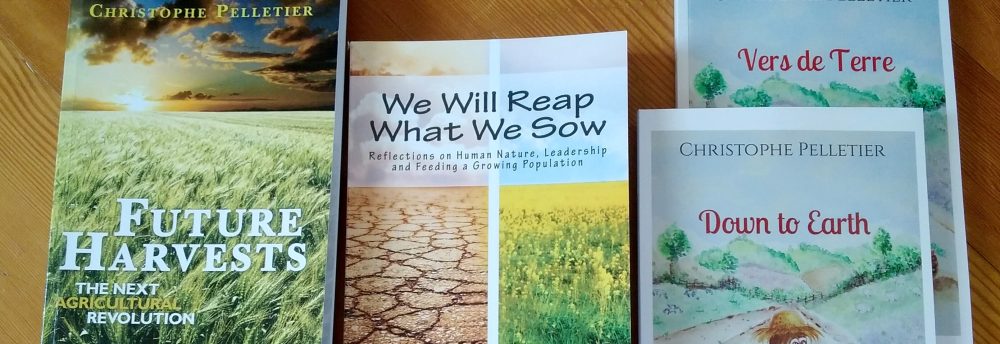
So, will we make it? I believe the answer is the same as the one I gave to a journalist who was asking me if I thought we could feed the world in 2050: “Yes we can but it will take a terrifying crisis before we do what it takes”. I ended up Future Harvest with “we can but will we?” and We Will Reap What We Sow takes it from there. The cover has two halves: a prosperous farm field and a devastated barren land. I see many more signs that we are heading towards the latter, not the former. Maybe there is hope, though. Today, the Great Pumpkin said that he did not think climate change was a hoax after all.

Copyright 2018 – Christophe Pelletier – The Happy Future Group Consulting Ltd.
Perhaps the ultimate challenge

There certainly is no lack of challenges on the path to feeding a growing world population, but a successful future does not just stop with food volumes. Beyond quantity, it is necessary to ensure that people eat balanced diets. Of course, this is true for those who are food insecure and need help to be able to access more food, but it just as true for the overweight and the obese. The health cost to society is high and is so the cost to the environment. Although excess calories end up as body fat and not in landfills, overweight and obesity should be looked at as food waste nonetheless. After all, body fat is food that has been produced but not consumed for any useful purpose. The problem is only getting bigger as rates of obesity are increasing among the population of emerging countries and are reaching alarming levels. It is not a Western countries’ problem anymore. It is a global one. There is no one particular cause to explain this trend, but it is a combination of lifestyle, example at home and education about the basics of nutrition. We are what we eat and we eat what we are. Diets are undoubtedly a reflection of society and its values.

One of the drivers of today’s economies is growth and too often this concept is restricted to quantitative growth. We must be honest and recognize that our food and agriculture systems still are greatly production driven. Although the idea of a market-driven approach is widely spread, the practice seems to differ, and it looks like it is only translated in marketing-driven instead, always with an underlying production-driven thinking. About all food sector and companies always look for ways to sell more volume. There is competition within any particular industry, but also between industries. For example, in the animal protein sector, poultry, pork, beef and fish are always trying to get a higher stomach share at the expense of one another. Usually, the main decision factor for consumer to make their purchase is the relative price of one type of protein versus the others.

The main message that consumers receive every day is: eat more of this or more of that. Then, it is only normal that they do just that. Why expect any other behaviour? The result is a value system of always more, without really thinking about how it all adds up, while it should be about always enough. Overconsumption leads to waste and to unbalanced diets. Waste is the number one enemy of sustainability, and educating the public about proper diet is actually an important weapon in fighting waste, but it is a difficult one. Although good habits are generally not any more difficult to adopt than bad habits, it seems that the latter group is more attractive. Changing eating habits is all about education. It starts at home and in school. Actually, it is rather easy to learn about the proper ratios between protein, fats and carbohydrates –both fast and slow ones- that are needed in a balanced diet. Information is everywhere, but unfortunately, the lack of education and therefore knowledge about nutrition results in many consumers having no idea how to read labels and how to compose proper meals. If our lifestyles and our needs have undergone major changes over the past five or six decades, physiology of digestion and nutritional metabolism have not changed much at all over the tens of thousands of years that humans have been roaming the planet. It would seem obvious that such an essential element of life should be common knowledge, but it is not. An interesting experiment is to ask people at random what the nutritional needs of an average human being are. Usually, people have an idea about how many calories a person should eat on a daily basis. When it comes to how many grams of protein and even more so fat, then the faces tend to turn blank. Another even more interesting experiment is to ask the same question to people working in food and agriculture. Just go ask how many calories, how many grams of protein and fat. It is an eye opener.

It is possible to make consumer behaviour change from harmful to healthy. There are lessons to be learned from the example of tobacco. To change, consumers need the proper incentives, but the bottom line is that people change only if they perceive the change to be an improvement. Since eating habits rest on powerful psychological triggers, the difficulty is in finding the right triggers and creating a perception of reward. Food producers have a critical role to play in this transformation, and it has to be a collective and collaborative effort with all other stakeholders as well.

Copyright 2017 – Christophe Pelletier – The Happy Future Group Consulting Ltd.

The Accordion, the Contrarian & the Robot

Although change happens all the time, in some areas human nature demonstrates great constancy. One of these areas is how Pavlovian we react to market fluctuations. Agriculture knows many cycles, most of which are as much the result of human nature as the mechanics of economics.

In the time of high commodity prices that preceded and followed the Great Recession of 2008, one of the main questions I was asked about the future of agriculture was to give predictions about prices and profitability of agriculture. This is a tricky exercise if there is any. So many factors can influence both supply and demand that it is unrealistic to believe someone could predict with certainty future prices. Price predictions would only be meaningful by predicting costs at the same time. Despite the difficulty, many economists venture in the exercise. The levels of accuracy are disappointing. Past research on economists’ and gurus’ predictions has shown accuracy levels of 47% on average. In other words, tossing a coin would statistically be more accurate by a margin of 3%.

When “predicting” the future, it is more useful to focus on patterns than trying to miraculously try to pull the right numbers. Human nature is rather predictable. When prices and profitability are good, suppliers want to produce more, because they expect the result to be even higher profits. It is intuitive, and it would work fine only if the competitors did not follow the same thinking. Unfortunately, they do and the result is an increase in supplies. As it takes two to have a supplier-customer relationship, the flip coin of the high price medal is that buyers are less warm to buy more of what increase their costs. I like to compare value chains to an accordion. There is only so much money that flows between the two ends of the entire chain, and all the links must share that money. One end is the consumer market and depending on prices, consumers switch foods when prices reach a pain threshold. Since the amount of money entering value chains actually come from the consumer end, consumer resistance limits the elasticity of the entire chain. Thus, depending on the relative supply and demand between the individual links of the chain, some see their profitability expand while others see it shrink. The FAO knows the conundrum. High food prices put the economically vulnerable into food insecurity, while low food prices put many small farmers in economic difficulties, and into food insecurity. There is nothing like a food shortage causing high prices to encourage farmers to produce more. Following high price years, they have done exactly that, and that is why prices have fallen, sometimes to the point that entire sectors suffer dramatic losses. Low prices will give an incentive to those who will survive to boost their production, and the cycle will continue.

The counter intuitive approach is to be a contrarian and to supply tomorrow products that have low price and low profitability today and reduce exposure to today’s attractive products. It is easier said than done, because natural conditions limit the choice of products a farm can produce and heavy investments for one kind of production can limit flexibility. Nonetheless, the contrarian approach is a good one from a planning and forecast perspective. Market swings happen because forecasts tend to be made with today’s prices in mind and assume that the system is static. It is not. Forecasts must take into account the big picture and project what all actors of the value chain will do, as well as in what shape other value chains are and will be. The tools have been here for a while. The exercise then comes down to technical analysis, which is a very common method used by traders. It uses historical data and the predictability of human behaviour to give an indication of which direction prices are most likely to go in the future. Unfortunately, too many actors in value chains do not use that tool for their forecasting and miss on the most likely picture of the future. Some help might be coming, though. The development of software, robotics and artificial intelligence will come to the rescue by eliminating the intuitive and preference of the present of human nature by more rational analysis and forecasting than is the case today. Price setting and negotiations will increasingly be automated and carried out by machines, squeezing out the human factor, especially for undifferentiated commodities. Wall Street is already working on this. Earlier this year, Goldman Sachs indicated that they were going to replace traders by software engineers to achieve this very change, and also to reduce their costs, as a software engineers cost them four times less than a trader.

Copyright 2017 – Christophe Pelletier – The Happy Future Group Consulting Ltd.

Two legs that make humanity move forward

The tremendous progress that the human species has made since its apparition on Earth is not the result of just good luck. Two qualities have driven our success: innovation and collaboration. There is no doubt that these two characteristics will be essential for our further ability to adapt and overcome future challenges. In this regard, the current dynamics bring some good news and some- not-quite-as-good-yet news as well.

The good news is that innovation is probably livelier than it has ever been in the past. There is not a day that goes by without hearing of some new idea being brought into action somewhere in the world. They will not all succeed, but in the grand scheme of innovation that is the price to pay to benefit from the ones that will make it. Every problem and every limitation is an invitation for a solution and always better ones, too. Since the human brain started to analyse its surroundings and look for better tools to deal with it, innovation has been driven by a number of rather stable incentives:

  1. Survival or just live better and longer
  2. Reducing physical labor
  3. Increasing efficiency, which reduces waste
  4. Helping communication
  5. Increasing mobility and speed
  6. Offering more leisure and entertainment
  7. Making some people a little wealthier

Many of the future challenges fall in these categories, and number 1 and 3 are probably the most critical ones in our dealings with the environment.

If innovation is doing well, the second leg –collaboration- is not at its optimum. In this column, I have expressed my wish to see more collaboration, cooperation and exchanges, several times in the past. Although it does not always appear that way, collaboration is one of the cornerstones of life. Just look at all the examples of symbiosis. It occurs everywhere. It is what an ecosystem is all about; it is the combination of all sorts of individuals that are interdependent for their survival. In the agriculture sector, we know that collaboration happens in the soil; we know it also happens inside the roots of legumes and in the food sector we know how the bacterial interacts with our digestive system. For all these reasons, collaboration should receive as much attention and praise as innovation. After all, good innovations are usually the result of active collaboration. Many ideas come from interacting with others, by listening to what they know, to their experiences and through the feedback they give to our own knowledge and experiences. In my opinion, the risk for sub-optimal collaboration is the result of an always increasing emphasis on competition. Competition is good, as I have written here before, but the key is to find a good balance between competition and collaboration. In Nature, both coexist but with a slight difference with the human attitude. In Nature, the competition is about survival, but the winner takes only what it needs. The “always more” concept does not apply. It is just about “always enough”. If you look at it, it provides a sound basis for a sustainable system, as long as supply can follow that is. And that was the original idea of agriculture: finding a way of adjusting food supply to the needs of the community. Agriculture rebalanced the relation between collaboration and competition. This original principle is somehow too often overlooked. To look at it from the triple bottom thinking, there is another analogy with sustainability or the lack of it. The strong emphasis on competition is mostly the result for always more financial profitability. Social and environmental issues are the result of the imbalance with the other two bottom lines.

To get the best of the combination between innovation and collaboration, the altruistic approach is often the best one. Innovations succeed only if they are profitable, too. From the technical point of view, most solutions to our future challenges already exist. It is just that the numbers often do not add up. In the end, innovation must deliver an added value. Often, the added value is monetary, but not always. On some of the innovation drivers from the previous bullet points, it is clear that time, convenience or quality of life also weigh in what added value represents. Sometimes it is of a quantitative nature, sometimes it is qualitative, and sometimes it is both. The beauty of adding value to others is that their adopting your innovation will add value to the supplier, as long as the innovation is priced properly of course. Innovations that truly add value just about sell themselves. Adding value just brings the supplier in a pull marketing situation, which is much easier, fun and lucrative than the push approach.

The magic word when collaborating is “how can I help you”, mean exactly that and then deliver!

Copyright 2017 – Christophe Pelletier – The Happy Future Group Consulting Ltd.

Feeding the future with focus on health and environment

In my opinion, the food and agriculture sector does not receive enough praise for its performance. Over the past four decades, the world population increased by 80%, which means that farmers have been able to supply food for an additional 3.3 billion people during that same period. Unfortunately, the number of hungry people has remained about stable, around a billion people. Every person who is hungry is a hungry person too many. There cannot be any discussion about that, and there still is a lot of work to be done. This is no small feat. Clearly, there is plenty of room for improvement, especially when you consider that about a third of the food produced is wasted but that means that the potential to supply future food demand is there.

nutrition

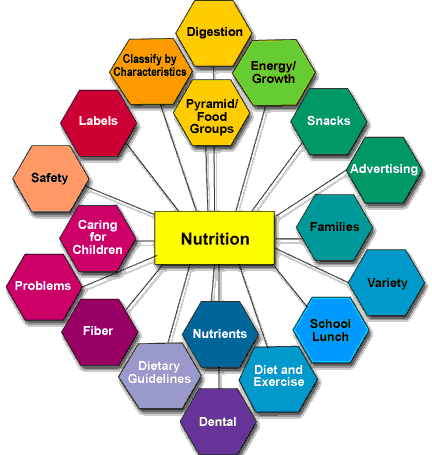
Image created by Paula Nettleton Source: Educational Materials Center (EMC), Central Michigan University

The discussions about meeting future food demand always tend to focus on production volumes. Of course that is the minimum requirement but to meet all other challenges, it is necessary to broaden the scope beyond volumes. Production is only half the equation. The other half is consumption. There is a lot of work to help consumption patterns contribute to a balanced future between supply and demand. The ongoing increase of obesity and diabetes are at least as worrying as hunger because of the negative health, environmental and economic consequences. One of the most important roles in the future for the food and agriculture sector will be to help people feed themselves properly. There is a need for this and it goes far beyond a marketing exercise. The basis for success will have to be education about nutrition and home economics. There already is action in these areas but it will be necessary to move towards a collaborative education, centred on physiological needs and how any particular food product contributes –or not- to healthy meals. The purpose will not have to be about enticing consumers to eat more volumes but to make educated decision and pick the right ingredients. Changing the focus from always more to always enough will also require a change in which foods to produce and what their future physical and organoleptic qualities will have to be. It also will change the dynamics of markets and on which criteria farmers get paid. Collaborative education will have to be carried out by and with full involvement of all stakeholders. It will have to place human physiological needs as the primary focus. Consumer well-being will have to come first, before particular interests and before volume.

Making future food and agriculture sustainable requires that we address both production and consumption. Waste and excess do not fit in a sustainable future. Food waste is only a part of the total picture. When food is wasted, all the inputs required, such as water, energy, fertilizers, crop protection and money, are all wasted in the process. Overconsumption is not a sustainable strategy either. It takes a lot of resources to produce all the excess calories and protein than end up producing nothing else than excess human body fat. Until the rise of mass consumption, our grandparents knew what sustainability meant. It was about saving and about moderation. These two concepts vanished from the moment that consumption goods became so cheap that and consumers lost touch with scarcity and long-term negative effects, also known as negative externalities. It would be an eye opener to quantify these externalities and include them in the cost structure of consumer products. The consumer price and/or the producer margin would look different! Although it is quite a difficult exercise to quantify the externalities, just carrying it out would give some good insights about the limitations of the current economic model and in which areas it needs to change. Such a calculation would help rethink many of the existing financial incentives that drive the economics of food and agriculture, in particular many subsidies that find their origin in times where the objectives were quite different than the ones of the future. For example, health issues related to food should be considered as externalities. Many governments have calculated estimates of the cost generated by these two diseases. If society were to be able to quantify what part of the amount should be factored in food, as well as lifestyle and distributed between the entire chain from farm to patient, and to try to estimate the relative part of responsibility between the different links of that chain, it certainly would give a good indication of how to look at future economics of a healthy and satisfied society. The price of food would change but the key would be to have it change in a way that helps a better nutrition and better health while keeping good food affordable.

Copyright 2017 – Christophe Pelletier – The Happy Future Group Consulting Ltd.

My Wish List 2017

Another year just started. It is always a good time to reflect a bit. As I have focused my activities for quite a few years on how the future of food and agriculture can be shaped, I regularly come across a number of the same little flaws that, in my opinion, delay the progress we can make towards a prosperous future.

Although the expression “keep it simple” is well-known, it seems that we have a hard time doing exactly that. I am amazed by the number of situations in my work in which I meet incredibly complicated set-ups. It is almost as if we have an almost masochistic tendency to make our lives more difficult than they need to be. Let me be clear, food production is a very complex system, but why make it even more complicated than it is? Too often, the problem is that food producers carry to much old baggage within their systems. Problems happen and innovations bring solutions. Unfortunately, it often results in adding layer after layer of old baggage. Keep it simple! Once in a while, just imagine how you would set up your production if you were starting with no past history and were setting processes and systems anew with all the latest technology, knowledge and experience. Then de-clutter! It makes life a lot easier.

Common sense is one of the things I would like to see more often. I remember a customer of mine who always enjoyed to say “With Christophe, if it makes sense he will deliver it; if does not make sense, he will say no” I know I have sometime frustrated some of my customers but I always took the time to explain how persisting in error would only result in bigger problems later and they actually always praised my no non-sense style. Remember that food production is not an intellectual exercise but a practical one. A customer will not reward you for your being intellectually stimulated, but for your reliability, consistency and honesty.

For the New Year, I also wish for more critical thinking. In these times of information oversupply and even fake news, it is quite easy to be misled. Sometimes it is accidental, sometimes it is intentional. Nonetheless, it always pays off to never assume and to double check. I pay special attention to numbers. Simple calculations help verify whether claims are true or not. I am amazed by how often I see numbers presented to the public that do not add up. Some numbers look spectacular and get attention, but that is no reason not to do the math again, just to make sure.

Another wish of mine is to see more listening and empathy, and less shouting and fighting in the debate about food. Too many arguments about this topic are a bit too Pavlovian for my liking. People are not rational, but they are always logical with themselves. It pays off to find out the logic and to have candid conversations. More than fighting about who is right and who is wrong, I prefer to see a focus on improving food production in a collaborative manner. Of course, it is easier said than done but he pays off because in the end, regardless of who is wrong or right, the customer is always right. The key for such a successful exercise is to use both our brain hemispheres and help our interlocutors do the same. How we will improve food and agriculture is really a balancing act between the emotional and the rational.

Another item on my list is humility. Every day, Nature and chance bring new challenges and sometimes opportunities. It is essential to stay on our toes. It does not take much for problems to happen and it is necessary to never slip into complacency. In particular, always beware of good times. It is always tempting to see successes be the result of one’s qualities and systems and setbacks as being caused by outside factors. It is tempting but it is rarely that simple. Adversity is the true test. An area of excessive ambition that humours me is when it comes to feed the world. I gently smile at statements such as “Insects will feed the world”, “Aquaculture will feed the world”, “So and so country or continent will feed the world”, etc… I smile because it sounds like we could feed the 10 billions of 2050 several times over. I say humour because it is more about excessive enthusiasm than a lack of humility. We will feed 10 billions –and I really believe that- through the combination of many foods and many production systems all over the world. There is no magic bullet. It will take dedication, work, innovation, market orientation and visionary leadership. It is a never-ending exercise.

Copyright 2017 – Christophe Pelletier – The Happy Future Group Consulting Ltd.

Changing economics to overcome future challenges

First, a personal story

A year ago, I moved away from Vancouver to the Okanagan Valley Region some 300 miles east from Vancouver. There, I bought a property with a decent yard where I will have a garden and with a small vineyard. In some way, it is an illustration of what is necessary to foster sustainable practices. The parallel is obvious with some of the global challenges the world is facing and will continue to face in the future. For eight months of the year, the area looks and feels quite similar to the Mediterranean. Precipitations are not abundant with an annual quantity of only 337 mm. Clearly, water is scarce and needs to be preserved, even though an extensive system of lakes fed by mountain snow ensures an adequate supply of water. The region is quite agricultural with many orchards and vineyards, all thanks to irrigation. There are also many lawns in the area and the estimate is that about 25% of the water consumed in the region is just to keep the lawns green.

My plan is to install rain barrels to collect the water from rain and snow and use it for the yard. This is where the economics do not go in parallel with all the talk from politicians about sustainability. Around the house I would need five rain barrels. The lowest and best retail price I can find is of about $80 for a 200 liter barrel. To set up my water collection system, it will cost me $400 to provide me with a 1 cubic meter storage capacity. In comparison, the price for a cubic meter that the municipality charges for water is $0.30 per cubic meter. In the most ideal situation, that is if I were able to collect all the rain and snow through my five barrels, I would at most collect about 30 cubic meters per year. In money, it comes down to a saving of roughly $10 per year. To break even, I’d better hope that the barrels will last 40 years, which they might, but considering my current age, there is a fair chance I may have moved to a much smaller underground dwelling by then. Of course, my example is about quite a small investment and if the return is lousy, it will not change my life. At least, the barrels will help me save water.

The point of my story is that the comparison between cost and benefit would deter most people to consider buying rain barrels. It just does not make financial sense, if money is what matters. I always say that money talks and what it says here is to forget about being sustainable. One of my neighbours also considered installing solar panels on the roof of their house. After comparing the price of the panels plus installation and maintenance with the electricity savings, they discovered that it would last twice the life of the panels to break even. In terms of money, solar panels are a different kettle of fish than my five rain barrels. Recently I saw the price of a propane generator that produces 3650 watts for Canadian $350 while a solar panel that produces 100 watts is sold for Canadian $250. I can understand people decide to not pursue the solar option.

The economics of water and energy savings that I just described can be extrapolated to the much larger picture. All through the food and agriculture value chains, many changes for more sustainable systems face the same kind of dilemma. What makes sense from an environmental point of view often does not make sense financially in the current economic environment. Demanding more sustainable production system is quite legitimate and sensible, but the conditions must also be there to make it happen. The numbers have to add up for farmers and businesses to make the switch. As usual, money is of the essence and it can come from different sides.

First, the purchase price and the cost of operation of alternatives have to come down and be competitive. Either suppliers are able to drop their prices or offer more efficient systems. Governments also can help through subsidies to ease the pain. Subsidies, being public money for the general interest, it is only fair that we all must pay if what we want is a sustainable. Subsidies must of course be set up properly and be effective

Second, the customers, which in a fair value chain would be eventually the consumers, have to pay for extra cost of the better production systems, simply because our consumption societies with their sense of entitlement have to understand that there is no such thing as a free lunch. Such a realization also means that producers also understand that mass production that only deplete resources do not fit in the long-term picture and that value will have to replace volume.

Searching for a new economic model

With the many challenges arising from a growing world population, it becomes more and more obvious that the economic model of the past six decades needs some refreshing. As such providing consumer goods at an affordable price for the masses is not a bad idea. Helping people to have a more comfortable and pleasant life is certainly welcome by most of us. The problem is that the so-called consumption society is not so much aboutpillars-of-economy consumption as it is about people buying and giving their money to someone else. In the current system, consumption is optional. Research has shown that consumers use 75 to 80% of the goods they buy no more than once.  What really matters is the act of purchasing the goods. It is good for growth and the GDP, currently the leading metrics for the state of the economy. The problem is that mass production has gradually shifted from affordability to cheapness and from value to price. It has focused mostly on volume and has not taken into account that consumers would have to get rid of what they bought after usage. Negative externalities have been kept external indeed. Short-term financial results have had the preference and long-term impact has been ignored. The system is hitting a wall and issues of greenhouse gases emissions and waste of resources are now becoming urgent matters to address. All industries will be affected one way or the other. Food and agriculture will be no exception.

The big question is how to change the system without having it implode. That is not an easy one to answer but sooner or later it will have to change. Vision and leadership are crucial to manage the transition. I wish I had seen more of it. So far, I see and hear more about pro this and anti that. It is highly insufficient and produces more noise than results.

In my opinion, the problem is not so much about growth as it is about what growth means. Over the past decades, growth has been mostly about volume numbers. It has been a quantitative growth. I believe that the best transition towards the next model is to focus on what I call qualitative growth. It is not so much about volume as it is about adding value to the buyer. For consumers and countries, qualitative growth would be to quantitative growth what EVA (economic value added) is to turn-over for a business. It is about prosperity.

For food producers, such a shift will lead to a different approach. The most valuable areas of value added for consumers and society lies probably in providing good and enjoyable nutrition, yet affordable, through advice and education. The industry will have to help consumers eat better and help them have healthy diets. It will go beyond just supply food. Consumers will also have to rediscover what proper nutrition is. Initiatives such as the Global Access to Nutrition Index can play a pivotal role in helping food producers make the transition towards quantitative growth. The food sector has also an important role to play in keeping our environment livable. The trend towards transparency is an important part of the evolution on both health and environment fronts.

Of course, such a change of economic model means that the economics must change, too. It is also essential that those who do the right thing must be rewarded. A new reward system must be introduced in the set of rules and regulations so that producers get the proper incentive to make the shift because adding the type of value that I mention to consumers also requires a different price tag in the store, or at least a different breakdown of costs and benefits along the entire chain from producers to consumers. How to distribute fairly the cost tag of the change is still open for debate. The reward system has to apply for the business activity by allowing margins to be comparatively competitive in the new situation. Consumers doing the right thing must also be rewarded. The reward system should also apply at the remuneration level. In particular, the share of qualitative improvements in companies’ bonus systems will have to increase at the expense of qualitative growth targets.  The adjustments needed in the food and agriculture sectors will not end in this sector. They will have to include other area of government. In particular the health sector will have to be involved, as the consequences of the quality of nutrition on health are obvious for individuals and society both at the personal as at the financial level.

I also believe that such a shift in economic model will mean that business partners within the value chain will have to challenge each other to carry out the transition and it will become a critical point in choosing with whom to do business in the future.

Copyright 2016 – Christophe Pelletier – The Happy Future Group Consulting Ltd.


Curiosity: it’s where the future starts

The challenges ahead are bigger than ever before, and be assured that they will bigger in the future. The good news is that progress and new developments in science and technology are bigger and faster than ever, too. From a technical point of view, I would dare to say that the solutions to the challenges already exist or are very close. Often, the problem is that these solutions are not immediately economically viable. In such a fast-changing world, curiosity is undoubtedly one of the most desirable qualities to adapt timely and find new ways of running the business.

Perhaps, it is because a lot of my work is about finding as much information and gathering as much knowledge as possible about all sorts of technologies, facts, systems, science and experiences that I find curiosity quite natural. Perhaps it is also because I have a curious nature. In my daily activities, I find that people are relatively not curious enough. I also can see that the ones who have that quality are always ahead of the pack. What is really amazing is how much is already out there. The trick is to find it and to know about it. Often, the information originates from very different business sectors or comes from other parts of the world or is available in a different language. I can see regularly a lot of organizations busy reinventing the wheel, going through the pain of setting up research and spending vast amounts of time, money and resources to find out results that are already available and that they could have taken over and adjusted to their particular situations. Curiosity can deliver huge savings.

Curiosity is quite time consuming. That is a fact and its main drawback. This may be the reason why it does not happen enough. The quest does not always deliver, although for those who have a proper strategy, the yield is quite good. Curiosity, for a business, cannot be a random activity. It has to be structured and carried out with discipline. There is quite a similarity between curiosity and access to food. There are those who know where to find the tasty mushrooms in the woods and those who get lost in the forest. It is the same thing when going out there to find knowledge. Some are talented and find it often and fast and others just wander endlessly without spotting anything significant. Just as it is important to know the right spots to find food when hunting and gathering, there are some places where the good knowledge is. As with food, it is important to know the supplier and know the origin of the knowledge. To pursue the comparison with mushrooms, some knowledge is good and some can be toxic. The supply chain is just as important, especially considering how fast and far social media can replicate and distribute information. When it comes to knowledge, the reliability, seriousness and quality of the sources is of utmost importance. A discerning knowledge consumer must be critical about what they find. A solid critical sense is of the utmost importance. Regardless of whether the knowledge is found through a hunting/gathering activity or comes from a knowledge farm, it is essential to double-check its validity. The packaging can be deceiving.

Next to focused curiosity activities, it is also important to encourage what I would call open curiosity, in which there is no particular objective but just letting new findings lead to new discoveries. There is no business discipline involved. It more often research you would do in your free time. One piece of information generates interest to know more and you just follow. It is similar to a child-like exploration in which each answer triggers the next “why?” question. It is pure learning. There is no way to tell when or even whether the new learned knowledge will be useful, but there is no such thing as too much knowledge. The trick is to be able to retrieve it when it is needed.

Another important aspect of curiosity is to link experience to knowledge. Usually, knowledge is the result of certain protocols. The knowledge itself takes its full dimension and value only through the use we make of it. Some people make good use and others do not. When gathering new knowledge, it is essential to also learn about the lessons from the experience of those who used it. Why did certain things work in certain conditions and others did not? Which factors influenced the outcome and how would different conditions or a different environment affect the outcome? Getting the big picture is a very important part of curiosity. Expanding the scope and seeing how the pieces of the puzzle come together are the foundation of future successful strategy and adaptation.

Curiosity is a great asset when it comes to face and prepare the future. It is not the whole story, though. Food and agriculture are not intellectual exercises. They must deliver concrete products and results. It is nice to be curious but what do you do with that? The answer to this question is quite simple: action.

According to the saying, knowledge is power. Knowledge is true power only when it is active and circulates. Knowledge that remains in a brain or in a drawer is not very useful for the greater good. The first step that I advise curious people to do is to share what they learn. It is even easier today with the Internet, and there is a lot of knowledge out there. By sharing, I do not mean simply copy and paste or click the share button. Before sharing, it is essential to make sure that what you share is quality. There is too much information that is spread on social media while clearly not critically reviewed, not to say not even read, as it is quite often the case. The mindset here is a mix of enthusiasm, critical thinking and practical service orientation. The knowledge must be correct and the message must come over. It also must be useful to the recipients. It must connect to their needs and add value to them. The final result has to be better food through more efficient and sustainable systems that are financially viable. In the food and agriculture sector, it must lead to always more collaboration and knowledge transfer in all directions within the entire value chain. Often, the weakness of communication is that it stays too long in the same circle and other links, consumers in particular, are kept too long out of the loop. It results too often in misunderstanding, distrust and erroneous perception.

Through collaboration and brainstorming, curiosity helps create a more accurate and achievable vision of the future, on which action can further be carried out to shape the future. From this angle, it makes no doubt that collaboration between all stakeholders is an ongoing process. This is especially true with technology. There are new developments all the time and it certainly takes a curious mind to be able to keep up with novelties. It actually takes many curious minds, considering how huge the quantity of knowledge and information is. It also takes minds that can connect all the dots, and also connect with each other. Although time consuming, the back and forth collaboration, together with ongoing feedback about performance and new demands, allows all links of the chain to know better what the objectives are and how to foster ongoing improvement. As many new technological developments come from outside the food and agriculture sectors, I believe it is critical that the food producers be proactive in the development of technologies and applications, but stating clearly what they expect from technology suppliers and tell them what they expect from them. It is never too early to let them know what your problems, limitations and/or objectives are, so that they can work on it as soon as possible. Being proactive will help speed up the development of the right products, systems and applications.

In this process, leadership is of the essence. Leadership is essential to create the right dynamics to make knowledge transfer happen, fast and well. The role of leaders here is to make knowledge transfer attractive and stimulating for others, so that more stakeholders participate in the development of innovation. The more pressure they will be on suppliers to bring better solutions to the food sector, the higher the chances it happens, indeed. Leaders must also foster connections and networking across the disciplines, even or actually especially with partners outside of the food and agriculture sector. A vision that includes the bigger picture will have more chances of stimulating the cross-discipline and cross-sector collaboration. At the same time, it is crucial to stay practical. The goal is to produce food, and that must be in the minds of all participants.

Curiosity is really the starting point. It feeds an entire chain of ideas and decisions that are the basis for improvement. There is no doubt that fortune favors the bold. In the never-ending quest towards better foods and better agricultural practices, such a process becomes an illustration of “the best way to predict the future is to create it”. This saying may have not been so true as today. Progress and food security depend on it.


Copyright 2016 – Christophe Pelletier – The Happy Future Group Consulting Ltd.