Genetically modified organisms (GMOs) are one the most, if not the most, controversial aspects of modern food and agriculture. So far, the focus had been on offering farmers alternatives to pesticides and herbicides. The proponents of GMOs praise the progress made and they claim that agriculture production benefits from this. Opponents warn about all sorts of potential disasters in health and environment. The reality is that GMOs have been around for about a decade and a half, and they are here to stay. There is currently no sign that they would be banned from the Earth, especially since genetic engineered traits have been found outside of farm fields, as I had mentioned in a previous article.
At his juncture, and to think of how this technology –and business- will evolve, it is worth asking a few questions.
Has the use of GMOs been successful for agriculture and food production?
There are several levels in this question, actually. From the yield point of view, it is rather difficult to answer objectively, as there is little possibility to compare the respective performance GMOs and non-GMOs. From what I gather, it would appear that the Bt cotton may have delivered better results. For corn, the picture is much less clear. Actually, some varieties have proven to have rather disappointing performance. For instance, the genetically engineered corn from Monsanto failed to produce in South Africa, and recently their SmartStax variety (developed together with Dow) has had lower results than expected. This forced the company to drop the selling price per unit from US$24 down to US$8! The stock market did not appreciate. Clearly, GMO producers can make mistakes, and this is not particularly reassuring.
However, GMOS have delivered some benefits, too. In Argentina, the use of glyphosate-resistant soybean has allowed the production of soybeans to recover strongly from the brink of disaster. After many years of intensive monoculture of soybeans, the soil had been damaged to a nearly point of no-return, With the use of glyphosate-resistant plants, combined with no-tillage technique, farmers have been able to rebuild the level of organic matter in their soils. The result has been a huge increase of production, as farming conditions have been restored.
Opposite to this success story, a study from China concluded that the use of Bt cotton changed the ecosystem in such a way that pests that are naturally not sensitive to the Bt toxin thrived in cotton fields. This forced farmers to use other regular chemical pesticides to fight them, and the overall use of pesticides was actually higher than before the introduction of Bt cotton. The number of glyphosate-resistant weeds is a growing concern in many areas of the USA, and farmers need to use other methods to eliminate the weeds. Currently, the situation has come to a point that Monsanto is offering a rebate to its customers to buy and use herbicide from their competitors, so that at least they keep buying their genetically engineered glyphosate-resistant seeds, because they do not have the solution of the problem in-house. These two examples demonstrate a simple fact: genetic engineering is not a panacea that solves all the problems. It must be used as a part of a well-thought set of techniques. Producing one type of crop with the included traits without understanding the ecosystem that a field is, simply does not work. A field is not a dead zone. A biologically very active system resists constantly the attempts of humans to get it under control. Since the odds of developing a resistance for all available products is statistically close to zero, rotating herbicides and pesticides strongly increases the chances of eliminating the “super weeds” and the “super bugs”. Of course, companies would rather not promote their competitors products by advising farmers to rotate herbicides and pesticides.
Are GMOs necessary?
Considering the rather mixed results, it is quite difficult to answer this question with certainty. The technology of genetic engineering is useful because it offers the possibility to introduce desirable traits in plants. However, genetic engineering deals with genes, and the actions of the genes, as well as their interactions with other genes, are very complex. This is still a field where we have much to learn. Caution is required. Genetic engineering is only one of the many ways we have to increase and improve production. It certainly is not, as some would like to make believe, the only way. This is also important to keep in mind when it comes to developing countries. In these countries, the problem is not that all other techniques have reached their potential. Many farmers do not even have access to just good seeds. If they had, together with proper financing, access to input and adequate techniques, they would achieve much better yields. Since they are poor, how could they even afford to buy GMOs? In my previous article, Hunger is about more than just food production, I indicated how Africa could become a net exporter without GMOs. On the other hand, in developed countries, such as Europe, where farmers achieve outstanding technical results, for instance wheat yields 2.5 to 3 times as high as in the USA, what could be the incentive? Europe is food secure, actually several European countries are among the world’s largest exporters of food and agricultural products. Why would consumers be hungry for GMOs, while food is already affordable? People may not always be rational, but there is always a strong logic about why they do what they do.
Are GMO safe or not?
In all objectivity, there is no certain answer to this question, either. Until this day, there has not been any proven disaster linked to GMOs. Since in biology things may take a long time to come out, there cannot be any certainty that something is not already changing, either. This debate is between those who think that progress always brings some new uncertainties that should accept, and those who think that we should not take chances. Genetic engineering is still a young science, and 15 years is a very short period in ecological terms.
A related question about this is: “Is there a moral issue about GMO?” There certainly is something about morals in the debate. There is the theme of playing to be God. There is the theme of corporate profits vs. people and environment. There is the theme of the control of food by a select few, and that is about power. There is the theme of secrecy vs. transparency. This is also about a certain vision of the world, and about which values should prevail. There is the New World set of values vs. the “Old World’s”. None of these themes has much to do with science, but they are quite important to many people, and they will remain so for a long time. The controversy and the debate are far from over. The food retailers, such as the giant Carrefour, are now entering the debate. A new interesting element is the awakening of the US consumers who start to question food production; while until recently, they were rather passive in that area. Many things will happen and change. At this stage, it is rather difficult to say what will emerge.
What is at stake?
Next to the themes that I have just mentioned, the most at stake is money, and a lot of it. This industry would never have developed if they had not been granted the possibility to apply for patents and collect royalties on their intellectual property (IP). Without IP, there are no GMOs. Patenting life is in itself a controversial topic. This is especially more so when a whole plant becomes private property while only a tiny part of it has been altered. The original whole plant was the collective property of humanity. Without asking permission to mankind, and not even offering to pay a rent for this collective property, GMO producers have managed to become the owners. For many people, there is a feeling of wrong entitlement.
The key element is IP. This is understandable, because most GMO companies are spin-offs from molecule makers, from the chemical and pharmaceutical industries. Their business has always been about investing large amounts of money in R&D to put new molecules on the market. Their philosophy behind GMO production is the same. They think like molecule makers, not like farmers. The objective is to develop products for which they can collect royalties to pay back for the R&D expenditure. The driver for this is the need to develop high margin products to satisfy the expectations of the shareholders. This is why GMOs were a logical step to replace gradually the chemical herbicides and pesticides, for which margins have been eroding. Something else needed to be developed to bring out solid financial results and future prospects. With the patent period ending soon, the existing GMOs will become generic products that will no longer be IP. This forces the producers to think of new traits to include, thus generating more IP for royalties. This leads to a new generation of GMOs
What will be the next phase?
 We will see two different paths for genetic engineering. One is a market-driven genetic engineering aimed at solving actual problems that farmers need to overcome. This will not be so much about IP and royalties, but it will be about practical and affordable solutions. This area will be taken over gradually by plant breeders and to some extent with government support. They will focus on issues such as drought resistance, flood resistance, ability for plants to grow in saline soils, and ability to transform solar energy more efficiently into food by enhancing photosynthesis processes. An interesting case to follow is China. Over there, the government is already leading a nationwide restructuring of the currently fragmented seed industry to make it more efficient, and deliver solutions that will help the country improve its food self-sufficiency. Since China is quite involved in farming investments in Africa, we can expect to see Chinese seed producers become more aggressive on that continent, too. China has also clearly expressed that genetic engineering is a part of their new approach.
The molecule makers, as I like to call them, will choose a different path. They will look for sophisticated products for which they can receive a high margin in the market. Their objective will be to introduce as many traits as they can in plants and help them produce… molecules. They are more interested to produce high-tech novelties. They will become the Apple of biology. Chemical synthesis will be replaced by biotechnology. Their areas of interest will be pharmaceutical production and health, more than agriculture. The industry will introduce genes in plants to produce medicines that can be used to treat all sorts of diseases, such as diabetes, cancer, possibly Aids, and many others. They will also focus on the development of healthy nutritional components, such as high Omega-3 fatty acids content in oil seeds and the elimination of allergic components in current foods.
This next phase will see a change in the landscape of GMOs. Companies will make strategic choices about which segment they want to operate. There will be divestment of activities, and there will be new Mergers & Acquisitions, too. It is very likely that GMO producers will focus on biotech and sell their herbicides and pesticides activities to the companies that will choose to specialize in chemicals only. Pharmaceutical companies will get closer to GMO producers, and we can expect to see a new generation of biotech start-ups that will aim at being taken over by larger corporations. Some companies will choose for business-to business, while others will choose for consumer products. For pharmaceuticals and nutraceuticals, companies will subcontract farmers, while remaining in charge of the marketing of the molecules.
Copyright 2010 – The Happy Future Group Consulting Ltd.
 Then, is one planet enough or not? Simple math should help finding the answer. If we need two Earths to feed nine billion, one planet would only feed 4.5 billion people. Currently, the world population is around seven billion, out of which one billion is hungry. Conclusion is that we currently can feed about six billion people. We are not doing that bad. Is it possible to find ways of feeding three more billion on this Earth? From the simple math above, it is clear that those who claim that we need three Earths or more are wrong.
 This movement is rather popular here in Vancouver, British Columbia. The laid-back residents who support the local food paradigm certainly love their cup of coffee and their beer. Wait a minute! There is no coffee plantation anywhere around here. There is not much barley produced around Vancouver, either. Life should be possible without these two beverages, should not it? The disappearance of coffee –and tea- from our households will make the lack of sugar beets less painful. This is good because sugar beets are not produced in the region. At least, there is no shortage of water.
 There is no argument against producing better. A market-driven and more efficient production reduces the amount of waste, and it increases the amount of food available for consumers. It reduces the impact on the environment and it actually reduces the cost of production. However, it is important to realize that actions to produce better often are investments, as the effect is not always immediate.
 If there is a never-ending feud in the food industry, the one here in British Columbia (BC) about farmed salmon certainly should be put on top of the list. The fight between salmon farmers and environmentalists has been going on for as long as the industry has been around, and it looks as if it will keep lasting for a long time to come.
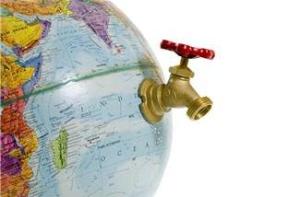 neglected. The quantity and the quality of water available are absolutely crucial for the future production of food. It will influence where and what type of food we can produce. It will define food security and world politics. Since 70% of fresh water use is for agricultural purposes, it is clear that water will soon be power.
 One currency has a special status. Because of the economic and political influence of the USA since World War II, the US dollar is the currency for most commodities. This special status also influences the actions of financial markets. Since the stock market plunge of October 2008, investors have become cautious. The value of stocks and commodities does not follow fundamentals anymore. A lot of cash has left the markets and, more than before, the active players in the market place their bets for short-term returns. Most transactions are computer-generated. Software programmers have developed algorithms that allow computers to make transactions based on technical analysis within a millisecond. This maybe a technological beauty, but such programs do not analyze data. They act mechanically, in a very sophisticated manner of course, but mechanically nonetheless. When it would have taken half an hour for traders to panic, the computer can now deliver the same result in less time than it takes to blink. When you add to this that investors, and especially speculators, borrow large sums of money to play with derivatives instead of doing so with the actual assets, the consequences for the real economy may be rather high.
 For most customers, white eggs are perceived as being from intensive cage production, while brown eggs are perceived as being more “natural”. Everyone with knowledge of the industry knows that the color of the shell has nothing to do with the nutritional quality of the egg. The belief that the egg color indicates a difference persists, though.
 Of course, it would be interesting to imagine what people would eat if they were rational, and what impact on our food production this would have. A rational diet would follow proper nutritional recommendation, and to this extent would follow the same principles as those used in animal nutrition. However, this would not have to be as boring a diet as what animals are fed. A rational diet does not need to be a ration. After, the human genius that is cooking would help prepare delicious rational meals. It would be like having the best of both worlds. The emotional, social and hedonistic functions of food would remain. The key would be about balance and moderation. If people were eating rationally, there would not be any diet-related illnesses. There would not be obesity. There also would be a lot less food waste. This would improve the level of sustainability of agriculture.
 To attract new people to the food sector, it is also quite important to tell what kind of jobs this sector has to offer. These jobs need to be not only interesting, but they also must offer the candidates the prospect of competitive income, long-term opportunities, and a perceived positive social status. Many students have no idea about the amazing diversity of jobs that agriculture (including aquaculture) and food production have to offer. This is what both the sector and the schools must communicate. Just to name a few and in no particular order, here are some of the possibilities: farming, processing, logistics, planning, sales, marketing, trade, operations, procurement, quality, customer service, IT, banking and finance, nutrition (both animal and human), agronomy, animal husbandry, genetics, microbiology, biochemistry, soil science, ecology, climatology, equipment, machinery, fertilizers, irrigation, consumer products, retail, research, education, plant protection, communication and PR, legal, management, knowledge transfer, innovation, politics, services, etc… Now, you may breathe again!
 The Food Futurist Solutions - Anticipate, Adapt, Succeed