Why we will change our eating habits, one way or the other

In the discussion about producing enough food for the 9 billion people the world will have by 2050, one of the sensitive issues, especially in the overfed world, is about what to eat and how much of it. There always is resistance to change, and changing eating habits may be even among the most difficult challenges we have. Eating habits are developed unconsciously since early childhood, and switching to conscious choices is not easy to achieve. It requires will power and self-discipline.

Most of the gloomy scenarios about the challenge of feeding the world are based on the assumption that the diet model would have to be the Western diet, and in particular the American diet. This is far from certain. Actually, do not expect this to be the case.

Changing eating habits will happen in two ways. One will be voluntary and the other will be a consequence of food prices.

There is a growing awareness of the health consequences due to overconsumption of food. All the stakeholders seem to blame each over for obesity, diabetes and other heart conditions, and try to convince the public that they are not the cause of the problem. Whose fault is it? Is it meat? Is it corn syrup? Is it fast food? Is it salt? Is it lifestyle? Is it the parents’ fault? Is it the schools with their vending machines offering snacks and soft drinks? We all have read such statements. Here is a scoop: overweight is caused by consuming more calories than are burnt through physical activity. Ailments are the results of rich and unbalanced diets. Eating (and drinking) too much, and too much of the wrong things is bad for you. There is a reason why gluttony is one of the seven deadly sins! Actually, our societies should have a close look at that list, because we might be in trouble.

In Western countries, we eat too much, and that should not be a surprise to anyone. Obesity and diabetes are becoming society problems in the USA, but other countries are following the same path. Europe and China have a rising percentage of obese people, especially young people. Even in Africa, there seems to be an increase of the number of overweight people. A recent study confirmed this (click here for the interactive chart). Awareness about health problems has already generated action. There are government campaigns. Food producers are reviewing their formulas and are working toward healthier products, in particular by lowering the content of salt and sugar of their foods. More and more consumers are also adjusting their eating habits, mostly by changing what they buy and where they buy it. The trend towards healthier and more natural food is growing and it will not stop. Only biotech companies seem to ignore this fact. This food trend is not just in Western countries but in China, too, the demand for natural and organic foods is increasing. After all, nobody really feels happy with being fat or unhealthy. If some people are taking action to improve their diets and its impact on the environment, this voluntary choice is still about a minority of the population, today. One of the reasons for this is that healthy diets seem more expensive than the junk fattening eating habits. I say seem, because those who can cook know that it is quite simple to make delicious balanced meal for less than the supersize combo deep fried so-called menu.

Money matters. That is a fact. This is why money is probably the best incentive for change. And the future will bring us plenty of incentive to change our diets. The current concerns about food prices, and the food riots of 2008, have created awareness about food supply. Although the price hike is more the result of investors, not necessarily speculators, looking for a safe haven for their US dollars through transactions in futures contract, the reality is that the commodity markets, even on paper, becomes the “official” market price. This enters the real economy and affects the price of food for households all over the world. The poorer countries are more sensitive to food price inflation, and this has the potential to cause very serious unrest.

Regardless of the current causes of food price increase, simple economics show that when demand increase, while supply has difficulties to keep up, prices increase. And this is exactly what will happen. In a previous article, I showed that the potential for meeting food demand, or I should say the demand for nutritional needs, of 9 billion was there. Quite easily. However, in this calculation, I indicated the road to success includes reducing food waste and a reduction of the quantity of meat in the diet. This means that we need to change our behaviour towards food.

If there is a sensitive topic about diet, this has to be meat. Opinions vary from one extreme to another. Some advocate a total rejection of meat and meat production, which would be the cause for most of hunger and environmental damage, even climate change. Others shout something that sounds like “don’t touch my meat!”, calling on some right that they might have to do as they please, or so they like to think. The truth, like most things in life, is in the middle. Meat is fine when consumed with moderation. Eating more than 100 kg per year will not make you healthier than if you eat only 30 kg. It might provide more pleasure for some, though. I should know. My father was a butcher and I grew up with lots of meat available. During the growth years as a teenager, I could gulp a pound of ground meat just like that. I eat a lot less nowadays. I choose quality before quantity.

The future evolution of the price of food is going to have several effects. The first one is the most direct. As food becomes more expensive, consumers look for the more affordable alternative first. If their budget is tight, they buy slightly smaller portions. People will slightly reduce their food intake. Those who were over consuming might actually benefit from a positive impact on their health. For those who already were struggling, this will be more difficult to deal with. From all the food sorts, animal protein will be the most affected by an increase of the price of food commodities. Already today, there are clear signs from the meat and poultry companies that the price of feed is seriously squeezing their margins. As usual, passing the price increase to consumers will take time, as retailers will resist. If the price of agricultural commodities is to stay high, consumers will inevitably have to accept price increases for food in general, and for meat and other animal products in particular. The price of meat is going to be affected by other factors than just feed prices. The need for more control on food safety issues, the stricter environmental regulations that will come for animal husbandry, on the land and in the sea, a change in animal husbandry practices, especially a lower use of antibiotics and farms with lower densities of animal will all contribute to an increase in costs. Energy will become more expensive, too. A whole system based on cheap commodities is about to change, simply because there will not be any cheap commodity anymore. These are all adjustments to rebalance our consumption behaviour from the unbridled overconsumption of the past decades, when consumers were not thinking about the consequences of their actions. The industry will figure out how to increase efficiency to contain some of the cost increases, but the change of farming practices will make meat significantly more expensive than it is today. The price of ad-lib cheap meat is ending. The future dynamics of food prices as presented here will be ongoing. A long as we will not have adjusted our diets to a new equilibrium, meat will keep increasing faster than other basic food staples, until meat consumption, and therefore meat production, will reset to different levels. Do not expect this to happen overnight. It will be a gradual process. There will not be any meat or fish riots. If food riots happen, they will be about the basic food staples, simply because the first ones to riot will be the poorer among us, and their diet is composed mostly from rice, wheat, corn, cassava or potatoes. Should the situation become dire, governments will intervene to ensure food for the poorest. Such price systems are already in place in many developing countries, and they are likely to be maintained, and even strengthened.

The same critical factors to keep food prices in check are very much the same as the ones that I presented in the previous article that I mentioned earlier: food waste reduction, moderate meat consumption per capita; and economic development, especially in Africa.

For more on similar topics, please visit my other website The Sensible Gourmet

Copyright 2011 – The Happy Future Group Consulting Ltd.
The rise of the non-profits and how they shape food production

In the years before the current economic crisis, the non-profit sector was already creating more jobs than the for-profit sector. Last year, the total of all operating budgets of non-profit organizations passed the US$1 trillion mark. This makes non-profits the eighth economy in the world. This amazing number seems to have been rather unnoticed, yet it has quite some significance for the way economy might evolve in the future. They are a force to be reckoned with.

They are perceived as independent, although this is not necessarily the case, and this tends to give them a higher moral status, especially compared with the for-profit sector. As I had written in a previous article, nobody has the monopoly of morals, but non-profits have a PR advantage in this area. A part of their strength comes from the loss of trust in government, science, industry and politics by the general public. In the food and agriculture sector, the influence of non-profit organizations is growing, and it challenges the way food is produced.

Just like in the for-profit sector, the size of non-profits as well as the quality of their message varies. Similarly to many corporations, the integrity of some non-profits is questioned. However, in order to motivate individuals and organizations to donate money, they need to have and to keep enough credibility. Competition exists in the non-profit sector, too. Only the ones that do the best job can survive. Nonetheless, non-profits have been instrumental for many changes in food production. It is also clear that change and improvement comes only from being challenged. In this article, I just want to name a few examples of the power of non-profits and their ability to cause visible change.

First, here is an example as recent as last week. The HSUS (Humane Society of the United States) came out with video footage of what they called inhumane treatment of pigs at a Smithfield Foods pig farm. For those who may be unaware of who these two organizations are, the HSUS is a non-profit organization strongly opposed to intensive animal husbandry. They want to end factory farms. Smithfield is the world’s largest pig processor. The HSUS and the US meat industry are no friends. They have opposite views on animal husbandry and meat production. They accuse each other of the usual shortcomings and lies, as is the case between industry and its opponents. What I found quite interesting in this case, though, was the communication of Smithfield about the “crisis” on Twitter. Here, I can only speak about my perception, which was that Smithfield was quite nervous about this matter. Obviously, the HSUS scares them, and not just a little bit. The pork company came with numerous tweets about the problem, and in my opinion too many messages. As long as the investigation is not completed, any communication is unnecessary, and potentially confusing. I got confused to the point that I even wondered how they actually implement the procedures about animal welfare that I believe they have. They even communicated that they would have emergency audits from authorities in the field of animal behaviour and animal handling, such as Temple Grandin and Jennifer Woods, from Alberta, Canada. The farm is in Virginia. That sounds rather drastic if all procedures are in place and followed. The end of the story, at this day, is the report of the Virginia State vet, who did not notice any violation during his visit. There is no way of knowing whether something bad actually happened. The vet’s reports also mentions that the farm will have to be monitored, which makes sense in the context. Smithfield also communicated to have fired three employees for violation of animal welfare procedures, which tends to confirm that the HSUS had put their fingers on something true. Of course, the background of the story is that the HSUS finds that Smithfield does not make the move to banning gestation crates for sows fast enough, as the company had announced a few years ago. They compare Smithfield with other US hog producers who have already implemented change of husbandry systems. Regardless of this specific case, the reaction of the world’s largest pig producer tells me that the HSUS is going to win its battle to reform substantially the US meat industry. It will not happen overnight, but it is just a matter of years.

Another example, still in the pig sector, comes from The Netherlands. The largest supermarket chain, Albert Heijn, part of Ahold, the fourth largest retailer in the world, will sell only pork produced in animal friendly conditions, according to a protocol set up together with Vion, The Netherlands’s largest pork producer and Dierenbescherming, a non-profit organization dedicated to humane animal treatment. I remember when I used to work in the pig industry in the late 1980s in The Netherlands; Dierenbescherming was considered a rather extremist organization that supposedly did not get the realities of meat production. How things can change in 20 years!

Greenpeace is one of the most active organizations that try to change how food is produced. The agriculture lobby is not too enthusiastic about their actions, but Greenpeace gets things changed. They addressed the issue of beef production in Brazil and its relation to deforestation. They achieve more than the Brazilian government by reaching agreements with beef producers in a region where the “law of the gun” tends to prevail, but also mostly with the beef producers’ customers. The main fast food companies (McDonald’s, Burger King, etc…) and retailers like Wal-Mart have pledged not to buy beef that would be produced at the expense of deforestation. Be assured that something like this has quite some leverage. A similar situation has happened about the production of palm oil in Indonesia and Malaysia. Greenpeace’s action to save the orang-utans’ natural habitat has resulted in large users such as Nestle and Unilever to purchase only sustainable palm oil products. This has more impact than government action. I had mentioned a few weeks ago, the ranking for seafood sustainability by Greenpeace of retailers. Costco, which came last, first tried to contest the results. However, within a couple of weeks they reduced their seafood assortment from 15 to only seven, sustainable, species.

Another non-profit with influence on food production is World Wildlife Fund (WWF). They created in 1997, together with Unilever, the Marine Stewardship Council, which role is to set sustainability standards and conduct certification of fisheries. In 2009, the WWF created, together with the Dutch Sustainable Trade Initiative, the Aquaculture Stewardship Council, which has a similar mandate as the MSC, but for aquaculture.

Another typical example came with the wish list of a prominent seafood industry representative for 2011. On that list, he chastises environmental organizations for their negative and critical picturing of the seafood industry. Especially Greenpeace and the WWF are on his “bad guys” list. That is not surprising, but the irony is when he expresses his wish for further development of clean energies to stop the risks of pollution by oil spills and other contaminants. When it comes to other industries than his, he sounds very much to me like a Greenpeace and WWF supporter.

These are just a few examples, but they show without any doubt that the message of non-profit organizations has an audience, and with environmental issues becoming common media material, their influence will only increase. It is also clear that, more and more, retailers, foodservice and, to a lesser extent, consumer goods manufacturers are joining them. The businesses with direct contact with the consumers (aka the public) are leading this change, as I had mentioned in “The quiet revolution of food retailers”.

The next step that I foresee to enforce more transparency is the development of WikiLeaks-like activities that will make public confidential internal memos and other information not destined to publication. This will bring deep changes in the way food is produced. Of course, where there is change, there is resistance, too. The food industry’s reaction is normal in this process. The winners of tomorrow will be the companies that understand where the business environment is heading, and that will see the opportunities to implement change faster and better than their competitors.

Copyright 2010 – The Happy Future Group Consulting Ltd.

Helping farmers produce better

Meeting food demand depends for a large part on the ability of farmers to produce adequate quantities of the food products of the right quality. To achieve such an objective, farmers depend on their business partners. To feed an increasing world population, helping farmers succeed is not an option; it is a necessity.

There is no argument against producing better. A market-driven and more efficient production reduces the amount of waste, and it increases the amount of food available for consumers. It reduces the impact on the environment and it actually reduces the cost of production. However, it is important to realize that actions to produce better often are investments, as the effect is not always immediate.

From a value chain point of view, efficient production starts with high-quality ingredients. If the world wants farmers to produce higher volumes, they must have access to good genetics. Seeds that have the potential to deliver high yields, or farm animals that can produce and grow fast, while using feed and water efficiently, are an absolute necessity. Genetics and agriculture must also take genetic diversity and sustainability into account, but with poor genetics, farmers will not be able to meet food demand, and they will not be financially viable for the long-term. Vision and proper strategy are the elements to deal with this dilemma.

Farming inputs, such fertilizers, pesticides, herbicides and animal feed, must help plants, and farm animals, to express as much of their genetic potential as possible. Suppliers can play a very important role in helping farmers use the proper products in the right amounts, in the right place, and at the right time. The same principle applies for food processors and distributors. It is their role to help farmers deliver what the market needs when it needs it. They must encourage this by rewarding financially the farmers who do things right. This is in the interest of all the parties involved. Farmers make more money with their products. Processors get products that are more efficient to process, thus saving on costs. Distributors gain market share because they offer the right product to their customers, thus increasing customer satisfaction, appeal and loyalty. The advantage of doing things right is that it becomes more difficult for business partners to switch to a competitor. By being the best partner in business, the need for complicated contractual and legal agreements becomes a little less relevant. It is about loyalty and mutual security.

To achieve this kind of ideal situation requires a lot of effort, commitment and communication. Market needs must be translated in clear product specifications. The knowledge on how to be able to meet the required standards needs the proper channels to be transferred to farmers. Access to information has become much easier with the development of communication tools such as Internet and cell phones. Smart phones are helping further, and now farmers, anywhere in the world, have much faster access to market and technical information than by the past. This helps them make faster and better decisions. However, better technologies and better communication tools are not enough. Extension services are crucial. In my book, Future Harvests, several examples show how positive this is for food production. One is the policy of the Ugandan government that resulted in a boom in rice production, making the country a net exporter of rice. The second example is about the extension services of a food corporation, McCain Foods, in India, that helped farmers produce a better quality of potatoes, meeting market requirements, and earning substantially more this way. Another illustration of the positive effect of knowledge transfer is about the farming leader in Burkina Faso who helped increase food production with simple techniques, and stopped the exodus of population. Proper education and on-going training is part of the food production of the future. The human factor in knowledge transfer is as important as ever. Only people can know what the specific situation of a farmer is. Knowing the farmer is the best way to help them set up plans and strategies to improve their technical and financial performance. A farmer being independent business owners, their main concern is to generate enough revenue to stay in business, and to offer a decent standard of living and a secure future for their families. Helping them in these objectives is the way to get their attention and loyalty. Extension services need to offer the most effective solutions by taking into account the level of skills of the farmers, as well as their financial situation. Some farmers can afford and use high-tech solutions easily. Others may have money, but lack the skills to use certain techniques or technologies. Others may be technically savvy, but may lack the money. Extension service people are the ones who can help farmers make the best choices. They also must assist farmers to get the proper financing if this is the limiting factor, for as long as the money would used to deliver the proper return.

As Cicero stated, “The sinews of war are… endless money”. This tends to be overlooked by many who talk about increasing food production. If farmers do not have access to enough money to be able to produce the food the world needs, they simply will not. Developing agriculture requires serious investments, either from individuals or from governments. Asian and Arab countries know this and this is why they spent massive amounts of money in African and Asian countries, and even in Brazil and Argentina. If farmers cannot buy the basics to produce efficiently, they will have poor harvests. If farmers cannot be profitable, they will stop farming. This is important to realize that being a farmer must be attractive financially, too, if we want to motivate the next generation to be in agriculture. Money is important, but just for food production, more is not necessarily better. To get good results, we must ensure to have the right amount of money at the right time at the right place for the right purpose. The money must be aimed at producing for the market. Financing agriculture is about meeting food demand, not to produce blindly. Just like there is a need for efficient market-driven precision agriculture, the future of agriculture financing must evolve to efficient food-market-driven precision financing.

Copyright 2010 – The Happy Future Group Consulting Ltd.

The quiet revolution of food retailers

While many debates continue in the political and “parapolitical” world about many aspects of food production systems and the impact of human activity on the environment, retailers lead a quiet revolution. Without making the headlines, they gradually change the way their suppliers will do business in the years to come.

Such an evolution is certainly welcome, especially in a time where important decisions need to be made. Political leaders seem unable to reach any agreement on environmental issues, as the world could see at the late Climate Summit of Copenhagen. In the food sector, there are many discussions going on about sustainability and genetic engineering, to name the two hottest items, but the political class does not seem to generate clear and concrete action plans.

Just like what happened in the 1990s about food safety in Europe, retailers are taking the initiative to create momentum on the current issues. The problems that plagued the food industry in Europe, such as salmonella in poultry, the mad cow disease, or the dioxin in Belgian fat for chicken feed showed a number of weaknesses that needed to be addressed. In the case of BSE, UK retailers did not wait for British or European legislation to demand meat and bone meal-free feed for farm animals. As I was working for a company supplying the UK market with chicken meat, I can testify that these were dramatic times. Tough decisions had to be made on a very short notice that had serious financial consequences. By then, a couple of reasons made the retailers took the lead. First, the inability of the government to prevent and tackle the issues was creating a bit of a vacuum on leadership. Consumer confidence in their institutions was fading, and retailers were the only ones, true or not, perceived to take the proper actions to protect the public. The second reason was the fact that many retailers had their own private labels. In this case, the problem was not the supplier’s problem anymore because the supermarket chain could have risked serious PR damage if a food safety issues would have been associated with their brand.

This time, retailers are again in the position where they can present themselves as the consumers’ champions. Legislation is slow to move and make significant decisions. The involvement of interest groups adds to the infighting and delays decision-making.

To prepare for the future, they already have come out with plans and communication on how and where they want the food they sell to be produced, and they try to offer a choice to consumers. By doing so, the most active among them are setting new standards, and forcing the whole production and supply chain to think about the things to come.

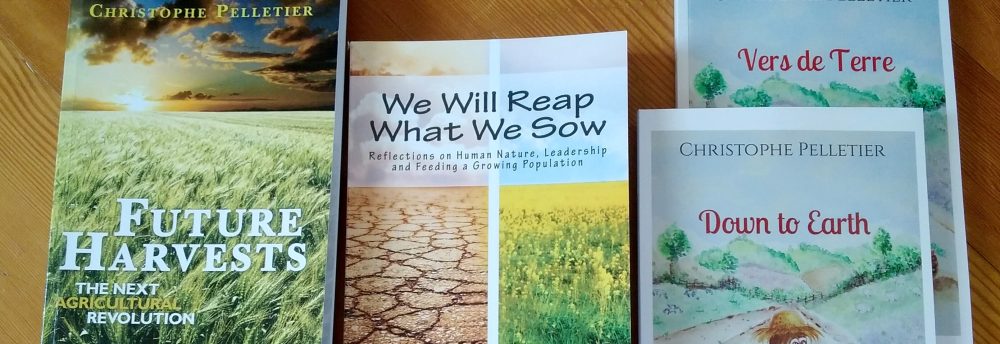
In previous blog posts, I have mentioned some of such initiatives, and in Future Harvests, I described the increasing leadership role of food retail in agricultural practices.

In particular, I mentioned the carbon footprint labelling on dairy products by Tesco, Wal-Mart’s Sustainability Index questionnaire to suppliers, and the seafood sustainability programs of many retailers. Marks & Spencer started their Plan A in 2007 with the objective of making their business more sustainable. To achieve this, they are involving their suppliers and the farmers producing for them to carry out the changes that M&S finds necessary for a better future.

More recently, new initiatives indicate that retailers are pursuing further on such initiatives. Wal-Mart came last week with their plan for sustainable agriculture. In the UK, Sainsbury let know last week that they were committing GBP40 million to invest in farming. Earlier this week, Carrefour unveiled their “Reared without GMO” program. In their stores in France, they will sell 300 food items labelled as being GMO-free, to offer consumer a choice based on transparent information. If Carrefour ventures into this, one can be sure that they do so because they already know that this will be good for their business. By gaining market share, it is very likely that their competitors will soon react by issuing similar programs. The EU Commission may be struggling to figure out how to deal with GMOs, but Carrefour says “Let the consumers tell us!” Vox populi, vox dei!

Of course, such initiatives do not please everyone. Today, I could read in a blog for a US magazine backed by the meat industry some interesting reactions about Carrefour’s new plan. Some readers were bringing up the typical arguments. Meat would be so expensive in Europe. Well, meat is quite affordable in France, even without GMOs, so think again! The other argument was about freedom of choice: people should be able to eat what they want. By labelling its food item, Carrefour does just that. French consumers are free to buy at Carrefour or somewhere else, and they have the right to choose what label they prefer. The freedom of choice is ironic coming from the US meat lobby, since American consumers do not have that freedom. Reared with GMOs is pretty much the only choice in the US. For now, that is. However, it is interesting to see on Carrefour’s press release that the pictures of fish, chicken and pork chops are exactly the same, regardless of whether they would be grown with or without GMOs.

In the 1990s, British and European consumers, and retailers, were challenging food industry practices because they were worried about their health and about the lack of transparency about food. Nowadays, in the USA, consumers are increasingly suspicious of their agribusiness, because they are worried about their health and the lack of transparency of the industry. Beef recalls because of E. coli, egg recalls because  of salmonella, spinach contaminated with manure are in the news on a (too) regular basis. They are also increasingly aware, and suspicious, of the relations between interest groups and their government agencies, and how this influences decisions on what they eat.

Retailers are now saying that they are not waiting for politicians to make decisions. They have defined their vision, they know what they want, and they are passing the message on to the suppliers. What would happen in agribusiness USA if Wal-Mart took a similar approach as Carrefour?

Copyright 2010 – The Happy Future Group Consulting Ltd.

How to attract people to food production?

With the population increase, food production becomes an increasingly strategic activity. Yet, the food sector does not seem to have the appeal it deserves, and attracting new people appears to be a challenging task.

In countries where the percentage of the active population in agriculture is low, many young people simply have never had any exposure to food production. Their food knowledge is limited to their visits to the local supermarket. Since one can love only what one knows, this seriously restricts the number of potential candidates. In a previous article, “Who will be the farmers of the future?“, I had already asked the question of who would be the farmers of the future. To get the attention of the youth, the food sector needs to become more visible and more approachable. There is a need for more interaction between education and visits to farms and food processors. As I mentioned in “Nutrition basics should be taught in school”, such activities should be part of the normal curriculum. Understanding food is understanding Nature, and understanding Nature is understanding who we are. Food, together with water and air, is the one thing that we cannot live without. This should make clear beyond any doubt how important food production and food supply are for the future of our species.

To attract new people to the food sector, it is also quite important to tell what kind of jobs this sector has to offer. These jobs need to be not only interesting, but they also must offer the candidates the prospect of competitive income, long-term opportunities, and a perceived positive social status. Many students have no idea about the amazing diversity of jobs that agriculture (including aquaculture) and food production have to offer. This is what both the sector and the schools must communicate. Just to name a few and in no particular order, here are some of the possibilities: farming, processing, logistics, planning, sales, marketing, trade, operations, procurement, quality, customer service, IT, banking and finance, nutrition (both animal and human), agronomy, animal husbandry, genetics, microbiology, biochemistry, soil science, ecology, climatology, equipment, machinery, fertilizers, irrigation, consumer products, retail, research, education, plant protection, communication and PR, legal, management, knowledge transfer, innovation, politics, services, etc…  Now, you may breathe again!

All these types of activities offer possibilities for work that can be both local and international. These jobs can be indoor or outdoor occupations. Employers are both small and large businesses. Jobs are available in industries, in government agencies, in not-for-profit organizations. Agriculture and food are about life science, and life science is about life. Not many economic sectors can offer such a broad choice of professions.

This said, getting more students in the field of food production will require relentless communication about the present situation as well as about future perspectives. It is necessary for colleges and universities to envision the future. Educating students today must help making them operational for the challenges of the future. Education is nothing less than developing the human resources that will increase the prosperity, the stability and the dynamics of the society of tomorrow. Attracting new students goes further than just agriculture and food production at large. Within food production, every sector also competes to attract new people. Some healthy competition should benefit the whole food chain.

Clearly, there is a need to identify future trends, future challenges and future needs to produce better food and more food. This will require a practical approach. Identify future needs is not an intellectual exercise. It is about providing people with food on a daily basis for the years to come. Identifying future challenges is a team effort between education, research, farmers, businesses and governments. All must work together to create a more secure future. If we want to avoid suboptimal solutions, there cannot be walls between the links of the food production chain.

In my opinion, the most effective way to work towards developing the proper curriculum and attracting students for the jobs of the future is to have a market-driven approach. The question is not only what type of jobs will be needed, but also where will they be needed? To be effective in this process, it is necessary to develop a vision of the things to come for the coming 10 to 20 years, which is the purpose of The Food Futurist (see mission statement). In our fast-changing world, today already belongs to the past. Developing a curriculum on current issues will not prepare students properly for their professional lives, and neither will it serve society properly. Only by identifying what skills will be needed is it possible to offer the best job perspectives for future food professionals, and being able to overcome future challenges. And feeding 9 billion people by 2050 is quite an objective! Identifying the challenges of the future indicates where the best job opportunities are. The action plans to develop tomorrow’s curricula will depend greatly on geographic location. Clearly, India will face with very different demographic, environmental and economic situations than North America, Europe or Brazil will. However, when it comes to food, we will become even more globally interdependent than we are today. This offers many opportunities to train people for work abroad, too.

As my head teacher in Animal Production, the late Julien Coléou, taught us in the first lesson of our final year at the Institut National Agronomique Paris-Grignon: “To live is to learn, to create and to fight”. When it comes being prepared for the future, these three pillars of life all need to be on the curriculum.

Copyright 2010 – The Happy Future Group Consulting Ltd.

Farming a better future by learning the lessons of the previous Green Revolution

After the facts, the Green Revolution of the 1960s has been criticized for having caused negative consequences on farmland. It is true that some intensive agricultural practices have brought serious damage to soils and water reserves, but it is also true that the actions taken have increase food production and they averted the risk of a devastating famine in India.

Today, humanity is facing another major challenge to meet agricultural production to meet the demand of an increasing population. The term “agricultural revolution” has come back in the news and this is a good opportunity to reflect on how to handle future actions.

This time, there is one major difference. With 9 billion people in sight by 2050, the consequences of our actions will have much more impact, negative as well as positive, depending on where we live. In 1950, there were “only” 2.5 billion people on Earth. Compared with today, one could argue that there was some margin for error by then. This margin for error is now gone. Therefore, it is necessary to think ahead and consider all the things that might go wrong. We must anticipate before we have to react.

What can we learn from the Green Revolution, then?

The first lesson is that when humans decide to put all their knowledge together and give themselves the means to succeed, good things happen. Food production increased and people were fed.

The second lesson is that our actions have consequences and that we need to be vigilant about what we do and how we do it.

Of course, it is always easy to criticize after the facts. Pinpointing the negative effects of the Green Revolution is only relevant to a point. Using the mistakes from then as an argument to not engage in further modernization and progress is at least as destructive as bad practices implemented without thinking. Not taking action to develop new practices, new techniques and new technologies –three very different concepts- comes down to giving up. This is not acceptable. This is not possible. To meet future food demand, farmers and all the players involved in food production will need to be innovative and daring. Being innovative and daring does not mean being reckless. We cannot accept this behavior, as the consequences could be too serious.

When looking back at the Green Revolution, the question is not so much “What did they do wrong?” as it is “Did they know something wrong would happen?”

We know today that heavy mechanization, intensive monoculture and use of chemicals caused soil erosion, loss of fertility and soil and water contamination. Is that something that the farmers and the agribusiness of that time realized was happening? Did they have a possibility to know it? Some might answer “No” and others will say “Yes, I told you so”. Could have things been done differently, and helped feeding the people while not damaging the farmland?

For the future, we need to asks ourselves similar questions and develop a plan that helps us 1) succeed, 2) limit risks and 3) have alternatives in the case problems come up.

To figure out what can go wrong, the best is to listen to the opponents of the practices, techniques and technologies considered to be used. In a very short time, it is possible to set up a whole list of potential problems. To do this, it is also important to keep an open mind, because the past has shown that often what actually goes wrong had been mentioned at some time in the debate, even it might have sounded irrelevant. “The Lorax”, the movie by Dr. Seuss gives a good representation of debate between industrialists and environmentalists. The question to answer is “What if the risks actually happen?” and to develop an extensive action plan to restore control on the situation as soon as possible. In food production, the control has to occur within a limited number of areas: soil fertility, water quality, climate (to some extent), weeds, pests, diseases, bacteria (including the good ones), insects (including the good ones), worms, all animals that live on and interact with “farmland” (on the land and in the oceans) and their habitat, genetic diversity, and ability to living organisms to reproduce.

Every time progress is made, there is a struggle between the enthusiastic and those who fear change. There is a tension between action and precaution. This is very human and normal. It is necessary to take the time to review the whole process thoroughly and accept that things do not change as fast, or not as slowly as some think they should. In the end, progress must help humanity improve and prosper, and not just on the short term.

The key is preparing ourselves, and as the saying goes: “The failure of preparation is the preparation of failure”.

Copyright 2010 – The Happy Future Group Consulting Ltd.

Since we cannot beat Nature…

It is convenient to paraphrase the saying “if you cannot beat them, join them”. This applies to our dealing with Nature just as well.

As a species, we have been very successful in conquering our environment and exterminating what threatens us. Actually, we have been successful up to a certain point. The very success that generated the current pace in human population increase brings the next challenge. Sustainability is just as much about the population increase as about how we use the resources. In 1950, there were “only” 2.5 billion humans on Earth. Compared with almost 7 billion today and the expected 9 billion in 2050, it sounds almost like a desert. How does this relate to sustainability? When 2.5 billion people behaved badly, from an environmental point of view, it had consequences, but there was room and time to correct the situation. When 7 or even 9 billion people consume, possibly waste precious resources, damage the environment and pollute beyond what is acceptable, the consequences are a lot more serious and a lot faster to hit back at us.

Sustainability is not just about production techniques, but it is at least as much about our attitude. Sustainability is even more a moral and behavioral necessity than one of a technological nature. The natural instinct when facing a problem is to look for the fastest and easiest way of solving it. This preference of the present tends to make us forget about the long-term effects of our actions. This behavior also tends to ignore how Nature works.

The first rule to remember is that Nature simply does not care whether we exist or not. Nature was there long before us, and it will be there after us, too. The calls to “save the planet” are in fact calls to save humanity. Nature is an open field where evolving life forms compete and fill the spaces left available. This is also what mankind has done since the beginning of its existence: compete, fight and conquer new habitats.

Nature does not care whether a particular species goes extinct. Only some people do. When a species disappears, others compete to take over the vacuum left, and life goes on. Nature is all about creating balances between species. This is why when a species’ population grows fast because of favorable conditions, it always becomes victim of its success. Even insects deplete food resources beyond what could have sustained them. When the food is gone, they simply die by the millions. As far as Nature is concerned, if climate changes, if the nitrate content of drinking water is too high, if soil is eroded, it does not matter. Let the best species win!

This ability of Nature to constantly adjust to changes in populations of life forms also explains why our efforts to kill threats in agriculture and food production will never be quite successful. Farmers may kill lots of pests and weeds thanks to chemicals, pharmaceuticals and now genetically engineered crops, they also create a vacuum for others or better organism to conquer. This is why we face antibiotic-resistant bacteria or herbicide-resistant weeds. This is simply the result of natural selection and evolution happening right before our eyes. Organisms mutate constantly and when a trait helps them survive some of our techniques and products, they thrive. The problem for us is that if forces us to find more specific treatment products as we go on, and this is getting more and more difficult. Are we going to have to fight ever increasingly resistant and strong superbugs, super bacteria and super weeds? If so, we are facing an uphill battle, because we are always at least one step behind new mutations and natural selection. It is not impossible for us to keep the upper hand, though, but the margin of error when looking for solutions will become thinner and thinner.

To stay ahead of the game, farmers and all the people involved in food production need to thinks like ecologists. Science and technology will be the basis for progress, but thinking only like chemists is too limiting. Managing ecosystems is one of the underlying principles of sustainability in food production. We will succeed only by understanding the big picture and thinking like chess players, and anticipate what the several following moves will be, as well from Nature’s side as from ours. We cannot make Nature checkmate, but Nature can do that to us.

The secret ingredient is long-term responsible thinking, even if this goes against the short-term interests of shareholders.

Copyright 2010 – The Happy Future Group Consulting Ltd.

The sockeye salmon returns with some lessons

This could have been the third example, after canola and vines, of what I called earlier “Science being taken hostage”, but this story actually goes beyond just the tactical use of selected science.

The Fraser River sockeye salmon is returning in record numbers to British Columbia (BC) in Canada, the highest numbers in a century. This good news comes at a time when discussions about the disappearance of sockeye were reaching a climax. Last year, the number of returning sockeye salmon was very low and considered by some as alarming. Scientists, and pseudo-scientists, were presenting their own conclusions and they were debating about how the future looked.

Those who are not familiar with the salmon issue in BC need to know that for 20+ years, a war between environmentalists and salmon farmers have been waging. Although all the participants in this debate claim to base their statements on science, Nature is just throwing facetiously some oil on the fire. Environmentalists have accused salmon farms of being the cause for the (apparent) depletion of wild salmon stocks. Much of the accusations rested on research carried out by a local environmentalist who linked her sea lice counting and mortality of juvenile pink salmon to fish farms. Until last year, she seemed to have something of a case, as returns of pink salmons into BC rivers were low. Last year, though, the pink salmon returned in large numbers, which contradicted her theory. For years, the fish farming industry did what it had to do. It always denied any responsibility in the decreasing numbers of pink salmon, using the selected relevant science to support its case.
Ironically, when the pink salmon returned massively last year, salmon farmers were cheering the good news, but environmentalists had been rather discrete to express what should have delighted them. Maybe good news is not always good news. To make things more twisted and controversial, last year’s returns of sockeye salmon, which is a different species of Pacific salmon, were quite low. Although environmentalists never addressed any concern about salmon farms and sockeye numbers, they suddenly saw a connection. The debate became so animated that the Canadian Prime Minister himself decided to set up an inquiry about the disappearing Fraser River sockeye salmon. An inquiry commission was set up with the objective of reviewing with all parties involved the situation, and then present some conclusion. Of course, science(once again) must be the basis for the investigation. I can give you the summary of what the conclusion of the commission would have been, and still might be. “The ecology of salmon is complex and it was not possible to identify any culprit for the disappearance of sockeye salmon with certainty. The commission recommends a number of actions to be taken by all stakeholders in their respective fields of activity. The commission recommends the set up of a monitor group to report and address any new development that can lead to a better understanding and management of the sockeye population”. Something of that nature. The thing is that the life cycle of salmon is quite complex and involves a vast array of environmental conditions in the mountains, in the lakes and rivers and in the ocean. It takes 4 to up to 6 years for a sockeye to return to its birthplace and many events can take place on their route. The high return depends on how many eggs were laid, how many hatched, how many juvenile salmon survived in fresh water and later in salt water. The survival rate can depend on how much food they had available on their trip, or on the population of their natural predators. And all this may be the result of human activity, but also of natural causes. Fact is very few people really know, and can really know what happened. Yet, most of the participants claim to have the knowledge that explains a drop in the sockeye population. There just seems to be less knowledge available about why the population increased.

The whole controversy is not so much about science as it is about politics. In the highly polarized political world of BC, looking for consensus is obviously not enough fun. Fighting is where the joy is, even if it means that everyone may lose in the end. Let’s face it; it does not take a genius to figure out how to have a harmonious cohabitation of fisheries and aquaculture. Unfortunately, there is little action in that direction. Once the problem is solved, there would be nothing left to criticize. Being a critic is a remunerated job.

With the high numbers of fish coming back, a new claim appears: salmon farms are not causing any problem at all, without presenting any science-based proof of that. Of course, this conclusion is already challenged. Remember what I said about polarization. The controversy will go on, as time goes by and future returns will probably show lower levels again. Salmon farmers are not off the hook.

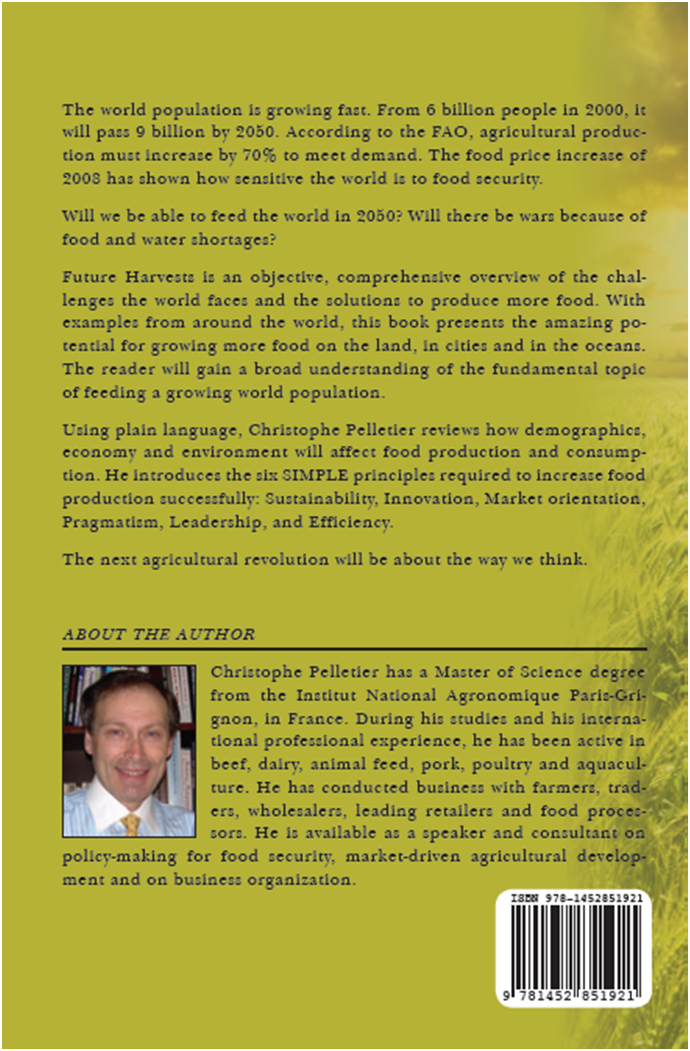
And this brings me to what goes beyond the discussion about science in the salmon debate. It illustrates several topics that I address in my book Future Harvests: sustainability and market orientation. With the high numbers of sockeye, the word out there is to catch as much as they can. I was talking with a fish broker last week. He told me that there is so much fishing activity in the plans that there is a shortage of ice and of totes to hold the fish in processing plants. A few weeks ago, the BC environmentalists denounced the certification of Fraser River sockeye as sustainable by the Marine Stewardship Council, claiming that the low return numbers of last year told a different story. Now, the numbers are so high that fishermen seem very eager to fish as much as possible and sustainability concerns have disappeared. It could be a good idea to take only what is possible to process and sell, and let the surplus of fish to swim back into the rivers and lay as many eggs as possible. This would help keeping high numbers for the return in 4-6 years from now. It would be rather sad to deplete the future stocks. Although fishermen have always criticized salmon farming companies for being driven by profit only, their attitude with the current situation follows pretty much that logic, though. With prices going down, I expect to hear soon some fishermen complain that there is too much sockeye. Question is who will get the blame this time?

This rush to catch that many fish illustrates the lack of market-oriented thinking. In fact, it could hardly be any more production driven. Fish brokers wonder where to sell all that fish. Simple economics tell that the price for salmon will fall. This has already started, and is likely to continue. Maybe saving more salmon to go reproduce in the rivers would have contributed to get better prices, too. In economics, this behaviour is known as the “preference of the present”. For instance, when you have a limited amount of water to cross the desert, you will choose to drink it up to satisfy your thirst, instead of rationing it and keep some for tomorrow.

Tonight, I will go for sushi!

Copyright 2010 – The Happy Future Group Consulting Ltd.

Future Harvests – A preview of the book

My book, Future Harvests, is expected to be published before the end of August.

Here is a preview to give you a flavor of the content.

For a full view, please click on the thumbnails.


Here is a sample containing the table of contents and the preface of the book:


For the video trailers, please visit my YouTube channel.

Beyond the book

Now that the publishing company is working out the final details before the release of the book, time has come for me to spend some time again on the blog part.

During the making of the book, I have been asked about my opinions on a number of subjects. Listing opinions was not the theme of the book, but the blog is a good vector for this. In the course of the coming weeks and months, I will review as concisely as possible specific subjects, present which areas require attention and how I believe the topics will evolve in the future. If you have any request, please let me know.

In addition to these articles, I will develop new topics for seminars and conferences that relate to the book and that offer matter for reflection to the attendees. I also will introduce new modules aimed at improving organization and efficiency of –and within- food value chains. The purpose of these modules will be twofold. They will help participants understand the broader picture, and they will help improving the functioning and the performance of business relationships. This is not only about economic performance, but also about technical, environmental and social performance.

 More about this soon.