Farming a better future by learning the lessons of the previous Green Revolution

After the facts, the Green Revolution of the 1960s has been criticized for having caused negative consequences on farmland. It is true that some intensive agricultural practices have brought serious damage to soils and water reserves, but it is also true that the actions taken have increase food production and they averted the risk of a devastating famine in India.

Today, humanity is facing another major challenge to meet agricultural production to meet the demand of an increasing population. The term “agricultural revolution” has come back in the news and this is a good opportunity to reflect on how to handle future actions.

This time, there is one major difference. With 9 billion people in sight by 2050, the consequences of our actions will have much more impact, negative as well as positive, depending on where we live. In 1950, there were “only” 2.5 billion people on Earth. Compared with today, one could argue that there was some margin for error by then. This margin for error is now gone. Therefore, it is necessary to think ahead and consider all the things that might go wrong. We must anticipate before we have to react.

What can we learn from the Green Revolution, then?

The first lesson is that when humans decide to put all their knowledge together and give themselves the means to succeed, good things happen. Food production increased and people were fed.

The second lesson is that our actions have consequences and that we need to be vigilant about what we do and how we do it.

Of course, it is always easy to criticize after the facts. Pinpointing the negative effects of the Green Revolution is only relevant to a point. Using the mistakes from then as an argument to not engage in further modernization and progress is at least as destructive as bad practices implemented without thinking. Not taking action to develop new practices, new techniques and new technologies –three very different concepts- comes down to giving up. This is not acceptable. This is not possible. To meet future food demand, farmers and all the players involved in food production will need to be innovative and daring. Being innovative and daring does not mean being reckless. We cannot accept this behavior, as the consequences could be too serious.

When looking back at the Green Revolution, the question is not so much “What did they do wrong?” as it is “Did they know something wrong would happen?”

We know today that heavy mechanization, intensive monoculture and use of chemicals caused soil erosion, loss of fertility and soil and water contamination. Is that something that the farmers and the agribusiness of that time realized was happening? Did they have a possibility to know it? Some might answer “No” and others will say “Yes, I told you so”. Could have things been done differently, and helped feeding the people while not damaging the farmland?

For the future, we need to asks ourselves similar questions and develop a plan that helps us 1) succeed, 2) limit risks and 3) have alternatives in the case problems come up.

To figure out what can go wrong, the best is to listen to the opponents of the practices, techniques and technologies considered to be used. In a very short time, it is possible to set up a whole list of potential problems. To do this, it is also important to keep an open mind, because the past has shown that often what actually goes wrong had been mentioned at some time in the debate, even it might have sounded irrelevant. “The Lorax”, the movie by Dr. Seuss gives a good representation of debate between industrialists and environmentalists. The question to answer is “What if the risks actually happen?” and to develop an extensive action plan to restore control on the situation as soon as possible. In food production, the control has to occur within a limited number of areas: soil fertility, water quality, climate (to some extent), weeds, pests, diseases, bacteria (including the good ones), insects (including the good ones), worms, all animals that live on and interact with “farmland” (on the land and in the oceans) and their habitat, genetic diversity, and ability to living organisms to reproduce.

Every time progress is made, there is a struggle between the enthusiastic and those who fear change. There is a tension between action and precaution. This is very human and normal. It is necessary to take the time to review the whole process thoroughly and accept that things do not change as fast, or not as slowly as some think they should. In the end, progress must help humanity improve and prosper, and not just on the short term.

The key is preparing ourselves, and as the saying goes: “The failure of preparation is the preparation of failure”.

Copyright 2010 – The Happy Future Group Consulting Ltd.

Lady Gaga, PETA and lack of knowledge about meat

At the last Video Music Award, Lady Gaga showed up with a garment (including hat) made out of meat. I read about the event in an article from Time. In this same article, Ingrid Newkirk, the founder of PETA (People for the Ethical Treatment of Animals) made some statements that I found just as outrageous as the singer’s outfit.

According to Ingrid Newkirk, “Meat is the decomposing flesh of an abused animal who didn’t want to die, and after being under the TV lights it would smell like the rotting flesh that it is and likely be crawling with maggots”.

Ingrid, here is some more info for you.

  • Meat is not decomposing flesh. If it were decomposing, it would not be edible. Meat is flesh. Period.
  • To get maggots, a fly is necessary, and it has to lay eggs and the eggs must hatch. That would not happen during the duration of the show.
  • What the heat from the lights would do though is to stimulate the growth of bacteria. Bacteria are what cause decomposition.

I have spent quite some time with farm animals in my life and I really could not make any statement about  them having any sense of wanting or not wanting anything. They mostly follow their instinct and do not walk around with a plan. They may not “want to die”, and we may not want it either, but this is life. In the end, we all die. In Nature, it is about eating or being eaten, and herbivores are at the bottom of the food chain. Eating meat is not unnatural. The purpose of farm animals is to feed humans. They are not pets. Adding the word “abused” in her statement is only rhetoric. Like in every profession, there are slobs, but they represent a tiny majority. The overwhelming majority of farmers treat their animals with respect. Similarly, in slaughterhouses, animals are handled with care, because stress causes poor meat quality, which in turn causes economic losses for the processing companies. It is a well-established fact in the industry that proper handling of animals is the economically right thing to do as well.

Quite a bit of misstated facts from the activist who knows it all. But I will leave PETA and its extremist activism here, and get back a bit on Gaga’s “clothes”.

The singer is an adept of excessive and outrageous behavior. We all know this by now. Yet, using meat as garment is beyond bad taste. To produce meat, an animal must be killed. This is not a mundane act. This used to be referred to as sacrifice, which indicates its true value. Our urbanized consumption society (two concepts that defined the New Yorker artist) has made many of us forget about this, though. That meat spoiled because of the stage lights, and was surely discarded and thrown away. In a world where one billion people do not have enough to eat, and where already 40% of all food is wasted, the meat dress is an obscenity. I do not mind provocation, but I do mind vulgarity. Meat is for eating, not for wearing. The justification that Gaga gave for using meat was that she was making a case for gay rights is lame at best.
For me, the final score is a tie. Gaga: zero – PETA: zero.

Copyright 2010 – The Happy Future Group Consulting Ltd.

What if agricultural subsidies were a good thing?

Over the past decades, agricultural subsidies have received an increasingly bad publicity, especially as a major part of the WTO Doha round of negotiations is aimed at removing them.

Yet, with an increasing world population and the need for more food production, one can wonder whether agricultural subsidies really are a problem. History has shown that subsidies can be a very effective way of boosting production. For instance, subsidies have been a major element for the European Union to increase its agricultural production in the decades following WWII. To show how effectively money talks, you just need to see how financial incentives have made European vintners pull off vines, then replant them pretty much at the same place later. Subsidies have encouraged Spanish farmers to plant many more olive trees than the olive market needed. Subsidies work. When people are paid to do something, they usually do it quite willingly.

The true problem with subsidies is to have a cost-effective system. Subsidies must help produce what is needed. They are only a means and they must not become an end. Subsidies also need to deliver the right incentive to be effective. Too often, they have adverse effects because they do not encourage the right behaviour. An example of subsidy that seemed to aim at the right action and yet did not deliver proper results is the subsidy on agricultural inputs by the Indian government. They subsidize fertilizers with the idea that, this way, fertilizers would be more affordable for farmers and therefore the farmers would be able to increase their yields. As such, this is not a bad idea, but the practice showed a different outcome. Farmers with little or no money were still not able to buy enough fertilizers, and richer farmers just bought and used more fertilizer than necessary. The result has been an over fertilization in some areas and an insufficient fertilization in other regions, as I explained in more details in my book, Future Harvests.

For subsidies, too, quality must come before quantity.

Subsidies must be a part of a comprehensive plan towards the essential goal: feeding more people. They must be part of a market-driven approach, and they should not to entertain a production-driven system. Subsidies, or should I call them government support, take many forms and many names, from straight subsidies to grants, “market support mechanisms”, “export enhancement programs” or specific tax regime for farmers, etc… There is quite a bit of semantics involved. Perhaps the stigma on subsidies comes from their being granted by governments. Aren’t private investments just another type of subsidies? After all, that money aims at encouraging more production. The main difference is about the kind of return. Private investors look for a capital return, while governments look for a societal return.

A positive example of effective money incentive linked to a comprehensive approach that involved government and private companies is the rice production boost in Uganda (which I also present in Future Harvests). This effective policy helped increase production 2.5 times and turned Uganda from an importing rice country to a net exporter within 4 years!

I believe that the main bone of contention about subsidies is the competition on markets. Every player involved on world markets, either importers or exporters wants 1) to have the best conditions to compete against others and 2) wants to make conditions for others to compete as difficult as possible. The untold story is that many countries would like others to cut their subsidies while keeping (some of) their own. Only the competitor’s subsidies are unfair. Moreover, addressing subsidies is not enough. At the same time as subsidies, all import restrictions, such as anti-dumping tariffs or import duties should be looked at, as they are blatant attempts to skew the competitive positions.

The issue is not really aimed at developing a comprehensive plan to feed the world. The Doha round started in 2001, but since then, we have had the food riots of 2008 and the spectre of further food inflation. This, too, should be taken into account.

Considering how critical financing is for farmers, and that many farmers (more than half in the USA) need a second job to make ends meet, some form of financial support is generally very useful. Also, let’s not forget that we will need farmers for the future and agriculture needs to be an attractive profession if we want to have the people that we need to produce all the food!

Copyright 2010 – The Happy Future Group Consulting Ltd.

Involve in order to convince!

A couple of days ago, I came across the following quote: “Tell me and I will forget, show me and I may not remember, involve me and I will understand”.

I cannot confirm who the author is, as it has been attributed to brilliant thinkers such as Confucius, Aristotle, Benjamin Franklin or an unknown Native American. It does not really matter.

This quote brought me to start thinking about what it could mean for the agricultural and food sectors, as they are under fire on a regular basis. Why cannot it convince the public of its message(s)?

Opponents of agribusiness tell a lot about their opinions, they also show a lot of pictures, documents or footage of what they criticize, and they certainly are very active involving as many people as they can. The agriculture and food sector, including aquaculture, also tells a lot, shows some, but not enough about their daily operations, and they seem to have a hard time involving enough outsiders of the industry.

I read many blogs and articles from both sides and I regularly come across the “agri-food” authors wondering why the public is so difficult to convince. After all, the industry claims to have the scientific facts that prove its points. The industry is wondering whether the difference in communication effectiveness is linked to budget amounts or whether it has to do with the quality of the PR officers from both sides. I do not think that it has much to do with either. I have concluded that it comes from the ability to make people understand the story. Therefore, it has to do the ability to involve the public with the industry.

To involve the public, it is necessary to create an emotional connection first. This is critical and, unfortunately for the agribusiness, this appears to be a difficult area. Indeed, how to connect with people who have little, if any, connection with the agricultural world and who rarely get to see the reality by themselves. Media and internet are the channels where they find information. Opponents of agriculture have an easier job in the sense that they want to change the system. The worst that can happen to them if they fail is the status quo. They win nothing, but they lose nothing, either. The industry is the one that has the most to lose. Generally, this translates into a defensive approach, and that does not communicate well. Per definition, being defensive means having lost the initiative. Only the ones who have the initiative can lead, and only the ones who lead have followers.

Connecting emotionally means exactly what it says. Rational arguments do not work. At least not until the connection is made. The typical response of the agri-food sector is about bringing scientific facts, but how to convince people who 1) do not trust you, 2) who are worried about their food and 3) who do not have the scientific knowledge to comprehend these scientific facts? Cold scientific explanations will not work. All this does is creating distance. Not ideal when you need to connect.

I always like to make a comparison with parents of children that just had a nightmare. The children’s fears are not rational, but they are quite real, as you certainly can remember. Normal parents try to comfort the children. And how do they do that? They ask what the problem is. They listen. They empathize. They tell the children that they will go with them to the bedroom and show them that there is no green monster hiding under the bed. They will lie down on the floor and look under the bed. Then, they will take the child to have a look, and that is involving the child! This is how they connect emotionally, which allows them to switch to rational arguments and get the child to go back to sleep. Of course, they will not close the door and leave a little light so that the child does not feel thrown back at the green monster again. They empathize again.

Do you think that telling the child that there is no scientific evidence of green monsters would work, or that research has showed that nightmares are not real? And do you think that dismissing the child’s fear as unfounded and therefore about stupid would work, although that is pretty much the truth? Of course, it would not work, and the child would remain fearful and possibly lose trust in the parents in such a case.

If the agribusiness wants to win the public’s trust, it will have go look under the bed and, together with the public, take a peek at it. The public could hardly care less for the industry’s scientific facts, but it cares about being listened to and being empathized with. Interesting challenge, is it not?

Copyright 2010 – The Happy Future Group Consulting Ltd.

Since we cannot beat Nature…

It is convenient to paraphrase the saying “if you cannot beat them, join them”. This applies to our dealing with Nature just as well.

As a species, we have been very successful in conquering our environment and exterminating what threatens us. Actually, we have been successful up to a certain point. The very success that generated the current pace in human population increase brings the next challenge. Sustainability is just as much about the population increase as about how we use the resources. In 1950, there were “only” 2.5 billion humans on Earth. Compared with almost 7 billion today and the expected 9 billion in 2050, it sounds almost like a desert. How does this relate to sustainability? When 2.5 billion people behaved badly, from an environmental point of view, it had consequences, but there was room and time to correct the situation. When 7 or even 9 billion people consume, possibly waste precious resources, damage the environment and pollute beyond what is acceptable, the consequences are a lot more serious and a lot faster to hit back at us.

Sustainability is not just about production techniques, but it is at least as much about our attitude. Sustainability is even more a moral and behavioral necessity than one of a technological nature. The natural instinct when facing a problem is to look for the fastest and easiest way of solving it. This preference of the present tends to make us forget about the long-term effects of our actions. This behavior also tends to ignore how Nature works.

The first rule to remember is that Nature simply does not care whether we exist or not. Nature was there long before us, and it will be there after us, too. The calls to “save the planet” are in fact calls to save humanity. Nature is an open field where evolving life forms compete and fill the spaces left available. This is also what mankind has done since the beginning of its existence: compete, fight and conquer new habitats.

Nature does not care whether a particular species goes extinct. Only some people do. When a species disappears, others compete to take over the vacuum left, and life goes on. Nature is all about creating balances between species. This is why when a species’ population grows fast because of favorable conditions, it always becomes victim of its success. Even insects deplete food resources beyond what could have sustained them. When the food is gone, they simply die by the millions. As far as Nature is concerned, if climate changes, if the nitrate content of drinking water is too high, if soil is eroded, it does not matter. Let the best species win!

This ability of Nature to constantly adjust to changes in populations of life forms also explains why our efforts to kill threats in agriculture and food production will never be quite successful. Farmers may kill lots of pests and weeds thanks to chemicals, pharmaceuticals and now genetically engineered crops, they also create a vacuum for others or better organism to conquer. This is why we face antibiotic-resistant bacteria or herbicide-resistant weeds. This is simply the result of natural selection and evolution happening right before our eyes. Organisms mutate constantly and when a trait helps them survive some of our techniques and products, they thrive. The problem for us is that if forces us to find more specific treatment products as we go on, and this is getting more and more difficult. Are we going to have to fight ever increasingly resistant and strong superbugs, super bacteria and super weeds? If so, we are facing an uphill battle, because we are always at least one step behind new mutations and natural selection. It is not impossible for us to keep the upper hand, though, but the margin of error when looking for solutions will become thinner and thinner.

To stay ahead of the game, farmers and all the people involved in food production need to thinks like ecologists. Science and technology will be the basis for progress, but thinking only like chemists is too limiting. Managing ecosystems is one of the underlying principles of sustainability in food production. We will succeed only by understanding the big picture and thinking like chess players, and anticipate what the several following moves will be, as well from Nature’s side as from ours. We cannot make Nature checkmate, but Nature can do that to us.

The secret ingredient is long-term responsible thinking, even if this goes against the short-term interests of shareholders.

Copyright 2010 – The Happy Future Group Consulting Ltd.

What a game changer my book is!

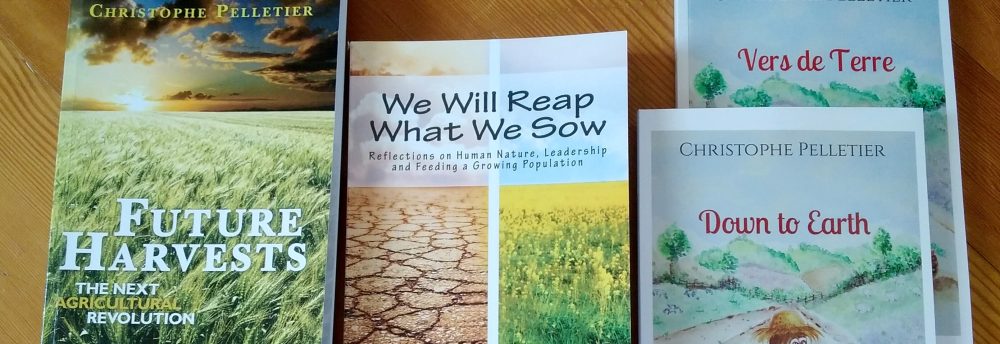
Future Harvests has been published less than two weeks ago, and it is going to change my company rather profoundly.

What started as a blog on the side of The Happy Future Group Consulting Ltd. is now about to become the very core of my business.

Not only the book sales are already higher than I would have thought, the book is creating much interest for my other activities. The book has already been shipped not only to Canada or the USA, but also as far as South America, Asia and Europe. This is truly amazing.

The reactions to the announcement of the book’s publication have been amazingly enthusiastic and they made me feel like I had just produced something that many were waiting for. This is both very rewarding and very humbling, because working on solutions for future food supply to an increasing world population is a huge task. Since the publication, people with whom I never had contact before, from all around the world, have approached me, thanking me for having engaged in this venture.

New contacts are asking me to participate in conferences and to organize workshops and seminars for them. The CBC (Canadian Broadcasting Corporation) is interested in having me on one of their programs. Of course, the concrete discussions are still to come, but I have to admit that my Food Futurist is now showing incredible potential.

The part on policy making and strategy is getting more attention, too. This activity has the potential to become a solid business that will need to involve more people in my organization. I have already started to develop a plan for this. I can see interest coming from companies, professional associations and governments, not only in Western countries, but in many emerging countries, such as in South America, Southeast Asia, India, or Russia to name a few.

The first step that results from all of the above is for me to formalize the Food Futurist further into a more structured activity than it has been so far. This has started with my defining and posting the mission on all the business pages of the website. The mission is “To help our clients challenge today’s certainties, shape the future, and manage the transition with a targeted and practical action plan for the coming 10 years and beyond”.

The following step is going to be to develop business around this mission and the principle expressed in Future Harvests.

If you are interested in this, please do not hesitate to contact me. Talking is cheap. If you know people who would be interested, please pass it on to them.

As Humphrey Bogart’s character said in the movie Casablanca, “I think this is the beginning of a beautiful friendship”.

The sockeye salmon returns with some lessons

This could have been the third example, after canola and vines, of what I called earlier “Science being taken hostage”, but this story actually goes beyond just the tactical use of selected science.

The Fraser River sockeye salmon is returning in record numbers to British Columbia (BC) in Canada, the highest numbers in a century. This good news comes at a time when discussions about the disappearance of sockeye were reaching a climax. Last year, the number of returning sockeye salmon was very low and considered by some as alarming. Scientists, and pseudo-scientists, were presenting their own conclusions and they were debating about how the future looked.

Those who are not familiar with the salmon issue in BC need to know that for 20+ years, a war between environmentalists and salmon farmers have been waging. Although all the participants in this debate claim to base their statements on science, Nature is just throwing facetiously some oil on the fire. Environmentalists have accused salmon farms of being the cause for the (apparent) depletion of wild salmon stocks. Much of the accusations rested on research carried out by a local environmentalist who linked her sea lice counting and mortality of juvenile pink salmon to fish farms. Until last year, she seemed to have something of a case, as returns of pink salmons into BC rivers were low. Last year, though, the pink salmon returned in large numbers, which contradicted her theory. For years, the fish farming industry did what it had to do. It always denied any responsibility in the decreasing numbers of pink salmon, using the selected relevant science to support its case.

Ironically, when the pink salmon returned massively last year, salmon farmers were cheering the good news, but environmentalists had been rather discrete to express what should have delighted them. Maybe good news is not always good news. To make things more twisted and controversial, last year’s returns of sockeye salmon, which is a different species of Pacific salmon, were quite low. Although environmentalists never addressed any concern about salmon farms and sockeye numbers, they suddenly saw a connection. The debate became so animated that the Canadian Prime Minister himself decided to set up an inquiry about the disappearing Fraser River sockeye salmon. An inquiry commission was set up with the objective of reviewing with all parties involved the situation, and then present some conclusion. Of course, science(once again) must be the basis for the investigation. I can give you the summary of what the conclusion of the commission would have been, and still might be. “The ecology of salmon is complex and it was not possible to identify any culprit for the disappearance of sockeye salmon with certainty. The commission recommends a number of actions to be taken by all stakeholders in their respective fields of activity. The commission recommends the set up of a monitor group to report and address any new development that can lead to a better understanding and management of the sockeye population”. Something of that nature. The thing is that the life cycle of salmon is quite complex and involves a vast array of environmental conditions in the mountains, in the lakes and rivers and in the ocean. It takes 4 to up to 6 years for a sockeye to return to its birthplace and many events can take place on their route. The high return depends on how many eggs were laid, how many hatched, how many juvenile salmon survived in fresh water and later in salt water. The survival rate can depend on how much food they had available on their trip, or on the population of their natural predators. And all this may be the result of human activity, but also of natural causes. Fact is very few people really know, and can really know what happened. Yet, most of the participants claim to have the knowledge that explains a drop in the sockeye population. There just seems to be less knowledge available about why the population increased.

The whole controversy is not so much about science as it is about politics. In the highly polarized political world of BC, looking for consensus is obviously not enough fun. Fighting is where the joy is, even if it means that everyone may lose in the end. Let’s face it; it does not take a genius to figure out how to have a harmonious cohabitation of fisheries and aquaculture. Unfortunately, there is little action in that direction. Once the problem is solved, there would be nothing left to criticize. Being a critic is a remunerated job.

With the high numbers of fish coming back, a new claim appears: salmon farms are not causing any problem at all, without presenting any science-based proof of that. Of course, this conclusion is already challenged. Remember what I said about polarization. The controversy will go on, as time goes by and future returns will probably show lower levels again. Salmon farmers are not off the hook.

And this brings me to what goes beyond the discussion about science in the salmon debate. It illustrates several topics that I address in my book Future Harvests: sustainability and market orientation. With the high numbers of sockeye, the word out there is to catch as much as they can. I was talking with a fish broker last week. He told me that there is so much fishing activity in the plans that there is a shortage of ice and of totes to hold the fish in processing plants. A few weeks ago, the BC environmentalists denounced the certification of Fraser River sockeye as sustainable by the Marine Stewardship Council, claiming that the low return numbers of last year told a different story. Now, the numbers are so high that fishermen seem very eager to fish as much as possible and sustainability concerns have disappeared. It could be a good idea to take only what is possible to process and sell, and let the surplus of fish to swim back into the rivers and lay as many eggs as possible. This would help keeping high numbers for the return in 4-6 years from now. It would be rather sad to deplete the future stocks. Although fishermen have always criticized salmon farming companies for being driven by profit only, their attitude with the current situation follows pretty much that logic, though. With prices going down, I expect to hear soon some fishermen complain that there is too much sockeye. Question is who will get the blame this time?

This rush to catch that many fish illustrates the lack of market-oriented thinking. In fact, it could hardly be any more production driven. Fish brokers wonder where to sell all that fish. Simple economics tell that the price for salmon will fall. This has already started, and is likely to continue. Maybe saving more salmon to go reproduce in the rivers would have contributed to get better prices, too. In economics, this behaviour is known as the “preference of the present”. For instance, when you have a limited amount of water to cross the desert, you will choose to drink it up to satisfy your thirst, instead of rationing it and keep some for tomorrow.

Tonight, I will go for sushi!

Copyright 2010 – The Happy Future Group Consulting Ltd.

Science taken hostage (cont’d) – The genetically engineered vines

Another example of what I had presented in my previous post about the “killer canola” is the case of the genetically engineered vines in France.

Last week, a group of opponents to GMOs went into a trial field of the French Agricultural Research INRA and pulled out vine plants. Two associations reacted strongly to this act of vandalism. The French Association for Scientific Information and the French Association for Plant Biotechnology stated that this act demonstrated that “science and technology are the targets” of such action groups. Of course, this statement is “colored” with some bias, and a little bit of paranoia always adds to the dramatic effect. What I see here is just that instead of a constructive debate about the use of genetic engineering, the rhetoric slides into partisanship and name-calling. Clearly, science does not really weigh much in this. The reality is that two groups with different views on how the world’s future should like oppose each other. The debate is more about politics than science. The people who pulled out the vines just do not want GMOs. Period. Nothing will convince them otherwise. The scientists and technicians see such an act as a threat to their jobs and to their beliefs as well. They will fight back. You can find more details in the article from the French agricultural magazine La France Agricole.

Interestingly enough, the French Minister of Research spoke during an interview about the matter. One of the arguments she brought up was that the “vandals” should be fined the value of all the work involved, meaning all the materials and salaries of the researchers. INRA is a state-owned research institute. As such, that is an interesting idea. Although, she is the Minister and she could use her position to press charges. However, there is no mention of such action from her part, at least explicitly. Would her indignation be only for political reasons? Another interesting aspect of this story is that France, although conducting research on GMOs is one of the fiercest opponents of the use of GMOs in agriculture. Where does science fit in all this?

The thing with science is that it does not take sides. Science is not biased. The same statements apply to Nature, too. It only serves to explains why things are the way they are. Technology, on the other hand is man-made, and therefore assists their users to pursue their agenda and goals. Another aspect about science, especially research is its cost. Conducting research is quite expensive and requires large amounts of funding. Since getting funding is quite similar in its process as selling a service or a product, researchers need to convince. Using drama and even fear works rather well and “polishing” scientific results and conclusion to get the yes to funding is not an unusual practice. The “climategate” story using the emails from researchers telling that they overstated the consequences of climate change is just an example of what extremes scientists sometimes need to go to be able to continue their research and in some cases keep their jobs. Sometimes, scientists are just so convinced about their own conclusions that they also report slightly beyond the truth. Mendel, the “father” of modern genetics supposedly “improved” the results he got with the crossing of his peas to demonstrate how characteristics were passed on through genes.

Copyright 2010 – The Happy Future Group Consulting Ltd.

Countries mentioned in Future Harvests

Here is a list of all the countries that appear in my book, Future Harvests:

Afghanistan, Angola, Argentina, Armenia, Australia, Azerbaijan, Bangladesh, Belarus, Belgium, Brazil, Burkina Faso, Cameroon, Canada, Chad, Chile, China, Congo, Côte d’Ivoire, Cuba, Denmark, Ecuador, Egypt, Ethiopia, Fiji, France, Germany, Ghana, Greece, Guinea, Hungary, India, Indonesia, Iran, Iraq, Ireland, Israel, Italy, Japan, Kazakhstan, Kenya, Kuwait, South Korea, Lebanon, Libya, Madagascar, Malaysia, Mali, Marshall Islands, Mauritania, Mexico, Moldova, Morocco, Mozambique, Nauru, Netherlands, New Zealand, Niger, Nigeria, Norway, Pakistan, Palau, Papua New Guinea, Paraguay, Peru, Philippines, Poland, Qatar, Russia, Saudi Arabia, Senegal, South Africa, Spain, Sudan, Sweden, Syria, Tanzania, Thailand, Tunisia, Turkey, Tuvalu, Uganda, Ukraine, United Arab Emirates, United Kingdom, United States of America, Uruguay, Venezuela, Vietnam, Zimbabwe.

Quite a trip around the world!

Two-thirds of world population live in the 16 most populated countries

When looking at their respective demographics, economic situations and food security status possible future scenarios can arise from this list.

The most obvious is probably that many countries on this list have little food security. Considering that many of these countries have a young, poor and increasing population, political stability is quite fragile. As long as this remains, the consequences of food inflation must be taken very seriously.

Country

Population

% of world population

China

1,337,320,000

19.6

India

1,180,220,000

17.3

USA

309,199,000

4.5

Indonesia

231,369,500

3.4

Brazil

192,860,000

2.8

Pakistan

169,410,000

2.5

Bangladesh

162,221,000

2.4

Nigeria

154,729,000

2.3

Russia

141,927,297

2.1

Japan

127,530,000

1.9

Mexico

107,550,697

1.6

Philippines

92,226,600

1.4

Vietnam

85,789,573

1.3

Germany

81,882,342

1.2

Ethiopia

79,221,000

1.2

Egypt

78,200,000

1.2

 Total  

4,531,656,009


66.7


What came to my mind when I saw the list the first time was the following.

The cluster Pakistan-India-Bangladesh represents 22.2% of the world population. This region is very sensitive to climate events, as the current floods in Pakistan demonstrate. The monsoon is the main factor that influences the level of crop production. These countries are below food self-sufficiency, and their agricultural infrastructure (and overall infrastructure in general) is in bad need for further development. However, the quality of agricultural land is good with around 40% of arable land. The task of India is huge. It has about 70% of its population in agriculture, and if the USA had India’s population density, there would be 3 billion Americans, 10 times its current population. In such a situation, the USA would not be self-sufficient, either. Agricultural reforms are necessary to improve yields and economic development is necessary to provide more inhabitants with higher revenue. It will take time, but expectations for the Indian economy are positive. Subsistence is not a good economic model. A good relationship between India and Pakistan is paramount for the stability of the region. A stable Pakistan is essential for the stability of the world.

In North America, I can see dramatic change coming. With two countries, Mexico and the USA, in sharp contrast with each other in the top 16, something will happen. The USA will remain an economic superpower and any events in that country will affect the world economy and politics. Mexico is growing but it needs to improve its economy and achieve better social stability. Poverty is fuelling many issues and the price hike of corn of 2008 has showed that it would not take much to cause food riots. The issue of immigration of Mexicans into the US will not go away, and no wall will stop it, especially with Mexico having a strong population increase. The difference in population numbers of the two countries will shrink. The USA and Mexico will have to develop a joint economic development program for the region to avoid an uncontrollable situation in the long term. I think that we will see more and more Mexicans settling in the USA and become the farmers of the future over there. However, climate conditions will probably affect the geographical distribution of productions. The southwest of the USA is increasingly suffering from water scarcity, and the area spreads. This will affect the distribution of the population over the continent, and it will affect Canada as well.

South East Asia has three representatives on this list: Indonesia, The Philippines and Vietnam. This region shows a strong population increase. From a food production point of view, geography tells that aquaculture has to be a leading, if not the leading, food source for the future. And this is exactly the direction that these countries are following. Rice is essential in this part of the world, and there is no doubt that the South East Asian Emergency Rice Reserve will be tested at some point in time.

Brazil is growing, demographically and economically. It is becoming an economic powerhouse, in particular in agricultural products. However, much still needs to be done to improve infrastructure and performance. In the future, I expect to see joint agricultural policies between a number of Mercosur countries, especially with Brazil, Chile, Argentina and Uruguay as the initiators. Export has led agricultural production of these countries in the past, but I expect to see them to rebalance policies towards feeding the South America market as well in the years to come.

The other thing that jumped out of the list is Africa. I doubt that many people would have expected Nigeria to be ranking #7. Africa will be an important element in the 21st century economy. The continent’s population will double in the coming 40 years and many African countries are attracting foreign investments. If this happens in orderly manner, which is far from sure at this stage, I would expect Africa to experience a boom comparable to the one that China has had over the last three decades. The continent is open for business and the rules of engagement are exactly what adventurous pioneers can wish for. Africa has tremendous potential for food production and foreigners are developing agriculture actively for their own food supply, but neither African countries nor investors should forget to include the Africans in the wealth creation, and help them earn the money to feed themselves. What will happen in Africa, will affect all of us.

Copyright 2010 – The Happy Future Group Consulting Ltd.