I am available for speaking engagements about the future of food and farming

Updated February 9, 2011

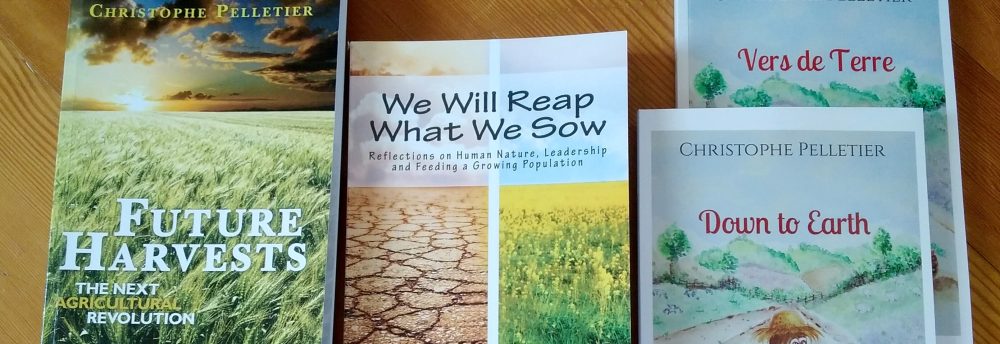
Publications about the future of food and farming are on the rise. I probably was just a little ahead of the pack with “Future Harvests – The Next Agricultural Revolution” that I published last August. First, I saw that it took 400 scientists and two years to publish the Foresight report titled “The future of food and farming: challenges and choices for global sustainability”, published on January 24. It is an interesting report. Then, on January 28, The World Economic Forum released the report titled “A New Vision for Agriculture”, which involved 17 global companies, 350 leaders of industry and 18 months. This one I read as a typical WFE document about the future agenda of these large corporations, really.

I must say that having written my book in six months and not coming short of any of the points mentioned in both reports, I feel quite proud of my achievement. Future Harvests does not come short of any of the topics these reports address. In fact, these two reports come short of some critical factors for food security that I do mention in my book. From feedback that I received, Future Harvest appears to be even more informative and more fun to read than these reports.

It looks like I did a reasonable job, then. For once, I will pay myself a compliment. Apparently, my company is the little consulting firm that can! That will be the slogan from now on.

As this topic is gathering momentum, and more people are buying my book, I believe I should tell about the big picture and inform people about what is likely to happen in the future. This fascinating topic keeps an audience on their toes.

I am available for speaking engagements to present this topic or any other related to it. This is a great story for any group interested in learning about trends and future developments in food production and food supply.

So, if you and your organization, be it industry, non-profit or government, are interested in a presentation, please do not hesitate to contact me or to pass it on to someone who you know would be interested.

Feeding nine billion is an exercise in leadership

In a previous article, “Hunger is about more than just food production”, I showed how much more potential we have to feed the world than we commonly think. However, having the potential to do so does not mean that we will do it. Human nature has the habit of fluctuating between its best and its worst. Therefore, whether we will actually feed nine billion is far from done. In this article, I am going to reflect to what it would take to be successful at making it happen.

In my book, Future Harvests, I present the six principles that are critical to meet future food demand successfully: Sustainability, Innovation, Market Orientation, Pragmatism, Leadership and Efficiency. I had regrouped these principles under the acronym SIMPLE. While I was writing the book, I always came back to the same observation: success or failure to feed nine billion simply depends on us all. Someone needs to set the course and create the conditions to take the proper actions. The world needs leaders that will make food production potential the reality by 2050.

The job description is, interestingly enough, rather reminiscent of food production and genetics. In order to express the full potential of its genes, an organism needs the proper environment. This is exactly the role of the future leaders. They must create the conditions that will allow farmers to produce efficiently, yet sustainably.

The starting point will be about making the right decisions for both the long term as for the short term. We must preserve the potential to produce for future generations, but we must not forget to provide for today as well. Proper leadership will need to take into account the interest of many different groups and manage a balanced approach between money, people and environment. For sure, future leadership will be a balancing act. This will be easier to achieve if the leaders can sell the world their plan, which means that they must have one.

Leaders come from all layers of society. They are in government, in industry, in non-profit organizations, they are independent farmers, or they come from non-food related occupations. Adequate food supply is the very fundament of societies. Where there is hunger, there is no prosperity. Without food, there is not life, and just as importantly, without water there is no food. Developing food security is not an option; it is probably the most important policy sector of any society. This is something that we must not take lightly, even in rich countries where we seem to take food for granted. Things may change.

What story do our leaders need to tell and execute? The points that I raised in the article mentioned at the very beginning are a good place to start. The scandal of food waste, because it really is a scandal, must be dealt with and fixed. In developing countries, this is caused by a lack of infrastructure. It is only a matter of money. If world leaders have the will to get that money at work, it will happen. For some reason, they do not do it. Maybe it is a sign that things are not that critical after all. Compared with the amounts of money thrown at financial bailouts and stimuli of all sorts, the cost of infrastructure development looks ridiculously insignificant. Such projects would actually create jobs and increase the wealth of the populations where it takes place. This would not be artificial GDP boosting, but actual poverty reduction and increased food availability. In rich countries, food waste happens at the consumer end. What leaders of these countries need to communicate is a sense of responsibility. Wasting food is simply immoral, just like any other waste. If we take the example of nitrogen, the waste by leaching is estimated at about half the nitrogen spread on crops. This is huge and very damaging for two reasons. One is that the nitrogen ends up in the drinking water making it harmful, especially for pregnant women and infants. The other is that the production of nitrogen fertilizers uses half the world’s agriculture natural gas consumption. Efficiency is not a luxury, but it is a necessity. When efficiency increases, the amount of waste decreases. This works towards a higher sustainability, too. Food waste is one thing, but food consumption excesses or unbalanced eating habits are another area of work for our leaders. Eating more food than one needs is not only detrimental for that person’s health, it is also food that is less available to others. This pushes food prices up, too.

The effectiveness of leaders depends on their ability to communicate and get the message over to their dependants. Changing habits and infusing a sense of solidarity and responsibility requires patience, communication and proper education programs. Defining vague objectives or using hollow populist slogans and expressions will have no effect. Only charismatic leaders with strong convictions about what ensures the future of their people, even if it means sacrifices, will be able to bring such a change. It is not easy to do when your country is not on the verge of a terrible crisis. An interesting example about unilateral leadership is the decision of the Chinese government to slow down the number of new car registrations. They consider that there are enough cars. Getting a licence plate will be difficult in the future. In 2008, they decided to ban the use of disposable plastic bags in supermarkets, thus saving an estimated 100 billion bags and the equivalent of 37 million barrels of oil per year. Similarly, China is now the world leader in renewable energies. What actions did the Western democracies take about new car sales and supermarket plastic bags? When children died because of tainted milk, the Chinese authorities arrested all the people involved, and even executed two persons. Of course, the use of melamine in the milk was intentional, making the case extreme. However, in the West, I do not recall anyone being arrested or considered personally liable after deaths by food poisoning. My point is not to demand imprisonment of CEOs as a standard operating procedure, but I am sure that if executives of food companies felt that they could be personally liable for food poisoning, the precautionary principle would apply much more systematically. Leaders need to make understand that doing something wrong comes with consequences. Although there is much to say about China’s political system, one must admit that not having to think in terms of elections every four years and not having political campaign funded by any industry of NGO of any sort can help politicians focus on the long-term, too. Maybe the fact that China is plagued with so much pollution in the air, in the water and in the soils also makes the issue more acute for the leaders to resolve.

If the stick is one option to make people do what is right, the carrot is, at the very least, as important. Nothing stimulates people more than being rewarded for doing a good job. People are at their best when they know that others appreciate what they do, and that what they do makes the world a better place. Then, they do not see their occupations as “have to” activities, but as “want to” ones. Subsidies, bonuses, tax credits are all motivating tools to make people do the better thing, but the key is to have incentives that meet the goals without having harmful side effects.

Leaders also need to be innovators. Considering how fast our world changes, and the quantity of new knowledge made available about on a daily basis, many new possibilities will be available to solve old problems. Innovation is the child of human genius and, to cope with future challenges, creativity and adaptability will be major assets. It is the leaders’ role to foster innovation, yet by keeping in mind all long-term implications.

The ideal leader would have the qualities described by Plato in “The Republic”. Although it is an ideal, having committed leaders matching his description would increase our odds of success.

Copyright 2011 – The Happy Future Group Consulting Ltd.

Food, Inc. or just the description of America?

A couple of days ago, I watched the documentary Food, Inc. Although the underlying theme is that the four large US corporations that dominate food would try to keep the American consumers ignorant of their activities, I saw this documentary much more as a review of the US society over the past 60-70 years.

As usual with this kind of documentaries, there is a mix of commentaries with pictures without presenting anything specific about the relation between the text and the images. The chicken farmer from Pennsylvania is angry, but it is not clear exactly at what. She removes dead chickens, but we do not hear what the cause of death is. To me, with my experience in chicken production, it seems that her chicken house is in very poor shape, and I am not sure about her level of commitment and overall technical performance. The Tyson grower seems quite a bit happier than the lady chicken farmer who ends up being terminated by Perdue. Unfortunately, the crew cannot film inside his chicken house and we never hear to know exactly why, but the commentary tends to imply that Tyson wants to hide something. Unfortunately as well, no representative from the large food companies mentioned wished to be interviewed, and that creates the impression that they want to conceal something. The chapter about the staff policies of meat companies is quite interesting. If this seems a surprise for the journalists, it was not for me. In Europe, we knew 20 years ago how harsh contracts were for farmers and plant staff. This is the product of free job market mechanism with a slight reminder of a certain thinking about labour force in the old south. Certain things simply die hard. John Steibeck’s Grapes of Wrath had shown several decades ago how agricultural labor force could be exploited. The reminder that meat packing plant workers used to have decent wages is an indicator of two things. One is a reflection of the disappearance of the American middle class in the manufacturing sector, and the other is that meat plants would purely and simply suffer tremendous financial losses if they had to reset wages the way they used to be. There might be some concerns about their financial long-term sustainability. They are not ready to cope with production cost increases, and they can hardly reduce personnel costs much anymore.

The family of four that lives on a diet of fast food is also a typical example. They do not have time to cook, and that justifies eating only burgers with fries and pop. The fast food meal for four comes down to almost US$ 3.00 per person. You can make a healthy meal for that money. The luxury meal that I prepared for my spouse on Christmas Eve was hardly more expensive than this. For that family, like for many American households, money is tight and they need to do the best out of a limited budget. The filmed visit to the supermarket tends to focus too much on the broccoli at US$1.29/lb. That price would be too high. That is possible, but there is more than broccoli to choose from. Potatoes, rice, carrots, beans, cabbage or onions are much cheaper than broccoli, and by combining them, it is possible to prepare quickly a healthy nutritious diet, including some meat. The mom works long hours and has no time to prepare diner. I accept that, but the teenage girl could do that to help her mother. My parents also worked long hours, and dinner was not before 9 pm. This is why I learned how to cook. When there is a will, there is a way. Then, we learn that the parents suffer of diabetes. This is not really a surprise considering such a crazy diet, and this problem is spreading to more and more American families. When you add the medication costs to the price of the fast food meals, preparing a healthy meal as I described above is really the best deal in all respects. In the land of individualism, where people are expected to take charge of their destinies, it is a bit strong to reduce the discussion to the agribusiness having “altered” foods, thus presenting this family as victims. I disagree with this. They made a choice, which may be the most convenient, but not the wisest. The alternative certainly requires some effort, and that may be difficult to handle. The blaming game, which is even more popular than baseball in the US is not leading anywhere. Most of all, why do they have to order pop with their burgers? They can cut their calorie count by filling bottles with tap water. Making sandwiches is easy and quick, too. This is a lot cheaper and a lot healthier, and it does not require much work at all. Last year, I had written an article in which I was showing the similarities of human behaviour and how we produce food. Food, Inc. makes this comparison quite vivid.

Then, the documentary shifts to food safety and presents some footage of meat processing plants. That is certainly a very important item in the US, where the number of recalls for bacterial contamination is simply astronomical. I found this part very interesting because in my many years in the meat, poultry and fish businesses, I have spent several years in close contact and even supervised plant operations as well. What this movie from 2009 showed gave me the same impression that I got the first time I came to the US in 1998, and toured what was by then one of the largest chicken processing plants in the country, in Alabama. Americans certainly love everything big, just like the calorie count of their meals. They love huge complicated plants where the molecules (chlorine by then in that particular chicken plant that smelled more like a swimming pool than anything else, and ammonia in the case of the plant featured in the movie) are supposed to do the work. Unfortunately, with such layouts, visual control is rather difficult as it appears in the documentary. When a plant is such a thick forest of pipes, chains and rotating parts, not only is it very difficult to see what is happening, but it is the best amusement park you can imagine for bacteria. They have so many niches where they can settle and grow in peace. The more complex the layout gets, the more difficult it is to sanitize the plant. The hamburger factory has installed cameras and management claims that this helps them to control what is going on in the several plants they own over the country. My view on meat processing plant supervision is that it has to be done in an ongoing manner, online, with the supervisor being on the plant floor, not sitting in his office. I doubt that cameras will eliminate food contamination issues. Moreover, online quality control requires motivated staff, which also requires proper wages and benefits. Food safety is less a technology matter than it is a matter of management and motivation of staff. Another important element that I noticed is that the boss of the hamburger plant describes himself as a mechanic. I had expected him to see himself as a food producer who wants most of all to offer safe food to consumers. I did not hear that statement. I also would have liked to see him eat some of his ammonia-marinated burgers. I am a meat lover, but I really do not need that on my plate. When I think that, in The Netherlands, we were not even allowed to use chlorine in the slaughterhouse water… We had to work on eliminating the causes of the problem instead of applying never-ending layers of technology band-aid. And we did significantly reduce the causes!

Then, the documentary presents the “natural farmer”, Joel Salatin of Polyface Farms. He certainly is very successful, but by his own admission, he has no plans is growing much more than he currently is. If there is more demand than he can supply, that will be the customers’ problem. By looking at his chicken slaughter installation and system, I doubt that he can supply much volume, but we never got to hear how big his business is. He is a niche producer, and his customers appreciate him, since one of them claims it to be worth driving 5 hours to get to his shop. That is 10 hours drive including the way back. One can wonder if the footprint of that food is all that great when it comes into the consumer’s home. How many of such farmers are necessary to meet consumer demand? And what is the price of the food they sell? Could this feed the family of four on a very tight budget that eats from the fast food drive-through? The movie never answers these questions.

The story of Stonyfield Farm yogurt was cause for more optimism. They offer the organic alternative. According to the CEO of the company, they are the third yogurt brand in the US and the most profitable one. This is a success story. They sell to Wal-Mart and fit in the retailer strategy towards more sustainable food. It also shows that organic has long passed the stage of hippie small-scale and that is a rational modern business, which the industrial agribusiness tends to refuse to see. The one thing that was missing about this story, though, was how the farmers who supply the milk perform financially.

Probably, the scariest part of Food, Inc. was the one about the lobbying and the politics. In the material country, this is no surprise. This does not make it any less scary, though. Since winning elections is about how much money candidates have in their “war chests”, the actual vote ballot is a banknote. The ones with the most bank notes have the most power. Reality is less idealistic than the idea of a “government of the people, by the people and for the people”. The system seems to have evolved to somehow reminiscent of an aristocracy structure. The US is a republic, but maybe a little less of a democracy after all. The money power is not only political, but in society where suing is a lifestyle, justice tends to favour the richer ones, simply because the poor cannot offer the fight very long. This power of money through lobby and lawmaking might not be as strong as one think, though, Last year, an oil lobby backed-Republican Senator of Arizona wanted to pass a bill to kill solar energy in the state. A Chinese company, Suntech Power, had plans to open a solar panel factory in Arizona (a Chinese company opening a manufacturing facility in the US. That is interesting is it not?) If this bill had passed, they would have lost the business. What did they do? They threatened to stop the project and kill the jobs. Do you know what happened? The Republican Senator did not proceed with his plans. Maybe China will help eliminate the negative effects of lobbies. Nonetheless, for now, lobbies are still active and powerful.

Then the conclusion of the documentary comes in a rush. Buy local, from the farmer’s markets. This is nice, but millions of households cannot afford that food. Moreover, production is not even remotely close to meeting the national food demand. You can vote three times a day to choose the food system. Americans voted a long time ago to have instant gratification, and they chose for the consumption society. Never things would have evolved to what they are if consumers had rejected it from the start. Nobody forced Americans to drive to a fast food restaurant and stay seated inside their cars to eat. Nobody forces them to drink pop, eat potato chips or candy bars, to think that the right size for a steak is 9 oz., to pour ketchup on everything, just as they did not have to spend more then they earned and dig themselves in huge debt.  I do not consume any of those items, yet my self-esteem is good, though.Freedom requires a bit of will power. Freedom of choice does not imply that one should not resist temptation. The American consumer’s behaviour has been a boon for the industry. Nothing is better than consumers who just consume without asking questions. Fortunately, this is now changing gradually. Americans realize that consumer goods producers have looked at them in a similar way as the livestock in feedlots, passive and submissive. Unlike what the makers of Food Inc. may say, all Americans are responsible of the society they have. The industry is, of course. But consumers are just as much. In order to change, consumers are going to realize what role they have played in the consumption society. They can vote, but the US is one of the countries with the lowest turnout at elections. The ones who choose not to express themselves just miss an opportunity to change things. Most Americans have lost faith in their politicians. Yet, there is a democratic force that can, and in my opinion, will restore true democracy. This force is the food retail, with Wal-Mart as the leader. They do not wait for politicians to make laws when it comes about food should be produced. They do not care much about the games played in Washington, DC. They just listen to the people and they offer the workable solutions to meet these wishes. Unlike politicians, they do not set their objectives for the next four years. Wal-Mart has already done more about sustainability of food supply than lawmakers have. Earlier, they had decided not to sell milk from cows injected with growth hormone. Yesterday, they announced their decision to make healthier food affordable to their customers. They represent such a purchasing power that they can force their suppliers to change their practices and their purchasing strategies, enforcing the change all the way back in the supply chain to the seed producers. Be assured that the food industry will do what the retail tells it to do, because without the retail, they are out of business. Their purchasing power is so much larger than the one of the people buying on farmers markets. People should cast their vote and give power of attorney to the retailers. Really, the food retail is just one step away of enforcing change on antibiotics, hormones, animal welfare and GMOs; even if the politicians have not made up their minds. Just compare the size, financially and in jobs, of Wal-Mart and Monsanto. Who is the true giant?

Altogether, I found that the movie was raising good questions, but it was not giving much hope for a quick change, either. This is a weakness, just as the lack of specifics of the pictures. They need to make a sequel in which they will show how things can change for the best, make food affordable and farming sustainable, and how they see the US making the transition. I missed that. The documentary is not as specific to the food industry as it seems. A similar movie with a similar commentary could be made on about every industrial sector of the US, from energy to electronics, telecommunications, the car industry, the banks or the pharmaceutical industry.

Copyright 2011 – The Happy Future Group Consulting Ltd.
Investing in agriculture requires thorough research

Since the price hike of food and other commodities in 2008, agriculture is one of the hot topics in the investment community. This is also fuelled by the perception that the world might face a food crisis. For those looking at investing in the food sector, there are many possibilities, but in this sector as in many other investment types, caution is required. The investment community is a pool of sharks, and the name of the game is to sell at a profit. Beware of the salesperson!

According to Jim Rogers, a famous investor and former partner of George Soros, farmers will be the ones driving Maseratis in the future. He believes firmly that, in the future, those who actually produce the commodities, instead of brokers, will make fortunes. It is a very interesting point of view, although history tends to show that the power in food value chains is in both ends of the chain: genetics and marketing to consumers. Becoming a farmer is not an investment. It is a job, and a busy one. Farmers need to generate cash on a regular basis to provide for their families and keep the farm in business. Land is not liquid. Investing is about reaping the profit when selling at a higher valuation.

For those interested in owning farmland, there are possibilities to buy large acreage in many countries. A recent article published in CNBC presents some strategies.  Large private investors seem interested in Brazil, Argentina, Uruguay and Canada. Prices of farmland have been firming up in the US. There are people advertising for Brazilian farmland who promise you a yearly guaranteed (not clear how, though) of 12%. In the former communist Eastern European countries, many farms are for sale. Net importing countries such as China, India and Arab countries choose to invest and develop farmland in Africa. For investors with a strong stomach, Africa may be a place of choice. The continent is pretty much for sale. However, the ownership of the land is not always very clear and the rules of engagements may vary. If you only wish to lease land, you might be interested in Ethiopia: the country is offering 100-year leases for $1 per acre. Although some offers may seem irresistible, buying farmland or a farm is a complex endeavour. Many factors weigh and things may not be as they seem. What is the quality of the soils? How is the climate, and in particular are there risks of floods or drought?  Is there proper access to water? What are the local regulations in the country where you are thinking of buying? How much bureaucracy should you expect? Who are the suppliers, and how they deal with their customers? Is there access to quality supplies? What are the banking facilities and what type of credit can you get? How are the infrastructures for storage and logistics? What access to markets do farmers have, and how is the marketing chain organized? Today’s situation may not be a good predictor of the future, and problems may loom ahead, as Jason Henderson, vice president and Omaha Branch executive of the Federal Reserve Bank of Kansas City told in an interview to Agri-pulse.

If farming or owning farmland is not your thing, there is always the possibility to invest in commodities with futures contracts. Instead of buying the hard commodity, which would take quite some space in your garage, you just do the same but on paper only. This is a risky business though and it should be left to the pros. Originally, futures had been introduced to give farmers the possibility to fix in advance the selling price for their crops, instead of waiting for the spot market at harvest time. Futures contracts have been taken over by the Wall Street geniuses who brought us the Great Recession. Also realize that nowadays the future contracts prices reflect the supply and demand situation of paper contracts, not of the actual physical market. The result is that futures markets are all about speculation and most transactions are made with borrowed money. Speculation may be about the weather, planted acreage, expected yields or plant diseases. Any news is cause for rumours and markets may change direction without warning. If agricultural commodities interest you, you may prefer to invest in funds that include these commodities, and therefore offer a lower risk. Another possibility to get money at work in the agriculture and food sectors is by buying shares of companies involved in agricultural value chains. For instance, when commodity prices increase strongly, the logical (?) thinking of stock investors is that the next food crisis is ahead and that the world is about to run short of food, which will stimulate farmers to plant more and therefore require more inputs. Especially shares of fertilizer suppliers always shoot up in such situations, all the more so as there are just a few of them. This gives them a strong bargaining position, and they pass on sharp price increases to the farmers… which is why the margins of farmers usually suffer after a year of high commodity prices. In the agricultural sector, it is important to remember what I said about which links in the chain have the strongest position, as this will affect their bargaining position and their ability to get, or to keep, the added value. Weak links will always underperform, while the stronger ones will outperform compared with the average of the sector, that is for as long as these companies are managed properly. Investing in stocks always require a thorough financial analysis, as well as a good understanding of the quality of the management. How does the future look like for a particular company? Does it have a sustainable competitive advantage? How does the future look like for the sector of activity of this company? What is the track record of performance? Does it depend on world market prices or is it more predictable than that? How is the valuation of the company?

Another type of investment that is gathering momentum in the agri-food business is new technologies start-ups. With worries about the future of oil, and especially oil prices, and the challenge of providing enough water to produce crops, many new technologies try to find their way to market. The sector of new technologies attracts many investors, probably because it seems reminiscent of what happened in the tech sector, therefore giving hopes of high return. I come across such ventures regularly, and every time I hear enthusiastic stories from the owner or from the venture capitalists involved. In many cases, the story is about how this new technology is going to revolutionize the way food is produced, or even it will be the solution to hunger. Returns on investments always sound amazing, making one wonder why this has not been on the market for some time already. For such projects, too, it is essential to do the proper research on the claims that the owners and financiers are making. In many cases, I find difficult to get the proper background to support the financial results that they claim. In even more cases, I do not see any real thorough market research, and instead of explaining in which niche they will operate, the market story is about macroeconomics. The macroeconomics may be true, but except for the unlikely event that the particular technology would indeed take over the world within a few years, they are not a relevant description of the actual market possibilities within the foreseeable future. Of course, there are also projects that have strong cases, but they are a minority.

In all cases, a number of simple rules can save you from a very painful experience.

  • Do not invest in something you do not understand.
  • Do not mind hypes and tips.
  • Take all the necessary time to do your research, and do it thoroughly.
  • When in doubt, do not invest.
  • Ask as many questions as possible. When investing, information is power, and lack of information is weakness.
  • Ask independent third parties, and never ask advice from someone who has a vested interest in your transaction.
  • Buy low, sell high.
  • If it sounds too good to be true, it probably is exactly that.
  • Investing is not mandatory, and if you miss an opportunity, there will be other bargains later again.

Copyright 2011 – The Happy Future Group Consulting Ltd.

My Christmas Eve’s dinner

Here is the dinner that I have prepared tonight for my spouse:

Kir

*

Smoked Salmon with a Shallot and Cream Mousseline

**

Stuffed Roasted Chicken with Provençale Vegetable Symphony

(A delicious stuffing made with almonds, prunes and Armagnac)

***

Dark Chocolate Mousse with a delicate hint of Cognac

****

Wine: Pfaffenheim Pinot Gris


All of this for a total of about $40, out of which the wine cost half!

No waste. Left-overs will do at least two more meals. This is how the art of cooking helps feel like royalty while costing very little…

And you will see what will be on the New Year’s menu.

Season’s Greetings

Here is this special time when we can reflect over the past year, think more about others and make wishes for the coming year.

For the Food Futurist, 2010 has been an exciting year. The publication of Future Harvests, the increased number of subscribers, and new business have made the last 12 months quite rewarding.

I thank all of you who have subscribed to the blog, who have bought my book, and of course who have approached me for new assignments. The coming year looks even more promising!

I try to bring as a wide a variety of topics as possible in the blog. If you have any subject in mind that you would like me to address, feel free to let me know, and I will do my best to meet your demand.

Happy Holidays and Best Wishes for 2011!

May the New Year bring you health, happiness and success!

The rise of the non-profits and how they shape food production

In the years before the current economic crisis, the non-profit sector was already creating more jobs than the for-profit sector. Last year, the total of all operating budgets of non-profit organizations passed the US$1 trillion mark. This makes non-profits the eighth economy in the world. This amazing number seems to have been rather unnoticed, yet it has quite some significance for the way economy might evolve in the future. They are a force to be reckoned with.

They are perceived as independent, although this is not necessarily the case, and this tends to give them a higher moral status, especially compared with the for-profit sector. As I had written in a previous article, nobody has the monopoly of morals, but non-profits have a PR advantage in this area. A part of their strength comes from the loss of trust in government, science, industry and politics by the general public. In the food and agriculture sector, the influence of non-profit organizations is growing, and it challenges the way food is produced.

Just like in the for-profit sector, the size of non-profits as well as the quality of their message varies. Similarly to many corporations, the integrity of some non-profits is questioned. However, in order to motivate individuals and organizations to donate money, they need to have and to keep enough credibility. Competition exists in the non-profit sector, too. Only the ones that do the best job can survive. Nonetheless, non-profits have been instrumental for many changes in food production. It is also clear that change and improvement comes only from being challenged. In this article, I just want to name a few examples of the power of non-profits and their ability to cause visible change.

First, here is an example as recent as last week. The HSUS (Humane Society of the United States) came out with video footage of what they called inhumane treatment of pigs at a Smithfield Foods pig farm. For those who may be unaware of who these two organizations are, the HSUS is a non-profit organization strongly opposed to intensive animal husbandry. They want to end factory farms. Smithfield is the world’s largest pig processor. The HSUS and the US meat industry are no friends. They have opposite views on animal husbandry and meat production. They accuse each other of the usual shortcomings and lies, as is the case between industry and its opponents. What I found quite interesting in this case, though, was the communication of Smithfield about the “crisis” on Twitter. Here, I can only speak about my perception, which was that Smithfield was quite nervous about this matter. Obviously, the HSUS scares them, and not just a little bit. The pork company came with numerous tweets about the problem, and in my opinion too many messages. As long as the investigation is not completed, any communication is unnecessary, and potentially confusing. I got confused to the point that I even wondered how they actually implement the procedures about animal welfare that I believe they have. They even communicated that they would have emergency audits from authorities in the field of animal behaviour and animal handling, such as Temple Grandin and Jennifer Woods, from Alberta, Canada. The farm is in Virginia. That sounds rather drastic if all procedures are in place and followed. The end of the story, at this day, is the report of the Virginia State vet, who did not notice any violation during his visit. There is no way of knowing whether something bad actually happened. The vet’s reports also mentions that the farm will have to be monitored, which makes sense in the context. Smithfield also communicated to have fired three employees for violation of animal welfare procedures, which tends to confirm that the HSUS had put their fingers on something true. Of course, the background of the story is that the HSUS finds that Smithfield does not make the move to banning gestation crates for sows fast enough, as the company had announced a few years ago. They compare Smithfield with other US hog producers who have already implemented change of husbandry systems. Regardless of this specific case, the reaction of the world’s largest pig producer tells me that the HSUS is going to win its battle to reform substantially the US meat industry. It will not happen overnight, but it is just a matter of years.

Another example, still in the pig sector, comes from The Netherlands. The largest supermarket chain, Albert Heijn, part of Ahold, the fourth largest retailer in the world, will sell only pork produced in animal friendly conditions, according to a protocol set up together with Vion, The Netherlands’s largest pork producer and Dierenbescherming, a non-profit organization dedicated to humane animal treatment. I remember when I used to work in the pig industry in the late 1980s in The Netherlands; Dierenbescherming was considered a rather extremist organization that supposedly did not get the realities of meat production. How things can change in 20 years!

Greenpeace is one of the most active organizations that try to change how food is produced. The agriculture lobby is not too enthusiastic about their actions, but Greenpeace gets things changed. They addressed the issue of beef production in Brazil and its relation to deforestation. They achieve more than the Brazilian government by reaching agreements with beef producers in a region where the “law of the gun” tends to prevail, but also mostly with the beef producers’ customers. The main fast food companies (McDonald’s, Burger King, etc…) and retailers like Wal-Mart have pledged not to buy beef that would be produced at the expense of deforestation. Be assured that something like this has quite some leverage. A similar situation has happened about the production of palm oil in Indonesia and Malaysia. Greenpeace’s action to save the orang-utans’ natural habitat has resulted in large users such as Nestle and Unilever to purchase only sustainable palm oil products. This has more impact than government action. I had mentioned a few weeks ago, the ranking for seafood sustainability by Greenpeace of retailers. Costco, which came last, first tried to contest the results. However, within a couple of weeks they reduced their seafood assortment from 15 to only seven, sustainable, species.

Another non-profit with influence on food production is World Wildlife Fund (WWF). They created in 1997, together with Unilever, the Marine Stewardship Council, which role is to set sustainability standards and conduct certification of fisheries. In 2009, the WWF created, together with the Dutch Sustainable Trade Initiative, the Aquaculture Stewardship Council, which has a similar mandate as the MSC, but for aquaculture.

Another typical example came with the wish list of a prominent seafood industry representative for 2011. On that list, he chastises environmental organizations for their negative and critical picturing of the seafood industry. Especially Greenpeace and the WWF are on his “bad guys” list. That is not surprising, but the irony is when he expresses his wish for further development of clean energies to stop the risks of pollution by oil spills and other contaminants. When it comes to other industries than his, he sounds very much to me like a Greenpeace and WWF supporter.

These are just a few examples, but they show without any doubt that the message of non-profit organizations has an audience, and with environmental issues becoming common media material, their influence will only increase. It is also clear that, more and more, retailers, foodservice and, to a lesser extent, consumer goods manufacturers are joining them. The businesses with direct contact with the consumers (aka the public) are leading this change, as I had mentioned in “The quiet revolution of food retailers”.

The next step that I foresee to enforce more transparency is the development of WikiLeaks-like activities that will make public confidential internal memos and other information not destined to publication. This will bring deep changes in the way food is produced. Of course, where there is change, there is resistance, too. The food industry’s reaction is normal in this process. The winners of tomorrow will be the companies that understand where the business environment is heading, and that will see the opportunities to implement change faster and better than their competitors.

Copyright 2010 – The Happy Future Group Consulting Ltd.

Swimming in circles – Part II: BC salmon farmers are proud!

In Swimming in circles, I was mentioning that salmon farmers should communicate more about their people, their work and the pride of doing what they do. My article had caught their attention, as I have several contacts and retweets and other things of the same nature. I do not know if my article is the cause, or if communicating pride was in the works anyway, but over the last few days, I have seen quite a number of messages and blogs on that very theme. Of course, this made me curious and I clicked on the links. The titles were clear: they are proud of being salmon farmers, but the text comes a bit short of communicating the passion. That is too bad. I had expected better.

I do not think that the message will reach the public this way. What the salmon farmers need to do is to come over here to Vancouver and talk to people in the street. Only by having personal contact, will they have a true chance of convincing the passers-by. One of the reasons why the environmentalists are successful is exactly because they go to the people to bring their message. They ask you in the street if you have a minute to talk about whatever it is they want to talk to you. The salmon superheroes that I was mentioning in that previous article of mine understand that communication is a contact sport. They went to the offices of the salmon farming companies in Campbell River to hand over the (super?) condoms, even if that meant having to deal with the company’s security officer.

I know to ideal spots in Vancouver for such interaction with the public about salmon farming. The first one is in Kitsilano, at the corner of 4th Avenue and Vine Street. There is the Capers Community Market (now owned by USA’s Whole Foods Market). This is a store selling many organic food items, sometimes for twice the price as at the Canadian Superstore, for the very same items. Environmentally conscious Kitsilano shoppers are quite eager to pay the voluntary eco-tax (Unless in their case it is the ego-tax. Not sure). Interesting details: the David Suzuki Foundation, a strong opponent of salmon farming in open nets, has its offices in the very same block as this store. Great way of killing two birds with one stone.

The second spot is the Fishermen Wharf, near Granville Island. Fishermen sell their catches there to the same ecgo-tax volunteers. The public is welcome there with a sign telling “Friends don’t let friends eat farmed salmon” and other similar “friendly” slogans. After all, fishermen are proud, too.

Future evolution of genetic engineering

Genetically modified organisms (GMOs) are one the most, if not the most, controversial aspects of modern food and agriculture. So far, the focus had been on offering farmers alternatives to pesticides and herbicides. The proponents of GMOs praise the progress made and they claim that agriculture production benefits from this. Opponents warn about all sorts of potential disasters in health and environment. The reality is that GMOs have been around for about a decade and a half, and they are here to stay. There is currently no sign that they would be banned from the Earth, especially since genetic engineered traits have been found outside of farm fields, as I had mentioned in a previous article.

At his juncture, and to think of how this technology –and business- will evolve, it is worth asking a few questions.

Has the use of GMOs been successful for agriculture and food production?

There are several levels in this question, actually. From the yield point of view, it is rather difficult to answer objectively, as there is little possibility to compare the respective performance GMOs and non-GMOs. From what I gather, it would appear that the Bt cotton may have delivered better results. For corn, the picture is much less clear. Actually, some varieties have proven to have rather disappointing performance. For instance, the genetically engineered corn from Monsanto failed to produce in South Africa, and recently their SmartStax variety (developed together with Dow) has had lower results than expected. This forced the company to drop the selling price per unit from US$24 down to US$8! The stock market did not appreciate. Clearly, GMO producers can make mistakes, and this is not particularly reassuring.

However, GMOS have delivered some benefits, too. In Argentina, the use of glyphosate-resistant soybean has allowed the production of soybeans to recover strongly from the brink of disaster. After many years of intensive monoculture of soybeans, the soil had been damaged to a nearly point of no-return, With the use of glyphosate-resistant plants, combined with no-tillage technique, farmers have been able to rebuild the level of organic matter in their soils. The result has been a huge increase of production, as farming conditions have been restored.

Opposite to this success story, a study from China concluded that the use of Bt cotton changed the ecosystem in such a way that pests that are naturally not sensitive to the Bt toxin thrived in cotton fields. This forced farmers to use other regular chemical pesticides to fight them, and the overall use of pesticides was actually higher than before the introduction of Bt cotton. The number of glyphosate-resistant weeds is a growing concern in many areas of the USA, and farmers need to use other methods to eliminate the weeds. Currently, the situation has come to a point that Monsanto is offering a rebate to its customers to buy and use herbicide from their competitors, so that at least they keep buying their genetically engineered glyphosate-resistant seeds, because they do not have the solution of the problem in-house. These two examples demonstrate a simple fact: genetic engineering is not a panacea that solves all the problems. It must be used as a part of a well-thought set of techniques. Producing one type of crop with the included traits without understanding the ecosystem that a field is, simply does not work. A field is not a dead zone. A biologically very active system resists constantly the attempts of humans to get it under control. Since the odds of developing a resistance for all available products is statistically close to zero, rotating herbicides and pesticides strongly increases the chances of eliminating the “super weeds” and the “super bugs”. Of course, companies would rather not promote their competitors products by advising farmers to rotate herbicides and pesticides.

Are GMOs necessary?

Considering the rather mixed results, it is quite difficult to answer this question with certainty. The technology of genetic engineering is useful because it offers the possibility to introduce desirable traits in plants. However, genetic engineering deals with genes, and the actions of the genes, as well as their interactions with other genes, are very complex. This is still a field where we have much to learn. Caution is required. Genetic engineering is only one of the many ways we have to increase and improve production. It certainly is not, as some would like to make believe, the only way. This is also important to keep in mind when it comes to developing countries. In these countries, the problem is not that all other techniques have reached their potential. Many farmers do not even have access to just good seeds. If they had, together with proper financing, access to input and adequate techniques, they would achieve much better yields. Since they are poor, how could they even afford to buy GMOs? In my previous article, Hunger is about more than just food production, I indicated how Africa could become a net exporter without GMOs. On the other hand, in developed countries, such as Europe, where farmers achieve outstanding technical results, for instance wheat yields 2.5 to 3 times as high as in the USA, what could be the incentive? Europe is food secure, actually several European countries are among the world’s largest exporters of food and agricultural products. Why would consumers be hungry for GMOs, while food is already affordable? People may not always be rational, but there is always a strong logic about why they do what they do.

Are GMO safe or not?

In all objectivity, there is no certain answer to this question, either. Until this day, there has not been any proven disaster linked to GMOs. Since in biology things may take a long time to come out, there cannot be any certainty that something is not already changing, either. This debate is between those who think that progress always brings some new uncertainties that should accept, and those who think that we should not take chances. Genetic engineering is still a young science, and 15 years is a very short period in ecological terms.

A related question about this is: “Is there a moral issue about GMO?” There certainly is something about morals in the debate. There is the theme of playing to be God. There is the theme of corporate profits vs. people and environment. There is the theme of the control of food by a select few, and that is about power. There is the theme of secrecy vs. transparency. This is also about a certain vision of the world, and about which values should prevail. There is the New World set of values vs. the “Old World’s”. None of these themes has much to do with science, but they are quite important to many people, and they will remain so for a long time. The controversy and the debate are far from over. The food retailers, such as the giant Carrefour, are now entering the debate. A new interesting element is the awakening of the US consumers who start to question food production; while until recently, they were rather passive in that area. Many things will happen and change. At this stage, it is rather difficult to say what will emerge.

What is at stake?

Next to the themes that I have just mentioned, the most at stake is money, and a lot of it. This industry would never have developed if they had not been granted the possibility to apply for patents and collect royalties on their intellectual property (IP). Without IP, there are no GMOs. Patenting life is in itself a controversial topic. This is especially more so when a whole plant becomes private property while only a tiny part of it has been altered. The original whole plant was the collective property of humanity. Without asking permission to mankind, and not even offering to pay a rent for this collective property, GMO producers have managed to become the owners. For many people, there is a feeling of wrong entitlement.

The key element is IP. This is understandable, because most GMO companies are spin-offs from molecule makers, from the chemical and pharmaceutical industries. Their business has always been about investing large amounts of money in R&D to put new molecules on the market. Their philosophy behind GMO production is the same. They think like molecule makers, not like farmers. The objective is to develop products for which they can collect royalties to pay back for the R&D expenditure. The driver for this is the need to develop high margin products to satisfy the expectations of the shareholders. This is why GMOs were a logical step to replace gradually the chemical herbicides and pesticides, for which margins have been eroding. Something else needed to be developed to bring out solid financial results and future prospects. With the patent period ending soon, the existing GMOs will become generic products that will no longer be IP. This forces the producers to think of new traits to include, thus generating more IP for royalties. This leads to a new generation of GMOs

What will be the next phase?

We will see two different paths for genetic engineering. One is a market-driven genetic engineering aimed at solving actual problems that farmers need to overcome. This will not be so much about IP and royalties, but it will be about practical and affordable solutions. This area will be taken over gradually by plant breeders and to some extent with government support. They will focus on issues such as drought resistance, flood resistance, ability for plants to grow in saline soils, and ability to transform solar energy more efficiently into food by enhancing photosynthesis processes. An interesting case to follow is China. Over there, the government is already leading a nationwide restructuring of the currently fragmented seed industry to make it more efficient, and deliver solutions that will help the country improve its food self-sufficiency. Since China is quite involved in farming investments in Africa, we can expect to see Chinese seed producers become more aggressive on that continent, too. China has also clearly expressed that genetic engineering is a part of their new approach.
The molecule makers, as I like to call them, will choose a different path. They will look for sophisticated products for which they can receive a high margin in the market. Their objective will be to introduce as many traits as they can in plants and help them produce… molecules. They are more interested to produce high-tech novelties. They will become the Apple of biology. Chemical synthesis will be replaced by biotechnology. Their areas of interest will be pharmaceutical production and health, more than agriculture. The industry will introduce genes in plants to produce medicines that can be used to treat all sorts of diseases, such as diabetes, cancer, possibly Aids, and many others. They will also focus on the development of healthy nutritional components, such as high Omega-3 fatty acids content in oil seeds and the elimination of allergic components in current foods.

This next phase will see a change in the landscape of GMOs. Companies will make strategic choices about which segment they want to operate. There will be divestment of activities, and there will be new Mergers & Acquisitions, too. It is very likely that GMO producers will focus on biotech and sell their herbicides and pesticides activities to the companies that will choose to specialize in chemicals only. Pharmaceutical companies will get closer to GMO producers, and we can expect to see a new generation of biotech start-ups that will aim at being taken over by larger corporations. Some companies will choose for business-to business, while others will choose for consumer products. For pharmaceuticals and nutraceuticals, companies will subcontract farmers, while remaining in charge of the marketing of the molecules.

Copyright 2010 – The Happy Future Group Consulting Ltd.

Hunger is about more than just food production

Everyone who works in agriculture and food knows that there are about one billion people on Earth suffering from hunger. The temptation to think that the cause is a lack of food production is great, but it does not reflect reality. Quite a few serious organizations and personalities claim that one Earth is not enough to feed nine billion people by 2050. Some claim that we would need two Earths. Others even go as far as mentioning the need for three, and even four, of our blue planet.

There are two possibilities with such statements.

If they are true, then humanity has a problem, because there is only one Earth, and we will not get a second one. In such a case, the only way for supply and demand to get in balance is a reduction of the world population. This could happen through famine, disease and/or wars. Since in such a scenario there is a maximum to the world population, once this number is reached, there must be a constant elimination of the couple of billion people too many, through one of the means just mentioned. This is not a particularly happy thought.

On the other hand, if such statements are erroneous, there is hope to feed the increasing world population with one Earth.

Then, is one planet enough or not? Simple math should help finding the answer. If we need two Earths to feed nine billion, one planet would only feed 4.5 billion people. Currently, the world population is around seven billion, out of which one billion is hungry. Conclusion is that we currently can feed about six billion people. We are not doing that bad. Is it possible to find ways of feeding three more billion on this Earth? From the simple math above, it is clear that those who claim that we need three Earths or more are wrong.

Out of the six billion who do not suffer hunger, it is estimated that one billion is overweight, a part of which, mostly in the USA, is obese. They clearly ingest more calories than they need. Purely theoretically, if those were to share the excess food they consume with the ones who have too little, the billion hungry people would have about enough. This means that today there is already enough food available to feed seven billion people.

Another interesting factor is waste. According to the FAO, about 40% of all the food produced is lost and wasted. In rich countries, most of the waste takes place at supermarkets, restaurants and households level. People simply throw away food. In developing countries, the waste takes place mostly post-harvest. The food does not even reach the market. The food is spoiled because of a lack of proper storage facilities and logistics. The food ends up rotting, contaminated with mould or is eaten by vermin. To fix the problem, the FAO estimates the cost to improve infrastructure at US$ 80 billion. This is less than the amount the EU just made available to bail out Ireland. What to say of the US$ 3.3 trillion that the US Federal Reserve lent to banks to alleviate the financial crisis? Of course, it will be impossible to achieve an absolute zero waste, but if we were to achieve 10%, this will feed many people. I have heard the statement that if post-harvest losses were eliminated in India, the country would be fully food secure. Per 100 tons of production, 40% wastage means that only 60 tons are available for consumers. By reducing waste from 40% down to 10%, there would be 90 tons available. This represents an increase of food available by 50%! Since we could already feed seven billion with the 40% waste, reducing wastage to 10% would allow feeding 10.5 billion people.

There are also many debates about whether we should eat meat or not. The nutritional need for protein is easily covered with 30 kg of meat per capita per year. I had shown in an earlier article that if Western consumers were consuming just what they need instead of eating superfluous volumes (very tasty and enjoyable, though), it would free meat to feed 1.4 billion people the yearly individual 30 kg. In China, the average meat consumption is already up to 50 kg per capita per year. The consumption is very unevenly distributed, but this is the average. Cutting 20 kg per capita over a population of 1.5 billion would free meat for the nutritional needs of an additional one billion people.

The other area of potential is Africa. The FAO estimates that the area of arable land that is not exploited is about 700 million hectares. This is about the size of Australia. To simplify and get an idea of the potential, we can calculate what it means in wheat equivalent. With the assumption that wheat yields would be the same as the current African average, a low 1.5 tons per hectare, this adds up to 1.05 billion tons of wheat. Since a person needs about one million calories per year, and there are about 3,000 calories in a kg of wheat, one ton of wheat can feed three people, the 1.05 billion tons of wheat can feed more than 3 billion people. Normally, there would a crop rotation of at least two harvests per hectare. With proper investment and financing, farms should be able to reach easily the US average of 3 tons of wheat per hectare. Clearly, this performance could be achieved with traditional techniques and good quality seeds. This is not even about high-tech or GMOs. This tremendous potential of Africa is why China, India and Arab countries are very active developing farming there. They did the math. This scenario also shows that Africa can easily become a strong net exporter of food. In this case, the world map of food looks very different. Without Africa being able to produce large amount of foods, the prospects for food security in Asia and the Middle East are a bit bleak. They can depend only on Western Europe, Russia, Ukraine, Kazakhstan, North and South America, and with Australia to a lesser extent. With Africa as a net food exporter, the world map looks a lot more balanced, East-West as well as North-South. Sea routes from Africa with the Arabic Peninsula, the Persian Gulf, and farther away with India and China create a much safer feeling of food security for the countries in those regions. For Africa itself, it may change the relations between Sub-Saharan country and the Maghreb countries. This in turns changes the type of relationship that the Maghreb may have with Europe, by creating more economic activities to the South. Africa’s success –or failure- will affect the whole world.

With the above, everyone can develop further assumptions, but these calculations show that this one Earth can produce enough food to cover the needs of between 12 and 15 billion people. It almost sounds impossible to believe, yet these numbers are not even ambitious. I have not even taken into account that in 2009, 25% of the corn produced in the USA was destined to feed cars, not people, via ethanol production, and that number is expected to grow to about one-third for 2010. The potential is even higher when one considers that a large part of the US corn goes into soft drinks, while it could be used to produce tortillas, with a side glass of water, a much healthier alternative.

That said, if the potential for food production supply looks adequate, actually producing it may not be as easy. The human factor, especially through politics and leadership, will be crucial to succeed.

One would ask why there is hunger if we can produce so much food. The answer is simple. Hunger is not just about food production, it is about poverty. People are hungry because they do not have money to buy food. They do not have money because they do not earn enough, as they have low paying jobs or simply no jobs at all. By developing the economy in these regions, people would get better wages. They could afford more food. The demand would drive the development of food production. Agricultural development would then be a normal and natural activity. Trying to develop agriculture if the locals cannot buy the food cannot work. Recently the FAO estimated that two-thirds of the world’s malnourished live in only seven countries: China, India, Pakistan, Bangladesh, Indonesia, Ethiopia and Congo. These are countries where most of the population is poor, and most of which lives in rural areas. The other proof that hunger is not only a consequence of low food self-sufficiency can be found in two agricultural exports behemoths: Brazil and the USA. In the latter, a recent survey carried out by Hormel Foods, the deli producer, shows that 28% of Americans struggle to get enough money to buy food, or they know someone who struggles. Last year, the USDA had estimated at 14.6% the percentage of US households that do not have enough food on the table. Food will find the money and vice-versa. If Bill Gates decided to move to the poorest and most food insecure place in the world, and would fancy a lobster, I am sure that someone would manage to find him one and deliver it within reasonable short notice.

My book, Future Harvests, investigates the possible scenarios to increase food supply and meet the demand at the horizon 2050.

Copyright 2010 – The Happy Future Group Consulting Ltd.