
252. Three key Technologies that will transform Food and Agriculture, plus a bonus one

Listen here to a Chrome AI-generated podcast type playback of the author’s article

Of all new technologies being developed, I can see three main ones that will dominate the food and agriculture (and most other sectors as well) scene in the years to come. As usual, I will not make a catalogue of technologies, companies or investment amounts. If you are interested, just ask any AI to produce a full report and you will get it in less than a minute. This is not what really matters. What matters is which technologies will get traction, which ones will be adopted and which ones will actually solve problems (see my previous post). The three areas of interest I have in mind are: artificial intelligence, robotics and gene technologies, and I will add a bonus fourth category at the end of the article. The latter is often overlooked, yet so important.

Artificial intelligence

Well, this one is not really original but AI is here. It is evolving and it is here to stay. It will bring many changes. Some will be good, others maybe not so much, but we are going to have to live with it. So, I will not be listing all the areas where AI will be used. Once again, use AI to give a full report. You can also do a search on this website to find all my articles about AI or look at my YouTube playlist about AI, too.

Instead, let’s review areas that are important to improve. AI was, perhaps still is, the missing link in digital food and agriculture. In my first book, published in 2010, I was already presenting the possibilities of having farming equipment units that would interact together. I foresaw this age of automation as being about building a nervous system. Until recently, the nervous system was still the human operator’s, because the previous age of mechanization was about giving the operator additional muscle, mostly in the form of mechanical horse power. It was replacing the legs and arms, if you wish. The digital age is giving the operator additional information processing abilities, and changing the relative functions of human and machines completely. All the data-collecting devices, such as drones, sensors, satellites and so on, would be extensions of senses. They can see, they can hear, they can smell, they can “feel” and be sure they can taste, too. But the one thing was missing with these devices, even from an IoT perspective were the synapses. That is what AI is. It makes data and information flow back and forth between all the devices, and the operator. It all sounds exciting, indeed. To quote the late French neurobiologist Henri Laborit, the purpose of a nervous system is not to think, it is there to act. I believe this is quite true for AI, too.

Yet, let’s not forget one thing: AI is not intelligent as such. It follows a mechanical structure. It looks like intelligence because it is so fast, actually faster than a human being, that it seems “alive”. That is a mistake we should not make. At least today. Let’s use AI for what it is today: an amazing assistant. As an assistant, it will do wonders. Like a speaker said in a presentation I was attending earlier this year: “AI is like having Einstein tied up in your basement”. That is quite a good comparison. The speaker in question is Steve Lerch. If you need someone to present you practical aspects of AI in an enticing manner and how it will help you add value to you customers, he is the person to have. The key is indeed to add value. It benefits your customers, and as a result it benefits you, too. To get there, it is necessary to know what to do with AI. This is where we need to move further.

First of all, proper training of operators is essential. I always say that new technologies and new tools need to come with a user’s manual. Of course, it can be fun to experiment to try to find out what you can do with the new toy, but that can be rather time consuming and the costs of mistakes along the way can end up being rather high. A well-prepared and well-structured training is an absolute requirement. Not only will it speed up the learning process but the quality of the training is where you can increase the desire to adopt and use the new technology. Playing with the toy is fun but just as it is always the case with toys, boredom or frustration happen fast and the toy is abandoned just a few days after Christmas, if you see what I mean.

Other area of improvement is the user friendliness. Systems like ChatGPT require prompting, and that part can be where the difficulties arise. Prompting still is challenging for many users and that can lead to frustration. Prompting needs to be more like instructions the user would ask another person (the assistant feel). And just like a human assistant, AI needs to ask questions if the instructions are too vague or unclear. Interactive is the key for an effective AI assistant, and for good results. It should be voice-activated and not just a typing exercise, people are less comfortable with the latter. Further, routine AI activities should be shaped as a menu with just buttons to push. Only then, it will become attractive.

A third area of work that is needed for AI is trust. It is a powerful tool and perhaps a little too much so. It can serve for good but it can also serve to mislead, deceive, destabilize or for criminal activities. AI needs to support critical thinking, which of course requires that users dispose of some themselves.

Beyond those issues, a number of other challenges will arise from the use of AI. One of them is to sort out who owns the data, who can use it and who cannot, or just even who can access the data and who cannot. Another challenge, which I mentioned above is crime. What happens is someone hacks the data and either takes it hostage, deletes it or even alters it? What would happen if food producers are suddenly unable to make decisions or even perform any work because of a malafide intrusion? We need to think quite seriously about this because the consequences could be rather devastating. I wish I heard more about the issue of criminal interference with AI than I do. Another, major, issue to address for the future is the current levels of energy and water use that AI requires. Can we afford AI altogether, or will it have to be “rationed”? What will be its impact on the environment and essential resources and what is the plan forward? Do we want some eccentric billionaires to own and run nuclear plants for their own AI platforms? A study from the University of Bonn, Germany had shown that all the data collected and used for crop productions and all the stakeholders of the value chain were stored by three companies: Microsoft, Google and Amazon. This shows the potential vulnerability and dependence of the entire food chain. How will we deal with that, too?

In the end, let’s not forget that technologies are not living creatures, although some like to think so or wish they were. Technologies are here to serve humans. We need a clear purpose, show some serious leadership about technology and not forget that competence and critical thinking will never be liabilities. They are the assets that will feed success.

Robotics

AI is the “backbone” of the new nervous system. It is part of an evolution, even though it is referred to as a revolution. Just like in biological evolution, any change, any mutation also brings a modification of the organism. The muscle I was mentioning earlier will just change. It is a “natural” consequence. This new nervous system is going to come along with the apparitions of new “organisms”. From that perspective, it is obvious that robotics are a natural extension of AI. We are starting to see this already. The recent plans of Amazon to eliminate 75% of its workforce by 2033, meaning elimination 600,000 US jobs show that AI and robotics will affect very strongly how businesses are run. There is no doubt in my mind that food and agriculture will also use more and more robots in the future, thanks to AI.

For agriculture, it might be as much of a new business model as it will be about the necessity to replace an increasingly difficult to find workforce. The causes may be many. Season work relies a lot on immigration and policies are making this more difficult. The number of farmers that are going to retire within a decade is actually rather scary and someone -or something- is going to have to do the job to feed the population.

So, how will robotics fit in? We can look at it from different angles. First, an improving AI will make robots more efficient and more cost-effective than now. The cost of robots and their payback time have been a disadvantage for the adoption of robotics in many areas of food and agriculture. If the economics change, expect to see the sector of robotics to make some serious progress. Secondly, the Amazon “effect” of going AI and robots will stimulate other sectors to look at their respective futures. Assuming that Amazon is successful, it will serve as examples in other industries. You can count on that. Thirdly, and also thanks to AI, the design of robots is going to change and I expect that future robots will be more nimble and easier to operate, and at a lower cost, too.

Gene technologies

Gene technologies certainly offer very interesting possibilities but the perception from the general public can be difficult. Genes are a sensitive topic and it does not take much to have fear blurry the conversation. Most of it has to do with the early beginnings of genetically modified organisms (GMO), in particular transferring a gene from one species to another. It did not need much to have GMOs associated with the idea of Frankenstein. In the food sector, the concept of Frankenfoods was born. Then came the Roundup-ready crops and the Bt-resistant crops which became major issues and still are today. The problem was not just about technical aspects of GMOs. The main player, Monsanto, just happened to be a terrible ambassador for genetic engineering. There is no need to pretend the contrary.

Anyway. the world has moved on, and so has genetic engineering. Just like I said about AI, if you want a catalogue of applications, just ask AI to provide you with a full report. Here I just want to browse through the scope of possible applications.

Since the beginning of selection of plants and animals by farmers, the focus was always to select the best performing individuals in a particular context. With biology, everything is relative. Some varieties or breeds may do well in certain environmental conditions and poorly in others. That was true in the early days of genetics and it still is true today.

Genetics are still a key part of selection and development of better plants and animals, as well as many other forms of life, such as microorganisms, but genetics is only half the equation. They are about genetic potential. The trick is to work in conditions that allow that potential to express itself to its maximum, if possible. Of course, there are many factors that can influence the outcome. Sometimes, conditions are positive, sometimes they are negative. Today, the challenge is also to at least minimize the impact of negative conditions so that the performance still stays acceptable even if Nature throws sticks in the farmers’ spokes, so to speak.

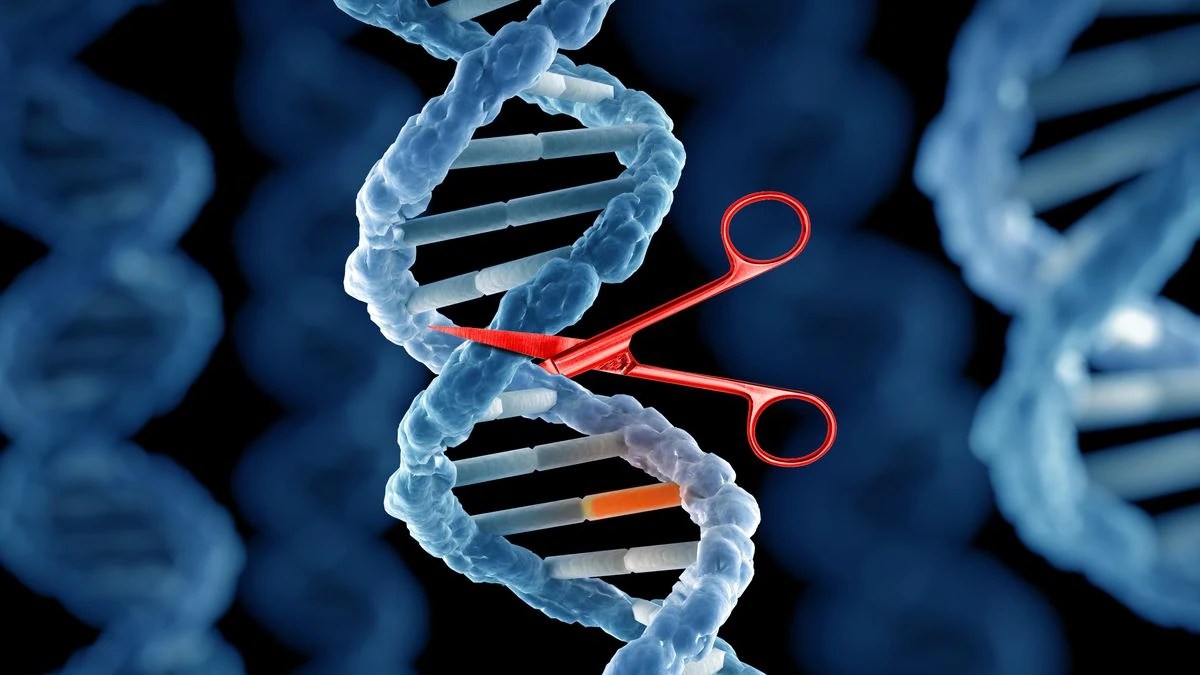
This is where gene technologies can help. They can help avoiding the expression of unfavorable genes, or allow some genes to express themselves against adverse conditions. It is what gene editing is about. There are many areas of work. Just think at the possibility of having plants that are more rustic to face difficult growing conditions such has drought or heat. It can be the possibility of having genes that offer resistance to diseases. This not just about financial aspects. It is also about animal welfare, as sick animals suffer. It is also about the environment as all yield losses from crops or sick animals are an inefficient use of resources.

For instance, the recent development of the PRRS-resistant pig (Porcine Reproductive and Respiratory Syndrome), a disease that has serious economic and animal welfare impact is interesting. The gene-edited pig production has now been authorized by the US FDA. Of course, such a novelty meets resistance and criticism. That is the way change goes. Considering the risk of diseases, as I was mentioning them in a previous post, any progress that can be made to prevent infection by plants, and humans deserves to be considered. The same thing is true for new medications and new vaccines. The reality is that new ways of protecting us will be needed in the future. Gene editing is a tool that we will need, and not just in agriculture. Actually, many of future applications will have a use in human medicine just as much. We must not give scientists a blank cheque about innovation, but we must also be open minded to new ways. Of course, this leads to discussions and all aspects must be considered, and that includes ethics as well.

An example of such discussions, with an unexpected outcome, is the use of gene editing of hens that produce only females. From a technical point of view, this eliminates the issue of chick sexing, as there is no male chick. Male chicks have been an issue in egg production as they would not be useful. The industry used to cull the males but that was cause for ethical issues. So, back to the gene-edited hens. The fact that they produce only females means that, statistically, to produce the same number of females, only half of the mothers are required. This means less feed needed, therefore freeing arable land, therefore less environmental impact. Of course, the ethics of gene technology would be questioned. Surprisingly, the company producing these hens got support from the Compassion in World Farming, which is no small feat. The CIWF is a vocal critic of intensive animal husbandry. The fact that they see an advantage in this application of gene editing is rather interesting and shows that pragmatism is needed if we want to improve for the future.

Bonus number 4: farmers’ ingenuity
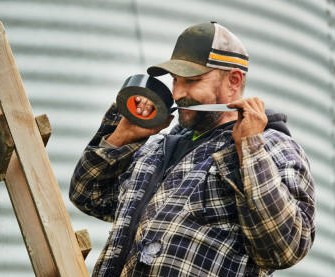
If I can think of a profession of people having resilience, adaptability and resourceful beyond the imaginable, I immediately think of farmers. Their work is not just about producing; it is mostly about solving and fixing unexpected problems. Just take a look at what they can do with a roll of duct tape and you know farmers are not your average person. You also know that they innovate with a cost-effective mindset. They perform miracles every day. Here is a device installed by Rose Acre Farms, the second largest egg producer, to deter migrating bird to get close to the hen houses and thus to reduce the risk of contamination with avian flu.
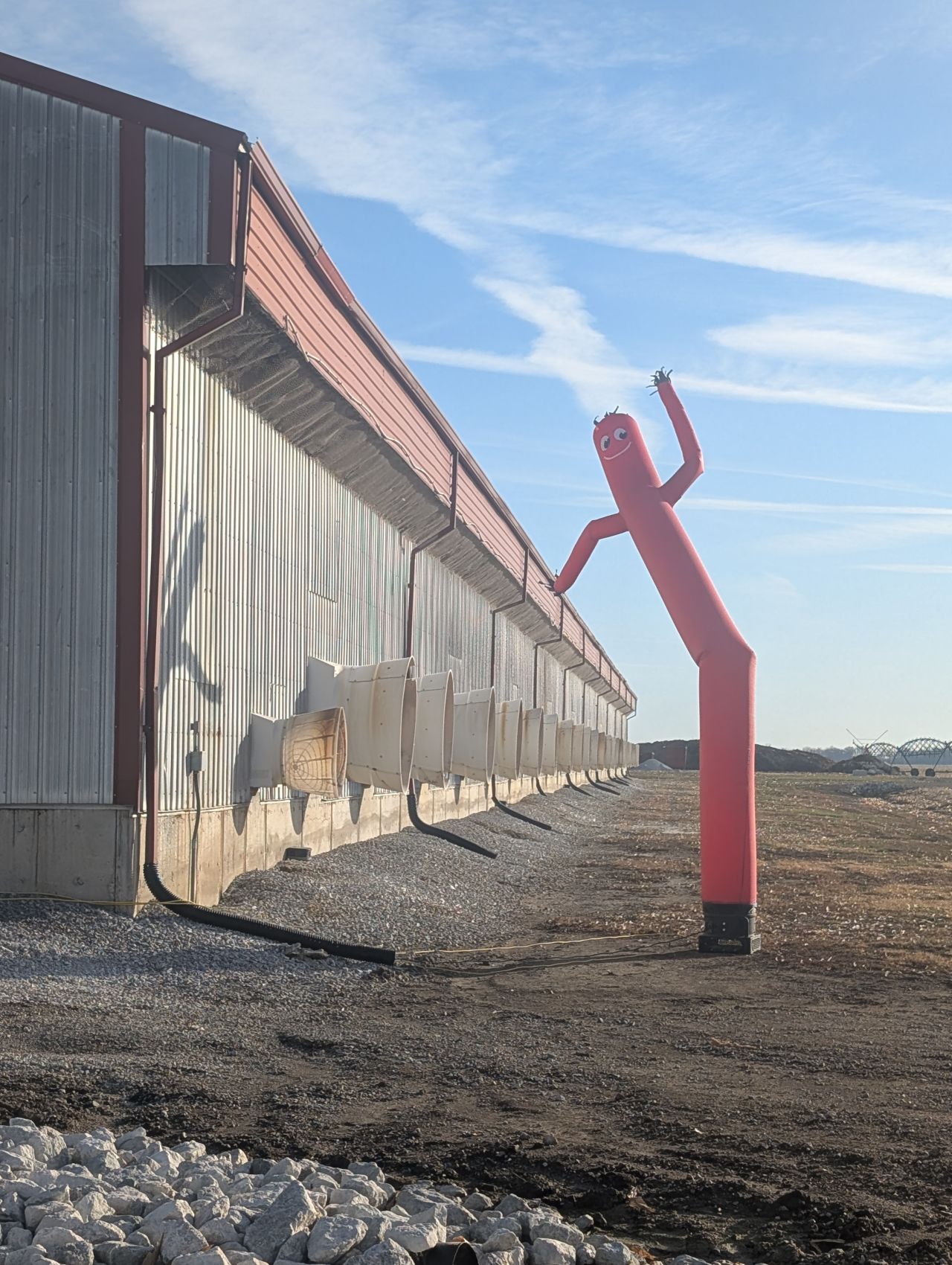
In my previous post in which I discussed the risks of diseases and that AI could be a great help, this shows how ingenuous farmers can be and that innovation is not only about high-tech. I hope for them that this simple device will work. Unfortunately. most consumers do not even realize that and what it takes to produce food. Farmers need more recognition. Even if they sometimes take their time to adopt new methods and technologies, they are definitely always looking at improving their operations and meet the demands from the public and from governments with a dedication that you will not find in many other professions. I regularly lament that farmers are not involved enough in the proper development of innovations. I also lament the fact that farmers are rarely involved and invited in conferences about the future of food and farming. Their practical experience, their knowledge of what works and what does not, of what is possible and what is not are essential contributions for a prosperous future. The world cannot miss their ingenuity.

Next week’s article: The Future of Family Farms: Navigating Generational Changes

Copyright 2025 – Christophe Pelletier – The Food Futurist – The Happy Future Group Consulting Ltd.
250. Three overlooked consequences of climate change we need to address

Listen here to a Chrome AI-generated podcast type playback of the author’s article

The conversation about climate change focuses too much on its causes and not on what we must to do in the future. At least, that is how I feel about it. The whole science behind why climate change is happening is important. I will not argue about that, but tons of CO2 in the atmosphere or 1.5°C vs. 2°C remain abstract concepts in the minds of most people. It is necessary to translate the change into concrete actions. Of course, a lot of that is already happening but some very basic consequences need to be addressed with more force than has been the case so far. In this article, I will review three of these consequences that I consider as the most pressing, yet too often overlooked, consequences:

Heat stress

Warming means higher temperature, but looking at average numbers, such as for instance 1.5°C does not indicate the real problem. Certainly, the average temperature matters from a planetary point of view but we all experience temperature swings that are as unpredictable as severe. The swings are definitely not in the range of 1 or 2°C.

For instance, plants may have a great start in the spring and then comes frost that can destroy an entire harvest in orchards within a few hours, or a sudden heat wave fries crops and in particular vegetables. Heat affects farm animals, too. I can remember when I lived and worked in poultry processing in The Netherlands, we always had some episode in the summer of higher temperatures and high humidity that seriously affected the welfare of chickens. Our company always had to plan for lighter average weights in the summer as the chickens would not eat as much and would not grow much, either. The introduction of misting installations definitely alleviated some of the problem. At least, we did not have to deal with overnight deaths by heat suffocation of entire flocks of birds, but we certainly had less tonnage because of the heat. Heat had a cost. Less tonnage meant less revenue but also higher costs as overhead costs per kg would be same regardless of the number of birds.

Research on the cost of heat stress on dairy cows has determined that in 2020, heat had affected milk production by an estimated 50 million tons at a cost of US$ 13 billion, according to IFCN (International Farm Comparison Network). This tonnage represents roughly 5% of the 2024/25 world milk production. Their estimate for 2050 is of a production loss of 90 million tons (9% of today’s world production) for a value of US$ 90 billion.

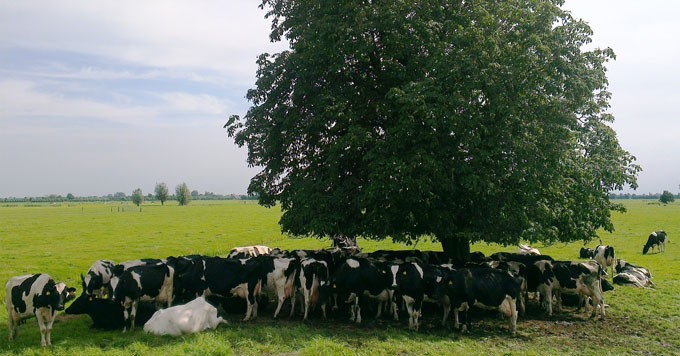
There is only one species of warm-blooded animals that I can think of that likes to roast in the sun: people. Other species are much smarter and tell us what we will have to do. On a hot sunny day, animals look for shade.

Shade is going to be a very hot (could not help the intended pun here) topic for the future. Actually, it is already getting more and more on everyone’s mind. Many studies have shown that shade reduces the temperature at ground level by substantial numbers. In paved environments, such as cities, the temperature difference varies in the range of 10 to 15°C. On pastures, the numbers seem to be less, but still in a range of at least 5-10°C.

There is already research carried out on the benefit of shade and how to bring more shades to animals. For instance, France’s INRAE (French Institute for Agricultural and Environment Research) is looking at strategies to reintroduce trees on pastures and determine which tree species would be the most effective. Besides trees as a source of shade, there are already some combined cattle or sheep husbandry paired with solar production on grasslands, with some very positive effects. The farm produces cleaner energy and the shade not only improves the animals’ welfare but it also protects the grass from the heat and help providing the animals with feed. In a way, this is a win-win-win. Heat stress is not just affecting feed quantity but its quality as well. There are also farms that produce vegetables under solar panels for the same reason: the panels protect the plants from the hot rays of the sun. Shade is going to b part of the food landscape. Early, I mentioned orchards. I expect many regions, like the one where I live to use shade screens as a standard production method for fruit production.

For the future, heat stress will lead us to rethink production locations, genetics of plants and animals, the type of housing for animals (and for people, too), feeding systems and feeding programs for animals, water management systems and water supply and conservation strategies.

Heat stress and shade are also going to become part of urban landscape. I recently was in Valencia, Spain. Some parts of the cities had some drapes spread on poles to provide shade and they also had misters to cool down the people sitting on some city squares. Those systems were not all that effective if you ask me. The best place was to be in the old river bed, now turned into a park where the trees were offering the best cooling effect in town. Spain is used to heat but it does not make it less of a problem. The most pressing action will be needed in countries that used to be temperate and where cities -and countryside- are not prepared and not equipped to deal with the heat that is likely to hit in the not-so-distant future. Heat is not just about crops and farm animals. It is about people and their pets, too.

Water availability

It does sound corny to say, but it is true: water is life. With climate change, former “predictable” precipitation patterns are disappearing. It looks like there is either too much water falling at once or hardly any at all. Of course, this has an impact, especially when it happens in combination with temperature swings. Droughts have always affected harvest volumes of crops and pasture production. Beef is a good illustration of that about the last couple of years in North America. Although drought is not the only reason, its impact of forage availability has noticeably contributed to the reduction of beef herds, and supply does not meet demand as it used to. The result has been a major increase of the price of beef at consumer level. Here in Canada, the price in the supermarkets of prime cuts has about doubled in a year time, and the price of ground beef has increased by about 50%.

Climate change shows up on the grocery bills and it hurts many households. Beef is an example but consumers can see the impact of climate event on many products, not just meat but fruit and vegetables, too. As such, it is not new. In the course of my life, I have seen unusual weather patterns affect the prices of food, but it just seems that the frequency and the impact is getting higher. We will see, but we need to manage climate events better. Artificial intelligence will likely be a big part of that solution.

There is what we can do about production systems and with the kind of technologies we will have in our toolbox, but there is also what we cannot influence. For this very reason, it is clear that water availability is going to redraw the world food map. Certain productions will disappear from some regions and reappear somewhere else. For example, the Bordeaux wine region in France seem to be at risk of not being able to produce the great wines it used to produce. On the other hand, it seems that England might have some ideal climatic conditions to produce excellent wines. Another example can be the Midwest region of the US which is a major crop producer, corn and soybeans in particular. The region depends heavily on the Ogallala aquifer for irrigation, but this aquifer gets depleted much faster that it can replenish. Water management has become a hot topic and a number of farmers, in particular in the State of Kansas, have switched to sorghum as an alternative to corn for animal feed, as it requires less water than corn.

The politics of water are another aspect of water availability that we rarely hear. Yet, we should pay attention. For instance, in central western France, there are hefty -and violent- conflicts about water management. Farmers wanted to have a number of water basins build so that they could keep producing their regular crops by using that water for irrigation. The basins would be filed by the river system in the winter. This project has faced strong opposition and many clashes have taken place between demonstrators and the police. Another example of water conflict is the dam that Ethiopia is building on the Nile River, which is causing great concern and reaction from Egypt and Sudan that see a risk for their water supply abilities for the future. And let’s not forget that the populations of these three countries are expected to increase strongly in the coming decades. Another example is what happened between India and Pakistan during the 2025 conflict in the Kashmir region. India threatened to stop its rivers from flowing into Pakistan. As you can see, as it becomes scarce, competition for water will become fierce. Water is going to be a major strategic and geopolitical resource with the potential to create major crises and possibly wars.

Cities also need to have sensible water supply and water use plans in place. A few years ago, Cape Town had dire water supply issues. Mexico City also got some worries. Considering the regions where population is expected to grow the fastest, water is going to be a major cause for concern. The number of megacities that are forecast to be built in Asia and Africa should keep many people awake at night. New cities with multimillion inhabitants are going to have to rely -and to depend- on mostly local water sources and the question is whether they will be able to succeed. This will require major investment and astute planning for the future.

Diseases

As climate changes, so do the local environmental conditions for living organisms. Some regions that were inhospitable for some species might become better suited in the future and we can expect to see a change of ecosystems as a consequence. This can happen for all sorts of species, large or small to very small. I will give here a few examples to show the variety and the complexity of the impact of climate change on the possible spread of diseases.

In cattle, two different problems have appeared recently. One is in France. A number of cow herds have been infected with the lumpy skin disease, which is a disease propagated by flies and mosquitoes. It is a disease that was until now limited to Africa. Now, it is in the French Alps near Switzerland and other cases have been detected in the Pyrenees, not far from the French-Spanish border. There is no cure available and the infected herds are being culled. Just imagine if the disease spreads further what the consequences can be for perhaps all of Europe. The second example with cattle is in Mexico and the US. Cases of Mexican cows infected with the New World screwworm have been identified and immediately, the US closed its borders to Mexican beef. Although there might be some politico-commercial aspects at play, fact is that the screwworm is an ugly disease vector. It basically eats the flesh of the cattle, but it could do the same to people. Texas got rid of that pest in the past with some difficulties and they do not want to see it reappearing, for good reasons.

I just mentioned vectors, and vectors we need to closely monitor. Avian flu, also known as HPAI or H5N1, is very contagious and is carried by wild birds. Monitoring of migrating birds and their routes is essential to identify where the disease could be present and take proper action to protect avian farms. Climate affects the migration routes and old patterns are probably already obsolete. There are already some systems in place, but I believe that more is going to be needed. Here too, artificial intelligence might be a big part of the solution. That will require sensors in bird houses, on farms, in the vicinity of farms and everywhere possible on the likely migration routes. It will need to be a 24/7 alert system. The problem -and the solutions- are similar when it comes to the increase of the population of wild boars in many parts of the world. Full monitoring will be essential in the fight against ASF (African Swine Fever). It also will be essential to understand the ecology of diseases if we want to stay ahead of the game.

In the world of small and very small, just look at the spread of tiger mosquitoes in Europe. A large part of France has been colonized and it will not stop there. Tiger mosquitoes carry “traditionally” tropical diseases such as dengue fever, yellow fever, chikungunya or even zika. Climate will contribute to the spread of many new diseases, be they plant, animal or human diseases.

The name of the game for the future of health is PREVENTION, and that needs to be imprinted in everyone’s mind in big bold capital letters. Protecting the immune system of our plants and animals as well as ours will be on top of the priority list. Let’s hope that politics will not stand in the way. We need to protect all we can. Once that is done, we will have time to discuss if we like it or not. It will be just like with the oxygen mask in planes. Put it on yourself first and then help others. We will have to develop new vaccines and new medication. For agricultural purposes, the use of gene technology will also help make some of our crops and animals resistant to diseases. Monitoring, which I mentioned earlier will also be key to protect ourselves and our food production. A major component of prevention is anticipation. We have the technologies to be able to monitor, to run scenarios and to develop solutions. We must use them to their full potential. We need cures, because massive culling or production losses will not be an option with two billion more people on Earth in the coming 25 years. Remember, 25 years is only one generation.

Copyright 2025 – Christophe Pelletier – The Food Futurist – The Happy Future Group Consulting Ltd.

247. The Key to Successful Tech in Agriculture: Meet Farmers’ Needs

Listen here to a Chrome AI-generated podcast type playback of the author’s article

A recurrent complaint I hear in the agricultural sector is how slow and difficult it seems to have farmers embrace new technologies. Most of the time, it sounds more like a reproach than anything else, as if there was something wrong with farmers to be so reluctant. I do not agree with that thinking. To me, the main reason why some technologies have a hard time gaining the support of farmers is simply because they do not meet their needs.

I was recently viewing an old video from Steve Jobs. Basically, what he said was that if you want people to adopt a new product, you must first look at the customer’s experience and then work backwards to build the right product for them. He was also lamenting that too often, tech companies think because they have a product that is a technological beauty, the world should just adopt it. Of course it does not work this way, and certainly not in the agriculture sector. I believe a lot of technology developers should find inspiration in Steve Jobs’s statement.

In my work, I get contacted from time to time by venture capital firms who would like me to invest. Usually, with three to five questions, I know whether it is an interesting proposal. Sometimes, I already know after my first question. So far, none of the companies offered to me have survived. Some lasted a couple of years, but all failed for the exact same reasons as I will describe further in this article. This is the reason why I offer my “Second Opinion” in my services.

I recently had the opportunity (or the misfortune I should say) to attend a rather painful presentation from a venture capital operative, supposedly expert in agtech and in artificial intelligence of lately, as many claim to be. Of course, he was to complain about how slow the agriculture sector is to adopt new technologies with the same kind of criticism about farmers as I have mentioned above. The irony here was that he did a terrible job at demonstrating any added value. If this is the way the tech sector tries to sell itself to farmers, it should be no surprise that adoption will be slow.

Farmers do adopt new technologies. They do. A lot. Anyone who has actively worked in the agricultural sector with farmers and visited farms over the past decades will tell you how many things have changed on farms. Just think of GPS, satellite imagery, sensors, drones, computer vision, robots, unmanned vehicles and so on.The transformation has been amazing. They will tell you how many new tools and new technologies they have adopted and integrated in their daily work. Farmers adopt novelties, but not because it is trendy or fashionable. No, they adopt the tools that actually add value to them. Farmers are quite keen on technology. They are just not keen on snake oil. They are busy people. They have a gazillion things to take care of and their time is precious, just as well as their money. Unlike many people gravitating around agriculture, they do not have the luxury to waste time with something that is not ready.

Farmers are the perfect illustration of what Steve Jobs said. If you want farmers to adopt a product or a technology, you’d better make sure it answers an actual need and that what you offer is foolproof. Farming is a business and as such a tool must make the business better. Better can mean faster, it can mean physically easier or it can mean making better decisions and many other things depending of what the tool is about. In the end better is about having better technical and financial results without additional headaches on top of those that Nature and markets send on a regular basis. To adopt a new tool, farmers want it to save them time, otherwise what is the point? They want it to be cost-effective, otherwise what would be the point of replacing an existing trusted and reliable tool. And thirdly, farmers want peace of mind. They do not want to end up spending time to figure out how the tool works or to have to call customer support for troubleshooting all the time.

So yes, the customer experience comes first. And that is what I always insist on, and have done so since I started The Food Futurist. Innovation must be market-driven. I can imagine that in the early stages, the tech geeks need to build prototypes but then, and as soon as possible, they must team up with users to review what is useful and what is not and develop a product that meets exactly their needs. A great frustration of mine is that farmers are not involved enough in the early stages. As Steve Jobs said, the tech people build something exciting but too often try to push it. If it does not fit, there is only one result: slow adoption or just plain rejection.

There is a picture I like to show to describe what market-driven and results-oriented innovation is. It is one of these kids toys with shapes that have to pass through holes of various shapes. With innovation, it is the same game. If the farmer has a square problem, trying to push a triangular solution, even it is the most beautiful triangle ever, just does not work. Actually, it creates only frustration. If the farmer has a square problem, the solution must be square, too. That is the only way it will fit and that the farmer will adopt it.

I also see an important role for the agriculture sector: they have to say out loud what kind of problems they have and what solutions they need. If it is square, say you want a square solution. If it is star-shaped, say you want a star-shaped solution. That way, the tech geeks, who really love to build things, will also know early enough on what they must work. It will save time and money. It will strongly increase the chances of adoption, which is a win-win for both farmers and tech companies, and it will help improve agriculture faster and better.

Copyright 2025 – Christophe Pelletier – The Food Futurist – The Happy Future Group Consulting Ltd.

246. How AI Will Transform the Role of Advisors in the Future

Listen here to a Chrome AI-generated podcast type playback of the author’s article

Over the past year, artificial intelligence has made tremendous progress. I remember sharing my frustrations about a year ago, but today, not only am I a regular user of AI, but I have to admit that the quality of the work it does is top notch.

So, how do I see AI impacting the work of advisors in the future? Well, I can see a number of areas where AI is going to be a game changer with profound consequences on the work of advisors, consultants or extension services.

First of all, why should clients pay advisors and consultants when they can have the same quality delivered by AI for a fraction of the cost and a fraction of the time? I often read posts and articles warning you that if you do not use AI, you will be replaced by people who do. That is true, but in reality, the shift goes beyond the competitors. If you do not use AI, you certainly will be at a disadvantage, but that is not the worst that can happen. The true concern is not so much competitors as the clients using AI for tasks that they used to outsource to you. If advisors use AI for some parts of their assignments, clients can do it just as well. Let’s face it, learning how to prompt is not that difficult. If an advisor can do it, be assured that so can the client. The client becomes the competitor for some tasks. It is not even about competition; it is about a market that will not longer exist, simply because it has no longer any reason to exist.

What will be the activities that advisors and consultants used to provide that will soon be obsolete? Everything that has to do with compiling information, conceptualization, knowledge and data will be the first to go. The bulk of reports, surveys and research will shift to AI. I used to see many similar reports that were passed to different clients and sold at retail price, thanks to word processing. This is going to be history very soon.

– Competence –

So, if advisors are not needed anymore to do their “traditional” work, what will be left for them to do? This is where the views about AI of a couple of years ago will change dramatically. I remember by then, a report from Harvard University showing that highly skilled consultants were showing less improvement by using AI than the less talented ones. That sounded like consultants would use AI and, miracle, even the mediocre ones could fool the rest and seem like high performers. I never bought that sort of thinking. To me, that already sounded like AI had the potential to simply replace them. Period. And that is what will happen. Using AI to try to look good is a weak strategy. Everyone can see that everyday on LinkedIn. There, the number of posts obviously generated with AI published everyday is amazing. But since it is AI, the natural question is to wonder whether the person publishing the post truly has the competences they claim to have, or is AI actually the one with the competences? When you start wondering about that, you are already questioning the real level of expertise of that person. This is where the top quality of the advisor of the future appears: competence! In the future, only talented advisors wil survive. Keep aside posts that have not been proofread while showing obvious errors, which is a reputation killer right away, it is interesting to look at comments. Competence (or lack hereof) appears right there. Can (or does) the person answer the questions asked or reply intelligently to comments or not? Then, you have your answer. Personally, I like to comment on posts, sometimes because I want to know more, and sometimes because I like to challenge a bit.

– Adding value –

Competence is one thing, but the advisor of the future will need to show more than just that. The key to survive as an advisor in a future with AI, is going to be able to deliver added value, and to demonstrate what it is and how much it is, in a tangible manner. The future role of advisors will not be anymore knowledge transfer (although that will always be an asset), but the core of the advice of the future will be in the know-how.

Farewell theoretical concepts alone! Welcome practical ability for execution!

This has been my philosophy since Day 1, so I like this idea. I would even go as far as to see the remuneration of advisors shift from flat fees for a project to a two-part system. A base fee, and a variable “bonus” linked to the actual performance improvement that the advisor will generate.

Adding value requires to understand the business of the client and especially what the specific needs for improvement are. It is truly a market-driven business-to-business approach. Successful advisors will be those who can “embed” themselves in the client’s operations, understand what works and what does not, and understand what should be happening but does not. AI is not just about technology. It is about having a tool to better help clients. It is a tool to support the human side of a business. Of course, some advisors are actually in that position. They are already doing quite well, and will keep doing so, as long as they do what is needed to stay sharp.

Copyright 2025 – Christophe Pelletier – The Food Futurist – The Happy Future

I am a techno-realist who focuses on the essential stuff

Listen here to a Chrome AI-generated podcast type playback of the original article

Recently, I accidentally came across someone’s self-description as a techno-utopian. Although it sounds cute, this concept does not really appeal to me. It lacks something I always look for in tech and what my clients always appraciate in my work: the essential stuff. Nonetheless, I felt compelled to look up the definition of utopia in the dictionary.

Utopia: an imagined place or state of things in which everything is perfect.

Then, right away it put things into place. “Imagined” is fine with me. Probably because as anyone who knows me would tell you that I have no shortage of imagination, and often just a little too much of it. The way I look at it, there cannot be enough of it. After all, imagination would not be imagination if we gave it boundaries and limits. The very core of imagination is that we can think of anything. In my work, I have been asked many times to brainstorm about how to use something new and what applications, even silly ones, it can offer.

The second part of the definition is a bit more of a problem. “Perfect” can simply not be defined. Nobody knows what it means. Being a perfectionist comes down to chase an illusion. In the meantime, some things need to actually happen. I understand and love excellence and the drive to always improve. I don’t care all that much for perfect. Clearly, I am not and never will be a utopian of any sort. I tried to think and find anything utopian that ever became reality… and I could not find anything. On the other hand, dystopia… Utopian thinking sounds great. Who wouldn’t want a perfect world, whatever that might mean? What’s not to like about utopian thinking? It sounds great, it doesn’t challenge anyone or hurt their feelings. It is totally risk-free and makes you look really nice, but more in a Miss Universe pageant sort of way, after a while. At some point, it’s time to come down teh cloud and start to actually solve real problems. When it comes to the future of food and agriculture, we better focus on adapting and improving, and certainly technology has an important role to play, but there is a time to dream and there is a time to achieve actual progress. During my professional life, I have heard time and time over about the many silver bullets that were going to fix all the problems. After almost 40 years of working in the food and agriculture sector, I am still waiting for any of such bullets. Actually, I still hear about the same problems. Yet, there have been many changes, many innovations and many ideas. Lots of things have happened and yet, I believe that we all can agree that despite all of that, our world is in more dire situation today than it was 40 years ago. If technology is the panacea, why don’t we succeed to solve problems, might you ask?

A large part of the answer lies in the fact that solutions are not solely of a technical or technological nature. That’s the mistake number 1 made by the tech people, and the techno-utopians. There is no shortage of technical and technological solutions, and there have never been. Actually, we have had all the necessary technologies available to fix our problems for quite some time. Of course, there is always room for better ones. We always can and must improve, as I mentioned earlier. So, what’s stopping us?

Well, it’s not technology or innovation. The dreamers and the visionaries have done quite well. No, what is stopping us is something I have discovered early in my professional life. Here is a quick flashback. When I started my career, if there was a hard-nosed all-rational science and tech believer and aficionado, that would have been me. I love the hard and cold facts of exactness. Subjective and more emotional stuff would not even be on my radar screen. It’s simply was not factual. Then, my career moved in the direction of sales and management. Then, I discovered that actually nothing happens unless it aligns with the subjective and emotional stuff. Facts, science and technology don’t make it if there don’t align with beliefs, values and the personal interests (usually those of a financial nature) of the users. Ha! There is the main hurdle!

The thing is, tech is more comfortable that jobs require dealing with people. Things don’t disagree. they don’t show anger and don’t challenge you. In tech, you’re in control. It feels rather safe. When dealing with people, you have to deal with differences of opinions, pushback, personal issues, negative emotions, even aggression and fights. It’s a lot more challenging and personal. Most people prefer the tech bubble to the real world. I understand why.

The limitation to solving problems is not technological. It actually plays at two main levels. The first one is the systemic level. If we don’t change the systems, actually meaning changing the way we think, technology is not going to break through. The second level is money, pure and simple. The numbers need to add up to succeed. As I said, technologically speaking we have all the tools we need. The problem is that often, it is not economically viable. It is not viable for several reasons. One is that it is indeed not economical. Another reason is that the math does not include externalities (the long-term costs and/or benefits) and the math is skewed, but nonetheless, the numbers do not look attractive on the short-term. Another reason is that the perceived value of the solution does not match its price tag.

Here is where my self-description in the title of this post comes to life. I focus on the essential stuff, not just the “beauty” of technologies and innovations. In 2015, I wrote a post on this blog about why technology is much more that just the technical part. My second book, We Will Reap What We Sow, focuses specifically on human nature and how it can influence how our future will look like. I always take the human dimension in my analysis, simply because if people don’t buy the story, it does not happen. They don’t adopt the technology, don’t see the point of changing the ways of the present, and the system stays the same in its main lines. Same thing with the money. If there is no financial advantage, they do not adopt the new technology. This is particularly important when it comes to business-to-business. I like to categorize technologies into two groups: tools and gadgets. In a business-to-business environment, tech has to be a tool, meaning the tool user must have an advantage in using the technology. It either saves time or saves money, and ideally both. If not, even the most wonderful utopian tool in the world will end in the “museum of great ideas that never succeeded”. Next to the tools, there are the gadgets. Those are different. It is not as much about savings as it is about emotional aspects. Money is less important. From what I just described, to me agtech are tools. Foodtech could be tools, but most are really gadgets, especially when it comes to consumer products. Many novel foods do not come close to have the same nutritional qualities as the existing category of foods that they aim to replace. And then, they are surprised that the hype is short-lived, because there is a little something that tech people overlook: consumers are not completely stupid and the large majority can tell when they see nonsense.

I guess you might tell me that I am wrong when I say that tech people neglect the financial side. Well, yes and no. There are two groups involved in tech.

One group consists of let’s say the tech geeks who want to build a business. They are totally focused on the technical aspects. They neglect the human side of the business and overlook the need to get to profitability. Often, they have about zero understanding of business management and of marketing. They assume that because they develop something that looks great in their eyes, it should succeed. Unfortunately, not everyone looks at things through the same lens. Further, they tend to not think beyond their little bubble and have no idea of what possible problems they might create, but that’s the tech modus operandi: “Promise anything to get funding, think of consequences later”.

The other group consists of the investors. Those are really focused on the money. Their understanding of technology varies greatly, which is why they sometimes invest in total dogs. The weakness of the investing community is that they love money so much, they expect high and fast return. Food and especially agriculture do not show that kind of dynamics. Usually, it is a long slow process and the returns are often modest. Of course, there are sometimes lucrative niches but they are rare and once the niche is full, the potential for further growth is rather limited, and they get stuck. I guess the investing community must have come to that realization, as the level of investments in agtech and foodtech is dropping, as showed in these graphs I found on Agfunder. They speak for themselves. And it is not just agtech and food tech. Wall Street has started ditching ESG investments, too. Obviously, utopians don’t generate value, and the real world eventually focuses on the essential stuff.

Of course, raising interest rates play a role, as suddenly free money is no longer available.

Yes, utopia is still a long way away, but that is the very nature of utopia. Cute fairy tales populated with unicorns (as you probably know, a term used for successful start-ups) are nice but they are just that: fairy tales. Saying the you believe that technology is going to solve all the problems does not necessarily make it so. Beliefs and reality are two very different things. To me, the techno-utopian discourse sounds too much like what sect members very diligently like to tell around without exerting hardly any critical thinking. Realistic aspects seem to be optional in this approach. Many see themselves as evangelists (see the connection with pseudo-religion now?). It is so lame, it is actually ineffective, except for the select few (“the sect leaders”) who fill their bank accounts by using the gullible and the naive who relay their message. But that’s what the influencer concept is all about, and it works. In a way, I see techno-utopians as followers, and techno-realists as precursors. In psychology, it is known that two basic needs of human beings are attachment and authenticity, and these two needs tend to go against each other. The balance between the two is difficult to find and failing to do so has psychological consequences. Followers give the preference to attachment . Precursors choose for authenticity and attachment comes from the authentic self. I can find myself in this description.

Understand me well, I like making money. In my professional life, I have turned around business operations in six countries, so you can trust me for being financially quite sharp. I also know that it did not happen by telly cute fairy tales or wishful thinking. It happened with stark business realism.

The techno-realist in me is totally insensitive to fairy tales and hypes of all sorts. I guess I still have that hard-facts no-nonsense part of me inside, but paired with my sense for human nature and financial rigor, I used both my cerebral hemispheres, not just half. I can spot what has potential to work and what doesn’t. And I have in the past. Very quickly, I will list the most significant cases of where I did not share the utopian naivety here, and for which history proved me right.

Vertical farming. I always saw more potential for low-tech vertical farming. I have never been impressed with tech vertical farming for a few simple reasons. The fixed costs are so high, it can work only for specific niches with high-end restaurants for fancy greens. Problem is only a small share of consumers eat in high-end restaurants, and that the world can not be fed on arugula and basil only. There have been enough bankruptcies in the sector for me to rest my case.

Blockchain. I have never seen blockchain as taking over the way the tech world was trying to convince us. Frankly, the benefits were rather marginal, all the more so that many businesses still don’t have a clear idea of what traceability and transparency really mean for consumers, despite what they think. But the development of artificial intelligence could revert the situation by providing a much more dynamic and practical tool. AI can definitely boost the development of very useful super-ledgers.

Tech plant-based fake meat imitations. To me, everything has been wrong with that stuff since day 1, and probably even before. OK, I’ll admit the Silicon Valley billionaires have done excellent PR to create the hype, but as the saying goes “you can fool some of the people some of the time, but you cannot fool all the people all the time”, and as I said, consumers are not completely stupid. That has been one of the main mistakes, but I cannot think of anything that those companies may have done right. It has been such a demonstration of incompetence in all areas, I won’t comment any further. Substitutes for meat have potential, but the ones that succeed are mostly low-tech local businesses run by humble people, and that makes a world of difference.

Lab meat. Although I have always considered it can have some potential for certain applications, I still don’t think it will be near the kind of volumes they think and I have always doubted their timelines. When I was writing my first book, Future Harvests, in 2009, I had a conversation with some of the Dutch pioneers. By then, I was told that lab burgers would hit the store shelves in five years. We are now 15 years later and not any noticeable volume of lab burger in sight in the stores. Recently, I heard the claim that it will be in the stores in 10 years from now. I’ll be waiting to see. Further, still the same story about the cost reduction coming soon. It is always “soon”. “Soon” is a euphemism for “no commitment on when” and for buying time and keeping on living on the investors’ money. And time passes by. I also love the term “parity”. What does it even mean? Parity with which product? If they want to price it at parity with meat, just have them do so. Change the price and see if it sells. Further, stories like Upside Foods and their chicken lab meat just contribute to undermine any credibility that is left. No wonder, the money does not flow all that much anymore in that category.

Although still in development, precision fermentation is another sector that creates some buzz. It is the current flavor of the month, taking over from plant-based and lab meat in the spotlight, as interest has faded in these two catgories. “Precision” sounds good, doesn’t it? Actually, the term is PR, something the lab/cell/cultured meat still has not been able to find, yet. As such, precision fermentation is not even particularly new. I find people in that sector rather frustrating. As everybody else who promotes alternative protein, they are obsessed with the claim to replace animal farming, and farming altogether. For starters, animal products are not just protein, they are so much more. Yet, even the animal farming sector prefers to reduce itself to protein, as they are terrified at the idea of having t talk about fat, while with the right choice of feed ingredients they could provide top notch essential fatty acids profiles in their products. The foodtech sector doesn’t even know what the production volumes of dairy, meats and eggs are. They have no clue of how much production capacity would be required to replace animal farming and how much it would cost to build. If they did, the fairy tales would collapse in no time. Considering the level of funding they already need for rather minor volumes, they are in for a surprise. Other source of frustration for me is that I never get straight answer to simple questions, such as “are you profitable?”, “what is your cost compared with the animal product you claim to replace” how much can you produce per year with your current production unit?” Sorry but “several thousands of tonnes” is not an answer. Is it 3,000 tons or is it 30,000 tons? I don’t know. Apparently, neither do they. Perhaps, I have not met the right people. About the claim tech proteins require hardly any land, they finally very reluctantly admit that to feed the microorganisms, they need sugar and lots of it, and just as reluctantly they finally admit that it is not all that sustainable. Yep, that sugar has to come from intensive specialized agriculture. ironical, isn’t it? Anyway, I’ll give them the benefit of the doubt, but it does not sound all that utopian after all. One problem they will face is the fact that they produce only molecules. For liquid products such as milk or eggs, the challenge is easier. There is no particular need to texture the protein. Nonetheless, albumin is not egg. You have to add the yoke. Using an old cooking test with a New York City fancy 3-star Michelin restaurant as a reference is not the best way to appeal to the overwhelming majority of the population who can’t afford to go in such a restaurant. Limiting themselves to albumin and telling there is cholesterol in the yoke as a reason why people should eat only egg white is not going to work with consumers. Try to live without any cholesterol at all and then let me know how that worked out! Once again, consumers are not stupid and they know if the novelty is comparable with the original thing or not. Same thing with milk proteins (casein, beta-lactoglobulin and lactoferrin). They are not milk. Milk contains and provides many other nutrients. Those who claim eggs and milk will be replaced are just following the same path as the plant-based meat imitations. That said, I see a lot more potential for these molecules as ingredients. Nothing new here. It has already been happening in dairy and with egg products for quite some time. There is also good potential, from a profitability point of view, in the sectors of health and wellness. Those are more niche markets but with good volumes and good prices. But trying to go after low price commodities like eggs in the shell and generic milk and cheese, will prove much more challenging. There is probably also some serious potential as a source of protein for animal feed, especially with an eye on essential amino acids profiles. Also, I see some possibilities in the fish feed sector. That’s the irony of protein alternatives. They have more chances of success in the animal feed sector to produce animal products, and that is fine. Every shift is useful.

Insects. That’s another development for which I saw much better prospects as animal feed ingredient than for human consumption, especially in Western countries. Anyway, I wrote about that on this blog years ago.

GMO herbicides and weed resistance. I was describing 15 years ago in Future Harvests, that mono-usage of the likes of Roundup Ready GMOs were going to end with massive issues of weed resistance. That’s exactly what happened. Anyone with basics in biology and understanding of how organisms mutate and adapt to their environment could have figured out that one. If you want to follow the matter, just check what the same groups of people who produced that mess are now working on in the area of biological herbicides with all the (should I say utopian) promises that goes with the need for funding. I don’t expect a smooth process.

So, as you can see a bit of a long story, why techno-utopian may sound nice but it works as long as it is talk. Although imagining new options and alternative is absolutely necessary, it is even more necessary to give it a serious reality check in the real world. That’s why I will never stop at imagining a future, I want to confront it with realism because that is where the action really is. Recently, I posted a video on my YouTube channel in which I answer questions about technology from viewers. The three questions are:

  • whether technology the solution for the future
  • which technologies will solve our problems
  • if I agree with the people who say that food tech is a distraction that does not solve any problem
 

Copyright 2024 – Christophe Pelletier – The Food Futurist – The Happy Future Group Consulting Ltd.
My take on artificial intelligence

Listen here to a Chrome AI-generated podcast type playback of the original article

Although the topic is on everyone’s mind lately, I have been presenting my views on artificial intelligence at conferences for more than a decade, long before it became trendy. I developed my logo with AI, and I use AI tools in my work as well, so it is not that huge of a deal to me. I was not really planning on writing a post about it because:


1) there are already so many of them around;


2) I have done presentations including the subject for many of my clients for many years and I even mentioned it in one of my poems about technologies from Down to Earth, my poetry book that I published in 2021;


3) it is just not me to jump in and follow the herd just for the sake of getting some attention.


It is just that I read a recent article, which triggered me to change my mind and get at the keyboard.


The article was about the result of research carried out by Harvard Business School, Reskilling in the Age of AI. The part that I found quite interesting was that according to this research, artificial intelligence was to reduce the gap between mediocre consultants and the “elite” consultants. The mediocre ones saw a performance boost of 43% thanks to AI, while the performance increase for the top consultants was much more modest. My spontaneous reaction was to conclude that businesses should either work only with top quality consultants or just eliminate the middleman when it is one of the mediocre ones and just make the switch to AI themselves, which is kind of what I hinted at in the one of my answers when I set up my FAQ section many years ago.


Another anecdote that shapes my views on AI and digitalization is what happens if there is a slight mistake in an online order. If the system does not recognize something in the information submitted, then we are dealing with artificial stubbornness, which is second to none, not even the “natural” one. I am sure many of you have experienced the frustration of dealing with an automatized package tracking system, and the agony of finding a real person who might be able to fix the problem.


Let’s face it, AI is still in its infancy and there is a whole world to open up in the future. As an illustration, I post in this article two slides taken from some of my presentations, which were not about AI as such, but in which I indicated in what respect the current automation in food and agriculture differs so much from the previous mechanization from the 20th century and earlier. The “old” automation was basically to replace human -and animal- labour and allow one person to perform physical tasks that had required much more individuals before. Mechanization was really all about adding “muscle” to the farmer and the worker, and sometimes to replace them, too.


The 21st century automation, although still adds muscle, is much more about adding a nervous system. Satellites, sensors of all sorts, management software, robotics, driverless vehicles and the many new technologies, when combined, actually mimic the nervous system as we know it. There are limbs, contact organs, senses and nerves that transport and transmit information that the brain (the intelligence centre) will process and send instructions back to the entire system to take action in the field, in the factory, in the logistics or in the store or restaurant. As the flow of data is essential for effective performance, it is clear that the synapses are of the utmost importance for this artificial nervous system. This why all the new technologies must be looked at from a system point of view and how they interact with one another. Developing technologies independently is a mistake, as it will miss many points.


So, we are building a nervous system, and since it is in its infancy, the way forward is really to treat it as an infant and follow the same process and the same steps that are required to develop a new human being and bring it up into a well-functioning grown-up. First, it is important to develop its cognitive abilities by exposing it to many experiences as possible, under serious supervision, of course. This will help the development of the right connections and the right amount in the nervous system. That is essential for AI to be able to function and deal with new and unknown situations and problems that need to be solved. When I was a student, one of my teachers had defined intelligence as the ability to cope and overcome situations never met before. I like that definition. As the “subject” develops further, it will need to learn more and more and, of course, the way to learn is to get a solid education, which means gathering knowledge, understanding how the knowledge connects together, and to be able to exercise critical thinking, therefore discerning what are true facts from what is raving nonsense. The learning process must be built on serious sources and there, too, serious supervision is needed. Just like with education, the system needs to be tested for progress and when difficulties arise, there must be proper monitoring and tutoring to help the “student” achieve success. The “subject” is still young and can still be subject to bad influences that might undermine its ability to identify the correct information and reject the nonsense, and thus perform properly. Really, developing AI looks a lot like raising a child all the way into adulthood.


The user also must take proper action to adapt and grow together with the nervous system. The artificial brain may be much faster at processing data that a human brain but humans using AI must be able to assess whether the outcome of the data processing makes sense or not. We must be able to spot if something in the functioning of the system is wrong, should that happen, in order to stop it from causing further errors and damage. If you use ChatGPT, to name a popular AI system, to write an essay and you do not proofread it for errors, both in content and form, then you expose yourself to possible unpleasant consequences. Automation and AI are to do work with us, not instead of us. Our roles will change, but just as it was not acceptable before, laziness (OK, let’s call it complacency) cannot be acceptable in the future, either.


Of course, like with any innovation, we must make a clear distinction between tool and gadget. So, what is the difference between the two? A tool performs a task, which has a clearly define objective and a clearly defined result. It must be effective and efficient. A gadget is just for fun and distraction. Tools evolve to get more useful. Gadgets do not,  and disappear when another gadget that is more entertaining comes along. 


Earlier, I was pinpointing the need to discern good sources of knowledge and information from nonsense. The saying “you are what you eat” is actually rather appropriate when it comes to AI in its current form. Indeed, the data AI is fed on will strongly influence what it produces.


In the food and agriculture production, supply and distribution chain, using AI should normally use reliable data, as the data should originate from a well-known and reliable source. Although the data can be quite voluminous, it is limited to these reliable sources, often the data of the producers themselves. Therefore, and as a tool, AI will be quite useful to tackle all the challenges that the sector is facing now and for the future. If the AI system that you use picks its data and information from an uncontrolled source, like the internet, you must realize that unless it has very solid safeguards to discriminate between truth and falsehoods, it will end up compiling the good, the bad and the ugly and thus further spread poison. Therefore, close scrutiny and monitoring is of the highest importance.


Further, here is a video on the subject that I posted on my YouTube Channel:


Copyright 2023 – Christophe Pelletier – The  Food Futurist – The Happy Future Group Consulting Ltd.

Tomorrow’s grocery shopping

Listen here to a Chrome AI-generated podcast type playback of the original article

Grocery shopping has undergone deep changes over the last 100 years and, like anything else, it will do the same in the future. The current Covid-19 pandemic is contributing to this evolution. Regardless of whether it will be over soon or not, one thing is sure: it has forced us to make adjustments and in a way, the virus has just accelerated changes that were already in the works. Here is how I see what to expect.

First of all, Covid-19 has changed how we live, and therefore how we shop. Online retail was growing but then it became almost a necessity for grocery stores to jump on board and engage in online sales. It was not always smooth. It took time for many outlets to organize taking orders, preparing them and get the orders ready for pick-up or for delivery. There was a lack of staff. The staff was not trained properly and there were all sorts of logistics issues to fix. Without getting in details, stores have been able to get a better presence online and ensured a better and smoother service over time, and rightly so, because many people have discovered the convenience of shopping at the time of their choice, not having to drive to the store, not having to be in the herd, which was already a pain in the neck before the pandemic, and not having to wait in line to check out. It saves them time and stress. These are the main reasons why I expect online grocery sales to stay and grow further. The offering and the navigability of online stores will have to improve as for now, it is still a tedious experience. The execution of orders is still a challenging area. More staff is needed and at the moment, this part of the business is the busiest and currently the largest employment opportunity at Wal-Mart. Amazon has also hired large numbers of new staff. Yes, it takes time and manpower to fill orders. It is nothing new. I used to do that part at my parents butcher’s shop. I used to prepare orders and deliver them to the customers who required it. Of course, my parents’ store was a relatively small operation and our phone and my brain (and my legs and arms, too) were all it took to get things done. The volume of business of modern grocery store is such that it could just be a family thing. My point is that preparing orders and executing them is nothing new and actually not all that complicated, and it is a pillar of good customer care.

Here is where I see more changes in the future. Having to manage so many new people to fill order –or to be personal shoppers to put it in fancier words- is a complex task. Such staff is usually paid little, not particularly motivated and always looking for better job opportunities, not to mention they can get sick or absent. Of course, the numbers and he economics will have to adapt, but I believe that in the future, order filling staff will be replaced by robots, connected to order software. The robots will manage orders, prepare and pack them. There are already robot waiters in some restaurants, so it is not so far-fetched. The robots also will be connected with the warehouse and the inventory management software. They will re-order for the warehouse, ensure first in first out, eliminate loss and waste and know exactly where to pick what and complete the entire job much more efficiently than humans and that on a 24/7 basis, and not require being unionized. I believe that corporations will like that.

Another area where I see potential for change is the sharing of online platforms. French retailer Carrefour offered that possibility to small retailers who had to close because of the Covid -19 lockdown in France. Thus, small stores did not have to venture and spend on developing their own online presence, which could have been challenging, not to mention stressful considering the circumstances. Further, cashing in fees for a online platform can be a business, too. What Carrefour offered is in fact the same as large online retailers like Amazon and Alibaba have done for independent sellers for years now. It is also not all that different from an EBay type of concept. Sharing of online platform will be a way of making the jump for small stores and from, there they will decide whether to keep using such platforms or build their own.

Order pick-up will certainly be a solution of choice for quite some time. Home delivery will have to evolve further, simply because it can be costly, except for outlets that can offer free deliveries for a minimum purchase amount, which is already the case. Deliveries might also be carried out by driverless vehicles in the future, such as Kroger has been testing for some time. Of course, there is always the possibility for restaurant delivery organizations to make the move to help retailers. After all, many of them want to be listed on the stock market and that will mean the necessity for them to keep growing always more and that will mean going beyond restaurants as per today. Here, the key will be to drop their fees. What these organizations charge for meal deliveries is rather brutal for pop-and mom restaurants and volume will have to take over fee based on bill percentage.

Retail will evolve further and there is no shortage of possibilities. Although everyone claims to collect data and know their customers, I think that it is more something in the realm of talk than actual effective execution. I have loyalty cards but I never get any shopping advice. My shopping news is either through the generic flyer that I find in my mail box like all other shoppers. And if I take a look online to see what is attractive, I have the exact same online flyer, as the paper one, with absolutely nothing specific or special about my own particular needs. I thought they would know what I buy and don’t buy and help me accordingly, but no, none of that ever happens and I do not have the feeling that is in the works. Hello, retailers! One the most daunting thing that shoppers go through is to make the bloody weekly shopping list. What do we need? What are we going to eat? What do they have on ad for us? Should we buy at retailer A or retailer B? No answer to any of that ever comes my way. If your retailer sends you personal shopping lists and tips, specific nutrition and menu tips you are lucky, and I am not. But I doubt it because I have never met anyone who did get of shopping tips. Retailers like Amazon do give some shopping tips and online ads also appear when I browse on Internet, but as far as I am concerned, they tend to miss the mark about every time. Perhaps, my being a frugal person makes me one of those difficult individuals to influence and to get to buy stuff but I really think that shopping tips should be a lot more on target than they are. I also believe that to improve this situation, it would be much better to have a voluntary and active participation from the shoppers themselves by having them giving more inputs about their needs and wants, although this of course enters the slippery area of online privacy, but you aill have to admit that it is a lot easier to serve customers well when they are in a position of telling you what they are exactly looking for. And in these times of “Internet of Things” why not combine store information with producer information and process it in a virtual product information and shopping advice system where people can make choices based on their values, their needs and all relevant information they need to make their decision, in a totally transparent manner? With such a system, why not even include a virtual tour of farms and packing facilities and show people where their food comes from and how it is produced and by whom? It could be accessible at home, could make use of VR helmet and could be consulted at a convenient time, not in the stressful rush of the in-store shopping with others breathing in their necks, especially if shoppers do not wish to go inside the store again.

Yet, as I show in this picture below, data servers and supermarket aisles look surprisingly similar. Every purchase and consumption is a transaction that goes way beyond money and product. It is a transaction between data – and therefore lifestyle choice, personal choices and values – versus the price shoppers pay. Why not include it in the shopping experience, then? I believe the answer is in the area of business thinking. In spite of the many claims, it is still a primarily production-driven, volume-driven cost-obsessed model, and not enough of a service-minded customer-oriented value-obsessed model. Of course, there is no reason why this would not change and anyway, the former model I mention is pushing for some positive innovations, such as cashierless stores where you can come in buy and leave without going through the tedious checkout lines or the even so much more fun do-it-yourself checkout where half the people I see seem helplessly stuck unable to figure out which button to press.

With what I just described, one could easily wonder why to have large supermarkets anymore. Why should the corporation spend all that money in prime –therefore expensive- locations, with fancy stores with light and all sorts of amenities, while in the future, most of the shopping might actually be just a warehouse order filling activity. This is an even more relevant question for staple foods and undifferentiated commodities? Since commodities are really mostly about low cost, then retailers keep your costs down and focus on specialties and value for the store experience. I see several areas for which this would make sense. Non-perishables should be in the warehouse and not take much space in the shopping area real estate. But perishables are another game. First, they are perishable products and they have to receive special care to avoid loss and waste. Second, people like to use their senses to purchase perishables. They like to touch them, to see them and inspect them, and to smell them. Perishable shopping is still a highly sensory activity, and it quite personal. Some people like their meat lean and others prefer a marbled one. People like to take a look at the produce to make sure it is not damaged, bruised or blemished or that it is ripe. They like to make sure it is fresh. Some people like baked goods to be well-baked and others prefer when it is on the paler side. Color is an important factor. For all these reasons, leaving the choice to underpaid staff who do not know the customers and do not care overly for them is quite a bit risky in terms of customer satisfaction, and I am not even talking about cases of mistakes such as delivering bacon instead of the ordered pork tenderloin I heard of at the beginning of the pandemic and the early times of packing orders for curbside pick-up. No, perishables will require special attention and my guess is that personal service will be high on the list.

When it comes to produce, I expect another evolution. Produce is delicate and with too high waste along the supply chain and in the store. Local production may have its advantages in term of sustainability, in particular when it involves truck road transport, but it makes a lot of sense about freshness and waste reduction. Just like the fruit and veggies that I get from my garden, picking fresh ripe produce just on time makes a world of difference. Just ask my wife about how it tastes compared with what we used to buy from thousands of kilometers away. In such a quality approach of perishable retail, why not get them locally. Urbanisation push produce farmers further way and yet, there is an amazing acreage that can be used to grow produce in cities, and interestingly enough a lot of that acreage is on top of supermarket, malls and warehouses. So why not build greenhouses on top of the store and sell the produce superfresh downstairs?

If you have to point of sale, it is much easier than being an urban farmer looking for customers. The store is there, people come to buy all sorts of things, just add the produce from the roof farm. Actually that is what a number of retailers have already started. France’s Carrefour, again, is one of them, but Benelux’s Ahold Delhaize has been working on the same thing and I am sure other will come and offer freshly picked local (roof) lettuce, leafy greens and tomatoes and strawberries.

Quality of products and quality of service will be the top demands and the old concept of small butcher, baker, greengrocer store will be the answer, although with a modern touch and with help of technology. I expect future supermarkets to be just that. They will be markets, like in the old days and they will be super, as they will wow their customers with prime shopping environment, prime products and prime personal service. A side advantage of this will also be that it reduces the use of packaging and has the potential to require no plastic whatsoever. After all, the purpose of plastic packaging has been to replace human labour by allowing self-service.

Copyright 2021 – Christophe Pelletier – The Happy Future Group Consulting Ltd.

Some lessons from an unusual year

Well, 2020 will probably remain in our memories as something rather different. Unlike most commentators, I would not refer to it as “unprecedented”. It is a great word, though. It makes one sound like an expert. Since nobody can know everything on any particular subject, I do not know what an expert is, really. Although there have been many inconveniences during this year, I believe that previous events such  the Black Death, the Spanish flu, both world wars and, any war really, have been much worse than this. So, there have been precedents. For all the crises and drama that has occurred, there is always something to learn from it. Here follow some of what struck me the most.

Since my primary focus is on food and agriculture, the first reaction I noticed was that even in countries of plenty, people felt food insecure as all the panic buying and hoarding showed. They were afraid of shortages, while there was absolutely no reason to think that way. At no point in time, was there any food shortage. Empty shelves in stores were the result of the hoarding that messed the normal smooth supply chain planning. Of course, these unexpected disruptions sent shock waves through the system and it needed some time to adjust, and it eventually did. The system adapted and the disaster scenarios did not happen, simply because they had no reason to occur.

Colorful 2020 - 3D rendering

Creator: carlotoffolo Credit: Getty Images/iStockphoto

The ability to adapt is another lesson from this year. Adapting is not new. It has been our way of life and an absolute necessity since the beginning. What I noticed is that many small businesses were much more agile and much faster to adapt than the heavier multi-layer organizations. In particular, food retailers have been lagging and still are. In particular, I think that it would only make sense for online sales, pick-up and home delivery to stay and grow further. They have some work to do in that area. They could reshape their activities in such better ways than today’s model but I think their problem is that they do not think like consumers, which is rather ironic for retailers. If businesses adapted rather quickly and in a rather disciplined manner, I cannot quite say the same about consumers who seemed to have a hard time to accept rather soft disruptions and making slight sacrifices. What I also found remarkable was the lack of structured strategy from about all levels of society. The main theme seems to have been knee-jerking, and that is for those who really had a strategy at all. My area of business also adapted. Conferences and speaking engagements moved to a virtual format. I thought that was gone but 2020 turned out in line with previous years in that area.

At the beginning of this post, I was mentioning experts. Everyone seems to have become a Covid expert. I have read and watched so many opinions about the future after Covid-19. It is amazing how quickly we get to have all sorts of extrapolations about something we know almost nothing. The future of work and the total reshuffle of food systems seem to have been rather popular. Yes, people have worked remotely and organizations have accommodated that because there was not much choice. But is that really a trend? What I see is that many organizations would like to have their staff come back to the office, with perhaps a mix of office presence and remote work, but claiming that remote working is the future is quite a step I will not make. What I see is that a lot of urban professionals would love to work remotely and live on the countryside, in theory. If executives from high-wage countries can perform their jobs remotely, what would be the reason not to move these jobs to people from lower-wage countries. There are many capable and very well-educated people in these countries who could do the work. If remote becomes the standard, those who dream of having the best of both worlds between urban life with high pay and the lifestyle of retirees might end up being just retired and unemployed. Be careful what you wish for. As for a total redesign of food supply chains, if there has been some talk about it, although that has faded as food producers made the proper adjustments, I do not see any significant action. There is some very locally, often for PR and marketing purposes but it does not go far. There is a simple reason for that: the farms and the farmers are just not there anymore near large consumption centres. The arable land has been paved and the land is too expensive. Dreaming is nice but we do not live in village scale anymore and we are talking about serious volumes that have to be produced. Further, about the topic of change, what clearly shows is that a lot of people just want to go back to where things were before the pandemic, with perhaps some minor adjustment, but priority number one seems to be leisure and breakaways with friends.

Crises always get the best and the worst out of people and the Covid-19 crisis is no exception. There has been lots of mutual support between individuals, but also some serious examples of selfishness. We have heard a lot about rights and freedom from the crowds, much less so on their duties and responsibilities. In my second book, I had a passage about humans looking at themselves more as legal entities than as biological entities. There have been many examples of this. Covid-19 is a biological event, and the legal decorum has no grip on any virus. The crowds were angry. Of course, there is always anger when there is change because when there is change, there is loss, but some really got over the top. For example here in British Columbia, there have been quite a few cases of customers insulting store staff and health care workers as well. People spat on store clerks because they were asked to put a mask on, or even assaulting and beating up staff for the same reason as it happened in a Wal-Mart store. Racial prejudice also came to the surface really quickly. Civilization is only skin-deep, and there are quite a few folks out there with a really thin skin. Of course, when some leaders enable this kind of moronic behavior, it should not be a surprise that followers follow.

Generosity, as usual, has not always been the come from the wealthiest. Since I am talking about money, one has to agree that all of a sudden, there has been plenty of money made available, as if it actually grew on trees. I am not too sure where it came from, how we will repay it and if the proper amounts have been distributed to the proper recipients. Money that before this crisis was lacking, as many programs could not be funded or worse had been cancelled. It is tempting to conclude that the reason why poverty has not been eradicated is simply because we have not had the resolve to get it done. People have been generous, as usual. Yet, the so-called philanthropists (cute euphemism for the Scrooge McDucks) with their billions, not so much. It is surprising considering how much their net worth shot up this year thanks to the solid stock markets, another sign that this crisis has not been all that disastrous. Regarding the wealthy, generosity came mostly from show business and sports personalities. Another example of disturbing priorities is this large Canadian retailer which temporarily had paid their staff a bonus for working in the front line at the beginning of the Covid-19, but ended it as the summer came and restrictions were loosened. Well, they decided not to reinstate this bonus as the virus flared up again since the fall, but in almost the same sentence as they were announcing their refusal to reinstate the bonus, they were also announcing a dividend increase to the shareholders. Very moral. Not.

Technology has been on everybody’s mind as being the solution for all of our problems. Well, technology certainly has helped a great deal during this crisis. It has helped many businesses to survive by bringing in remote working and virtual interaction. Also, it is a great help in speeding up substantially the possibilities to find a vaccine. Just think of the same problem 20 years ago. Things would have been much more difficult by then. Technology is a big part of our future for a better world, but technology alone will not be enough. We also have to rethink our behaviour in many areas if we want to succeed. If we do not make this inner change, technology will not solve much. And there is a lot to think about our behaviour and attitude. Just think at how extreme polarization and division have become, about how the most twisted and idiotic conspiracy theories and alternate reality take root and gain ground. Supposedly, we are the intelligent species, but that means that we must keep this ability to reason and reject nonsense. Responsibility is the ability to respond. Here, I would make the same remark about some leader and the followers I already made above.

Speaking of this leadership, the world moved on and found new directions for the future around the special case of the US. In the agriculture sector, China reoriented its sourcing of commodities to Brazil and Argentina, US farmers needed to get compensated with billions to keep afloat (that’s kind of socialism to rescue people who overwhelmingly vote republican,  bit ironic). The Chinese are quite astute people. I am quite baffled by how this country is still looked down by some Western countries that do not seem to realize how much China has changed. It is the same attitude as with Japan in the 1960s and 70s, which saw having these same Western countries being outcompeted in markets, cars in particular, and had to end up learning quality systems from the Japanese. Asian countries and Australia and New Zealand finalize a trade agreement, which is a reworked version of the TPP that the US shot down (or better said, one single American did). These countries no longer consider getting the US, which has a long coast on the Pacific, as being an indispensable partner. The world is moving on, the boat is sailing. Too bad for those who missed it. A cherry on the cake of the poor display we had to witness of the last couple of months. For as much as I love the US, and I really do, I must admit that my head has been hurting lately.

Since, I did not want to write a book on the topic, I will end it here. We have seen human nature express itself perhaps more clearly this year. We have seen the best and the worst. It is nothing new, but adversity always makes the contrast appear more clearly. Even though, Covid-19 has been quite disruptive, for most of us it was manageable with discipline and modest sacrifices. As I wrote in my introduction, I do not see this crisis as “unprecedented”, but I am pretty sure that we will face much worse ones. In particular, if we do not decisively take action to curb the effects of climate change, 2020 will look like a year in heaven in comparison. For those who had a hard time to accept wearing mask or just keeping distance, I believe that they will lose it completely when the serious problems take place. Just look at 2020 as being a gentle signal from Mother Nature. It was just a dry run to see how prepared we were to face much tougher challenges. I guess it has been pretty obvious that we are not prepared one bit. In my second book (We Will Reap What We Sow) that I mentioned earlier, I also had a passage in which I warned that Nature does not do politics, does not do PR and does not care if we are part of it or not. The dinosaurs went extinct, but the universe did not freeze because of that. Actually it processed the dead reptiles into fossil fuels, which we use to possibly repeat history. Since the time I published the book, some new concepts have developed and I should add that Nature does not do conspiracy theories, does not function in an alternative physics, either. The choice of our future is ours. We can succeed or we can fail. It truly is a case of We Will Reap What We Sow.

Copyright 2020 – Christophe Pelletier – The Happy Future Group Consulting Ltd.

Positively setting the stage in my office

A substantial part of my work consists of speaking engagements, in particular keynote presentations to conferences. Of course, Covid-19 has been a bit of a disruptor. Yet, many events organizers have adjusted to the new situation and virtual conferences have now become a new format. If I felt at first like I was going to have lots of time on my hands, I have been rather surprised by the ongoing interest for the future of food and farming, and by the many requests for virtual speaking engagements that I have received. I am as busy as ever. In a way, there is some irony –or maybe just a sign that I saw certain things before others- because virtual meetings have been on my list of services for a decade. Few had used that possibility until Covid-19 raised its ugly head. Virtual meeting are now happening.

At first, it was a matter of simply accommodating, getting on Skype or Zoom, just like everybody else. I can understand that lockdowns took everybody by surprise and it is a matter of first things first. I just want to go the next level. Zoom meetings are nice but, and I do not know if you will agree with me, there is a bit of a depressed atmosphere about it. People do not dress as they would for business in the “real” world and everybody looks a little subdued and droopy. It feels a little soft. Often, it has more to do with not setting the camera in the right spot but nonetheless, I want virtual meetings and conferences to feel as dynamic, energetic and upbeat as the “real” ones. We are not going to let the virus get us down, are we? It is a matter of mindset, really.

Virtual meetings will stay, even after we have defeated the virus. The old in-person conferences will return but many people and event organizers will have discovered the value and the benefit of virtual events as well. This why I have organized my home office as a stage, where I can stand and look at the audience right in the eyes (although through the lens of a camera). Every time, I am just trying to replicate the feeling of an in-person meeting. A positive mindset is always contagious, hopefully more so than Covid-19. I have a whole array of tech gizmos to be able to do presentations, as I mention in the video. In a number of occasions, I needed to get in touch with my inner MacGyver.

I just want to let you know that virtual meetings and conferences are on my list of services. I hope that it is something that appeals to you and if you are interested, let’s get in touch and see what we can organize.

Christophe Pelletier

The futuristic and the future

From the many requests I get, the one thing that excites people most about the future is to be presented with a futuristic picture of the future. They like the idea of seeing a different world than the one they know. Maybe it has to do with the fact that many feel unhappy with our world the way it is. Maybe they want to dream a bit or maybe they simply want to have a feeling that there is hope for a utopian world. Science fiction is full of that futuristic feeling. Sometimes it carries an optimistic feeling and sometimes it paints a brutally gloomy vision of the future.

Very often, conference organizers approach me because they would like me to present a futuristic view of food and agriculture. If all they are looking for is science fiction entertainment, I prefer to decline. Fiction is nice, but my business is about realistic and practical evolution of food and agriculture. Everyone who knows me well will tell you that I have no lack of imagination, on the contrary, but that is not what I do as a futurist. My main objective is that my audiences go home with a feeling that it is possible to evolve from today to tomorrow with feasible changes, instead of chasing dreams, which nobody can say whether they have any chance of succeeding. I believe in baby steps, and possibly quick ones.

Perhaps it is the advantage of having been around the block for quite a while, but I always take a circumspect attitude regarding futuristic visions. I am old enough to have heard that we were all going to shift away from traditional foods and that our future diet would be made of pills, one for energy, one for protein and one for God knows what else. That was the time of the Apollo space missions and of the movie 2001: A Space Odyssey. Our future meals would be an astronaut type of diet. Well, guess what, we have passed 2001 a long time ago and meat and potatoes are still on our plates. Be careful about science fiction, because although it certainly is a great source of inspiration for exciting innovations, it also contains the word “fiction”. To me, the most realistic part of 2001: A Space Odyssey is HAL 9000, the computer. As we are eagerly working on artificial intelligence, I can very well see that we could end up with machines that can think and feel the way that HAL does. If some genius finds a way of creating an artificial ego and implant it in such an AI machine, then humans would have a problem. Anyway, we are not there yet.

Another big change in our food, presented several decades ago, was making synthetic meat out of oil (does that sound somehow familiar; you know meat from an incubator?). I started my Career at BP Nutrition, which was part of the BP oil and gas company. Apparently, BP had moved into the food business because they thought that the “oil steaks” could be a reality and be a part of their business. Of course and as usual, nobody can foresee everything and the oil crisis of the 1970s hit and that was the end of the synthetic meat, because guess what? Money matters and if the numbers do not add up, the project dies.

In more current innovations, I remember feeling a bit of the ugly duckling in a conference about the future of agriculture where one of the hottest topics was the Google glass. Maybe you remember, some sort of portable smart device that would make you feel like a cyborg. I did not see the added value of the glasses for a farmer. Apparently, I was one of the very few and you know almost not much a futurist at all for not embracing unconditionally some tech innovation. No, I do not do unconditional support. Instead, in these current days of compulsively pressing “Like” buttons, I did –and still do- this almost heretic thing: I think and exercise my critical sense. Just as a short addendum, I would like to remind you of the quote by Descartes ”I think, therefore I am”. The way, I look at things, a derivative of that quote would be “I don’t think, therefore I am nothing”

Another recent hot topic that seems to have lost steam is the 3D printer that would produce food. I remember even posting a question on a futurist’s website. It was several years ago and I am still waiting for an answer. My question related to an article with the illustration of a banana laid on the printing area of a 3D printer. I was asking two things. The first was why anyone would use resources to make the banana peel as it appears on the posted picture, as the peel is waste. The second was to know what material would be used to make the flesh of the banana (and where it would be coming from) because if it were banana flesh, that would be rather absurd. This banana example is the perfect illustration of hypes being parroted by everyone who wants to be trendy without thinking about the most basic principles, such as the one expressed by Lavoisier “Nothing is created, everything is transformed” If you want to print a banana, you need some material to print with. Everyone seems to think that it would be created out of nothing. Great way to solve famine…

If I have an issue with the banana, I do not have any about 3D printing. When it comes to food, it could certainly crate new textures and new ways to experience foods and perhaps even discover new flavors that do not pop up in traditional textures. That is an area that could be useful. If lab meat is to be a viable production system, 3D printing might be a way of making it more appealing to the market. It is worth investigating. Another area that I would hope 3D printing to be useful is the production, possibly at home, of spare parts that you and I could use when some device gets broken (instead of having to buy an entire device all together), and possibly by using recycled raw materials to make the replacement parts. That would be a great step towards sustainability and in the fight against planned obsolescence.

I can name other hypes that have never impressed me. Remember the “new economy” that was going to make the old economy obsolete? Well, the result was the dotcom crash (bubbles are made out of hot air usually) and the good old-fashioned economy came back with a vengeance, as the good old care for our living environment will. Bitcoin and other cryptocurrencies were going to make existing currencies obsolete. Guess what? It is bursting simply because these are currencies that do not have any really economic roots. They are artificial with nothing to sustain them but hype, so poof goes the bubble. In the area of something more useful, I have not been impressed by blockchain either. I found it artificially inflated for something actually quite simple and basic. By the time, they complete it, if that ever happens, it will already be replaced by something more useful and effective. And I could go on with a list of things that would revolutionize our world and that nobody remembers.

To me, the main difference between the future and the futuristic is that the latter finds its source in imagination while the former is about practical and economical feasibility. We need both, but it is essential to make the distinction because it is difficult to find our way with a blurred vision. The virtual is not the real but it can become it under the right circumstances.

Similarly, we must not think that innovation is only about technology and that technology is only about high-tech. High tech is very sexy and the fact that teenagers can become billionaires overnight is very appealing but, in the grand scheme of things, that part is only a drop in the ocean of problems to solve for the future. I am convinced that many solutions will actually be low tech and inspired by old-fashioned wisdom. Innovation must address the causes of the problems it solves, not just the symptoms. Morphine can be very useful for cancer patients but it does not cure the disease. Another misconception is also to think that innovation is the same as progress. There is a difference. It may appear that way on the short term, but progress is also a relative concept. What seems progress today might appear as a disaster a few decades from now. I will let you think for yourselves of some examples for “progress” from the 19th and 20th centuries that hurt us today to illustrate my point.

A similar kind of confusion is to think that science and knowledge are the same. Indeed, good science is, but through the centuries people have known many facts even though they had not been scientifically proven. Here, I will only mean knowledge and not beliefs, as beliefs very often rest on non-proven concepts, and in some cases possibly improvable but beliefs are not about knowledge. They are about creating a system of values that help making sense of what we do not know or do not control. Therefore, beliefs and knowledge are two distinct things. Bordering on knowledge and science, but quite abundant in bad science is another confusion: statistics and facts. Anyone who has studied statistics knows that one must first make a hypothesis and then test it. If the test is negative, one must reject the hypothesis. That is the easy, and non-confusing, part. If the test result is positive, one can only say that one cannot reject the hypothesis and that is all. One cannot conclude that the hypothesis is correct. No, all one can say is that the hypothesis may just not be incorrect. But that subtle -yet essential- difference is never a problem for those who want to push their point of view and they will merrily go as far as using to claim the absence of evidence as being the evidence of absence. So much for intellectual integrity. Further, depending on which statistical test you chose, you may come to a different result about the same hypothesis. It can be a bit complicated, can’t it? That is the conundrum of research and science when they are not independent anymore, not to mention when they are funded by groups who are after making a profit of their “findings”, but that is the way human nature goes.

For a successful future, futuristic ideas are important but critical thinking, a solid dose of common sense, a practical approach and the ability to make the money work are essential. If we lose grip on reality or, worse, if we ignore it, it will catch up with us, a bit the way HAL 900 does in the movie. Dreaming is good as it feeds the human machine, but a strong sense of reality is essential to go in the right direction. It is a bit like both the legs and the brain when riding a bicycle.

Copyright 2018 – Christophe Pelletier – The Happy Future Group Consulting Ltd.