How can insects be a part of future food security?

Since the FAO published a report in May 2013 presenting insects as a possible source of food to meet future protein demand, the topic has become quite popular in the mainstream media. I wrote an article about this (Insects on the menu) in May 2010, in which I was giving some of my thoughts. I still think along the same lines.

In the last few weeks, I bumped into the insect story several times, purely by coincidence. I believe insects can play a role but I am getting a bit frustrated by the lack of specifics in all the talk about insects and worms.

Apparently insects would present many performance advantages compared with traditional meat productions. Aaron Dossey did a presentation at the IFT15 symposium organized by the Institute of Food Technologists. Here are the advantages of insects he mentioned as reported in the article from Science Daily of July 14 2015:

  1. Efficiency. They use less land, water, feed, energy and other resources than livestock.
  2. Environmentally friendly/clean. Insects create fewer greenhouse gases and are not contaminated with pesticides. They also do not have any hormones in their bodies.
  3. Prolific. They reproduce quickly so they can replace depleted resources.
  4. Biodiverse. There are millions of insect species, so it is easy to find a match to a location’s need.
  5. Nutritious. They have protein and Omega 3s, a class of essential fatty acids that help lower cholesterol.

All of this is nice but…

  1. How efficient? How much less land, water, feed and energy and other resources?
  2. Environmentally friendly as long as they do not massively invade it. How many fewer greenhouse gases? No hormones at all, really? Of course insects contain hormones. They are necessary for their physiology and development. So which hormones was he referring to?
  3. Yes they are prolific, which raises the issue of what would happen if insects escape from farms in large numbers. They are prolific but they are tiny, so it takes huge numbers to match the weight of a cow or pig or even a chicken. The real question to answer is how many tonnes of insect protein can a farm produce compared with other animal productions? What should be the size of an insect farm and how many farms should there be to meet future demand. Also what feed will the bugs eat to grow?
  4. Biodiversity may be nice, but what species would be production worthy when it comes to the mass production of volumes that would be comparable with other productions?
  5. They are not the only food sources of omega-3

Unless someone can quantify the above, the story remains rhetoric. If insects are to become a large-scale production along the lines of other animal proteins, it is necessary to single out the species that will be the most efficient, technically and economically. It is also necessary to sketch the design and the magnitude of farms. There are a number of companies that have been venturing in the insect business but most of them are tiny, in the grand scheme of world food security. Aaron Dossey’s company produces 25,000 lbs of insect powder per year. That is 12 tonnes, and he does not sell them to the hungry of Asia and Africa. Compared with the world average meat consumption per capita per year, 12 tonnes of meat represents the yearly consumption of 250 to 300 people. If insects represented 1% of the world average meat consumption per person, his production would feed only 25,000 to 30,000 people, or less than 0.0005%! Clearly, even to cover 1% of the average animal protein need as it is on average per today, the magnitude of the challenge to set up a significant production is huge. The other challenge to overcome is to make insect production economically competitive, be it for human consumption of for animal feed purposes. Most businesses offering insect products today are operating in a small niche, just because there is little industrial production. The dominant part of the insects and worms consumed are picked in nature by those who eat them, as those animals are usually consumed when there is a seasonal shortage of other protein sources. The niche businesses sell their insect products at prices that even many people in wealthy country could not afford on a frequent basis. The insect products are offered to consumers at prices reaching several hundreds of dollars per pound.  Presenting such foods as helping the world feeding itself, which means mostly helping the world’s poorest to be able to afford nutritious food is at best delusional if not even plain cynical. Insects and worms can be contributors to future food security only if they are affordable and competitive against the other meat sorts. That cannot happen if they are limited to the treat sector.

Another aspect of insects as food is their attractiveness, or lack of it. Insects and worms are much more common in Asia and Africa, where the largest part of the world population is and will be in the future. In Western countries, insects and worms are perceived as repugnant by most people. In terms of marketing, it would make more sense to focus on the Asian and African markets instead of trying to convince Westerners to eat lots of insects, just because of the respective levels of acceptance.

However, there is communication to do and lessons to learn from the past. I would name two. First, escargots, which are so popular under their French name, are an expensive item on menus. Escargots are never sold as “snails” because that sounds gross for most people. Everything sounds tastier in French. Try presenting insects under a French names and the Anglo-Saxon population might be more tempted. Snails used to be, just like insects and worms in Africa and Asia today, food that the French were going to pick on walls after a rain in times of food shortages. My second example is lobster. Lobster used to be considered a bottom feeder that was only for the poor, and so it was. Clearly, the image of lobster has changed a lot. The other lesson about lobster, and I would add shrimp, langoustine and many other ugly crustaceans, is that there are expensive delicacies that actually look a lot like insects, and they are actually rather close to insects in their body structures.

When it comes to human consumption, I wonder whether people will still be tempted to eat bugs if the economic situation keeps on improving in Asia and Africa. Not that long ago, China was in situation of near famine. Anything that contained protein was food. They were roasted rats for sell. In France, during the privations of World War II, rats – and cats- were used to replace pork in many deli specialties. There is a big difference between having to and wanting to. Has rat meat consumption increased in China since the economic boom? Do the French since WWII ended have been asking their butcher for rat pâté? I may be wrong, but I really think that when people, wherever in the world, have the choice, they will go for a juicy steak or some chicken before looking for bugs.

Then, there is the possibility of using insects and worms for animal feed. The advantage of animals compared with humans is that they eat to satisfy their hunger, but there is no psychological side to what is in animal feed, at least from the animal perspective. A trial to feed live insects to chickens just started in The Netherlands. It will be interesting to see the results. What I am wondering about this trial is why use live insects instead of dead ones. When I worked in animal husbandry, one of the things farmers worked on preventing was the possible invasion of insects in the houses, in particular because of the damage to insulation material. Further, I hope they make sure the insects will not escape, and that at least, should that happen, they are not using species that could cause damage in the neighbourhood. Also, I hope that the insects chosen have been screened on the health safety in terms of passing on diseases. Especially, after all the problems caused over the past years by avian flu and contamination by migratory birds, one can never be too cautious.

So what will be a good production system for large-scale production? I do not know yet, and I cannot find much information on how insect husbandry of the future may look like. However, I remember a TV program I saw some 25-30 years ago on the Dutch channel VPRO. I am not sure about the title of the program, but here is what it was about. The documentary was presenting an old fellow living as a hermit somewhere in the wild. He was using meat offal from his farm animals to attract flies, by storing them in a large tank. The flies were colonising the offal and bones and used them to lay their eggs. Later, the maggots hatched and when he found they were large and ripe enough, the hermit harvested the maggots and boiled them in a large caldron. He used that mass of cooked maggots as feed for his pigs and so he recycled the carcasses leftovers of the previous batch of pigs to produce the next one. I found that it was a pretty smart feeding and recycling system. Perhaps, it could be a solution for the future. In his system there was no waste. Of course, it sounds a bit like a porcine version of the movie Soylent Green.

For as much as I can see potential for insects and worms, I also see a huge lack of number crunching and comparative trials to figure out which species to produce and in which productions systems to provide an abundant and affordable of safe insect and worm food for both consumers and environment worldwide. The generality talk about bugs is cheap and does not help me envision how insects would play a prominent role in feeding the future.

Maybe a different approach of climate change conferences would help

The climate conference COP20 has ended in Lima. As usual, there was lots of hype and fear mongering beforehand. Then, after lots of false hope press releases and fun hobnobbing, the conclusion was exactly the same as usual and as expected: a few vague statements meaning about nothing and no agreement except the one to meet next year in Paris, because having to cancel two weeks in the City of Light… oh la la quel malheur!

As COP20 indicates, that was the 20th time that such a conference was organized, and that was the 20th time that the outcome and conclusion were so predictable. One can wonder why it is so difficult to make significant progress. Is there really a problem? If so, why is this charade going on and what do the world leaders waiting for. Well, maybe it is just because they have no vision for an alternative economic model. That could be a problem, indeed.

This repetitive failure is frustrating. Sometimes, I think that the conference participants should be locked in the conference center with no air conditioning (or maybe on at full blast is another option) and only 80% of the food and water necessary to make it through the duration of the event. It might be more stimulating. But I admit this is not a politically correct proposition. As an alternative I give you here an excerpt of my second book, We Will Reap What We Sow that I published in 2012. In this excerpt, I had written some of my thoughts about how to do it differently.

Here it is:

“The reason behind the resistance and the denial of climate change is actually very mundane. It is about money. Climate change is an incremental process. It takes years to show significant effects. Opposite to this, the effect of tougher legislation is immediate. The negative impact on costs and on jobs manifests quickly. The negative short-term impact is even more sensitive in a time of economic hardship. In such conditions, it becomes more difficult to gain acceptance for long-term sacrifices while there is no viable alternative to generate at least an equivalent profit and employment in the short term. Of course, subsidies can alleviate the pain and make the transition acceptable, but they are difficult to justify in times when government deficits take alarming proportions everywhere around the world.

The path of least resistance and the preference of the short-term prevail. The leaders choose not to be courageous. Such a conclusion is common, and it is a simplistic one. Is the failure to take courageous decisions only the responsibility of the leaders? To answer this question, one must wonder how many people in polluting industries would accept to sacrifice their jobs, their livelihoods to save the next generation. If there is no viable alternative, the answer will be a loud “No!” without the shadow of a doubt. Similarly, one can wonder if consumers would be willing to stop buying products that contribute to climate change. Would they give up their cars and switch to bicycles? Unless the alternative would be much more painful, it is likely that they would answer “No!” to that question, too. In the current economic model based on consumption, asking people to cut back on consumer goods to live lives that are more frugal would cause a deep recession.

Such a proposal will never receive the support of the political and business deciders, even if it would keep the world livable for the coming generations. The truth is that everybody is responsible for the problem, not just the leaders. Everybody enjoys the convenience and the comfort created by mass consumption. Very few would be willing to give it up voluntarily. The lack of political will, as it is called, showed by the world leaders is only a reflection of the collective inertia. While many people are contributing to the problem, nobody feels responsible for it. It is always someone else’s fault. Climate change can be seen as an illustration of Jean Paul Sartre’s quote “Hell is other people”. It is difficult to hope to see a solution to the problem as long as nobody is willing to acknowledge responsibility and take action so drastic that others will feel compelled to follow the example. The world leaders skillfully dodge their opportunity to state whether they think climate change is a problem or not. It would be nice to hear from the different countries how they feel about the issue. It would also make it easier to understand why they act the way they do. Climate change is a problem or it is not a problem. The leaders who think that climate change is not a problem should say so. Those who think it is should do the same. Of course, those who would state that it is a problem will have to develop their plan to show what they want to do about it.

Failure to do so would look strange. Another reason why talks about climate change make so little progress is the lack of vision for the future. The international conferences try to address greenhouse gases emissions without addressing the economic model of the consumption society at the same time. In such a model, where people are supposed to buy more and more goods that are cheaper and cheaper, that are made and delivered with massive amounts of energy and natural resources, there is simply no climate-friendly alternative. There will probably never be any climate-friendly alternative in the future, either. There is no point in being hypocritical and in trying to make believe that the economy can grow forever. It is not possible to increase the use of finite resources in a finite system indefinitely. It is physically impossible, but it is possible to deny it.

In this case, humanity will reap what it will have sowed. However, it is possible to debate and find out where the point of no return is. Even if some countries have higher emissions than others do, pointing fingers at them is not productive. Greenhouse gases emissions may be produced locally, but their effects extend much farther than the national borders. The solutions must be global and developed by all countries as a team. They need to have a vision and a plan to reduce the effects globally. As different sources of energy have different effects on the level of greenhouse gases emitted, the focus should be more on how to produce the required energy than on where the problem originates. The conferences should offer brainstorming sessions about solutions and concrete funding measures for cleaner energy production. The approach should be one of a global contest to offer systems that solve the problem. It would be interesting to change the discussion from one focusing on by how much which country should reduce greenhouse gases emissions into one focusing on developing a vision for energy production, both quantitative as qualitative. The next step is how to produce the amount of energy needed in the future while producing this energy below a global limit that all parties must define. Since money plays a central role in political decisions, it could be a good idea to organize a different type of conference. This time, the participants would have to present all the scenarios that would be possible if they did not consider the short-term economic consequences. It would be stimulating to hear how the problem can be solved from a technical point of view. The solutions would have to review all the possibilities for all industries, starting by the most polluting, to produce more with fewer emissions. Once this part would be completed, the next question would have to address how much these scenarios would cost, and to elaborate a plan that would fund the winning solutions. Nowadays, economic decisions seem to be based on the too-big-to-fail-bailout concept. Then, why not apply the same approach to humanity and climate? Pumping as much money as necessary to ensure the transition in order to create the energy production of the future and save humanity from much costlier consequences sounds reasonable. It would be interesting to compare it with the amount of money printed and the amount of debt created to alleviate the effect of the Great Recession of 2008 that still lingers in many regions today.”

Copyright 2014 – Christophe Pelletier – The Happy Future Group Consulting Ltd.


Robots, sensors, drones and big data are coming to the sea, too – Fishermen and aquaculturists: be prepared!

There is not a day that goes by without articles about new technologies in agriculture. I enjoy seeing the excitement because I believe it is will revolutionize how farmers produce food. When I started The Food Futurist in 2009, I saw right away that this was coming. I have to say that I am even happier to see the interest for all the drones, robots, driverless tractors and sensors as when I was telling about it in my presentations until probably just 18 months ago, the audience would look amused. They would love to hear my “Star Trek” story. That is how my topic was referred to. It was entertaining. They liked the story but they reacted as if I had a bit too much of imagination. For sure I never come short of that but to me, it was no fantasy. It was going to happen. And I do not see why it would not happen at sea just as well.

The arrival of new technologies is interesting far beyond simply the technological aspect. The possibilities are many if we decide to use them to their full potential, by linking them with each other and with the management of farms and of the environment.

Just like in agriculture, so far mechanization had been mostly about adding muscle to the operators. It was about performing physical tasks faster with less manual labor. The new technologies are of a different nature. They are about creating a nervous system. With the new technologies, the ability to monitor, collect data, analyze, make decisions will not only be faster, it has the potential to be autonomous, but under supervision of the farmer. It will provide more precise information, reduce the possibility of errors and will fix mistakes mush faster when they happen.

Just like on the land, new devices will be available. Satellites, drones and sensors will be able to be the eyes and the senses of the operator. Data processing software and artificial intelligence will be able to monitor in real time and 24/7 any event on the fish farm and in its environment. It will be able to report and initiate relevant actions. Robots will carry tasks that used to be done by the farmers. Fish robots are being developed. Fish robot MITFor instance, the Massachusetts Institute of Technology (MIT) has created a soft body fish robot. The development of such fish robots is aimed at carrying out research on fish schools in the oceans, but there is no reason why similar robots could not be made to swim between the fish on farms, to monitor them and to record and report information about proper feeding, fish growth and fish health. From a technical point of view, nothing stops us from adding biometrics software in the fish robot that could be used for ongoing sampling to estimate the size of the fish in production, and the size distribution as well. It would replace static cameras and the need to dive in the nets. The “vision” of robot fish would probably be better than the human eye. Of course, the information collected by the robot would be sent to the computer to continuously determine technical production results and readjust feeding and harvest schedules. Sensors inside and outside the nets would allow to monitor environmental conditions such as water quality, in particular oxygen content. Biosensors could monitor levels of plankton and risks of algae blooms as well as the presence or the level of pathogens. All that information would be linked to the computer and fed to the central nervous system assisting the farmer. Satellites and aerial drones can also help monitor events inside the pens and provide further production information to complement what originates from the fish robots. They also can give a bird’s eye view of the farm environment. This would work in two directions. One is the prevention of harmful events to enter the nets. The other is the monitoring of the environmental impact of farms to prevent any pollution or take corrective action at once. Sensors at the bottom of the ocean and aquatic drones could also take continuous sample of the environment around the farm to detect any potentially harmful component for the environment. This would help making fish farms more environmentally friendly. In such a design, the farm becomes part of the nervous system. It can be managed even from a distance. After all, some people have already built a number of houses that are connected in such a way these houses can send tweets to the owner to tell them of any event inside or outside, even if someone is at the door. It is also possible to think of linking the system to the nets and have the net size adjusting automatically to the production conditions inside and the need of the proper volume based on water quality data. The farms could also move –horizontally and/or vertically if needed, depending on water quality, but also to avoid harmful interaction with wild fish, which is always a contentious issue between fish farming and commercial fisheries. Such mobile cages already exist. With all these systems, the farmer could actually follow several sites, instead of one, at the same time on interactive screens and interact with the machine and the systems.

It gets even more interesting by looking from further away and higher up. By having robots and aquatic drones roaming the oceans, it will become easier to have a full monitoring of ocean ecology, environmental conditions, sources of pollution, stocks of the different seafood species and all other life forms present. It would make fisheries’ management easier and more effective. It would address sustainability issues both for fisheries and for aquaculture. It would not only help seafood producers, but it would provide fact-based support to make policies -locally and globally- and to manage an important part of food production in better harmony.

The use of new technologies does not stop at the farm or in the ocean, though. Seafood processing, like any other food production, is also going to use robots more and more. Quality will also be monitored through new technologies and reports will be produced automatically. Robotics and data collection will ensure production and quality system that can take corrective action automatically. By connecting all the data produced along the entire production chain, traceability and transparency will be improved further. If used well big data can help improve food quality, sustainability and cooperation between the different stakeholders. It will help manage more efficiently. It also will be a tool to increase trust in the way food is produced and allow a closer connection between producers and consumers.

Copyright 2014 – the Happy Future Group Ltd.

Precision is the future of agriculture and our future

By the end of last July, the InfoAg conference took place in St Louis, Missouri. Matt Waits, CEO of SST Software, a conference sponsor, introduced me before my presentation titled “Beyond the Farm of the Future”. In his brief introduction he told the audience that he strongly believes that precision agriculture is the future of agriculture. His statement resonated quite positively with me. I see only advantages in making agriculture more precise. Just for starters, per definition the opposite of precision agriculture would be an imprecise agriculture. That is already reason enough to become a supporter of precision agriculture.

The first reason why a precise agriculture is the way to go is the necessity to manage finite resources more efficiently. Precision agriculture means sustainability. The philosophy behind precision agriculture is to use only what is needed where it is needed when it is needed in the mount that is needed by crops. In practical terms, this means that every molecule of input in agricultural production has to be transformed into food and not end up in the environment. Precision agriculture reduces waste. When I was writing my first book on the future of agriculture in 2009, the estimated worldwide amount of nitrogen loss due to leaching was of about 50%. The example of nitrogen shows what reducing waste can mean. In an ideal world where nitrogen would be used much more efficiently, it could be possible theoretically to use only half of the nitrogen we have been using, or in other terms, the current amount of nitrogen used should help produce twice as much food. Considering that the FAO claims that between 2010 and 2050, agricultural output should increase by 70%, it means that in an ideally precise agriculture, the world could meet the demand for agricultural products by using 15% less nitrogen than it did in 2010, theoretically. Also considering that the production of chemical nitrogen fertilizers represents about half the use of fossil fuels in agriculture, the positive impact on the carbon footprint of agriculture would be substantial. Similar calculations can be done on other inputs, such as water and crop protection products. By bringing just the right quantities at the right time at the right place, the consumption of water and chemicals will be reduced substantially, too. As recent droughts have reminded us how precious water is, precision watering is also becoming more important than ever. Water is precious, but in many cases, its price has not emphasized this enough. The main reason for wasting is always the result of economics. If inputs appear cheap, the low price is always implicitly perceived as a sign of abundance and of negligible value. Such a perception goes against the reflex of sustainability. Our elders did not waste anything (candle bits, soap bits, socks, you name it). They were frugal simply because the cost of replacement was too high, and at least was higher than the cost of repairing and saving. When a government subsidies inputs to make them cheaper, the users end up wasting much more. It is sad because such subsidies always have a well-meant starting point. The idea is to make it affordable to poor farmers so that they can increase their production. The result is when the less poor ones get the subsidies, they do not see the new price as affordable anymore but they see it as cheap instead. Managing for sustainability really is about managing the fine line between affordable and cheap. That is not easy, because the difference is not just about the price of inputs; it is also about the financial situation of the subsidy’s recipient. Subsidies should not be aimed at just price, but at more at efficient use of inputs and should be based on achievable yields. If governments wish to spend money, it should not result in farmers overusing and wasting water and production inputs. That is counterproductive. These governments, which often are in developing countries where resources are scarce and access to inputs difficult, had better spend money on helping farmers being more precise. The math is simple: efficiency is the ratio output/input, and the difference between what comes out and what got in the field in the first place is what is wasted – or lost. A precise agriculture reduces the waste, and therefore increases the ratio. This means that precision is the way toward increased efficiency.

As I mention developing countries, here is another important point to bring up: precision agriculture is not just for large farms but can be implemented everywhere. The development of precision agriculture goes parallel with the development of new technologies. At first, it would seem that such technologies are too expensive for small and/or poor farmers. If the point of view were to be that every farmer should own all the precision equipment, the answer is: yes, it is only for the large and wealthy, but looking at precision agriculture from that angle would be rather dull. Satellite imagery, drones, sensors, robots and other big data software can also be shared. In the era of the cloud and social media which are all about sharing, so can new technologies. Just like ownership of agricultural machine has also been shared through equipment coops for instance, so can these new devices. After all, it does not matter so much who owns them, as long as those who need it to do a good job can have access to them. Mobile communications have changed how farmers everywhere can get the latest information on markets. Smart phones have become affordable to the point that there are about as many mobile phones as people on the planet. Similarly to mobile communications, precision agriculture will also become more affordable in the future. If precision agriculture tools can monitor, map and help make fast decisions on farms of tens – and even hundreds – of thousand acres, they just as well can look after an area of the same size even if it is divided between many farms. It is just a matter of management and coordination between farmers. In poorer regions, it could very well be that the authorities be the owner of the equipment and proactively communicate with farmers through extension services to help the groups of farms manage the region efficiently for higher output. Such tools will help developing agriculture, in a sustainable manner. The benefits will be many. It will help increase farmers revenues, create economic activity, enhance social stability and help reduce the waste of water, energy and all other inputs. It will pay off in the long run and actually probably in the not-so-long run at all. Agricultural development requires financing and investments. Precision agriculture is in my opinion a very good place to put money at work.

In the future, the key for these technologies will be to also help see the bigger picture, not just the field and not just production data. The potential for applications and interfaces seems almost endless. By connecting all the devices and allowing sharing information of all events taking place on farms, these technologies are going to help reconcile the interests of all stakeholders much more effectively than it has been the case in the past. By monitoring production parameters as well as environmental parameters, proactive action will help anticipate instead of reacting. Actions will be targeted timely. One of the difficulties to manage sustainability is one of timelines. It is possible to monitor financial performance on a second to second basis, even faster actually, in the case of financial markets where algorithms can execute millions of transactions in less than a second. Environmental impact does not manifest immediately. It takes decades to notice the impact of a particular type of activity. With this time discrepancy between financial performance and environmental performance, it is only logical that money has trumped environment, even though there is a price to pay some day. That is the dilemma of externalities: how to factor such externalities when the exact cost is unknown. The future generations of technologies to monitor and map agriculture and environment will bring solutions. Once the focus widens from the field to the level of regions, countries and the entire planet, then it is possible to envision monitoring systems for all resources, environmental impact of agriculture and production output. It is only logical to expect dynamic information systems that could look like Google Earth, but with many editions, such as, the aquifer status edition, the nutrient edition, the crop yield edition, the soil erosion/restoration edition, the pest edition, the contaminants edition, and so on and so on. With such dynamic systems, it will be possible to not only monitor but to also produce simulations and test different scenarios. It would become possible to have an idea of how long resources can last, depending on different production techniques. It could be possible to make estimates and develop policies to adapt agriculture timely and ensure that future practices will maintain sustainable production systems. With such tools, precision agriculture, it will possible to develop worldwide policies and strategies to coordinate agricultural production. It also will help make markets much more transparent, as such dynamic systems would take into account consumption demand, worldwide stocks and production updates. Such transparency will reduce risks of speculation as the system would present a continuous update on the most likely scenario. Let’s face it! The computers will eventually replace the market places or agricultural commodities.

I agree with Matt Waits, precision agriculture will be the agriculture of the future. I also believe that the technologies that agriculture will use will play a role at a much larger scale and beyond just agriculture to shape the way we deal with our planet and our societies. Precision agriculture will play a crucial role in ensuring food security and prosperity.

Copyright 2014 – The Happy Future Group Consulting Ltd.

Tree oils can fuel economic development by integrating different agricultural activities

Over the past few years, agriculture has been a hot center of attention and rightly so. In my line of work, I am always interested in finding new and innovative ways of growing production more efficiently, more sustainably and in a way that offers viable jobs and attractive livelihoods. Recently, I got acquainted with Mr. Sreenivas Ghatty, from India, and Dr. John Wightman, from Australia. They both are involved in the production of tree oils for the production of a renewable alternative to diesel oil. Mr. Ghatty founded Tree Oils India Ltd and owns a plantation of 3,000 oil trees. Dr. Wightman is actively promoting the development of similar projects in Australia, USA, Africa and South Asia. The story of the tree oil interested me right away for several reasons. First, it reminded me of the Sahara Forest Project that I had mentioned in Future Harvests, but with this difference that the tree oils projects are already there. Secondly, and more importantly, it is a great example of a project that can generate many economic activities, while filling an environmental and social function by calling upon a collaborative approach like what I discussed in We Will Reap What We Sow. As several projects have already reached the production stage, the gentlemen have the numbers to present a case to interested investors.

Seven year old Pongamia trees at the TOIL (Tree Oils India Ltd) R&D farm

Seven year old Pongamia trees at the TOIL (Tree Oils India Ltd) R&D farm

In India and Australia, the species farmed is Pongamia. It is an indigenous tree to India that used to provide oils for various applications, of which fuel. However, with the rise of cheap fossil fuels, its use regressed to some extent but in the second half of the 20th century, the Mumbai commodity market traded one million tonnes of Pongamia oil per year. The purpose of this production is to develop land that would otherwise have no agricultural use, because of the arid climate. Some of the current projects are aimed at using waste lands around former mines, as is already the case in some parts of Queensland in Australia. It is a way of regenerating a landscape and agricultural production by fixing carbon and producing a renewable fuel that emits less greenhouse gases than fossil fuel. Pongamia is a rustic species that is well-suited in such regions. To understand what this production can create, it is important to put it in a broader context than oil alone, and that is why I find it particularly interesting.

It takes the Pongamia tree four years to start producing its oil-rich seeds and once in production, it will keep producing at a steady level for a hundred years or more. To give an idea of the production potential, a conservative yield estimate that Mr. Ghatty and Dr. Wightman gave me was of 1,000 liters per acre of Pongamia plantation. Although the harvest is not all year-round, the seeds can easily be stored and the oil production capacity can be organized evenly all through the year to optimize the oil production capacity. The oil is suitable for diesel engines without any particular further refining. The oil provides a source of fuel to run the farms and when acreage is large enough, it could cover the needs of local communities, too. The by-products from the oil production, such as the seed cake that is of good agronomic value, can be used as a fertilizer or mulch to return to the land, and thus enrich it as production goes. They can also be used as fodder for cattle, as a complement for other feed sources.

Pigeonpea growing between rows of 3 yr old Pongamia trees on the TOIL farm

Pigeonpea growing between rows of 3 yr old Pongamia trees on the TOIL farm

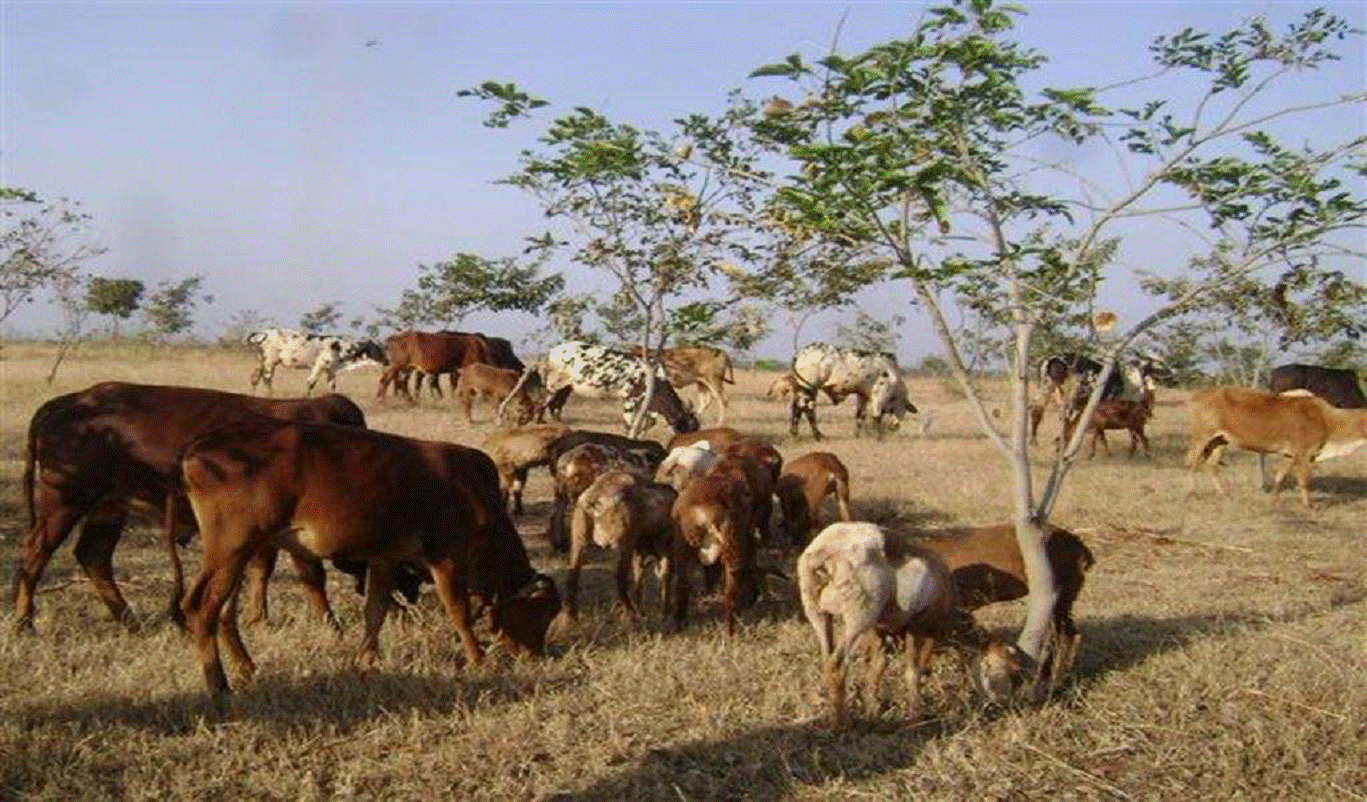
Next to storing oil in its seed, Pongamia is a tree legume, and therefore it can fix nitrogen and help enrich the soil where it grows. It also has nematicide and fungicide qualities. Pongamia production can be the basis for a multi-level and complex agricultural activity. With its agronomic qualities, Pongamia is quite suitable for an agro-forestry production system. The combination of the shade provided by the trees with soil enrichment by nitrogen fixing and seed cake fertilizer and the moisture retention that results from these new local conditions creates a suitable environment for the production of vegetal crops for food production. For instance, on the Tree Oils India Ltd farm, they grow pigeonpea between the Pongamia rows. Further development of optimal combination and rotation of crops will be enhanced as the system will enrich itself over time. It is also possible to combine the tree plantation with extensive grazing cattle. The Pongamia plantation helps the production of grass and in return the cattle fertilize the soil with manure.

Agro-forestry can be combined with extensive cattle grazing to restore soil and agriculture potential

Agro-forestry can be combined with extensive cattle grazing to restore soil and agriculture potential

The combination of the various possible productions also offers different possibilities of cooperation. Not all activities need to be done by the same farmer. There is always the possibility to offer land for use for vegetal crops or grazing. The partners can decide of which form the cooperation can work, between ownership, renting, sharing of land or of harvest or any other form that can create a harmonious cohabitation. Such different possibilities allow the integration of local rural communities to access production potential as the plantation creates the condition and the potential for both vegetal and animal productions such as meat, milk or wool. By generating different farming activities, the Pongamia production has the potential to create several agricultural value chains for all the productions involved as well as processing, storage and marketing. It can have a snowball effect beyond simply agriculture. When the local communities develop livelihoods, they also will need access to other products and services to function. The combination of all these activities allows creating sustainable production systems, as all the products and by-products can be used locally and thus, closing the loops. However, the system does not have to be a closed one. Productions can be used locally or sent to markets elsewhere, and the same is true for inputs, but integrating all the activities allows monitoring and managing the production systems in a sustainable manner. Closing loops is a key phrase in regard to such integrated production systems. In this case, the loops cover carbon, nutrients, moisture and organic matter.

Oil press used for Pongamia oil production in India (TOIL R&D project)

Oil press used for Pongamia oil production in India (TOIL R&D project)

Like many economic development projects, a leading project is necessary to create the necessary momentum upon which other activities can connect and grow along. Pongamia production has this potential but as always for such projects, the need for investment is critical in the early stages. It must start somewhere and the return is not immediate. There is always a chance to take. Because it takes several years for the Pongamia tree to enter production, the early years do not generate revenue from oil, and only the crops generate income. However after the trees start producing, income increases substantially. Over a period of ten year after planting the trees on the plantation, the return allows farmers to have a good income. Economic development requires long-term commitment from the shareholders. As many activities and also economic benefits are the objectives, all stakeholders that can benefit in the long term should also be shareholders. Success cannot be the responsibility of the plantation investor alone. When stakeholders are shareholders, they become owners of the project as well; and owners are more determined than spectators to turn a project into a success. Many jobs can be created in farming, in different activities of oil processing, logistics, trade, and in the different activities of the different value chains that can spin off from Pongamia. It is also not just a matter for businesses only, but governments also would benefit. More economic activity means more taxes down the road, as well as less need for financial support of rural communities once they can generate a solid local economy.Every project would have to adjust to the local conditions. If the projects in India and Australia are developed on mining grounds, other regions may offer different types of land for development. The available land might decide the size of the plantations and the production volumes. From there, each project will have to list the potential other activities that can be combined with the plantations, and how many jobs in which activities may be created. By reviewing the entire production potential with the socio-economic potential, it will give clarity to the different stakeholders of what their individual return would be. Then, they can determine how big a share of the project they want or how much they can contribute to the development of such integrated activities. If, for now, tree oil projects are more advanced in India and in particular in Australia, they certainly could be quite instrumental to help develop economic development in particular in arid parts of Africa. It is possible as a number of success stories with agro-forestry have already demonstrated there. This type of integrated agriculture has good potential to recreate productive vegetal landscape in former deforestation areas like for instance in Brazil.

If you wish to know more about Pongamia oil, feel free to contact Dr. John Wightman or Mr. Sreenivas Ghatty

(Photos: courtesy of Mr. Sreenivas Ghatty and Dr. John Wightman)

Adapting our thinking to the future – part 2

At the end of part 1 of this article, I had mentioned how our elders used to make progress by blending the modern with the traditional. It is quite important to keep this way of looking at our life environment quite alive. How we evolved to where we are today determines very much why we have the current possibilities available. They are the direct result of our history. Whether we like it or not, our future has its roots in our past. The art is to improve what we have, and to improve, we need to learn from the mistakes of the past. Rejecting solutions for the simple reason that they are old-fashioned or not based on science is really excluding diversity, while diversity is the fuel of progress. Reducing diversity comes down to reducing options to move forward. As someone who looks toward the future and tries to find out what is likely to come as well as what is desirable to create, I find this balance between past and future especially interesting. I often am surprised to see how many people are actually busy reinventing the wheel, while they think that they are busy innovating. Many projects and research that I see taking place have actually already been carried out in some way either in another place or in another industry. I regularly have to tell some of my contacts about similar projects that took place years and sometimes even decades ago. This is why I always insist on the need to be curious. For the future, curiosity is an asset. I could never urge anyone enough to have an open mind for anything that happens anywhere and in any industry. Maybe, I am doing some sort of transfer about this and I wished others would be as curious and eager to learn as I am, but this is so helpful to foresee the changes to come, that anyone who is interested in the future should be wired like that. Unfortunately, I find most people to not be really curious. They seem to be interested in what will serve them directly in the short term, but much less for what may serve others now but also in the future. Until someone can tell me that it is better to limit one’s perception and understanding of the world and of its possibilities, I will keep being curious and open-minded.

People really need to expand their horizons. Not only is it useful to be prepared for the future, the main reason is that it is incredibly fun to learn to know new things and new people. For the sake of humanity, it is time to open up towards others. The attitude of future business will not be about pushing new products and services to others, but to have a “what can I do for you “ and “how can I help you” mindset. The business of the future is the one that delivers solutions. In the future, successful products will be at least as much about the service included as it is about the actual physical product. This is what circular thinking will deliver. In a future where others are really what matters the most, the social perception will also change. “Old boys clubs” (which are nowadays just as much girls clubs) and other clans are not really the most dynamic organizations. There is no doubt that they are incredibly comfortable, because they are basically made out of clones. Everyone thinks the same, shares the same values, comes from the same university or social group, lives in the same country or region, has the same feeling of importance, and looks to the outsiders just as such: outsiders. There is a lack of diversity; therefore there is a lack of progress. A new interesting development that, to me, shows the quality of networks has appeared recently on LinkedIn. They visualize how much of your network belong to which organizations. I recently have seen some of the apparently very social individuals that have close to 40% of their network linked to only one company, and the second organization in his network only 1%. To me, that does not spell open network. And I thought that the main organization in my LinkedIn network was already high at 5%. Personally, I prefer by far those who have a balanced distribution of their networks. The chances are much higher that people who have a more balanced distribution of their networks have been exposed to more diversified experiences, and are likely to be more open and more flexible to different or challenging ideas. For a successful future, we must not think in terms of networks, but we all should be interconnected in the same one that would be the complete integration and interaction of all the ones that exist. My customers have demonstrated this to me. About all of my business has come from my being on the web with this blog and my books. They caught my customers’ attention who decided to get in contact with me. None of them knew me personally beforehand. The result has been business. Actually, I have not prospected once for the Food Futurist services. I just found a way of being visible beyond any limitation of network boundaries. The Food Futurist has become part of that global web.

One of the main differences between nowadays and yesterday lies in how intricate our world has become. In the past, things used to be more compartmented. Today, the whole world has opened. Knowledge travels fast and is accessible from almost anywhere on the planet. The level of interaction between industries and technologies is much higher now than it used to be. Most innovation that will help progress in food and agriculture in the future will not originate from the food and agriculture community, but from many different fields such as robotics, nanotechnologies, telecommunications, software development or medicine, just to give a few examples. Although technology will definitely play a major role in improving what we do, it will be important to not see technology as a panacea with dictatorial tendencies. I always underline the importance of the balance that we must maintain between technology and steering human nature for the best. In the end, technology is only as good and useful as the way we use and master it. Just take the example of gun powder. When the Chinese started to use it, they made fireworks for entertainment purposes. The “white man” chose to use it to kill others. Clearly, a similar technology used with different philosophies of life will serve different purposes. This is still true with today’s technology and it will be true with tomorrow’s. It will depend on the leadership. Technology needs to pass the test of morals and ethics, unless we accept that it might serve to be used against us. Technology and leadership go together, just like science and philosophy do. It is important to not forget it. If curiosity is an asset for the future, clearly, so is having a critical mind for the reasons just presented. It is essential to keep control on what we do and that we address concerns. Of course, this may delay some valuable financial objectives for some, but the quality of the future will depend on us doing the right things. The debate that results from critical thinking may be time-consuming, but open debate is an integral part of the democratic process. Open debates protect us from going back to dark ages. Looking back how what such ages have caused in human history, and unfortunately still do in some parts of the world, the need to learn from the past is clearly essential for a prosperous future.

Thinking ahead like a chess playerOther advantages of critical thinking are that it stimulates reflection and is a source of ideas. It is also important to make clear that critical thinking is not about criticizing but about questioning. Sterile boring criticism is just as useless for our future as not thinking at all. Let’s face it, critical thinking is not easy. It requires emotional distance. It is about accepting that what we may have believed appears to be wrong, or that they are better ways and beliefs. To be a good critical thinker, one needs to have enough confidence to overcome disappointment and to accept to change the course. Not that many people are willing to deal with such challenges. Yet, if we want to prepare for a prosperous future, we will have to accept that exercise, because, the future will be quite different, and in particular our interaction with our environment and the world will change and evolve further. Critical thinking actually requires a rather Zen mindset. One needs to have the calm and openness to observe and listen before speaking. One needs to accept being wrong as the debate that arises from the exercise will also show the value of other people’s points of views. Critical thinking is an exercise in humility. Humility is a highly valuable, yet often neglected quality. Yet, it is essential to be humble when thinking about the future. The challenges are quite serious and dealing with natural forces that may or may not be about to unleash upon us will not be an easy task. We will need to understand our relationship with Nature and accept the idea that, in spite of all our cool technologies, we are vulnerable and mortal. One of the arts of future thinking will be about pushing the system while knowing where the limits are that we must not transgress. That is what sustainability really is about. We really do not want to open Mother Nature’ Pandora’s Box. To be equipped properly to face the future, we need leaders that will think like chess players. We need leaders in all areas of society that can understand how the consequences of their decisions and of their vision will trickle down through the system. They must be able to foresee what may happen when they make their moves. Many already hardly can foresee what comes next. Those we need are the ones who can visualize what happens two, three, four and more degrees ahead, so that they can adjust their choices and already develop alternatives before troubles arise. A good plan A always includes a plan B, and preferably even a plan C. Plans that lack alternatives are not plans, they are merely wish lists.

Copyright 2013 – The Happy Future Group Consulting Ltd.

Adapting our thinking to the future – part 1

Everybody will agree that the coming decades are presenting many new challenges. Never before have we faced such a population growth and demand for about everything, food and water being the most essential. The difference between success and failure will reside mostly in our attitude towards change and our willingness to adapt to a different new situation. For obvious reasons, the economic model of mass consumption and resources depletion that generates a mindboggling amount of waste is coming to an end one way or another. A new system needs to come and will come. Whether it will be the easy way or the hard way really depends on us all and in particular on our leaders. I like to tell that our future will be only as bright as our leaders. It is a bit of a joke, but not quite.

The circular will look linear when approached from the right angle

What does need to change in our thinking and attitude, then? In a finite world, we must understand that always more is not sustainable. This is especially true when several billion people are thinking of having the same consumption lifestyle as developed countries have had over the past 60 years or so. The pie is not big enough to allow that kind of party (and neither is the bakery that must produce the pie). This is where we seem to be stuck in our thinking. We have learnt to think linear in the past several decades. It can go only in one direction, and it has to be up, doesn’t it? God forbid of anything going down. In the field of farming when I hear the linear argument, I like to mention two things. The first one is that if farming stats must go linear, there should not be any farm left in developed countries in the not so distant future, and the same should happen in developing countries, too, just a bit later. No farm means no food. Apparently, that does not seem acceptable. There goes a crack in the linear thinking. My second argument against thinking blindly linear is that in biology and in population dynamics, there are no linear functions. All curves are curbed in some way. There are bell curves, sigmoid curves, exponential and logarithmic curves, just to name a few. None of them are linear. If we want to plan our relation with our environment in a prosperous manner, we need to leave the linear thinking and start thinking curbed, and the curve that fits the ability to renew indefinitely our access to essential resources best is the circle. Circular thinking is the never-ending linear. That is just as much of a thinking revolution as moving away from the concept of a flat earth to embrace the idea of a spherical one, or to fathom the curbed space. Shifting from linear thinking to circular thinking simply means a shift in thinking from always more to always enough. All it means is that we need to change our ways, but it certainly does not mean the end of the world. It would only mean the end of a world. With a growing population, circular thinking actually presents a lot of business opportunities, especially considering that the alternative is going nowhere eventually. There is no doubt that those who will catch these opportunities will be the winners of tomorrow.

Such a change in thinking also results in rethinking the meaning of growth. Currently, growth, and the GDP as its favorite indicator, means mostly volume and consumption. Actually consumption is probably not the correct world to describe our societies. Buying is a more correct one. Producers want consumers to buy. Consuming in this process is really optional. What counts is the act of purchasing over and over again. We think of growth as quantitative growth. Future growth will have to be a qualitative growth. With so many new people who will need employment in the decades to come, it will be crucial that future growth will have to fill a positive social role. Similarly, to have a livable planet, the future will have to contribute positively to maintaining a healthy environment. Social and environmental responsibility will become the standard. There is no escaping this. Well, that is with the angle of building a prosperous future. If not, chaos is always a possibility.

One of the most visible consequences of a growth model based essentially on quantity and mass purchasing is waste. As consumption goods became cheaper credit became easier and disposable income increased, consuming has become about buying and throwing away. The mountains of garbage in landfills around the world should be a reminder, although we seem to have located them far away from the eyes of the wealthy and in the backyard of the poor. Quite convenient. This way, consumers could forget about the consequences of their actions… and keep on buying and throwing away. Although this happens for all consumer goods, this is especially immoral when it comes to food in a world where about a billion people do not have enough to eat. It is immoral, simply because food means the difference between life and death, and wasting food is indirectly contributing to the death of others. It is also immoral because food waste is also the waste of all the inputs used for the production of food, be it water, energy or money. Waste is an indicator of the level of efficiency. Highly efficient systems generate little or no waste. Inefficient systems generate a lot of it. I will let you judge how efficient you think we are. Waste is also an indicator of our attitude. It is not just about morals, but also about discipline. Our societies waste a lot, because we still are much too lenient with ourselves, and also because in many cases the financial incentives to do the right thing are sadly lacking. We choose the path of least resistance.

As life became easier in a number of countries, people have started to lose some essential reflexes for survival. It is not necessary to go all that much back in time to see the change. My parents, grandparents and ancestors grew up in times that were not of plenty, simply because there was no consumption society, and incidentally there was the occasional war. People would not waste anything not so much out of morals, but because they simply could not afford it. Yes, mass wasting is the fruit of luxury. My elders would not waste and they were very skilled at circular thinking. They knew that nothing is created or lost, but that everything is transformed. As resources were not plenty, the right answer was to show plenty of resourcefulness. This is how things were by then.

To take the example of food waste, they would make sure that leftovers would be on the table the next day. They would most certainly not end up in the garbage. They would feed the pigs with what they could not eat themselves. Actually, they were turning low value products such as potato peels in high value protein in the form of pork. When I was in the agricultural university, my animal nutrition teacher once told a joke that I have never forgotten, especially considering that I have spent a substantial part of my professional life in animal production. He told us that modern animal husbandry was the art of turning high value protein into cheap fat. Not quite untrue, and so much the contrast with the pork made out of table scraps. This contrast is very much present in the ongoing debate about meat production systems.

We can find many answers for the future by looking at the past. In our current times of science-based facts obsession, many seem to look down at words such as experience, wisdom and philosophy. This is not wise. Our elders might not have known all the scientific background of what they were doing, but they knew what was best for them to survive. They knew how to manage a finite world of finite resources to sustain themselves. Passing on that knowledge, experience and wisdom was an essential part of survival. There was no conflict between modernity and that knowledge, experience and wisdom. They integrated the new and the old to build a better world. Although, there is still a lot of work to eradicate poverty, let’s not forget that the result has been the emergence of prosperous societies in which a record number of people are living now.

(Part 2 of this topic will be published soon)

Copyright 2013 – The Happy Future Group Consulting Ltd.

Dealing with complexity

Looking at the future of food and farming goes far beyond agriculture. It comes down to looking at the future of humankind. Balancing future supply and demand of food is an exercise that includes many disciplines and dimensions, probably more so than any other human economic activity. Anything that affects life and its level of prosperity must be taken into account. Feeding the world is not just a matter of production. Of course, the ability to produce and to keep producing enough food is paramount, but there is more to it than that. The consumption side is just as important. Demand will depend on the diet, which also depends on how much money people have available to pay for food.

Total future food demand is a combination of which foods and food groups people in the various regions of the world will buy and eat. This is a function of demographic, economic, cultural, religious and ethical factors. If future demand is about consuming according to the nutritional needs of a human being, clearly the situation will be different than if people demand twice as many calories and protein as the actual nutritional needs. The relative share of animal products in the total diet will also change the situation in terms of production and of production systems. Food production must adjust to the demand and do its best to meet it, but not at all costs. Therefore, it is essential to optimize food production at the global level so that the largest quantity of food can be produced at the lowest environmental cost. At the local level, production depends of course on natural conditions, but also on economic, political and cultural conditions as well. This may be the most profound change that we must deal with: feeding the world of the future is a global exercise. As more and more people worldwide have more and more money to spend on food, demand is now global, and therefore production plans must also be global. The times of producing food simply for the own people and exporting surpluses is over. Markets will now react to any event that will affect production or consumption somewhere else. Borders do not make this shift in thinking easy. It is always tempting to think that having one’s house in order is enough, but it is not. What happens in other countries on the other side of the world will affect us just as well. Why is that? Just one word to explain it: markets. There used to be a time, not so distant when if there was a drought in Russia, China or Brazil, markets would not react as strongly, and anyway not so much in the media, as we have seen over the past few years. This was the case because only a minority of the world was consuming large quantities and that minority did not have competition. Now the competition is wide open. Markets will keep reacting on this and the relative price levels of various foods will influence how much of what is consumed and where. We will see eating habits change because of this economical aspect of food supply.

At the same time, food production is also adapting to a changing environment, and to face its future challenges. The amount of new developments in technology, access to information and knowledge and in decision-making tools is amazing. Innovation is flourishing everywhere to solve environmental issues, to cope with new energy and water situations. The dominant themes are the reduction waste of all sorts, as well food as agricultural inputs and by-products, and the prevention of the release of harmful contaminants. Innovation is developing towards better and more efficient systems that must ensure the future continuity of food production and, at the same time, keeping food affordable for consumers. Interestingly enough, many innovations that will be useful for agriculture do not originate from the food sector. Food producers will need to be curious and look beyond the field to prepare for the farming of the future.

Clearly, the number of factors affecting both consumption and supply are many. To add to the complexity, many of these factors are not of an agricultural nature. Many of them originate from the population, its activities and its needs for all sorts of goods. I mentioned earlier that what happens in one region affects others, but the natural resources markets, such as energy, metals and minerals, that must meet demand for non-food consumer goods also affects agriculture and its production costs. Although many see rising costs first as a threat, I tend to welcome them, as they always stimulate innovative solutions to increase efficiency and reduce waste. Two examples show that it works. One is the car market in the USA that shifted from gas-guzzlers to high gas mileage vehicles since gas at the pump became much more expensive than it was only 5 years ago. The second one is food markets. Had you heard as much about food prices, food security or food waste before the food price hikes of 2008 and 2012?

In my work, I always try to make my clients and audiences aware of how everything that has to do with food is interconnected with many other sectors, and how economic, demographic and political events are linked to food security or how they might affect it in the future. That is an underlying them in my books.

Even, within the food and farming sectors, organizations do not realize enough how their future will be influenced by other food productions and vice-versa. I always get reactions of surprise at the magnitude of the interconnection and the interdependence with these factors, and how they affect their activities indirectly. It is a normal reaction, as most people tend to focus on what has a direct connection with their activities. After all, that is why I do what I do: to help them see and decipher this complexity, and understand what actions to take to adapt and prosper. I never shy away from show the complexity. My audience needs to get a flavor of the any dimensions and many layers involved. However, I always take a practical approach and show them that complexity is not the same as complicated. Deconstructing the complexity actually works well to show the many levels of actions there are. It helps my clients connect the dots between their activities and what will affect them and how. It gives them a level of confidence in how to deal with the future and take action. I also like to warn against oversimplifying, which is another tendency that I observe from time to time. The mainstream media is rather good at that. But I also get questions that sound like those who ask hope that I have a magic wand and will be able to give them a foolproof recipe for success. That simply does not exist.  If preparing the future were easy, nobody would even talk about it. It would be done. It it was easy, I guess many of the organizations that have been involved in agricultural development and food aid for decades would have already succeeded, and they would not exist anymore. Yet, they still have to keep up with their work.

Feeding the world is work in progress. Developing the right actions is complex, but not as complicated as it sounds. However, the true difficulty is in the execution, and in particular bringing other stakeholders with different agendas and different views on board to contribute to the success.

Copyright 2013 – The Happy Future Group Consulting Ltd.

Rio+20, Riots+30?

The Rio+20 conference is over. Announced with much publicity, accompanied with many tactically timed media articles and other conferences about sustainability, it has been the occasion for many to demonstrate their apparent concern about the future of the planet. A couple of weeks after the conference, the excitement has faded away, and the tweets that were so abundant on the subject have become rare. This is rather symptomatic of the current behavior of short attention span. Much has been written about Rio+20 and the dominant conclusion is that it has not achieved much, as expected.

For obvious reasons, I followed the part about agriculture and food security with special attention. Since I did not expect anything, I was not disappointed. To me, this conference has left me with the impression that the world leaders are resigned. The text was written before they would meet and it was far from bold. I read it and I could only shake my head. To me it looked like a very politically correct list of commitments that would fit nicely in typical New Year’s resolutions. The principles and statements mentioned in the text are noble but who can seriously think that effective action will follow? Just like world peace, everybody will agree on the principle of a sustainable livable planet where hunger does not exist. The reality is different. Human nature is not that noble and our many flaws hinder us to achieve such goals. In We Will Reap What We Sow, I wrote among others a chapter dedicated to the human weaknesses and how they affect our ability to deliver what we all secretly want. In the book, I also discuss how we can overcome these weaknesses and work toward a successful change. The theme of Rio+20 was “The future we want”. It was not clear to me who we might be, and whether it should be about wanting. Is what we want the same as what we need? The theme should have been “The future we need”. That would have been more precise and more relevant.

I also followed the webcasts dedicated to food and agriculture of the conference, and they disappointed me. I would have loved to see people clearly expressing their frustration about the resistance our world faces to go in the right direction. I would have expected strong calls on the leaders for effective action. I would have expected to see clear action points with clear and non-negotiable deadlines. I would have expected clarity about who should be responsible to do what. I did not get these. Instead, I saw some well-rehearsed PowerPoint presentations carried out by speakers who were rather satisfied with the work of their countries or organizations and who sounded like they found that at least their contribution was excellent and so would it be in the future. I am always suspicious when I hear people justifying themselves while nobody is asking for justifications. I believe that the overwhelming majority of people who work in agriculture to produce more and better food in a better manner do a good job. Most people go to work with the desire to do something good. Such presentations did not add much to the objectives of producing more food in a sustainable manner.

What would I have liked to see happening at the Rio+20 conference, you might ask? Very simple: I would have liked to see people arguing quite vividly and even getting angry, even leaving the negotiation room and slamming the door. This would have been the sign that the right questions had been asked. Considering the complexity of growing more food and at the same time maintain the potential of agriculture to keep producing for generations to come, difficult issues and really annoying questions are inevitable. I really would have liked to see the likes of a Nikita Khrushchev who in the UN took off his shoe to bang it on his desk in the 60s. Although his behavior was somehow out of line and by today’s political correctness standards totally unthinkable, it would be good to have leaders engaging in robust arguments. After all, if the survival of humanity is indeed at stake, this would be a cheap price to pay. Instead of that, the leaders came only to pay lip service, show up on the group picture and went back home knowing that the conference did not address the issues as it should have. At least everybody felt good about a text that was not threatening for anyone, that did not ask for any significant sacrifice and thus life can go on. As soon as they left the building, they returned to business as usual. All the principles listed in the text are correct as such. The only problem is that it is written as if the UN expects world leaders to become altruistic, long-term oriented and good-hearted. It is a bit naive. They are politicians! Yes, in a perfect world, there is no doubt that the world would feed itself sustainably, just as it would not cause climatic change and there would be no poor and hungry people, either. In a perfect world, there would be no need for the UN or the FAO.

What can happen if the economic model derails and collapses if it does not make the right choices to become sustainable? That is not very difficult to figure out. A number of events from the last few years can give us some clues. The riots that took place when the price of food increased sharply in 2008, affecting the lives of many people in developing countries, show that food will play a crucial role for the stability of many regions. It will not take much for such riots to happen again. Because of the economic crisis, a number of heads of states in democratic countries have been defeated during recent elections. The people clearly asked for a different leadership. In Arab countries, a similar demand has been met through social unrest, riots and near civil wars, and the process is still ongoing. The people asked for a different leadership. The intensity of the economic crisis has actually been reduced substantially by the massive printing of money and the large amounts of debts that many countries have had to issue to keep their economies from stopping abruptly. If money printing has softened the short-term impact of the financial meltdown, it also will lengthen its duration quite significantly. Considering the amount of debt and the demographics of Western countries, it will take generations before the debt can be paid back entirely, if that ever even happens. To restore a sound ratio of debt on GDP, most of these countries would actually need a new baby boom to ensure a growth that matches the challenges. Of course, another approach could be to allow immigration numbers to increase strongly, but that does not seem to be on any of these countries’ plans. Moreover, a growth based on the same economic model of consumption society does not appear sustainable and before the right numbers would be met, one can wonder if our species would have survived.

I often tell that the difference between the effects of the financial, the social and the environmental parts of the economy manifest at different speed. Anyone can follow share prices live on the stock market, anyone can follow his/her bank account on a second-by-second if desiring to do so. Social consequences can take months or longer to manifest, and environmental effects can take decades to manifest. The financial crisis has been the result of postponing actions to ensure that the money world could be sustainable. It is still far from being there and the financial crisis is not over, but at least there was the possibility to print money and to emit debt. That entertains the illusion. When it comes to environmental sustainability, our leaders are also postponing actions to ensure that our physical world be sustainable. The main difference is that there is no printing of Nature possible. Printing of wheat, rice, beans or other essential food items is not an option. If we lose the ability to produce enough, there will be fights for food. That is inevitable.

An unsustainable economic model, and in particular an unsustainable agriculture, will result in shortages, not just local but everywhere and anywhere to some extent. It will result in large numbers of people left with few options to survive. Some cultures might deal with it in more orderly manner than others might, but overall, the result will be social unrest that could have the potential to turn into riots and probably even into regional conflicts. A quick look at the world map gives an idea of where it can happen and the potential risks. The Rio+20 conference should have presented prospective scenarios of what will happen if we do not act properly and timely, and it should have asked the leaders on solutions. Leaving a conference handling such a sensitive and complex problem without a genuine brainstorming and a solid and courageous action plan made by the leaders for the world in order to preserve peace and stability comes short of leadership.

Considering the pace of economic, social and environmental change, this was the least that should have been done. Are we going to wait another 20 years for the following conference? Will it be as lame as this one? Will the result of Rio+20 be Riots+30, or +40? I tend to think so more and more. I am increasingly convinced that only a really scary crisis affecting the rich will shake the lethargy. I think that political change will come from the street before it comes from leaders who have apparently already given up. In the food and agriculture sectors, I also expect salvation to come from the ones who are the most involved in production: the farmers, the food producers and the food distributors, simply because their livelihoods will depend directly on an agriculture that is sustainable. Politicians will only follow later, when they and their constituents become food insecure.

Copyright 2012 – The Happy Future Group Consulting Ltd.

The Sustainability Dilemma

Although almost everyone seems to agree that our world needs to be sustainable (what is the alternative anyway?), making it happen seems much more challenging. The good intentions have difficulties to turn into action. The reason is simple. To make human activities sustainable, we will need to accept some serious trade-offs. That is where it hurts. There is the dilemma. Are we willing to change and sacrifice on the superfluous today to have a bright future, or do we want to keep instant gratification as the way of life and risk to lose it all later? Even though the answer to this question is obvious, it is only human to choose the short term. The issue in the background is one of change, not so much one of a choice about sustainability. To understand why this is so, one needs to realize that fear of change is not about change. It is about the fear of loss. This fear is even stronger when there is little certainty about what will come next.

Making the move towards sustainability presents many short-term challenges. There is a lot of money at stake, but this is not just about the financial aspects of the economy. There is a social cost, too. Changing the economic model into a sustainable one means that many jobs will be threatened. In these times of economic hardships, the fear of unemployment and of the social unrest that would result from it is reason for many politicians to be reluctant to take drastic action. They also think about their jobs. Sustainability is about the long term. It is about later and somewhere else. On the contrary, personal consequences of the change are here and now. There is no need to look any further to understand why there is resistance and inertia. In the debate about sustainability, shortcomings appear in several areas.

A first area is the lack of strong vision from the leaders about which alternative to offer to the current consumption society. Actually, consumption society is not an accurate description. The purpose is not so much about consumption as it is about buying stuff, use them or not, throw them away and buy new stuff instead. Clearly, with more people having more disposable income, this is going to hit a wall. As more people want to have a piece of the shrinking pie, and as finite resources deplete gradually, excessive consumption and waste are not going to last for much longer. It is simple math and it is common sense. Supply and demand will readjust markets by sending prices up. High prices will make consumption slow down, and so will the world economy. Regardless of which one between market forces or the environment will cause the current system to collapse, the economic model will change. The time has come to bring a clear vision for an alternative system. The alternative must ensure that the economy is prosperous, that people have work that pays well enough for them to cover their needs and to ensure that human societies can have a future for generations to come. Until this day, nobody has come with a vision and a road map that make the change acceptable here and now. This is why all international conferences lead to little action. As long as this is the case, the only thing that will force a change in attitude is a major crisis in which the wealthy are at risk of losing what they have. As long as crises touch only the poor and the powerless, nothing really changes, unfortunately.

A second area of weakness is the lack of collaborative action. Every group of stakeholders look at its interest first, while the proper approach would have to be altruistic and empathic. This is another case of the here and now vs. the elsewhere and later. If we want to succeed, it is necessary to transcend differences and borders. We need to find ways of going beyond simple accountability, and impose co-responsibility. This is much easier said than done.

A third area to address is the numbers. In the end, it is about money and jobs. Actions to make the world sustainable must also work financially. If change is not sustainable financially, change will not happen. If businesses go bankrupt and if people are at risk of losing their livelihoods, they will not go for the change. The new economic model needs to consider this. The transition towards a better world needs to consider it, too. The externalities need to be internalized in some way, but the new model must be robust as well, otherwise all efforts would be for nothing.

A fourth area is about definitions. What is sustainability? How can we monitor and measure all human activities to know which ones are within sustainable limits and which ones have no future? How and where to draw the line, and how to enforce it? In the case of agriculture, every particular activity has its own specific impact. Depending on the nature of the environment, the nature of the impact and the range of sustainability vary, too. Monitoring must be tailor-made to each particular situation.

A fifth area is the consumer’s behavior. It is impossible to address sustainability without addressing consumption habits, and in particular excessive consumption and waste. As long as consumers will not eliminate the use of products that have an unsustainable effect on the environment, very little will improve. Putting the emphasis on production only is not enough. Production methods certainly can improve, but a substantial share of the damage is the result of consumers wanting more of what is not so good. Consumers are the largest group of influence. They are the people. What and how they consume is democracy in action. Businesses and governments follow their lead to quite some extent. When the majority chooses for a different economic model, things will change fast, but for now, the majority is still choosing for the old model.

Whether our world will move towards sustainability or choose a more hazardous way depends on us all. It depends on how we want to solve the dilemma that we face. The choice is not easy, but it is essential. There are many questions still unanswered, simply because they have not been asked. These important questions are mostly of a practical nature. They are more about how to make the system work not only environmentally and socially, but also financially. If businesses tend to focus mostly on financial aspects, environmental and social movement tend to neglect it too much. Like everything else in life and nature, it is about balance.

In my latest book, We Will Reap What We Sow, I address in much more details many of these questions and discuss the value of possible alternatives in relation with our future ability to feed a growing population.

Copyright 2012 – The Happy Future Group Consulting Ltd.