
Without water, there is no agriculture, there is no food, and there is no life. It is obvious, and yet the water question is too often 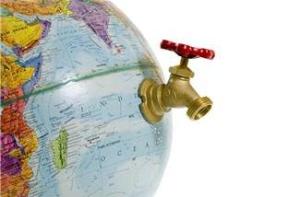 neglected. The quantity and the quality of water available are absolutely crucial for the future production of food. It will influence where and what type of food we can produce. It will define food security and world politics. Since 70% of fresh water use is for agricultural purposes, it is clear that water will soon be power.
The need to preserve water and use it efficiently is going to be one of the main challenges to overcome for the decades to come. This will stimulate innovation and the development of new technologies and new techniques.
Field sensors that measure the level of humidity in the air and in the soil connected with “crop per drop” irrigation systems can allow the distribution of the right amount of water at the right time, thus saving waste through evaporation and drainage. The selection of plant varieties will focus more and more on water efficiency. Drought-resistant plants that can thrive in arid conditions are in the works. For instance, a trial on wheat in Australia has delivered promising results, as the yield was 25% higher than non drought-resistant varieties. Researchers, through hybridization and genetic engineering, are working to develop varieties that can use less water and produce similar yields as per today. Although high tech may bring solutions, other methods deliver good results, too. Agro forestry, the production of crops under a cover of trees seems to help farmers achieve satisfying results in the Sahel region. The foliage of the trees helps reduce evaporation from the soil. Combined with proper techniques to apply organic matter and fertilizing elements, farmers can create better conditions for plants to grow.
Another field of research is the development of alternatives to traditional desalination, which is very demanding in energy. Transforming seawater into fresh water for the production of food is not simple, and it is expensive. The technology is here. Israel has used it for decades. Currently in the United Arab Emirates, a project of floating islands covered with solar panels to provide the energy to desalinate seawater is being developed. This system has the advantage to produce both fresh water, which is precious in desert countries and clean energy at the same time. A project, called The Sahara Forest Project aiming at producing food in the desert is currently in the works. It combines solar energy, modern biomass production and a type of greenhouse, built by the Seawater Greenhouse company, that helps the humidity produce by the plants to condensate.
In many countries, the problem is not so much physical scarcity of water as it is a lack of proper infrastructure to collect, pump and irrigate efficiently. The population density contributes to the problem, because the more people, the less for each of them. In many countries, for instance in India, the equipment is old, inadequate and poorly maintained, because of a lack of finance of governments and farmers. The result is a waste of water resources, and a suboptimal production. Another area that has potential for improvement is the collection and the storage of rainwater. A large quantity of water runs off and is not available for food production because there are not enough containers, if any. Developing and improving storage infrastructure will definitely help farmers to produce more food.
If the availability of water is important, so is its quality. In China, the situation is a lack of both, because of the heavy pollution of many streams and rivers. In many areas, the water is there, but it cannot be used, as it is fit neither for human consumption nor for agricultural production.
The respective situation of countries about water availability will determine their ability to feed their own people or not. In Arab countries, irrigation has led to a high level of salinity and it has depleted drinking water reserves. Saudi Arabia, for instance, has now abandoned its policy of increasing food production to become be self-sufficient. Saudis are actively purchasing land in African and Asian countries to meet their food needs. China and India, that represent about 40% of the world population, are following a similar approach and invest heavily to help develop land in Africa. In countries where drinking water is scarce, there are discussions about the need of not exporting, as export of food is actually water export as well.
If a number of countries face a water shortage, others have a different situation. This is the case for large areas of North America and South America. Especially Brazil disposes of large water reserves. Together with a favourable climate, Brazil has many advantages to produce food, especially animal protein. According to Osler Desouzart of OD Consulting, the production of 1 kg of beef requires 16,000 litres of water, while it takes 6,000 litres for 1 kg of pork and only 2,800 litres for a kg of chicken. This shows why Brazil has been gaining market share in beef and poultry. It indicates that intensive animal production will be more challenging in countries where water is not as abundant. This also tends to show that poultry will be the most successful type of land animal production. The US and Canada have large water reserves, although there are also clear regional differences. The South West of the US becoming increasingly arid, and one can wonder if California, that currently produces most of the fruit and vegetables for the North American continent, will be able to keep its production levels. It is likely that fresh produce will be gradually produced closer, even inside, the large urban centers in the northeast as well. Considering the emphasis on water preservation, it is also interesting to note that before the housing crisis in the US, the most irrigated type of plant production were lawns, using three times as much water as US corn. Food recalls are another source of water waste, especially meat and eggs recalls. From the numbers presented above, it is easy to see how much water is lost when dozens of tons of animal products must be destroyed, not to mention the huge food waste that this represents.
When it comes to food and water, aquaculture offers interesting possibilities for the efficient production of protein. Fish produced in the ocean do not consume freshwater. This saves large amounts that can be used for other purposes. However, one of the challenges for the fast-growing aquaculture industry will be to be able to source feed ingredients that do not directly compete with other farm animals and direct human consumption. Land-based aquaculture is developing the very interesting concept of aquaponics, which is a combination of fish production in tanks combined with the production of vegetables indoors. The system recycles the water used for the fish tank, and helps fertilize the plants with fish waste. This is a very water–efficient system that can help produce large amounts of food on a small area, making it fit for urban farming units.
Copyright 2010 – The Happy Future Group Consulting Ltd.
 Yet, with an increasing world population and the need for more food production, one can wonder whether agricultural subsidies really are a problem. History has shown that subsidies can be a very effective way of boosting production. For instance, subsidies have been a major element for the European Union to increase its agricultural production in the decades following WWII. To show how effectively money talks, you just need to see how financial incentives have made European vintners pull off vines, then replant them pretty much at the same place later. Subsidies have encouraged Spanish farmers to plant many more olive trees than the olive market needed. Subsidies work. When people are paid to do something, they usually do it quite willingly.
 Those who are not familiar with the salmon issue in BC need to know that for 20+ years, a war between environmentalists and salmon farmers have been waging. Although all the participants in this debate claim to base their statements on science, Nature is just throwing facetiously some oil on the fire. Environmentalists have accused salmon farms of being the cause for the (apparent) depletion of wild salmon stocks. Much of the accusations rested on research carried out by a local environmentalist who linked her sea lice counting and mortality of juvenile pink salmon to fish farms. Until last year, she seemed to have something of a case, as returns of pink salmons into BC rivers were low. Last year, though, the pink salmon returned in large numbers, which contradicted her theory. For years, the fish farming industry did what it had to do. It always denied any responsibility in the decreasing numbers of pink salmon, using the selected relevant science to support its case.
 The heat wave combined with the drought in wheat-producing region of Russia is causing some concerns, as the wheat production will be affected. That is annoying but not terribly threatening. Moreover, the price of wheat, as well as the prices of other agricultural commodities were due for a rebound because farmers had reduced production after the price fall of the previous year.

 The Food Futurist Solutions - Anticipate, Adapt, Succeed