
Early July the SeaFest 2015 event was held in Ringaskiddy, Co. Cork, Ireland. The Our Ocean Wealth conference was aimed at showing the potential of the sea as part of a successful economic development for Ireland. I had been invited by BIM (Bord Iascaigh Mhara, the Irish Seafood Development Agency) as a speaker and my presentation was about future technologies and how they will change seafood production, both in fisheries and aquaculture. One of my previous articles, “Robots, sensors, drones and big data are coming to the sea, too” had caught some attention.
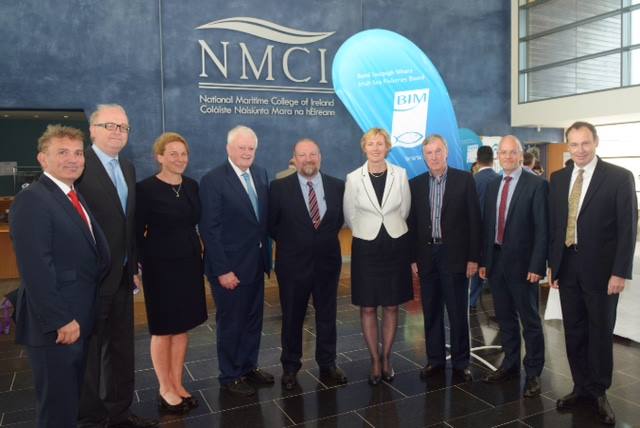
From left to right:
Peter Marshall (RS Standards), Joe Gill (Goodbody Stockbrokers), Susan Steele (SFPA), Kieran Calnan (BIM), Donal Maguire (BIM), Helen Brophy (UCD Smurfit Business School), Eddie Power (Green Isle Foods), Øyvind Oaland (Marine Harvest) and Yours Truly (Photo: BIM)
The agricultural sector is currently implementing many new technologies at an amazing pace. The comparison with precision agriculture is quite useful for the seafood sector. The development of robotics, sensors, satellite imaging and analysis, unmanned vehicles such as drones and driverless tractors, data software, artificial intelligence and interconnected devices are already revolutionizing many sectors of food production and it is just the beginning. The picture of the future that I have in mind is amazing and the possibilities seem almost endless. Imagine if fishing vessels do not need operators anymore. Would they need to float or should they operate as submarines? What would the effect it be on their size, their shape and the way they fish? Imagine robots equipped with sensors replacing divers on fish farms, executing the current tasks and at the same time being able to inform about water quality and other production conditions, presence of contaminants or diseases. Imagine fish farms being connected to such robots and to global satellite and data collection systems making them move or change configuration to get to better production conditions or to avoid negative interaction with wild marine life, thus constantly optimizing production performance and reducing –maybe eliminating- long-lasting environmental impact. Carrying out an “Imagine Exercise” is not only useful but it is fun.
While the previous generation of automation was about adding muscle to operators, the new technologies are adding extensions to the operator’s senses and creating a nervous system. The muscle era was about strong, big and fast, but it required an operator. The nervous system era is about smart, adaptable, much faster, and decision and action will be taken without human intervention.
By combining the possibility to monitor production parameters with the ability to detecting faster than ever before the environmental impact of production activities, new technologies will play a prominent role in helping food production become more efficient and more sustainable. They will help reduce the use of resources and save money. The interconnection of databases for both production and environmental monitoring will allow many possibilities for forecasts, simulations and comparison of scenarios. They will be outstanding tools for decision making and policy making. New technologies are going to offer a platform for collaboration between all stakeholders, be it businesses, governments and NGOs. Similarly, as the data will be made available, all the links of food value chains will be able to access and exchange information like never before. The potential to reconnect consumers and producers is amazing. Transparency and interaction are the way of the future and the tools that are coming will make it so easy. The global village is going to be exactly that. Virtually, everybody will have the possibility to know about everything they need to know about everybody else. Just like in old-fashioned villages, keeping secrets will be quite difficult and social control will prevail. Just see the reactions to inappropriate statements on social media to realize that this trend is already on. Communication and behavior of food producers will have to adapt to this new form of relationship, because there always will someone watching and telling.
Adjusting to a new technological world is a necessity. Food producers need to approach the future with the right mind. After all, technology is only as useful and effective as those who use it. I like to illustrate that statement with the example of gun powder. When the Chinese invented it, they used it for fireworks and entertainment. When the Europeans discovered it, they decided for quite a different use: weapons and killing people. Current technologies and future ones will also depend on who will use it and how. In my work, I always wish to make my clients realize the importance of the human factor on the future outcome of technologies and innovation. The outcome will depend on the intentions behind the development and the use of technology, but even if the intentions are pure, the outcome will depend on the skill of the users. Continuous training is essential to get the most out of technology. As I wrote in my first book, Future Harvests, there are several recurrent drivers of innovation:
- Reducing physical labor.
- Helping us live better and longer.
- Increasing efficiency.
- Helping communication.
- Increasing mobility.
- Offering more leisure and entertainment.
- Making some people a little wealthier.
However, these drivers are not sufficient by themselves. An essential part of successful innovation lies in its practical use. I always insist in my presentations on practicality of technology. Innovation is not an intellectual exercise. When it comes to business, innovation must actually fulfil one or more of the drivers mentioned above and it must also be financially viable and advantageous. In other words, to be adopted, innovation and technology must add value. Although they may be fun, cute and exciting, gadgets do not really belong in that category.
For the future, we need to look beyond just technology. Giving the proper importance to the human factor and focusing on the practical side of new developments are two essential aspects of success. This is why the second book I published, We Will Reap What We Sow, is subtitled “Reflections on Human Nature and Leadership and Feeding a Growing Population”. Getting people to do the right things right through clear vision and solid leadership is what will eventually make the difference between prosperity and trouble. A number of qualities will help a long way towards a successful future.
Curiosity will be an invaluable quality. Innovation is taking place is all areas and many innovations can offer useful applications. It is necessary to follow what is happening elsewhere. In the past, innovations came from the own sector. It is no longer the case. Now it happens in start-ups that have nothing to do with food. The potential lies in creating applications for a particular purpose. There is much to learn from other food sectors, but also from the military, the medical sector, the tech sector, and not just in Silicon Valley. Another essential quality will be pragmatism and openness. Disruptive technologies will bring disruptive solutions. Tomorrow’s way will be different, technologically and philosophically. It will be useful to regularly brainstorm and review how things should be if they were to be set up from scratch all over again, by using all the latest knowledge and also from the experience, successes and mistakes from the past. To tackle the challenges of the future effectively with new technologies, it will be crucial to be practical. Applications must serve a purpose and deliver the solutions to the problems we face. It is not an intellectual exercise. A spirit of collaboration will be one of the keys for future success. Nobody can solve future problems alone. Wanting to help others succeed and not being shy to ask for solutions to succeed will get us a long way. Even though we seem to live in a world where pointing fingers, blaming and punishing is the preferred choice to deal with problems, it is necessary to approach the future with a 180 degree angle and reward and praise those who do things right and solve problems.
Copyright 2015 – Christophe Pelletier – The Happy Future Group Consulting Ltd.

 Those who are not familiar with the salmon issue in BC need to know that for 20+ years, a war between environmentalists and salmon farmers have been waging. Although all the participants in this debate claim to base their statements on science, Nature is just throwing facetiously some oil on the fire. Environmentalists have accused salmon farms of being the cause for the (apparent) depletion of wild salmon stocks. Much of the accusations rested on research carried out by a local environmentalist who linked her sea lice counting and mortality of juvenile pink salmon to fish farms. Until last year, she seemed to have something of a case, as returns of pink salmons into BC rivers were low. Last year, though, the pink salmon returned in large numbers, which contradicted her theory. For years, the fish farming industry did what it had to do. It always denied any responsibility in the decreasing numbers of pink salmon, using the selected relevant science to support its case.
 There is a growing concern about environmental and health aspects of food production. About the environment, you can list very diverse things such as the depletion of wild fish stocks in the oceans, the interaction between aquaculture and wild fish stocks, manure and smell of intensive animal husbandry and impact of manure on soils and drinking water, deforestation of rainforest for ranching of beef or about growing GMOs (Genetically Modified Organisms). On the health side, consumers worry about food poisoning due to bacteria, such as E. Coli, listeria, campylobacter and salmonella, but also about residues of pesticides or antibiotics, as well as they worry about the use of hormones in animal productions. As the discussions get more animated in the US about the reform of health care and the cost of obesity, more and more people are wondering about whether the fast food diet is a proper one. Next to this, animal welfare is a growing concern by more and more consumers.
 Here is an
  Having the ability to change location has several advantages. It allows finding areas where water quality is better as this varies with seasons and climate conditions. It also can allow farms to move away from the routes of wild fish and substantially reduce risks of disease and parasite contamination and spreading. Being closer to consumers market also has the advantage of reducing the amount of transportation and have the fish brought to market faster, therefore fresher, theoretically.
 The Food Futurist Solutions - Anticipate, Adapt, Succeed