
Ten human factors that may hinder feeding nine billion people

The road to ensure food security for all is still long. Although humans are very creative to solve and overcome their problems, when it comes to food production, they still lack control on many parameters. Since the beginning of agriculture, farmers have watched towards the sky to see what the weather would bring them. Rituals to call for friendly climatic conditions and soil fertility have been common in all cultures. Droughts, floods, never-ending rainfall, frost and other climatic events have happened on an ongoing basis and, climate change or not, they still will happen in the future. If natural events are out of our control, we can influence another parameter, although mankind’s history has shown that it is a difficult one to tackle: the human factor.

Here follows in condensed form my top ten human limitations to succeed in feeding nine billion people by 2050:

#10: Fear

Although fear is a defence mechanism, it will not protect humanity against food shortages. There are many fears that play a role in our understanding (or lack of it) of food production. The problem is not so much fear itself, but the inability to overcome it and to start bringing effective solutions to the problems. The other risk that fear brings is its ability to spread and to evolve into panic.

There are many challenges ahead, but we need to keep our heads cool, and address the issues practically and rationally, at least as much as we can. Inaction, which is a symptom of fear, will not be helpful. To feed nine billion we cannot be passive.

#9: Greed

Greed is fear’s twin sibling. It is a strong driver that makes people take risks for the sake of material reward. As such, a little bit of greed is good, as it stimulates action and entrepreneurship. It stimulates the need for action that I just mentioned. Speculation, the purest form of greed, will have to be brought under control. Its consequences in terms of social unrest and on the stability of societies are too serious. The risk with greed is that all the focus is on the short-term financial reward. It is also essential to ensure the continuity of food production for the long term, and we should not engage in solutions that can undermine future food security. A little bit of fear will help bring some balance.

#8: Not addressing the right issues

This, together with the slow disappearance of common sense, is a growing tendency. Too often, the focus is on eliminating the symptom rather than the cause of the problem. This usually results in creating a new set of unnecessary problems. By eliminating the cause of a problem, the solution does not create any new problem. We just have to deal with other problems and their causes. In the case of food security, an example of mistaking the cause and the symptom is hunger. The cause is poverty, not the lack of food. The food is there, but the poor cannot afford it. In our world of information overflow where the media are more interested in the sensational and the “sexy”, true and thorough analysis has gradually become less interesting to the public. Although analysis may be boring indeed, it is an absolute necessity if we really want to solve problems.

#7: Lack of education/training

Here is a topic that rarely makes the headlines in the media. Farmers, and candidates farmers, need to have access to proper education and training. In order to improve and produce both more and better, they need to have the knowledge and have the possibility to update this knowledge. This may seem obvious in rich countries where education and training are well organized, but in many developing nations, usually plagued with food insecurity, this is not the case. Too often, even the most basic knowledge is missing. For these populations to succeed and to contribute in increased food security, it is necessary to have education high on the list of priorities.

#6: Lack of farmers

This topic does not get much publicity, although it is of the highest importance. In many countries, the average age of farmers is above average and there seems to be little interest from the youth to take over. We need farmers if we want food. To have farmers, we need to make the profession attractive and economically viable. Two weeks ago, the US Secretary of Agriculture announced measures to make it easier to start up a farm. He mentioned that his country needs to find 100,000 new farmers. In Japan, they are developing robots to do the farmers’ work as there is too little interest from the youth for agriculture, and they face a serious risk of not having enough farmers. In the EU, there are more than 4.5 million farmers older than 65, while there are fewer than 1 million farmers younger than 30. This is how serious the situation is becoming.

#5: Lack of compassion/Indifference

In our increasingly individualistic and materialistic societies, the focus has shifted towards the short term, and even to instant gratification. Our attention span has shrunk dramatically, and unless other people’s problems affect us, we tend to forget about it. When it comes to food security for nine billion people, this will not work. There are many possibilities to produce enough food, as I have shown in previous articles, but to achieve this goal, we still have a lot of work to do. Mostly, we have to change a number of bad habits.

Throwing large amounts of food in the garbage is one of those bad habits. By changing this, we can save amazing quantities of food. First, we must lose the I-do-not-care attitude.

Large quantities of food are lost before reaching markets in developing countries. All it takes to solve the problem is to make the funds available. Compared with the stimulus packages and bank bailouts, the amount is ridiculously low. There too, the not-my-problem attitude is improper.

Another example is Africa. With the size of Australia of unexploited arable land, and low yields because of lack of proper seed and proper support, the potential for food production is huge. We need to help Africa succeed. The attitude of the West towards Africa, and Africans, needs to change.

Humans are social animals. This behaviour is an evolutionary advantage aimed at ensuring the survival of the species. Hard-nosed individualism and indifference go in the opposite direction. They work only in period of abundance. By showing some compassion and helping others succeed, the fortunate ones actually increase their own odds of survival. In our globally interconnected world, any negative food security event affects us all, eventually. We feel a pinch while we are “only” seven billion. This says how painful it would be by being nine billion.

#4: Interest groups

A better name should be self-interest groups. There is not a day that goes by without showing us the total lack of interest they have for those who are not affiliated to them. For as much as it is essential that all opinions and philosophies can express themselves, it is just as essential that they also have empathy and respect for those who think differently. Interest groups do not appear to do that. They express the behaviours that I indicate under #10, #9, #8 and #5. Their objective is to influence policies by bypassing the people who elected the representatives who depend on these groups for their political funding. Would that sound accidentally reminiscent of corruption and banana republic?

#3: Lack of long-term commitment to the vision/plan

There are many plans for food security out there. About every government has one. Industry groups come out with their vision as well. So do environmental groups. The problem in many cases is not the lack of objectives; it is the failure of execution.

To achieve food security, proper execution is paramount. It requires much more than a vision and a plan on paper. It requires a clear allocation of responsibilities and a schedule for the delivery of the objectives.

Often, what undermines the execution of a plan is the lack of a sense of ownership of the mission. All the actors of food security need to be involved as early s possible in the process. This makes them participate in the set up of the plan and this increases their level of commitment. There is nothing worse than a plan developed by a limited group that tries to push it on those who actually must make it happen. When people are not involved and committed, they feel no ownership of the plan. They simply will not participate.

#2: Ego

There is nothing like some good old-fashioned ego to thwart the general interest. Unfortunately, ego is a rather common component in higher circles of government, business and organizations. Some of the symptoms include the inability to say “I don’t Know”, the inability to admit being wrong, the tendency to wage turf wars, and the unawareness of the win-win concept. Acknowledging one’s ignorance is the first step to learning, therefore improving. Believing to be always right is simply delusional and shows a lack of sense of reality. Turf wars may end up with a winner, but usually it is a Pyrrhic victory.  Thinking that one can win only if the others lose is just an illustration of point #5. When it comes to food security for nine billion, a short-term victory at someone else’s expenses will soon be a defeat for all.

#1: Poor leadership

Leadership is paramount in any human endeavour and feeding nine billion is quite the objective. While I was writing Future Harvests, I constantly came across the importance of leadership. I have no worries in our technical abilities.

All the success stories that I could learn from had all in common having a strong leader with a clear vision of what needs to be done. The leader also had the ability to gather all the energies behind him and get a consensus on the objectives and the path to follow.

Similarly, all the failures stories also had leadership in common. Usually, it shows a despotic leader who acts more out of self-interest than for the general interest, who does not accept being wrong and change course before things go haywire.

In order to succeed and meet food demand by 2050, we will need leaders, at all levels of society, who have the following qualities. They will overcome fear, keep greed under control, address the right issues, will foster education, will encourage farmers’ vocations, will be compassionate, will work for the general interest, will involve and commit all to succeed, and will not put their egos first.

Copyright 2011 – The Happy Future Group Consulting Ltd.

An Interview with The Food Futurist: 100 Answers about the Future of Agriculture

Following up on the recent publication of the report “100 Questions of Importance for the Future of Global Agriculture” by a group of experts from all over the world under the lead of Jules Pretty of the University of Essex in the United Kingdom, I wanted to react candidly and spontaneously on every of these 100 questions.

Since giving extensive answers would represent several months, if not years, of work for a single individual, I chose for the interview format. I gave myself just a couple of minutes to say what came to my mind.

The result is this document: 100 Answers – An interview with the Food Futurist

I hope it will be as enjoyable for you to read as it was for me to write. I hope that it will trigger reactions, as this is more a first attempt to initiate a forum discussion.

The questions were quite interesting. However, I missed a few elements tat I believe to be quite important in the challenge of feeding a population of nine billion by 2050. The initial report did not raise enough questions about the issue of water. Water is essential to agriculture, and the challenge of accessing enough water is even more urgent and more critical than improving food availability. Similarly, the initial report did not reflect much on urban farming. Estimates of today’s urban food production are of 15-20% of the total world food production. Considering that about 50% of the population lives in cities, this means that 30-40% of all the food consumed in cities is produced in urban centers. This is far from negligible. As the urban population is expected to double by 2050, urban farming will be an essential part of our food supply. I had also expected more attention to aquaculture, which is the fastest growing food production.

The initial report focuses more on production aspects and systems than it does focus on the human factor. Population increase, distribution and especially the quality of leadership will be crucial for the way food security strategies can be set up. As I mention in one of my answers, our future will be as bright as our leaders.

Writing this document, and reacting to questions asked by highly qualified experts, was a good way of assessing the book “Future Harvests” that I published in August 2010. I was quite happy to see that the book addresses all the concerns of the thinkers and policymakers.

I wish you happy reading.

Of food riots and economic hardship

The riots in North Africa are getting a lot of coverage. This is good, because the problems in this region have been ignored for a long time. In 1987, I had bought a book “L’Europe Submergée – Sud-Nord dans 30 ans” by the late French economist Alfred Sauvy, the man who created the term Third World. His book was a description of the demographic differences between Europe and the nations from the South, and of the likely consequences. His prediction was by then that within 30 to 40 years, Europe would see a flow of immigration from the other side of the Mediterranean Sea that would replace the original European population. He also saw in this migration a great opportunity in terms of economic renewal for Europe. He certainly would have deserved the title of futurist!

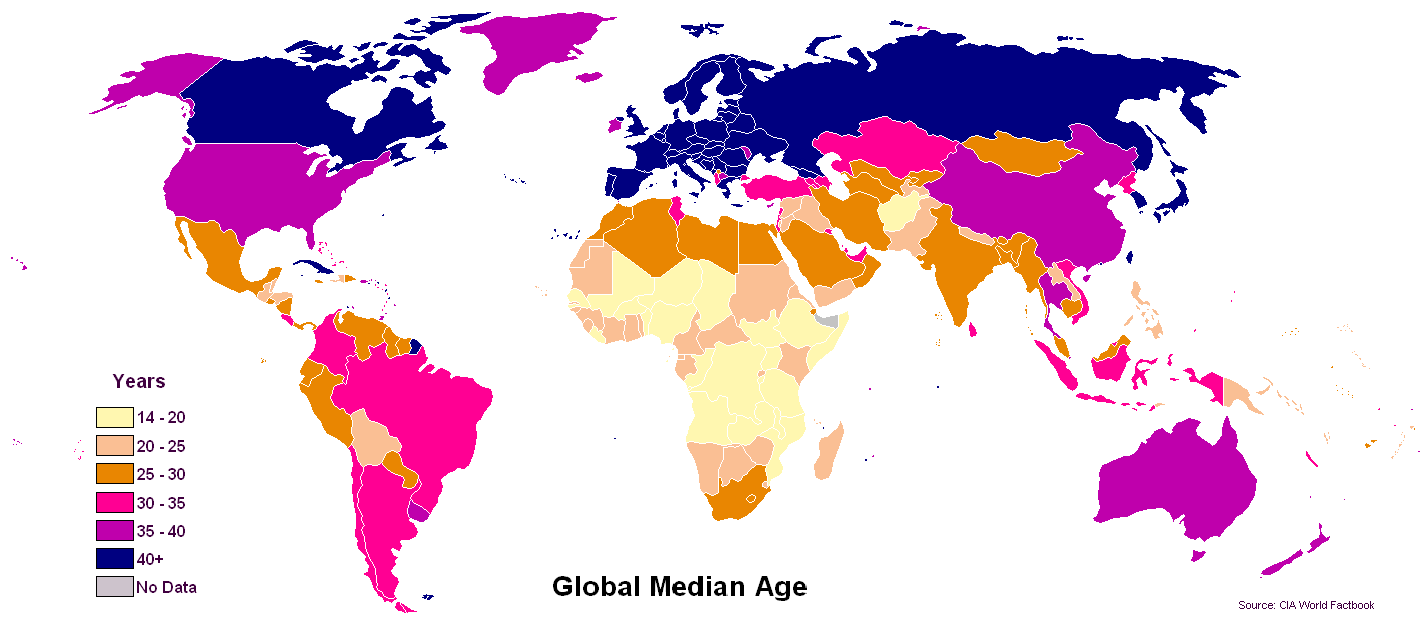
When I wrote Future Harvests, I dedicated a chapter on the changing demographics. It clearly appeared to me that he was right, and that the evolution of the population numbers between the different regions of the world will influence decisions about food production, food supply, and economies altogether. In Future Harvests, I indicate in which regions I think tensions would arise. The Arab world was number one on my list. Here is the map of the median age per country. The median age of a country is the age of half its population. Most of Arab countries have half their populations under 25. And what to think of Sub-Saharan Africa where that age is lower than 20? This is in sharp contrast with Western countries where almost half the population is older than 40. It was really striking to see the pictures of Tunisian rioters: there were teenagers. With a chronic unemployment, especially with the youth, reaching levels of 25%, and many people living on a pittance, riots erupting and governments being toppled are no surprises. This situation has been going on for a few decades. A new generation of people who see little hope and future is simply sending a message. Change must come or change will come.

In the news, everything is mixed together and it may appear a little difficult to understand what causes Arab countries to flare up like this. Everyone speculates which country will be next. Of course, food is mentioned as one of the many causes, and I can read all sorts of opinions about that. From what I understand, the riots in Tunisia were caused by the arrest of a food street vendor for not having the proper license, which immediately cut his meagre source of income. After the success of the Tunisian upheaval, it is not surprising to see neighbouring  countries with a similar demographic and similar dire economic situation following a similar path. Does this mean that there will be riots over the entire Arab world? Probably not all at once. It might not be successful everywhere, either. Other rulers in the region will make some moves, even symbolic ones, to defuse potential tensions. Both the Tunisian and Egyptian rulers are doing their best to defuse the tensions, and by resigning if this is what it will take to avoid complete chaos. The lesson is hard for Arab countries and they are now more aware than ever of the dangerous situation they are in. This is also a loud warning to the rich nations. However, at the Davos conference, the elite were not even aware of what was going on. Eventually, they heard it, and paid attention. Stock markets dropped for one day only as unrest was spreading in Egypt. Interestingly enough, markets were up on the days that a bomb exploded in Moscow’s airport and when Japan’s economic rating was downgraded by S&P. Certain things matter more than others. Europe must now realize that unless it helps its southern neighbours solve the problem, they are going to become a part of it. Yet, European countries seem to have trouble taking some clear position on the events. North Africa, just like the rest of Africa needs economic development. The people of these countries need to regain hope in the future. The generation that comes of age to leave the parents’ home and start, and support, their own families must see reasons why it will be possible for them. At this juncture, they doubt that they will be able to do so.

In Future Harvests, I mention two regions with a demographic time bomb waiting for a food security problem to explode. One is the area between Russia and the former Central Asian Soviet republics, extended to Iran and Pakistan. The other one is the border between Mexico and the USA. Mexico is disintegrating and law and order are fading away. Both these regions are going to have to work together to find strategies to ensure stability. This probably will not happen without serious clashes.

Many of the countries where booming demographics, poor economic situation and precarious food security are the normal state of affairs need a 21st century Marshall Plan. As I have presented in previous articles, the potential for feeding the world population is there, but the main cause of hunger is the lack of affordability of food. In 2008, there were food riots, but there was no real food shortage. The main problem was that the populations could not pay for it because the price had skyrocketed, especially the price of basic food staples such as rice, wheat and corn. This time, although according to the FAO, food prices are even higher than in 2008, we have not seen the same kind of riots. A reason for this difference may have been the fact that retail prices of food staples remained contained. So far.

Some sort of Marshall Plan is a necessity. Development and stability is in the interest of rich countries, just as much as it is for developing countries. Europe, Russia and the USA cannot thrive with countries on the verge of complete collapse at their borders. If there has ever been a good investment, this would be it. It is interesting to look at the example of China. This hard-core communist country was on the verge of economic disaster and famine, until they decided to put the doctrine on the side, and open their doors to foreign investments. From the moment that China decided to feed its people, things changed. For the communist government, this was the only way to stay in power. A billion hungry, and angry, people are impossible to keep under control. For the capitalist “Satan”, it was convenient to present the Chinese “opening” as a victory of the aspiring capitalism, but mostly it was the greatest opportunity ever to reduce labour costs of consumer goods and boost corporate profits. Investing in China was not exactly like the Marshall Plan that rebuilt Europe, but the amount of money that flowed into the country helped turn around a bad situation into what soon will be the world’s first economy. While the middle class in Europe is stagnating at best, if not actually disappearing, China has grown its middle class to 300 million people (the whole US population) and it aims at increasing the number to 850 million by 2030. China is still (officially) a communist country with no elections, but that does not seem to bother too many people. Developing nations need money to flow into their economies to create jobs.

Many people are asking whether we will see food riots again. Unfortunately, the answer is yes. Although there is much political talk about food prices and risks of riots, nothing is really done to prevent it from happening. It does not look like there is much political will to make the necessary reform to prevent extreme tensions. Most world forums of all sorts seem to be more of an opportunity for the wealthy and powerful to hobnob than a place where actual decisions are made. The WTO Doha Round, which if well completed can bring many solutions, takes for ever to come to a conclusion. It looks like reason and leadership are not prevailing much right now. It is highly likely that the world, and mostly the rich nations, will understand the message and act only when they will feel that their position is in danger, too. Food riots will come as soon as food affordability drops under an acceptable level of suffering. Of course, Asia, Latin America and Arab countries are the most likely candidates for such unrest, but rich countries are not immune to that, either. Especially the USA is more vulnerable that many may think. In 2009, the USDA estimate of households that do not have enough money to feed themselves was of 14.6%. Although the economy seems to have stabilized, it has not recovered yet. Moreover, the housing situation in the US is far from stabilized. Many Americans have been able to keep consuming somehow because they simply stopped paying their mortgages and could stay in their homes. The number of mortgage delinquencies is so high that banks cannot handle all the cases. Actually, most cases have been postponed, but one day some decisions will have to be made. If the banks played by the book and foreclosed all houses, the owners of which cannot pay the mortgages, it would result in an incredibly high number of homeless broke people. The banks would have to report serious losses. Today a report indicated that 11% of all American homes are empty. More foreclosures will increase this number further. How will these people manage to eat by then? Banks can decide to settle according to individual situations. There will be less broke homeless coming on the streets and the banks will have fewer losses. In a previous article, I had mentioned the risk of a decreasing dollar, especially the risk of inflation as financial markets play the commodities only to hedge against the loss of value of the dollar. Inflation in an economy that is stagnating will reduce the affordability of food for the less wealthy. Unemployment is staying rather high and I have not seen any report from anyone presenting a situation in which employment would increase in significant numbers any time soon. In 2008, Gerald Celente, a trend forecaster who predicted the 1987 stock market crash and the fall of the former Soviet Union, told that by 2012, America would have food riots, a tax rebellion, and even a revolution. At first, I was sceptical, but I am starting to wonder if he might be right. After all, during the food price hike of 2008, Americans were hoarding goods from the supermarkets.

The food riots to come will finally force government to intervene and do what they are supposed to do, which is to ensure the stability and the viability of the society by setting the proper rules for the game. Especially, proper regulation on commodities markets and corporate near-monopolies will become crucial for social stability. The only unknown is the cost of our procrastination.

Copyright 2011 – The Happy Future Group Consulting Ltd.
Feeding nine billion is an exercise in leadership

In a previous article, “Hunger is about more than just food production”, I showed how much more potential we have to feed the world than we commonly think. However, having the potential to do so does not mean that we will do it. Human nature has the habit of fluctuating between its best and its worst. Therefore, whether we will actually feed nine billion is far from done. In this article, I am going to reflect to what it would take to be successful at making it happen.

In my book, Future Harvests, I present the six principles that are critical to meet future food demand successfully: Sustainability, Innovation, Market Orientation, Pragmatism, Leadership and Efficiency. I had regrouped these principles under the acronym SIMPLE. While I was writing the book, I always came back to the same observation: success or failure to feed nine billion simply depends on us all. Someone needs to set the course and create the conditions to take the proper actions. The world needs leaders that will make food production potential the reality by 2050.

The job description is, interestingly enough, rather reminiscent of food production and genetics. In order to express the full potential of its genes, an organism needs the proper environment. This is exactly the role of the future leaders. They must create the conditions that will allow farmers to produce efficiently, yet sustainably.

The starting point will be about making the right decisions for both the long term as for the short term. We must preserve the potential to produce for future generations, but we must not forget to provide for today as well. Proper leadership will need to take into account the interest of many different groups and manage a balanced approach between money, people and environment. For sure, future leadership will be a balancing act. This will be easier to achieve if the leaders can sell the world their plan, which means that they must have one.

Leaders come from all layers of society. They are in government, in industry, in non-profit organizations, they are independent farmers, or they come from non-food related occupations. Adequate food supply is the very fundament of societies. Where there is hunger, there is no prosperity. Without food, there is not life, and just as importantly, without water there is no food. Developing food security is not an option; it is probably the most important policy sector of any society. This is something that we must not take lightly, even in rich countries where we seem to take food for granted. Things may change.

What story do our leaders need to tell and execute? The points that I raised in the article mentioned at the very beginning are a good place to start. The scandal of food waste, because it really is a scandal, must be dealt with and fixed. In developing countries, this is caused by a lack of infrastructure. It is only a matter of money. If world leaders have the will to get that money at work, it will happen. For some reason, they do not do it. Maybe it is a sign that things are not that critical after all. Compared with the amounts of money thrown at financial bailouts and stimuli of all sorts, the cost of infrastructure development looks ridiculously insignificant. Such projects would actually create jobs and increase the wealth of the populations where it takes place. This would not be artificial GDP boosting, but actual poverty reduction and increased food availability. In rich countries, food waste happens at the consumer end. What leaders of these countries need to communicate is a sense of responsibility. Wasting food is simply immoral, just like any other waste. If we take the example of nitrogen, the waste by leaching is estimated at about half the nitrogen spread on crops. This is huge and very damaging for two reasons. One is that the nitrogen ends up in the drinking water making it harmful, especially for pregnant women and infants. The other is that the production of nitrogen fertilizers uses half the world’s agriculture natural gas consumption. Efficiency is not a luxury, but it is a necessity. When efficiency increases, the amount of waste decreases. This works towards a higher sustainability, too. Food waste is one thing, but food consumption excesses or unbalanced eating habits are another area of work for our leaders. Eating more food than one needs is not only detrimental for that person’s health, it is also food that is less available to others. This pushes food prices up, too.

The effectiveness of leaders depends on their ability to communicate and get the message over to their dependants. Changing habits and infusing a sense of solidarity and responsibility requires patience, communication and proper education programs. Defining vague objectives or using hollow populist slogans and expressions will have no effect. Only charismatic leaders with strong convictions about what ensures the future of their people, even if it means sacrifices, will be able to bring such a change. It is not easy to do when your country is not on the verge of a terrible crisis. An interesting example about unilateral leadership is the decision of the Chinese government to slow down the number of new car registrations. They consider that there are enough cars. Getting a licence plate will be difficult in the future. In 2008, they decided to ban the use of disposable plastic bags in supermarkets, thus saving an estimated 100 billion bags and the equivalent of 37 million barrels of oil per year. Similarly, China is now the world leader in renewable energies. What actions did the Western democracies take about new car sales and supermarket plastic bags? When children died because of tainted milk, the Chinese authorities arrested all the people involved, and even executed two persons. Of course, the use of melamine in the milk was intentional, making the case extreme. However, in the West, I do not recall anyone being arrested or considered personally liable after deaths by food poisoning. My point is not to demand imprisonment of CEOs as a standard operating procedure, but I am sure that if executives of food companies felt that they could be personally liable for food poisoning, the precautionary principle would apply much more systematically. Leaders need to make understand that doing something wrong comes with consequences. Although there is much to say about China’s political system, one must admit that not having to think in terms of elections every four years and not having political campaign funded by any industry of NGO of any sort can help politicians focus on the long-term, too. Maybe the fact that China is plagued with so much pollution in the air, in the water and in the soils also makes the issue more acute for the leaders to resolve.

If the stick is one option to make people do what is right, the carrot is, at the very least, as important. Nothing stimulates people more than being rewarded for doing a good job. People are at their best when they know that others appreciate what they do, and that what they do makes the world a better place. Then, they do not see their occupations as “have to” activities, but as “want to” ones. Subsidies, bonuses, tax credits are all motivating tools to make people do the better thing, but the key is to have incentives that meet the goals without having harmful side effects.

Leaders also need to be innovators. Considering how fast our world changes, and the quantity of new knowledge made available about on a daily basis, many new possibilities will be available to solve old problems. Innovation is the child of human genius and, to cope with future challenges, creativity and adaptability will be major assets. It is the leaders’ role to foster innovation, yet by keeping in mind all long-term implications.

The ideal leader would have the qualities described by Plato in “The Republic”. Although it is an ideal, having committed leaders matching his description would increase our odds of success.

Copyright 2011 – The Happy Future Group Consulting Ltd.