258. Food systems are built in the market and on farms, not in cozy offices

As usual, listen here to a Chrome AI-generated podcast-type playback of this article:

Surely, you have heard the following statement many times: “the food system is broken”. It is a nice slogan, especially for activists. The reality is that this statement is rather meaningless. Criticism about modern agriculture is not new, far from that. Some time after my graduation from the agricultural university, I had bought a book titled “Le Krach Alimentaire – Nous redeviendrons paysans” (“The Food Crash – We will become peasants again“). This book, published in 1988, was written by Philippe Desbrosse who worked as an expert with the Commission and Parliament of the European Union of then. The book is a gloomy criticism of modern agriculture, making claims that world agriculture is on the verge of complete bankruptcy and the author wondered whether there still would be farmers and even bread by year 2000. He saw organic agriculture as the only possible and viable option for the future. Well, we know the answers to his questions and the solutions that have been developed during this period. Although his predictions did not come true, he did addressed a number of valid points that are still relevant today, such us the depletion of soils. His solution was just not realistic. Nothing is black and white. Nobody has it all right and nobody has it all wrong. Excessive alarmism never really helps, and neither does denial.
First, there is no such thing as the food system. There are many food systems because there are many different natural conditions, many different types of consumers and many different kinds of governments with different objectives and policies. A farmer selling directly to consumers operates in a system that is totally different than one who sells commodities on the world market. Different markets have different sizes in volumes sold and very different economics as well. The second error about the slogan is to say that “the system is broken”. It is not broken. It actually still works rather well, as it has been able to provide foods to an increasing world population. Not only does agriculture produce enough food, but when you factor in 1) the huge amount of food waste caused by either lack of proper infrastructure and market access or because of negligent behavior from consumers, retailers and food service operators and 2) the large amount of crop production used for biofuels (just in the US 40% of corn and 47% of soybeans), as I described in a previous article (maxed out or a planet of plenty?)

Since the publication of Desbrosse’s book, the world population has increased by 3 billion people! Food production systems are in constant evolution, as they constantly need to meet new challenges and new demands. Today’s farms and agriculture are rather different than they were 50 years ago. They are quite different than they were ten, even five years ago. Only people with little insight in food and agriculture think that food systems are frozen in time. Perhaps, they should visit farms and talk to farmers more often than they do, to realize the ongoing transformation of agriculture.

Food systems are the way they are for good reasons. They are not designed on a whim. There is a strong logic behind them. Although they are not broken, they are not perfect, either. Here, it should be a case of he who has never sinned cast the first stone. Personally, I do not know of any human activity that is perfect. All occupations have their flaws. Perfection does not exist. It is a hard truth to accept for perfectionists who usually are also born critics. What matters is not perfection but excellence. Everything has room for improvement. So do food and agriculture systems. It is work in progress. When you look at it from that angle, the future looks brighter. It means that there is hope. We just need to make work of it, which is much better than criticizing without offering any viable and practical solution or throw soup on Mona Lisa.

Food systems are about viable economics, not intellectual exercises

How food is produced and brought to consumers does not happen per accident. Although food systems are quite complex and are influenced by a myriad of dimensions (see a previous article on this blog: Why changing food systems is a challenge), their success -or failure- always come down to one thing and one thing only: their economic viability. It is about money. I know this is a boring topic that irritates some people but fact is that money plays a role in everything in our lives. Denying it does not change that fact.

There can be as many “intellectuals” assessing, criticizing or conceptualizing food systems as we want, food systems will have to pass the economics acid test. In a way, that economic check up is where the term food system meets its limitations, and where the concept of value chain is a lot more relevant. Indeed, the economics of the food system determine whether it creates value and how it distributes that value from the field to the plate.

It is important to emphasize that food systems need to produce what consumers are willing to buy. It may sound obvious. Yet, this part is often overlooked. If people do not buy a product, it means the end of that product and of its production system. The key criterion for people to buy or not to buy is value. If consumers find that a product has value, they show interest. If they do not see any value in the product, they ignore it and it dies. Then, comes the second part of value: does the price align with the perceived value or not? If consumers think that they get good value for money, they buy. If they think the product is too expensive for what it is, they do not buy. It is that simple.

The result of consumer interest is that the product -and its production system- has potential. But this is not the entire story, yet. The consumer end is only one part of the total equation and this is where the concept of value chain is quite important. All the steps before the point of sale to the consumer need to also find value in participating. All the links of the chain must have an economic interest in producing for the consumers.

The essential point of a value chain is that money enters that chain only from one end: the price that the consumer pays. That amount of money goes into the value chain pot, if you wish. Then, the trick is to make sure that all the links of the chain can get a share of what is in the pot so that they can continue to produce and participate. For each of the partners in the value chain, the share of the money pot that they get must cover their individual costs. No business can survive if they get less money than they spend to produce. The pot that I am mentioning is going to have to be shared through a cascade of commercial negotiations between all the links of the chain. They are all one-on-one negotiations and they do not take into account their impact on the other chain participants. As usual, a chain is only as strong as its weakest link, and that plays a critical role in the strength and the viability of the entire system.

Of course, they are many aspects that influence costs. Just to name a few, it is obvious that market size (volumes), government regulations, quality standards, infrastructure (logistics), relative bargaining positions (commercial negotiations) and training producers to have the proper skills for the new system strongly influence the total cost from producers to consumers. Every change in these criteria affects the total costs and how the money pot can be shared. These are major factors from the down-and-dirty business reality. These factors are never considered by the “food systems theoreticians” I pointed at earlier in this article. There are two main reasons for that. The first one is that this reality is very far away from the thinking of the theoreticians. The second one is that, they tend to perceive day-to-day business activities as not being part of the intellectual conceptualization. They fly at higher altitude. In other words, it is not their problem. Except that, with that very attitude, those who attempt to design the new, beautiful and ideal(istic) food systems often set food producers for failure.

A few examples for illustration

To explain what kind of consequences changing food systems causes, there is nothing like a few examples. I will try to be as concise as possible.

The rise of supermarkets. They have changed food distribution dramatically. Their success and growth are strongly related to cars and mobility. They have strongly influenced infrastructure and logistics. Their professional procurement approach has also changed dramatically the availability, the standards, the origin and the prices of the foods they sell. Their dominant position has also forced food producers to offer larger volumes and also to get bigger to rebalance the bargaining position. This has led to consolidation and much larger food corporations.

Role of government policies. A good example is the European Union. Its history of subsidies has shaped its post WW2 agriculture. It has deeply transformed the size and the purpose of farms. That in turn has also had profound consequences on the social fabric of rural areas. EU standards on quality, animal welfare and the ban on GMOs have also had a strong impact on the cost structure of foods and on the competitive position of European agriculture compared with other agriculture behemoths like the US or Brazil. Their policies will also have huge consequences on future European agriculture production volumes and trade.

Dogmatic policies ignoring market reality. Perhaps the most “beautiful” example would be the mandate from the French government to impose a target of 20% of organic dairy production a few years ago. They offered financial support to farmers to carry out the transition. Only problem has been that there are not enough consumers willing to pay the extra price for organic milk and organic dairy farmers had no market for their products. The result has been a massive crisis leading to many of the farmers who switched to organic to abandon organic production at great cost to them. Consumers did not perceive much of a value difference and would not pay for it. No real market research had been carried out but just dogmatic objectives. Result: financial disaster and major hangover.

Market-driven dairy success story. In Senegal, there is a dairy company called Laiterie du Berger. Their main product is yoghurt that they sell to urban population in the country. It has been a market-driven approach lead by France’s Credit Agricole (banking), Danone (one of the world’s leading dairy companies) and several NGOs. They started from the market end and partnered with local dairy farmers, most of whom were Fula people with small herds and low technical support. Laiterie du Berger has organized milk collection and as the business was growing and making progress, the Fula farmers are now getting technical support for their operations and better genetic material for their livestock. The result is that the farmers produce more milk per cow, produced the quality needed by the dairy company and have now better living standards. The production system has changed and many benefit from it, from farmers to consumers. Similar projects to improve dairy production are also underway in other countries. For instance, Nigeria is partnering with Danish organizations to improve the genetic level of their herds. Indonesia has plans to import more than 1 million cows to produce more milk for their population and one of their targets is to offer milk in schools. These are examples that show how a market-driven approach leads to 1) changes in production systems and 2) improve life quality. These are pragmatic and economic approaches not based on utopian dreams.

Developing new products without thinking from a solid market potential perspective. Current champions in this category would be investor-driven start-ups, usually based on inflated ego, and some weird messianic complex in some cases, more than on solid market research and understanding. Beyond Meat and other fake meat tech foods have been superb examples of how not to do things. The insect farming sector is another major flop. Insect farming companies are literally dropping like flies, going bankrupt one after another. They did not do proper market research. First, they got misled by FAO hype on insects. Secondly, they deluded themselves in their own green washing while reality proved rather different and had no idea of supply challenges. Similarly, tech vertical farms have been failures. The main reason has been that they serve very small markets. The world does not and cannot feed itself on expensive basil and arugula. Inevitably, the results are high costs that sales prices cannot cover and few consumers who care for the value of such systems compared with traditional ones. However, early big investors who knew when to exit and to cash in have sometimes done quite well, but perhaps that was their only real goal after all… shhh… Start-ups need to master business basics before making bold statements about saving the planet or revolutionizing food and agriculture. Actually, such megalomaniac claims should be red flags right away.

And I could give quite a few personal examples of business sectors in which I have been involved changes I have led in marketing and production. From my personal experiences, I would say that any change of system goes along with serious changes of economics. Often, costs and prices do not move in parallel and the new system fails for purely economic reasons. In particular, beware of those market surveys that pop up once in a while, stating that a “large” percentage of the population would be willing to pay “more” for a product if it were to be produced “better”. Such market research is usually set up more as a New Year’s resolution wish list than a true research. The intention sounds good but usually when in the store, the consumers look at the price tags and make very different decisions than the ones mentioned in these surveys.

New systems also require serious investments both from financial and skills training point of view. They often require mental changes that either people are not prepare to accept or that will cause resistance that will lead to some compromises. Anyway, the key is to do a lot of thorough number crunching, as the changes are far from simple to work out.

Conclusions

#1 Always be market-driven. Not doing so spells trouble. It is always much better to produce what consumers need and want than to produce and then struggle to figure out who will buy and for what price. Usually that price is significantly lower than what the theoreticians plan for. Market-driven is less risky, has higher rates of success, costs less and is also less difficult to manage. That is a non-negligible advantage. Building a production system for which the market and the entire chain are not buying in is doomed to fail.

#2 Food systems have consequences in terms of market size and costs. Changing a component of the system changes the cost of production and therefore has an impact on consumer prices and profitability. This in turn has an effect on how many people are willing to buy the products from the “new” system and therefore the size of that market. Nothing is worse for producers than a market that is oversupplied, except for a drop in demand because of a price change.

#3 Don’t be an idealist, at least not for too long. Most of the people presenting themselves as food system experts, be it from NGOs, academia or supranational organizations (such as UN agencies, and the EU, just to name a couple), very often seem to follow a particular bias. There are many of those around. Some themes are appealing. In particular small-scale farming and family farms. Unfortunately, such ideological and dogmatic approaches rarely deliver because they overlook the economic realities of all levels from farm to plate. Actually, it would be interesting to know how many of them have really had all that much of a positive impact, if any. At best, those that succeeded remained limited in small niches. Business people are usually more pragmatic and they focus on what works. They usually implement change when it becomes necessary. The food and agriculture industry is actually quite good and finding new ways. Their only problem is that they tend to wait too long and act only under an existential threat. The reason is mostly to not increase costs, but that often tends to be a rather short-term thinking mistake. The idealism part of building better production systems is commendable but it needs to go hand-in-hand with a solid dose of realism. Those who make that move on time will succeed. Those who stick to unrealistic goals will achieve nothing.

Copyright 2026 – Christophe Pelletier – The Food Futurist – The Happy Future Group Consulting Ltd.
253. The Future of Family Farms: Navigating Generational Changes

Listen here to a Chrome AI-generated podcast type playback of the author’s article

The concept of family farm plays an important role in the perception of agriculture. Consumers definitely like the idea of a small family-run farm. It gives them a feeling of things well-cared for, and they relate better with such operations because they feel it still has the human scale they feel has disappeared in all sectors of life. Governments and industry are also rather adamant to maintain the family status of farms, as it resonates with the general public. With the many changes ahead, what future will family farms face?

A turn of generations

In most parts of the world, farmers are getting old, in their high 50’s. In many countries, the current generation of farmers is expected to retire within a decade. A number that is often mentioned is that about 50% of farmers will reach retirement age in 10 years from now, in 2035. Here in Canada, I have even read the number of 40% within 5 years.

Of course, this presents a major challenge. Replacement is needed. The question is who will and who can take over the farms. Perhaps, the most difficult challenge for new farmers is to be able to buy a farm. Agricultural land prices have increased strongly over the past two decades and farms have become unaffordable to many farming candidates. One of the reasons behind the price increase is that agricultural land is now seen as an investment by people who have no connection or activity in agriculture. Aspiring farmers cannot compete with Big Money. Then, what is left to them?

Of course, one must buy only what one can afford. This could mean that new farmers might have to settle for less land, but can it be economically viable? The type of ownership -and owner- might also bring a new type of farming structure. There will be land owners who farm. Others will not farm the land themselves. The ones working the land might not be owners, but rent the land. It is easy to imagine all sorts of constructions between ownership and actual physical farming depending on how the money flows. As such, this is not new. In all times, there have been large land owners who would not do much of the actual work. There also always have been people farming the land based on a lease contract, or remunerated on what they produce from the land they work. The difference now is that the turn of generations also comes together with the end of the farming family that established the farm.

For very long, farms have been transmitted from parents to children. This is not going to be quite the case in the future. Many farmers’ children have chosen different career paths. They are simply not attracted by the farming life, for various reasons. They have decided to leave agriculture and have a life somewhere else. In many cases, this leaves the parents with no successor. On the other hand, a substantial number of aspiring farmers are not from farming families. They come from the cities, but they want to get into agriculture, also for various reasons. The question that comes now is: how to organize the succession? And that is not an easy process, especially from a psychological point of view.

A difficult transition?

For farmers, especially those who come from families who have owned the farm for generations, this feels like an end. Often, the idea of accepting to pass the farm on to a total stranger is not easy. From numbers I have seen in Canada, it appears that initiating a succession process is something that the men rarely do. The farmers’ wives are the ones who generally start the process. Let’s face it, letting go of a farm is a heavily emotionally loaded moment. For potential buyers, the main problem is of a different nature. The most important for them is to have a solid project. That is not easy, either.

Depending on all the different situations, many outcomes are possible for how farm ownership will look like in the future. What will the new farmers be looking for? They can choose for a smaller size and focus on niche high-margin productions. But they also can choose for large efficient commodity farms if they can finance the purchase, unless they would do that as tenants paying a rent to the non-farming owner. Everything is possible. What matters the most for the future is that farmers make a decent living out of agriculture. That has always been a challenge everywhere in the world, and it has always been a challenge at any time in history. Economic viability will determine what the farms of the future will look like and what they will produce. Future business models will be key. Of course, another question that may arise is whether all the farmland that is to change hands will find a farmer. If not, what happens to the land, and what happens to production volumes?

What is a family farm and its future?

The discussion of the farm size is going to happen, one way or another. Just for illustration, here are some statistics from the USDA / National Agricultural Statistics Service: in 2022, family farms represented 95% of all US farms. Small family farms made up 85 % of all farms. They represented 39 % of the farmland and accounted for only 14 % of the value of agricultural products sold. Midsize family farms represented 6 % of farms and produced 16 % of total agricultural value. Large-scale family farms, though only 4 % of the total, generated 51 % of the value of all agricultural products.

Non-family farms represented just 5% of all farms but accounted for 19% of the value of agricultural products, so more than all 85% small family farms together. This shows another reality of agriculture, which is that the lion’s share of agricultural production comes from a minority of farms. If farms become too expensive for individuals, could it mean that the share of non-family farms will increase in the future, as being on a payroll would be an attractive alternative for aspiring farmers?

The general public may love the idea of small family farms but to feed the world, large farms play an essential role. My point is not to say whether it is a good thing or a bad thing. Reality is just reality. If we want to solve challenges for a successful future, we must not delude ourselves in a romanticized idea of agriculture, but we must make sure that agriculture does a proper work to keep doing what it is supposed to do. I have a video on YouTube in which I discuss whether the farm size matters or not. In my opinion, size does not matter, and neither should the type of ownership. What truly matters is that, regardless of size or ownership, farmers do a good job. Skills and ongoing training are essential. Of course that includes quantitative aspects (volumes, yields, etc.) but also qualitative aspects, such as minimal environmental impact (all human activities have an impact) and sustainability.

Further, what is a family farm really? As I mentioned in the introduction, everybody is a strong supporter of family-owned farms, but the reality is a bit more complex than just who owns the land and the buildings. Family-owned does not necessarily mean independent. It is not the same thing. I know that this is a sensitive topic, especially considering the difference in size between farms and their business partners. It feels like David vs. Goliath. The romantic idea of the farmer holding an ear of wheat in his mouth, happily living off the land without pressures from the rest of the world is a nice one but, once again, reality is different. A farm cannot be isolated from the production and supply chains. These chains are quite sophisticated in their organization to ensure that products find their way to the consumers because, well, that is the purpose.

The farm may be owned by the farmer but it also says nothing about all the contractual relationships that exist between the farmers and the other players in that chain. This might become even more prevalent in the future, as some agribusiness companies are already looking at helping young farmers to get in the saddle. Making sure that there will be farmers in the future is quite essential for the rest of the value chain partners. Without farmers, they do not have a business. That said, the help will not be without conditions. Future farmers who can get in the business will likely be bound contractually with the company that provided the support in the first place. it would be unlikely that businesses would bring financial support to see those farmers go to a competitor.

What the future will bring for family farms will depend greatly on government policies. What will be their idea of their respective agricultures? How do they see the future of their rural areas? What role will they want for their agricultures to play in their economies and in geopolitics, or just politics? These are some of the many questions that will have to receive answers and the place of family farms will depend on the answers.

Next week: Animal-plant hybrid products: compromise or demise?

Copyright 2025 – Christophe Pelletier – The Food Futurist – The Happy Future Group Consulting Ltd.
251. Make Manure Sexy Again!

Listen here to a Chrome AI-generated podcast type playback of the author’s article

Manure is probably the underrated part of farming, animal farming in particular, paradoxically. It is considered as waste and as a burden. It sounds like everyone would love manure to not exist. Big mistake.

It used to not have this negative image, though. Here is an old picture taken in the Lorraine region of France. There, villages are laid out along the main street. They are called villages-rue, which can be translated as a street village. Houses are on each side of the main street and that is about it. The particularity of this region is that in the old days, the houses were piling the manure in the front, right by the street. You might not realize it right away, but having the pile of manure in front of the house had some major significance and was actually playing an important social function.

The boys of the village would be quite interested in courting the girls coming from homes with the most manure. Apparently, manure was rather sexy in those times. The reason is simple. The more manure, the more cows and therefore the bigger the farm and the wealthier the family. Manure was the promise of a nice dowry. In a way, manure was a status symbol, a bit like a big expensive SUV on the driveway nowadays. In those times, people valued manure.  This is no longer the case today. Yet, it is high time to reinstate it at its righteous place. We need to rediscover the sexy in manure.

Why is that, you might ask?

First of all, manure is extremely valuable because it is very rich in nutrients and is a formidable fertilizer. That said, manure is at its best only if we know how to produce it properly. In the old days, farms were mixed. They produced both crops and animal products. The crops -and pastures- would feed the animals and the manure would be used to fertilize the land on the same farm. In the modern times, farms have specialized. They produce either crops or animals. The circular system between plants and animals has been broken open. Crop farms use mostly synthetic fertilizers and animal farms store manure without having the land where to spread it themselves, and that is one of the issues of modern manure. I explained that in one of my YouTube videos: The importance of closing back the loops.

Circularity is one of the fundamental pillars for sustainability. By keeping loops open, and especially by keeping the system linear instead of circular, there is no true sustainability. We can delude ourselves by giving the impression that it is. The reality is that on the long term, a linear system that needs to be refilled constantly at one end will never be sustainable, like it or not,

In the case of agriculture, this is where manure plays its essential role. Manure is the interface between crop farming and animal agriculture. Crop farms crave fertilizers and organic matter. Manure, if well done, is the answer. By creating circularity, manure is at the very core of sustainability and of regenerative agriculture, which is too often more of a buzzword and a renaming of the term sustainability, which has been more and more accused of being mostly greenwashing. I have another YouTube video (A thin line between greenwashing and excessive enthusiasm? Example of regenerative agriculture) in which I go into more details about this.

As I said, the key about manure is to do it right. What does this mean?

It means that we need to look at the quality of the manure. Manure is one of the products coming out of an animal farm and as such, farmers should have a similar quality approach to manure as they have to their other products, be it milk, eggs, wool, meat or livestock. Manure quality is of the essence. The most detrimental assumption about manure is to look at it as an inert product. It is definitely not. It can evolve and ripen and that is what changes everything.

How does this work? Manure is nitrogen-rich product but it is carbon-poor. That is the weakness of “modern” manure compared to the one that attracted boys as much as flies. The carbon-rich components can be found in crops by-products. Think here as products like straw. The “old-fashioned” manure from mixed farms mixed the nitrogen-rich excrement of animals with the carbon-rich components from crop residues.

This is where magic happens!

When nitrogen and carbon are brought into balanced proportions, the bacteria present in the manure are going to make it ripen and mature, transforming it into a wonder product, at no extra cost. In this process, nitrogen and carbon are going to create an amazing synergy. By letting manure ripening, several things will happen with the final product.

  • There will be less ammonia emissions into the atmosphere, which reduces the impact on climate change.
  • The manure will smell much less, which no doubt will be appreciated by the neighbors.
  • The ripe manure has a lower water content than liquid manure (higher dry matter content), which means less transportation of useless water, and the costs associated to it.
  • The ripe manure will ensure a much better water retention in the soil, reducing the need for irrigation.
  • It will reduce the mobility of minerals, reducing the need for additional use from synthetic fertilizers and reducing the risk of minerals leaching into the waterway system and into the environment.
  • The stable organic matter will reduce the risk of soil erosion, thus preserving the soil potential and reducing the need for future amendments.

There you see, the formula of balanced nitrogen-carbon ripe manure (the good old-fashioned kind if you wish) is:

1+1>6

In modern specialized animal farming, the only manure that has such quality is from broiler production, just because carbon-rich material, such as wood shavings, is used as litter on which the birds drop their feces.

Farmers who might use carbon-rich material in productions for which specialization has hindered the use of such material probably end up with better manure than their counterparts.

For farms where no or little carbon-rich material is available the synergy formula cannot apply. The same thing is true for farms that do not use manure. They may use cover crops but those tend to be high in nitrogen. They may use liquid unripened manure but it lacks the synergies from the carbon. In all those situations, their formulas can be 1+0=1 or 1+1=2, but no more than that. That is far from the 6+.

Conclusions and further thoughts

The most important conclusion is that good manure is the best there is. The second most important conclusion is that we should take good care of manure and that animal farming is essential for the sustainability of food and agriculture at large. A world without animal farming would only lead to a massive additional use of synthetic fertilizers that have a major environmental footprint.

An interesting person to follow about manure management is Twan Goossens, a Dutchman who has broad knowledge of the topic, especially since The Netherlands have been struggling for some 50 years with manure surpluses and have been struggling the past few years with their own nitrogen legislation, which is horribly convoluted and so far rather ineffective. So far all they seem to have achieved is spending billions on buying out farmers without really getting benefit from it. Recently, the Dutch government started to change course on their approach to ammonia reduction in farming. They started to look at the issue in more pragmatic and practical terms, instead of using standards based on averages -and also on ideology- that depicted quite poorly the reality of farms. The recent elections of October 2025 brought a change of government and the future will tell which direction the coming cabinet will choose.

The main mistakes that the Dutch have made over the past decades have been:

  • To look at manure only as an inert mineral solution instead of looking at it for what it is: a living and evolving product.
  • To not realize that manure quality is key.
  • To confuse intensification and efficiency (see my previous post).
  • To not think circular.
  • To focus on expensive technologies that turned out to not be economically viable, instead of letting Nature do the work at low cost (just feel the temperature of a manure pile to realize that microorganisms actively work for free).

Another interesting source of information is the Wageningen University and Research agro-innovation center De Marke, which focuses on solutions to make animal farming sustainable and where manure management is one of their research areas.

You might have your own opinions about animal farming. The real issue is not animal farming as such but how we can close the loops again between crop farming and animal farming. The production system is really what matters. Specializing farms does not mean that it is impossible to close the loops. We need to be creative. India exports cow dung over long distances to overseas countries, even to the US. If they can do that, then has to be possible to move both carbon-rich material (high dry matter) and ripened manure (higher dry matter content than liquid manure) between regions. If you look at Europe, North and South America, just to take to obvious examples, the distances between crop production regions and animal farming regions are not that big, and certainly less than between India and the US.

One last thought, though.This article was about animal farming, and animal farming exists for a reason. We must not forget what is probably the least circular part of the entire food chain: people. In the end, food ends up in the homes of consumers, and then what does happen to the “human manure”? It does not return to where the food has been produced and it does not fertilize anything, not to mention the incredible amounts of water wasted to flush the stuff. Human poop and pee, being the end destination of the food chain also accumulates all sorts of contaminants. Think here of all sorts of pharmaceutical and chemical compounds people use. Those would be a challenge to recycle. It will only get worse, as the population is not only going to increase and will be increasingly concentrated in urban centers, making the consumer end of the food chain even less circular.

Next week’s article: Three key Technologies that will transform Food and Agriculture, plus a bonus one

Copyright 2025 – Christophe Pelletier – The Food Futurist – The Happy Future Group Consulting Ltd.

250. Three overlooked consequences of climate change we need to address

Listen here to a Chrome AI-generated podcast type playback of the author’s article

The conversation about climate change focuses too much on its causes and not on what we must to do in the future. At least, that is how I feel about it. The whole science behind why climate change is happening is important. I will not argue about that, but tons of CO2 in the atmosphere or 1.5°C vs. 2°C remain abstract concepts in the minds of most people. It is necessary to translate the change into concrete actions. Of course, a lot of that is already happening but some very basic consequences need to be addressed with more force than has been the case so far. In this article, I will review three of these consequences that I consider as the most pressing, yet too often overlooked, consequences:

Heat stress

Warming means higher temperature, but looking at average numbers, such as for instance 1.5°C does not indicate the real problem. Certainly, the average temperature matters from a planetary point of view but we all experience temperature swings that are as unpredictable as severe. The swings are definitely not in the range of 1 or 2°C.

For instance, plants may have a great start in the spring and then comes frost that can destroy an entire harvest in orchards within a few hours, or a sudden heat wave fries crops and in particular vegetables. Heat affects farm animals, too. I can remember when I lived and worked in poultry processing in The Netherlands, we always had some episode in the summer of higher temperatures and high humidity that seriously affected the welfare of chickens. Our company always had to plan for lighter average weights in the summer as the chickens would not eat as much and would not grow much, either. The introduction of misting installations definitely alleviated some of the problem. At least, we did not have to deal with overnight deaths by heat suffocation of entire flocks of birds, but we certainly had less tonnage because of the heat. Heat had a cost. Less tonnage meant less revenue but also higher costs as overhead costs per kg would be same regardless of the number of birds.

Research on the cost of heat stress on dairy cows has determined that in 2020, heat had affected milk production by an estimated 50 million tons at a cost of US$ 13 billion, according to IFCN (International Farm Comparison Network). This tonnage represents roughly 5% of the 2024/25 world milk production. Their estimate for 2050 is of a production loss of 90 million tons (9% of today’s world production) for a value of US$ 90 billion.

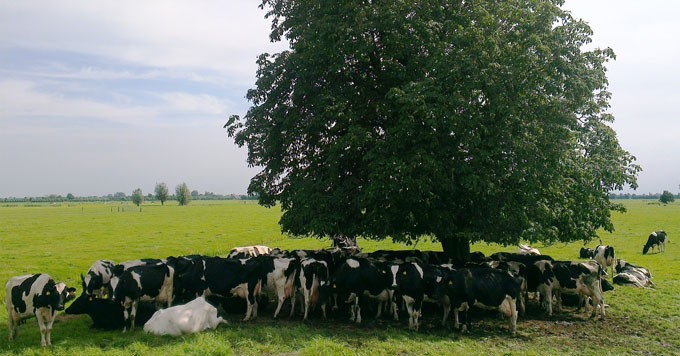
There is only one species of warm-blooded animals that I can think of that likes to roast in the sun: people. Other species are much smarter and tell us what we will have to do. On a hot sunny day, animals look for shade.

Shade is going to be a very hot (could not help the intended pun here) topic for the future. Actually, it is already getting more and more on everyone’s mind. Many studies have shown that shade reduces the temperature at ground level by substantial numbers. In paved environments, such as cities, the temperature difference varies in the range of 10 to 15°C. On pastures, the numbers seem to be less, but still in a range of at least 5-10°C.

There is already research carried out on the benefit of shade and how to bring more shades to animals. For instance, France’s INRAE (French Institute for Agricultural and Environment Research) is looking at strategies to reintroduce trees on pastures and determine which tree species would be the most effective. Besides trees as a source of shade, there are already some combined cattle or sheep husbandry paired with solar production on grasslands, with some very positive effects. The farm produces cleaner energy and the shade not only improves the animals’ welfare but it also protects the grass from the heat and help providing the animals with feed. In a way, this is a win-win-win. Heat stress is not just affecting feed quantity but its quality as well. There are also farms that produce vegetables under solar panels for the same reason: the panels protect the plants from the hot rays of the sun. Shade is going to b part of the food landscape. Early, I mentioned orchards. I expect many regions, like the one where I live to use shade screens as a standard production method for fruit production.

For the future, heat stress will lead us to rethink production locations, genetics of plants and animals, the type of housing for animals (and for people, too), feeding systems and feeding programs for animals, water management systems and water supply and conservation strategies.

Heat stress and shade are also going to become part of urban landscape. I recently was in Valencia, Spain. Some parts of the cities had some drapes spread on poles to provide shade and they also had misters to cool down the people sitting on some city squares. Those systems were not all that effective if you ask me. The best place was to be in the old river bed, now turned into a park where the trees were offering the best cooling effect in town. Spain is used to heat but it does not make it less of a problem. The most pressing action will be needed in countries that used to be temperate and where cities -and countryside- are not prepared and not equipped to deal with the heat that is likely to hit in the not-so-distant future. Heat is not just about crops and farm animals. It is about people and their pets, too.

Water availability

It does sound corny to say, but it is true: water is life. With climate change, former “predictable” precipitation patterns are disappearing. It looks like there is either too much water falling at once or hardly any at all. Of course, this has an impact, especially when it happens in combination with temperature swings. Droughts have always affected harvest volumes of crops and pasture production. Beef is a good illustration of that about the last couple of years in North America. Although drought is not the only reason, its impact of forage availability has noticeably contributed to the reduction of beef herds, and supply does not meet demand as it used to. The result has been a major increase of the price of beef at consumer level. Here in Canada, the price in the supermarkets of prime cuts has about doubled in a year time, and the price of ground beef has increased by about 50%.

Climate change shows up on the grocery bills and it hurts many households. Beef is an example but consumers can see the impact of climate event on many products, not just meat but fruit and vegetables, too. As such, it is not new. In the course of my life, I have seen unusual weather patterns affect the prices of food, but it just seems that the frequency and the impact is getting higher. We will see, but we need to manage climate events better. Artificial intelligence will likely be a big part of that solution.

There is what we can do about production systems and with the kind of technologies we will have in our toolbox, but there is also what we cannot influence. For this very reason, it is clear that water availability is going to redraw the world food map. Certain productions will disappear from some regions and reappear somewhere else. For example, the Bordeaux wine region in France seem to be at risk of not being able to produce the great wines it used to produce. On the other hand, it seems that England might have some ideal climatic conditions to produce excellent wines. Another example can be the Midwest region of the US which is a major crop producer, corn and soybeans in particular. The region depends heavily on the Ogallala aquifer for irrigation, but this aquifer gets depleted much faster that it can replenish. Water management has become a hot topic and a number of farmers, in particular in the State of Kansas, have switched to sorghum as an alternative to corn for animal feed, as it requires less water than corn.

The politics of water are another aspect of water availability that we rarely hear. Yet, we should pay attention. For instance, in central western France, there are hefty -and violent- conflicts about water management. Farmers wanted to have a number of water basins build so that they could keep producing their regular crops by using that water for irrigation. The basins would be filed by the river system in the winter. This project has faced strong opposition and many clashes have taken place between demonstrators and the police. Another example of water conflict is the dam that Ethiopia is building on the Nile River, which is causing great concern and reaction from Egypt and Sudan that see a risk for their water supply abilities for the future. And let’s not forget that the populations of these three countries are expected to increase strongly in the coming decades. Another example is what happened between India and Pakistan during the 2025 conflict in the Kashmir region. India threatened to stop its rivers from flowing into Pakistan. As you can see, as it becomes scarce, competition for water will become fierce. Water is going to be a major strategic and geopolitical resource with the potential to create major crises and possibly wars.

Cities also need to have sensible water supply and water use plans in place. A few years ago, Cape Town had dire water supply issues. Mexico City also got some worries. Considering the regions where population is expected to grow the fastest, water is going to be a major cause for concern. The number of megacities that are forecast to be built in Asia and Africa should keep many people awake at night. New cities with multimillion inhabitants are going to have to rely -and to depend- on mostly local water sources and the question is whether they will be able to succeed. This will require major investment and astute planning for the future.

Diseases

As climate changes, so do the local environmental conditions for living organisms. Some regions that were inhospitable for some species might become better suited in the future and we can expect to see a change of ecosystems as a consequence. This can happen for all sorts of species, large or small to very small. I will give here a few examples to show the variety and the complexity of the impact of climate change on the possible spread of diseases.

In cattle, two different problems have appeared recently. One is in France. A number of cow herds have been infected with the lumpy skin disease, which is a disease propagated by flies and mosquitoes. It is a disease that was until now limited to Africa. Now, it is in the French Alps near Switzerland and other cases have been detected in the Pyrenees, not far from the French-Spanish border. There is no cure available and the infected herds are being culled. Just imagine if the disease spreads further what the consequences can be for perhaps all of Europe. The second example with cattle is in Mexico and the US. Cases of Mexican cows infected with the New World screwworm have been identified and immediately, the US closed its borders to Mexican beef. Although there might be some politico-commercial aspects at play, fact is that the screwworm is an ugly disease vector. It basically eats the flesh of the cattle, but it could do the same to people. Texas got rid of that pest in the past with some difficulties and they do not want to see it reappearing, for good reasons.

I just mentioned vectors, and vectors we need to closely monitor. Avian flu, also known as HPAI or H5N1, is very contagious and is carried by wild birds. Monitoring of migrating birds and their routes is essential to identify where the disease could be present and take proper action to protect avian farms. Climate affects the migration routes and old patterns are probably already obsolete. There are already some systems in place, but I believe that more is going to be needed. Here too, artificial intelligence might be a big part of the solution. That will require sensors in bird houses, on farms, in the vicinity of farms and everywhere possible on the likely migration routes. It will need to be a 24/7 alert system. The problem -and the solutions- are similar when it comes to the increase of the population of wild boars in many parts of the world. Full monitoring will be essential in the fight against ASF (African Swine Fever). It also will be essential to understand the ecology of diseases if we want to stay ahead of the game.

In the world of small and very small, just look at the spread of tiger mosquitoes in Europe. A large part of France has been colonized and it will not stop there. Tiger mosquitoes carry “traditionally” tropical diseases such as dengue fever, yellow fever, chikungunya or even zika. Climate will contribute to the spread of many new diseases, be they plant, animal or human diseases.

The name of the game for the future of health is PREVENTION, and that needs to be imprinted in everyone’s mind in big bold capital letters. Protecting the immune system of our plants and animals as well as ours will be on top of the priority list. Let’s hope that politics will not stand in the way. We need to protect all we can. Once that is done, we will have time to discuss if we like it or not. It will be just like with the oxygen mask in planes. Put it on yourself first and then help others. We will have to develop new vaccines and new medication. For agricultural purposes, the use of gene technology will also help make some of our crops and animals resistant to diseases. Monitoring, which I mentioned earlier will also be key to protect ourselves and our food production. A major component of prevention is anticipation. We have the technologies to be able to monitor, to run scenarios and to develop solutions. We must use them to their full potential. We need cures, because massive culling or production losses will not be an option with two billion more people on Earth in the coming 25 years. Remember, 25 years is only one generation.

Copyright 2025 – Christophe Pelletier – The Food Futurist – The Happy Future Group Consulting Ltd.

245. Is EU food and agriculture about to become a museum?

Listen here to a Chrome AI-generated podcast type playback of the author’s article

I was speaking recently at an event in Spain and by the end of my presentation, I had a slide on which I indicated which regions I saw as the winners of the future. The title and subtitle of the slide were:

“Winners: Conquerors

Bold, ambitious and determined fighters”

Being in Spain with many Europeans in the audience, I got the question of why I did not mention the EU among the winners. Fair question, and by the way, Canada, my second country of citizenship, did not appear among the winners, either.

About the case of the EU, I shared my concerns about EU policies which I find counterproductive. Although I find the idea of a Green Deal to make agriculture more sustainable a good idea full of good intentions, I do not have the same enthusiasm about the policies and means used to achieve improvements. I find the policies too much into the ideological and dogmatic and not enough into the practical and realistic, as I mentioned some time ago in one of my YouTube videos on the subject.

As the conversation was progressing with the audience, I lamented that the future would not be for the timid and that in particular that the EU does not seem to know how to stand up to the Putins and Trumps of this world. The EU has a leadership problem. Everyone can see that every day. I went as far as to say that if the EU does not wake up soon, it will end up being a museum. Apparently, this statement had impact. It obviously created a shock, and from a few one-on-one conversations I had later, it sounded like it was a useful shock. The argument of the quality of foods from the EU and their heritage was raised and I confirmed that I, for one, always appreciate these traditional products. Since we were in Spain, I mentioned one of my all-time favorites which is the Jamón Ibérico (I truly am a total fan). Every time I am in Europe I certainly love to go shopping on markets and I love the quality of the foods that I find.

My point about the EU turning into a museum was not that I do not consider the EU as a future winner because of its quality of foods. My point was because of the policies, EU farmers and producers are less competitive and will not be able to grow. The EU market share and influence will decrease because of such policies.

And this is a huge pity because European farmers are at the top when it comes to efficiency, high technical performance, low waste and, yes, product quality. European farmers and the associated industry are actually incredibly innovative and resourceful. Unfortunately, they often do not have access to the same amount of resources or of political support as in some other regions of the world. Personally, it really hurts my feelings when I see such top farmers being bought out and leave agriculture mostly for dogmatic reasons. Just imagine a company where the Human Resource Department would systematically get rid of its top performers for reasons that have nothing to do with performance. It would be stupid, wouldn’t it? Well, truth is that such idiotic actions actually happen in some companies, but that is another story. What is the result down the road? It is a leveling down of the sector, which follows by a weakened competitive position, a loss of market share, of presence and eventually of viability. And that is exactly what I fear is going to happen to EU food and agriculture.

The original European food and agriculture policies were about food security, which made a lot of sense after the harsh time of World War II. It is a good philosophy. It must never be removed for the top priority of the EU, or of any country that wants to play an influential role. I have been thinking of whether there ever was an economic powerhouse that did not have food security, and I cannot think of any. Often, it feels like the critics of food and agriculture take food for granted and do not even understand what it takes to bring it onto tables. My advice here is simple: do not ever take food for granted and make sure that those producing it can keep doing so!

For these reasons and to be among the winners, the EU must have bold, ambitious and determined food and agriculture policies. The food and agriculture sector must be vocal about this and must force every EU politician to answer a simple question: do they want to support their farmers or do they want to set them up to fail? It is either one. I cannot be both or neither. Just that simple. Further, the EU should also distantiate itself from the UN FAO goals of all sorts, most of which are more anchored in wishful thinking and ideology than they are in pragmatic reality. Fact is that most of them are lagging and will not be met on time. It is good to have goals, but when they are not realistic or attainable, they should see it as a duty to amend them and readjust goals and timelines. Just a look at the state of the European automobile industry is enough to see the damage that wrong policies, as I describe above, can generate. That nonsense simply must not happen to EU food and agriculture.

So, how to make the EU among the winners and avoid it to become a museum? Well, a couple of principles must be applied:

  1. The EU must produce the quantity (and quality) of food that the EU consumers need, so that there is less need for imports. A market-driven approach is key. Unfortunately, all food and agriculture policies always seem built from a production-driven angle.
  2. EU farmers and producers must be supported by their politicians, so that they are at least as competitive as their counterparts from third countries, which would make it easier for EU buyers to choose EU products first. Saying “choose EU” or “EU has the best food in the world” has about no impact with buyers. In the end, price always plays a major role and often is the major parameter. When it comes to competition, things are very simple: those who do not have a strong competitive position will lose. Like it or not, that is the way it is. And it is even more so with undifferentiated commodities for markets such as foodservice and processing industry for which the product is only an ingredient. For niches such as traditional products or regional specialties, it is possible for producers to protect their turf better, but such niches are not the lion’s share of consumption. Such niches will make a great museum, but what about the bulk of the EU market?

Nonetheless, there might be a silver lining about some of the policies. For example, The Netherlands have struggled with their nitrogen emissions reduction policies. After spending a few years persisting in error and wasting several billions of Euros with no result by buying out farmers and for those who could continue trying to force them into a rigid frame of rules telling them what is allowed and what is not, policymakers are rethinking the approach. Of course, anyone who understands farming knows that such rigid frames based on dos and don’ts simply do not work because agriculture is the opposite of rigid. It constantly faces changes, fluctuations and unexpected events. The Dutch farmers knew that. They wanted a more pragmatic and feasible approach, and opposed the policies but to no avail. Personally, I find essential to involve farmers to work on solutions fir a better agriculture. That was the topic of another video of mine. Farmers know the work. They know what works and what does not. Yet and too often, policymakers do not seem al that interested in listening to their input. That is a mistake.

In The Netherlands, the approach is now changing. Instead of imposing a script, the government now wants to focus on goals of nitrogen emissions reduction and leave it up to farmers to decide how they want to achieve the goals in the most effective manner. They will have to show progress and depending on the results might have to take corrective action if needed. To me, this makes sense. It is about results and that is all that matters. The how is secondary. Now, the thing is that elections are coming next month in The Netherlands and, depending on who wins, the new policies might be abandoned. We will see.

Copyright 2025 – Christophe Pelletier – The Food Futurist – The Happy Future Group Consulting Ltd.

Why changing food systems is a challenge

Listen here to a Chrome AI-generated podcast type playback of the original article

Over the years, there has been no shortage of publications and conferences about the theme of “changing the food system(s)”. Yes, like everything else, nothing is carved in stone and ongoing evolution is a part of life. Yet, it is obvious that change is slow and there are many reasons for it. Well, there is one main reason actually: the economics of food production. Money is always what makes or breaks change. In previous posts on this blog, I mentioned the importance of economics many times, and in particular the need to change the economics if we want to succeed with change. To change the economics, we must look at externalities. For those who follow my blog, you know that externalities is one of my recurring topics, simply because we cannot ignore them. We cannot ignore them because of their very nature, which is about identifying the long-term effects -positive and negative- of our activities. If in doubt, the reason for the demand to change food systems is obvious: it is about the negative long-term impact of food production on the very conditions that affect food production and our future ability to do so. Nobody argues that we must have sustainable production systems. The difficulty is to agree on what is sustainable and what is not. One of the main causes of the disagreement is that many people seem to confuse efficiency and intensification. I posted a video on my YouTube channel some time ago, in which I explain the between those two terms and why it is so important not to confuse them, because otherwise we end up with all sorts of misconceptions and keep disagreeing because we do not use the same definition. I encourage you to look at the video.

As I explain, it is all about finding the optimum point from an environmental point of view. Environment is not the only aspect to consider, though. The optimum also needs to match technical goals, especially meeting food production volumes. It must be optimal from an economic point of view, too. If the products become too expensive, consumers don’t buy, and if they are too costly to produce, farmers and food manufacturers will stop producing. Everything is possible but everything has a cost. Once, when I was working in the poultry industry, I had a customer who asked me for a product specification change. He wanted us to trim chicken fillets in rather drastic manner. As the conversation went on, I had told him just that: everything is possible. I added that we probably could even cut the breast fillets in star-shaped bits if he wanted to. I just added that it all came down to a matter of whether he would be willing to pay for the additional costs. Actually, it was a friendly conversation, as we had known each other long enough to trust each other. Yes, everything is possible. It just has a cost but is the customer willing to pay for it? That is an important part of the conversation about changing food systems. Is the consumer willing to pay the price for a more respectful product? Well, sometimes yes and sometimes no. And some consumers are willing to pay and others are not.

Really, externalities are essential. The additional costs for a better system are about internalizing the externalities. It is about pricing products the right price, not just from a money point of view but actually from a triple bottom line point of view. Further, externalities are not just about the unit that produces the final product. It is about the entire system. Too often, a link of the entire chain makes sustainability claims simply because it shifts the environmental and/or social problem to other links of the chain, but as a whole, the system has not really improved. The externalities -and the responsibilities- have moved in the chain but the problem remains. When this happens, the link claiming to be “sustainable” is just forgetting to look at the entire system. Of course, people with a bit of critical thinking will notice that the problem has not been eliminated but just simply shifted. That is when the accusations of greenwashing arise, and rightly so. One link of the chain looks cleaner and probably think it is all shiny, but the entire chain is just as dirty as before.

But the greenwashing issue is not just a matter of producers and industries. Governments do that, too. Often, governments try to internalize externalities with subsidies and taxes but it is often simplistic and just focused only one element of the entire system. They make the same mistake. Let’s face it, it is often the result of political calculations and trying to offer good optics, but it is often short-sighted, nonetheless.

Another problem with externalities is that they are extremely difficult to calculate with accuracy. Just to illustrate what I mean just take a look of diagrams that the food system specialists like to produce. They are very complex, and rightly so because the system includes many dimensions and aspects. Here is one I have found on Dalhousie University website. This one is relatively easy on the eyes. Some others can be quite a bit less readable.


Those who produce such diagrams of food systems should calculate the externalities for all the lines and arrows they put in the charts otherwise the chart is just some intellectual exercise that will not produce much progress, and they tend to be rather useless as long as no economic aspect is included. Without the externalities of the existing system that we wish to replace and those of the new alternatives, we are stuck into rather unproductive dynamics.

For how much industry and governments approach systems and how to replace them in often incomplete manner, NGOs and activists make the same mistake. Wishing to see something disappear and be replaced but something more appealing is not enough. Actually, it is more in the realm of wishful thinking, which is why progress is so slow and encounters so much resistance. About activists, I often say that they are quite good at identifying problems, but quite a lot less so at finding workable and viable solutions. Opposite to that, industry is really good at finding solutions despite lacking the proactive attitude to recognize and acknowledge issues on time. They tend to make work of it only when severely challenged by the activists. It is pretty easy to see where the synergies are, don’t you think? A piece of advice that I have given n a number of occasions has been: “Talk with people you don’t like! That’s the only solution”.

Trying to change the food systems also faces a more general hurdle, which is the entire economic system. The entire economy is built around growth. As such, there is nothing wrong with growth, as long as it is “good” growth. In previous posts of this blog, I have mentioned the need to shift from quantitative growth to qualitative growth.

Just let me illustrate this with simple examples. A common joke about the GDP, which is our indicator of growth, is that if we decide to take rocks and smash all the windows, the window industry will get a huge boost as everybody would ask for new windows, but in the end from a quality of the society point of view, we would not create any improvement. We would be back to where we were, nothing more. On the other end, thanks to the window industry boom, the GDP would show a nice jump. It would be quantitative growth but there would not be qualitative growth.

Now, let’s imagine than instead of enticing people to always eat more of everything, and in particular of poor-quality foods, we would make sure that they eat really good food and have really good diets, the impact would be noticeable. There would be a lot less diabetes, obesity, cardiovascular diseases and other forms of morbidity caused by bad diets and bad foods. Quantitative growth would probably suffer, but qualitative growth would be impressive. The externalities would shift from negative to positive ones. For one, the costs for health care would decrease significantly and since there would be fewer sick people, all the other medical procedures could be carried out faster and thus also affect people’s health positively. I know some will tell me that this would affect the pharmaceutical industry negatively. True, although it also would mean that they could refocus they activities on other more difficult diseases to tackle and also grow as they would expand in other medical areas. Anyway, I hope that you get my drift about the difference between quantitative and qualitative growth. On a personal note, I really think it would be much better to help people eat just to meet their actual nutritional needs, therefore eat less but eat better. Their health would be better. There would be less food waste as there would less of it stored as unnecessary and useless excess body fat. Food producers would have to change the way to remunerate themselves differently, which is what I also mean with changing the economics. Quality focuses more on margin and less on volume.

In the end, we can create our own problems or we can create the solutions. Let’s think quick because time is running out.

Copyright 2024 – Christophe Pelletier – The Food Futurist – The Happy Future Group Consulting Ltd.
#futureoffood #futureofagriculture

What is food -and implications for the future?

I recently realized that in the almost 10 years that I have been active with the topic of the future of food, one question has never been asked. I never brought it up, either -until now. Yet it is an important one, especially in a time where food start-ups are popping up like we were living in the dotcom era all over again, presenting all sorts of new foods with huge investments to back them up. The question is: what is food?

The question may sound simple, but the answer might not be as obvious as you might think. Food covers many dimensions, the importance of which varies greatly, depending on whom you are asking. The most essential dimension of food is nutrition. Living organisms need nutrients to live. Without food, they die. Food is what provides the nutrients. It sounds obvious, doesn’t it? Considering the high percentage of overweight people, nutrition clearly is not a discipline that many really master. One of the reasons for this health disaster lies in the psychological dimension of food. Let’s face it, how many of you ever build a meal solely on good rational nutritional logic? No, we eat what we like and we do not eat what we do not like. The reasons for our taste preferences are plenty. They have to do with the way our parents have taught us about food, with cultural preferences, with experiences in early life, with religious beliefs and with all sorts of beliefs that have nothing to do with religion just as well. We all have our own particular systems of reference when it comes to food.

To illustrate my point, here are a few anecdotes. Being French from birth, I will start with frogs and snails. As most people know, the French have a reputation for their cuisine, although some ingredients have shocked some of their neighbours for ages. Snails and frogs legs are among the typical clichés of French food, to the great disgust of the Brits who, besides snails and frogs, are not too keen on rabbit and, even more shocking, on horse meat. In turn, the French have quite the low appreciation about typical British cuisine. Tastes differ. If snails have been a disgusting thought, they seem to turn into a desirable delicacy as soon as they are served as “escargots” (the French translation of “snails”). Yes, food is a lot about psychology. Another example of the psychological aspect of food that has always baffled me is why vegetarian products have to mimic meat. It sounds contradictory, but that is the way it is.

When I moved to the Netherlands, where I spent 13 wonderful years, one of my first visits to a grocery store included buying eggs. It might sound like the simplest thing in the world. Think again! I walked around and around in the store looking for eggs and I could not see any. I finally spotted someone from the store and asked if they had eggs. He pointed right behind me and said: there they are! I turned around and it took me a couple of seconds to finally see them, and there they were indeed: an entire stack about as tall as I am. I passed by the stack of eggs several time during my search and did not “see” them. There was a simple reason for that: the eggs were white and all I had seen in my life were brown eggs, although I knew about white eggs. My brain simply did not make the connection. All I could see was a huge stack of what I genuinely thought were ping-pong balls, because the packaging was also different from what I was used to.

When it comes to food, taste is important but many other physical qualities influence what we like or don’t like such as colours, smells, texture, how it feels when touching. Food is really something that involves our senses, except maybe for sound, which is more useful when hunting, I suppose. It is not just about number of calories, grams of protein or fat. It is how we experience it from the moment we see it and inspect it with our noses, mouths and hands.

Our senses, and how they have been trained, decide what we perceive as desirable or as repugnant. This part is not in the realm of rationality, yet it is not about being irrational, either. The irrational part is more in the domain of our system of reference and beliefs. For how irrational they may seem to those who do not share these beliefs, they are quite logical and true beliefs for those who adhere to them. In the always controversial conversation about food and agriculture, it is quite important to acknowledge these beliefs and accept that different people have different views about food. Without this acknowledgement, there cannot be much of a constructive conversation, which then always evolves into a fight.

The question “What is food?” is only part of the equation when looking forward. The other –often neglected- question is: Do people know what food is? The answer to this one is really simple: it is a resounding NO!!! I can see that every day around me, and it is appalling. With urbanization comes the detachment from agriculture and Nature. Often what is left is some vague recollection or stories from previous generations that have been gradually altered and turn into beliefs of all sorts. The result is a lot of misconceptions, prejudices and dogmas, and this on all sides regardless of people are pro this or anti that. Every tribe now has its own mythology when it comes to food and agriculture, picking half-truths and only the facts that conveniently support those half-truths. Nonetheless and regardless of what beliefs they follow, most people have only a skewed knowledge of food at best, and most have none whatsoever. One of a side effects is the old adage that in the land of the blind, the one-eyed is king. Problem is that the one-eyed is not always ruling with integrity and truth in mind but more from a power and money point of view.

With all these points in mind, the question that needs to come next is what will food be about in the future? What will be the future beliefs, because they will play at least as important a role to define future foods as rational nutrition will? In fact, I believe that the psychology of food will largely prevail over rationality in what will be on our plates in the future, just like today. There are currently many popular topics.

One of them is insects. Insects are common foods in Asia and Africa, the two continents with the largest population growth for the future, unlike Western countries where insects are not really part of the food culture. So, is it a good idea to try to push insects into westerners’ mouths or would it be better to focus on markets where insects have a much more positive image? Insects remind me of the snails story. Originally, the French were not eating snails because it was fancy. Snails were a seasonal source of protein in times when protein was not abundant. The French simply used their cooking skills to make something rather unappealing to a delicacy. Another food that can be used as an example about insects is lobster. Lobster was not always a delicacy, on the contrary. Times change and so did the lobster’s image. If you like lobster and feel repulsed by insects, just think about what a lobster really looks like: a giant insect!

Another popular topic is plant-based protein. In my opinion, that is really not a novelty in the sense that people used to not eat that much meat and most of their protein used to come from plants: beans, peas, lentils and the entire family of legumes have always been a great source of protein. Also, textured soy burgers have been around for decades. In the future will such products made from these ingredients but processed and transformed into meat-like products really take over meat? I do not have the answer. Just with any new trend, the question is what will be short term and what will be long term. In times when processed industrial products have a poor image and are blamed for a number of nutrition-related health issues, one contradiction that I see, but food consumers are full of contradictions, is whether processed industrial products will be an appealing solution for the future.

Speaking of processed foods, a number of food start-ups that claim to re-invent food, are working on developing foods that sound more like synthetic foods. Perhaps some science-fiction writers from the 1950s and 60s had an amazing sense of foresight, or perhaps they are just a source of inspiration for producers who want to bring new products on the market. How will these foods of the future compare with our current system of reference? It is difficult to say. While currently, consumers long for authentic and natural, how do manufactured and synthetic answer their desire? And how will consumers’ desires evolve in a couple of decades from now? I have my views on it. The future will tell.

Another currently popular topic regarding the future of food is lab meat or clean meat or incubator meat. Although the claims that such products will be competitive with meat coming from an animal that has been slaughtered, the dollar numbers still are quite far from being so. When I wrote Future Harvests, the Dutch company that was at the front end of lab meat claimed it would be competitive and on the market in five years. That has clearly not materialized, yet. The same thing is true about the price at point of sale for incubator blue fin tuna flesh, which a start-up is developing. But maybe those products are only aimed at the 1% richest people. Regardless of those considerations, the big issue with these innovative protein products is the name. There is already a growing debate about the names “meat” and “milk”. Of course, it is convenient to use those names because it creates enough a confusion to lure meat and dairy eaters to alternative products. Of course, the producers of the “real thing” will argue that the alternative products are not meat or milk. After all, soy or almonds do not indeed have udders and nipples… Here, too, similar question as “What is food?” need to be asked:  What is meat? What is milk? In an environment where most people could not answer what food is, it is easy to imagine the confusion between traditional century old ways of looking at food and new concepts. Let’s face it, the debate will not be over any time soon and many clashes are on the way, not so much because the outcome is complicated to reach. It will be difficult because, both sides will want to win the debate instead of looking at it as just more alternatives in the market. All sides of the debates will want to win because they will be so afraid that losing the debate could mean their end as food businesses. That is the price to pay when truth matters less than perception.

However, it is also important to not forget that unlike food innovation, human physiology, human metabolism and human biochemistry have barely changed over the past few dozens of thousands of years. The needs for nutrients and the mechanics of food inside the body will still have to meet the same physical specific requirements. Food is a unique connector between humans and Nature, even though many seem to have lost the awareness of this connection, often to their detriment. Like it or not, we come from Nature and Nature rules over us. The foods of the future must not ignore our biological nature if they want to be beneficial. They must not ignore all the psychological, culture and social roles that food fulfils and are a source of happiness and mental health as well.

Copyright 2018 – Christophe Pelletier – The Happy Future Group Consulting Ltd.

Changing economics to overcome future challenges

First, a personal story

A year ago, I moved away from Vancouver to the Okanagan Valley Region some 300 miles east from Vancouver. There, I bought a property with a decent yard where I will have a garden and with a small vineyard. In some way, it is an illustration of what is necessary to foster sustainable practices. The parallel is obvious with some of the global challenges the world is facing and will continue to face in the future. For eight months of the year, the area looks and feels quite similar to the Mediterranean. Precipitations are not abundant with an annual quantity of only 337 mm. Clearly, water is scarce and needs to be preserved, even though an extensive system of lakes fed by mountain snow ensures an adequate supply of water. The region is quite agricultural with many orchards and vineyards, all thanks to irrigation. There are also many lawns in the area and the estimate is that about 25% of the water consumed in the region is just to keep the lawns green.

My plan is to install rain barrels to collect the water from rain and snow and use it for the yard. This is where the economics do not go in parallel with all the talk from politicians about sustainability. Around the house I would need five rain barrels. The lowest and best retail price I can find is of about $80 for a 200 liter barrel. To set up my water collection system, it will cost me $400 to provide me with a 1 cubic meter storage capacity. In comparison, the price for a cubic meter that the municipality charges for water is $0.30 per cubic meter. In the most ideal situation, that is if I were able to collect all the rain and snow through my five barrels, I would at most collect about 30 cubic meters per year. In money, it comes down to a saving of roughly $10 per year. To break even, I’d better hope that the barrels will last 40 years, which they might, but considering my current age, there is a fair chance I may have moved to a much smaller underground dwelling by then. Of course, my example is about quite a small investment and if the return is lousy, it will not change my life. At least, the barrels will help me save water.

The point of my story is that the comparison between cost and benefit would deter most people to consider buying rain barrels. It just does not make financial sense, if money is what matters. I always say that money talks and what it says here is to forget about being sustainable. One of my neighbours also considered installing solar panels on the roof of their house. After comparing the price of the panels plus installation and maintenance with the electricity savings, they discovered that it would last twice the life of the panels to break even. In terms of money, solar panels are a different kettle of fish than my five rain barrels. Recently I saw the price of a propane generator that produces 3650 watts for Canadian $350 while a solar panel that produces 100 watts is sold for Canadian $250. I can understand people decide to not pursue the solar option.

The economics of water and energy savings that I just described can be extrapolated to the much larger picture. All through the food and agriculture value chains, many changes for more sustainable systems face the same kind of dilemma. What makes sense from an environmental point of view often does not make sense financially in the current economic environment. Demanding more sustainable production system is quite legitimate and sensible, but the conditions must also be there to make it happen. The numbers have to add up for farmers and businesses to make the switch. As usual, money is of the essence and it can come from different sides.

First, the purchase price and the cost of operation of alternatives have to come down and be competitive. Either suppliers are able to drop their prices or offer more efficient systems. Governments also can help through subsidies to ease the pain. Subsidies, being public money for the general interest, it is only fair that we all must pay if what we want is a sustainable. Subsidies must of course be set up properly and be effective

Second, the customers, which in a fair value chain would be eventually the consumers, have to pay for extra cost of the better production systems, simply because our consumption societies with their sense of entitlement have to understand that there is no such thing as a free lunch. Such a realization also means that producers also understand that mass production that only deplete resources do not fit in the long-term picture and that value will have to replace volume.

Searching for a new economic model

With the many challenges arising from a growing world population, it becomes more and more obvious that the economic model of the past six decades needs some refreshing. As such providing consumer goods at an affordable price for the masses is not a bad idea. Helping people to have a more comfortable and pleasant life is certainly welcome by most of us. The problem is that the so-called consumption society is not so much aboutpillars-of-economy consumption as it is about people buying and giving their money to someone else. In the current system, consumption is optional. Research has shown that consumers use 75 to 80% of the goods they buy no more than once.  What really matters is the act of purchasing the goods. It is good for growth and the GDP, currently the leading metrics for the state of the economy. The problem is that mass production has gradually shifted from affordability to cheapness and from value to price. It has focused mostly on volume and has not taken into account that consumers would have to get rid of what they bought after usage. Negative externalities have been kept external indeed. Short-term financial results have had the preference and long-term impact has been ignored. The system is hitting a wall and issues of greenhouse gases emissions and waste of resources are now becoming urgent matters to address. All industries will be affected one way or the other. Food and agriculture will be no exception.

The big question is how to change the system without having it implode. That is not an easy one to answer but sooner or later it will have to change. Vision and leadership are crucial to manage the transition. I wish I had seen more of it. So far, I see and hear more about pro this and anti that. It is highly insufficient and produces more noise than results.

In my opinion, the problem is not so much about growth as it is about what growth means. Over the past decades, growth has been mostly about volume numbers. It has been a quantitative growth. I believe that the best transition towards the next model is to focus on what I call qualitative growth. It is not so much about volume as it is about adding value to the buyer. For consumers and countries, qualitative growth would be to quantitative growth what EVA (economic value added) is to turn-over for a business. It is about prosperity.

For food producers, such a shift will lead to a different approach. The most valuable areas of value added for consumers and society lies probably in providing good and enjoyable nutrition, yet affordable, through advice and education. The industry will have to help consumers eat better and help them have healthy diets. It will go beyond just supply food. Consumers will also have to rediscover what proper nutrition is. Initiatives such as the Global Access to Nutrition Index can play a pivotal role in helping food producers make the transition towards quantitative growth. The food sector has also an important role to play in keeping our environment livable. The trend towards transparency is an important part of the evolution on both health and environment fronts.

Of course, such a change of economic model means that the economics must change, too. It is also essential that those who do the right thing must be rewarded. A new reward system must be introduced in the set of rules and regulations so that producers get the proper incentive to make the shift because adding the type of value that I mention to consumers also requires a different price tag in the store, or at least a different breakdown of costs and benefits along the entire chain from producers to consumers. How to distribute fairly the cost tag of the change is still open for debate. The reward system has to apply for the business activity by allowing margins to be comparatively competitive in the new situation. Consumers doing the right thing must also be rewarded. The reward system should also apply at the remuneration level. In particular, the share of qualitative improvements in companies’ bonus systems will have to increase at the expense of qualitative growth targets.  The adjustments needed in the food and agriculture sectors will not end in this sector. They will have to include other area of government. In particular the health sector will have to be involved, as the consequences of the quality of nutrition on health are obvious for individuals and society both at the personal as at the financial level.

I also believe that such a shift in economic model will mean that business partners within the value chain will have to challenge each other to carry out the transition and it will become a critical point in choosing with whom to do business in the future.

Copyright 2016 – Christophe Pelletier – The Happy Future Group Consulting Ltd.
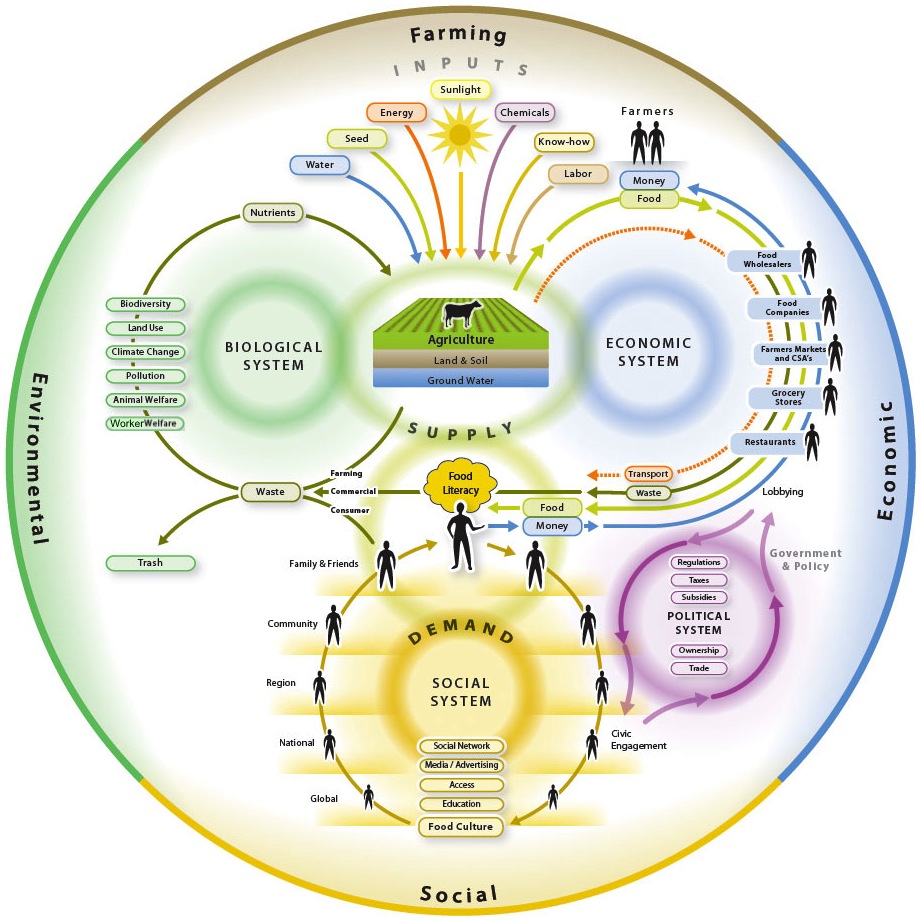


Food fights will go on and it is a good thing

A funny thing happened to me when I moved from Europe to North America in 1999. In Europe, I was used to having demanding customers. Issues about how food is produced have been rather common during pretty much my whole life (I will turn 55 later this year so that you have an idea of how long it has been).

When I came to North America, I dealt with a completely different situation. I did not get some of those 30-page product specification documents from retailers, foodservice and manufacturers with all the do’s and don’ts of how to produce food. I just got some 30-page disclaimers and liability documents, for the customer to dodge any heat should there be a law suit some time down the road instead. Before, I left Europe, I remember my Managing Director from the poultry company I worked for telling me how lucky I was because “over there (North America), customers hardly ask anything, you just sell them what you produce”. I remember looking at him and thinking that it could not be possible. I was wrong and he was right. For as much as European consumers were picky on all things such as hormones, antibiotics, GMOs, animal welfare, feed composition and origin, North American consumers, and retailers as well, seemed totally uninterested about production methods. It was almost eerie and to be quite frank, it was boring, because I could not see any challenge. One of my American colleagues enjoyed telling that it was the way it was and that it would never change because that is how Americans are. I disagreed but it certainly appeared he was right for a few years. Things have changed now. The American consumer has become more demanding and the dynamics of the discussions have become quite similar to what I had known in Europe for decades. It is actually rather easy for me to “predict” the future as I am living in an ongoing déjà vu nowadays.

The debate about food has indeed evolved into food fights. If there is one thing that I always found remarkable in my professional life in the food and agriculture sector is the issue of the producer-consumer relationship. Maybe it comes from my family background, but I have never understood why the food industry is so defensive when challenged by consumers or any organizations. My father used to be a butcher and I spent quite a bit of time around the shop and with him on the markets. I discovered very early that customers would ask the weirdest things but that what matters is not the factual truth but whether they trust the supplier. If you cannot deal with that fact, I suggest you do something else than producing food. Food is loaded with emotions and that is that. If consumers were rational, there would not be any diversity in foods and other consumer goods. They always would do the right thing and would not pay attention to all the marketing efforts that support the world economy. If consumers were rational, I bet you that they would deconstruct any PR by spotting all biases. If consumers were rational, they would focus on nutrition only and they also would reject anything that is unsustainable. I have a feeling that a lot of people who resent consumers’ emotions would actually be out of business because they would deal with a much tougher audience than the current consumers. Be careful what you wish for. Further, it is also clear that those who criticize consumers for not being rational, are not rational themselves in their consumption patterns, either. Nobody is.

Last year, a book titled No more food fights hit the shelf. Considering the author is actually supporting the conventional agriculture and has a problem with consumers and activists who challenge the food system, it is actually ironic. It reminded me of the words of my Managing Director about the North American market. What could be better than the good old days when the agribusiness could push their products to lethargic consumers? It sure must have been a good time, but it is gone. The book’s author, just like the agriculture sector, does not want anybody questioning the food system. They don’t want anyone looking over their shoulders and find out the bad and the ugly, at the risk of not showing the good either. I do not understand the food producers’ reluctance. If you are proud of what you do and what you produce, as they claim, you are proud to show the world and to share that goodness. You are also willing to always improve and make your customers satisfied. In my opinion, the attitude is really more about being production-driven –or should I say production-centred- than market-driven. The difference is that the former is about oneself and the latter about others. That difference actually reflects quite well in term of whom consumers trust. They trust the latter group, but are very distrustful of the former. I can understand both attitudes because I have filled functions that were more oriented towards technical operation as well as commercial functions.

I started my professional life in a position in a technical and scientific field, which suited me well by then because I was a hard-nosed rational fellow with a tendency of not accepting unfounded non-sense. Then, by accident, I got myself involved in a commercial role, which opened me new doors, and my eyes, too. The successful experience led me to other commercial positions and the lessons that I had learned in my father’s shop, I rediscovered on a daily basis in the multinational company. There is a huge gap of perception of the customers between the different departments of a company. Very often this discrepancy is reflected in the dynamics of the sales and operations departments of a business. One wants to say yes and the other wants to say no.

Food fightPersonally, I find being challenged a very good thing that can happen to a producing company. I would agree that negative feedback is never pleasant, but even though the message can be rough, it is feedback after all. In this regard, it should be handled in the same way as customer complaints, the good kind of handling that is, not the denial kind. The latter is usually more of a reason for a customer to drop a supplier than the problem that occurred in the first place. Business, like it or not, is first of all about human interaction. Money is only a means to secure it. In the course of my career, I had to deal with “consumer resistance” in quite a few occasions, but what it put into motion brought me most interesting and rewarding experiences. They helped me to learn about business and to understand the complex dynamics of entire value chains faster than ever. They helped me grow and that experience has made me one of those who understand the ins and outs of marketing, production and management in a variety of discipline the best. I am thankful to my “difficult” customers forever.

The reason is simple. By being very demanding, customers forced us to be better than ever and be resourceful to find ways of both meeting their expectations and allow us to remain profitable. Quality only improves through pressure from customers and a competitive environment. It very rarely happens as the result of a voluntary decision, simply because there is a cost at first. In the case of my past professional experience, needless to say that adjusting to consumer demands was never an easy process internally. On the one hand, there was the source of the company’s revenue – in other words salaries – at stake, and on the other hand, the natural drive to keep production costs under control. The key was to not lose our focus on the one essential parameter: the margin. Margin management with market vision really delivered amazing results in such situations. Another essential point was to negotiate everything and always get something in return for any effort made on our part. I remember some very tense conversations with Marks & Spencer in the time the talks were about the removal of meat and bone meal from animal feed. We showed them the impact of their demand on our bottom line and made clear that if they helped out on the bottom line we would go along. Because we were offering top quality chicken, we were able to find an agreement. For as much as we could not afford to lose their business, they did not want to lose us as a supplier, either. The willingness to accept challenges from the market and the drive to always improve our products and service served us. We would not have been in a position to ask anything in return if we had produced a basic commodity. By aiming at being the best, we had a sustainable competitive advantage. Finally we were able to have them accept to buy more from us so that we could dilute the extra cost over a larger volume and have more efficient logistics. The result for us was actually more volume of above average margin products. The customer had to say goodbye to some suppliers who were not ready to go the extra mile for them, and we also said goodbye to customers who would not support us in the cost effort. In the end, a very tough challenge ended up in a strong long-term profitable win-win situation. We came out of a crisis that could potentially have destroyed us stronger and more respected than ever. This is only an example of a tough market challenge. I went through similar situations in the various sectors –feed, pig, poultry and aquaculture- in which I have worked. The added value got in the millions per year each time.

Food fights are good, but they work only by picking the right partners in the market. As a producer, you need to have customers and make the right choice to achieve this goal. As a consumer, you need to find a producer that listens to you and meet your expectation. They will be disagreements along the way, but in the end both parties can benefit, but it will not just fall on your lap. Fights are a part of life. On the first day of my last year in the Agricultural University, the head teacher had a short presentation. He said that life is about:

  • Learning
  • Creating

Those two points were very well received by the students. Of course, it fits quite nicely with a crowd of intellectuals. The third point was received by the chilliest silence I can remember. The third point was…

  • Fighting!

Yes fighting is an integral part of life. We all fight all the time. We fight with competitors, with other drivers, with customer service representatives, with sales people, with the tax man, with retailers, waiters. You name it and it you will find an example of fighting. So no more food fights? Forget it, it won’t happen. In my experience, the only reason why anyone asks for a fight to stop is when they are losing. In this case, if they are losing, it is more because of their refusal to listen to where the market is going than because of those bad irrational consumers. The smart food producers, big or small, have all made moves in the direction of consumers’s demands because they know that is where the growth and the future are.

Copyright 2016 – Christophe Pelletier – The Happy Future Group Consulting Ltd.

Nature will reshape food value chains

The recent climatic events, in particular droughts, have attracted more attention on future challenges for food production, and rightly so. Unfortunately, the mainstream media cannot help presenting the as all gloom and doom. Certainly, there are very serious reasons for concerns, but solutions can be found. I wish the media would present more examples of positive actions to face and overcome the challenges.

It is not easy to deal with a changing environment, especially when it is impossible to predict accurately what the change will be. Predictions about temperature increases are useful but they are quite insufficient. An increase of 2 degrees on average will be different if the standard deviation is 1 degree or if it is 20 degrees. Other factors such as hours of sunlight and precipitations (including their nature, frequency and intensity) will impact agriculture at least as much as average temperatures. Changing climatic conditions will not only affect plant growth and development, but they will change the ecology of weeds and pests as well and that needs to be factored in future forecasts and models

Nature will reshape food value chainsA special attention on water is necessary. Without water, there is no life. Unfortunately, over the past few decades, wasting natural resources has been a bit of a way of life. The issue of food waste has finally received the attention it deserves, but the waste is not just about food. It is about all the inputs such as water, energy, money, time, and fertilizers. Water is still wasted in large quantities. Just compare how many liters a human being needs to drink compared by the amount of water that is flushed in bathrooms every day. Before the housing crash of 2008 a study in the US had estimated that lawn watering used three times as much water as the entire national corn production. But the issue of water is not just about waste. It is also about preserving water reserves. The late example of the drought in California illustrate what water scarcity may mean for food value chains. California is not only a major agriculture power house, but it exports a large part of the production outside of the state’s borders. The issue of water scarcity and the dwindling level of the Colorado River are not new for Californian agriculture. It has been known for a couple of decades that problems were coming. California produces a lot of water-rich fresh produce by means of irrigation. It actually has been exporting its water in the form of lettuce, spinach, melons, strawberries and citrus far away to places from where the water will never return to California. The water loop has been broken wide open and that is why, among other reasons, the system is not sustainable. If California can no longer supply its current markets, it will have to rethink its target markets. At the same time, other regions, that may not be competitive with California today, because externalities are never included in the cost of production, will eventually take over and replace the Golden State as suppliers for some productions. Unfortunately for the future, California is not the only region with a water problem. Saudi Arabia changed its food security policy a couple of years ago as the country leaders realized that trying to produce all its food would lead to a severe depletion of its available drinking water reserves. Instead of pursuing food self-sufficiency at all costs, the country chose to find other supply sources through international trade and through the purchase of farmland in foreign countries. The examples of California and Saudi Arabia demonstrate how natural –and demographic- conditions shape food value chains. The issue of water is not just about produce. Animal productions require usually more water than vegetal ones. In the future, water availability will surely affect where which kind of animal products are produced. New regions will arise and old traditional ones may review their strategies from volume-driven to higher margin specialty animal products market opportunities because of environmental constraints.

Climate change and water scarcity show how international trade can actually contribute to food security when done responsibly and with long-term vision. The prevailing model of producing where it is cheapest to produce without taking into account negative environmental externalities is facing its own contradiction and demise. The next model will be to produce not only where it is the cheapest to produce but where it is sustainable to do so. When water runs out, it is no longer possible to ignore the externalities of a production. When water becomes scarce, it gets more expensive. The law of supply and demand commands. When inputs get more expensive, several things happen. The economic model shifts. Priorities and externalities change, too. At first, producers try to find ways to increase efficiency and eliminate waste. The benefits outweigh the additional costs. Uncertainty stimulates innovation. New systems, or sometimes old ones that found a second youth, replace the current ones. If that does not work well enough, then producers start considering producing something else to ensure the continuity of their operation and find new business.

It is not the first time that our natural environment changes. Finding successful solutions to deal with it really are about our ability to adapt and to preserve our future, as it has been the case in the past. The challenges may be of a magnitude like never before, but so are our knowledge, our technical abilities and the tools present and future.

From an agricultural point of view, adapting to a new environment is about finding the type of production that thrives under new conditions. It may mean different areas of production for some species. In North America, there is already a shift for corn. Iowa has traditionally the main grower, but the corn production area is now expanding north. Minnesota is now producing more corn than in the past and so are the Canadian Prairies. Similarly, the production area for soybean is shifting north. Minnesota is growing an increasing volume of soybean and even in the province of Manitoba in Canada, soybean production attempts have been carried out since a few years.  It is the result of better production conditions and the development of new varieties that can adapt to new less favorable climatic conditions. Because of the local supply for soybean, the development of aquaculture with local soybean products for fish feed is now considered a long-term possibility in Minnesota among others. In Europe, corn production regions also saw a shift to the north for corn during the 1970-80s thanks to the development of new varieties, which largely contributed to the growth of dairy production in these new areas through the widespread use of corn silage. For the future, there is no doubt that genetics will contribute again to ensure food security. There is currently a lot of work done to develop varieties that can withstand droughts, floods or soil salinity. The ability to know the complete genome of species, to spot genes through gene markers, to be able to create new varieties that are less sensitive to diseases help speed up the development of crops that can thrive under future conditions. The recent developments in synthetic biology are quite interesting. Research conducted at the IRRI (International Rice Research Institute) on the development of rice varieties that can have a higher photosynthesis efficiency and thus higher yields could open new perspective for a more productive and more sustainable production.

Next to the development of better and more adapted seeds and genetic material, the development of new technologies that I described in a previous article will bring a number of effective solutions as well. In particular the rise of precision agriculture is certainly quite promising. The ability to deliver to the crops exactly what they need when they need it at the right time and at the right place in the right quantity will help reduce the environmental impact of agriculture while offering the possibility of delivering higher yields. Similarly, in animal production, there still is room to improve feed efficiency. It can happen through further genetic improvement, the use of more efficient feed ingredients and feed composition and through better farm management. The latter is definitely an essential facet of a better future for food production. Better and updated skills for food producers will help being more efficient, more productive and more sustainable at the same time.

An area that is often forgotten when it comes to the future of food is the functioning of markets. If demand for certain products, and in particular animal products, increases faster than supply, price will go up and there will differential increases between the different types of products. As most consumers, unlike what marketers sometimes tend to make believe, still choose what they eat depending on the price of foods, there will be shifts. Some productions will thrive while others will struggle.

As prices still will be an essential driver of the location of the various vegetal and animal productions, markets and environmental constraints will increasingly have a joint effect. In the future, the dominant economic model of producing where it is the cheapest to produce will evolve. As the pressure on water supplies, soil conditions and pollution issues will keep increasing, the model will include an increasing share of negative externalities. They are the long-term costs that are never factored in the production costs but that will affect future production economics. Externalities are the hidden side of sustainability and they will determine the future map of agriculture, as it will no longer be possible to ignore them. Choices will have to be made between short-term financial performance and the long-term ability of various regions to be able to produce, and to keep producing, the volumes and the quality specifications that are needed by the different food markets of the future.

A friend of mine told me a couple of years ago after a trip to Asia how she could see from the plane the large plantations of palm oil trees, and how they had replaced the jungle. She described her impression as the view resembled the strategic game of Risk to her. Yes, climate change and water availability in particular, will reshape food value chains because agriculture, regardless of it scale, is a strategic activity. It is about life and death. It is about peace and war. Future strategies for both global commodities as well as for local food value chains will integrate Nature’s new deal of precious resources and conditions of productions. Together with the geography of future consumption markets, world agriculture will readjust, relocate and the Earth will look different once again.

Copyright 2015 – Christophe Pelletier – The Happy Future Group Consulting Ltd.