
No shortage of action points for the future

The path to feeding the growing world population and to preserve agriculture’s ability to provide adequate volumes is paved with many challenges. Leaders will have to show how to resolve the many issues food production is facing or will face in the coming decades, and how to create a viable future.

As the population increases, the need for energy increases, too. Oil reserves are finite and new oilfields are becoming more and more difficult and expensive to exploit. It is only logical that oil will become more and more expensive in the future. This will call for more fuel-efficient equipment and vehicles. At the same time, oil that is more expensive also means that the relative price for alternative energy sources will become more competitive. In March 2011, an analyst from the bank HSBC published a report announcing that oil will no longer be available in 2060. In its future projections, the International Energy Agency (IEA) describes our energy sources as more diverse than they are now. They also mention that oil will not be the main source of energy anymore. Natural gas will take over. We should expect some significant changes in the way agriculture uses energy, the type of machinery that farmers will use and how future logistics will be organized.

The change of economics in energy will affect fertilizers, too. Especially, the production of nitrogen fertilizers uses large amounts of fossil fuel, essentially natural gas. On average, half of the nitrogen spread on fields is lost because of leaching. We can expect the focus to be on efficiency and on strategies of applications that are more efficient. This is already happening with precision agriculture techniques. Next to this, the focus of the fertilizer industry should be on developing nitrogen fertilizers that are less sensitive to leaching. Imagine a nitrogen fertilizer that may cost twice the price of the current ones, but for which there is no loss. Farmers would use only half the quantities that they currently do. The money to spend would be the same, but the use of fossil fuel to produce the fertilizer would be much less. There would be an environmental advantage to do so.

In the area of environmental issues, climate change needs to be addressed more effectively than it has been so far. Regardless whether people believe in it, or believe it is caused by human activity or it is only a natural phenomenon, the number of severe climatic events is reason to consider counter measures, just in case. The debate should not be about whether climate change is real or not. It is not about who may be responsible for it. True leaders take care of their people, and in this case, they should at least come with scenarios, contingency plans and emergency preparedness plans. That is the least we must expect from those in position of power and responsibility. In this case, the saying “the failure of the preparation is the preparation of failure” takes all its meaning.

Linked to climate to some extent, and a precious resource in all cases, water needs to be managed properly and carefully. For instance, all major river systems in Asia depend on Himalayan glaciers. If the glaciers were to disappear, which is a possibility, the source of water that sustains 2.5 billion people would be depleted, even if water used for agriculture also comes from other sources, the monsoon especially. The consequences would be catastrophic. Further, as agriculture uses 70% of all fresh water resources, growing food production will require more efficient water usage techniques. The focus must be on efficiency and on reduction of waste of water resources. Such objectives will require substantial financial resources and solid planning.

In the area of waste, food losses must be reduced as much and as diligently as possible. The moral issue of food being thrown away by the wealthy is obvious. The wealthy are not just in developed countries. In emerging countries, similar behavior is appearing. It is interesting to know that the Indian government is considering fines for those who discard edible food. It is even more interesting to notice that in Western countries where the percentage of food thrown away is the highest, governments are not investigating this possibility of fines. The other food waste scandal is the post-harvest losses. The food is produced. It is edible, but because of a lack of proper infrastructure, it is left to rot. What a waste of seeds, land, water, money, labor and all other necessary inputs. I have mentioned this problem in previous articles, as I have shown that the financial return to fix the problem is actually high and quick. There is plenty of work in this area for leaders. The first step to succeed in this is to recognize that no organization can fix this on its own. There is a need for collaborative leadership, because all the stakeholders in the food chains must participate, and they all will reap the financial benefits of fixing post-harvest problems.

Food production is not a hobby. It is of the utmost importance for the stability and the prosperity of societies. Well-fed and happy people do not riot. The need to improve infrastructure and logistics is obvious. Food must be brought to those who need it. A proper transportation infrastructure is necessary. The choice of transportation methods has consequences for the cost of food supply, and for the environmental cost as well. Road transport is relatively expensive and produces the highest amounts of greenhouse gases. Rail transport is already much better, and barge transport even better. The distance between production areas and consumption centers also needs to be looked at, together with the efficiency of logistics. Optimization will be the name of the game. Completing the cycle of food and organic matter will become even more important than today, as the world population is expected to concentrate further into urban centers. As humans are at the end of the food chain, many nutrients and organic matter accumulates where the human settlements are. These nutrients, as well as the organic matter, will have to be brought back to the land. This is essential if we want to maintain soil fertility. As phosphates mines are gradually running out, sewage and manure are going to play a pivotal role in soil fertility management. The concentration of the population in urban centers, together with the change of economics in energy, will require a very different look on economic zoning, and in urban planning in particular.

Special attention will be necessary to inform and educate consumers to eat better. Overconsumption, and the health problems that result from it, is already becoming a time bomb. Overweight is not only a Western problem. The same trend is appearing in many developing countries as well. Overweight is on the rise all over the world. The number of obesity cases in China, and even in some African countries, is increasing. The cost of fixing health is high, and it will be even more so in countries with an aging population, as age-related ailment add up to eating-habits-related problems. Healthy societies are more productive and cost less to maintain.

As the economy grows, and wealth increases in more and more countries, diets are changing. Consumers shift from carbohydrate-based meals to a higher consumption of animal products, as well as fruit and vegetables. The “meat question” will not go away. Since it takes more than one kg of feed to produce one kg of animal product, increasing animal production puts even more pressure to produce the adequate volumes of food. The question that will arise is how many animals can we -or should we- keep to produce animal protein, and what species should they be? Levels of production, and of demand, will result in price trends that will regulate production volumes to some extent, but government intervention to set production and consumption quotas cannot be excluded, either.

Similar questions will arise about biofuel production, especially the type of biofuel produced. There will be debates about moral, economic, social and practical aspects of biofuels. The consequences on the price of food and animal feed are not negligible. The function of subsidies in the production of biofuels adds to this debate and there are strongly divergent points of view between the various stakeholders.

One of the most important issues in the discussion about feeding the increasing world population is food affordability. Producing more, and producing enough, is not enough. The food produced must be affordable, too. When this is not the case, people cannot eat, and this is the main reason for malnourishment. To make food affordable, food production must be efficient. The costs of production need to be kept under control to avoid either food inflation and/or farmers bankruptcies.

In agriculture, just like in any other human activity, money always talks. Money is a powerful incentive, and when used properly, it is a powerful driver for improvement. Strategic use of financial incentive is part of policies. To meet the future challenges, leaders will have to develop the right kind of incentives. The focus will have to be on efficiency, on long-term continuity of production potential as well as on short-term performance. The financial incentives can be subsidies. Although the debates tend to make believe subsidies are all bad, there are good and useful subsidies. Another area of incentives to think about is the type of bonuses paid to executives. Just imagine what would happen if, instead of just profit, the carbon footprint per $1000 of sales was factored in the bonus? Gas emissions would be high on the priority of management teams.

If the way executives are paid matters, the type of financial structure of businesses could influence the way they operate, too. Now, it may sound surprising, but in the future, expect the question whether food companies should be listed on the stock exchange to arise. Short-term focus on the share price can be quite distracting from the long-term necessities. If we find that elected officials are short-term-oriented because elections take place every four or five years, how short-term quarterly financial results to the stock markets influence CEOs? The pressure by investors on companies’ Executive Boards to deliver value is high. They expect some results within a relatively short period, while what happens to the companies, their employees and long-term effect on the environment after they took their profits is irrelevant to them. This brings the question of the functioning of financial markets as a whole. What derivatives are acceptable? Who should be allowed to have access to which ones? What quantity could they be allowed to buy and sell? Many questions will arise more and more loudly every time food prices will jump up again the future, and as social unrest may result from it.

To prepare the future, it is important to prepare the generations of the future. Education will play a critical role in the success of societies. Only by helping future generations to have access to knowledge, to develop skills and to train to fill in the jobs of the future, will countries develop a strong middle class. Thanks to education, people can get better paying jobs. This allows them to buy adequate quantities of food for themselves and their families. Education is an investment to fight poverty and hunger. In the agricultural sector, it will be important to attract more young people to work in the food and agricultural sector. In many countries, farmers are getting old and replacement is scarce.

These are just a few of the issues that the current and future leadership will have to solve, if we want the feed and preserve the world. There will be many discussions about which systems are the best suited to ensure prosperity and stability. The respective roles of governments, businesses, non-profits and of the people will certainly be reviewed with scrutiny.

During the writing of Future Harvests, it became obvious to me how crucial the role of leadership is for our chances of success. In the course of a number of assignments with my company, this observation has grown even stronger.

For these reasons, I have decided to start writing another book focused on the role of leadership to develop long-term development of food production and food supply. It will be a reflection about the tough calls that leaders need to make. The final objective is to ensure viable food production systems and proper infrastructure, while ensuring the continuity of food supply in the long-term, through a successful interaction between all stakeholders.

Tentatively, the publication date is fixed for the summer or the fall of 2012.

Copyright 2011 – The Happy Future Group Consulting Ltd.

Believing in the future

The recent economic crisis gives an example of how the perception of the future can change, and how the level of economic security affects our behavior.

While before the economic crisis, many people preferred to spend rather than save, since the economic perspectives have changed, so has the behavior. A similar behavior, but at business level, is the reluctance of companies to hire when the economic outlook is uncertain.

Readiness to act to build the future depends greatly on people’s perception of what that very word means to them. Some have such comfortable lives that they actually do not think much about the future. They consider it a given, and take the current situation for granted. They have not much incentive to change. They might be in for a surprise someday, though. On the opposite end of this, there are those who have no expectation of the future. For them, life is so insecure because of famine, disease or violence, that all that matters is the here and now. Thinking ahead is almost impossible, and all that matters is the immediate. The future is irrelevant.

For those who live between these two extremes, the goal is to see life conditions improve. However, how this can be achieved, and whether it seems realistic depends greatly on the resources available.

Although many areas of the food and agriculture value chain need to be improved and can be improved, it is important to notice how much resistance many food security plans are facing during their execution. Obviously not all participants agree on the objectives and on the steps to follow. This is especially important in developing countries where  many problems affect food security, such as limited financial resources, limited water availability, post-harvest losses or difficult access to market to name a few.

To get people to believe in “the” future, the first step is to connect to their sense of how far the future is. When you are 20 in a country where the life expectancy is 80, thinking about the future is quite normal, and the life expectancy gives an indication of the period that the privileged ones have in mind. In regions where life prospects are dire, thinking even a couple of years ahead will probably be irrelevant to many. When presenting a vision of the future, one must consider this way of thinking. The acceptance and the commitment to implement actions will depend largely on whether the timeline is perceived as reasonable. People are more inclined to participate when they think that they will be able to see the results in their lifetime.

On the way to the future, actions are always more convincing than words. Positive results need to appear soon. Otherwise, the momentum in favor of the promised changes might slow down. This is why a good strategy is to start with the simplest and the easiest projects. They will deliver results faster. As success breeds success, they will generate more enthusiasm for the more difficult projects that require more time and more resources to be completed. This approach is a good way to build credibility and defuse criticism. Another advantage is that the participants will become more aware of what they can achieve as they achieve success. This gain in confidence will boost the morale to pursue with the further improvements. Often, this creates very healthy bottom-up dynamics that generates newer ideas on how to achieve the goals better and faster, or even exceed them.

Clearly, increasing confidence requires actions at many different levels. In the case of food security, the scope needs to go beyond agricultural development alone. Producing more food will not feed people if the hungry ones still do not make enough money to pay for food. Agriculture is only one of the economic sectors, and it will not produce miracles if it is not included in a more ambitious and broader goal.

Of all activities carried out to improve food security, I find the Chinese policies rather interesting. They are a long-term oriented culture. They are very patient and persistent, as many episodes of their history demonstrate. Their development activities in Africa are comprehensive. Next to all their work to develop agricultural production, they also invest heavily in the development of small businesses. They are working to develop the local economy beyond simply food production. Possibly, they experience of the last 30 years in developing the economy in China explains their approach. They know that social stability depends on people having at least the bare necessities. In the 1990s, I remember when we, in Europe, started to realize that China’s goal was to feed its people first. Imports of agricultural commodities into China started to increase. In particular, their demand for wheat and for what Europeans considered animal by-products was strongly on the rise. They seem to have a similar approach with Africa. They understand that their food supply will be more secure if the countries where they invest are economically and socially stable. It is worth noting that China invests more money in Africa than all G8 countries together do. It would appear that, to follow through with these policies, not having elections every few years allows them to execute a long-term vision without having to sacrifice it through short-term distraction.

On the other end of the spectrum, in terms of making people lose faith in the future, I could mention Libyan land purchases in Mali. The farmers, who had been working the land for themselves, although the land did not belong to them, have received notice that they will have to leave at the end of this year. This is exactly the kind of practice that could lead a country into civil war.

Businesses and non-profits that are active to develop food production need to take into account the same aspects that increase confidence in the execution of their plans. The owners, shareholders and fund providers must take a long-term approach to succeed. In such projects, the day-to-day share price on the stock exchange is not relevant. Such projects are long-term investments that will deliver a return only after many years. Among the most important investments, I would give a special mention to health and education. Without them, people can simply not get any fulfilling occupation, and economic development will be stuck in low gear.

At my modest level, I once inherited a project to get a fish processing plant operational. This project was a taking place in one of British Columbia’s Central Coast First Nations communities, which was plagued by a staggering 80% unemployment rate. Apart from the fact that there had been no budget allocated, I faced another problem. The local Economic Development Corporation in charge of their end of the project was never carrying out what they were supposed to do. Being my old little me, I never accepted this situation as a reality, and I made sure that all parties would do what they agreed to do. Only after a couple of years did I get the explanation for their dragging their feet. Many projects had taken place in this community before, but they all failed. The locals had concluded that no project would ever succeed, and they were not adamant to invest much in the future. The initial agreement had been signed between the salmon farming company and the leaders of the community, but time was necessary to get the lower levels of the village to be convinced. At some point in time, I was told that if it had not been for my indestructible faith in the project’s success, my persistence and my sometimes quasi-obnoxious insistence, this project would have had the same fate as the other previous ones. I had to deal with many heated discussions, a small social upheaval and death threats, but I quite alive to say proudly that, 11 years after I started it, the plant still is operational today, for the benefit of the community and its residents!

Long-term vision, empathy, sharing the value, strong leadership (even some dose of benevolent dictatorship) are all critical elements to make developing nations believe in the future.

Copyright 2011 – The Happy Future Group Consulting Ltd.

What a waste!

Nobody can have missed it. The hot topic of the past month was the so-called global food crisis. If you believe the media, the conventional ones as well as the social media, we are facing food shortages. For those who follow my articles, it will be no surprise that I am inclined to challenge such statements.

When 40% of all the food produced is wasted and lost, it is not possible to talk about food shortages. As I had explained in “Hunger is about more than just food production”, there is plenty of potential to increase food availability. Currently, and with this extremely sloppy 40% food waste, the world agriculture feeds quite reasonably six billion people. Unfortunately, this is not the case for one billion hungry people. By eliminating the waste, we could supply enough food to feed nine billion people. Not in 2050, but today already! That is not ideology or political agenda. It is simple math. Interestingly enough, the amount of the 40% food waste corresponds with the 70% more food the FAO says we should produce to feed nine billion. The more food we will save, the less we will need to push production up.

Unfortunately, the food waste issue receives little attention in the media. This is surprising because there would be some sensational articles to write about it. A little bit of guilt here, a little bit of horror there. That should sell some newspaper or get people watching TV. If this does not happen, it is probably because the food situation is not dire. From time to time, I receive requests from journalists. Sadly, the stories that interest them have to be scary, such as doomsday scenarios including food shortages and the imminence of food riots everywhere, to be followed of course by World War III. I do not do that. Other type of topics that journalists love is science fiction stuff, such as meat artificially grown in labs and anything related with high-tech, or freaky stuff like eating insects and worms.

The food crisis was not so about shortages. If it had been the case, we would have seen pictures of people fighting for food. It did not happen. Actually, it is a price crisis. The price increase of commodities futures results from the depreciation of the dollar (as I was predicting in “The danger of a weakening US dollar”), and the strategy of what the financial media likes to call hedging against inflation. The later is really smart stuff, as investors rush into buying commodities to hedge against potential future inflation. The high demand for commodities results in price increase. That is the best guarantee to get inflation. Brilliant!

The media attention has been interesting to follow, though. Every newspaper wanted to have a piece about the subject. And they really published a lot. Everyone became a food security expert, from restaurant critics, to balcony gardeners and other economy reporters. Depending on the sources they wanted to use, the sponsors, and of course their paying audience, everybody could find about anything and everything about the subject. Some made a bit of sense, but many reports were sadly erroneous.

For some pundit, we are just one bad harvest away from a global food crisis. That was true 10,000 years ago, that was true just before the Irish famine, and it will be true as long as farmers do not control the weather. Is that worth receiving coverage? For many, it has been an opportunity to push their respective agendas. For some, the only way is high-tech big agriculture. Hmm is that so? For others, only small-scale organic farming will save us. Hmm again. For others, eating meat is responsible for all the problems. Did I say hmmm already?

In this frenzy of food apocalypse reporting,  I simply have not seen one article dedicated to food waste, just like I have not seen any sensible research about how the price of commodities is set, either. When the total market for financial derivatives is US$ 600 trillion, while the world GDP is only US$ 60 trillion, something is a little out of balance, would not you think? The daily trading volumes of commodities largely exceeds the actual physical daily consumption of these commodities. Are all the traders only adding costs in the food chain?

However, let’s come back to the waste part. What the math I presented at the beginning of this article shows, is that the future is not so much about producing more, but about producing better and smarter, consuming better and smarter, and organizing the supply chain more effectively to ensure that food indeed reaches consumers.

The waste issue is rather simple to sum up. In rich countries, and also increasingly among the wealthier in emerging countries, the food waste occurs at the consumer end of the chain. In developing countries, the waste occurs at the post-harvest level. Food rots before it had a chance to reach consumers. In these countries, food losses are the result of an insufficient infrastructure. Another area of major food waste is fisheries. Because of (ironically) highly efficient trawlers, many fish species, as well as large quantities of edible fish are lost as they are crushed in fishing nets

Retailers are working on improving their part. For instance, Wal-Mart has initiated a large program to offer food to food banks, as part of their zero-waste strategy. European retailers did something similar several years ago. Consumers must do their part, too. Throwing food away is inexcusable for people who have refrigerators at home. People need to get some basics of household management. When I was a kid, there were classes about this at school, but it disappeared somewhere in the 1960s. Throwing away food is bad economics. Although nobody would think of throwing away coins and bank notes in the garbage, throwing away food is exactly that. That money could be used for better purposes.  Throwing food in the garbage, or as I have recently read in a local paper here in Vancouver throwing it in the toilet pot, is pretty much an immoral act, especially when so many lack food. Of course, not throwing away food in North America will not solve hunger in Africa, but there are other consequences to think about. Producing food requires a lot of energy (for production of fertilizers, for transport, for agriculture machines, packing plants etc..) and water. Wasting food means that the water and energy have been used for nothing! It is pure waste. Some may think that this is not relevant in Europe or North America. Do not be so sure, because for instance California is struggling with water scarcity, while exporting its water to other regions in the form of produce and other perishables. The gas emissions created for the wasted food will have been for nothing. Not wasting food actually reduces the environmental impact of agriculture, and this particular impact is the consumers’ responsibility. They need to know about this, because their behaviour influences the quality of the environment.

In rich countries, there is no food shortage, but we could use more leadership in informing and educating consumers to do the right thing. This is not only a matter for retailers or food service, but for all levels of the society. Rising awareness about the cost of wasting food should be on the agenda of all community leaders. Schools, parents, religious and political leaders should all address this topic in their respective circles. Food waste is where economics meet morals.

The post-harvest losses in developing countries are also both about economy and morals. The moral part is about their populations who already have so many difficulties to afford enough food, while almost half of it rots because of poor storage and infrastructure. The economic part is about the waste beyond the food losses. In many developing countries, water is scarce and most of them use large amounts of this water to irrigate food crops. Many developing countries already struggle to have clean drinking water, yet almost half the water used for irrigation is wasted together with the food. This is not acceptable, morally and economically. Moreover, some governments subsidise water for farmers to irrigate. Yet half of these subsidies are wasted with the food. Some governments also need to subsidize food for low-income families and to counter food inflation, simply to allow their people to buy food. If food availability were about to almost double by fixing the infrastructure, this would have some very positive consequences. Today, close to half the food receives zero money for revenue, while the production costs have been made to produce all of it, the eaten food as well as the wasted food. By eliminating the post-harvests losses, the currently lost quantities would create revenue that is currently missing. Considering the volumes of food involved, the total amount of new revenue generated in all these countries would be astronomic. Everybody would win. Retailers and wholesalers would increase their sales substantially. Farmers would make more money. Storage companies would have a business. Transport companies would have more business as there would be much more food to bring to market. More food available would also mean less inflationary pressure on food prices. This new activities would create jobs. This would help more people have a better income and be able to afford food a bit more easily. Governments would not have to spend as much money to subsidize food. A population that eats better would not be as tempted into social unrest as a hungry mob. At the production level, less food waste would mean less waste of water, energy and inputs. This would alleviate water problems, and increase the efficiency of the use of energy. All of this has a positive impact on the environment. According to the FAO, the cost of fixing the post-harvest losses in developing countries is about US$81 billion. Considering the quantities of extra food involved available “almost for free” since it has already been produced, the US$81 billion sound like a bargain. Indeed, agriculture represents 5.8% of the world GDP (source: CIA Factbook), or roughly US$ 3.5 trillion! Therefore, saying that post-harvest losses must be in the neighborhood of US$ 1 trillion is probably conservative. One would expect to see the payback time for infrastructure investments to be rather short. Someone needs to crunch the numbers, to take the lead and to show to all parties involved what their advantage will be. I certainly would be happy to do that. All actors of the food chain will have to participate, private sector as well as public sector. The return will be high in all respects, financially of course, especially once the current social and environmental externalities will be eliminated as the result of an efficient supply chain.

Copyright 2011 – The Happy Future Group Consulting Ltd.

The math and the myth

No, this is not one of those “are in a boat” riddles. Those who have read my articles or my book know that I like to bring some perspective by crunching numbers and double checking statements that seem beyond any discussion.

During National Agriculture Week held last week in the US, one of such statements popped up in most of the social media dedicated to agriculture: In 2010, one US farmer provided on average for the needs of 155 people, while in 1960 this number was only 26!

Of course, if you follow social media, you know that, immediately, the partisans, mostly in the Midwest, spread the good news as fast and as much as they could. To them, this number of 155 is the best proof that large-scale industrial technology and mechanization driven agriculture is the best there is, and US farmers are the best in the world! So that the world knows it this time!

That is clear. Or is it really? Then let’s look at the numbers a little closer and do some math.

Knowing that China became the first export destination of US agricultural goods since only last month, finally passing Canada and its gigantic 35-million population, I had some doubts.

First, one statistic that is not mentioned in the 155 per farmer is the total number of farms. This number dropped from 4 million in 1960 to 2.2 million in the latest (of 2007) census mentioned on the USDA website. Going from 26 to 155 would have been very impressive if the number of farmers had been stable, but this is not the case.

In 1960, 4 mio x 26 = 104 million people fed.

In 2010, and by keeping the number of 2.2 million farms, the calculation is 2.2 mio x 155 = 341 million people fed.

Instead of increasing 6-fold (155/26) as the fans try to make believe, the actual improvement of US agricultural production has increased only 3.3 times. Over a period of 50 years, this represents an average year-on-year increase of people fed by US agriculture of only 2.4%. It is higher than the average year-on-year increase of the world population over the same period, but it is not stellar, either. As an indication for comparison, the world’s food production has increased by 3% year-on-year over the same period.

This becomes interesting when comparing with other parts of the world. I choose India, because, it is often presented, especially in the Anglo-Saxon press, as a country that does not tackle agriculture properly. According to those articles, India should be a lot more like the US, going big and industrial, instead of keeping their large rural population.

India has 1.2 billion inhabitants, and statistics indicate that 200 million people are malnourished. This implies that 1 billion people are fed reasonably. Now, let’s compare another number that rarely appears in analyses. The population density of India is 10 times higher than the American population density. This means that if the US had the same population density as India, there would be 3 billion Americans, and only 341 million of them would have food. In such conditions, they would not eat much meat, they would not suffer from obesity and they certainly would think twice before growing food to feed their cars. If India had the population density of the US, there would be only 120 million Indians. India would probably be the largest food exporter in the world.

Maybe this comparison is not the best to make. After all, the Indian diet is rather different from the American one, and India still needs imports to feed its people. Let’s try something that is closer to America in terms of eating situation: the EU.

There rarely passes a day by without some article from a US industrial agriculture supporter that criticizes Europeans to resist the American model, especially GMO crops. According to the biased pundits, Europe is losing ground because of this shortsighted stubbornness. There again, some math can help. Once again, the population density will provide us with insight. If the US had the population density of the EU, there would be 1.1 billion Americans. Once again, that is much higher than the 341 million that US farmers can feed. As far as the EU is concerned, the region is self-sufficient, and in most European countries, the yearly per capita consumption of meat is close to 100 kg. There is no food security problem in the EU. In this case, we are not comparing meat eaters and vegetarians. Just as it looked that India was doing not such a bad job at feeding its people, the EU actually delivers a nice and enviable performance.

The math shows us that the number of people fed by one farmer is not a good indicator of the actual performance of the national agriculture. I would compare it with bragging about the number of horsepower in one’s car engine without looking at how far that car can take you. Gas mileage is more important. In the case of the US, the 155 only indicates that there are very few farmers, and that they have to manage very large farms. It is not an indicator of yields. Bigger, more intensive or more technology do not necessarily mean more efficient. It has to be the right size, the optimal level of intensification and the proper use of the right type of technology.

A much more relevant number is the number of people that one hectare (or one acre) of land can feed. With this indicator, the performance of the US is average. The key is the yield. In the case of wheat, which is grown in most regions, the yield in the EU varies between 6 and 9 tons per hectare, depending on the country. In the US, the yield is of only 3 tons/hectare, which also happens to be the world average.

What the math really shows is that the world is very diverse. It is diverse from demographic, economic, sociocultural, climatic, agricultural points of view. Agriculture is not mechanics. It must consider all these parameters and be adapted to the specific environment to meet food demand optimally. There is no universal model, and there does not need to be any. We simply must focus on producing high yields in a sustainable manner, meaning that this performance can be repeated indefinitely for the generations to come. To grow food, we need good seeds, fertile soil , proper financial resources and skilled farmers!

Copyright 2011 – The Happy Future Group Consulting Ltd.

Why we will change our eating habits, one way or the other

In the discussion about producing enough food for the 9 billion people the world will have by 2050, one of the sensitive issues, especially in the overfed world, is about what to eat and how much of it. There always is resistance to change, and changing eating habits may be even among the most difficult challenges we have. Eating habits are developed unconsciously since early childhood, and switching to conscious choices is not easy to achieve. It requires will power and self-discipline.

Most of the gloomy scenarios about the challenge of feeding the world are based on the assumption that the diet model would have to be the Western diet, and in particular the American diet. This is far from certain. Actually, do not expect this to be the case.

Changing eating habits will happen in two ways. One will be voluntary and the other will be a consequence of food prices.

There is a growing awareness of the health consequences due to overconsumption of food. All the stakeholders seem to blame each over for obesity, diabetes and other heart conditions, and try to convince the public that they are not the cause of the problem. Whose fault is it? Is it meat? Is it corn syrup? Is it fast food? Is it salt? Is it lifestyle? Is it the parents’ fault? Is it the schools with their vending machines offering snacks and soft drinks? We all have read such statements. Here is a scoop: overweight is caused by consuming more calories than are burnt through physical activity. Ailments are the results of rich and unbalanced diets. Eating (and drinking) too much, and too much of the wrong things is bad for you. There is a reason why gluttony is one of the seven deadly sins! Actually, our societies should have a close look at that list, because we might be in trouble.

In Western countries, we eat too much, and that should not be a surprise to anyone. Obesity and diabetes are becoming society problems in the USA, but other countries are following the same path. Europe and China have a rising percentage of obese people, especially young people. Even in Africa, there seems to be an increase of the number of overweight people. A recent study confirmed this (click here for the interactive chart). Awareness about health problems has already generated action. There are government campaigns. Food producers are reviewing their formulas and are working toward healthier products, in particular by lowering the content of salt and sugar of their foods. More and more consumers are also adjusting their eating habits, mostly by changing what they buy and where they buy it. The trend towards healthier and more natural food is growing and it will not stop. Only biotech companies seem to ignore this fact. This food trend is not just in Western countries but in China, too, the demand for natural and organic foods is increasing. After all, nobody really feels happy with being fat or unhealthy. If some people are taking action to improve their diets and its impact on the environment, this voluntary choice is still about a minority of the population, today. One of the reasons for this is that healthy diets seem more expensive than the junk fattening eating habits. I say seem, because those who can cook know that it is quite simple to make delicious balanced meal for less than the supersize combo deep fried so-called menu.

Money matters. That is a fact. This is why money is probably the best incentive for change. And the future will bring us plenty of incentive to change our diets. The current concerns about food prices, and the food riots of 2008, have created awareness about food supply. Although the price hike is more the result of investors, not necessarily speculators, looking for a safe haven for their US dollars through transactions in futures contract, the reality is that the commodity markets, even on paper, becomes the “official” market price. This enters the real economy and affects the price of food for households all over the world. The poorer countries are more sensitive to food price inflation, and this has the potential to cause very serious unrest.

Regardless of the current causes of food price increase, simple economics show that when demand increase, while supply has difficulties to keep up, prices increase. And this is exactly what will happen. In a previous article, I showed that the potential for meeting food demand, or I should say the demand for nutritional needs, of 9 billion was there. Quite easily. However, in this calculation, I indicated the road to success includes reducing food waste and a reduction of the quantity of meat in the diet. This means that we need to change our behaviour towards food.

If there is a sensitive topic about diet, this has to be meat. Opinions vary from one extreme to another. Some advocate a total rejection of meat and meat production, which would be the cause for most of hunger and environmental damage, even climate change. Others shout something that sounds like “don’t touch my meat!”, calling on some right that they might have to do as they please, or so they like to think. The truth, like most things in life, is in the middle. Meat is fine when consumed with moderation. Eating more than 100 kg per year will not make you healthier than if you eat only 30 kg. It might provide more pleasure for some, though. I should know. My father was a butcher and I grew up with lots of meat available. During the growth years as a teenager, I could gulp a pound of ground meat just like that. I eat a lot less nowadays. I choose quality before quantity.
The future evolution of the price of food is going to have several effects. The first one is the most direct. As food becomes more expensive, consumers look for the more affordable alternative first. If their budget is tight, they buy slightly smaller portions. People will slightly reduce their food intake. Those who were over consuming might actually benefit from a positive impact on their health. For those who already were struggling, this will be more difficult to deal with. From all the food sorts, animal protein will be the most affected by an increase of the price of food commodities. Already today, there are clear signs from the meat and poultry companies that the price of feed is seriously squeezing their margins. As usual, passing the price increase to consumers will take time, as retailers will resist. If the price of agricultural commodities is to stay high, consumers will inevitably have to accept price increases for food in general, and for meat and other animal products in particular. The price of meat is going to be affected by other factors than just feed prices. The need for more control on food safety issues, the stricter environmental regulations that will come for animal husbandry, on the land and in the sea, a change in animal husbandry practices, especially a lower use of antibiotics and farms with lower densities of animal will all contribute to an increase in costs. Energy will become more expensive, too. A whole system based on cheap commodities is about to change, simply because there will not be any cheap commodity anymore. These are all adjustments to rebalance our consumption behaviour from the unbridled overconsumption of the past decades, when consumers were not thinking about the consequences of their actions. The industry will figure out how to increase efficiency to contain some of the cost increases, but the change of farming practices will make meat significantly more expensive than it is today. The price of ad-lib cheap meat is ending. The future dynamics of food prices as presented here will be ongoing. A long as we will not have adjusted our diets to a new equilibrium, meat will keep increasing faster than other basic food staples, until meat consumption, and therefore meat production, will reset to different levels. Do not expect this to happen overnight. It will be a gradual process. There will not be any meat or fish riots. If food riots happen, they will be about the basic food staples, simply because the first ones to riot will be the poorer among us, and their diet is composed mostly from rice, wheat, corn, cassava or potatoes. Should the situation become dire, governments will intervene to ensure food for the poorest. Such price systems are already in place in many developing countries, and they are likely to be maintained, and even strengthened.

The same critical factors to keep food prices in check are very much the same as the ones that I presented in the previous article that I mentioned earlier: food waste reduction, moderate meat consumption per capita; and economic development, especially in Africa.

For more on similar topics, please visit my other website The Sensible Gourmet

Copyright 2011 – The Happy Future Group Consulting Ltd.

Of food riots and economic hardship

The riots in North Africa are getting a lot of coverage. This is good, because the problems in this region have been ignored for a long time. In 1987, I had bought a book “L’Europe Submergée – Sud-Nord dans 30 ans” by the late French economist Alfred Sauvy, the man who created the term Third World. His book was a description of the demographic differences between Europe and the nations from the South, and of the likely consequences. His prediction was by then that within 30 to 40 years, Europe would see a flow of immigration from the other side of the Mediterranean Sea that would replace the original European population. He also saw in this migration a great opportunity in terms of economic renewal for Europe. He certainly would have deserved the title of futurist!

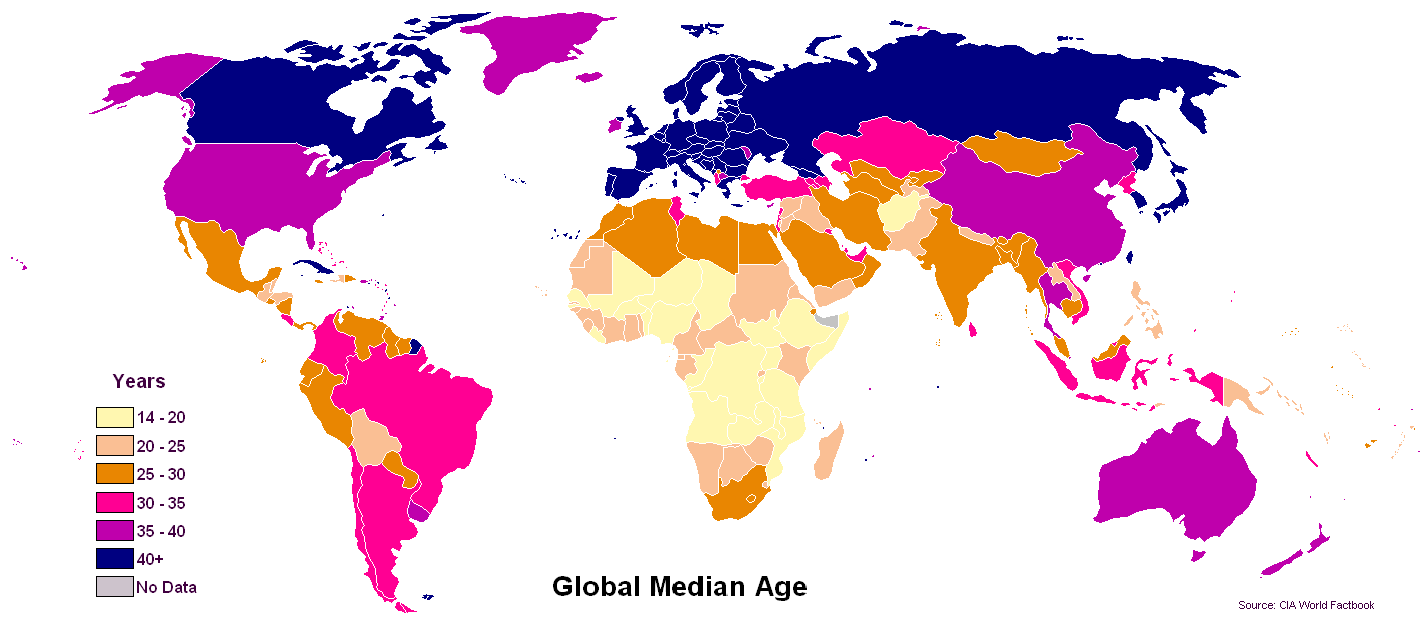
When I wrote Future Harvests, I dedicated a chapter on the changing demographics. It clearly appeared to me that he was right, and that the evolution of the population numbers between the different regions of the world will influence decisions about food production, food supply, and economies altogether. In Future Harvests, I indicate in which regions I think tensions would arise. The Arab world was number one on my list. Here is the map of the median age per country. The median age of a country is the age of half its population. Most of Arab countries have half their populations under 25. And what to think of Sub-Saharan Africa where that age is lower than 20? This is in sharp contrast with Western countries where almost half the population is older than 40. It was really striking to see the pictures of Tunisian rioters: there were teenagers. With a chronic unemployment, especially with the youth, reaching levels of 25%, and many people living on a pittance, riots erupting and governments being toppled are no surprises. This situation has been going on for a few decades. A new generation of people who see little hope and future is simply sending a message. Change must come or change will come.

In the news, everything is mixed together and it may appear a little difficult to understand what causes Arab countries to flare up like this. Everyone speculates which country will be next. Of course, food is mentioned as one of the many causes, and I can read all sorts of opinions about that. From what I understand, the riots in Tunisia were caused by the arrest of a food street vendor for not having the proper license, which immediately cut his meagre source of income. After the success of the Tunisian upheaval, it is not surprising to see neighbouring  countries with a similar demographic and similar dire economic situation following a similar path. Does this mean that there will be riots over the entire Arab world? Probably not all at once. It might not be successful everywhere, either. Other rulers in the region will make some moves, even symbolic ones, to defuse potential tensions. Both the Tunisian and Egyptian rulers are doing their best to defuse the tensions, and by resigning if this is what it will take to avoid complete chaos. The lesson is hard for Arab countries and they are now more aware than ever of the dangerous situation they are in. This is also a loud warning to the rich nations. However, at the Davos conference, the elite were not even aware of what was going on. Eventually, they heard it, and paid attention. Stock markets dropped for one day only as unrest was spreading in Egypt. Interestingly enough, markets were up on the days that a bomb exploded in Moscow’s airport and when Japan’s economic rating was downgraded by S&P. Certain things matter more than others. Europe must now realize that unless it helps its southern neighbours solve the problem, they are going to become a part of it. Yet, European countries seem to have trouble taking some clear position on the events. North Africa, just like the rest of Africa needs economic development. The people of these countries need to regain hope in the future. The generation that comes of age to leave the parents’ home and start, and support, their own families must see reasons why it will be possible for them. At this juncture, they doubt that they will be able to do so.

In Future Harvests, I mention two regions with a demographic time bomb waiting for a food security problem to explode. One is the area between Russia and the former Central Asian Soviet republics, extended to Iran and Pakistan. The other one is the border between Mexico and the USA. Mexico is disintegrating and law and order are fading away. Both these regions are going to have to work together to find strategies to ensure stability. This probably will not happen without serious clashes.

Many of the countries where booming demographics, poor economic situation and precarious food security are the normal state of affairs need a 21st century Marshall Plan. As I have presented in previous articles, the potential for feeding the world population is there, but the main cause of hunger is the lack of affordability of food. In 2008, there were food riots, but there was no real food shortage. The main problem was that the populations could not pay for it because the price had skyrocketed, especially the price of basic food staples such as rice, wheat and corn. This time, although according to the FAO, food prices are even higher than in 2008, we have not seen the same kind of riots. A reason for this difference may have been the fact that retail prices of food staples remained contained. So far.

Some sort of Marshall Plan is a necessity. Development and stability is in the interest of rich countries, just as much as it is for developing countries. Europe, Russia and the USA cannot thrive with countries on the verge of complete collapse at their borders. If there has ever been a good investment, this would be it. It is interesting to look at the example of China. This hard-core communist country was on the verge of economic disaster and famine, until they decided to put the doctrine on the side, and open their doors to foreign investments. From the moment that China decided to feed its people, things changed. For the communist government, this was the only way to stay in power. A billion hungry, and angry, people are impossible to keep under control. For the capitalist “Satan”, it was convenient to present the Chinese “opening” as a victory of the aspiring capitalism, but mostly it was the greatest opportunity ever to reduce labour costs of consumer goods and boost corporate profits. Investing in China was not exactly like the Marshall Plan that rebuilt Europe, but the amount of money that flowed into the country helped turn around a bad situation into what soon will be the world’s first economy. While the middle class in Europe is stagnating at best, if not actually disappearing, China has grown its middle class to 300 million people (the whole US population) and it aims at increasing the number to 850 million by 2030. China is still (officially) a communist country with no elections, but that does not seem to bother too many people. Developing nations need money to flow into their economies to create jobs.

Many people are asking whether we will see food riots again. Unfortunately, the answer is yes. Although there is much political talk about food prices and risks of riots, nothing is really done to prevent it from happening. It does not look like there is much political will to make the necessary reform to prevent extreme tensions. Most world forums of all sorts seem to be more of an opportunity for the wealthy and powerful to hobnob than a place where actual decisions are made. The WTO Doha Round, which if well completed can bring many solutions, takes for ever to come to a conclusion. It looks like reason and leadership are not prevailing much right now. It is highly likely that the world, and mostly the rich nations, will understand the message and act only when they will feel that their position is in danger, too. Food riots will come as soon as food affordability drops under an acceptable level of suffering. Of course, Asia, Latin America and Arab countries are the most likely candidates for such unrest, but rich countries are not immune to that, either. Especially the USA is more vulnerable that many may think. In 2009, the USDA estimate of households that do not have enough money to feed themselves was of 14.6%. Although the economy seems to have stabilized, it has not recovered yet. Moreover, the housing situation in the US is far from stabilized. Many Americans have been able to keep consuming somehow because they simply stopped paying their mortgages and could stay in their homes. The number of mortgage delinquencies is so high that banks cannot handle all the cases. Actually, most cases have been postponed, but one day some decisions will have to be made. If the banks played by the book and foreclosed all houses, the owners of which cannot pay the mortgages, it would result in an incredibly high number of homeless broke people. The banks would have to report serious losses. Today a report indicated that 11% of all American homes are empty. More foreclosures will increase this number further. How will these people manage to eat by then? Banks can decide to settle according to individual situations. There will be less broke homeless coming on the streets and the banks will have fewer losses. In a previous article, I had mentioned the risk of a decreasing dollar, especially the risk of inflation as financial markets play the commodities only to hedge against the loss of value of the dollar. Inflation in an economy that is stagnating will reduce the affordability of food for the less wealthy. Unemployment is staying rather high and I have not seen any report from anyone presenting a situation in which employment would increase in significant numbers any time soon. In 2008, Gerald Celente, a trend forecaster who predicted the 1987 stock market crash and the fall of the former Soviet Union, told that by 2012, America would have food riots, a tax rebellion, and even a revolution. At first, I was sceptical, but I am starting to wonder if he might be right. After all, during the food price hike of 2008, Americans were hoarding goods from the supermarkets.

The food riots to come will finally force government to intervene and do what they are supposed to do, which is to ensure the stability and the viability of the society by setting the proper rules for the game. Especially, proper regulation on commodities markets and corporate near-monopolies will become crucial for social stability. The only unknown is the cost of our procrastination.

Copyright 2011 – The Happy Future Group Consulting Ltd.

Feeding nine billion is an exercise in leadership

In a previous article, “Hunger is about more than just food production”, I showed how much more potential we have to feed the world than we commonly think. However, having the potential to do so does not mean that we will do it. Human nature has the habit of fluctuating between its best and its worst. Therefore, whether we will actually feed nine billion is far from done. In this article, I am going to reflect to what it would take to be successful at making it happen.

In my book, Future Harvests, I present the six principles that are critical to meet future food demand successfully: Sustainability, Innovation, Market Orientation, Pragmatism, Leadership and Efficiency. I had regrouped these principles under the acronym SIMPLE. While I was writing the book, I always came back to the same observation: success or failure to feed nine billion simply depends on us all. Someone needs to set the course and create the conditions to take the proper actions. The world needs leaders that will make food production potential the reality by 2050.

The job description is, interestingly enough, rather reminiscent of food production and genetics. In order to express the full potential of its genes, an organism needs the proper environment. This is exactly the role of the future leaders. They must create the conditions that will allow farmers to produce efficiently, yet sustainably.

The starting point will be about making the right decisions for both the long term as for the short term. We must preserve the potential to produce for future generations, but we must not forget to provide for today as well. Proper leadership will need to take into account the interest of many different groups and manage a balanced approach between money, people and environment. For sure, future leadership will be a balancing act. This will be easier to achieve if the leaders can sell the world their plan, which means that they must have one.

Leaders come from all layers of society. They are in government, in industry, in non-profit organizations, they are independent farmers, or they come from non-food related occupations. Adequate food supply is the very fundament of societies. Where there is hunger, there is no prosperity. Without food, there is not life, and just as importantly, without water there is no food. Developing food security is not an option; it is probably the most important policy sector of any society. This is something that we must not take lightly, even in rich countries where we seem to take food for granted. Things may change.

What story do our leaders need to tell and execute? The points that I raised in the article mentioned at the very beginning are a good place to start. The scandal of food waste, because it really is a scandal, must be dealt with and fixed. In developing countries, this is caused by a lack of infrastructure. It is only a matter of money. If world leaders have the will to get that money at work, it will happen. For some reason, they do not do it. Maybe it is a sign that things are not that critical after all. Compared with the amounts of money thrown at financial bailouts and stimuli of all sorts, the cost of infrastructure development looks ridiculously insignificant. Such projects would actually create jobs and increase the wealth of the populations where it takes place. This would not be artificial GDP boosting, but actual poverty reduction and increased food availability. In rich countries, food waste happens at the consumer end. What leaders of these countries need to communicate is a sense of responsibility. Wasting food is simply immoral, just like any other waste. If we take the example of nitrogen, the waste by leaching is estimated at about half the nitrogen spread on crops. This is huge and very damaging for two reasons. One is that the nitrogen ends up in the drinking water making it harmful, especially for pregnant women and infants. The other is that the production of nitrogen fertilizers uses half the world’s agriculture natural gas consumption. Efficiency is not a luxury, but it is a necessity. When efficiency increases, the amount of waste decreases. This works towards a higher sustainability, too. Food waste is one thing, but food consumption excesses or unbalanced eating habits are another area of work for our leaders. Eating more food than one needs is not only detrimental for that person’s health, it is also food that is less available to others. This pushes food prices up, too.

The effectiveness of leaders depends on their ability to communicate and get the message over to their dependants. Changing habits and infusing a sense of solidarity and responsibility requires patience, communication and proper education programs. Defining vague objectives or using hollow populist slogans and expressions will have no effect. Only charismatic leaders with strong convictions about what ensures the future of their people, even if it means sacrifices, will be able to bring such a change. It is not easy to do when your country is not on the verge of a terrible crisis. An interesting example about unilateral leadership is the decision of the Chinese government to slow down the number of new car registrations. They consider that there are enough cars. Getting a licence plate will be difficult in the future. In 2008, they decided to ban the use of disposable plastic bags in supermarkets, thus saving an estimated 100 billion bags and the equivalent of 37 million barrels of oil per year. Similarly, China is now the world leader in renewable energies. What actions did the Western democracies take about new car sales and supermarket plastic bags? When children died because of tainted milk, the Chinese authorities arrested all the people involved, and even executed two persons. Of course, the use of melamine in the milk was intentional, making the case extreme. However, in the West, I do not recall anyone being arrested or considered personally liable after deaths by food poisoning. My point is not to demand imprisonment of CEOs as a standard operating procedure, but I am sure that if executives of food companies felt that they could be personally liable for food poisoning, the precautionary principle would apply much more systematically. Leaders need to make understand that doing something wrong comes with consequences. Although there is much to say about China’s political system, one must admit that not having to think in terms of elections every four years and not having political campaign funded by any industry of NGO of any sort can help politicians focus on the long-term, too. Maybe the fact that China is plagued with so much pollution in the air, in the water and in the soils also makes the issue more acute for the leaders to resolve.

If the stick is one option to make people do what is right, the carrot is, at the very least, as important. Nothing stimulates people more than being rewarded for doing a good job. People are at their best when they know that others appreciate what they do, and that what they do makes the world a better place. Then, they do not see their occupations as “have to” activities, but as “want to” ones. Subsidies, bonuses, tax credits are all motivating tools to make people do the better thing, but the key is to have incentives that meet the goals without having harmful side effects.

Leaders also need to be innovators. Considering how fast our world changes, and the quantity of new knowledge made available about on a daily basis, many new possibilities will be available to solve old problems. Innovation is the child of human genius and, to cope with future challenges, creativity and adaptability will be major assets. It is the leaders’ role to foster innovation, yet by keeping in mind all long-term implications.

The ideal leader would have the qualities described by Plato in “The Republic”. Although it is an ideal, having committed leaders matching his description would increase our odds of success.

Copyright 2011 – The Happy Future Group Consulting Ltd.

Investing in agriculture requires thorough research

Since the price hike of food and other commodities in 2008, agriculture is one of the hot topics in the investment community. This is also fuelled by the perception that the world might face a food crisis. For those looking at investing in the food sector, there are many possibilities, but in this sector as in many other investment types, caution is required. The investment community is a pool of sharks, and the name of the game is to sell at a profit. Beware of the salesperson!

According to Jim Rogers, a famous investor and former partner of George Soros, farmers will be the ones driving Maseratis in the future. He believes firmly that, in the future, those who actually produce the commodities, instead of brokers, will make fortunes. It is a very interesting point of view, although history tends to show that the power in food value chains is in both ends of the chain: genetics and marketing to consumers. Becoming a farmer is not an investment. It is a job, and a busy one. Farmers need to generate cash on a regular basis to provide for their families and keep the farm in business. Land is not liquid. Investing is about reaping the profit when selling at a higher valuation.

For those interested in owning farmland, there are possibilities to buy large acreage in many countries. A recent article published in CNBC presents some strategies.  Large private investors seem interested in Brazil, Argentina, Uruguay and Canada. Prices of farmland have been firming up in the US. There are people advertising for Brazilian farmland who promise you a yearly guaranteed (not clear how, though) of 12%. In the former communist Eastern European countries, many farms are for sale. Net importing countries such as China, India and Arab countries choose to invest and develop farmland in Africa. For investors with a strong stomach, Africa may be a place of choice. The continent is pretty much for sale. However, the ownership of the land is not always very clear and the rules of engagements may vary. If you only wish to lease land, you might be interested in Ethiopia: the country is offering 100-year leases for $1 per acre. Although some offers may seem irresistible, buying farmland or a farm is a complex endeavour. Many factors weigh and things may not be as they seem. What is the quality of the soils? How is the climate, and in particular are there risks of floods or drought?  Is there proper access to water? What are the local regulations in the country where you are thinking of buying? How much bureaucracy should you expect? Who are the suppliers, and how they deal with their customers? Is there access to quality supplies? What are the banking facilities and what type of credit can you get? How are the infrastructures for storage and logistics? What access to markets do farmers have, and how is the marketing chain organized? Today’s situation may not be a good predictor of the future, and problems may loom ahead, as Jason Henderson, vice president and Omaha Branch executive of the Federal Reserve Bank of Kansas City told in an interview to Agri-pulse.
If farming or owning farmland is not your thing, there is always the possibility to invest in commodities with futures contracts. Instead of buying the hard commodity, which would take quite some space in your garage, you just do the same but on paper only. This is a risky business though and it should be left to the pros. Originally, futures had been introduced to give farmers the possibility to fix in advance the selling price for their crops, instead of waiting for the spot market at harvest time. Futures contracts have been taken over by the Wall Street geniuses who brought us the Great Recession. Also realize that nowadays the future contracts prices reflect the supply and demand situation of paper contracts, not of the actual physical market. The result is that futures markets are all about speculation and most transactions are made with borrowed money. Speculation may be about the weather, planted acreage, expected yields or plant diseases. Any news is cause for rumours and markets may change direction without warning. If agricultural commodities interest you, you may prefer to invest in funds that include these commodities, and therefore offer a lower risk. Another possibility to get money at work in the agriculture and food sectors is by buying shares of companies involved in agricultural value chains. For instance, when commodity prices increase strongly, the logical (?) thinking of stock investors is that the next food crisis is ahead and that the world is about to run short of food, which will stimulate farmers to plant more and therefore require more inputs. Especially shares of fertilizer suppliers always shoot up in such situations, all the more so as there are just a few of them. This gives them a strong bargaining position, and they pass on sharp price increases to the farmers… which is why the margins of farmers usually suffer after a year of high commodity prices. In the agricultural sector, it is important to remember what I said about which links in the chain have the strongest position, as this will affect their bargaining position and their ability to get, or to keep, the added value. Weak links will always underperform, while the stronger ones will outperform compared with the average of the sector, that is for as long as these companies are managed properly. Investing in stocks always require a thorough financial analysis, as well as a good understanding of the quality of the management. How does the future look like for a particular company? Does it have a sustainable competitive advantage? How does the future look like for the sector of activity of this company? What is the track record of performance? Does it depend on world market prices or is it more predictable than that? How is the valuation of the company?

Another type of investment that is gathering momentum in the agri-food business is new technologies start-ups. With worries about the future of oil, and especially oil prices, and the challenge of providing enough water to produce crops, many new technologies try to find their way to market. The sector of new technologies attracts many investors, probably because it seems reminiscent of what happened in the tech sector, therefore giving hopes of high return. I come across such ventures regularly, and every time I hear enthusiastic stories from the owner or from the venture capitalists involved. In many cases, the story is about how this new technology is going to revolutionize the way food is produced, or even it will be the solution to hunger. Returns on investments always sound amazing, making one wonder why this has not been on the market for some time already. For such projects, too, it is essential to do the proper research on the claims that the owners and financiers are making. In many cases, I find difficult to get the proper background to support the financial results that they claim. In even more cases, I do not see any real thorough market research, and instead of explaining in which niche they will operate, the market story is about macroeconomics. The macroeconomics may be true, but except for the unlikely event that the particular technology would indeed take over the world within a few years, they are not a relevant description of the actual market possibilities within the foreseeable future. Of course, there are also projects that have strong cases, but they are a minority.

In all cases, a number of simple rules can save you from a very painful experience.

  • Do not invest in something you do not understand.
  • Do not mind hypes and tips.
  • Take all the necessary time to do your research, and do it thoroughly.
  • When in doubt, do not invest.
  • Ask as many questions as possible. When investing, information is power, and lack of information is weakness.
  • Ask independent third parties, and never ask advice from someone who has a vested interest in your transaction.
  • Buy low, sell high.
  • If it sounds too good to be true, it probably is exactly that.
  • Investing is not mandatory, and if you miss an opportunity, there will be other bargains later again.

Copyright 2011 – The Happy Future Group Consulting Ltd.

Hunger is about more than just food production

Everyone who works in agriculture and food knows that there are about one billion people on Earth suffering from hunger. The temptation to think that the cause is a lack of food production is great, but it does not reflect reality. Quite a few serious organizations and personalities claim that one Earth is not enough to feed nine billion people by 2050. Some claim that we would need two Earths. Others even go as far as mentioning the need for three, and even four, of our blue planet.

There are two possibilities with such statements.

If they are true, then humanity has a problem, because there is only one Earth, and we will not get a second one. In such a case, the only way for supply and demand to get in balance is a reduction of the world population. This could happen through famine, disease and/or wars. Since in such a scenario there is a maximum to the world population, once this number is reached, there must be a constant elimination of the couple of billion people too many, through one of the means just mentioned. This is not a particularly happy thought.

On the other hand, if such statements are erroneous, there is hope to feed the increasing world population with one Earth.

Then, is one planet enough or not? Simple math should help finding the answer. If we need two Earths to feed nine billion, one planet would only feed 4.5 billion people. Currently, the world population is around seven billion, out of which one billion is hungry. Conclusion is that we currently can feed about six billion people. We are not doing that bad. Is it possible to find ways of feeding three more billion on this Earth? From the simple math above, it is clear that those who claim that we need three Earths or more are wrong.

Out of the six billion who do not suffer hunger, it is estimated that one billion is overweight, a part of which, mostly in the USA, is obese. They clearly ingest more calories than they need. Purely theoretically, if those were to share the excess food they consume with the ones who have too little, the billion hungry people would have about enough. This means that today there is already enough food available to feed seven billion people.

Another interesting factor is waste. According to the FAO, about 40% of all the food produced is lost and wasted. In rich countries, most of the waste takes place at supermarkets, restaurants and households level. People simply throw away food. In developing countries, the waste takes place mostly post-harvest. The food does not even reach the market. The food is spoiled because of a lack of proper storage facilities and logistics. The food ends up rotting, contaminated with mould or is eaten by vermin. To fix the problem, the FAO estimates the cost to improve infrastructure at US$ 80 billion. This is less than the amount the EU just made available to bail out Ireland. What to say of the US$ 3.3 trillion that the US Federal Reserve lent to banks to alleviate the financial crisis? Of course, it will be impossible to achieve an absolute zero waste, but if we were to achieve 10%, this will feed many people. I have heard the statement that if post-harvest losses were eliminated in India, the country would be fully food secure. Per 100 tons of production, 40% wastage means that only 60 tons are available for consumers. By reducing waste from 40% down to 10%, there would be 90 tons available. This represents an increase of food available by 50%! Since we could already feed seven billion with the 40% waste, reducing wastage to 10% would allow feeding 10.5 billion people.

There are also many debates about whether we should eat meat or not. The nutritional need for protein is easily covered with 30 kg of meat per capita per year. I had shown in an earlier article that if Western consumers were consuming just what they need instead of eating superfluous volumes (very tasty and enjoyable, though), it would free meat to feed 1.4 billion people the yearly individual 30 kg. In China, the average meat consumption is already up to 50 kg per capita per year. The consumption is very unevenly distributed, but this is the average. Cutting 20 kg per capita over a population of 1.5 billion would free meat for the nutritional needs of an additional one billion people.

The other area of potential is Africa. The FAO estimates that the area of arable land that is not exploited is about 700 million hectares. This is about the size of Australia. To simplify and get an idea of the potential, we can calculate what it means in wheat equivalent. With the assumption that wheat yields would be the same as the current African average, a low 1.5 tons per hectare, this adds up to 1.05 billion tons of wheat. Since a person needs about one million calories per year, and there are about 3,000 calories in a kg of wheat, one ton of wheat can feed three people, the 1.05 billion tons of wheat can feed more than 3 billion people. Normally, there would a crop rotation of at least two harvests per hectare. With proper investment and financing, farms should be able to reach easily the US average of 3 tons of wheat per hectare. Clearly, this performance could be achieved with traditional techniques and good quality seeds. This is not even about high-tech or GMOs. This tremendous potential of Africa is why China, India and Arab countries are very active developing farming there. They did the math. This scenario also shows that Africa can easily become a strong net exporter of food. In this case, the world map of food looks very different. Without Africa being able to produce large amount of foods, the prospects for food security in Asia and the Middle East are a bit bleak. They can depend only on Western Europe, Russia, Ukraine, Kazakhstan, North and South America, and with Australia to a lesser extent. With Africa as a net food exporter, the world map looks a lot more balanced, East-West as well as North-South. Sea routes from Africa with the Arabic Peninsula, the Persian Gulf, and farther away with India and China create a much safer feeling of food security for the countries in those regions. For Africa itself, it may change the relations between Sub-Saharan country and the Maghreb countries. This in turns changes the type of relationship that the Maghreb may have with Europe, by creating more economic activities to the South. Africa’s success –or failure- will affect the whole world.

With the above, everyone can develop further assumptions, but these calculations show that this one Earth can produce enough food to cover the needs of between 12 and 15 billion people. It almost sounds impossible to believe, yet these numbers are not even ambitious. I have not even taken into account that in 2009, 25% of the corn produced in the USA was destined to feed cars, not people, via ethanol production, and that number is expected to grow to about one-third for 2010. The potential is even higher when one considers that a large part of the US corn goes into soft drinks, while it could be used to produce tortillas, with a side glass of water, a much healthier alternative.

That said, if the potential for food production supply looks adequate, actually producing it may not be as easy. The human factor, especially through politics and leadership, will be crucial to succeed.

One would ask why there is hunger if we can produce so much food. The answer is simple. Hunger is not just about food production, it is about poverty. People are hungry because they do not have money to buy food. They do not have money because they do not earn enough, as they have low paying jobs or simply no jobs at all. By developing the economy in these regions, people would get better wages. They could afford more food. The demand would drive the development of food production. Agricultural development would then be a normal and natural activity. Trying to develop agriculture if the locals cannot buy the food cannot work. Recently the FAO estimated that two-thirds of the world’s malnourished live in only seven countries: China, India, Pakistan, Bangladesh, Indonesia, Ethiopia and Congo. These are countries where most of the population is poor, and most of which lives in rural areas. The other proof that hunger is not only a consequence of low food self-sufficiency can be found in two agricultural exports behemoths: Brazil and the USA. In the latter, a recent survey carried out by Hormel Foods, the deli producer, shows that 28% of Americans struggle to get enough money to buy food, or they know someone who struggles. Last year, the USDA had estimated at 14.6% the percentage of US households that do not have enough food on the table. Food will find the money and vice-versa. If Bill Gates decided to move to the poorest and most food insecure place in the world, and would fancy a lobster, I am sure that someone would manage to find him one and deliver it within reasonable short notice.

My book, Future Harvests, investigates the possible scenarios to increase food supply and meet the demand at the horizon 2050.

Copyright 2010 – The Happy Future Group Consulting Ltd.

The danger of a weakening US dollar

The global economic situation is still fragile, and one of the symptoms is the nervousness about currencies. All it takes is a rumor to see a particular currency drop within minutes. The actions taken by central banks during the financial crisis have consequences. The amount of debt and the ability, or inability, of individual countries to manage the situation will influence the relative strengths of all currencies.

One currency has a special status. Because of the economic and political influence of the USA since World War II, the US dollar is the currency for most commodities. This special status also influences the actions of financial markets. Since the stock market plunge of October 2008, investors have become cautious. The value of stocks and commodities does not follow fundamentals anymore. A lot of cash has left the markets and, more than before, the active players in the market place their bets for short-term returns. Most transactions are computer-generated. Software programmers have developed algorithms that allow computers to make transactions based on technical analysis within a millisecond. This maybe a technological beauty, but such programs do not analyze data. They act mechanically, in a very sophisticated manner of course, but mechanically nonetheless. When it would have taken half an hour for traders to panic, the computer can now deliver the same result in less time than it takes to blink. When you add to this that investors, and especially speculators, borrow large sums of money to play with derivatives instead of doing so with the actual assets, the consequences for the real economy may be rather high.

Considering the amount of debt that the Federal Reserve Bank has issued, also known as the amount of money they printed, the burden for both taxpayers and the American economy is heavy, and will remain that way for a long time. The bank crisis is not over. Unpaid mortgages and foreclosures will keep on weighing on the health of the financial sector for quite some time.

The low interest rate may help the American economy to some extent, but the key for a true economic recovery will be job creation. So far, the unemployment situation does not seem to present much improvement anytime soon. To consume, Americans need to make money. With the tightening of credit conditions, they now have started to save money again, instead of spending it at the mall. Before the crisis, on average, Americans were spending 105% of their income, thanks to credit cards and loans based on their theoretical home equity, which supposedly would only go up. Retail accounted for 70% of the GDP. Clearly, this model will not come back. All of the above explains why the US dollar will weaken over the long-term. To alleviate this trend, the USA should increase interest rates, but in the current situation this probably would stop the recovery. The USA are somehow stuck.

Lately, it looks like most of the trends in stocks and commodities prices are linked to the relative strength or weakness of the US dollar. Commodities have become currencies. When the US dollar drops, the price of stocks and commodities goes up, and vice-versa when the currency drops. The logic behind this is simple. Investors are interested in protecting the value of their capital. Instead of owning actual dollars, they prefer to own assets. This is why the demand for materials, oil and agricultural commodities is firm. By switching from cash to finite resources, investors want to ensure that they will, at the very least, be protected from the erosion of the currency. Most of the demand is not for the real commodities, though, but for futures contracts. By borrowing money, they can buy even more of such investment vehicles than they normally would, or should. The higher demand for commodities results in an increasing price, in US dollars that is. Since they buy as the US dollar weakens, they will get more dollars back when they sell, although with the potential depreciation, this might not be an actual profit, but at least it is not a loss.

What may be the consequences for food prices? We have had a flavor of what a run on commodities can do in 2008. This time, the level of leverage will be lower than by then, because investors will not be able to access loans as much and as easily as they could prior to the financial crisis. Nonetheless, increased demand for oil futures contracts together with an increased demand for agricultural commodities futures contracts will result in food inflation. Ironically, the most vulnerable country for this are the USA themselves, because the price inflation will be in US dollars, and that is the only currency that they have. Food inflation will put more stress on the income of Americans, and depending on the level of inflation, this can bring the country back into a recession. Considering the importance of the US economy, the whole world would suffer the consequences.

Food inflation will hit globally, because the demand on paper will be higher than the physical demand, and because, the focus will be in the price expressed in US dollars only. The exchange rate between other currencies with the US dollar will not be taken into account immediately. This will happen when consumers start to offer enough resistance. The resistance can be less consumption of consumer goods in rich countries, but it can be riots and violence in poor countries. Although food inflation has not hit consumers too much, yet, the high price of animal feed ingredients is already a concern for companies involved in animal productions. Processors will face a dilemma between a decrease of margins and the need to fill their plants at full capacity to keep costs down. Their margins and the farmers’ margins will be under pressure, because the retailers will resist price increases as long as they can. Another area of margin pressure for farmers will come from the price of inputs, fertilizers in particular. If the rumor, based on paper contracts, turns into the idea that demand for agricultural production is really increasing sharply, suppliers will hike their prices as soon as they can. If farmers get higher prices for their products, they also will pay much more for their inputs.

Reactions to food inflation will be the strongest in Asia. The situation is already sensitive, and the share of food in the household budgets is still relatively high, especially compared with Western countries. For many people, food is already difficult to afford. The situation is such that the Indian government is considering offering subsidized grains to 75% of the population. This represents about 800 million people. This is roughly the combined population of the EU, USA, Canada, Australia and New Zealand together!

What happens with currencies, stocks and commodities exchange markets will have direct as well as indirect consequences. We all need to follow the developments, because we all will feel the consequences in our wallets, eventually.

Copyright 2010 – The Happy Future Group Consulting Ltd.