Insects on the menu

I came across a very interesting article from the French newspaper Le Monde, titled “Insects, the steak of the future”.
Photo: AFP/Mario Tama

The article reviews the potential of using insects as a food source to complement the traditional food production in order to meet the needs of the increasing world population.

Here are the main points.The nutritional quality of insects is high. They are a source of protein, fats, minerals (especially iron and zinc) and vitamins.

The production performance of insects out performs the one of traditional livestock, with a feed conversion ratio (number of kg of food to produce 1 kg of insect) ranging between 1 and 2.

There are already 1,400 species of insects consumed regularly in Africa, Asia and Latin America. Among the favorites, they name beetle larvae, ants, caterpillars, locusts, crickets, silkworm chrysalis, scorpions and spiders (although the two latter ones technically are not insects).

In most cases, insect consumption is the consequence of food shortage, but there is also a festive consumption of the bugs. The author mentions that in the old Roman Empire, caterpillars were a delicacy. Of course, in some Western countries, some restaurants offer insects at a premium price for a certain self-proclaimed sophisticated elite… After all, a lobster looks very much like a large aquatic bug.

However, trying to convince Western consumers to switch to insects and other bugs for their protein will be a tough call, especially when served in their original form. An possible alternative would be to process them into sausages and ground patties. There also could be the possibility to texture the protein in similar ways as it happens with soy.

Another interesting potential for insect is to use them as a raw material for animal feed. Bugs and worms can also be a good source of protein for poultry and pigs. After all, in nature, this was a regular part of their diet. Similarly, for many fish species, insects are a natural source of food. Currently, fish feed is made of increasingly expensive raw materials, such as fish meal, fish oil and vegetable oils, for which they compete with human consumption, or are used for feed destined to other farm animals.

There are talks about organizing the first congress on insect as a food source as early as 2012.

Copyright 2010 – The Happy Future Group Consulting Ltd.

Beyond the book

Now that the publishing company is working out the final details before the release of the book, time has come for me to spend some time again on the blog part.

During the making of the book, I have been asked about my opinions on a number of subjects. Listing opinions was not the theme of the book, but the blog is a good vector for this. In the course of the coming weeks and months, I will review as concisely as possible specific subjects, present which areas require attention and how I believe the topics will evolve in the future. If you have any request, please let me know.

In addition to these articles, I will develop new topics for seminars and conferences that relate to the book and that offer matter for reflection to the attendees. I also will introduce new modules aimed at improving organization and efficiency of –and within- food value chains. The purpose of these modules will be twofold. They will help participants understand the broader picture, and they will help improving the functioning and the performance of business relationships. This is not only about economic performance, but also about technical, environmental and social performance.

 More about this soon.

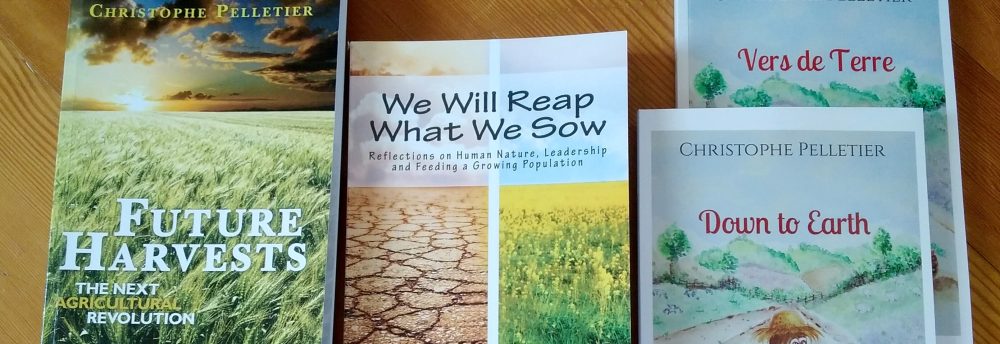
Future Harvests – The book is coming soon!


The editing of my book “Future Harvests – The next agricultural revolution” is about completed. All that is left to do is developing the cover and start the publishing.

I have already received orders, even before the book is out. That is quite a good sign. And a great surprise for me.

If you wish to be updated automatically when the book is published, just subscribe in the sidebar window on the right.

To describe the topics addressed, I have posted three short promotional videos on YouTube. In previous articles (The fun of writing this book and The next agricultural revolution), I had already given an idea about the content of the book.

Video #1: The Fundamentals (duration 2:37) – Introduction to the background and fundamental principles mentioned in the book “Future Harvests – The next agricultural revolution” to achieve food security for 9 billion people in 2050. Topics such as demographics, the shift in economic power, the control of food  and food security strategies are reviewed. Sustainability, innovation, efficient market driven food production and strong leadership are required.

or click here if video does not appear

Video #2: The Actions (duration 2:12) – A short review of some of the actions mentioned in the book to achieve the objectives. Solving the water challenge, finding new land for production, urban farming, hydroponics, farming the desert, rebuilding fisheries and developing aquaculture further are all possibilities.

or click here if video does not appear

Video #3: The Questions (duration 3:08) – A sample of some of the questions raised in the book. They cover technology, land deals in Africa, improving yields, restoring soil fertility, change in consumer needs, organic farming, risks of conflicts, biofuels or meat are some of the topics presented.

or click here if video does not appear

If you know someone who could be interested by the topics on this page, please pass it on!

The fun of writing this book

Over the last few months, I have been working quite a bit on writing this book about the future of agriculture.

I must say that compiling in one book a wide range of topics that, without any doubt, will be part of the future of our food production has been an exhilarating experience.

From demographics in full motion to the latest in technology, we can envision many different scenarios to set up the most efficient food production possible, as local farmers, industry NGOs and governments will need to find optimal solutions with the land, the water, the labor force and the capital available to them. Water and soil will be of vital importance, and their proper management is essential for the stability of many countries.

In the future, there will be no room left for wastage and inefficiencies, or we all will be punished if we get complacent. Similarly, we will need to change our thinking and accept that solving future problems will not be about transferring a one-fit-all model to very diverse situations. We might have had the illusion that it once worked, but it actually did not. We will learn from the mistake of the past to perform better. Sustainability is not an option; it is the only choice, because per definition what is not sustainable is doomed.

As food is a necessity, and since when we share between 9 billion people there is less left for each of us than when we shared between 4 billion, efficiency will be paramount. This will affect food prices and social stability. Technology is necessary but it is not the panacea in itself. The most needed resource for the future is strong visionary leadership to help us develop the plan for the next decades.

Let’s prepare ourselves for a deep change and we must accept the idea that we might have futuristic farms run by robots, satellites and computers in some regions as well as local urban gardeners in the heart of the cities, where 70% of the world population is expected to live. We will have small organic farmers and we will have large industrial farms using genetically engineered crops, but we also will have large highly efficient semi-organic farms that will combine the best of both worlds. We still will have specialized farms as well as mixed operations. Hydroponics and aquaponics will grow substantially in the future.

Today’s diet will be revisited and excesses will be out of place. Should we become vegetarians or do we simply need to eat less meat? Will aquaculture live up to the expectation and become the main source of animal protein? You will find out in the book.

Countries will have to think on how to guarantee food security to their populations. If it is not done well, this challenging task might end up in serious conflicts. Foreign and private investment in land and farming will continue in Asia and Africa. If managed properly, they will bring much prosperity to these regions, but if not managed properly, then we can fear the worst.

All these topics and many more will be presented in the book and I hope that it will help readers to understand all the variables that are at play, as well as it will help them get a more objective view of many controversial topics such as GMOs, nanotechnology or in-vitro meat. Once readers will have finished the book, they will be able to figure out whether and how we can feed 9 billion people. Thanks to examples from all over the world in as diverse countries as Uganda, Kenya, the USA, China, Indonesia, India, Brazil, Argentina, France, The Netherlands, Cuba, Kazakhstan and many more, we discover a myriad of different situations and solutions that illustrate human ingenuity to produce food.

However, for now just a few more months of patience as I need to get through the process of publishing.

Reducing waste works – The example of Hormel Foods

Hormel Foods issued a press release yesterday about their packaging waste reduction program, and the amount of packaging material that they saved is simply impressive. Reduction covers cartons, paper sleeves, thinner glass jars, plastic trays or shrink-wrap.

Not only this program has a direct effect on the packaging of Hormel products, but it indirectly also saves a lot of resources, such as a significant reduction of paper fiber, less trailers on the road using fuel and less petroleum for plastics of all sorts.

The only detail that do not mention in their press release is the money savings. You can be sure that they would not go through all this effort if it was not bringing significant savings.

Economy meets environment and vice-versa. This only proves that common sense and a clearly defined strategy deliver positive results.

Yes you can! You just need to want to!

Click here for the complete press release from Hormel Foods

Coca-Cola and the bottle of the future

Coca-Cola will start selling its beverages in a special bottle, called the PlantBottle, which is made from PET plastic and from plant-based materials by the end of 2010. A first launch will take place in Western Canada during the Olympic Games held in Vancouver, BC.

In the US and Canada, the bottles will include 30% of plant material, and the bottles are 100% recyclable. The biological material will come from sugar cane by-products, originating from the production of ethanol, mostly from Brazil. Including this material in the PET plastic reduces the carbon footprint of the bottles, and reduces the dependence on oil-based materials. The benefits are both environmental and economic.

The ultimate goal of the company is to produce bottles that will be made of 100% non-food plant-based materials such as wood chips and wheat stalks.

For further details, read the Coca-Cola press release at http://www.thecoca-colacompany.com/presscenter/presskit_plantbottle.html.

“Let’s end the polarized debate on food” Holden urges

Glad to read this statement!

Hopefully what Patrick Holden, director of the Soil Association is advocating in this article will come true.

It is high time for the partisan debate to end, for both sides to recognize that they do not know it all, and they both can learn a lot from each other; and for all of us to make the right changes. Yes industry, there will be changes, and some profound ones that will reshape your landscape. And yes environmentalists there will be changes and you will not have all that you want because eating is not an ideal, it is a necessity.

Goes along what I wrote in “Food production and environmentalists: time to co-operate

Uruguay, the quiet leader in beef?

Here is an interesting article about how Uruguay works towards a healthier future.

Not only does the country invests a lot in renewable energy but it works in improving its beef, too.

Uruguay’s  100%-traceable, hormone-free, grass-fed beef farming is offering many answers to the concerns of today’s consumers, and the system rewards the farmers doing the right thing, too! Read the article at http://www.benzinga.com/36898/hamburgers-in-montevideo

Not the largest producer, but certainly among the smartest.

Environmental performance on labels: it is coming. Really.

Sweden has started presenting the carbon footprint of food on the labels for food products sold in supermarkets and on some restaurant menus. The Swedish National Food Administration is managing this program.

I was announcing this trend to inform consumers about the environmental impact of the food they consume, and as an aid to make their eating choices, in my earlier articles “Environmental performance on foods labels” and “The dining of the future“.

Here is the link to the article from fis.com with more details on how some food items, such as fish, beef, chicken or pork, perform.

Educating the consumer – Nutritional information only is not enough

Last week a survey was published in the US about whether fast food customers were using nutritional information to make their choice. The result was that although they could read how many calories their meal would include, they did not choose for a healthier lower calorie meal.

Apparently, this was a shocker. It was not to me, and this for a couple of simple reasons. First, people do not go to a fast food restaurant to nibble on a knackebrod. Secondly, information disclosed is never enough to make people change their habits, especially if they have a craving for what they buy. Otherwise, why do some people still smoke when they can read in big letters on the pack that it will kill them?

Parents play a crucial role in getting good eating habits

Parents play a crucial role in getting good eating habits

If we want to make people change their eating habits, information is necessary, but by far not sufficient. When it comes to food, we are dealing with many complex issues that have to do with psychology and with taste and a behaviour that we have acquired at a very young and developed as we grow up in the environment that our parents have provided. Further, we all know how skillfully marketing has use these psychological “weaknesses”.

In the US, there is currently quite a debate on health care and obesity is one of the main issues. In many ways, our eating habits are a reflection of our life style and of our society, as I have mentioned in my article “If we are what we eat, what will we eat in the future?” Therefore, trying to induce a change in our eating habits can only succeed if we make broader changes in the way we live.

Next to information, what consumers need is education. Unless they have an understanding of what the data they get really means, how can we expect them to act upon it?

Teaching children about nutrition will help them eat properly

Teaching children about nutrition will help them eat properly

We need to teach children about the basics of nutrition and of metabolism as early as possible, and this education must include their parents, too. There is no big mystery behind what causes obesity, diabetes and other food excesses related ailments. It is quite easy to explain what functions the different food groups fill and how to compose healthy meals, as it is really just a matter of adding up and keeping the right proportions.

It would be highly useful to educate everyone about where food comes from and how it is produced. A program like “Know your food, know your farmer” introduced in the US is useful, but “Know your farming” is just as needed.

What parents also need to understand is that it is their duty to give their children a balanced diet, although it might mean that they, too, should have one, but most importantly, when it comes to decide what is on the table, the children do not dictate what they want simply based on what they like.

Education, though, goes much further than just parents and schools, and retailers, restaurants and the agribusiness need to co-operate more than they currently do, even though some are more active than others in this field. If we want to solve a society problem, the whole society must participate. It is rather interesting to see how the meat industry in the US is reacting to the proposal of a meat-free Monday in school cafeterias. I can understand the resistance to government intervention in telling how people should feed themselves, although when this leads to many health issues, one could argue that if the people cannot make the right choices, maybe someone else should set stricter rules to help them. I also can understand that such a meat-free Monday is a bit threatening to the meat industry, as it means (a tiny little) bit less business in the short-term and maybe quite a bit more if it meant that the next generation might cut on meat consumption. On the other hand, what the meat industry in developed countries needs to realize is that there are plenty of people in other countries who are longing for meat, and these new markets have more than the potential to replace the volumes lost in their domestic markets.

Another great source of information is consumers’ organizations, like the ones I know in Europe. They are independent and they provide many surveys and comparisons on consumer products. They have been very useful in helping consumers gain more awareness about what they consume. Unfortunately, such open and objective information is not directly available in all countries and this is a weakness in the fight for health.

Copyright 2009 The Happy Future Group Consulting Ltd.