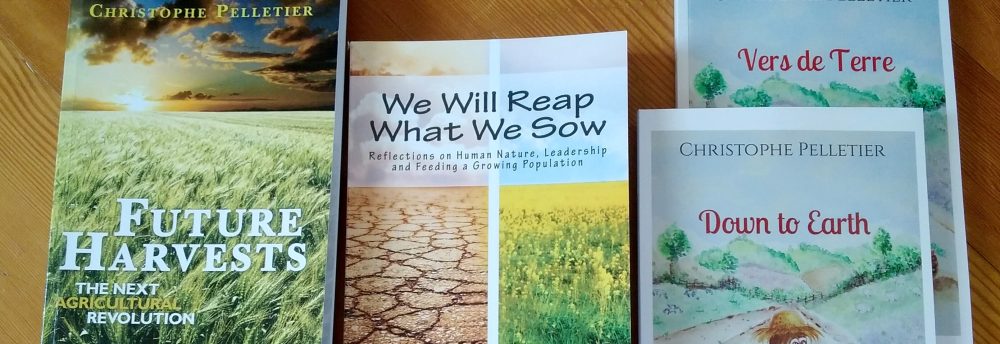
Future Harvests – The book is coming soon!


The editing of my book “Future Harvests – The next agricultural revolution” is about completed. All that is left to do is developing the cover and start the publishing.

I have already received orders, even before the book is out. That is quite a good sign. And a great surprise for me.

If you wish to be updated automatically when the book is published, just subscribe in the sidebar window on the right.

To describe the topics addressed, I have posted three short promotional videos on YouTube. In previous articles (The fun of writing this book and The next agricultural revolution), I had already given an idea about the content of the book.

Video #1: The Fundamentals (duration 2:37) – Introduction to the background and fundamental principles mentioned in the book “Future Harvests – The next agricultural revolution” to achieve food security for 9 billion people in 2050. Topics such as demographics, the shift in economic power, the control of food  and food security strategies are reviewed. Sustainability, innovation, efficient market driven food production and strong leadership are required.

or click here if video does not appear

Video #2: The Actions (duration 2:12) – A short review of some of the actions mentioned in the book to achieve the objectives. Solving the water challenge, finding new land for production, urban farming, hydroponics, farming the desert, rebuilding fisheries and developing aquaculture further are all possibilities.

or click here if video does not appear

Video #3: The Questions (duration 3:08) – A sample of some of the questions raised in the book. They cover technology, land deals in Africa, improving yields, restoring soil fertility, change in consumer needs, organic farming, risks of conflicts, biofuels or meat are some of the topics presented.

or click here if video does not appear

If you know someone who could be interested by the topics on this page, please pass it on!

Reducing waste works – The example of Hormel Foods

Hormel Foods issued a press release yesterday about their packaging waste reduction program, and the amount of packaging material that they saved is simply impressive. Reduction covers cartons, paper sleeves, thinner glass jars, plastic trays or shrink-wrap.

Not only this program has a direct effect on the packaging of Hormel products, but it indirectly also saves a lot of resources, such as a significant reduction of paper fiber, less trailers on the road using fuel and less petroleum for plastics of all sorts.

The only detail that do not mention in their press release is the money savings. You can be sure that they would not go through all this effort if it was not bringing significant savings.

Economy meets environment and vice-versa. This only proves that common sense and a clearly defined strategy deliver positive results.

Yes you can! You just need to want to!

Click here for the complete press release from Hormel Foods

Study on waste production in meat and fish supply chains

A study to determine how much waste is produced in the meat and fish supply chains has been initiated in the UK by the Waste and Resources Action Program (aka WRAP) and Envirowise. The goal is to help reduce waste and save money.

To read the article from fis.com, please go to http://fis.com/fis/worldnews/worldnews.asp?l=e&ndb=1&id=34467

This confirms the issue I mentioned in my article “More action needed on food waste

More action needed on food waste

Food waste is one of those topics that rarely make the headlines while the numbers that come out surveys are simply stunning.

40% of food production does not reach the plate

40% of food production does not reach the plate

Five years ago, the University of Arizona had published a report about the situation in the USA. Their estimate of food waste was almost that 50% of the food produced in the US never gets eaten. Although some losses are inevitable in the supply chain, their report estimated that 14% of the food bought but American households are thrown away, and even 15% of that amount is sent to garbage without even being opened. Not only, this is lost food that could have even eaten, but also the environmental impact of food waste is far from negligible. According to the University of Arizona research, cutting half of the food waste would reduce the environmental impact by 25%, because of reduced landfill use, soil depletion and application of fertilizers, pesticides and herbicides. Recent USDA studies indicate a level of 25% of food that never reaches a plate.

In the UK, research by the government’s waste reduction agency, WRAP, found that one third of all food bought in Britain is thrown away – of which half is edible! I read an amazing statement from Liz Goodwin, WRAP’s chief executive in a 2007 article from The Guardian: ‘If we stopped the amount [of food waste] that we could stop, it would be the same as taking one fifth of cars off the road.’  About a third of the food waste in the UK comes from households, food manufacturers account for about 20%, food service and restaurants for about 15%, and retailers just under 10%.

In Australia, it is estimated that food waste makes up half of that country’s landfill!

At the global level, estimates of food going wasted are that over half of the food produced globally is lost, wasted or discarded as a result of inefficiency in the human-managed food chain, finds a new study by the United Nations Environment Programme released in early 2009.

According to UNEP Executive Director Achim Steiner There is evidence within the report that the world could feed the entire projected population growth alone by becoming more efficient while also ensuring the survival of wild animals, birds and fish on this planet.” This statement is a nice illustration of what I was presenting in my article The transition from a consumption society towards a maintenance society.

Let’s check if this is correct:
Today’s food production being 100 with waste of 40%, means that we actually consume 60. FAO claims that food production needs to increase by 70% to meet the needs of the population in 2050. This means available food must be 60 x 1.70 = 102, compared with 100 gross production currently. With no waste, Achim Steiner statement sounds consistent and correct!

If this is not food for thought, I do not know what is. Nonetheless, this is definitely a part of what we need to address for the future of food supply.

Copyright 2009 The Happy Future Group Consulting Ltd.