
As usual, listen here to a Chrome AI-generated podcast-type playback of this article:
Surely, you have heard the following statement many times: “the food system is broken”. It is a nice slogan, especially for activists. The reality is that this statement is rather meaningless. Criticism about modern agriculture is not new, far from that. Some time after my graduation from the agricultural university, I had bought a book titled “Le Krach Alimentaire – Nous redeviendrons paysans” (“The Food Crash – We will become peasants again“). This book, published in 1988, was written by Philippe Desbrosse who worked as an expert with the Commission and Parliament of the European Union of then. The book is a gloomy criticism of modern agriculture, making claims that world agriculture is on the verge of complete bankruptcy and the author wondered whether there still would be farmers and even bread by year 2000. He saw organic agriculture as the only possible and viable option for the future. Well, we know the answers to his questions and the solutions that have been developed during this period. Although his predictions did not come true, he did addressed a number of valid points that are still relevant today, such us the depletion of soils. His solution was just not realistic. Nothing is black and white. Nobody has it all right and nobody has it all wrong. Excessive alarmism never really helps, and neither does denial.
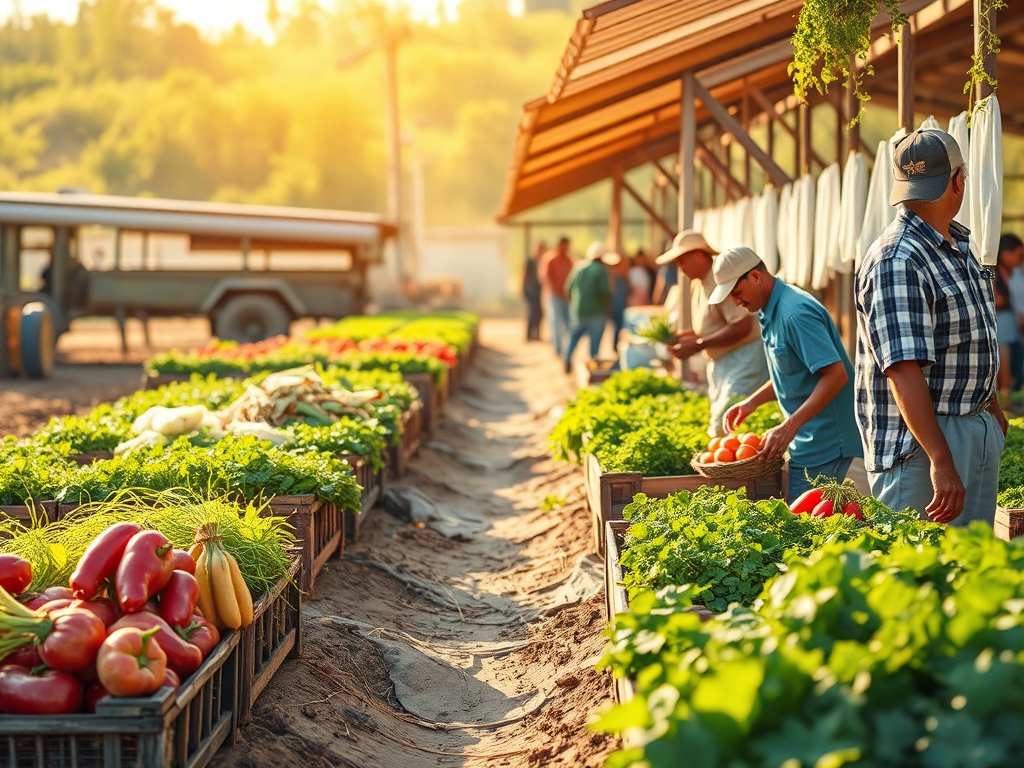
First, there is no such thing as the food system. There are many food systems because there are many different natural conditions, many different types of consumers and many different kinds of governments with different objectives and policies. A farmer selling directly to consumers operates in a system that is totally different than one who sells commodities on the world market. Different markets have different sizes in volumes sold and very different economics as well. The second error about the slogan is to say that “the system is broken”. It is not broken. It actually still works rather well, as it has been able to provide foods to an increasing world population. Not only does agriculture produce enough food, but when you factor in 1) the huge amount of food waste caused by either lack of proper infrastructure and market access or because of negligent behavior from consumers, retailers and food service operators and 2) the large amount of crop production used for biofuels (just in the US 40% of corn and 47% of soybeans), as I described in a previous article (maxed out or a planet of plenty?)
Since the publication of Desbrosse’s book, the world population has increased by 3 billion people! Food production systems are in constant evolution, as they constantly need to meet new challenges and new demands. Today’s farms and agriculture are rather different than they were 50 years ago. They are quite different than they were ten, even five years ago. Only people with little insight in food and agriculture think that food systems are frozen in time. Perhaps, they should visit farms and talk to farmers more often than they do, to realize the ongoing transformation of agriculture.
Food systems are the way they are for good reasons. They are not designed on a whim. There is a strong logic behind them. Although they are not broken, they are not perfect, either. Here, it should be a case of he who has never sinned cast the first stone. Personally, I do not know of any human activity that is perfect. All occupations have their flaws. Perfection does not exist. It is a hard truth to accept for perfectionists who usually are also born critics. What matters is not perfection but excellence. Everything has room for improvement. So do food and agriculture systems. It is work in progress. When you look at it from that angle, the future looks brighter. It means that there is hope. We just need to make work of it, which is much better than criticizing without offering any viable and practical solution or throw soup on Mona Lisa.
Food systems are about viable economics, not intellectual exercises
How food is produced and brought to consumers does not happen per accident. Although food systems are quite complex and are influenced by a myriad of dimensions (see a previous article on this blog: Why changing food systems is a challenge), their success -or failure- always come down to one thing and one thing only: their economic viability. It is about money. I know this is a boring topic that irritates some people but fact is that money plays a role in everything in our lives. Denying it does not change that fact.
There can be as many “intellectuals” assessing, criticizing or conceptualizing food systems as we want, food systems will have to pass the economics acid test. In a way, that economic check up is where the term food system meets its limitations, and where the concept of value chain is a lot more relevant. Indeed, the economics of the food system determine whether it creates value and how it distributes that value from the field to the plate.
It is important to emphasize that food systems need to produce what consumers are willing to buy. It may sound obvious. Yet, this part is often overlooked. If people do not buy a product, it means the end of that product and of its production system. The key criterion for people to buy or not to buy is value. If consumers find that a product has value, they show interest. If they do not see any value in the product, they ignore it and it dies. Then, comes the second part of value: does the price align with the perceived value or not? If consumers think that they get good value for money, they buy. If they think the product is too expensive for what it is, they do not buy. It is that simple.
The result of consumer interest is that the product -and its production system- has potential. But this is not the entire story, yet. The consumer end is only one part of the total equation and this is where the concept of value chain is quite important. All the steps before the point of sale to the consumer need to also find value in participating. All the links of the chain must have an economic interest in producing for the consumers.
The essential point of a value chain is that money enters that chain only from one end: the price that the consumer pays. That amount of money goes into the value chain pot, if you wish. Then, the trick is to make sure that all the links of the chain can get a share of what is in the pot so that they can continue to produce and participate. For each of the partners in the value chain, the share of the money pot that they get must cover their individual costs. No business can survive if they get less money than they spend to produce. The pot that I am mentioning is going to have to be shared through a cascade of commercial negotiations between all the links of the chain. They are all one-on-one negotiations and they do not take into account their impact on the other chain participants. As usual, a chain is only as strong as its weakest link, and that plays a critical role in the strength and the viability of the entire system.
Of course, they are many aspects that influence costs. Just to name a few, it is obvious that market size (volumes), government regulations, quality standards, infrastructure (logistics), relative bargaining positions (commercial negotiations) and training producers to have the proper skills for the new system strongly influence the total cost from producers to consumers. Every change in these criteria affects the total costs and how the money pot can be shared. These are major factors from the down-and-dirty business reality. These factors are never considered by the “food systems theoreticians” I pointed at earlier in this article. There are two main reasons for that. The first one is that this reality is very far away from the thinking of the theoreticians. The second one is that, they tend to perceive day-to-day business activities as not being part of the intellectual conceptualization. They fly at higher altitude. In other words, it is not their problem. Except that, with that very attitude, those who attempt to design the new, beautiful and ideal(istic) food systems often set food producers for failure.
A few examples for illustration
To explain what kind of consequences changing food systems causes, there is nothing like a few examples. I will try to be as concise as possible.
The rise of supermarkets. They have changed food distribution dramatically. Their success and growth are strongly related to cars and mobility. They have strongly influenced infrastructure and logistics. Their professional procurement approach has also changed dramatically the availability, the standards, the origin and the prices of the foods they sell. Their dominant position has also forced food producers to offer larger volumes and also to get bigger to rebalance the bargaining position. This has led to consolidation and much larger food corporations.
Role of government policies. A good example is the European Union. Its history of subsidies has shaped its post WW2 agriculture. It has deeply transformed the size and the purpose of farms. That in turn has also had profound consequences on the social fabric of rural areas. EU standards on quality, animal welfare and the ban on GMOs have also had a strong impact on the cost structure of foods and on the competitive position of European agriculture compared with other agriculture behemoths like the US or Brazil. Their policies will also have huge consequences on future European agriculture production volumes and trade.
Dogmatic policies ignoring market reality. Perhaps the most “beautiful” example would be the mandate from the French government to impose a target of 20% of organic dairy production a few years ago. They offered financial support to farmers to carry out the transition. Only problem has been that there are not enough consumers willing to pay the extra price for organic milk and organic dairy farmers had no market for their products. The result has been a massive crisis leading to many of the farmers who switched to organic to abandon organic production at great cost to them. Consumers did not perceive much of a value difference and would not pay for it. No real market research had been carried out but just dogmatic objectives. Result: financial disaster and major hangover.
Market-driven dairy success story. In Senegal, there is a dairy company called Laiterie du Berger. Their main product is yoghurt that they sell to urban population in the country. It has been a market-driven approach lead by France’s Credit Agricole (banking), Danone (one of the world’s leading dairy companies) and several NGOs. They started from the market end and partnered with local dairy farmers, most of whom were Fula people with small herds and low technical support. Laiterie du Berger has organized milk collection and as the business was growing and making progress, the Fula farmers are now getting technical support for their operations and better genetic material for their livestock. The result is that the farmers produce more milk per cow, produced the quality needed by the dairy company and have now better living standards. The production system has changed and many benefit from it, from farmers to consumers. Similar projects to improve dairy production are also underway in other countries. For instance, Nigeria is partnering with Danish organizations to improve the genetic level of their herds. Indonesia has plans to import more than 1 million cows to produce more milk for their population and one of their targets is to offer milk in schools. These are examples that show how a market-driven approach leads to 1) changes in production systems and 2) improve life quality. These are pragmatic and economic approaches not based on utopian dreams.
Developing new products without thinking from a solid market potential perspective. Current champions in this category would be investor-driven start-ups, usually based on inflated ego, and some weird messianic complex in some cases, more than on solid market research and understanding. Beyond Meat and other fake meat tech foods have been superb examples of how not to do things. The insect farming sector is another major flop. Insect farming companies are literally dropping like flies, going bankrupt one after another. They did not do proper market research. First, they got misled by FAO hype on insects. Secondly, they deluded themselves in their own green washing while reality proved rather different and had no idea of supply challenges. Similarly, tech vertical farms have been failures. The main reason has been that they serve very small markets. The world does not and cannot feed itself on expensive basil and arugula. Inevitably, the results are high costs that sales prices cannot cover and few consumers who care for the value of such systems compared with traditional ones. However, early big investors who knew when to exit and to cash in have sometimes done quite well, but perhaps that was their only real goal after all… shhh… Start-ups need to master business basics before making bold statements about saving the planet or revolutionizing food and agriculture. Actually, such megalomaniac claims should be red flags right away.
And I could give quite a few personal examples of business sectors in which I have been involved changes I have led in marketing and production. From my personal experiences, I would say that any change of system goes along with serious changes of economics. Often, costs and prices do not move in parallel and the new system fails for purely economic reasons. In particular, beware of those market surveys that pop up once in a while, stating that a “large” percentage of the population would be willing to pay “more” for a product if it were to be produced “better”. Such market research is usually set up more as a New Year’s resolution wish list than a true research. The intention sounds good but usually when in the store, the consumers look at the price tags and make very different decisions than the ones mentioned in these surveys.
New systems also require serious investments both from financial and skills training point of view. They often require mental changes that either people are not prepare to accept or that will cause resistance that will lead to some compromises. Anyway, the key is to do a lot of thorough number crunching, as the changes are far from simple to work out.
Conclusions
#1 Always be market-driven. Not doing so spells trouble. It is always much better to produce what consumers need and want than to produce and then struggle to figure out who will buy and for what price. Usually that price is significantly lower than what the theoreticians plan for. Market-driven is less risky, has higher rates of success, costs less and is also less difficult to manage. That is a non-negligible advantage. Building a production system for which the market and the entire chain are not buying in is doomed to fail.
#2 Food systems have consequences in terms of market size and costs. Changing a component of the system changes the cost of production and therefore has an impact on consumer prices and profitability. This in turn has an effect on how many people are willing to buy the products from the “new” system and therefore the size of that market. Nothing is worse for producers than a market that is oversupplied, except for a drop in demand because of a price change.
#3 Don’t be an idealist, at least not for too long. Most of the people presenting themselves as food system experts, be it from NGOs, academia or supranational organizations (such as UN agencies, and the EU, just to name a couple), very often seem to follow a particular bias. There are many of those around. Some themes are appealing. In particular small-scale farming and family farms. Unfortunately, such ideological and dogmatic approaches rarely deliver because they overlook the economic realities of all levels from farm to plate. Actually, it would be interesting to know how many of them have really had all that much of a positive impact, if any. At best, those that succeeded remained limited in small niches. Business people are usually more pragmatic and they focus on what works. They usually implement change when it becomes necessary. The food and agriculture industry is actually quite good and finding new ways. Their only problem is that they tend to wait too long and act only under an existential threat. The reason is mostly to not increase costs, but that often tends to be a rather short-term thinking mistake. The idealism part of building better production systems is commendable but it needs to go hand-in-hand with a solid dose of realism. Those who make that move on time will succeed. Those who stick to unrealistic goals will achieve nothing.
Copyright 2026 – Christophe Pelletier – The Food Futurist – The Happy Future Group Consulting Ltd.


 The Food Futurist Solutions - Anticipate, Adapt, Succeed