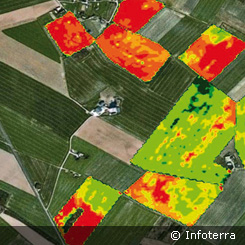
When satellites assist farmers for higher yields

Satellites are the modern way of agricultural land assessment. Not only is it accurate, but it proves to be much more cost efficient than former techniques such as soil analysis.

The status of farmland at a glance!

The status of farmland at a glance!

By measuring the electro-magnetic radiation reflected from the ground, a whole region can be scanned at once, and farmers can have a review for their whole farmland area. On such maps, they can see the variations of their crop performance as well as soil and fertilization status. From there, they receive advice; they can set up their own action plan and time it with meteorological data.

Here is the link to the article of Economist.com for the whole story.

The vertical farm

Here is a think-out-of-the-box article about the “vertical farm”.

It is an interesting vision of a replacement of agricultural land, by indoor robot-tended hydroponic agriculture. They also envision the possibility of raising farm animals and developing aquaculture in the water used to grow the plants; and the fish waste would be used as fertilizer.

All of this would be grown in a 30-floor skyscraper located in the city, powered by the energy coming from city sewage, and the ground floor would be a food supermarket that would provide food for 50,000 people.

Such projects are under review in Abu Dhabi, South Korea, Seattle, WA and Las Vegas, NV.

It looks like science-fiction, yet there are some really interesting arguments in favor of such a development.

Let’s not confuse efficiency and intensification!

Although it may sound like a bit of semantics, the difference between these two terms is quite important when it comes to agriculture and food production.

Let's not confuse efficiency and intensification!Since WWII, much progress has been made to increase food production, such as genetic improvement, production techniques and mechanization, use of fertilizers, chemicals and pharmaceuticals, the development of animal nutrition, and of course government incentives. This has resulted in our ability to produce more efficiently and face a previous doubling of the world population. It has helped reduce costs and made food more affordable to more, although unfortunately not to all.

The main driver behind this evolution has been to shift from a mostly labor intensive food production to a mostly capital intensive one, and this why it had to become intensive. The labor force moved to urban centers where they could find jobs in manufacturing and later in services. Thanks to mechanization, less people were needed to work on farms. This has led to a sharp drop of the population active in agriculture from above 50% of all actives to less than 5% in Western countries within 30 years. Moreover, as the standard of living increased, labor costs increased and made a labor-intensive approach too expensive to fit in the type of society that we created, and the only, apparent, solution has been to further intensify and mechanize.

The strong development of manufacturing that went along with the rise of the consumption society increased the standard of living and the disposable income. In the same time, in constant currency, food became relatively cheaper and much more affordable. This led to a change of diet from mostly starch-based to protein-based, and we have seen recently a similar trend in emerging countries.

Clearly, all of this has improved the quality of life, maybe a little too much too fast though. Intensification has brought its share of problems as well, as it always does with progress. For instance, I can mention soil erosion and loss of organic matter, soil fertility and ground water quality affected by manure (especially minerals) surpluses, reduced genetic diversity and possibly lessened resistance to diseases, to name a few. Of course, for each of the problems, we come with a solution mostly based on technology, which usually fits in and reinforces intensification.
Unfortunately, Nature does not work that simply. All it needs is time to process and eliminate problems through its cycles in the soil and in the water. Nature can handle quite a lot, but it can handle only that much. This is where the difference between intensification and efficiency becomes obvious.

Intensification tends to continuously load and overload the system, which is why we hear so much talk about sustainable agriculture nowadays. Food production cannot be sustainable if it does not allow its natural environment to process and eliminate the contaminants. Similarly, Nature cannot replenish on its own what we take out, unless we create the conditions for this.

Efficiency, on the other hand, integrates performance and sustainability. It allows having a high production, not so much by using massive amounts of water, fertilizer, energy or other production inputs, but by using them when needed where need and just as much as needed. This way, we can grow plants or animals with the minimum amount of waste and respect the ecosystem. Efficiency also comes from optimization, and to this extent, efficiency and intensification go hand in hand, up to that particular point when any incremental input does not produce more in the same proportion. More importantly, once we produce beyond the optimum, we take the chance of creating a stress. This is very clear in animal production, when densities exceed a certain point, the animals’ organism defence becomes weak and makes them vulnerable to diseases.

Copyright 2009 The Happy Future Group Consulting Ltd.

Wal-Mart’s Yiannas promotes food safety culture

This article reports of Mr. Yiannas (VP Food Safety at Wal-Mart) speaking at the Grocery Manufacturers Association’s Executive Conference in Colorado Springs, Colo., and his views on this topic.

It just shows that there is a new trend coming in the US, as I happened to describe in my article of yesterday (Health and environment as the drivers of food production). There are growing concerns from consumers and the retail will probably be the catalyst for change. Wal-Mart as the leading retailer is going to pave the way forward, just like it does on sustainability. This certainly is going to mean some deep changes in the way the suppliers will have to run their businesses.

Health and environment as growing drivers of food production

Health concerns will gain more importance in the future in the decision process of consumers when they buy their food.
More and more, we can hear and read about concerns and even rejection of the current production systems. Although this bad publicity is not always based on the most objective facts, it has been able to find a growing audience.

It must be true, it was in the newspaper

It must be true, it was in the newspaper

Since most consumers have little or no knowledge of agriculture and food, their only source of information is in the popular media. On the other side of the discussion, the agri-food industry is not getting through, because its message tends to be too defensive and too technical. Unfortunately for the industry, errors from the past (for example, the use of DDT) or cases from other industries (for example, tobacco) contribute to cast a shadow on its credibility. As I wrote my previous article “Less controversy thanks to transparency”, the agribusiness will achieve much more by opening up and having consumers visit their premises so that they can tell what they saw. They must organize more Open House days.

Therefore, for now, consumers have a certain perception of how food is produced, and it is not so relevant to argue whether this perception is correct or not. Perception simply is reality, and consumers act according to what they believe is true.
A little bit of this...There is a growing concern about environmental and health aspects of food production. About the environment, you can list very diverse things such as the depletion of wild fish stocks in the oceans, the interaction between aquaculture and wild fish stocks, manure and smell of intensive animal husbandry and impact of manure on soils and drinking water, deforestation of rainforest for ranching of beef or about growing GMOs (Genetically Modified Organisms). On the health side, consumers worry about food poisoning due to bacteria, such as E. Coli, listeria, campylobacter and salmonella, but also about residues of pesticides or antibiotics, as well as they worry about the use of hormones in animal productions. As the discussions get more animated in the US about the reform of health care and the cost of obesity, more and more people are wondering about whether the fast food diet is a proper one. Next to this, animal welfare is a growing concern by more and more consumers.
The answer to many of these worries has started to appear in the last few years with the growth of the organic market segment. When we see the growth and the performance of a retailer such as Whole Foods, there is no doubt that organic foods have a growing audience.

The concerns about the environment are forcing retailers, food service and businesses involved in the production chain of food to make changes. Some of the actions they have taken can be seen as marketing or PR, but they also have become mainstream. Just a look at how many restaurant and supermarket chains have already implemented sustainable seafood programs indicates how serious this change in consumer attitude is. Fast food chains are also actively working on reducing their environmental impact and set standards on where they source their meat, based on environmental concerns, such as no beef from ranches deforesting the Brazilian rainforest.
In the past, we have seen some examples of production methods that had to be abandoned, simply because no solution to cope with environmental problems could be found. This has been the case in The Netherlands where the level of intensification caused such manure surpluses and risks of animal disease to such a point that after many years of looking for viable technical solutions in vain, the government decided that the size of the national herds had to be reduced.
Similarly to what happened in Europe over the last decade, we can expect that much stricter rules in the use of antibiotics will be applied, and I expect a similar trend to a progressive elimination of the use of hormones in animal husbandry. About animal welfare, there should not be any surprise the day that only husbandry systems that allow enough “recreation” area for animals will be allowed. All of the above is going to have an impact on how and where food is produced. Systems will become less intensive, and progressively we will see more techniques to improve efficiency to compensate.

Past Food?

Past Food?

As I also had mentioned in another article (Future price of fish and meat: up), it is simple logic that with more people to feed, food is going to become more expensive. However, the relative prices of various food products also need to go along their relative health benefits. Today, it looks like only wealthy people can afford a healthy diet, as the price of “good” food is substantially higher than the price of what makes a nutritionally unbalanced meal. This clearly does not work in the direction of a healthier population at large.

The way consumers think will define the way we eat and produce our food. Many changes in consumption patterns, in production systems and in product offering are under way. I will get back later with more details on what my views are on this.

Copyright 2009 The Happy Future Group Consulting Ltd.

How much can the rule of 80-20 tell us about the future?

We all have heard about this rule across all industries, including agriculture and food. Eighty percent of the food would be produced on 20% of the farms and vice-versa. If it still applies in the future, it can indicate us how our food production and supplies will look like in the future. Of course, this is always a theoretical exercise, but it is quite convenient to elaborate on our thoughts.

As the population is expected to grow quite strongly in the coming decades, especially in urban areas, this could indicate two dominant trends:
• Further size increase of the largest farms and further industrialization of agriculture and food for global markets, although the number of farms in this segment would not increase strongly.
• Strong increase of the number of small farms involved in specific value chains and strongly linked with their local economy.

Industrial agriculture
Producing more, yet in a sustainable way. That is the challenge!This group will continue to be involved in mass production of commodities for global supplies, like this is the case today.
Yet, they will face an increased pressure to adapt to the requirements of sustainability, which technically is quite possible. New systems and more efficient technologies will be the pillars of its growth and development. They will have to find ways of reducing the amount of chemicals in crops and the amount of pharmaceuticals in animal productions
The requirements for capital will be quite high and the sector will be led by increasing larger corporations, by an increasing level of capital by large private investors and, last but not least, by some governments. This agriculture will innovate further and will be developed thanks to this capital. It will use automation and mechanization to reduce the dependence on labor. Mergers & acquisitions will continue in the agricultural sector and a few large blocks will remain, dominating their sectors.
Their mandate will be about more control the natural conditions of production and about reducing to a minimum their impact on air, water and soil, by using less polluting transport methods, water preservation, effluent treatment and soil preservation. They also will have to engage in maintenance of their environment.
The role of this type of agriculture will be to bring to market large amounts of affordable food for the masses, and should play an important role in strategies around food security, which is where corporations and government will interact on a regular basis.

Local food value chains
Closer to natureThis sector should undergo a strong growth and be build in a market-driven approach. These are the farmers that produce specialty products aimed at serving either a very specific segment of the retail or foodservice market.
This trend, which has been already initiated around concepts such as organic or authentic, will evolve into a more integrated local economy, and the initial concepts will probably become less differentiated as food production in general, be it industrial or traditional, will use more sustainable techniques.
Contrarily to the common belief, this agriculture will be developed thanks to very efficient techniques, but will be centered relatively more about labor and relatively less about capital. In this case, efficiency does not necessarily mean intensification.
We must not underestimate the significance of this part of the food production, as it will play an important role. However, we must not expect this type of agriculture to be the solution to feed the world, and this is not the purpose of the farmers involved in such food production chains.

This type of farming will grow in two different environments:

  •  In “developed” countries to serve a increasing, but aging, population more demanding about the origin and the production methods, and who is ready to pay a premium for the perceived better quality. The angle will be about quality, transparency, sustainability, traceability and as close to zero a use of chemicals and pharmaceuticals. In some areas, it could help strengthening a local economy and local communities.
  • Developing a local economy thanks to agriculture (Picture: FAO) In emerging countries, the development of a local agriculture, and aquaculture, will be a key driver of economic development for under industrialized and/or under urbanized regions. It also will be a way of slowing down the migration of population to urban centers and limit social problems, by creating satisfying economic conditions and by securing food supplies locally. This farming will be about basic needs, before marketing.

Copyright 2009 The Happy Future Group Consulting Ltd.

Less controversy thanks to transparency

The agribusiness and food industry come regularly in the media with some bad publicity. As such, it does not differ from other industries, as criticism comes with the territory.

What is unfortunate is that the agribusiness mostly responds to this in a rather defensive manner, either by attempting to bring rational scientific facts or by denying the facts that their opponents bring forward.

Criticism of food and food quality is not new. When I started my professional life, I had been lent a book about how food in general, and animal husbandry in particular, are perceived. The introduction of this book was a long complaint about the quality of bread, and by then (in the mid 80’s) the arguments presented sounded quite familiar to me. The funny part of it was that in fact this text was, according to the author, a report written in Ancient Egypt, some 3,000 years ago.

Although bad publicity and criticism are obviously no novelty when it comes to food, it seems that the industry has a hard time fighting this battle.

Some pressure is goodAs such, criticism is not a bad thing as long as it is not done in bad faith with the only purpose to bring damage. There is nothing wrong with consumers being concerned about the quality of the food they eat, and about the way it is produced. Being worried about whether and how antibiotics or hormones are used, about the potential problems to the environment linked to intensive production is quite legitimate when you are rather ignorant of production techniques. After all, nobody has ever claimed that any industry was perfect, and business is always work in progress. It is utmost important for all of us to have watchdogs in order to make sure that we do not get into excesses that can lead to irreparable damage.

Let’s also realize that only a tiny minority of people now work in agriculture and that most city residents have a very limited, if any, knowledge of how farms are operated. On the other hand, they have very strong, often idealistic and romantic, opinions on how they think farming should be, regardless of whether it is viable or if it can provide them enough food. Surveys with city kids have shown that many of them do not make any connection between eggs and hens, or between milk and cows and calves. For many, it is not even a clear fact that in order to get meat, one has to kill an animal.

Further, it is human nature to pick on the big guy, as we all love the story of David defeating Goliath. Moreover, bad news, the more sensational the better, always get more attention than good news, like the recent article published in Time. There is nothing like fear to get people glued to their TVs or reading reports in the papers or on internet. These psychological traits are quite difficult to deal with.

The problem with defensiveness, when dealing with bad publicity, is that it always brings the defendant in an awkward position. If this not handled properly, it can very easily come over as suspicious, which reinforces the poor impression.

Transparency creates trustIn my opinion, the only proper way forward about information on agriculture and food is transparency. Only transparency can eliminate (or at least reduce to a minimum) negative publicity. Only by being candid and open about the way food is produced, can the agricultural community inform properly the public.

Remember that issues around food production are highly emotional, as they deal with much more than just nutrition. This is why responding with rational arguments has so little effectiveness. First, emotional concerns must be dealt with as emotions, not merely with cold scientific facts. Only once the emotional connection has been established, it is possible to bring the communication to more rational aspects and facts.

The better informed the public is, the easier it is to also discuss and address issues that come along the way. Candour is only the first step, the clearly expressed will to always improve the way food is produced is absolutely necessary, and this is not about vague promises. It must come with an open agenda of issues that the industry knows about and is (and will be) addressing without complacency. A clear commitment to a plan of actions with defined time lines is the best way to create and restore trust with consumers. And the best way to score in this is by taking the initiative and the lead. The industry and this includes any participant in the production chain and its watchdogs, from breeding to retail, needs to make these decisions, instead of having to react to changes in legislation, which very often is the result of pressure from the public opinion.

Copyright 2009 The Happy Future Group Consulting Ltd.

High-tech fish farm

Hawaii Oceanic Technology IncHere is an article from fis.com about another type of high tech fish farm with some nice futuristic design.

Hawaii Oceanic Technology Inc. has created the Oceansphere. “These elegant, self-sustaining and untethered semi-submerged floating pods are a revolution in open ocean aquaculture technology”, according to the fis.com article. The system is operated without the use of fossil fuels, which makes it environmentally quite acceptable.

As mentioned in the article, the company’s “plan is to demonstrate the feasibility of this technology and, as Jacques Cousteau said, farm the ocean as we farm the land.”

USDA experiments with grain harvesting device

Here is a nice illustration of what I meant with my article “Innovation and tradition shape the future“.

New harvest method for same yields and better soil and moisture preservationThis is an article from WorldGrain.com describing the result of a test on a new harvesting system for grain carried out by the USDA. They tested the stripper header on millet and wheat.
The idea of this system is to strip away the grain and leave as long as possible a stubble, so that it protects the soil from erosion and enhances precipitation storage. So far results tend to indicate that yields are not affected by this harvesting method.
Just an example of using new technology and innovation to help improve a rather traditional method of getting organic matter in the soil.

Wal-Mart’s 15 questions to suppliers on sustainability

Recently, Wal-Mart has sent a questionnaire to all their suppliers, including for food items, asking them to give answers to 15 questions about they actually do about sustainability.

I like this questionnaire, because it is simple, practical and straight to the point. Suppliers who have difficulties to figure out the answers definitely have quite some catching up to do, because this is not going away.

This is the first step to impose a change towards sustainable products, and we can expect that this document, although only the beginning, will soon become the standard for retailers, and therefore to industry. I believe that their approach will be much more effective than all the partisan talk that seems to create more division than help create a comprehensive plan for the general interest.

I recommend reading this article from GreenBiz, which explains quite well what the Wal-Mart questionnaire will concretely mean for suppliers.