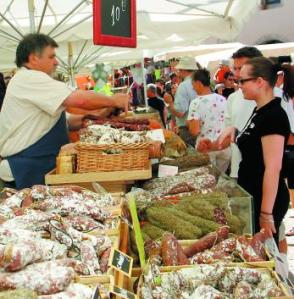
German agriculture Minister says “Eat less meat!”

Ilse Aigner made that statement during the “Green Week” held in Berlin early January, one of the largest shows about food and agriculture in the world.

This is quite remarkable to hear a Minister of Agriculture making such a statement, based on the recommendation of the German Nutrition Society that indicates that 300 to 600 grams (that is about 11 to 22 ounces for our American friends, who usually consume this amount in less than two meals…) of meat per capita per week is enough for a person to cover their nutritional needs. Yet, her statement was linked to environmental concerns, since it is fashionable to blame meat production for climate change issues.

From a nutritional point of view, this recommendation is correct. That is all we need. That is less than most of us want, but that is a very different topic. I had addressed this, mentioning that 30 kg per capita per year (equals 600 g per week) was plenty,  in my earlier posting “The future price of meat and fish: up” a few months ago,. I also mentioned that if we ate only what we need, the West would free a quantity of meat large enough to feed a population as large as China’s.

It is unlikely that the Minister’s statement will change consumption patterns any time soon, but the future price of animal protein will. Considering the feed conversion ratio of farm animals and the increased competition between human consumption, animal feed industry needs and biofuels, the production cost of meat will increase. Feed is the main cost in those productions. Further, the amount of water required by farm animals and the manure issues that still linger with intensive animal husbandry, will add to the price pressure.

There is no need to become vegetarians, but the days of gluttony are numbered.

Copyright 2010 – The Happy Future Group Consulting Ltd.

“Let’s end the polarized debate on food” Holden urges

Glad to read this statement!

Hopefully what Patrick Holden, director of the Soil Association is advocating in this article will come true.

It is high time for the partisan debate to end, for both sides to recognize that they do not know it all, and they both can learn a lot from each other; and for all of us to make the right changes. Yes industry, there will be changes, and some profound ones that will reshape your landscape. And yes environmentalists there will be changes and you will not have all that you want because eating is not an ideal, it is a necessity.

Goes along what I wrote in “Food production and environmentalists: time to co-operate

Environmental performance on labels: it is coming. Really.

Sweden has started presenting the carbon footprint of food on the labels for food products sold in supermarkets and on some restaurant menus. The Swedish National Food Administration is managing this program.

I was announcing this trend to inform consumers about the environmental impact of the food they consume, and as an aid to make their eating choices, in my earlier articles “Environmental performance on foods labels” and “The dining of the future“.

Here is the link to the article from fis.com with more details on how some food items, such as fish, beef, chicken or pork, perform.

USDA launches nutritional web tools

This news is a beautiful confirmation of what I am announcing for the future (see my remarks in “Nutrition basics should be taught in school” and “The dining of the future“) about the need and the coming tools that will help people know more about agriculture, food and health, not only the educational tools, but also the software and/or website that will allow them to set up their own diet and make their own “educated” dining choices.

The article from Food Business News also mention what I have been telling all around and a number of comments that I have left on blogs from food organization and media such as Meatingplace that city people know very little about how food is produced and about their lack of understanding beyond the supermarket counter (read my comments in “Less controversy thanks to transparency” and in “Health and environment as growing drivers of food production“).

Feeding the world in 2050 – FAO coming summit

This question seems to keep many people busy, and this article sums up a number of conclusions drawn by the FAO about the subject.

The information that I find the most interesting is their estimate of the percentage of the world population living in cities, moving up from 49% today to 70% by 2050. Expressed in number of people living in rural areas, this means a drop from roughly 3.2 billion people today to roughly 2.9 billion people in 2050, or around 10% less! This clearly indicates that the future of food supply is not with small farms, but that large units will have to do most of the work in order to feed everyone.

When it comes to their estimate of a necessary increase of 70% of agricultural production to meet the food demand, I have some reservations about their expectations. I doubt that with such a tight supply, people will eat as much meat and animal products as they claim. I believe that money will talk and meat being more expensive that they expect, the diet will probably include relatively more vegetal products and relatively less meat than the numbers that they present.

As I showed at the end of my previous article titled “Price of fish and meat: up”, a healthy readjustment of the Western diet will free a lot of food to feed many more people. As per today, we already are much closer, theoretically, to be able to feed these 9 billion people than we think. I say theoretically because the main problems are:

  1. Guaranteeing access to food through proper infrastructure, which in large part rests on the shoulders of politicians, and
  2. Ensuring that people have enough money to pay for food.

For those who claim that we need three or even four Earths to deal with the problem, clearly, their assumptions are based on having the whole world on the American diet, but that will not happen. We have only one Earth and that will not change. Other things will, though.

The hot regions of the future

Food strategies for the world

Food strategies around the world

In this article, the term hot does not refer to climate, but to strategic and active food producing regions. Not only is the population growing, but also the demographics vary greatly between regions and this will change deeply where from and where to the trade is going. Here are, briefly, the main changes as I see them happening as we go forward.

The aging and increasingly health-conscious West will not show any increase in consumption per capita, and very likely it even will drop, as older people need less food than the youth and also because the shift from quantity to quality will continue. Of course, immigration policies in these countries might offset this somehow. The direct consequence of this is that suppliers are going to have to look for alternative markets for agricultural products. They should not have to worry too much, as there will be plenty of people to feed in other regions.

Asia, with about half of the world population is definitely a huge market, although it presents a great variety of conditions and situations.

The largest economy in the region, China, is developing a middle class with more disposable income. This results in a change of diet, with relatively more protein, especially animal protein than by the past. Although being the largest meat producing country in the world, China is struggling to feed its population, and I expect that it will remain a net food importer. Further, the country has major challenges to overcome when it comes to availability and quality of water. However, in the long run, the past one-child policy will affect the Chinese demographics and influence their need for food, as well as the dynamism of their economy at large, by the way.

The second largest economy, India, is very dependent on the monsoon for its food supplies, and climate will remain a challenge. They seem to struggle to be able to secure their self-sufficiency, rural development is still a challenge and poverty remains a concern to reach prosperity.

Emerging South Asian countries, on the other hand, for instance Vietnam, show a different picture. They have a young population and want to benefit of the economic momentum coming from China. They are actively developing agricultural and aquaculture production for export purposes, and they keep on this policy. Aquaculture is very active, as some of these countries have a very extensive shoreline, like for instance The Philippines.

Although food security in the region remains uncertain, and the scare of last year’s food price increase, some countries are trying to establish structures to protect from such risks. For instance, a number of ASEAN countries are trying to set up a rice cartel, some sort of an OPEC for rice, in order to have more control on the market and the prices. Of course, we will have to see if this will work as planned.

Another region that is showing booming demographics is the Arab world and the Middle East. Many countries in the region are wealthy thanks to oil, but also have the disadvantage to be located in desert areas. Attempts to increase food production have met their limits, and they do not guarantee food security. The main reason is the shortage of water and trying to grow more food would create a drinking water crisis. This is why some Arab countries are developing other strategies to “outsource” their food production like mentioned in the article “The Great Unseen Land Grab”. Other countries, like Qatar, are considering investing in food companies in order to secure their food supplies.

Some players are already making their moves

Some players are already making their moves

I expect stronger ties between the Middle East and former soviet republics. Russia, Ukraine and Kazakhstan are joining forces in the “Black Sea Wheat Pool”, another agricultural OPEC. Although we will see how this combination works. Another area that I see booming in the future is the Mediterranean region, which is the interface between Africa and Europe. Although immigration has been a hot issue in the past, there is a great potential for a win-win situation for both sides if managed properly. The idea of creating an Economic Zone around the Mediterranean has already been brought forward and considering the demographics of the region, it makes quite a lot of sense.

Africa, although plagued by many problems, be it natural, social, political, humanitarian or health, as a huge untapped potential. The plans of Arab and Asian countries to lease land on this continent and develop agriculture for their needs, could give the necessary impulse to develop African economies. I also believe that South Africa has the potential to be the driver of the economic surge for the continent.

Last but not least. South America and Brazil in particular, is going to play a major role in agricultural production. They have an amazing potential, but also many issues to solve, especially on the environmental and political level. Their position of producers of basic commodities as well as high value products like meat gives them a strategic role in the international food trade, and the upcoming merger between JBS and Pilgrim’s Pride in the US and between JBS and Bertin is another step in the creation of agribusiness giants, following the merger between Perdigao and Sadia.

Copyright 2009 The Happy Future Group Consulting Ltd.
Ownership of food: the seeds of future conflicts

From an agriculture that mostly was producing locally for a local market with a straight forward production chain, the organization of food production has become more complex and structured over time. As we moved towards always more integration, traceability and globalized markets, the roles and bargaining positions of the different actors has changed.

bargaining power evolves

Facing the possibilities of more food riots in the future, if we are not in a position to make food affordable for all, we certainly can expect to see new power struggles emerge.

If we place ourselves in a scenario of food shortage, it is normal to assume that the power would be in the hands of whoever owns the food. But who is the owner, or better said who is actually in charge?

Is it the retailer? Is it the farmer? Is it the owner of the land on which the crops are grown? Is it the futures contract trader? Is it the seed supplier? Because without farmers, there is not much food in the stores; and without seeds, farmers cannot grow much food, and without food, no futures contracts to negotiate.

In the same way, who should decide where to the food would go? Does it belong to the country and the people who produce it, or does it belong to a corporation that prefers to sell it abroad? In a situation of shortage, this could lead to serious conflicts.
Corporations look primarily at markets and try to maximize their profit. That is their mandate.
Governments have a different look at things, as politicians want to have happy citizens, so that their position of power can continue. All they want is avoid social unrest.
Potentially, this can lead to new regulations and even to the possibility of nationalizations if companies and governments do not agree.

To get back to the example of seeds and genetics, there is a growing responsibility resting of the shoulders of breeding and genetic engineering companies. Not so long ago, let’s say a bit more than a century, there was much more genetic diversity in agricultural crops and farm animals. This diversity has shrunk quite significantly and we face the potential risk of not having the right genes available if we were to face a natural situation that would eradicate plants or animals as a result of inability to resist and to adapt to the new conditions these organisms must deal with. The genetic pool used to be a collective asset, but it has moved more and more into a private asset. About this, too, one can wonder who is in charge and who has ownership, and what could the consequences be.

As long as we are not facing any severe supply unbalance, the current situation will probably linger as it is a bit further, with the players having the most power trying to grow their position and influence other deciders to their advantage, but this kind of consensual vagueness about who is the owner of food will sooner or later cause some major shake-up.

Copyright 2009 The Happy Future Group Consulting Ltd.

The lurking menace of weeds – Farmers’ enemy #1

Here is quite an interesting article from the FAO about the cost of weeds in agriculture.

 the more weeds, the less yieldAccording to their numbers, weeds limit crop yields to such an extent that the world misses yearly the equivalent of 380 million of wheat a year, or in money $95 billion. My first reaction was that there is an untapped market for herbicides producers, but the article describes ways of getting rid of the weeds that do not require the use of chemicals.

Compared with the medical cost of obesity in the US of $147 billion a year, or the contribution of the US meat and poultry industry of $382 billion per year to the economy, or the TARP funds for the banks of $700 billion, or the estimated financial toxic assets losses worldwide of $4 trillion, the $95 billion does not seem that big a number after all.

Yet, 380 million tonnes wheat equivalent represent, according to the FAO, half of the 2009 expected world wheat production!

Assuming simplistically that with this wheat we would feed people only a diet of bread, this could feed decently more than 1 billion people! This is all the more amazing as the FAO currently estimates the number of hungry people in the world at 1 billion. Clearly, there should be some possible solutions if policies and politics were targeted at the right goals.

Always interesting to put numbers in a different perspective…

Innovation and tradition shape the future

Tradition in food can be quite resilientIn order to understand what changes are ahead of us, we need to realize that opposite forces are engaged in shaping the world of the future. As we all know, accepting change is always a slow and sometimes a difficult process. There are those who see the possibilities and those who see the drawbacks. The first train was going, supposedly, to get cows stop giving milk, but we now know that cows love to watch trains passing by. Probably, the first caveman who drew a picture of an animal on the wall was considered by some as a great magician and probably by others as pure evil. As such, such a struggle is very useful, as on the one hand it shakes immobility and open new doors, and on the other hand it prevents us to rush into the unknown without thinking first.

Change is part of our lives and that will not change. The problem that we face about change is actually about the pace of change, more than over the change itself. Over the last century, this pace has just increased steadily, thanks to more and more efficient technology.

If we look back the lifespan of the oldest living person, which brings us back to the end of the nineteenth century, just take a minute to think of all the changes that have occurred since then. There was no car industry, no antibiotics, no commercial airlines, no TV, no internet or cell phones, no supermarkets, just to mention a few things that we take for granted nowadays.

Although such a change is dramatic and has affected the way we live today, it has been a process that has needed time. Usually, it is said that more than 60% of the products that exist today did not exist 10 years ago and if we extrapolate this to decade to come, we can expect some even more spectacular changes.

Innovation is in constant motion and technology helps us to conceive and to use much faster than by the past. Yet, it is interesting to see that even with such a pace of change, traditions still play a very important part in our lives. Even with lots of modern gadgets, most cultures keep their specific characteristics. Their respective values do not evolve as much as our “things“, these just become part of the culture. This is an important point when it comes to innovation: what you offer must meet a need, if it does not, it will either fail, or at best be a fad.

Having a look at the future, you must wonder what the underlying trends of innovation are since it started. I can see several major constant areas of innovation:

  • Reducing physical labor.
  • Helping us live better and longer.
  • Increasing efficiency.
  • Helping communication.
  • Increasing mobility.
  • Offering more leisure and entertainment.
  • Making some people a little wealthier.

What could this mean for food production in the years to come?

  • high tech agriculture - photo BayerMore technology to improve efficiency of water use, fertilizer use, animal feed use, land use, energy use (objective: zero waste).
  • More mechanization, automation and robotising, especially in software more than hardware, working on precision (intelligent technology).
  • Greater focus on health and natural solutions for food and for agriculture/aquaculture/fisheries (objective: zero residue and zero contaminants in water, air, soil, and food).
  • Projects to repair environmental damage and include agriculture/aquaculture/fisheries in environmental management (restore and maintain sustainable food production).
  • Policies, and politics, to increase food production (disease control, regulation, more government intervention at strategic level, incentives).
  • Redistribution of markets with geographical shift of production and consumption areas.
  • Shift from convenient to practical food solutions (bulk meal components).
  • More education on agriculture, food and nutrition (balanced diets, food safety, traceability).

While such changes will come over time, consumers will still be looking for some level of tradition in foods. This can be about authenticity, regional specialties and recipes, or choosing to buy directly from farmers. Obviously, this is not a rational process, but it is more about the perception of “true” and “natural” production systems. After all, nostalgia is a constant of human emotions, too.

Copyright 2009 The Happy Future Group Consulting Ltd.

G8 shifts focus from food aid to farming

Here is an interesting article from the Financial Times describing the new approach from G8 countries towards food security. It connects with my previous posting, and shows how strategic agriculture is becoming. It is also nice to see that some world leaders look at this issue in a more sensible manner than in the past, shifting from “give a man a fish, he will have food for a day” to” teach him to fish and he will have food every day”. Well, that is if we manage to replenish our oceans, which is a topic on which I will write in the future.

Of course, it must be clear that if they choose this new approach, it is because they have an advantage in doing so.