An Interview with The Food Futurist: 100 Answers about the Future of Agriculture

Following up on the recent publication of the report “100 Questions of Importance for the Future of Global Agriculture” by a group of experts from all over the world under the lead of Jules Pretty of the University of Essex in the United Kingdom, I wanted to react candidly and spontaneously on every of these 100 questions.

Since giving extensive answers would represent several months, if not years, of work for a single individual, I chose for the interview format. I gave myself just a couple of minutes to say what came to my mind.

The result is this document: 100 Answers – An interview with the Food Futurist

I hope it will be as enjoyable for you to read as it was for me to write. I hope that it will trigger reactions, as this is more a first attempt to initiate a forum discussion.

The questions were quite interesting. However, I missed a few elements tat I believe to be quite important in the challenge of feeding a population of nine billion by 2050. The initial report did not raise enough questions about the issue of water. Water is essential to agriculture, and the challenge of accessing enough water is even more urgent and more critical than improving food availability. Similarly, the initial report did not reflect much on urban farming. Estimates of today’s urban food production are of 15-20% of the total world food production. Considering that about 50% of the population lives in cities, this means that 30-40% of all the food consumed in cities is produced in urban centers. This is far from negligible. As the urban population is expected to double by 2050, urban farming will be an essential part of our food supply. I had also expected more attention to aquaculture, which is the fastest growing food production.

The initial report focuses more on production aspects and systems than it does focus on the human factor. Population increase, distribution and especially the quality of leadership will be crucial for the way food security strategies can be set up. As I mention in one of my answers, our future will be as bright as our leaders.

Writing this document, and reacting to questions asked by highly qualified experts, was a good way of assessing the book “Future Harvests” that I published in August 2010. I was quite happy to see that the book addresses all the concerns of the thinkers and policymakers.

I wish you happy reading.

Of food riots and economic hardship

The riots in North Africa are getting a lot of coverage. This is good, because the problems in this region have been ignored for a long time. In 1987, I had bought a book “L’Europe Submergée – Sud-Nord dans 30 ans” by the late French economist Alfred Sauvy, the man who created the term Third World. His book was a description of the demographic differences between Europe and the nations from the South, and of the likely consequences. His prediction was by then that within 30 to 40 years, Europe would see a flow of immigration from the other side of the Mediterranean Sea that would replace the original European population. He also saw in this migration a great opportunity in terms of economic renewal for Europe. He certainly would have deserved the title of futurist!

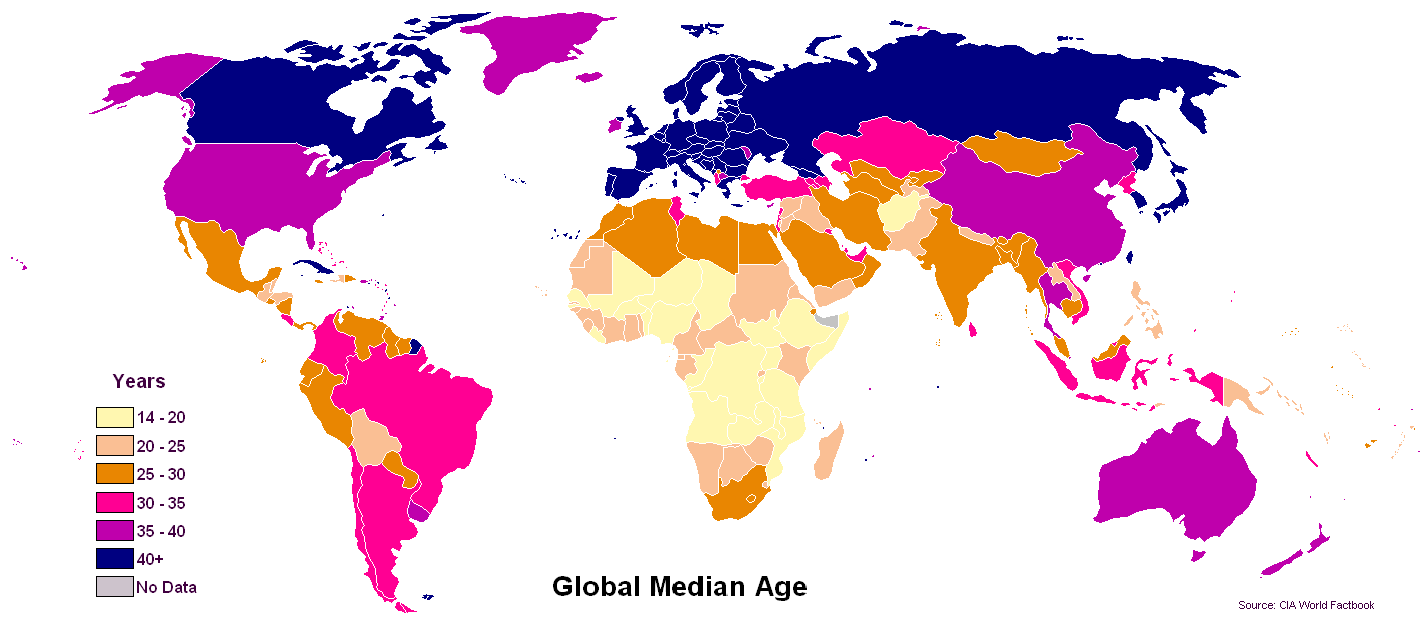
When I wrote Future Harvests, I dedicated a chapter on the changing demographics. It clearly appeared to me that he was right, and that the evolution of the population numbers between the different regions of the world will influence decisions about food production, food supply, and economies altogether. In Future Harvests, I indicate in which regions I think tensions would arise. The Arab world was number one on my list. Here is the map of the median age per country. The median age of a country is the age of half its population. Most of Arab countries have half their populations under 25. And what to think of Sub-Saharan Africa where that age is lower than 20? This is in sharp contrast with Western countries where almost half the population is older than 40. It was really striking to see the pictures of Tunisian rioters: there were teenagers. With a chronic unemployment, especially with the youth, reaching levels of 25%, and many people living on a pittance, riots erupting and governments being toppled are no surprises. This situation has been going on for a few decades. A new generation of people who see little hope and future is simply sending a message. Change must come or change will come.

In the news, everything is mixed together and it may appear a little difficult to understand what causes Arab countries to flare up like this. Everyone speculates which country will be next. Of course, food is mentioned as one of the many causes, and I can read all sorts of opinions about that. From what I understand, the riots in Tunisia were caused by the arrest of a food street vendor for not having the proper license, which immediately cut his meagre source of income. After the success of the Tunisian upheaval, it is not surprising to see neighbouring  countries with a similar demographic and similar dire economic situation following a similar path. Does this mean that there will be riots over the entire Arab world? Probably not all at once. It might not be successful everywhere, either. Other rulers in the region will make some moves, even symbolic ones, to defuse potential tensions. Both the Tunisian and Egyptian rulers are doing their best to defuse the tensions, and by resigning if this is what it will take to avoid complete chaos. The lesson is hard for Arab countries and they are now more aware than ever of the dangerous situation they are in. This is also a loud warning to the rich nations. However, at the Davos conference, the elite were not even aware of what was going on. Eventually, they heard it, and paid attention. Stock markets dropped for one day only as unrest was spreading in Egypt. Interestingly enough, markets were up on the days that a bomb exploded in Moscow’s airport and when Japan’s economic rating was downgraded by S&P. Certain things matter more than others. Europe must now realize that unless it helps its southern neighbours solve the problem, they are going to become a part of it. Yet, European countries seem to have trouble taking some clear position on the events. North Africa, just like the rest of Africa needs economic development. The people of these countries need to regain hope in the future. The generation that comes of age to leave the parents’ home and start, and support, their own families must see reasons why it will be possible for them. At this juncture, they doubt that they will be able to do so.

In Future Harvests, I mention two regions with a demographic time bomb waiting for a food security problem to explode. One is the area between Russia and the former Central Asian Soviet republics, extended to Iran and Pakistan. The other one is the border between Mexico and the USA. Mexico is disintegrating and law and order are fading away. Both these regions are going to have to work together to find strategies to ensure stability. This probably will not happen without serious clashes.

Many of the countries where booming demographics, poor economic situation and precarious food security are the normal state of affairs need a 21st century Marshall Plan. As I have presented in previous articles, the potential for feeding the world population is there, but the main cause of hunger is the lack of affordability of food. In 2008, there were food riots, but there was no real food shortage. The main problem was that the populations could not pay for it because the price had skyrocketed, especially the price of basic food staples such as rice, wheat and corn. This time, although according to the FAO, food prices are even higher than in 2008, we have not seen the same kind of riots. A reason for this difference may have been the fact that retail prices of food staples remained contained. So far.

Some sort of Marshall Plan is a necessity. Development and stability is in the interest of rich countries, just as much as it is for developing countries. Europe, Russia and the USA cannot thrive with countries on the verge of complete collapse at their borders. If there has ever been a good investment, this would be it. It is interesting to look at the example of China. This hard-core communist country was on the verge of economic disaster and famine, until they decided to put the doctrine on the side, and open their doors to foreign investments. From the moment that China decided to feed its people, things changed. For the communist government, this was the only way to stay in power. A billion hungry, and angry, people are impossible to keep under control. For the capitalist “Satan”, it was convenient to present the Chinese “opening” as a victory of the aspiring capitalism, but mostly it was the greatest opportunity ever to reduce labour costs of consumer goods and boost corporate profits. Investing in China was not exactly like the Marshall Plan that rebuilt Europe, but the amount of money that flowed into the country helped turn around a bad situation into what soon will be the world’s first economy. While the middle class in Europe is stagnating at best, if not actually disappearing, China has grown its middle class to 300 million people (the whole US population) and it aims at increasing the number to 850 million by 2030. China is still (officially) a communist country with no elections, but that does not seem to bother too many people. Developing nations need money to flow into their economies to create jobs.

Many people are asking whether we will see food riots again. Unfortunately, the answer is yes. Although there is much political talk about food prices and risks of riots, nothing is really done to prevent it from happening. It does not look like there is much political will to make the necessary reform to prevent extreme tensions. Most world forums of all sorts seem to be more of an opportunity for the wealthy and powerful to hobnob than a place where actual decisions are made. The WTO Doha Round, which if well completed can bring many solutions, takes for ever to come to a conclusion. It looks like reason and leadership are not prevailing much right now. It is highly likely that the world, and mostly the rich nations, will understand the message and act only when they will feel that their position is in danger, too. Food riots will come as soon as food affordability drops under an acceptable level of suffering. Of course, Asia, Latin America and Arab countries are the most likely candidates for such unrest, but rich countries are not immune to that, either. Especially the USA is more vulnerable that many may think. In 2009, the USDA estimate of households that do not have enough money to feed themselves was of 14.6%. Although the economy seems to have stabilized, it has not recovered yet. Moreover, the housing situation in the US is far from stabilized. Many Americans have been able to keep consuming somehow because they simply stopped paying their mortgages and could stay in their homes. The number of mortgage delinquencies is so high that banks cannot handle all the cases. Actually, most cases have been postponed, but one day some decisions will have to be made. If the banks played by the book and foreclosed all houses, the owners of which cannot pay the mortgages, it would result in an incredibly high number of homeless broke people. The banks would have to report serious losses. Today a report indicated that 11% of all American homes are empty. More foreclosures will increase this number further. How will these people manage to eat by then? Banks can decide to settle according to individual situations. There will be less broke homeless coming on the streets and the banks will have fewer losses. In a previous article, I had mentioned the risk of a decreasing dollar, especially the risk of inflation as financial markets play the commodities only to hedge against the loss of value of the dollar. Inflation in an economy that is stagnating will reduce the affordability of food for the less wealthy. Unemployment is staying rather high and I have not seen any report from anyone presenting a situation in which employment would increase in significant numbers any time soon. In 2008, Gerald Celente, a trend forecaster who predicted the 1987 stock market crash and the fall of the former Soviet Union, told that by 2012, America would have food riots, a tax rebellion, and even a revolution. At first, I was sceptical, but I am starting to wonder if he might be right. After all, during the food price hike of 2008, Americans were hoarding goods from the supermarkets.

The food riots to come will finally force government to intervene and do what they are supposed to do, which is to ensure the stability and the viability of the society by setting the proper rules for the game. Especially, proper regulation on commodities markets and corporate near-monopolies will become crucial for social stability. The only unknown is the cost of our procrastination.

Copyright 2011 – The Happy Future Group Consulting Ltd.

Feeding nine billion is an exercise in leadership

In a previous article, “Hunger is about more than just food production”, I showed how much more potential we have to feed the world than we commonly think. However, having the potential to do so does not mean that we will do it. Human nature has the habit of fluctuating between its best and its worst. Therefore, whether we will actually feed nine billion is far from done. In this article, I am going to reflect to what it would take to be successful at making it happen.

In my book, Future Harvests, I present the six principles that are critical to meet future food demand successfully: Sustainability, Innovation, Market Orientation, Pragmatism, Leadership and Efficiency. I had regrouped these principles under the acronym SIMPLE. While I was writing the book, I always came back to the same observation: success or failure to feed nine billion simply depends on us all. Someone needs to set the course and create the conditions to take the proper actions. The world needs leaders that will make food production potential the reality by 2050.

The job description is, interestingly enough, rather reminiscent of food production and genetics. In order to express the full potential of its genes, an organism needs the proper environment. This is exactly the role of the future leaders. They must create the conditions that will allow farmers to produce efficiently, yet sustainably.

The starting point will be about making the right decisions for both the long term as for the short term. We must preserve the potential to produce for future generations, but we must not forget to provide for today as well. Proper leadership will need to take into account the interest of many different groups and manage a balanced approach between money, people and environment. For sure, future leadership will be a balancing act. This will be easier to achieve if the leaders can sell the world their plan, which means that they must have one.

Leaders come from all layers of society. They are in government, in industry, in non-profit organizations, they are independent farmers, or they come from non-food related occupations. Adequate food supply is the very fundament of societies. Where there is hunger, there is no prosperity. Without food, there is not life, and just as importantly, without water there is no food. Developing food security is not an option; it is probably the most important policy sector of any society. This is something that we must not take lightly, even in rich countries where we seem to take food for granted. Things may change.

What story do our leaders need to tell and execute? The points that I raised in the article mentioned at the very beginning are a good place to start. The scandal of food waste, because it really is a scandal, must be dealt with and fixed. In developing countries, this is caused by a lack of infrastructure. It is only a matter of money. If world leaders have the will to get that money at work, it will happen. For some reason, they do not do it. Maybe it is a sign that things are not that critical after all. Compared with the amounts of money thrown at financial bailouts and stimuli of all sorts, the cost of infrastructure development looks ridiculously insignificant. Such projects would actually create jobs and increase the wealth of the populations where it takes place. This would not be artificial GDP boosting, but actual poverty reduction and increased food availability. In rich countries, food waste happens at the consumer end. What leaders of these countries need to communicate is a sense of responsibility. Wasting food is simply immoral, just like any other waste. If we take the example of nitrogen, the waste by leaching is estimated at about half the nitrogen spread on crops. This is huge and very damaging for two reasons. One is that the nitrogen ends up in the drinking water making it harmful, especially for pregnant women and infants. The other is that the production of nitrogen fertilizers uses half the world’s agriculture natural gas consumption. Efficiency is not a luxury, but it is a necessity. When efficiency increases, the amount of waste decreases. This works towards a higher sustainability, too. Food waste is one thing, but food consumption excesses or unbalanced eating habits are another area of work for our leaders. Eating more food than one needs is not only detrimental for that person’s health, it is also food that is less available to others. This pushes food prices up, too.

The effectiveness of leaders depends on their ability to communicate and get the message over to their dependants. Changing habits and infusing a sense of solidarity and responsibility requires patience, communication and proper education programs. Defining vague objectives or using hollow populist slogans and expressions will have no effect. Only charismatic leaders with strong convictions about what ensures the future of their people, even if it means sacrifices, will be able to bring such a change. It is not easy to do when your country is not on the verge of a terrible crisis. An interesting example about unilateral leadership is the decision of the Chinese government to slow down the number of new car registrations. They consider that there are enough cars. Getting a licence plate will be difficult in the future. In 2008, they decided to ban the use of disposable plastic bags in supermarkets, thus saving an estimated 100 billion bags and the equivalent of 37 million barrels of oil per year. Similarly, China is now the world leader in renewable energies. What actions did the Western democracies take about new car sales and supermarket plastic bags? When children died because of tainted milk, the Chinese authorities arrested all the people involved, and even executed two persons. Of course, the use of melamine in the milk was intentional, making the case extreme. However, in the West, I do not recall anyone being arrested or considered personally liable after deaths by food poisoning. My point is not to demand imprisonment of CEOs as a standard operating procedure, but I am sure that if executives of food companies felt that they could be personally liable for food poisoning, the precautionary principle would apply much more systematically. Leaders need to make understand that doing something wrong comes with consequences. Although there is much to say about China’s political system, one must admit that not having to think in terms of elections every four years and not having political campaign funded by any industry of NGO of any sort can help politicians focus on the long-term, too. Maybe the fact that China is plagued with so much pollution in the air, in the water and in the soils also makes the issue more acute for the leaders to resolve.

If the stick is one option to make people do what is right, the carrot is, at the very least, as important. Nothing stimulates people more than being rewarded for doing a good job. People are at their best when they know that others appreciate what they do, and that what they do makes the world a better place. Then, they do not see their occupations as “have to” activities, but as “want to” ones. Subsidies, bonuses, tax credits are all motivating tools to make people do the better thing, but the key is to have incentives that meet the goals without having harmful side effects.

Leaders also need to be innovators. Considering how fast our world changes, and the quantity of new knowledge made available about on a daily basis, many new possibilities will be available to solve old problems. Innovation is the child of human genius and, to cope with future challenges, creativity and adaptability will be major assets. It is the leaders’ role to foster innovation, yet by keeping in mind all long-term implications.

The ideal leader would have the qualities described by Plato in “The Republic”. Although it is an ideal, having committed leaders matching his description would increase our odds of success.

Copyright 2011 – The Happy Future Group Consulting Ltd.

Hunger is about more than just food production

Everyone who works in agriculture and food knows that there are about one billion people on Earth suffering from hunger. The temptation to think that the cause is a lack of food production is great, but it does not reflect reality. Quite a few serious organizations and personalities claim that one Earth is not enough to feed nine billion people by 2050. Some claim that we would need two Earths. Others even go as far as mentioning the need for three, and even four, of our blue planet.

There are two possibilities with such statements.

If they are true, then humanity has a problem, because there is only one Earth, and we will not get a second one. In such a case, the only way for supply and demand to get in balance is a reduction of the world population. This could happen through famine, disease and/or wars. Since in such a scenario there is a maximum to the world population, once this number is reached, there must be a constant elimination of the couple of billion people too many, through one of the means just mentioned. This is not a particularly happy thought.

On the other hand, if such statements are erroneous, there is hope to feed the increasing world population with one Earth.
Then, is one planet enough or not? Simple math should help finding the answer. If we need two Earths to feed nine billion, one planet would only feed 4.5 billion people. Currently, the world population is around seven billion, out of which one billion is hungry. Conclusion is that we currently can feed about six billion people. We are not doing that bad. Is it possible to find ways of feeding three more billion on this Earth? From the simple math above, it is clear that those who claim that we need three Earths or more are wrong.

Out of the six billion who do not suffer hunger, it is estimated that one billion is overweight, a part of which, mostly in the USA, is obese. They clearly ingest more calories than they need. Purely theoretically, if those were to share the excess food they consume with the ones who have too little, the billion hungry people would have about enough. This means that today there is already enough food available to feed seven billion people.

Another interesting factor is waste. According to the FAO, about 40% of all the food produced is lost and wasted. In rich countries, most of the waste takes place at supermarkets, restaurants and households level. People simply throw away food. In developing countries, the waste takes place mostly post-harvest. The food does not even reach the market. The food is spoiled because of a lack of proper storage facilities and logistics. The food ends up rotting, contaminated with mould or is eaten by vermin. To fix the problem, the FAO estimates the cost to improve infrastructure at US$ 80 billion. This is less than the amount the EU just made available to bail out Ireland. What to say of the US$ 3.3 trillion that the US Federal Reserve lent to banks to alleviate the financial crisis? Of course, it will be impossible to achieve an absolute zero waste, but if we were to achieve 10%, this will feed many people. I have heard the statement that if post-harvest losses were eliminated in India, the country would be fully food secure. Per 100 tons of production, 40% wastage means that only 60 tons are available for consumers. By reducing waste from 40% down to 10%, there would be 90 tons available. This represents an increase of food available by 50%! Since we could already feed seven billion with the 40% waste, reducing wastage to 10% would allow feeding 10.5 billion people.

There are also many debates about whether we should eat meat or not. The nutritional need for protein is easily covered with 30 kg of meat per capita per year. I had shown in an earlier article that if Western consumers were consuming just what they need instead of eating superfluous volumes (very tasty and enjoyable, though), it would free meat to feed 1.4 billion people the yearly individual 30 kg. In China, the average meat consumption is already up to 50 kg per capita per year. The consumption is very unevenly distributed, but this is the average. Cutting 20 kg per capita over a population of 1.5 billion would free meat for the nutritional needs of an additional one billion people.

The other area of potential is Africa. The FAO estimates that the area of arable land that is not exploited is about 700 million hectares. This is about the size of Australia. To simplify and get an idea of the potential, we can calculate what it means in wheat equivalent. With the assumption that wheat yields would be the same as the current African average, a low 1.5 tons per hectare, this adds up to 1.05 billion tons of wheat. Since a person needs about one million calories per year, and there are about 3,000 calories in a kg of wheat, one ton of wheat can feed three people, the 1.05 billion tons of wheat can feed more than 3 billion people. Normally, there would a crop rotation of at least two harvests per hectare. With proper investment and financing, farms should be able to reach easily the US average of 3 tons of wheat per hectare. Clearly, this performance could be achieved with traditional techniques and good quality seeds. This is not even about high-tech or GMOs. This tremendous potential of Africa is why China, India and Arab countries are very active developing farming there. They did the math. This scenario also shows that Africa can easily become a strong net exporter of food. In this case, the world map of food looks very different. Without Africa being able to produce large amount of foods, the prospects for food security in Asia and the Middle East are a bit bleak. They can depend only on Western Europe, Russia, Ukraine, Kazakhstan, North and South America, and with Australia to a lesser extent. With Africa as a net food exporter, the world map looks a lot more balanced, East-West as well as North-South. Sea routes from Africa with the Arabic Peninsula, the Persian Gulf, and farther away with India and China create a much safer feeling of food security for the countries in those regions. For Africa itself, it may change the relations between Sub-Saharan country and the Maghreb countries. This in turns changes the type of relationship that the Maghreb may have with Europe, by creating more economic activities to the South. Africa’s success –or failure- will affect the whole world.

With the above, everyone can develop further assumptions, but these calculations show that this one Earth can produce enough food to cover the needs of between 12 and 15 billion people. It almost sounds impossible to believe, yet these numbers are not even ambitious. I have not even taken into account that in 2009, 25% of the corn produced in the USA was destined to feed cars, not people, via ethanol production, and that number is expected to grow to about one-third for 2010. The potential is even higher when one considers that a large part of the US corn goes into soft drinks, while it could be used to produce tortillas, with a side glass of water, a much healthier alternative.

That said, if the potential for food production supply looks adequate, actually producing it may not be as easy. The human factor, especially through politics and leadership, will be crucial to succeed.

One would ask why there is hunger if we can produce so much food. The answer is simple. Hunger is not just about food production, it is about poverty. People are hungry because they do not have money to buy food. They do not have money because they do not earn enough, as they have low paying jobs or simply no jobs at all. By developing the economy in these regions, people would get better wages. They could afford more food. The demand would drive the development of food production. Agricultural development would then be a normal and natural activity. Trying to develop agriculture if the locals cannot buy the food cannot work. Recently the FAO estimated that two-thirds of the world’s malnourished live in only seven countries: China, India, Pakistan, Bangladesh, Indonesia, Ethiopia and Congo. These are countries where most of the population is poor, and most of which lives in rural areas. The other proof that hunger is not only a consequence of low food self-sufficiency can be found in two agricultural exports behemoths: Brazil and the USA. In the latter, a recent survey carried out by Hormel Foods, the deli producer, shows that 28% of Americans struggle to get enough money to buy food, or they know someone who struggles. Last year, the USDA had estimated at 14.6% the percentage of US households that do not have enough food on the table. Food will find the money and vice-versa. If Bill Gates decided to move to the poorest and most food insecure place in the world, and would fancy a lobster, I am sure that someone would manage to find him one and deliver it within reasonable short notice.

My book, Future Harvests, investigates the possible scenarios to increase food supply and meet the demand at the horizon 2050.

Copyright 2010 – The Happy Future Group Consulting Ltd.
The quiet revolution of food retailers

While many debates continue in the political and “parapolitical” world about many aspects of food production systems and the impact of human activity on the environment, retailers lead a quiet revolution. Without making the headlines, they gradually change the way their suppliers will do business in the years to come.

Such an evolution is certainly welcome, especially in a time where important decisions need to be made. Political leaders seem unable to reach any agreement on environmental issues, as the world could see at the late Climate Summit of Copenhagen. In the food sector, there are many discussions going on about sustainability and genetic engineering, to name the two hottest items, but the political class does not seem to generate clear and concrete action plans.

Just like what happened in the 1990s about food safety in Europe, retailers are taking the initiative to create momentum on the current issues. The problems that plagued the food industry in Europe, such as salmonella in poultry, the mad cow disease, or the dioxin in Belgian fat for chicken feed showed a number of weaknesses that needed to be addressed. In the case of BSE, UK retailers did not wait for British or European legislation to demand meat and bone meal-free feed for farm animals. As I was working for a company supplying the UK market with chicken meat, I can testify that these were dramatic times. Tough decisions had to be made on a very short notice that had serious financial consequences. By then, a couple of reasons made the retailers took the lead. First, the inability of the government to prevent and tackle the issues was creating a bit of a vacuum on leadership. Consumer confidence in their institutions was fading, and retailers were the only ones, true or not, perceived to take the proper actions to protect the public. The second reason was the fact that many retailers had their own private labels. In this case, the problem was not the supplier’s problem anymore because the supermarket chain could have risked serious PR damage if a food safety issues would have been associated with their brand.

This time, retailers are again in the position where they can present themselves as the consumers’ champions. Legislation is slow to move and make significant decisions. The involvement of interest groups adds to the infighting and delays decision-making.

To prepare for the future, they already have come out with plans and communication on how and where they want the food they sell to be produced, and they try to offer a choice to consumers. By doing so, the most active among them are setting new standards, and forcing the whole production and supply chain to think about the things to come.

In previous blog posts, I have mentioned some of such initiatives, and in Future Harvests, I described the increasing leadership role of food retail in agricultural practices.

In particular, I mentioned the carbon footprint labelling on dairy products by Tesco, Wal-Mart’s Sustainability Index questionnaire to suppliers, and the seafood sustainability programs of many retailers. Marks & Spencer started their Plan A in 2007 with the objective of making their business more sustainable. To achieve this, they are involving their suppliers and the farmers producing for them to carry out the changes that M&S finds necessary for a better future.

More recently, new initiatives indicate that retailers are pursuing further on such initiatives. Wal-Mart came last week with their plan for sustainable agriculture. In the UK, Sainsbury let know last week that they were committing GBP40 million to invest in farming. Earlier this week, Carrefour unveiled their “Reared without GMO” program. In their stores in France, they will sell 300 food items labelled as being GMO-free, to offer consumer a choice based on transparent information. If Carrefour ventures into this, one can be sure that they do so because they already know that this will be good for their business. By gaining market share, it is very likely that their competitors will soon react by issuing similar programs. The EU Commission may be struggling to figure out how to deal with GMOs, but Carrefour says “Let the consumers tell us!” Vox populi, vox dei!

Of course, such initiatives do not please everyone. Today, I could read in a blog for a US magazine backed by the meat industry some interesting reactions about Carrefour’s new plan. Some readers were bringing up the typical arguments. Meat would be so expensive in Europe. Well, meat is quite affordable in France, even without GMOs, so think again! The other argument was about freedom of choice: people should be able to eat what they want. By labelling its food item, Carrefour does just that. French consumers are free to buy at Carrefour or somewhere else, and they have the right to choose what label they prefer. The freedom of choice is ironic coming from the US meat lobby, since American consumers do not have that freedom. Reared with GMOs is pretty much the only choice in the US. For now, that is. However, it is interesting to see on Carrefour’s press release that the pictures of fish, chicken and pork chops are exactly the same, regardless of whether they would be grown with or without GMOs.

In the 1990s, British and European consumers, and retailers, were challenging food industry practices because they were worried about their health and about the lack of transparency about food. Nowadays, in the USA, consumers are increasingly suspicious of their agribusiness, because they are worried about their health and the lack of transparency of the industry. Beef recalls because of E. coli, egg recalls because  of salmonella, spinach contaminated with manure are in the news on a (too) regular basis. They are also increasingly aware, and suspicious, of the relations between interest groups and their government agencies, and how this influences decisions on what they eat.

Retailers are now saying that they are not waiting for politicians to make decisions. They have defined their vision, they know what they want, and they are passing the message on to the suppliers. What would happen in agribusiness USA if Wal-Mart took a similar approach as Carrefour?

Copyright 2010 – The Happy Future Group Consulting Ltd.

The Russian heat wave gives some people sunstroke

The heat wave combined with the drought in wheat-producing region of Russia is causing some concerns, as the wheat production will be affected. That is annoying but not terribly threatening. Moreover, the price of wheat, as well as the prices of other agricultural commodities were due for a rebound because farmers had reduced production after the price fall of the previous year.

But when politicians and speculators get involved, the problem takes a new dimension.  Vladimir Putin announced a possible ban on Russian wheat exports and hell broke loose. The crisis then appears on all media. From mainstream media to the financial press, the world must know that we are in very big trouble, apparently.

Bloomberg and CNBC reports on the price of wheat on the commodity exchange. The speculators are there, looming. The Wall Street Journal asks whether US farmers should plant more wheat and take advantage of the good wheat prices. The Financial Times reports about the quiet doubling of the price of barley. This is bad news for beer drinkers. Food inflation is around the corner. And what if Ukraine and Kazakhstan have the same problem? The Black Sea region is one of the main wheat producers. Even Lester Brown, of Earth Policy, flooded twitter this morning with an unusual amount of tweets expressing his concerns about the effect of climate change and the rise in temperatures. This is all well-known and well-studied stuff, but suddenly my friends, we are close to the end of the world. Or are we really? Mr. Brown even suggests that an increase of 14 F in temperature in the Mid-West would cause a drop of corn production by 50%. Considering that US corn is used for three purposes: biofuels (not food), high-fructose corn syrup (not food) and animal feed, the consequences for Americans would be positive: less driving, less soft drinks and less meat, all three items for which they largely over-consume, at the expense of their health. The ones who would hurt the most would be the Mexicans.

When hysteria hits, it is always good to sit back, reflect quietly and maybe enjoy a cool drink, as long as we can afford it.

What is really going on? Well, we have a climatic event that affects wheat production. It is not new. We have managed worse crises in the past.

The excitement comes from two events. First, speculators have been active for quite some time on the wheat market and this gives them a good opportunity to jack up the prices. Although, remember the price hike of agricultural commodities of 2008! It was all on paper and not so much in the physical world. Yet, people were hoarding food in supermarkets like there was no tomorrow. Are we going to see the futures contract impact the real economy once more. I believe that if this happens again, we will see governments take action to regulate the trading of futures contracts. The bad thing about this is that the example of the new Wall Street regulations have been very slow to take shape and will take a long time to be implemented. Therefore, the “golden boys” still have some good times ahead with markets. Second event, which has reinforced the first one is the declaration of Vladimir Putin. Should we worry about it? Yes and no. Russia is now famous for its muscle showing policies. When oil prices were jumping up, the Russian government played quite rough with oil companies, especially Shell and BP. Their relation got a chill, and later they became good friends again. Russia’s policy on import of meat and poultry shows a similar pattern. Import restrictions alternate with more relaxed policies. Russia is struggling to achieve a satisfying level of food security and it uses all the means it has to develop and protect its domestic production, while sending a message abroad that Russia is strong. In my first language, a roller coaster is called “montagnes russes” (Russian mountains). That is quite relevant to describe this country’s style.

Is the world food situation at risk? As usual, we need to be vigilant, but there is no need for more panic than last year. What we need is a global production plan and increase production on a regular basis, simply because there is an increasing number of mouths to feed. If our approach is knee jerking on the actions of speculators, we will not achieve greatness. Farmers should consider planting more when the market demand increases. That is market-oriented production! If the farmers rush to plant more out of short-term speculation, they will experience the same as after the situation in 2008. Their suppliers (the ones listed on the stock markets) will increase the prices of inputs, especially fertilizers and gobble up the margin away from the farmers, like in 2009. The reality is that food is going to become more expensive, especially animal products. We need to get used to this idea right now, because over the long-term, this trend will not disappear. We need to act with vision and determination to achieve the goals, as I describe in the soon-t0-be-published “Future Harvests”.

Today ended up on a positive note after all. US Agriculture Secretary Ed Vilsack declared that we were not facing a wheat crisis. And wheat prices eased on news that farmers were planting more. Famine averted.

We need more long-term focused leaders and fewer speculators.

Copyright 2010 – The Happy Future Group Consulting Ltd.
Future Harvests – The book is coming soon!


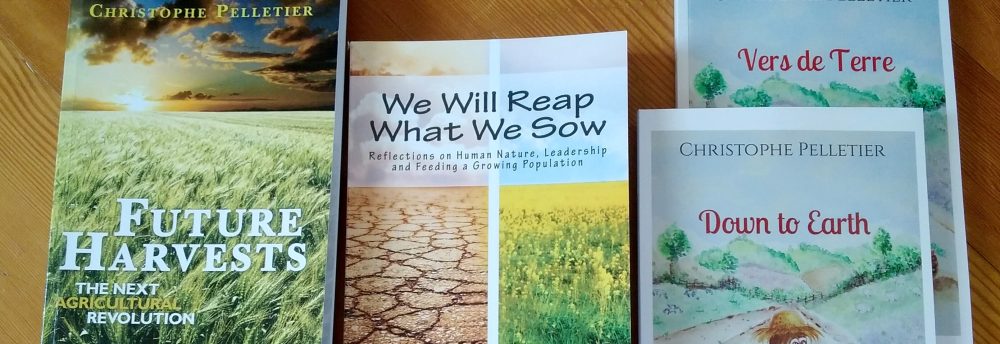
The editing of my book “Future Harvests – The next agricultural revolution” is about completed. All that is left to do is developing the cover and start the publishing.

I have already received orders, even before the book is out. That is quite a good sign. And a great surprise for me.

If you wish to be updated automatically when the book is published, just subscribe in the sidebar window on the right.

To describe the topics addressed, I have posted three short promotional videos on YouTube. In previous articles (The fun of writing this book and The next agricultural revolution), I had already given an idea about the content of the book.

Video #1: The Fundamentals (duration 2:37) – Introduction to the background and fundamental principles mentioned in the book “Future Harvests – The next agricultural revolution” to achieve food security for 9 billion people in 2050. Topics such as demographics, the shift in economic power, the control of food  and food security strategies are reviewed. Sustainability, innovation, efficient market driven food production and strong leadership are required.

or click here if video does not appear

Video #2: The Actions (duration 2:12) – A short review of some of the actions mentioned in the book to achieve the objectives. Solving the water challenge, finding new land for production, urban farming, hydroponics, farming the desert, rebuilding fisheries and developing aquaculture further are all possibilities.

or click here if video does not appear

Video #3: The Questions (duration 3:08) – A sample of some of the questions raised in the book. They cover technology, land deals in Africa, improving yields, restoring soil fertility, change in consumer needs, organic farming, risks of conflicts, biofuels or meat are some of the topics presented.

or click here if video does not appear

If you know someone who could be interested by the topics on this page, please pass it on!

The next agricultural revolution

(Excerpt from my upcoming book, Future Harvests)

The next agricultural revolution to feed nine billion people will be different from the previous one. After World War II, agriculture advanced thanks to chemistry and petroleum. This time, biology and renewable energies will lead us to progress. It will not be just a revolution in science and technology. It also will be a different way to think about the economy and the environment. Knowledge and communication will become increasingly important, even more so than today.

Agriculture is a life science. Biological solutions will gradually replace chemical applications. All sorts of organisms will be involved to improve the way farmers and the food industry will produce.

Bacteria and viruses will help fight pests and diseases. They will help us reduce our use of chemical herbicides and pesticides dramatically. Genetic engineering will evolve and, as a business, it will mature. DNA science will focus on eliminating flaws and on increasing the metabolic efficiency of living organisms. Genetic engineering cannot continue to be about intellectual property and patents. Soon, seed companies all over the world will know how to do the same. Competition and market forces will determine which model will survive. Governments will not allow a select few to control food. They will get involved in genetic engineering programs and they will break monopolies. Genetic improvement will become collective property again.

Ecology will be a part of food production. Agriculture will manage ecosystems, and economy will become the management of the planet. Living organisms on land and in water will assist us. Farmers will think in terms of systems and cycles. Instead of isolating the field, they will integrate environmental parameters as well.

Organic matter will become central in the future agriculture. Farmers will recreate the cycles to improve the structure of the soil and its fertility. Agriculture will help fixing carbon. The use of mineral fertilizers will decrease sharply.

The economics of agriculture will be different, because the economics of energy will be different. New technologies will come. Solar power and wind energy will become common sources of energy. The economics of water will change, too. The management of water will reshape our food production. Water will become substantially more expensive and only systems that save and preserve water will survive.

Information technology will help make decisions faster than ever before. Portable computers will give the farmer the ability to get data almost instantly about the status of the crops, markets, health status and conditions of production. It will allow them to optimize inputs and outputs better and faster. It will save time, inputs and money. Knowledge and information will be our best tool to act efficiently and to improve our food production.

Transparency will become the rule. There will be no secret because consumers will be better informed and because there will be nothing left to hide.

The most critical part of the next agricultural revolution is leadership. Having a responsible long-term vision is critical, but it will not be enough. The world will need leaders that will make the right things happen. In all sectors of the society, there will be a need for such leaders who can muster the energies and who make the general interest and the long-term come first. The need for food security will alter our governance systems, in government as in business ethics. A challenge will be to manage greed and fear. First, there will be greed. Then, there will be fear. Until this day, humans have done a poor job of feeding the world. Famines have come and have gone and there still are hungry people. Humans have done a poor job at preserving their environment, too. With nine billion people, such a poor performance will have much heavier consequences. Procrastinate or being sloppy are attitudes the world cannot afford anymore. The proper leadership will come, but the change will not happen per accident. There will be a heavy crisis first.

Agriculture will regain its place in the economy as the most important activity. A change in the attitude towards funding and investments will also be part of the revolution. More players will engage in agriculture because returns will be higher for all.

The revolution will not just be for farmers and the other players in agriculture to carry out, but consumers will have their share to deliver. A change in mentalities is necessary. Wasting food is not acceptable. Selfishness will not work anymore. Food security is not a given, it is work in progress.

Copyright 2010 – The Happy Future Group Consulting Ltd.

The fun of writing this book

Over the last few months, I have been working quite a bit on writing this book about the future of agriculture.

I must say that compiling in one book a wide range of topics that, without any doubt, will be part of the future of our food production has been an exhilarating experience.

From demographics in full motion to the latest in technology, we can envision many different scenarios to set up the most efficient food production possible, as local farmers, industry NGOs and governments will need to find optimal solutions with the land, the water, the labor force and the capital available to them. Water and soil will be of vital importance, and their proper management is essential for the stability of many countries.

In the future, there will be no room left for wastage and inefficiencies, or we all will be punished if we get complacent. Similarly, we will need to change our thinking and accept that solving future problems will not be about transferring a one-fit-all model to very diverse situations. We might have had the illusion that it once worked, but it actually did not. We will learn from the mistake of the past to perform better. Sustainability is not an option; it is the only choice, because per definition what is not sustainable is doomed.

As food is a necessity, and since when we share between 9 billion people there is less left for each of us than when we shared between 4 billion, efficiency will be paramount. This will affect food prices and social stability. Technology is necessary but it is not the panacea in itself. The most needed resource for the future is strong visionary leadership to help us develop the plan for the next decades.

Let’s prepare ourselves for a deep change and we must accept the idea that we might have futuristic farms run by robots, satellites and computers in some regions as well as local urban gardeners in the heart of the cities, where 70% of the world population is expected to live. We will have small organic farmers and we will have large industrial farms using genetically engineered crops, but we also will have large highly efficient semi-organic farms that will combine the best of both worlds. We still will have specialized farms as well as mixed operations. Hydroponics and aquaponics will grow substantially in the future.

Today’s diet will be revisited and excesses will be out of place. Should we become vegetarians or do we simply need to eat less meat? Will aquaculture live up to the expectation and become the main source of animal protein? You will find out in the book.

Countries will have to think on how to guarantee food security to their populations. If it is not done well, this challenging task might end up in serious conflicts. Foreign and private investment in land and farming will continue in Asia and Africa. If managed properly, they will bring much prosperity to these regions, but if not managed properly, then we can fear the worst.

All these topics and many more will be presented in the book and I hope that it will help readers to understand all the variables that are at play, as well as it will help them get a more objective view of many controversial topics such as GMOs, nanotechnology or in-vitro meat. Once readers will have finished the book, they will be able to figure out whether and how we can feed 9 billion people. Thanks to examples from all over the world in as diverse countries as Uganda, Kenya, the USA, China, Indonesia, India, Brazil, Argentina, France, The Netherlands, Cuba, Kazakhstan and many more, we discover a myriad of different situations and solutions that illustrate human ingenuity to produce food.

However, for now just a few more months of patience as I need to get through the process of publishing.

Retailers take the lead in sustainability

Sustainability is a bit like quality: everyone talks about it but few give a clear definition when it comes to practical and concrete specifications. Just as importantly, leadership is badly needed to transform the talking into effective action.

The future is in our handsAs long as the lawmakers remain slow to bring up the change and the clarity to give clear directions, we will need the leadership of some of the most influential players in consumer markets to get things moving.

Even environmental organizations and sustainability bodies have some difficulties to agree with each other. For example Greenpeace does not seem to think that the guidelines from the Marine Stewardship Council offer solid enough guarantees that products brought to market according to these guidelines truly are sustainable. Clearly, this is an area in continuous evolution and the ideal concept is still in the making.

The consumer themselves are both still under informed as well as overwhelmed by all sorts of contradictory messages to know clearly which choices to make, therefore some decide of what to buy either based on philosophical or on financial reasons.

Similarly, many businesses are trying to find their green way as they can, but there again the lack of a strong regulatory frame and the uncertainty of the return on the green investment do not help them. The result is that, although the awareness about sustainability among businesses has grown substantially over the last few years, many companies have taken rather timid steps so far, limiting their actions to the least costly possible and the most PR and marketing-driven. They claim to go green, they communicate a lot about it, but the progress is slow.

Yet, some companies take more initiative, show leadership and push to make the whole supply chain evolve to sustainable production systems. A very active sector in this area is the retail. Retailers in the UK such as Tesco or Waitrose, in Canada with Loblaw’s and Overwaitea Food Group, and of course especially Wal-Mart in the USA have definitely made their choice. They clearly understand that the future cannot be anything but sustainable and they are demanding that their suppliers now come with products that meet the requirements of tomorrow. Last month Wal-Mart demanded from all their suppliers to “develop comprehensive programs to promote sustainability and transparency – or else contemplate a future without Wal-Mart as a customer” (read article).

Tesco is now indicating the carbon footprint of milk products on the labels (see article “Environmental performance on food labels”); Waitrose, Loblaw’s and Overwaitea are going for sustainable fish products, adopting for example the SeaChoice specifications as their guideline. Wal-Mart stores have already implemented a number of measures to reduce their carbon footprint by reducing the energy consumption, and they have already have made some of their suppliers introduce different product presentation. For example, they were the first to demand laundry detergent to be more concentrated and packed in smaller containers. This saved water, it saved energy used to transport useless water, and it saved plastic used for the jugs and for the pallets on which the product was transported. Today, concentrated laundry detergent in smaller jugs is the standard. Without Wal-Mart pushing for the change, we probably still would use the old product in the old packaging.

Copyright 2009 The Happy Future Group Consulting Ltd.