
The future has had the same intriguing appeal since the dawn of time. The reason is simple. Trying to predict the future is simply about reducing uncertainty. Looking into the future is about anticipating change. It is about preparing to adapt. Regardless of whether the motivation is fear, greed, pride, power or any other reason, the urge to foresee the things to come is really about one goal only: survival.
The material I offer focuses on how the future will affect my customers and what they can do to adapt and thrive. My approach to futurism is centered on how my clients can turn future changes into a competitive advantage for themselves. One of my main objectives is to show them how their activities are actually interconnected with developments that seem out of their daily world. It is quite easy to overlook these connections, but they exist nonetheless and will have an effect. Bringing the big picture helps create awareness and stimulates critical thinking, curiosity and questions. It makes the experience active and lively. The big picture broadens the scope away from the tech gadgets innovation part. It includes the human dimension, and the interactions between people and technology. It initiates a reflection about what to do and to use, as well as what not to do and what not to use.
In that regard, I could describe my form of futurism as practical and applicable. I do not limit my presentations and seminars to storytelling. Setting up a science-fiction-like story is rather easy to do. In very little time, anyone can gather the latest news about technological advances by going on internet and doing a search on these topics for agriculture and food. It probably will make this very website pop up high on the list. I have to admit that presenting scenarios that sound like science fiction always appeals to audiences. It has the mystique of an ideal world in the making where all problems will be solved by science and new technologies. Such an approach of futurism is fine for entertainment purposes. Journalists, writers and performers will excel in this kind of exercise. It is true that technology has brought many new possibilities. It has helped overcome many challenges, as well as it has open new frontiers. However, technology alone is not enough to describe the future. Especially not in an activity that depends so much on nature’s laws and nature’s forces as agriculture and food.

As a futurist, I often get the question of whether I have a crystal ball. It could be useful to have one, but so far I have not heard of any futurist predicting that crystal balls will ever exist. Ironic, isn’t it? Especially more so when some predict things as bold as plants will communicate to each other, as I read recently. If we can insert some sort of a nervous system in plants, I am sure crystal balls have to be in the realm of possibilities. Futurist can’t support that. I suppose it would put them out of business. I do believe that artificial intelligence will help replace them, as the technology will help create machines that can analyze faster, better and without interference from emotions and bias. One tempting pitfall to fall into is to try to make exact quantified predictions on market components, in particular prices and volumes. Until this day, I have seen many of such predictions fail quite sadly. After all, even computer models must contain in a factor of uncertainty. Personally, I do not try to give exact numbers, but I explain the trends and the dynamics behind to show in which range such specifics would land. Since food production and consumption can be influenced by many factors on which we have relatively little control, it is always good to remind audiences of such uncertainties. Although my approach may not appear particularly bold, my predictions are of rather good quality (click here to some of my past predictions). For instance, when I started giving presentations or participating in panels, I crossed skeptical looks when I was telling that Africa is a region that has tremendous agricultural potential and that opportunities abound there. It has been ice since then hearing some of my apparently skeptical clients now seeing that continent as a key one for the future and theirs as well. Similarly a few years ago, I received amused smiles when I was mentioning the rise of robots, drones, sensors and other futuristic devices that would help farmers make better and faster decisions, and that in a time when I hardly ever heard any of the futurists talk about them. Now, most of them bring up this same topic. Yet, the information had been there all along. It was rather easy to know what was in the works. By then, agriculture had not reached the level of fancy it has lately. That will pass and practical analysis will replace entertainment. I also prefer to not make many predictions, which saves me from ending up tongue in cheek. I always give the preference to the sensible and the prudent. Until this day, it has helped my predictions to be accurate and valuable to my business partners.
Another important thing for me is to stick to a sector that I know and understand. I do not believe it is possible to have enough insights in everything. The more sectors one wants to follow thoroughly, the thinner the outer layer of practical and applicable knowledge he/she can bring over. The risk, in my view, is to fall back being the storyteller with the nice tech gadgets of the future. It is entertaining, but with little direct use for my public. I follow many sectors, always with the angle of what it might mean to food and agriculture. I am convinced that many developments that will help food production progress in the future will originate in other areas, but I am not going to pretend I am an expert in all these sectors. I stick to food and that is already vast enough a domain.
From my end, what I want is that the members of my audiences can go back home with several concrete points that are important to their work and that will affect them one way or the other during their professional life span, not in 50 years. Ideally, I wish they can start using my material the next morning to build a better future for themselves. Considering the lines of people who wish to speak to me after my presentations and the number of contacts that I receive afterwards, I believe that I reach both my goal and theirs.
With this philosophy in mind, I will add soon several programs that will be useful for my customers to envision, shape and build the future.
Copyright 2013 – The Happy Future Group Consulting Ltd.
 Every activity that pollutes without cleaning the contaminants is a negative externality. Everything that damages physically the environment and undermines the sustainability of food production is a negative externality. Every activity that depletes essential resources for the production of food is a negative externality. In this highly industrialized world, the consequences of economic and human activities, slowly add up. Nature’s resilience makes it possible for damage to remain unnoticed for quite some time. However, the ability of Nature to repair the damage shrinks, as the damage is continuous and exceeds Nature’s ability to cope with the problem. As the population increases, the level of human and economic activities intensifies further. There will come a time when Nature simply cannot handle the damage and repair it in a timely manner anymore. The buffer will be full. When this happens, the effect of negative externalities will manifest immediately, and it will include the cumulated damage over decades as well. It will feel like not paying the bills for a long time and then having all belongings repossessed. Humanity will feel stripped and highly vulnerable. The advisory services company KPMG published a report in 2012 stating that if companies had to pay for the environmental cost of their production, it would cost them an average 41% of their corporate earnings. These costs are currently not included in the pricing. That is how high negative externalities can be. Looking at it from the other way, companies would still deliver 59% of their current earnings. Repairing the damage and still generate profits shows that sustainability is financially achievable. On average, the profits would only be lower, but the impact would vary substantially between companies. Businesses that create high negative externalities will show much bigger drops in profits, than business that do the right thing. The only ones who would have to get over some disappointment would be Wall Street investors and all those who chase capital gains on company shares. The world could live with that. Investors should put their money only in companies that actually have a future.
 The job description is, interestingly enough, rather reminiscent of food production and genetics. In order to express the full potential of its genes, an organism needs the proper environment. This is exactly the role of the future leaders. They must create the conditions that will allow farmers to produce efficiently, yet sustainably.
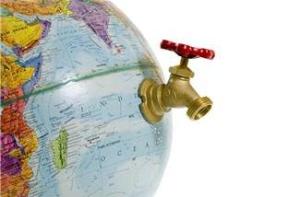 neglected. The quantity and the quality of water available are absolutely crucial for the future production of food. It will influence where and what type of food we can produce. It will define food security and world politics. Since 70% of fresh water use is for agricultural purposes, it is clear that water will soon be power.
 This time, there is one major difference. With 9 billion people in sight by 2050, the consequences of our actions will have much more impact, negative as well as positive, depending on where we live. In 1950, there were “only” 2.5 billion people on Earth. Compared with today, one could argue that there was some margin for error by then. This margin for error is now gone. Therefore, it is necessary to think ahead and consider all the things that might go wrong. We must anticipate before we have to react.
 The Food Futurist - Anticipate, Adapt, Succeed