What if agricultural subsidies were a good thing?

Over the past decades, agricultural subsidies have received an increasingly bad publicity, especially as a major part of the WTO Doha round of negotiations is aimed at removing them.
Yet, with an increasing world population and the need for more food production, one can wonder whether agricultural subsidies really are a problem. History has shown that subsidies can be a very effective way of boosting production. For instance, subsidies have been a major element for the European Union to increase its agricultural production in the decades following WWII. To show how effectively money talks, you just need to see how financial incentives have made European vintners pull off vines, then replant them pretty much at the same place later. Subsidies have encouraged Spanish farmers to plant many more olive trees than the olive market needed. Subsidies work. When people are paid to do something, they usually do it quite willingly.

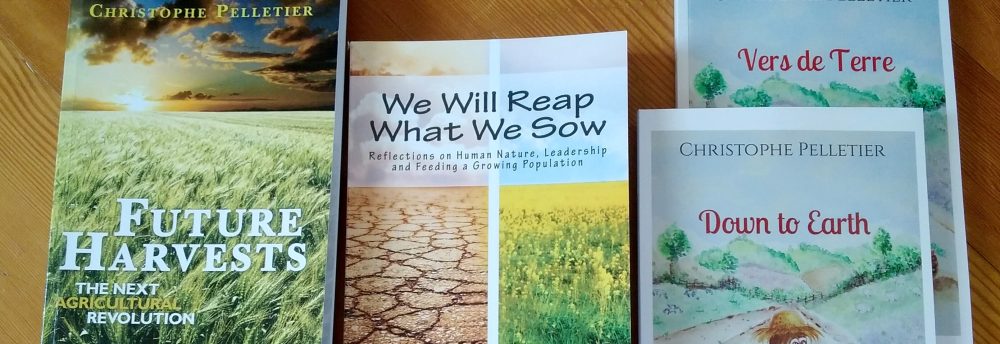
The true problem with subsidies is to have a cost-effective system. Subsidies must help produce what is needed. They are only a means and they must not become an end. Subsidies also need to deliver the right incentive to be effective. Too often, they have adverse effects because they do not encourage the right behaviour. An example of subsidy that seemed to aim at the right action and yet did not deliver proper results is the subsidy on agricultural inputs by the Indian government. They subsidize fertilizers with the idea that, this way, fertilizers would be more affordable for farmers and therefore the farmers would be able to increase their yields. As such, this is not a bad idea, but the practice showed a different outcome. Farmers with little or no money were still not able to buy enough fertilizers, and richer farmers just bought and used more fertilizer than necessary. The result has been an over fertilization in some areas and an insufficient fertilization in other regions, as I explained in more details in my book, Future Harvests.

For subsidies, too, quality must come before quantity.

Subsidies must be a part of a comprehensive plan towards the essential goal: feeding more people. They must be part of a market-driven approach, and they should not to entertain a production-driven system. Subsidies, or should I call them government support, take many forms and many names, from straight subsidies to grants, “market support mechanisms”, “export enhancement programs” or specific tax regime for farmers, etc… There is quite a bit of semantics involved. Perhaps the stigma on subsidies comes from their being granted by governments. Aren’t private investments just another type of subsidies? After all, that money aims at encouraging more production. The main difference is about the kind of return. Private investors look for a capital return, while governments look for a societal return.

A positive example of effective money incentive linked to a comprehensive approach that involved government and private companies is the rice production boost in Uganda (which I also present in Future Harvests). This effective policy helped increase production 2.5 times and turned Uganda from an importing rice country to a net exporter within 4 years!

I believe that the main bone of contention about subsidies is the competition on markets. Every player involved on world markets, either importers or exporters wants 1) to have the best conditions to compete against others and 2) wants to make conditions for others to compete as difficult as possible. The untold story is that many countries would like others to cut their subsidies while keeping (some of) their own. Only the competitor’s subsidies are unfair. Moreover, addressing subsidies is not enough. At the same time as subsidies, all import restrictions, such as anti-dumping tariffs or import duties should be looked at, as they are blatant attempts to skew the competitive positions.

The issue is not really aimed at developing a comprehensive plan to feed the world. The Doha round started in 2001, but since then, we have had the food riots of 2008 and the spectre of further food inflation. This, too, should be taken into account.

Considering how critical financing is for farmers, and that many farmers (more than half in the USA) need a second job to make ends meet, some form of financial support is generally very useful. Also, let’s not forget that we will need farmers for the future and agriculture needs to be an attractive profession if we want to have the people that we need to produce all the food!

Copyright 2010 – The Happy Future Group Consulting Ltd.

Involve in order to convince!

A couple of days ago, I came across the following quote: “Tell me and I will forget, show me and I may not remember, involve me and I will understand”.

I cannot confirm who the author is, as it has been attributed to brilliant thinkers such as Confucius, Aristotle, Benjamin Franklin or an unknown Native American. It does not really matter.

This quote brought me to start thinking about what it could mean for the agricultural and food sectors, as they are under fire on a regular basis. Why cannot it convince the public of its message(s)?

Opponents of agribusiness tell a lot about their opinions, they also show a lot of pictures, documents or footage of what they criticize, and they certainly are very active involving as many people as they can. The agriculture and food sector, including aquaculture, also tells a lot, shows some, but not enough about their daily operations, and they seem to have a hard time involving enough outsiders of the industry.

I read many blogs and articles from both sides and I regularly come across the “agri-food” authors wondering why the public is so difficult to convince. After all, the industry claims to have the scientific facts that prove its points. The industry is wondering whether the difference in communication effectiveness is linked to budget amounts or whether it has to do with the quality of the PR officers from both sides. I do not think that it has much to do with either. I have concluded that it comes from the ability to make people understand the story. Therefore, it has to do the ability to involve the public with the industry.

To involve the public, it is necessary to create an emotional connection first. This is critical and, unfortunately for the agribusiness, this appears to be a difficult area. Indeed, how to connect with people who have little, if any, connection with the agricultural world and who rarely get to see the reality by themselves. Media and internet are the channels where they find information. Opponents of agriculture have an easier job in the sense that they want to change the system. The worst that can happen to them if they fail is the status quo. They win nothing, but they lose nothing, either. The industry is the one that has the most to lose. Generally, this translates into a defensive approach, and that does not communicate well. Per definition, being defensive means having lost the initiative. Only the ones who have the initiative can lead, and only the ones who lead have followers.

Connecting emotionally means exactly what it says. Rational arguments do not work. At least not until the connection is made. The typical response of the agri-food sector is about bringing scientific facts, but how to convince people who 1) do not trust you, 2) who are worried about their food and 3) who do not have the scientific knowledge to comprehend these scientific facts? Cold scientific explanations will not work. All this does is creating distance. Not ideal when you need to connect.

I always like to make a comparison with parents of children that just had a nightmare. The children’s fears are not rational, but they are quite real, as you certainly can remember. Normal parents try to comfort the children. And how do they do that? They ask what the problem is. They listen. They empathize. They tell the children that they will go with them to the bedroom and show them that there is no green monster hiding under the bed. They will lie down on the floor and look under the bed. Then, they will take the child to have a look, and that is involving the child! This is how they connect emotionally, which allows them to switch to rational arguments and get the child to go back to sleep. Of course, they will not close the door and leave a little light so that the child does not feel thrown back at the green monster again. They empathize again.

Do you think that telling the child that there is no scientific evidence of green monsters would work, or that research has showed that nightmares are not real? And do you think that dismissing the child’s fear as unfounded and therefore about stupid would work, although that is pretty much the truth? Of course, it would not work, and the child would remain fearful and possibly lose trust in the parents in such a case.

If the agribusiness wants to win the public’s trust, it will have go look under the bed and, together with the public, take a peek at it. The public could hardly care less for the industry’s scientific facts, but it cares about being listened to and being empathized with. Interesting challenge, is it not?

Copyright 2010 – The Happy Future Group Consulting Ltd.

Since we cannot beat Nature…

It is convenient to paraphrase the saying “if you cannot beat them, join them”. This applies to our dealing with Nature just as well.

As a species, we have been very successful in conquering our environment and exterminating what threatens us. Actually, we have been successful up to a certain point. The very success that generated the current pace in human population increase brings the next challenge. Sustainability is just as much about the population increase as about how we use the resources. In 1950, there were “only” 2.5 billion humans on Earth. Compared with almost 7 billion today and the expected 9 billion in 2050, it sounds almost like a desert. How does this relate to sustainability? When 2.5 billion people behaved badly, from an environmental point of view, it had consequences, but there was room and time to correct the situation. When 7 or even 9 billion people consume, possibly waste precious resources, damage the environment and pollute beyond what is acceptable, the consequences are a lot more serious and a lot faster to hit back at us.

Sustainability is not just about production techniques, but it is at least as much about our attitude. Sustainability is even more a moral and behavioral necessity than one of a technological nature. The natural instinct when facing a problem is to look for the fastest and easiest way of solving it. This preference of the present tends to make us forget about the long-term effects of our actions. This behavior also tends to ignore how Nature works.

The first rule to remember is that Nature simply does not care whether we exist or not. Nature was there long before us, and it will be there after us, too. The calls to “save the planet” are in fact calls to save humanity. Nature is an open field where evolving life forms compete and fill the spaces left available. This is also what mankind has done since the beginning of its existence: compete, fight and conquer new habitats.

Nature does not care whether a particular species goes extinct. Only some people do. When a species disappears, others compete to take over the vacuum left, and life goes on. Nature is all about creating balances between species. This is why when a species’ population grows fast because of favorable conditions, it always becomes victim of its success. Even insects deplete food resources beyond what could have sustained them. When the food is gone, they simply die by the millions. As far as Nature is concerned, if climate changes, if the nitrate content of drinking water is too high, if soil is eroded, it does not matter. Let the best species win!

This ability of Nature to constantly adjust to changes in populations of life forms also explains why our efforts to kill threats in agriculture and food production will never be quite successful. Farmers may kill lots of pests and weeds thanks to chemicals, pharmaceuticals and now genetically engineered crops, they also create a vacuum for others or better organism to conquer. This is why we face antibiotic-resistant bacteria or herbicide-resistant weeds. This is simply the result of natural selection and evolution happening right before our eyes. Organisms mutate constantly and when a trait helps them survive some of our techniques and products, they thrive. The problem for us is that if forces us to find more specific treatment products as we go on, and this is getting more and more difficult. Are we going to have to fight ever increasingly resistant and strong superbugs, super bacteria and super weeds? If so, we are facing an uphill battle, because we are always at least one step behind new mutations and natural selection. It is not impossible for us to keep the upper hand, though, but the margin of error when looking for solutions will become thinner and thinner.

To stay ahead of the game, farmers and all the people involved in food production need to thinks like ecologists. Science and technology will be the basis for progress, but thinking only like chemists is too limiting. Managing ecosystems is one of the underlying principles of sustainability in food production. We will succeed only by understanding the big picture and thinking like chess players, and anticipate what the several following moves will be, as well from Nature’s side as from ours. We cannot make Nature checkmate, but Nature can do that to us.

The secret ingredient is long-term responsible thinking, even if this goes against the short-term interests of shareholders.

Copyright 2010 – The Happy Future Group Consulting Ltd.

What a game changer my book is!

Future Harvests has been published less than two weeks ago, and it is going to change my company rather profoundly.

What started as a blog on the side of The Happy Future Group Consulting Ltd. is now about to become the very core of my business.

Not only the book sales are already higher than I would have thought, the book is creating much interest for my other activities. The book has already been shipped not only to Canada or the USA, but also as far as South America, Asia and Europe. This is truly amazing.

The reactions to the announcement of the book’s publication have been amazingly enthusiastic and they made me feel like I had just produced something that many were waiting for. This is both very rewarding and very humbling, because working on solutions for future food supply to an increasing world population is a huge task. Since the publication, people with whom I never had contact before, from all around the world, have approached me, thanking me for having engaged in this venture.

New contacts are asking me to participate in conferences and to organize workshops and seminars for them. The CBC (Canadian Broadcasting Corporation) is interested in having me on one of their programs. Of course, the concrete discussions are still to come, but I have to admit that my Food Futurist is now showing incredible potential.

The part on policy making and strategy is getting more attention, too. This activity has the potential to become a solid business that will need to involve more people in my organization. I have already started to develop a plan for this. I can see interest coming from companies, professional associations and governments, not only in Western countries, but in many emerging countries, such as in South America, Southeast Asia, India, or Russia to name a few.

The first step that results from all of the above is for me to formalize the Food Futurist further into a more structured activity than it has been so far. This has started with my defining and posting the mission on all the business pages of the website. The mission is “To help our clients challenge today’s certainties, shape the future, and manage the transition with a targeted and practical action plan for the coming 10 years and beyond”.

The following step is going to be to develop business around this mission and the principle expressed in Future Harvests.

If you are interested in this, please do not hesitate to contact me. Talking is cheap. If you know people who would be interested, please pass it on to them.

As Humphrey Bogart’s character said in the movie Casablanca, “I think this is the beginning of a beautiful friendship”.

Is science being taken hostage? The “killer canola” example

In the debate between environmentalists and industry, science is a word that comes regularly in their arguments. However, scientific “evidence” seems to be used to support an agenda instead of making us all wiser.

The recent example of the “killer canola” that has been widely spread in the media over the past week illustrates the concerns we should have about the use of science for non-scientific purposes.

To sum up the story about canola, researchers from the University of Arkansas found herbicide-resistant genetic traits included in the plants through genetic engineering in canola growing in the wild in North Dakota. They even found traits from two different GMO producers. This does not exist in commercial varieties. They claimed that they demonstrated these GMO escaped into the USA.

Of course, all media, internationally, with a bias against GMOs jumped on the occasion to make their point about the risks of genetic engineering.

Very quickly, media favourable to the GMO industry, actually funded by that industry reacted to undermine the finding of the researchers. In particular, I enjoyed this column in AG Network. To counter the results of the researchers, the author claims that most scientists reject their theory. He names only two, one in the UK and one in Canada. Is a sample of two scientifically representative? I think not. He does not review the protocol of the research. Does that mean it was in order? I would tend to think so; otherwise, he would surely have attacked it. His main argumentation is about canola not being able to thrive in the wild; therefore, the “gene escape” is about a non-event, so let’s not talk about it anymore. Case closed.

What really disappoints me in this process is the bias. The opponents of GMO see this research as a proof of their point of view without really looking into the research and challenging it, or at least asking a few questions to the researchers. The proponents of GMOs, at least this one, elude the conclusions of the research by shifting the debate to the survival chances of wild canola. The real questions that arises from this survey is to find out how a genetic trait introduced by people (therefore, not the result of natural evolution and selection) can spread outside of our control (nature does not care about intellectual property), and what can be done to have more control on this. What all participants in this debate should do is to join their science and collaborate. It deserves the necessary attention.

The purpose of science is to help us understand our world so that we can take the proper measures to stay in control of what we created. If science tells us something that we do not like, that is too bad, but what we can learn is for our best interest. In the end, it would serve nobody to take chances with food security. The long-term interests must come before the short-term ones. The example of the canola is just one out of many. I could have chosen other food production sectors with similar cases.

Selectively picking the science that suits one’s agenda is not scientific. It does not serve anyone on the long run. On this blog, I posted a poll asking what should come first between morals and science. Although, this poll has no scientific value, it shows an interesting trend that I had not expected.

Copyright 2010 – The Happy Future Group Consulting Ltd.

The Russian heat wave gives some people sunstroke

The heat wave combined with the drought in wheat-producing region of Russia is causing some concerns, as the wheat production will be affected. That is annoying but not terribly threatening. Moreover, the price of wheat, as well as the prices of other agricultural commodities were due for a rebound because farmers had reduced production after the price fall of the previous year.
But when politicians and speculators get involved, the problem takes a new dimension.  Vladimir Putin announced a possible ban on Russian wheat exports and hell broke loose. The crisis then appears on all media. From mainstream media to the financial press, the world must know that we are in very big trouble, apparently.

Bloomberg and CNBC reports on the price of wheat on the commodity exchange. The speculators are there, looming. The Wall Street Journal asks whether US farmers should plant more wheat and take advantage of the good wheat prices. The Financial Times reports about the quiet doubling of the price of barley. This is bad news for beer drinkers. Food inflation is around the corner. And what if Ukraine and Kazakhstan have the same problem? The Black Sea region is one of the main wheat producers. Even Lester Brown, of Earth Policy, flooded twitter this morning with an unusual amount of tweets expressing his concerns about the effect of climate change and the rise in temperatures. This is all well-known and well-studied stuff, but suddenly my friends, we are close to the end of the world. Or are we really? Mr. Brown even suggests that an increase of 14 F in temperature in the Mid-West would cause a drop of corn production by 50%. Considering that US corn is used for three purposes: biofuels (not food), high-fructose corn syrup (not food) and animal feed, the consequences for Americans would be positive: less driving, less soft drinks and less meat, all three items for which they largely over-consume, at the expense of their health. The ones who would hurt the most would be the Mexicans.

When hysteria hits, it is always good to sit back, reflect quietly and maybe enjoy a cool drink, as long as we can afford it.

What is really going on? Well, we have a climatic event that affects wheat production. It is not new. We have managed worse crises in the past.

The excitement comes from two events. First, speculators have been active for quite some time on the wheat market and this gives them a good opportunity to jack up the prices. Although, remember the price hike of agricultural commodities of 2008! It was all on paper and not so much in the physical world. Yet, people were hoarding food in supermarkets like there was no tomorrow. Are we going to see the futures contract impact the real economy once more. I believe that if this happens again, we will see governments take action to regulate the trading of futures contracts. The bad thing about this is that the example of the new Wall Street regulations have been very slow to take shape and will take a long time to be implemented. Therefore, the “golden boys” still have some good times ahead with markets. Second event, which has reinforced the first one is the declaration of Vladimir Putin. Should we worry about it? Yes and no. Russia is now famous for its muscle showing policies. When oil prices were jumping up, the Russian government played quite rough with oil companies, especially Shell and BP. Their relation got a chill, and later they became good friends again. Russia’s policy on import of meat and poultry shows a similar pattern. Import restrictions alternate with more relaxed policies. Russia is struggling to achieve a satisfying level of food security and it uses all the means it has to develop and protect its domestic production, while sending a message abroad that Russia is strong. In my first language, a roller coaster is called “montagnes russes” (Russian mountains). That is quite relevant to describe this country’s style.

Is the world food situation at risk? As usual, we need to be vigilant, but there is no need for more panic than last year. What we need is a global production plan and increase production on a regular basis, simply because there is an increasing number of mouths to feed. If our approach is knee jerking on the actions of speculators, we will not achieve greatness. Farmers should consider planting more when the market demand increases. That is market-oriented production! If the farmers rush to plant more out of short-term speculation, they will experience the same as after the situation in 2008. Their suppliers (the ones listed on the stock markets) will increase the prices of inputs, especially fertilizers and gobble up the margin away from the farmers, like in 2009. The reality is that food is going to become more expensive, especially animal products. We need to get used to this idea right now, because over the long-term, this trend will not disappear. We need to act with vision and determination to achieve the goals, as I describe in the soon-t0-be-published “Future Harvests”.

Today ended up on a positive note after all. US Agriculture Secretary Ed Vilsack declared that we were not facing a wheat crisis. And wheat prices eased on news that farmers were planting more. Famine averted.

We need more long-term focused leaders and fewer speculators.

Copyright 2010 – The Happy Future Group Consulting Ltd.

Future Harvests – A preview of the book

My book, Future Harvests, is expected to be published before the end of August.

Here is a preview to give you a flavor of the content.

For a full view, please click on the thumbnails.


Here is a sample containing the table of contents and the preface of the book:


For the video trailers, please visit my YouTube channel.

Are “land grabs” a necessary evil?

The large land deals between African and Arab countries or Asian countries, mostly China, have drawn quite some attention.

I mentioned them in an earlier post on this blog (The great unseen land grab).

The discussion has taken an increasing political flavour, but very few people seem to look at the causes of the problem.

The reality is simple: the countries looking for land do so because they have a serious problem to feed their people and to guarantee them access to potable drinking water.

The water problem is obvious in Arab countries. In the past, they tried to grow more food on their land by developing irrigation. Unfortunately, they have concluded that this approach depleted their water reserves, while they also realize that they cannot feed their increasing population. For instance, Saudi Arabia has now turned away from its previous food security strategy and chooses to preserve water and look for other sources of food than their own agriculture. China and other Asian countries also realize that they cannot meet the increasing demand for food.

What should these countries do? Home production will not be sufficient. The first other possibility is to import, but volumes in the current world agriculture will also soon meet limitations. Keeping on buying on the world markets will solve some of the shortage problem, but it leaves the importing countries vulnerable to world market price increases. This is a threat for the domestic social stability as many of their inhabitants can hardly afford food at the current prices. These countries simply cannot remain passive. They needed to take action, and they did.

Why is Africa so attractive? Africa is the only continent where agricultural development has lagged behind. Yields are low. Infrastructure is far from optimal. Africa can increase production if African countries can fund their agricultural development. The main problem is one of money and policies. Africa has huge areas of arable land, but that land is not exploited. The FAO estimates at 700 million hectares the amount of land that could be developed for agricultural production. That area is about the size of Australia. It is twice the size of the current world wheat area. This offers huge potential.

What the importing countries bring to Africa are funds ready for investing in infrastructure and equipment. They could wait for African governments to develop agriculture and then buy from them. Considering how slow agricultural development has been in the past, this solution probably would come down to waiting for nothing to happen and cause serious food shortages in Asia and Arab countries, with all the risks of conflicts that this would generate.

The approach of going to Africa and offering to buy and develop the land makes a lot of sense. By being proactive, the importing countries actually speed up the process of getting investment money at work on the land, and the host countries do not have to worry about how to get the money.

Can these land deals work? In theory, they can. The main issue at stake is how both the importing/investing countries and the host countries set up such deals. The population of Africa is very young and it is growing fast. Africa will see its population double within the next 40 years.  Africa is also a poor continent and the combination poverty and high population increase has the potential to create many problems because of a lack of food security. Developing agriculture in Africa is the way to increase food security, but at the same time, a large part of the food produced on the newly developed land will go abroad, to China and Arab countries. This is why it is utmost important that such deals be set up as win-win situations. The foreign countries must help create agricultural and economic development in Africa in order to feed the local population by developing food production and offering employment so that they also can buy food. Failure to do so will very likely result in riots and violence against the new farms and their staff. This would not feed the local population, and could eventually result in not feeding the foreign countries either. Such land deals must be managed very carefully. The people in charge will have more than just agriculture to look after. Social, cultural and environmental aspects will play a very important role in the execution of these projects.

Africa is the continent where such deals have grown to large proportions, but similar deals are also being made in many Asian nations. It is interesting to see that other regions where large amount of investment money would be useful for agricultural development do not get as much attention from the importing countries. Yet, areas like in Kazakhstan, Ukraine or Russia could use some injection of funds, too. Brazil is starting to attract new money. For instance, the China National Agricultural Development Group Corporation has plans to grow corn and soybeans and it is looking for land in Brazil. The corporation has been allowed an annual budget of US$2 billion to realize the objectives and secure grain supplies to China.

More in my upcoming book Future Harvests.

Copyright 2010 The Happy Future Group Consulting Ltd.

Future Harvests – The book is coming soon!


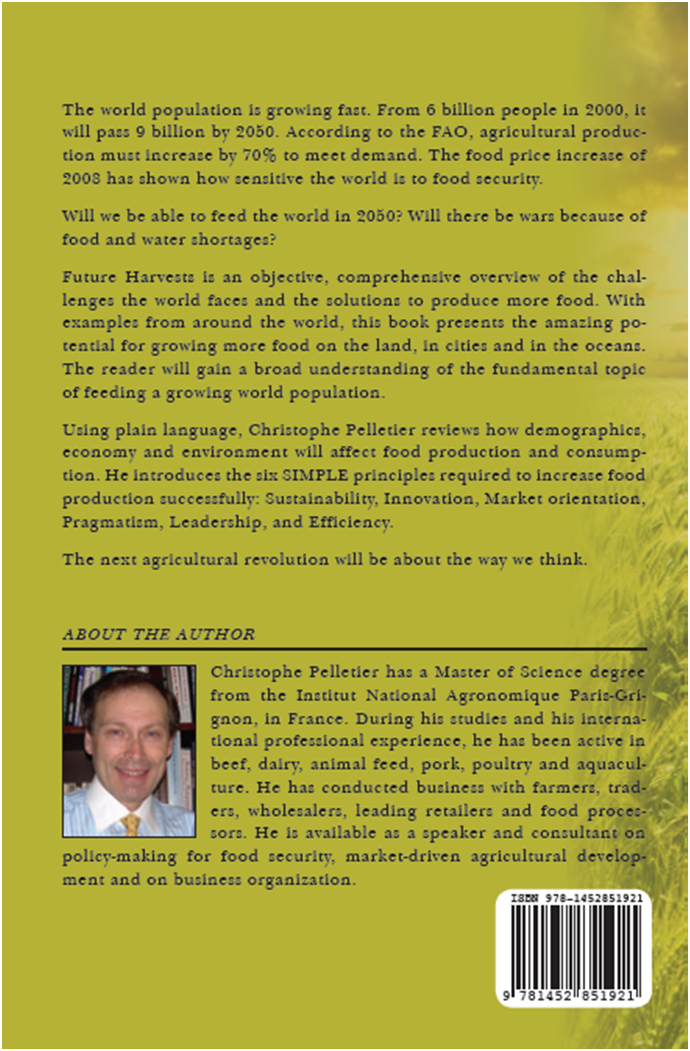
The editing of my book “Future Harvests – The next agricultural revolution” is about completed. All that is left to do is developing the cover and start the publishing.

I have already received orders, even before the book is out. That is quite a good sign. And a great surprise for me.

If you wish to be updated automatically when the book is published, just subscribe in the sidebar window on the right.

To describe the topics addressed, I have posted three short promotional videos on YouTube. In previous articles (The fun of writing this book and The next agricultural revolution), I had already given an idea about the content of the book.

Video #1: The Fundamentals (duration 2:37) – Introduction to the background and fundamental principles mentioned in the book “Future Harvests – The next agricultural revolution” to achieve food security for 9 billion people in 2050. Topics such as demographics, the shift in economic power, the control of food  and food security strategies are reviewed. Sustainability, innovation, efficient market driven food production and strong leadership are required.

or click here if video does not appear

Video #2: The Actions (duration 2:12) – A short review of some of the actions mentioned in the book to achieve the objectives. Solving the water challenge, finding new land for production, urban farming, hydroponics, farming the desert, rebuilding fisheries and developing aquaculture further are all possibilities.

or click here if video does not appear

Video #3: The Questions (duration 3:08) – A sample of some of the questions raised in the book. They cover technology, land deals in Africa, improving yields, restoring soil fertility, change in consumer needs, organic farming, risks of conflicts, biofuels or meat are some of the topics presented.

or click here if video does not appear

If you know someone who could be interested by the topics on this page, please pass it on!