255. Communication: Humanity and Authenticity make for Effective Conversations

As usual, listen here to a Chrome AI-generated podcast-type playback of this article:

The original non-AI generated article follows below:

A question that I get regularly is: “How to communicate effectively with the general public about food and agriculture?” My answer usually surprises the person who asked the question. I guess it is because it sounds simple. Yes, shouldn’t the answer to that question be a complicated one, preferably? Well, what I recommend has worked for me all my professional life, in which I also would include my coming from a butcher’s family and having interactions with customers in the shop or on the market when I was a kid.

My answer is: Start a conversation!

It surprises them, and that in turn always surprises me. Then, the following question I get is: “How do you start a conversation?” My usual answer to this seems to even puzzle them more: “Say hello and see what happens next!” Apparently, this often seems to sound like a scary idea. Don’t ask me why because I do not know. Yes, every good conversation begins with “Hello!”. I will continue with how the conversation can succeed later in this post. First, I would like to quickly review the issue of trust with the general public.

The general public has lost trust but there is hope

The issue of trust is not new, but it certainly has strongly deteriorated over the past decade, mostly because of all the disinformation and the weirdest nonsense that social media have helped to spread. For most people, it has become quite difficult, if not impossible, to sort out what is true and what is not, and who can be trusted and who cannot. The public does not trust anything or anyone anymore, be it politics, industry, business, non-profits, mainstream media and even social media. Let’s face it, they are right to think that way. All those parts of society have done an amazing job of losing credibility on an almost daily basis.

In the past, I posted an article and a YouTube video on the issue of trust, (see at bottom of this article) in which I indicated that trust is about safety and that any confusion creates fear. The good news is that an antidote exists for fear: hope.

The general public does not trust. In the case of food and agriculture, this applies particularly to entities that they cannot really identify with a person. The public really craves for humanity. Putting a human face on a farm or a business makes a huge difference. If the industry seems to be a faceless “thing”, they will not trust. Dehumanization is a trust killer, and not just in food and agriculture, but in all aspects of daily life.

Even though this sounds gloomy, it is not all lost. The public does not trust but it would love to know. They would really like to find someone who could explain to them how things truly are and whom they could trust. The large majority of the public are interested in hearing how food is produced and why it is produced the way it is. Many people are open to hear about how it is done. What they do not want to hear anymore is all the disinformation, the misinformation and all the communication lies from all sides. The members of the public have their opinions about food and agriculture. They have beliefs, which sometimes are correct and sometimes are incorrect. Beliefs are tricky. Much research has been done on beliefs and why people stick to them. One recurrent conclusion is that beliefs always trump facts and science. If you tell people a story that goes against their beliefs, their natural reaction will be to not believe you, even if what you tell is the truth and their beliefs are false. Beliefs give people structure and values. Taking the beliefs away feels to them like their world collapses, and they cannot have that. Probably, none of us, including me, can have that. So, if beliefs always trump facts, how to convince them of the truth if it is not what they believe?

Facts and science are the favorite approach of food and agriculture communication specialists. And for all my life, I have seen this approach fail over and over again. The reason? What I just wrote about beliefs vs. facts and science. It fails every time and yet, they keep doing it. Sounds absurd? Well, not so much so, because of what I just wrote about beliefs. Communication operatives believe that facts and science are what the public needs to know. You can show the communicators facts that prove that facts and science is the wrong approach, they will not believe you. And here it is: I have come full circle on the topic of beliefs vs. facts. But then, industry communication specialists will ask what they can talk about if they should not talk about facts and science.

The way to do it

The public wants to know but they do not trust anyone. That sounds like an impossible equation to solve. Not really. The fact that they do not trust anyone does not mean that they cannot get information. Actually, information is everywhere, especially with all of today’s tools. What they do, and the way they want to do it, is to search for the truth themselves. They do not want a guide, and that is quite an adventure. They will find all sorts of points of views and their opposites. So how can they choose the right -and truthful- sources?

I like to tell that getting trusted with communication is like dating. Who goes on a first date with a lengthy pack of slides to show all the facts about themselves, such as health records or bank statements? Some people probably do, but it does not seem like the way to go, does it? No, the first contact is just that. If you communicate about your activities, always assume that people are not necessarily interested in knowing everything all at once. Most probably have never heard of you and they want to get acquainted first, before going into details.

Rule #1: Do not be pushy or aggressive! Say hello and see how the conversation goes. The purpose is not to convince or win an argument. The purpose is to create a connection and generate interest. The convincing will come later. Just let the public know you exist, that you are interesting and that you are there if they want to ask you questions. Communication is much more effective when you answer questions. The reason is simple. The questions are precisely about what the public wants to know. If you tell a story without knowing if it is interesting to the audience, there is a good chance that you will not address what they want you to address.

Rule #2: Be likable! It is a quality that goes along with rule #1, but it is more than that. The success of communication is not about the amount of information but it is about the quality of the interaction. Effective communication is first and foremost about connecting. The public needs to like the communicator, because if they do not, there will be no second date. Then, it is game over. The public will go with someone else. It is interesting to note that industries generally never have any popular celebrity to communicate for them, while activist organizations can pull actors, singers, models and other rich and famous to speak for them. The life background of celebrities often explains why they are on the side of activists. There are usually good reasons and they have nothing directly to do with the issue, but that is another story that I might tell in a future post. Any way, long story short: likable people win the communication war.

Rule #3: Relax! What always strikes me is how Pavlovian communication often is. All it takes is a little attack, a little controversy and immediately, there comes the facts and science stuff again. Stay cool and think first if it is a battle worth being fought. Does it deserve a response? Most stuff on social media has a shelf life shorter than a mayfly. Choose your battles carefully and use your time and energy wisely. Often, silence is the most powerful weapon. Often, rabble rousing is just a way of getting visibility and get trendy by using you to do that very work, thanks to algorithms. Silence is kryptonite to people who crave attention. If a response is necessary, it is most powerful when it is short and concise. Repeating consistently the same message also works well. The message eventually gets through. No need for tangents.

Rule #4: Be confident! You know your stuff and that must be crystal clear for the audience. You are the expert, but always be humble. The public must be the ones who conclude that you are indeed the expert. It is always much more powerful to let the audience conclude than trying to tell them what they should think. Actually, the latter will kill any authority you are trying to build. Haven’t we all had bosses who had to always tell they were the bosses every time there was a disagreement? See the similarity? Remember, you are cool and relaxed. That makes people feel comfortable.

Rule #5: Be respectful, always! First be respectful of the public’s opinions. They have good reasons to think the way they think, even if they are wrong. These are their reasons, not yours. Make clear to the audience that you know their opinions and that you respect them. That will earn you respect, and that is the foundation for trust. In the process of connecting, it is also quite valuable to go through a number of agreements to disagree, all in full respect. It is impossible to agree with everyone all of the time. Just take your time and move one small agreement at a time, and say thank you for the good conversation. Make sure the public will be looking forward to a next conversation. Be human, that will make you likable.

The way not to do it

Error #1: Long technical stories. In this age of short attention span, the shorter the communication the better. So, keep it short! Besides, when it comes to make a point, short is much more powerful than long stories. Ideally, pictures are much more powerful than words.  They can carry many subliminal messages. This is why activists use the power of images and of associations so much. Unfortunately, the industry has a tendency to linger on with their facts. Long stories full of facts, science and beautiful busy charts work only when the industry speaks to the industry. That is preaching to the choir. The audience is already an ally. This is not communication with the general public. This kind of communication would work mostly with nerds, but that is not really the general public. Most people are not food and agriculture insiders. They do not have a specialized background in those areas. When flooded with technical information, most people will unplug and do something else. This kind of communication is not likable.

Error #2: The boring school teacher. The important thing to keep in mind about the public, especially younger generations, is the need for a strong dose of entertainment. They love it. Actually, they crave it. Communication and connection must feel like a game. It is learning by playing. It needs to include a playful element. This can be the nature of the dialogue or it can be the medium or platform used to communicate. The entertainment value will strongly impact the quality of the interaction. What does not work well is the opposite of entertainment: the boring lecture. It does not work because it is boring and because it feels like a lecture. It feels like “all work and no play” and that, as the saying goes, is dull. The feeling of lecture is always reminiscent of school. It makes the public members feel like there is a power distance. A sure way to create that distance is to start the conversation with “Did you know…?” For most people, this makes them feel like they are treated as ignorant and as inferior, and that does not create friends. Once again, it makes the communication perceived as not likable. Recently, in a presentation, I told an industry audience that boring technical communication makes them sound like PBS, while the public prefers to watch reality TV. The comparison is rather accurate. PBS is quite interesting if you set your mind on serious educative material. Personally, I always found that PBS had excellent programming, but that is just for a certain public at certain times. Having fun is important in life. The trick is to make educative material fun. That should be priority #1 for communicators.

Error #3: Denial. An important mistake not to make, that the industry makes time and time over, is to rush into denial. Don’t, especially if the issue is a complex one! It is much better to acknowledge that the issue is indeed one that floats around and that you are aware of it. The difference with upfront denial is that it does not sound defensive. Just that acknowledgment already defuses tension, which is important when you want to have a fruitful conversation. Tension kills a conversation because, when tense, people do not listen. They shift into Pavlovian mode. One word and there is the trigger for confrontation, instead of connection. Most of the fights around food and agriculture, or any industry or even opinions, is that nothing is really black and white. A lot of the differences of opinions are in the grey areas, in the nuance. Unfortunately, polarization does not like grey because grey and nuance undermine polarization. Yet, the debate needs nuance badly, and most of the general public knows that. The key for effective communication is to avoid the trap of polarization and shift into nuance, but well thought-out and solid nuance, that is.

Error #4: Being self-centered. Avoid, the tendency to talk about yourself or about only about your industry or company when dealing with controversy. When communicating, the most important person is the recipient. If you are a communicator, communication is never and never must be about you. Communication is a sales process. The public is the customer. The communicator sells a point of view, an opinion, an angle. For this very reason, communication must be market-oriented. Usually, communicators do not think nor act that way. Instead, they have a production-oriented approach. It does not work well. It is much more effective to communicate to the public about what the public is interested in than trying to push a message that does not align with their curiosity. This is why, just like a skilled salesperson does with a buyer, it is essential to start with hello and ask questions about what the “customer” is looking for. Do not talk about you, your company or your industry because that is not what the public wants to hear. Instead, find out what is important to them and come with an answer that meets their needs and show them why your point of view is valuable to them. Start by looking at the world from their perspective and then, let them see the world from yours. This creates empathy and mutual understanding. Take the time it deserves. Forcing the process will only work against you. Trust me, this approach is very likable and will deliver many dividends.

Error #5: The sound of PR. This is lethal for communication. Keep in mind that everybody knows how public relations sounds. They hear it all the time from businesses, from industries or from politicians. The sound of PR, with its techniques to twist facts, to say half truths and to spin reality is well-known. The sound of PR is what has destroyed trust in everything, as I mentioned at the beginning of this article. The public knows it and the public loathes it. So. forget the mechanics and the techniques that make you sound like a predictable robot. There is a chance that you are more transparent than you think. To be likable, use the very opposite of the technical stuff: humanity and authenticity. You will not believe how much you can achieve with them.

Further, if you are interested, I also have a playlist about communication on my YouTube channel:

Next week: Let’s not Take Food for Granted! Understanding Food Security this Holiday Season

Copyright 2025 – Christophe Pelletier – The Food Futurist – The Happy Future Group Consulting Ltd.
253. The Future of Family Farms: Navigating Generational Changes

Listen here to a Chrome AI-generated podcast type playback of the author’s article

The concept of family farm plays an important role in the perception of agriculture. Consumers definitely like the idea of a small family-run farm. It gives them a feeling of things well-cared for, and they relate better with such operations because they feel it still has the human scale they feel has disappeared in all sectors of life. Governments and industry are also rather adamant to maintain the family status of farms, as it resonates with the general public. With the many changes ahead, what future will family farms face?

A turn of generations

In most parts of the world, farmers are getting old, in their high 50’s. In many countries, the current generation of farmers is expected to retire within a decade. A number that is often mentioned is that about 50% of farmers will reach retirement age in 10 years from now, in 2035. Here in Canada, I have even read the number of 40% within 5 years.

Of course, this presents a major challenge. Replacement is needed. The question is who will and who can take over the farms. Perhaps, the most difficult challenge for new farmers is to be able to buy a farm. Agricultural land prices have increased strongly over the past two decades and farms have become unaffordable to many farming candidates. One of the reasons behind the price increase is that agricultural land is now seen as an investment by people who have no connection or activity in agriculture. Aspiring farmers cannot compete with Big Money. Then, what is left to them?

Of course, one must buy only what one can afford. This could mean that new farmers might have to settle for less land, but can it be economically viable? The type of ownership -and owner- might also bring a new type of farming structure. There will be land owners who farm. Others will not farm the land themselves. The ones working the land might not be owners, but rent the land. It is easy to imagine all sorts of constructions between ownership and actual physical farming depending on how the money flows. As such, this is not new. In all times, there have been large land owners who would not do much of the actual work. There also always have been people farming the land based on a lease contract, or remunerated on what they produce from the land they work. The difference now is that the turn of generations also comes together with the end of the farming family that established the farm.

For very long, farms have been transmitted from parents to children. This is not going to be quite the case in the future. Many farmers’ children have chosen different career paths. They are simply not attracted by the farming life, for various reasons. They have decided to leave agriculture and have a life somewhere else. In many cases, this leaves the parents with no successor. On the other hand, a substantial number of aspiring farmers are not from farming families. They come from the cities, but they want to get into agriculture, also for various reasons. The question that comes now is: how to organize the succession? And that is not an easy process, especially from a psychological point of view.

A difficult transition?

For farmers, especially those who come from families who have owned the farm for generations, this feels like an end. Often, the idea of accepting to pass the farm on to a total stranger is not easy. From numbers I have seen in Canada, it appears that initiating a succession process is something that the men rarely do. The farmers’ wives are the ones who generally start the process. Let’s face it, letting go of a farm is a heavily emotionally loaded moment. For potential buyers, the main problem is of a different nature. The most important for them is to have a solid project. That is not easy, either.

Depending on all the different situations, many outcomes are possible for how farm ownership will look like in the future. What will the new farmers be looking for? They can choose for a smaller size and focus on niche high-margin productions. But they also can choose for large efficient commodity farms if they can finance the purchase, unless they would do that as tenants paying a rent to the non-farming owner. Everything is possible. What matters the most for the future is that farmers make a decent living out of agriculture. That has always been a challenge everywhere in the world, and it has always been a challenge at any time in history. Economic viability will determine what the farms of the future will look like and what they will produce. Future business models will be key. Of course, another question that may arise is whether all the farmland that is to change hands will find a farmer. If not, what happens to the land, and what happens to production volumes?

What is a family farm and its future?

The discussion of the farm size is going to happen, one way or another. Just for illustration, here are some statistics from the USDA / National Agricultural Statistics Service: in 2022, family farms represented 95% of all US farms. Small family farms made up 85 % of all farms. They represented 39 % of the farmland and accounted for only 14 % of the value of agricultural products sold. Midsize family farms represented 6 % of farms and produced 16 % of total agricultural value. Large-scale family farms, though only 4 % of the total, generated 51 % of the value of all agricultural products.

Non-family farms represented just 5% of all farms but accounted for 19% of the value of agricultural products, so more than all 85% small family farms together. This shows another reality of agriculture, which is that the lion’s share of agricultural production comes from a minority of farms. If farms become too expensive for individuals, could it mean that the share of non-family farms will increase in the future, as being on a payroll would be an attractive alternative for aspiring farmers?

The general public may love the idea of small family farms but to feed the world, large farms play an essential role. My point is not to say whether it is a good thing or a bad thing. Reality is just reality. If we want to solve challenges for a successful future, we must not delude ourselves in a romanticized idea of agriculture, but we must make sure that agriculture does a proper work to keep doing what it is supposed to do. I have a video on YouTube in which I discuss whether the farm size matters or not. In my opinion, size does not matter, and neither should the type of ownership. What truly matters is that, regardless of size or ownership, farmers do a good job. Skills and ongoing training are essential. Of course that includes quantitative aspects (volumes, yields, etc.) but also qualitative aspects, such as minimal environmental impact (all human activities have an impact) and sustainability.

Further, what is a family farm really? As I mentioned in the introduction, everybody is a strong supporter of family-owned farms, but the reality is a bit more complex than just who owns the land and the buildings. Family-owned does not necessarily mean independent. It is not the same thing. I know that this is a sensitive topic, especially considering the difference in size between farms and their business partners. It feels like David vs. Goliath. The romantic idea of the farmer holding an ear of wheat in his mouth, happily living off the land without pressures from the rest of the world is a nice one but, once again, reality is different. A farm cannot be isolated from the production and supply chains. These chains are quite sophisticated in their organization to ensure that products find their way to the consumers because, well, that is the purpose.

The farm may be owned by the farmer but it also says nothing about all the contractual relationships that exist between the farmers and the other players in that chain. This might become even more prevalent in the future, as some agribusiness companies are already looking at helping young farmers to get in the saddle. Making sure that there will be farmers in the future is quite essential for the rest of the value chain partners. Without farmers, they do not have a business. That said, the help will not be without conditions. Future farmers who can get in the business will likely be bound contractually with the company that provided the support in the first place. it would be unlikely that businesses would bring financial support to see those farmers go to a competitor.

What the future will bring for family farms will depend greatly on government policies. What will be their idea of their respective agricultures? How do they see the future of their rural areas? What role will they want for their agricultures to play in their economies and in geopolitics, or just politics? These are some of the many questions that will have to receive answers and the place of family farms will depend on the answers.

Next week: Animal-plant hybrid products: compromise or demise?

Copyright 2025 – Christophe Pelletier – The Food Futurist – The Happy Future Group Consulting Ltd.
252. Three key Technologies that will transform Food and Agriculture, plus a bonus one

Listen here to a Chrome AI-generated podcast type playback of the author’s article

Of all new technologies being developed, I can see three main ones that will dominate the food and agriculture (and most other sectors as well) scene in the years to come. As usual, I will not make a catalogue of technologies, companies or investment amounts. If you are interested, just ask any AI to produce a full report and you will get it in less than a minute. This is not what really matters. What matters is which technologies will get traction, which ones will be adopted and which ones will actually solve problems (see my previous post). The three areas of interest I have in mind are: artificial intelligence, robotics and gene technologies, and I will add a bonus fourth category at the end of the article. The latter is often overlooked, yet so important.

Artificial intelligence

Well, this one is not really original but AI is here. It is evolving and it is here to stay. It will bring many changes. Some will be good, others maybe not so much, but we are going to have to live with it. So, I will not be listing all the areas where AI will be used. Once again, use AI to give a full report. You can also do a search on this website to find all my articles about AI or look at my YouTube playlist about AI, too.

Instead, let’s review areas that are important to improve. AI was, perhaps still is, the missing link in digital food and agriculture. In my first book, published in 2010, I was already presenting the possibilities of having farming equipment units that would interact together. I foresaw this age of automation as being about building a nervous system. Until recently, the nervous system was still the human operator’s, because the previous age of mechanization was about giving the operator additional muscle, mostly in the form of mechanical horse power. It was replacing the legs and arms, if you wish. The digital age is giving the operator additional information processing abilities, and changing the relative functions of human and machines completely. All the data-collecting devices, such as drones, sensors, satellites and so on, would be extensions of senses. They can see, they can hear, they can smell, they can “feel” and be sure they can taste, too. But the one thing was missing with these devices, even from an IoT perspective were the synapses. That is what AI is. It makes data and information flow back and forth between all the devices, and the operator. It all sounds exciting, indeed. To quote the late French neurobiologist Henri Laborit, the purpose of a nervous system is not to think, it is there to act. I believe this is quite true for AI, too.

Yet, let’s not forget one thing: AI is not intelligent as such. It follows a mechanical structure. It looks like intelligence because it is so fast, actually faster than a human being, that it seems “alive”. That is a mistake we should not make. At least today. Let’s use AI for what it is today: an amazing assistant. As an assistant, it will do wonders. Like a speaker said in a presentation I was attending earlier this year: “AI is like having Einstein tied up in your basement”. That is quite a good comparison. The speaker in question is Steve Lerch. If you need someone to present you practical aspects of AI in an enticing manner and how it will help you add value to you customers, he is the person to have. The key is indeed to add value. It benefits your customers, and as a result it benefits you, too. To get there, it is necessary to know what to do with AI. This is where we need to move further.

First of all, proper training of operators is essential. I always say that new technologies and new tools need to come with a user’s manual. Of course, it can be fun to experiment to try to find out what you can do with the new toy, but that can be rather time consuming and the costs of mistakes along the way can end up being rather high. A well-prepared and well-structured training is an absolute requirement. Not only will it speed up the learning process but the quality of the training is where you can increase the desire to adopt and use the new technology. Playing with the toy is fun but just as it is always the case with toys, boredom or frustration happen fast and the toy is abandoned just a few days after Christmas, if you see what I mean.

Other area of improvement is the user friendliness. Systems like ChatGPT require prompting, and that part can be where the difficulties arise. Prompting still is challenging for many users and that can lead to frustration. Prompting needs to be more like instructions the user would ask another person (the assistant feel). And just like a human assistant, AI needs to ask questions if the instructions are too vague or unclear. Interactive is the key for an effective AI assistant, and for good results. It should be voice-activated and not just a typing exercise, people are less comfortable with the latter. Further, routine AI activities should be shaped as a menu with just buttons to push. Only then, it will become attractive.

A third area of work that is needed for AI is trust. It is a powerful tool and perhaps a little too much so. It can serve for good but it can also serve to mislead, deceive, destabilize or for criminal activities. AI needs to support critical thinking, which of course requires that users dispose of some themselves.

Beyond those issues, a number of other challenges will arise from the use of AI. One of them is to sort out who owns the data, who can use it and who cannot, or just even who can access the data and who cannot. Another challenge, which I mentioned above is crime. What happens is someone hacks the data and either takes it hostage, deletes it or even alters it? What would happen if food producers are suddenly unable to make decisions or even perform any work because of a malafide intrusion? We need to think quite seriously about this because the consequences could be rather devastating. I wish I heard more about the issue of criminal interference with AI than I do. Another, major, issue to address for the future is the current levels of energy and water use that AI requires. Can we afford AI altogether, or will it have to be “rationed”? What will be its impact on the environment and essential resources and what is the plan forward? Do we want some eccentric billionaires to own and run nuclear plants for their own AI platforms? A study from the University of Bonn, Germany had shown that all the data collected and used for crop productions and all the stakeholders of the value chain were stored by three companies: Microsoft, Google and Amazon. This shows the potential vulnerability and dependence of the entire food chain. How will we deal with that, too?

In the end, let’s not forget that technologies are not living creatures, although some like to think so or wish they were. Technologies are here to serve humans. We need a clear purpose, show some serious leadership about technology and not forget that competence and critical thinking will never be liabilities. They are the assets that will feed success.

Robotics

AI is the “backbone” of the new nervous system. It is part of an evolution, even though it is referred to as a revolution. Just like in biological evolution, any change, any mutation also brings a modification of the organism. The muscle I was mentioning earlier will just change. It is a “natural” consequence. This new nervous system is going to come along with the apparitions of new “organisms”. From that perspective, it is obvious that robotics are a natural extension of AI. We are starting to see this already. The recent plans of Amazon to eliminate 75% of its workforce by 2033, meaning elimination 600,000 US jobs show that AI and robotics will affect very strongly how businesses are run. There is no doubt in my mind that food and agriculture will also use more and more robots in the future, thanks to AI.

For agriculture, it might be as much of a new business model as it will be about the necessity to replace an increasingly difficult to find workforce. The causes may be many. Season work relies a lot on immigration and policies are making this more difficult. The number of farmers that are going to retire within a decade is actually rather scary and someone -or something- is going to have to do the job to feed the population.

So, how will robotics fit in? We can look at it from different angles. First, an improving AI will make robots more efficient and more cost-effective than now. The cost of robots and their payback time have been a disadvantage for the adoption of robotics in many areas of food and agriculture. If the economics change, expect to see the sector of robotics to make some serious progress. Secondly, the Amazon “effect” of going AI and robots will stimulate other sectors to look at their respective futures. Assuming that Amazon is successful, it will serve as examples in other industries. You can count on that. Thirdly, and also thanks to AI, the design of robots is going to change and I expect that future robots will be more nimble and easier to operate, and at a lower cost, too.

Gene technologies

Gene technologies certainly offer very interesting possibilities but the perception from the general public can be difficult. Genes are a sensitive topic and it does not take much to have fear blurry the conversation. Most of it has to do with the early beginnings of genetically modified organisms (GMO), in particular transferring a gene from one species to another. It did not need much to have GMOs associated with the idea of Frankenstein. In the food sector, the concept of Frankenfoods was born. Then came the Roundup-ready crops and the Bt-resistant crops which became major issues and still are today. The problem was not just about technical aspects of GMOs. The main player, Monsanto, just happened to be a terrible ambassador for genetic engineering. There is no need to pretend the contrary.

Anyway. the world has moved on, and so has genetic engineering. Just like I said about AI, if you want a catalogue of applications, just ask AI to provide you with a full report. Here I just want to browse through the scope of possible applications.

Since the beginning of selection of plants and animals by farmers, the focus was always to select the best performing individuals in a particular context. With biology, everything is relative. Some varieties or breeds may do well in certain environmental conditions and poorly in others. That was true in the early days of genetics and it still is true today.

Genetics are still a key part of selection and development of better plants and animals, as well as many other forms of life, such as microorganisms, but genetics is only half the equation. They are about genetic potential. The trick is to work in conditions that allow that potential to express itself to its maximum, if possible. Of course, there are many factors that can influence the outcome. Sometimes, conditions are positive, sometimes they are negative. Today, the challenge is also to at least minimize the impact of negative conditions so that the performance still stays acceptable even if Nature throws sticks in the farmers’ spokes, so to speak.

This is where gene technologies can help. They can help avoiding the expression of unfavorable genes, or allow some genes to express themselves against adverse conditions. It is what gene editing is about. There are many areas of work. Just think at the possibility of having plants that are more rustic to face difficult growing conditions such has drought or heat. It can be the possibility of having genes that offer resistance to diseases. This not just about financial aspects. It is also about animal welfare, as sick animals suffer. It is also about the environment as all yield losses from crops or sick animals are an inefficient use of resources.

For instance, the recent development of the PRRS-resistant pig (Porcine Reproductive and Respiratory Syndrome), a disease that has serious economic and animal welfare impact is interesting. The gene-edited pig production has now been authorized by the US FDA. Of course, such a novelty meets resistance and criticism. That is the way change goes. Considering the risk of diseases, as I was mentioning them in a previous post, any progress that can be made to prevent infection by plants, and humans deserves to be considered. The same thing is true for new medications and new vaccines. The reality is that new ways of protecting us will be needed in the future. Gene editing is a tool that we will need, and not just in agriculture. Actually, many of future applications will have a use in human medicine just as much. We must not give scientists a blank cheque about innovation, but we must also be open minded to new ways. Of course, this leads to discussions and all aspects must be considered, and that includes ethics as well.

An example of such discussions, with an unexpected outcome, is the use of gene editing of hens that produce only females. From a technical point of view, this eliminates the issue of chick sexing, as there is no male chick. Male chicks have been an issue in egg production as they would not be useful. The industry used to cull the males but that was cause for ethical issues. So, back to the gene-edited hens. The fact that they produce only females means that, statistically, to produce the same number of females, only half of the mothers are required. This means less feed needed, therefore freeing arable land, therefore less environmental impact. Of course, the ethics of gene technology would be questioned. Surprisingly, the company producing these hens got support from the Compassion in World Farming, which is no small feat. The CIWF is a vocal critic of intensive animal husbandry. The fact that they see an advantage in this application of gene editing is rather interesting and shows that pragmatism is needed if we want to improve for the future.

Bonus number 4: farmers’ ingenuity

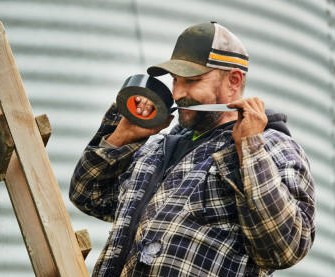
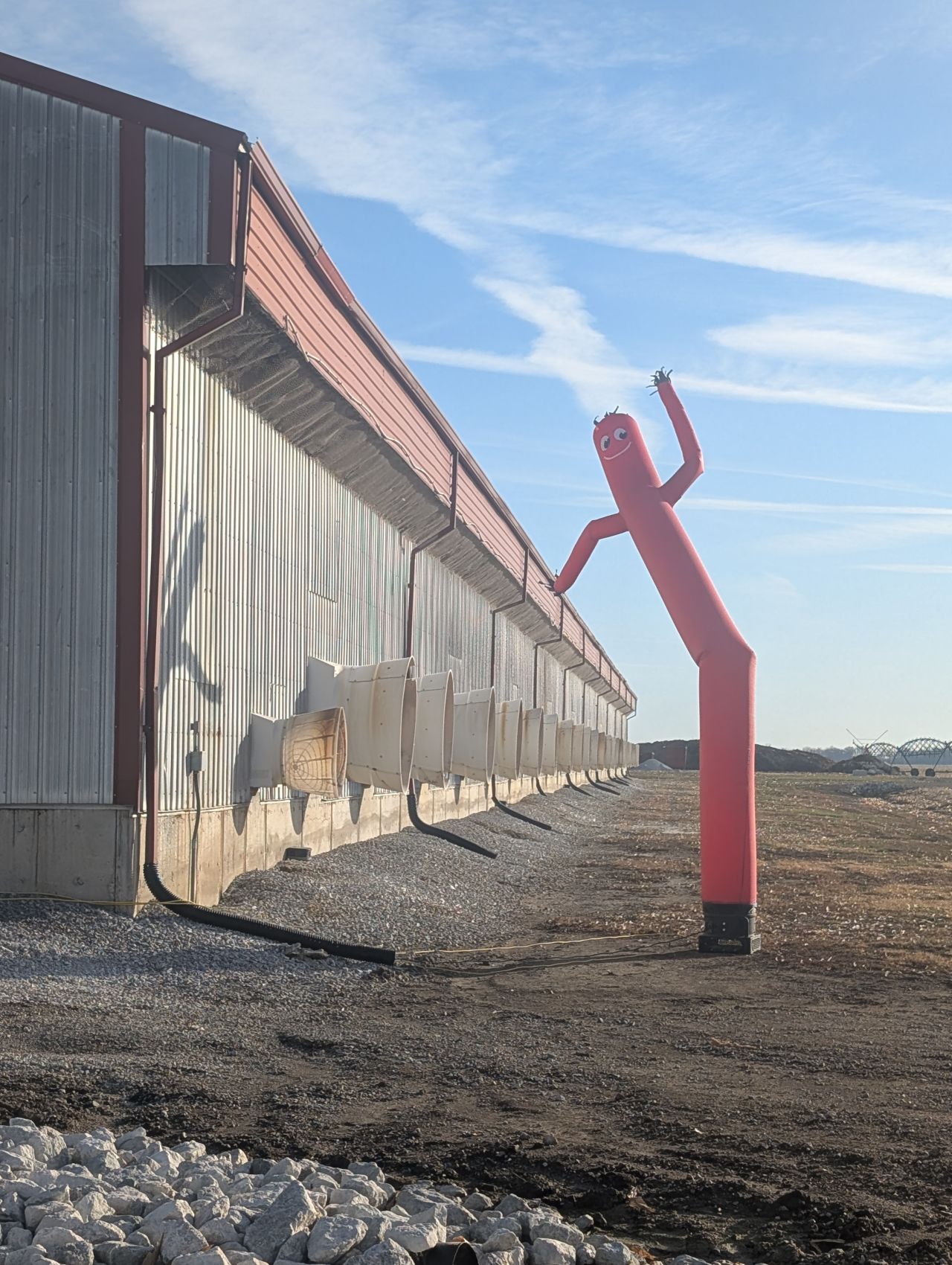
If I can think of a profession of people having resilience, adaptability and resourceful beyond the imaginable, I immediately think of farmers. Their work is not just about producing; it is mostly about solving and fixing unexpected problems. Just take a look at what they can do with a roll of duct tape and you know farmers are not your average person. You also know that they innovate with a cost-effective mindset. They perform miracles every day. Here is a device installed by Rose Acre Farms, the second largest egg producer, to deter migrating bird to get close to the hen houses and thus to reduce the risk of contamination with avian flu.

In my previous post in which I discussed the risks of diseases and that AI could be a great help, this shows how ingenuous farmers can be and that innovation is not only about high-tech. I hope for them that this simple device will work. Unfortunately. most consumers do not even realize that and what it takes to produce food. Farmers need more recognition. Even if they sometimes take their time to adopt new methods and technologies, they are definitely always looking at improving their operations and meet the demands from the public and from governments with a dedication that you will not find in many other professions. I regularly lament that farmers are not involved enough in the proper development of innovations. I also lament the fact that farmers are rarely involved and invited in conferences about the future of food and farming. Their practical experience, their knowledge of what works and what does not, of what is possible and what is not are essential contributions for a prosperous future. The world cannot miss their ingenuity.

Next week’s article: The Future of Family Farms: Navigating Generational Changes

Copyright 2025 – Christophe Pelletier – The Food Futurist – The Happy Future Group Consulting Ltd.
251. Make Manure Sexy Again!

Listen here to a Chrome AI-generated podcast type playback of the author’s article

Manure is probably the underrated part of farming, animal farming in particular, paradoxically. It is considered as waste and as a burden. It sounds like everyone would love manure to not exist. Big mistake.

It used to not have this negative image, though. Here is an old picture taken in the Lorraine region of France. There, villages are laid out along the main street. They are called villages-rue, which can be translated as a street village. Houses are on each side of the main street and that is about it. The particularity of this region is that in the old days, the houses were piling the manure in the front, right by the street. You might not realize it right away, but having the pile of manure in front of the house had some major significance and was actually playing an important social function.

The boys of the village would be quite interested in courting the girls coming from homes with the most manure. Apparently, manure was rather sexy in those times. The reason is simple. The more manure, the more cows and therefore the bigger the farm and the wealthier the family. Manure was the promise of a nice dowry. In a way, manure was a status symbol, a bit like a big expensive SUV on the driveway nowadays. In those times, people valued manure.  This is no longer the case today. Yet, it is high time to reinstate it at its righteous place. We need to rediscover the sexy in manure.

Why is that, you might ask?

First of all, manure is extremely valuable because it is very rich in nutrients and is a formidable fertilizer. That said, manure is at its best only if we know how to produce it properly. In the old days, farms were mixed. They produced both crops and animal products. The crops -and pastures- would feed the animals and the manure would be used to fertilize the land on the same farm. In the modern times, farms have specialized. They produce either crops or animals. The circular system between plants and animals has been broken open. Crop farms use mostly synthetic fertilizers and animal farms store manure without having the land where to spread it themselves, and that is one of the issues of modern manure. I explained that in one of my YouTube videos: The importance of closing back the loops.

Circularity is one of the fundamental pillars for sustainability. By keeping loops open, and especially by keeping the system linear instead of circular, there is no true sustainability. We can delude ourselves by giving the impression that it is. The reality is that on the long term, a linear system that needs to be refilled constantly at one end will never be sustainable, like it or not,

In the case of agriculture, this is where manure plays its essential role. Manure is the interface between crop farming and animal agriculture. Crop farms crave fertilizers and organic matter. Manure, if well done, is the answer. By creating circularity, manure is at the very core of sustainability and of regenerative agriculture, which is too often more of a buzzword and a renaming of the term sustainability, which has been more and more accused of being mostly greenwashing. I have another YouTube video (A thin line between greenwashing and excessive enthusiasm? Example of regenerative agriculture) in which I go into more details about this.

As I said, the key about manure is to do it right. What does this mean?

It means that we need to look at the quality of the manure. Manure is one of the products coming out of an animal farm and as such, farmers should have a similar quality approach to manure as they have to their other products, be it milk, eggs, wool, meat or livestock. Manure quality is of the essence. The most detrimental assumption about manure is to look at it as an inert product. It is definitely not. It can evolve and ripen and that is what changes everything.

How does this work? Manure is nitrogen-rich product but it is carbon-poor. That is the weakness of “modern” manure compared to the one that attracted boys as much as flies. The carbon-rich components can be found in crops by-products. Think here as products like straw. The “old-fashioned” manure from mixed farms mixed the nitrogen-rich excrement of animals with the carbon-rich components from crop residues.

This is where magic happens!

When nitrogen and carbon are brought into balanced proportions, the bacteria present in the manure are going to make it ripen and mature, transforming it into a wonder product, at no extra cost. In this process, nitrogen and carbon are going to create an amazing synergy. By letting manure ripening, several things will happen with the final product.

  • There will be less ammonia emissions into the atmosphere, which reduces the impact on climate change.
  • The manure will smell much less, which no doubt will be appreciated by the neighbors.
  • The ripe manure has a lower water content than liquid manure (higher dry matter content), which means less transportation of useless water, and the costs associated to it.
  • The ripe manure will ensure a much better water retention in the soil, reducing the need for irrigation.
  • It will reduce the mobility of minerals, reducing the need for additional use from synthetic fertilizers and reducing the risk of minerals leaching into the waterway system and into the environment.
  • The stable organic matter will reduce the risk of soil erosion, thus preserving the soil potential and reducing the need for future amendments.

There you see, the formula of balanced nitrogen-carbon ripe manure (the good old-fashioned kind if you wish) is:

1+1>6

In modern specialized animal farming, the only manure that has such quality is from broiler production, just because carbon-rich material, such as wood shavings, is used as litter on which the birds drop their feces.

Farmers who might use carbon-rich material in productions for which specialization has hindered the use of such material probably end up with better manure than their counterparts.

For farms where no or little carbon-rich material is available the synergy formula cannot apply. The same thing is true for farms that do not use manure. They may use cover crops but those tend to be high in nitrogen. They may use liquid unripened manure but it lacks the synergies from the carbon. In all those situations, their formulas can be 1+0=1 or 1+1=2, but no more than that. That is far from the 6+.

Conclusions and further thoughts

The most important conclusion is that good manure is the best there is. The second most important conclusion is that we should take good care of manure and that animal farming is essential for the sustainability of food and agriculture at large. A world without animal farming would only lead to a massive additional use of synthetic fertilizers that have a major environmental footprint.

An interesting person to follow about manure management is Twan Goossens, a Dutchman who has broad knowledge of the topic, especially since The Netherlands have been struggling for some 50 years with manure surpluses and have been struggling the past few years with their own nitrogen legislation, which is horribly convoluted and so far rather ineffective. So far all they seem to have achieved is spending billions on buying out farmers without really getting benefit from it. Recently, the Dutch government started to change course on their approach to ammonia reduction in farming. They started to look at the issue in more pragmatic and practical terms, instead of using standards based on averages -and also on ideology- that depicted quite poorly the reality of farms. The recent elections of October 2025 brought a change of government and the future will tell which direction the coming cabinet will choose.

The main mistakes that the Dutch have made over the past decades have been:

  • To look at manure only as an inert mineral solution instead of looking at it for what it is: a living and evolving product.
  • To not realize that manure quality is key.
  • To confuse intensification and efficiency (see my previous post).
  • To not think circular.
  • To focus on expensive technologies that turned out to not be economically viable, instead of letting Nature do the work at low cost (just feel the temperature of a manure pile to realize that microorganisms actively work for free).

Another interesting source of information is the Wageningen University and Research agro-innovation center De Marke, which focuses on solutions to make animal farming sustainable and where manure management is one of their research areas.

You might have your own opinions about animal farming. The real issue is not animal farming as such but how we can close the loops again between crop farming and animal farming. The production system is really what matters. Specializing farms does not mean that it is impossible to close the loops. We need to be creative. India exports cow dung over long distances to overseas countries, even to the US. If they can do that, then has to be possible to move both carbon-rich material (high dry matter) and ripened manure (higher dry matter content than liquid manure) between regions. If you look at Europe, North and South America, just to take to obvious examples, the distances between crop production regions and animal farming regions are not that big, and certainly less than between India and the US.

One last thought, though.This article was about animal farming, and animal farming exists for a reason. We must not forget what is probably the least circular part of the entire food chain: people. In the end, food ends up in the homes of consumers, and then what does happen to the “human manure”? It does not return to where the food has been produced and it does not fertilize anything, not to mention the incredible amounts of water wasted to flush the stuff. Human poop and pee, being the end destination of the food chain also accumulates all sorts of contaminants. Think here of all sorts of pharmaceutical and chemical compounds people use. Those would be a challenge to recycle. It will only get worse, as the population is not only going to increase and will be increasingly concentrated in urban centers, making the consumer end of the food chain even less circular.

Next week’s article: Three key Technologies that will transform Food and Agriculture, plus a bonus one

Copyright 2025 – Christophe Pelletier – The Food Futurist – The Happy Future Group Consulting Ltd.
250. Three overlooked consequences of climate change we need to address

Listen here to a Chrome AI-generated podcast type playback of the author’s article

The conversation about climate change focuses too much on its causes and not on what we must to do in the future. At least, that is how I feel about it. The whole science behind why climate change is happening is important. I will not argue about that, but tons of CO2 in the atmosphere or 1.5°C vs. 2°C remain abstract concepts in the minds of most people. It is necessary to translate the change into concrete actions. Of course, a lot of that is already happening but some very basic consequences need to be addressed with more force than has been the case so far. In this article, I will review three of these consequences that I consider as the most pressing, yet too often overlooked, consequences:

Heat stress

Warming means higher temperature, but looking at average numbers, such as for instance 1.5°C does not indicate the real problem. Certainly, the average temperature matters from a planetary point of view but we all experience temperature swings that are as unpredictable as severe. The swings are definitely not in the range of 1 or 2°C.

For instance, plants may have a great start in the spring and then comes frost that can destroy an entire harvest in orchards within a few hours, or a sudden heat wave fries crops and in particular vegetables. Heat affects farm animals, too. I can remember when I lived and worked in poultry processing in The Netherlands, we always had some episode in the summer of higher temperatures and high humidity that seriously affected the welfare of chickens. Our company always had to plan for lighter average weights in the summer as the chickens would not eat as much and would not grow much, either. The introduction of misting installations definitely alleviated some of the problem. At least, we did not have to deal with overnight deaths by heat suffocation of entire flocks of birds, but we certainly had less tonnage because of the heat. Heat had a cost. Less tonnage meant less revenue but also higher costs as overhead costs per kg would be same regardless of the number of birds.

Research on the cost of heat stress on dairy cows has determined that in 2020, heat had affected milk production by an estimated 50 million tons at a cost of US$ 13 billion, according to IFCN (International Farm Comparison Network). This tonnage represents roughly 5% of the 2024/25 world milk production. Their estimate for 2050 is of a production loss of 90 million tons (9% of today’s world production) for a value of US$ 90 billion.

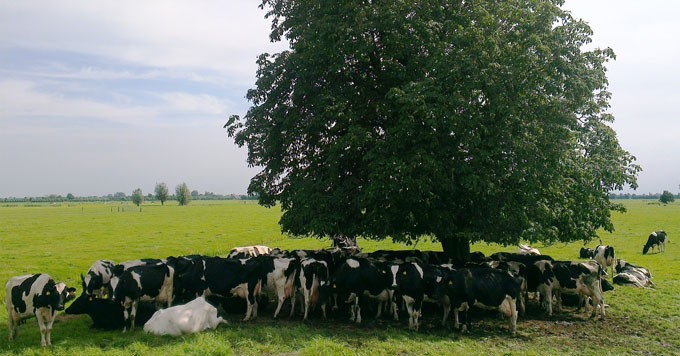
There is only one species of warm-blooded animals that I can think of that likes to roast in the sun: people. Other species are much smarter and tell us what we will have to do. On a hot sunny day, animals look for shade.

Shade is going to be a very hot (could not help the intended pun here) topic for the future. Actually, it is already getting more and more on everyone’s mind. Many studies have shown that shade reduces the temperature at ground level by substantial numbers. In paved environments, such as cities, the temperature difference varies in the range of 10 to 15°C. On pastures, the numbers seem to be less, but still in a range of at least 5-10°C.

There is already research carried out on the benefit of shade and how to bring more shades to animals. For instance, France’s INRAE (French Institute for Agricultural and Environment Research) is looking at strategies to reintroduce trees on pastures and determine which tree species would be the most effective. Besides trees as a source of shade, there are already some combined cattle or sheep husbandry paired with solar production on grasslands, with some very positive effects. The farm produces cleaner energy and the shade not only improves the animals’ welfare but it also protects the grass from the heat and help providing the animals with feed. In a way, this is a win-win-win. Heat stress is not just affecting feed quantity but its quality as well. There are also farms that produce vegetables under solar panels for the same reason: the panels protect the plants from the hot rays of the sun. Shade is going to b part of the food landscape. Early, I mentioned orchards. I expect many regions, like the one where I live to use shade screens as a standard production method for fruit production.

For the future, heat stress will lead us to rethink production locations, genetics of plants and animals, the type of housing for animals (and for people, too), feeding systems and feeding programs for animals, water management systems and water supply and conservation strategies.

Heat stress and shade are also going to become part of urban landscape. I recently was in Valencia, Spain. Some parts of the cities had some drapes spread on poles to provide shade and they also had misters to cool down the people sitting on some city squares. Those systems were not all that effective if you ask me. The best place was to be in the old river bed, now turned into a park where the trees were offering the best cooling effect in town. Spain is used to heat but it does not make it less of a problem. The most pressing action will be needed in countries that used to be temperate and where cities -and countryside- are not prepared and not equipped to deal with the heat that is likely to hit in the not-so-distant future. Heat is not just about crops and farm animals. It is about people and their pets, too.

Water availability

It does sound corny to say, but it is true: water is life. With climate change, former “predictable” precipitation patterns are disappearing. It looks like there is either too much water falling at once or hardly any at all. Of course, this has an impact, especially when it happens in combination with temperature swings. Droughts have always affected harvest volumes of crops and pasture production. Beef is a good illustration of that about the last couple of years in North America. Although drought is not the only reason, its impact of forage availability has noticeably contributed to the reduction of beef herds, and supply does not meet demand as it used to. The result has been a major increase of the price of beef at consumer level. Here in Canada, the price in the supermarkets of prime cuts has about doubled in a year time, and the price of ground beef has increased by about 50%.

Climate change shows up on the grocery bills and it hurts many households. Beef is an example but consumers can see the impact of climate event on many products, not just meat but fruit and vegetables, too. As such, it is not new. In the course of my life, I have seen unusual weather patterns affect the prices of food, but it just seems that the frequency and the impact is getting higher. We will see, but we need to manage climate events better. Artificial intelligence will likely be a big part of that solution.

There is what we can do about production systems and with the kind of technologies we will have in our toolbox, but there is also what we cannot influence. For this very reason, it is clear that water availability is going to redraw the world food map. Certain productions will disappear from some regions and reappear somewhere else. For example, the Bordeaux wine region in France seem to be at risk of not being able to produce the great wines it used to produce. On the other hand, it seems that England might have some ideal climatic conditions to produce excellent wines. Another example can be the Midwest region of the US which is a major crop producer, corn and soybeans in particular. The region depends heavily on the Ogallala aquifer for irrigation, but this aquifer gets depleted much faster that it can replenish. Water management has become a hot topic and a number of farmers, in particular in the State of Kansas, have switched to sorghum as an alternative to corn for animal feed, as it requires less water than corn.

The politics of water are another aspect of water availability that we rarely hear. Yet, we should pay attention. For instance, in central western France, there are hefty -and violent- conflicts about water management. Farmers wanted to have a number of water basins build so that they could keep producing their regular crops by using that water for irrigation. The basins would be filed by the river system in the winter. This project has faced strong opposition and many clashes have taken place between demonstrators and the police. Another example of water conflict is the dam that Ethiopia is building on the Nile River, which is causing great concern and reaction from Egypt and Sudan that see a risk for their water supply abilities for the future. And let’s not forget that the populations of these three countries are expected to increase strongly in the coming decades. Another example is what happened between India and Pakistan during the 2025 conflict in the Kashmir region. India threatened to stop its rivers from flowing into Pakistan. As you can see, as it becomes scarce, competition for water will become fierce. Water is going to be a major strategic and geopolitical resource with the potential to create major crises and possibly wars.

Cities also need to have sensible water supply and water use plans in place. A few years ago, Cape Town had dire water supply issues. Mexico City also got some worries. Considering the regions where population is expected to grow the fastest, water is going to be a major cause for concern. The number of megacities that are forecast to be built in Asia and Africa should keep many people awake at night. New cities with multimillion inhabitants are going to have to rely -and to depend- on mostly local water sources and the question is whether they will be able to succeed. This will require major investment and astute planning for the future.

Diseases

As climate changes, so do the local environmental conditions for living organisms. Some regions that were inhospitable for some species might become better suited in the future and we can expect to see a change of ecosystems as a consequence. This can happen for all sorts of species, large or small to very small. I will give here a few examples to show the variety and the complexity of the impact of climate change on the possible spread of diseases.

In cattle, two different problems have appeared recently. One is in France. A number of cow herds have been infected with the lumpy skin disease, which is a disease propagated by flies and mosquitoes. It is a disease that was until now limited to Africa. Now, it is in the French Alps near Switzerland and other cases have been detected in the Pyrenees, not far from the French-Spanish border. There is no cure available and the infected herds are being culled. Just imagine if the disease spreads further what the consequences can be for perhaps all of Europe. The second example with cattle is in Mexico and the US. Cases of Mexican cows infected with the New World screwworm have been identified and immediately, the US closed its borders to Mexican beef. Although there might be some politico-commercial aspects at play, fact is that the screwworm is an ugly disease vector. It basically eats the flesh of the cattle, but it could do the same to people. Texas got rid of that pest in the past with some difficulties and they do not want to see it reappearing, for good reasons.

I just mentioned vectors, and vectors we need to closely monitor. Avian flu, also known as HPAI or H5N1, is very contagious and is carried by wild birds. Monitoring of migrating birds and their routes is essential to identify where the disease could be present and take proper action to protect avian farms. Climate affects the migration routes and old patterns are probably already obsolete. There are already some systems in place, but I believe that more is going to be needed. Here too, artificial intelligence might be a big part of the solution. That will require sensors in bird houses, on farms, in the vicinity of farms and everywhere possible on the likely migration routes. It will need to be a 24/7 alert system. The problem -and the solutions- are similar when it comes to the increase of the population of wild boars in many parts of the world. Full monitoring will be essential in the fight against ASF (African Swine Fever). It also will be essential to understand the ecology of diseases if we want to stay ahead of the game.

In the world of small and very small, just look at the spread of tiger mosquitoes in Europe. A large part of France has been colonized and it will not stop there. Tiger mosquitoes carry “traditionally” tropical diseases such as dengue fever, yellow fever, chikungunya or even zika. Climate will contribute to the spread of many new diseases, be they plant, animal or human diseases.

The name of the game for the future of health is PREVENTION, and that needs to be imprinted in everyone’s mind in big bold capital letters. Protecting the immune system of our plants and animals as well as ours will be on top of the priority list. Let’s hope that politics will not stand in the way. We need to protect all we can. Once that is done, we will have time to discuss if we like it or not. It will be just like with the oxygen mask in planes. Put it on yourself first and then help others. We will have to develop new vaccines and new medication. For agricultural purposes, the use of gene technology will also help make some of our crops and animals resistant to diseases. Monitoring, which I mentioned earlier will also be key to protect ourselves and our food production. A major component of prevention is anticipation. We have the technologies to be able to monitor, to run scenarios and to develop solutions. We must use them to their full potential. We need cures, because massive culling or production losses will not be an option with two billion more people on Earth in the coming 25 years. Remember, 25 years is only one generation.

Copyright 2025 – Christophe Pelletier – The Food Futurist – The Happy Future Group Consulting Ltd.

249. Is the Earth maxed out or is it a world of plenty?

Listen here to a Chrome AI-generated podcast type playback of the author’s article

In my previous blog article, I was mentioning the growing population. This topic has been keeping many people busy for a long time. By the end of the 18th century-early 19th century, Thomas Malthus predicted that the human population would exceed the amount of food it can produce to feed itself. By then, the world population was less than one billion people. His views, so far, have proven wrong, although there indeed could be a maximum number of people that is viable. What is this number? Nobody knows for sure but there are many opinions out there.

A quick exercise I did recently as part of a presentation about the future of food production and consumption was to make people think about how we use agricultural land. My purpose was to take distance from all the usual narratives and provoke some thoughts in a playful manner. It is not so much about some hard numbers, as it is about thinking differently and looking at the world and the future from a different angle. I brought up a few topics.

Technical performance

There is a debate about extensive and intensive agriculture. In my opinion, this is the wrong debate in the sense that these are just two qualitative adjectives. They are not quantitative, so everyone can use them as they please. They do not tell what the acceptable limit of intensification is.

I prefer to speak of efficiency. Many people, even in academia, seem to confuse intensification with efficiency. That is a serious mistake. The key is to find the particular point of the maximum intensification that does not compromise sustainability. I discuss that in one of my YouTube videos, which I also have a shorter version just focusing on what I think sustainable intensification means.

To make a long story short, and from a perspective of sustainable intensification, better yields mean less land necessary. Same thing with animal farming: higher productive animals need less feed per kg of final animal product relatively because the energy needs for maintenance are lower, therefore less land. And from a perspective of the so popular cow burps as they are called nowadays, let’s take a simple example. Let’s compare one cow producing 9,000 liters of milk vs. three cows producing 3,000 liters each. It is rather obvious that the one cow will burp less than three cows combined, therefore less methane, therefore better from an environmental point of view.

The main lesson from this is simple: genetics play a critical role for sustainability.

Biofuels

An interesting study by the Institut für Energie und Umweltforschung (Institute for Energy and Environmental Research) from Heidelberg, Germany has been published in 2023. In their conclusion, the authors determined that the farm area used in the European Union for crops destined to the production of biofuels (ethanol and biodiesel) represented an area the size of the entire island of Ireland and could feed a population of about 120 million people. This is interesting, especially considering that the EU strives to go full electric on vehicles. Obviously, this could free major volumes land and therefore of food to feed the future. Just keep this number in your mind as an indicator but be careful to not extrapolate too quickly for the rest of my story because not all agricultural lands are as good as those used for crops in the EU and not all climates are as favorable.

Another similar comparison to make is to take a look at the USA. There, it is estimated that about 40% of the corn is used for the production of ethanol as a biofuel. If you take 40% of the area planted in corn, you get the size of two Irelands. Somehow ironically, this is also the size of the State of Iowa which is the top corn US state, and also for soybeans, 49% of which are used for biofuels. In the US, the ethanol mandate plays an important role for corn farmers. This is especially true since the US and China had a little disagreement during the first Trump administration, which resulted in China nearly buying no corn or soybean any longer from the US. This is still the case in 2025. The recent agreement on soybeans between China and the US might alleviate some of the pain but considering what a roller coaster this relationship is, let’s wait and see. US farmers cheered as the US recently increased volumes for the ethanol mandate. This is understandable, as US corn volumes have been quite high with about zero alternative market. It is actually to the point that the US is coming close to have a shortage of storage space for grain. Clearly, ethanol is not going to go away, unless the Midwest farmers decide to produce entirely different crops in the future. For water reasons, some have switched to sorghum as an alternative to corn for animal feed, but that goes only so far. Clearly, there will be little incentive to push too hard for electric vehicles as this would affect the domestic ethanol market. Without the ethanol market, it is not unreasonable to say that US crop farmers would all go bankrupt in a heartbeat. Even with the mandate, they are already in rough shape. This is the cost of losing your best customer. The old rule of thumb saying that it costs between 10 and 20 times more to lose a customer than to make some compromise sounds like it is still very relevant.

Of course, the EU and the US are not the only biofuel producers. There is more, like sugar cane ethanol in Brazil or even India making fast strides with bioethanol, but I will not include them in the calculation.

Anyway: about 2 Irelands with US corn ethanol.

Food waste

It is well known that about a third of all food produced is lost or wasted in some way. It is also true that most of the wasted food consists of crops. In developing countries, crops rot in the fields or in poor warehousing, or are eaten by vermin. In developed countries, the top two wasted products are bread and produce, both groups from plant origin, too. So, just for argument’s sake, let’s just consider that the food waste is just from arable land. Let’s forget the grasslands in this calculation. According to the UN FAO, the world arable land area is of about 1.38 billion hectares. A third of that is 460 million hectares, which is slightly more than the area of the EU as a whole, or slightly more than half the size of China or the US.

Expressed in Irelands, a third of the world arable land represents about 65 Irelands.

Warmer climate in Russia and Canada

Now, this is the fun part of the exercise. It is fun because 1) it is very speculative and 2) the result will blow your mind. Here is what I calculated: imagine a narrow strip of land of a width of 50 km across both Russia and Canada, which are both 9,000 km long from East to West. As summer are warming, it is not inconceivable that another 50 km to the North could be put in production for crops. These 50 km multiplied by two times 9,000 km is 900,000 km2 or 90 million hectares.

That narrow strips is roughly 20% of the EU area, or 13 Irelands.

Others

I will let you dig further where there is potential. Of course, there are challenges ahead. Climate change will also put yields under pressure. As I indicated, my purpose is mostly to make you think about whether the Earth is maxed out or whether we can still create of world of plenty. The answer will depend greatly on us and on our leaders. Do we want to cultivate the Earth for success or are we going to make pricey mistakes? That was the purpose of We Will Reap what We Sow, my second book, by the way.

Conclusion

This is a lot of Irelands!

Copyright 2025 – Christophe Pelletier – The Food Futurist – The Happy Future Group Consulting Ltd.
248. The future is not for the timid. Winners will be bold, ambitious, determined fighters!

Listen here to a Chrome AI-generated podcast type playback of the author’s article article

As the population keeps increasing, so does the strategic role of agriculture. In particular, geopolitical strategy will become even more prevalent in the future than it is today. Trade and influence will shape the future. In this environment, competition is going to be fierce. Like with any competition, there will be winners and there will be losers. For the future, the winners will be the conquerors!

The question, before considering who the winners might be, is really about to identify what will make some countries, industries and companies fare better than others. So, let’s review which components will play a role for future success.

Have a clear vision

To succeed, it is essential to know what the game is, what the rules are and how to navigate them. It all starts (or ends) with leadership. It is equally essential to have a very clear idea of what one wants to achieve and of how to thrive in a competitive environment because, like it or not, life is competition. Different people aim for the same goal, but only a select few will win it.

Money

As Cicero wrote “Money, endless money, is the sinews of war”. There is no doubt that the winners will be the ones who can fund their ambitions. They will be the ones who give themselves all the means they can find to succeed. To win, one has to think big and prepare accordingly. Those who think small will only obtain only even less than their goal. This is the role of the vision I was mentioning earlier. Being timid with funding for the future will only lead to defeat. I would compare it as preparing for the Olympics. Even the best athlete in the world would fail if not having the proper support.

Resourcefulness

I believe it was Anthony Robbins, the famous motivational speaker, who said something like it is not necessarily the ones who have access to the most resources who succeed, but the ones who are the most resourceful. This is true. Many successful entrepreneurs often started with hardly any money and had to gamble all of their meager savings and even their family stability. Yet, they found ways of generating interest and cash flow in order to keep going. On the other end, there is no shortage of startups that were (over)abundantly funded and yet failed. The difference was in the character of the entrepreneur.

Strong sense of identity

Those with a clear idea of who they are, what they represent and what role they can play in tomorrow’s world will be at a great advantage. Identity sets their values. It also boosts confidence and helps overcome setbacks. Thanks to identity, they will never take no for an answer and pursue their goals until completion. This does not mean that they will be the nicest ones or the best choice around, but a strong sense of identity will make them winners. If you have any doubt, just look around and you will see that all those who do not have a clear identity are on the decline.

Policies for success

Of course, one could argue about the definition of success but that does not serve anyone well in a competition in which the contenders all have their very own. In my recent article about whether the EU might become a museum, I address the necessity of making a clear choice. Do policies support farmers to succeed or are they undermining their chances of success in the global competition? To elaborate on my previous example about athletes in the Olympics, the metaphor would be about whether the policies are providing athletes with everything they need to express their full potential and go for gold, or does the “coach” tie their shoelaces together, leading the athletes to trip and hit the ground probably even before the game has started.

Spirit

Like with any competition, it is never over until it is over. The difference between champions and the rest is that champions never give up. They might suffer as much as the rest but the difference is in the spirit. It is about mental fortitude. It is about never giving up the fight. There always are ups and downs. This is life, once again like it or not. Winning the future starts with attitude. Never doubt when you face headwinds because everybody else does, but also never get cocky when things go well because complacency or mental superiority complex are deadly poisons. Never lose your sight of the objective.

Agility

Keeping the course is good, but sometimes the itinerary needs to change. Once in a while, life likes to create some detours. The winners of the future are also the ones who know that nothing goes in a straight line. Changes and adjustments are always necessary. The difference between the winners and the others is that winners are swift to adapt, yet not lose track of where the end line is. On the contrary, those who get distracted by setbacks will end up like the proverbial headless chicken. In that regard agility and spirit go hand in hand.

Not being too nice

In the geopolitical environment, it is clear that not all contenders play fair. Let’s face it, quite a number of them are actually nasty. This is a fact of life (yes once again, like it or not). To be among the winners, especially with that kind of competitors, it is clear that it is necessary to show some teeth once in a while. Be subservient and you will be bullied out of the game. It is just that simple. The answer of course is not necessarily to become one of them, either. It is possible to stick to proper values, but any way you might choose, there will be a fight. There also will be low blows and all sorts of dirty fighting going on. Just be prepared and train to be strong and to deal with that. Also build your own little arsenal to strike back and stun the bullies. You will need it.

Copyright 2025 – Christophe Pelletier – The Food Futurist – The Happy Future Group Consulting Ltd.

247. The Key to Successful Tech in Agriculture: Meet Farmers’ Needs

Listen here to a Chrome AI-generated podcast type playback of the author’s article

A recurrent complaint I hear in the agricultural sector is how slow and difficult it seems to have farmers embrace new technologies. Most of the time, it sounds more like a reproach than anything else, as if there was something wrong with farmers to be so reluctant. I do not agree with that thinking. To me, the main reason why some technologies have a hard time gaining the support of farmers is simply because they do not meet their needs.

I was recently viewing an old video from Steve Jobs. Basically, what he said was that if you want people to adopt a new product, you must first look at the customer’s experience and then work backwards to build the right product for them. He was also lamenting that too often, tech companies think because they have a product that is a technological beauty, the world should just adopt it. Of course it does not work this way, and certainly not in the agriculture sector. I believe a lot of technology developers should find inspiration in Steve Jobs’s statement.

In my work, I get contacted from time to time by venture capital firms who would like me to invest. Usually, with three to five questions, I know whether it is an interesting proposal. Sometimes, I already know after my first question. So far, none of the companies offered to me have survived. Some lasted a couple of years, but all failed for the exact same reasons as I will describe further in this article. This is the reason why I offer my “Second Opinion” in my services.

I recently had the opportunity (or the misfortune I should say) to attend a rather painful presentation from a venture capital operative, supposedly expert in agtech and in artificial intelligence of lately, as many claim to be. Of course, he was to complain about how slow the agriculture sector is to adopt new technologies with the same kind of criticism about farmers as I have mentioned above. The irony here was that he did a terrible job at demonstrating any added value. If this is the way the tech sector tries to sell itself to farmers, it should be no surprise that adoption will be slow.

Farmers do adopt new technologies. They do. A lot. Anyone who has actively worked in the agricultural sector with farmers and visited farms over the past decades will tell you how many things have changed on farms. Just think of GPS, satellite imagery, sensors, drones, computer vision, robots, unmanned vehicles and so on.The transformation has been amazing. They will tell you how many new tools and new technologies they have adopted and integrated in their daily work. Farmers adopt novelties, but not because it is trendy or fashionable. No, they adopt the tools that actually add value to them. Farmers are quite keen on technology. They are just not keen on snake oil. They are busy people. They have a gazillion things to take care of and their time is precious, just as well as their money. Unlike many people gravitating around agriculture, they do not have the luxury to waste time with something that is not ready.

Farmers are the perfect illustration of what Steve Jobs said. If you want farmers to adopt a product or a technology, you’d better make sure it answers an actual need and that what you offer is foolproof. Farming is a business and as such a tool must make the business better. Better can mean faster, it can mean physically easier or it can mean making better decisions and many other things depending of what the tool is about. In the end better is about having better technical and financial results without additional headaches on top of those that Nature and markets send on a regular basis. To adopt a new tool, farmers want it to save them time, otherwise what is the point? They want it to be cost-effective, otherwise what would be the point of replacing an existing trusted and reliable tool. And thirdly, farmers want peace of mind. They do not want to end up spending time to figure out how the tool works or to have to call customer support for troubleshooting all the time.

So yes, the customer experience comes first. And that is what I always insist on, and have done so since I started The Food Futurist. Innovation must be market-driven. I can imagine that in the early stages, the tech geeks need to build prototypes but then, and as soon as possible, they must team up with users to review what is useful and what is not and develop a product that meets exactly their needs. A great frustration of mine is that farmers are not involved enough in the early stages. As Steve Jobs said, the tech people build something exciting but too often try to push it. If it does not fit, there is only one result: slow adoption or just plain rejection.

There is a picture I like to show to describe what market-driven and results-oriented innovation is. It is one of these kids toys with shapes that have to pass through holes of various shapes. With innovation, it is the same game. If the farmer has a square problem, trying to push a triangular solution, even it is the most beautiful triangle ever, just does not work. Actually, it creates only frustration. If the farmer has a square problem, the solution must be square, too. That is the only way it will fit and that the farmer will adopt it.

I also see an important role for the agriculture sector: they have to say out loud what kind of problems they have and what solutions they need. If it is square, say you want a square solution. If it is star-shaped, say you want a star-shaped solution. That way, the tech geeks, who really love to build things, will also know early enough on what they must work. It will save time and money. It will strongly increase the chances of adoption, which is a win-win for both farmers and tech companies, and it will help improve agriculture faster and better.

Copyright 2025 – Christophe Pelletier – The Food Futurist – The Happy Future Group Consulting Ltd.

245. Is EU food and agriculture about to become a museum?

Listen here to a Chrome AI-generated podcast type playback of the author’s article

I was speaking recently at an event in Spain and by the end of my presentation, I had a slide on which I indicated which regions I saw as the winners of the future. The title and subtitle of the slide were:

“Winners: Conquerors

Bold, ambitious and determined fighters”

Being in Spain with many Europeans in the audience, I got the question of why I did not mention the EU among the winners. Fair question, and by the way, Canada, my second country of citizenship, did not appear among the winners, either.

About the case of the EU, I shared my concerns about EU policies which I find counterproductive. Although I find the idea of a Green Deal to make agriculture more sustainable a good idea full of good intentions, I do not have the same enthusiasm about the policies and means used to achieve improvements. I find the policies too much into the ideological and dogmatic and not enough into the practical and realistic, as I mentioned some time ago in one of my YouTube videos on the subject.

As the conversation was progressing with the audience, I lamented that the future would not be for the timid and that in particular that the EU does not seem to know how to stand up to the Putins and Trumps of this world. The EU has a leadership problem. Everyone can see that every day. I went as far as to say that if the EU does not wake up soon, it will end up being a museum. Apparently, this statement had impact. It obviously created a shock, and from a few one-on-one conversations I had later, it sounded like it was a useful shock. The argument of the quality of foods from the EU and their heritage was raised and I confirmed that I, for one, always appreciate these traditional products. Since we were in Spain, I mentioned one of my all-time favorites which is the Jamón Ibérico (I truly am a total fan). Every time I am in Europe I certainly love to go shopping on markets and I love the quality of the foods that I find.

My point about the EU turning into a museum was not that I do not consider the EU as a future winner because of its quality of foods. My point was because of the policies, EU farmers and producers are less competitive and will not be able to grow. The EU market share and influence will decrease because of such policies.

And this is a huge pity because European farmers are at the top when it comes to efficiency, high technical performance, low waste and, yes, product quality. European farmers and the associated industry are actually incredibly innovative and resourceful. Unfortunately, they often do not have access to the same amount of resources or of political support as in some other regions of the world. Personally, it really hurts my feelings when I see such top farmers being bought out and leave agriculture mostly for dogmatic reasons. Just imagine a company where the Human Resource Department would systematically get rid of its top performers for reasons that have nothing to do with performance. It would be stupid, wouldn’t it? Well, truth is that such idiotic actions actually happen in some companies, but that is another story. What is the result down the road? It is a leveling down of the sector, which follows by a weakened competitive position, a loss of market share, of presence and eventually of viability. And that is exactly what I fear is going to happen to EU food and agriculture.

The original European food and agriculture policies were about food security, which made a lot of sense after the harsh time of World War II. It is a good philosophy. It must never be removed for the top priority of the EU, or of any country that wants to play an influential role. I have been thinking of whether there ever was an economic powerhouse that did not have food security, and I cannot think of any. Often, it feels like the critics of food and agriculture take food for granted and do not even understand what it takes to bring it onto tables. My advice here is simple: do not ever take food for granted and make sure that those producing it can keep doing so!

For these reasons and to be among the winners, the EU must have bold, ambitious and determined food and agriculture policies. The food and agriculture sector must be vocal about this and must force every EU politician to answer a simple question: do they want to support their farmers or do they want to set them up to fail? It is either one. I cannot be both or neither. Just that simple. Further, the EU should also distantiate itself from the UN FAO goals of all sorts, most of which are more anchored in wishful thinking and ideology than they are in pragmatic reality. Fact is that most of them are lagging and will not be met on time. It is good to have goals, but when they are not realistic or attainable, they should see it as a duty to amend them and readjust goals and timelines. Just a look at the state of the European automobile industry is enough to see the damage that wrong policies, as I describe above, can generate. That nonsense simply must not happen to EU food and agriculture.

So, how to make the EU among the winners and avoid it to become a museum? Well, a couple of principles must be applied:

  1. The EU must produce the quantity (and quality) of food that the EU consumers need, so that there is less need for imports. A market-driven approach is key. Unfortunately, all food and agriculture policies always seem built from a production-driven angle.
  2. EU farmers and producers must be supported by their politicians, so that they are at least as competitive as their counterparts from third countries, which would make it easier for EU buyers to choose EU products first. Saying “choose EU” or “EU has the best food in the world” has about no impact with buyers. In the end, price always plays a major role and often is the major parameter. When it comes to competition, things are very simple: those who do not have a strong competitive position will lose. Like it or not, that is the way it is. And it is even more so with undifferentiated commodities for markets such as foodservice and processing industry for which the product is only an ingredient. For niches such as traditional products or regional specialties, it is possible for producers to protect their turf better, but such niches are not the lion’s share of consumption. Such niches will make a great museum, but what about the bulk of the EU market?

Nonetheless, there might be a silver lining about some of the policies. For example, The Netherlands have struggled with their nitrogen emissions reduction policies. After spending a few years persisting in error and wasting several billions of Euros with no result by buying out farmers and for those who could continue trying to force them into a rigid frame of rules telling them what is allowed and what is not, policymakers are rethinking the approach. Of course, anyone who understands farming knows that such rigid frames based on dos and don’ts simply do not work because agriculture is the opposite of rigid. It constantly faces changes, fluctuations and unexpected events. The Dutch farmers knew that. They wanted a more pragmatic and feasible approach, and opposed the policies but to no avail. Personally, I find essential to involve farmers to work on solutions fir a better agriculture. That was the topic of another video of mine. Farmers know the work. They know what works and what does not. Yet and too often, policymakers do not seem al that interested in listening to their input. That is a mistake.

In The Netherlands, the approach is now changing. Instead of imposing a script, the government now wants to focus on goals of nitrogen emissions reduction and leave it up to farmers to decide how they want to achieve the goals in the most effective manner. They will have to show progress and depending on the results might have to take corrective action if needed. To me, this makes sense. It is about results and that is all that matters. The how is secondary. Now, the thing is that elections are coming next month in The Netherlands and, depending on who wins, the new policies might be abandoned. We will see.

Copyright 2025 – Christophe Pelletier – The Food Futurist – The Happy Future Group Consulting Ltd.

The trust challenge

Lately, the topic of trust seems to receive more attention. In my opinion, it is a good thing, as I personally consider it one of the biggest challenges the food and agriculture sector is going to have to face in the future. Actually, trust is not going to be an issue for food and agriculture only. It will for about all areas of society. Trust is eroding in about everything, from businesses to politics, non-profit sector, media and even social media and technology such as artificial intelligence. I have addressed it in a number of conferences in the course of this year already.

Today’s world is filled with anxiety and considering all the environmental, societal and geopolitical pressures, it is only natural to expect this anxiety to only increase over time. I thought I would share some thoughts, and some ideas to restore some trust, on my YouTube channel. Here are two videos that I have made recently. I hope you will enjoy them.

Copyright 2025 – Christophe Pelletier – The Food Futurist – The Happy Future Group Consulting Ltd.