Finding your niche

One of the most common questions I get from my clients and audiences is how to find better markets. Regardless of whether I am addressing crop farmers in the Canadian prairies, food companies in the US, seafood producers in Ireland or local farmers here in British Columbia, the need to escape the undifferentiated commodity market is close to universal.

In my opinion, there is a simple reason for this. I usually explain it by joking about commodity markets being 95% price and 5% psychology, while niche markets are 95% psychology and 5% price. Of course, the percentages must not be taken literally. My point is that for commodities, since all the physical qualities of the offerings are similar, the (almost) only decision factor to choose between suppliers is price. All other arguments do not weigh much. For producers, this is often frustrating because it is a cold-hearted process in which the market decides. They feel that they have no control about the price setting, which is true for the most part. Although futures markets are there to help farmers limit the price risk, the lack of control in the actual price setting contributes to uncertainty, especially for producers in region with a relatively high production costs. In many developing countries, the disconnection between farmers and the markets presents similarities with the above. The lack of access together with the lack of control is a major impediment for the development of strong and successful farming operations.

Then, is niche marketing the way to go? Before answering this, it is useful to take a closer look at what a successful niche is about. Probably the best way to visualize it is to look at it from Maslow’s pyramid of needs, and look at which gradients we can define as we climb up the pyramid.

Niche &MaslowClick on the picture to view enlarged chart

The first one that comes to mind is that the bottom of the pyramid represent the need for generic cheap commodities and the top the exclusive luxury niches. The second one is directly derived from the previous one and from the content of the pyramid. It is the amount of emotion and psychology involved in the customer’s choice. This means that the level of quality also must increase as we go up the pyramid. Similarly, the level, and the quality, of service are also more important, as the target group lies higher in the pyramid. These differences clearly mean different way to conduct business. A solid niche is difficult to enter. If it is not, then many followers will rush into it, commoditize it and destroy it in no time. The difficulty can have very different reasons. It can be technical. It can be organizational. It can be commercial. It can be a matter of logistics or of planning. Whichever the reason may be, the message is clear for the producers: they must have the specific know-how to serve the niche well. They need to have the right set and the right combination of skills in-house. If done well, the development of a niche will also result in higher and more predictable margins, as well in the short term as in the long term. This has a lot of value to food producers, because they can plan ahead much better. Another important aspect of a solid niche is its growth potential. A good niche will grow. Of course, it will not become a commodity market, but that is what the producers want to avoid. If the niche has no growth potential, then as a producer you will be stuck and will need to find other solutions somewhere else for your business. This is why a niche has to be market-driven. There is no way that a production-driven approach will develop a niche successfully in the long term. It might work for a while, but putting production first will weaken the concept eventually.  Good niche management requires a deep connection between the producer and the customers. Developing a niche is not a marketing gimmick. It is not wrapping the old product or service in a new packaging. It is easy to make claims about sustainability, social responsibility or other concerns of consumers, but a good niche is not about the superficial stuff. It is about mutual dependence and shared value. To succeed in niche business, producers must be passionate about what they offer. They must believe in their vision, in their product and in their customers. They must commit to them and engage in a true partnership. If this is not the case or if it is not mutual, the honeymoon will be short-lived. Beyond the common vision and goals, what really counts is to speak the same language. Speaking the language of the customer is not enough. A good niche is one where customers want to buy from you, not having you hounding them for more sales. Good niche marketing rests on collaborative planning with the customers.

Although the comparison with Maslow’s pyramid of needs is useful, it is also important to realize that it does not necessarily means that a niche be tiny. Niche marketing is not the same as local and/or micro business. Especially in a world where purchasing power is evolving and where a huge middle-class with increasing disposable income, as well as a growing upper-class, are rising in populated emerging countries, niches may actually be quite large in comparison with the traditional Western markets.

Because there is such a need for niche developement, I am offering a specific program here at my company to help producers who want to walk the niche path. In my professional life, I have had many jobs and projects that were about getting away from the undifferentiated market and develop specialty markets that generate higher margins. The reason is that the production units where in countries with so-called uncompetitive production costs. Despite that, I successfully turned around difficult situations by setting up adequate strategies that capitalized on the strengths of the businesses and took them away from their areas of weakness.

Developing successful niches takes time and perseverance. For instance, it took me three years to get the poultry company I was working for to be approved as a supplier to Marks & Spencer. It also took some painful human resources decisions to turn around the sales activities I inherited in Germany. It took a lot of energy to lead for change here in British Columbia in an organization that was all about production and with no marketing skills, just as it took a lot of energy to convince the market that our new strategy would work (focusing on Chinook salmon instead of Atlantic Salmon) because many tried before and finally gave up. Yet, we did it and in half the time from what was stated in our supposedly very ambitious plan, and both the company and the customers benefited greatly from this move. I must also state clearly that to achieve such outcomes, I had set up teams with the mix of the right skills and talents to execute my vision. Nobody can do everything alone. That is valid for yours truly just as well. I am quite thankful for the great people who joined me in these endeavours and made it happen.

The difficulty to enter the niche protects you from the competition, but you also must pass the hurdle yourself. This means that you need to have the capacity to be stronger than your competitors. If you are not, realize that you will have difficulties to stay in business anyway.

Copyright 2013 – The Happy Future Group Consulting Ltd.

The locavore’s dilemma

There is a growing trend, or at least a growing noise in favour of eating locally produced food. The “locavores” as they are called, claim that 100-mile food is the way to a more sustainable agriculture and consumption. Is this approach realistic and could it be the model for the future?

This movement is rather popular here in Vancouver, British Columbia. The laid-back residents who support the local food paradigm certainly love their cup of coffee and their beer. Wait a minute! There is no coffee plantation anywhere around here. There is not much barley produced around Vancouver, either. Life should be possible without these two beverages, should not it? The disappearance of coffee –and tea- from our households will make the lack of sugar beets less painful. This is good because sugar beets are not produced in the region. At least, there is no shortage of water.

But this is not all. There is no cocoa plantation around here, and believe me, there are many people who are addicted to chocolate. British Columbia does not produce citrus or other warm climate fruit. If we are to become locavores, we must say goodbye to orange juice, to lemons, to bananas. Even the so popular sushi must disappear because of the lack of rice. There are no rice fields in this area, and neither are there wheat fields. The Asian population certainly would have a hard time eliminating rice from their diet. The lack of wheat means no flour; and no flour means no bread, no pastries, and no cookies. The carbohydrate supply is going to be tough. If we must consume local, our lifestyle is going to change dramatically. Potatoes and cabbage is the way of the future. But before going all local food, the local locavores must realize that British Columbia produces only 48% of all the food its inhabitants consume. One out of two locavores would have to starve. Going exclusively local would also affect deeply the source of animal protein. Most of the animal feed is made of ingredients that come for much farther than 100 miles. The chickens and eggs would become less available. Farmed salmon, BC’s largest agricultural export could not use the type of feed they currently use, as fishmeal and fish oil come from Peru and vegetal oil comes from farms located far away. There would go many jobs with very little alternatives. If we look beyond food, other agricultural products such as cotton and wool would not be an option anymore. Cars would disappear, because the main component of tires, rubber, is not produced under this climate. The 100-mile rule will solve traffic problems. If local consumption is the rule for food, should not it be the rule for everything as well? China would probably have different views about this. Not only would their manufacturing collapse, but also if they have to produce food within 100 miles of the consumer, they would have to give up importing agricultural commodities. For them, a true locavore system would mean famine. The same would be true here in British Columbia. When people are hungry, they are not so picky about the distance from the producing farm.

The problem with concepts such as local consumption is that the basic idea has some value, but the idea quickly evolves into an ideology, and ideologies tend to make their followers stop thinking pragmatically. Today, the idea of eating locally in a place like Vancouver is possible because supply easily meets demand, thanks to the 3,000-mile foods. This is ironical. If the distance to market has to be within 100 miles, farmers in low population density areas, such as many regions of North America, South America and Central Europe, would have a different type of problem. They would produce an abundance of food, but because there are not enough people to consume it locally, the law of supply and demand tells us that the price of agricultural commodities would plummet, food would stay in storage and farmers would go out of business, while people in China, and in British Columbia, would suffer hunger. Clearly, the 100-mile diet needs some amendments.

Intuitively, it sounds logical that locally produced food has a lower carbon footprint than food that comes from 2,000 to 10,000 miles away. However, this is only partly true. The mean of transportation affects the carbon footprint. The environmental impact of transport is much higher for road transport than it is for rail transport, which is also higher than water transport. The type of transport also depends on the type of commodity brought to market. Perishables need to reach consumers as quickly as possible for shelf life reasons, while dry goods, such as for instance grains and oilseeds do not face the same kind of deadline. The quality of the logistics is also crucial to reduce the carbon footprint. A fully loaded truck is much more efficient than a local truck dropping small quantities in many places, thus driving around most of the time with empty space in the trailer.

The emphasis should not be so much on local as it should be about the search for efficient and low environmental impact. More than the distance from the farm to the consumer, it would be more useful to provide consumers with information about the actual carbon footprint of the products they buy. They would have the possibility to make the right choices. Retailers, too, would be able to make decisions about their sourcing strategies. Clean products and clean producers need to be rewarded for doing a good job. Here in Vancouver, local food products are more expensive than similar offerings from California, Mexico, Ecuador or Chile. How do you convince families with a tight budget to spend more for local products that look pretty much the same? This problem needs to be addressed. Currently, farmers markets are much about marketing. They sell the experience as much as their production methods. Only a wealthy minority can afford to buy on these markets. The prices are not based on production costs plus farmers income. They are as high as possible, because the farmers can ask these prices. The wealthy city dwellers are willing to pay a substantial premium above what they can buy from the local supermarket. In this relation farmer-consumer, the price bargaining does not take place. If these farmers were to try to sell to a grocery retail chain, they would never get the prices they get from the consumers who will not haggle about the price. This is why more farmers try to sell directly to consumers: they make more money that way. However, this might change in the future. A number of retailers are working towards offering “farmers market” products into their store. This already makes market farmers nervous.

Is local production for local markets the way of the future? My answer is that it partly will be and it partly will not. I do expect a shift of the location of production for perishables. Consumer habits will change, too. In the West, consumers have been spoiled. They can eat anything from anywhere at any time of the year. This luxury probably will not be affordable for long anymore. The superfluous will naturally be eliminated.

As the economics of energy, and therefore of food, will change, producers will increasingly locate their operations closer to cities; and even inside cities. Urban farming is a growing activity. Although it started mostly in poor neighbourhoods as a way of having a small patch of land for personal consumption, more sophisticated and efficient systems are being developed. My expectation is that production, and consumption, of vegetables and fragile fruit (for instance strawberries) will gradually become more integrated in the urban landscape than they are now. I also think that we will see animal productions, such as fresh dairy, poultry meat and eggs relocate closer to consumer markets. An interesting development is aquaponics, the combination of greenhouse produce with fish production in tanks. The production of non-perishables will not relocate. It does not have to. What will probably change is the transportation infrastructure in many areas where these commodities are produced.  This is good news for coffee drinkers and chocolate addicts. After all, transport of commodities over long distance is not just the result of cheap oil. The Silk Road and the spice trade by the Dutch took place before mankind even knew about oil. Trade has always been a force of progress for humanity. It helps an increasing number of people to have access to goods that make their lives better. The rules of trade may not always be fair, but like all human activities, it is a work in progress. Limiting our food supply to 100 miles would be a regression. Subsistence agriculture has not demonstrated that it could feed the world. Most of the people suffering of hunger live in subsistence agriculture areas.

(This topic is one of the many that are presented and discussed in my second book, We Will reap What We Sow)

For more on similar topics, please visit my other website The Sensible Gourmet

Copyright 2010 – The Happy Future Group Consulting Ltd.

How sustainable is “sustainable”?

The more as read about new certified sustainable foods sources, the more I start to wonder about how really sustainable they are. As I have mentioned before, I believe that sustainability is the only way forward because, per definition, what is not sustainable has no future, but I am beginning to have doubts about the credibility of some certification schemes.

There are two things bothering me:

  1. I thought that I had heard something about fisheries collapsing all over the world, but it sounds like more and more seafood is sustainable, and in such quantities that large retailers can offer it. Almost every week there is at least one new certified fishery and many more to come from what I hear. Does this really add up?
  2. Sustainable foods seem to follow the same logic as the consumption society that has brought us in such trouble already. The message seems to be: consume more of it because it is sustainable! I just miss the “consume with moderation” message.

Clearly, certifying sustainable food is a business, and definitely a big business growing further. Moreover, the more food programs certified, the more captive audit customers, therefore the more revenue, it produces.

In addition, it is very clear that there is a lot more “green” talk in business and marketing than actual improvement, at this stage.

Sustainability is a very serious matter, and therefore it is of the utmost importance that certification standards are above any suspicion. Only their credibility will allow us to make the proper progress towards a better future.

Funding and accountability to consumers are two important tools to guarantee such high standards and integrity. I like France’s Label Rouge model, because certification is carried out and supervised by the Ministry of Agriculture, therefore funded and accountable to the French people, their consumers.

Copyright 2009 The Happy Future Group Consulting Ltd.

Health and environment as growing drivers of food production

Health concerns will gain more importance in the future in the decision process of consumers when they buy their food.
More and more, we can hear and read about concerns and even rejection of the current production systems. Although this bad publicity is not always based on the most objective facts, it has been able to find a growing audience.

It must be true, it was in the newspaper

It must be true, it was in the newspaper

Since most consumers have little or no knowledge of agriculture and food, their only source of information is in the popular media. On the other side of the discussion, the agri-food industry is not getting through, because its message tends to be too defensive and too technical. Unfortunately for the industry, errors from the past (for example, the use of DDT) or cases from other industries (for example, tobacco) contribute to cast a shadow on its credibility. As I wrote my previous article “Less controversy thanks to transparency”, the agribusiness will achieve much more by opening up and having consumers visit their premises so that they can tell what they saw. They must organize more Open House days.

Therefore, for now, consumers have a certain perception of how food is produced, and it is not so relevant to argue whether this perception is correct or not. Perception simply is reality, and consumers act according to what they believe is true.
A little bit of this...There is a growing concern about environmental and health aspects of food production. About the environment, you can list very diverse things such as the depletion of wild fish stocks in the oceans, the interaction between aquaculture and wild fish stocks, manure and smell of intensive animal husbandry and impact of manure on soils and drinking water, deforestation of rainforest for ranching of beef or about growing GMOs (Genetically Modified Organisms). On the health side, consumers worry about food poisoning due to bacteria, such as E. Coli, listeria, campylobacter and salmonella, but also about residues of pesticides or antibiotics, as well as they worry about the use of hormones in animal productions. As the discussions get more animated in the US about the reform of health care and the cost of obesity, more and more people are wondering about whether the fast food diet is a proper one. Next to this, animal welfare is a growing concern by more and more consumers.
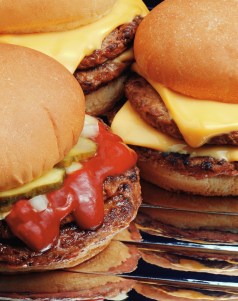
The answer to many of these worries has started to appear in the last few years with the growth of the organic market segment. When we see the growth and the performance of a retailer such as Whole Foods, there is no doubt that organic foods have a growing audience.

The concerns about the environment are forcing retailers, food service and businesses involved in the production chain of food to make changes. Some of the actions they have taken can be seen as marketing or PR, but they also have become mainstream. Just a look at how many restaurant and supermarket chains have already implemented sustainable seafood programs indicates how serious this change in consumer attitude is. Fast food chains are also actively working on reducing their environmental impact and set standards on where they source their meat, based on environmental concerns, such as no beef from ranches deforesting the Brazilian rainforest.
In the past, we have seen some examples of production methods that had to be abandoned, simply because no solution to cope with environmental problems could be found. This has been the case in The Netherlands where the level of intensification caused such manure surpluses and risks of animal disease to such a point that after many years of looking for viable technical solutions in vain, the government decided that the size of the national herds had to be reduced.
Similarly to what happened in Europe over the last decade, we can expect that much stricter rules in the use of antibiotics will be applied, and I expect a similar trend to a progressive elimination of the use of hormones in animal husbandry. About animal welfare, there should not be any surprise the day that only husbandry systems that allow enough “recreation” area for animals will be allowed. All of the above is going to have an impact on how and where food is produced. Systems will become less intensive, and progressively we will see more techniques to improve efficiency to compensate.

Past Food?

Past Food?

As I also had mentioned in another article (Future price of fish and meat: up), it is simple logic that with more people to feed, food is going to become more expensive. However, the relative prices of various food products also need to go along their relative health benefits. Today, it looks like only wealthy people can afford a healthy diet, as the price of “good” food is substantially higher than the price of what makes a nutritionally unbalanced meal. This clearly does not work in the direction of a healthier population at large.

The way consumers think will define the way we eat and produce our food. Many changes in consumption patterns, in production systems and in product offering are under way. I will get back later with more details on what my views are on this.

Copyright 2009 The Happy Future Group Consulting Ltd.

Retailers take the lead in sustainability

Sustainability is a bit like quality: everyone talks about it but few give a clear definition when it comes to practical and concrete specifications. Just as importantly, leadership is badly needed to transform the talking into effective action.

The future is in our handsAs long as the lawmakers remain slow to bring up the change and the clarity to give clear directions, we will need the leadership of some of the most influential players in consumer markets to get things moving.

Even environmental organizations and sustainability bodies have some difficulties to agree with each other. For example Greenpeace does not seem to think that the guidelines from the Marine Stewardship Council offer solid enough guarantees that products brought to market according to these guidelines truly are sustainable. Clearly, this is an area in continuous evolution and the ideal concept is still in the making.

The consumer themselves are both still under informed as well as overwhelmed by all sorts of contradictory messages to know clearly which choices to make, therefore some decide of what to buy either based on philosophical or on financial reasons.

Similarly, many businesses are trying to find their green way as they can, but there again the lack of a strong regulatory frame and the uncertainty of the return on the green investment do not help them. The result is that, although the awareness about sustainability among businesses has grown substantially over the last few years, many companies have taken rather timid steps so far, limiting their actions to the least costly possible and the most PR and marketing-driven. They claim to go green, they communicate a lot about it, but the progress is slow.

Yet, some companies take more initiative, show leadership and push to make the whole supply chain evolve to sustainable production systems. A very active sector in this area is the retail. Retailers in the UK such as Tesco or Waitrose, in Canada with Loblaw’s and Overwaitea Food Group, and of course especially Wal-Mart in the USA have definitely made their choice. They clearly understand that the future cannot be anything but sustainable and they are demanding that their suppliers now come with products that meet the requirements of tomorrow. Last month Wal-Mart demanded from all their suppliers to “develop comprehensive programs to promote sustainability and transparency – or else contemplate a future without Wal-Mart as a customer” (read article).

Tesco is now indicating the carbon footprint of milk products on the labels (see article “Environmental performance on food labels”); Waitrose, Loblaw’s and Overwaitea are going for sustainable fish products, adopting for example the SeaChoice specifications as their guideline. Wal-Mart stores have already implemented a number of measures to reduce their carbon footprint by reducing the energy consumption, and they have already have made some of their suppliers introduce different product presentation. For example, they were the first to demand laundry detergent to be more concentrated and packed in smaller containers. This saved water, it saved energy used to transport useless water, and it saved plastic used for the jugs and for the pallets on which the product was transported. Today, concentrated laundry detergent in smaller jugs is the standard. Without Wal-Mart pushing for the change, we probably still would use the old product in the old packaging.

Copyright 2009 The Happy Future Group Consulting Ltd.

Cod farming: difficult start, but bright future

Sometimes success stories do not happen at once. This is my feeling about cod farming. Cod products are in good demand, and unfortunately, wild stocks are in serious trouble, which leaves a huge opening in the market.
Farmed Cod - Courtesy of FiskeriforskningSo far, farmed cod producers have not delivered good financial results and opinions diverge according to whom you listen. Culprit seems to be the “market”, but this is generally a very vague and inaccurate explanation.

Feed companies initiated cod farming, as an extension of the feed business, but not as a standout business. Moreover, the volumes that have been planned initially answered to a production driven approach, and not to a market-driven approach. Production was set up for quite significant volumes, without building up a solid sales plan from an already established market position for cod products. If you read my previous articles “Be always market-driven” and “The consumer must be the focus point of value chains“, you can understand why such an approach delivered poor results.
Recently, I was browsing through the web site of one of the farming companies and, although they claim to have set up a value chain, they have not quite done so. Their value chain needs to integrate much more strongly the marketing/customer end, and I think that they need to rebalance their bargaining position with feed suppliers and customers, in order to obtain a fairer distribution of profits. Today, there are people making good money out of cod farming, but the farmers are not.
Cod filletOnce they refocus their marketing mix to the right countries and the right type of customers, which they will have to do with a reduction of production volumes, then they can grow the business with and for the cod market by being in the driver’s seat.

Considering the demand for white fish and the depletion of the supply of the natural competitor (wild cod), cod farming’s future can only be bright. It would not surprise me if, in the future, cod farming could surpass salmon farming in production volumes. But first, one step back.

Copyright 2009 The Happy Future Group Consulting Ltd.

If we are what we eat, what will we eat in the future?

The past 50 years have seen, at least in the Western world, the development of the consumption society. The emphasis has been on consuming always more, by having an apparently unlimited quantity of increasingly cheaper consumption goods available. This trend happened in the agriculture and food sectors just as well, and followed a rather simple patter, actually. Mass consumption has been coupled to mass production, thanks to intensification, technical and technological progress and, last but not least, marketing.

Junk foodTechnical progress improved yields and productivity, while marketing was aimed at creating more, and new, needs. Our food has become standardized, industrialized, and processed in a wide variety of forms. As the emphasis moved to lifestyle and convenience, which came along with the rise of mass distribution, cheap energy and suburbia, we lost the connection between ourselves, the origin of our food and nature. Food became just things you buy at the supermarket, already packed in plastic and cardboard.

Now, we have come to the realization that this high production of waste, be it packaging material, be it blemished product that do not look good anymore while still perfectly edible, be it the overproduction of manure and its minerals, or be it the massive use of antibiotics and pesticides is not sustainable. Of course, much progress has already done to reduce this waste and there is a growing trend towards organic and traceable, but at this stage it not clear yet whether this is a true change in our behavior or whether it has more to do with a social status and marketing issue.

However, what the current situation might be, the fact that we understand that we cannot keep on intensifying and wasting the way we did, will inevitably bring a more fundamental change in how we consume in the future.

Some people predict such changes as the astronaut diet made out of pills, the use of a computer to tell us what and how much of it we should eat based on our activity level, or the tissue culture to replace meat, and many other scenarios. Will any of those ever happen? Who knows?

Personally, I believe that food as a very strong psychological connotation. We associate food with experiences and, although there are differences between cultures, that emotional bond will stay.

Clearly, the consumption society with all its excesses is coming to its end, and maybe the current economic crisis, which also originated in the excess of having it all at any cost, could very well be the turning point.

The next evolution is probably going to be a balanced approach between consumption, which we need to some extent, and the necessity of preserving what keeps us alive. There will be different graduations of this balance between geographic regions, but sustainability is the only way forward, as I mentioned in my previous article (Sustainability: as natural as balance).

Intensification is showing its limitations, waste of manure and of packaging are also hitting a wall, energy is getting more expensive and makes the production and the transport of food more expensive, too. This will reshape how we want to consume our food, how and where it is produced, how it is presented to us.

Cattle feedlotWe still are in a society where some people get obese by eating lots of food as quickly as they can, while they have less physical activity than the previous generations, thanks to automation. That food is produced on intensive farms and feedlots where the animals grow and fatten as quickly as possible, as they eat lots of food, while not having much physical activity. Similarly, in our society meat producers use hormones to boost growth and carcass quality, while body builders and sport professionals use steroids and growth hormone to boost their performance. Interesting similarities, don’t you think? We are indeed what we eat.

So, in a conservation society, should we expect the farms to be led by the need to preserve? This almost sounds like the farms we had at the beginning of the twentieth century. I think that there will be some of it, but the efficiency of production as well as the efficiency of preserving the environment will be much better, thanks to new technologies. We will have high yields, and at the same time, we will have highly efficient systems to use water, to recycle waste and preserve the fertility of our soils and the balance of our oceans.

Copyright 2009 The Happy Future Group Consulting Ltd.

The PR and the reality about earth-friendly production

On Earth Day, Meat & Livestock Australia unveiled its campaign about the eart-friendly character of their production (see the article).

One can wonder if this concept is more about PR and rethoric than it is about true higher standards. Hopefully it is, but since there is quite a bit of space in the production areas, planting a few trees and leaving areas for wildlife habitat does not really seem like a particularly challenging task. Unless the impact on the environment can be monitored and tangible results can be shown over time, this could just be no more than a marketing approach to ask a few pennies for their meat without changing the cost structure. The market will decide.

Copyright 2009 The Happy Future Group Consulting Ltd.

The consumer must be the focus point of value chains

The shopping cart: your ultimate target!Regardless which link in the value chain you represent, it is essential to always consider the “big picture”. In this picture, a key element is the end of the chain: the consumer.

As the final user, the consumer will always drive the activities and the profitability of the whole value chain. Although the interaction is left over to the retail sector, the consumer’s quality requirements will trickle down along all the links of the chain. If I take the example of meat for instance, what the consumer wants will have implications all the way back to genetics, and breeding companies know how critical it is for their survival to be able to anticipate these needs, as choices have to be made several years in advance. If you are a breeder, your end product is the consumer product, not just the animal that you produce. If you are a feed company, you do not simply produce feed for the farmer, you are an important element in the acceptance (or rejection) of your direct customer’s product. Your feed becomes eventually the consumer’s choice.

Understanding the consumer is what makes successful value chains, and there is very little acceptable concession from that statement. Many companies fail because they do not listen or understand the consumer market. Pretending to do so, with help from new product development, sleek communication or fancy marketing concepts may help for a while, but it will not stand the test of the consumer. This is why commodities always sell at market price: they do not represent anything to the consumer; therefore, the only differentiation with your competitor’s commodity is the price.

Your product will flow towards the consumer market, and your information must originate from there as well. When building a value chain, always spend time understanding the final link, because it is the strongest and most powerful link!

Copyright 2009 The Happy Future Group Consulting Ltd.

Value chains are a great way to develop a niche

In the food production world, just like in other business sectors, there are been two major successful strategies.
One is to produce a non-differentiated commodity at the lowest cost possible. The number of units compensates what is lost in margin per unit.
The other is to produce a limited and controlled volume, and to market it to people who will pay a premium for it as they see an added value in the product.
So far, nothing too revolutionary here.
Generally, other strategies seem to have failed, either because the niche started to expand too much and was losing its specificity. The product becomes something of a better commodity, but not a specialty anymore. More players start to enter the niche and very quickly, the margin per unit drops and so does profitability. The deathblow generally comes when people start to try to counter this decreasing margin by cutting costs in the wrong places, quality being the most obvious.
The mass commodity producers, who try to create an artificial differentiation, by creating an illusion of specialty, cause another type of failure. This marketing tactics usually fails because the difference is mostly an illusion and the customers realize that quickly.

Value chains are very useful for smaller producers who want to market a good superior product.
Often, they are local producers with limited resources. They know how to produce well, but they miss the marketing arm or the industrial arm of the value chain that they are in.
On the other hand, also at the local level, there are other businesses that have the other links of the chain, but that have no production of their own.
When these players join forces and truly collaborate to offer to the right type of customers the type of product that is right for them, the value chain can become very successful. In a previous article, there is a presentation of the Angus Beef story, which also started in such a way.
In order to be successful, a value chain needs a number of basic elements.
The product must indeed differentiate itself by recognizable and superior physical characteristics. Over time the mystique will be created, but do not expect to sell hot air for very long.
The partners need to indeed be partners and play together. This is a critical part of such a joint venture. The worst thing that can happen is a lack of commitment, or worse one of the partners trying to force his own agenda before the common interest. The most successful partnerships come from a balance of power between the parties involved, and also by the necessity of interdependence, as they all should miss – and not be able to easily replace – the other parts of the puzzle.
Another key element is the will to pursue, as very often, and mostly in the early stages, the progress will meet many setbacks. This discipline needs to be applied and someone must fill this role, to constantly enforce the quality specifications and all agreements that are need and made to make the value chain succeed.

Copyright 2009 The Happy Future Group Consulting Ltd.