What do consumers really want to know about food?

Listen here to a Chrome AI-generated podcast type playback of the original article

My previous article about what consumers know about food is only part of the equation. What is as important is to know what they want to know and why. When it comes to knowledge of food, consumers can be divided into three main groups. There are those who know about food and most are always interested to learn more. Then, there is the (large) group of people who do not know. Some are willing to learn. Usually, they are confused by all the contradictory points of views that they hear or read and they just do not know who they should believe. This open-minded sub-group gathers people from all walks of life. They may have their biases but they are willing to change their minds. Another sub-group among those who do not know much about food gathers people who do not know and do not care as long as their food is safe, tastes good to them and has the right price. Then there is the third group, the difficult group of those who think they know but don’t. Usually, they are not willing to learn because, well, they already know it all and they are certainly not looking forward to have their certainties challenged. This group can be divided into two sub-groups, too: those who think they have the monopoly of science and those who think they have the monopoly of morals.

In this article, I will focus on the people who have the willingness to learn about food. What would be the point of trying to spend time if that willingness was not there? Also, all I can tell is my personal experience when meeting with people who are asking questions about food and where it is all going. Actually, I always found that the conversations I have had with people asking me about food and agriculture went quite well. I guess the secret for that is to not try to force people into any conclusion. Let them decide for themselves. People do not like being told what they should know and believe. It is a very normal reaction, and that is why so-called “educating” the consumer will never really achieve much. Just have a relaxed talk without any particular agenda other than to listen and respect each other’s point of view.

Further, even though marketing experts always like to define specific areas of attention, the mapping of consumers is not all that useful when it comes to the food conversation. Of course people are concerned about health, environment, origin of product, production methods, etc… When you look at what consumers want to know, it really comes down to two main issues. One is “How do I know that my food won’t make me sick -or worse?”, and the other one is “Can I trust the food producer?” These two issues are quite interconnected and not easy to address for food suppliers. The first issue, which really comes down to the topic of food safety is work in progress. There has never been full absolute food safety in the past and it will not be possible to guarantee that in the future, either. A large part of food safety issues actually happen in the consumers’ homes because of poor food handling. Many consumers do not know the basics of proper food handling. But even at the producer’s level, no production system is immune. Problems happen just as well with industrial production as with farmers’ market type of food. It happens with large producers just as it happens with small producers. This is where the issue of trust plays an important role. Consumers want to know which suppliers they can trust for food that does not contain anything harmful or/and weird. In previous posts, I have raised the issue of trust many times and mentioned how difficult it is to earn. Why do some food producers earn trust and others not? It has been the idea of brands since day one: the consumer can recognize the producer easily and know that the product is reliable every time. In our world flooded with information, rumours and stories of all sorts, and with a reach like never before, this is not sufficient anymore. If the question of how to earn trust is often difficult to answer, another way of looking at it is to do what I like to do when I cannot get an answer: to look at it from the opposite angle. The question then becomes what makes consumers not trust a producer? I am sure that you can make a list of reasons very quickly. Here I can give you a few: not knowing the producer, bad or unknown reputation, unreliable quality, regular problems, hiding information, not answering questions, lying to the customer, saying one thing and doing another, etc… It has a lot to do with quality of the product and quality of the communication, and consumers want to know what the quality of both is.

Traceability and transparency address those concerns to some extent. They are certainly helping by creating a much required communication and openness. However, the question remains whether food suppliers are on the same wave length as what consumers want to know. Traceability and transparency are not new concepts. They were part of my dealings with my customers some 25 years ago, and I still have the same reservations today as I had by then. I can state without any doubt that traceability is essential but I would like to see it become a proactive tool, instead of about just recording history. I remember telling one of my customers by then that I thought that traceability in order to be able to explain on rather short notice what went wrong was really short changing the customer. With today’s mass digitalization, which makes getting the information about the records even quicker, I believe that my point has become even more important. Traceability cannot just be about finding out the cause of a problem after the customer has found out. I always have considered that the customer can never be the quality control of a supplier. If producers have traceability systems that allow them to tell within moments what went wrong, then the system has to be able to prevent the problem from happening. The traceability system has to be connected with the quality assurance system. With the rise of sensors, internet of things, data collection software and artificial intelligence, the traceability system must become the frame for quality assurance and the high-tech devices will have to allow a real time 100% quality control on physical, chemical and biological quality criteria. It will have to be able to shut down the production line as soon as a deviation from the quality standard occurs. Traceability will move from “writing history” to “making (clean) history”. There are already a lot of possible quality defects that are prevented from being sent to consumers but it has to be even better in the future. Ideally, the objective must become zero recall, because even if recalls help prevent problems from getting worse, their incidence is creating a feeling of insufficient safety.

Regarding transparency, I believe that there is a disconnect between what food producers are doing and what consumers are looking for. Of course, the best way to be fully transparent is to put every bit of data and information in the system. From a consumer’s point of view, what is transparency really about? Do you know anyone who wants to check every detail of the production of what s/he buys? Consumers might be interested to know from which farm their food comes from. They might be interested in knowing the farmer’s name and see pictures. Will they want to be interested in digging as far as to know when chickens were born and when, what feeds they ate during their life and where the feeds came from and what they were made of and where the ingredients used for the feed came from and when they were produced, or would they really be interested in knowing the genealogy of the chickens and look up for where the parents and grandparents were raised, or have the production details in the slaughterhouse? I doubt it. In my opinion, the highest value of transparency for consumers is that the food producer has it and is willing to show everything if questions arise. In other words, the producer is not trying to hide or misrepresent anything.  After all transparent means exactly that: you can see for yourself through the window and you do it without having someone telling you what and where to look. More than the content of information presented, it is the food producer’s attitude that matters. The role of social media also amplifies the need for transparency, but it also may contain some pitfalls for producers. A recent survey by Deloitte shows that Millennials and GenZ assess producers by their values a lot and that their loyalty will be to the values and not to the brand. I believe that values are going to be a critical aspect of how consumers choose from whom they will buy their food, and anything else. The combination of social media with heightened sense of individualism (some would say narcissism) and yet at the same time a strong trend towards polarization and tribalism around sets of values and beliefs means that food producers will have to navigate skillfully in the future.

Copyright 2019 – Christophe Pelletier – The Happy Future Group Consulting Ltd.

How much do consumers really know about food?

Listen here to a Chrome AI-generated podcast type playback of the original article

Perhaps it is a case of multiple copy-and-paste events but I was surprised to read and hear recently in several occasions something that intrigued me. According to some research, millennials would know a lot more than their parents and previous generations about food and how it is produced. It surprised me because I wish I could bump into millennials who know something about food. Actually I wish I could bump into people from any generation that would have some significant knowledge of food and agriculture. I also disagree with those who claim that people have never known as little about food and agriculture as nowadays, but those have their own hidden agenda.

The main reason marketers are interested in the millennials is that this group has much more money than previous generations, or at least that is the thinking. Since the world population has more than tripled since 1950, representing an increase of more than 5 billion people, it is no surprise that millennials represent a financial force. However, one should look at the average individual financial situation of a millennial compared with previous generations. If the group has more money as a whole but less on an individual basis, their consumption pattern might not be as expected. Also, it would be wise to compare between regions as the boost might be different depending on whether they live in emerging countries or mature developed countries. 

So, have I been sleeping too much lately or do I meet the wrong people? Or is it a matter of confusing terms as it seems to happen more and more. Do millennials have more knowledge about food, or is it perhaps that they have access to more information? As Einstein supposedly said, “Information is not knowledge” and this might be truer more than ever in today’s world where we are constantly buried in information, some of it being accurate and most of it being not so, sometimes by accident and sometimes on purpose. It would be good to think about several concepts that we tend to consider synonyms while they are quite different: data, information, fact, knowledge, truth and wisdom. I will try to explain the difference by using a very food and agriculture related metaphor.

Imagine data as a field of potatoes. There are plenty of plants and potatoes in the field and you are going to harvest. All you do is to collect all the potatoes from the field and eventually bring them to a place where you will sort out what you have harvested. At that stage, potatoes are just like data. It is raw units without any processing of any sort. All you can tell at this stage is how many potatoes you have, what they are and what the total volume is.

Once the potatoes have been harvested, you are going to look at them in more detail. You are going to sort out the small ones from the larger ones. You are going to sort out the ones that may have been damaged or are not proper to send to market. Depending on the criteria that are useful for you, you are going to distribute your potatoes into small groups according to various qualities and uses. Each group or package has a particular relevance. You want to make these groups in such a way that they are useful, practical and to make something good out of each group. Each group contains information that either your customers if you sell the potatoes or the person who cooks will use to decide what to do with the potatoes. Are they for mashing, for frying, for sautéing, for baking, etc…?

Once the potatoes have been sorted out, you have information and that information could fit on a label. If the label is accurate, anyone using the group of potatoes will have some knowledge of what the bag contains, but they will not have all the knowledge. Will other users know when the potatoes have been harvested, what variety they are, how they have been produced and by whom and if they are safe to eat? Here is why regulations, traceability and transparency increase the amount of information to the user who will use the batch of potatoes. As long as the information is correct, it equates to some knowledge. If the information in incomplete, so is the knowledge. If the information is incorrect, it is neither knowledge nor truth and can lead to wrong decisions by the user. If the information is incorrect on purpose, it is deception and even fraud (think about the case of horse meat that was labelled as beef in Europe a couple of years ago, the numerous cases of fraudulent fish names or the fact that many honey pots might contain more corn fructose syrup than honey but labelled as if it were all pure honey). Here is a case for information vs. misinformation vs. disinformation vs. deception and lies.

So imagine that the gossip mill now says that your potatoes have been contaminated by some disease or some creatures roaming in your field. How can you tell and how can the user of your potatoes tell? You grew the potatoes and you sorted them out, so you can tell if there were signs of disease, such as for instance black spots. You grow potatoes and you know what kind of disease of defect that may mean. How do you know and how do you translate the information (presence of black spots) into the knowledge of what the cause is? You know from experience, and that is exactly the difference between information and knowledge. Experience can be your own or someone else’s that you consult on the problem at hand. You and they have gathered experience into knowledge. Experience links information and facts into knowledge and understanding. Acquiring knowledge is a learning process. Reading information is not. So, what will happen with the person at home buying a bag of potatoes and finding black spots? If they do not have the experience, their imagination can go wild and they will enter their interpretation into the gossip mill (aka as social media). Many people without knowledge will forward the posting. Since they have no knowledge of potatoes they will not know if they should or not blow life in the gossip, but since something “weird” happened, how could they resist the urge to share and they will forward the information to the larger community and add their own comments such as “ew!!” , “gross!!”, “unacceptable!!”,  “shame!!” or even “boycott Christophe’s potatoes because they are weird and probably not naturally grown, etc…” and that is how a simple little problem can spin out of control and how ignorance and basic human nature attraction for gossip will change the fate of my growing potatoes.

Information is one thing and knowledge is another, but what about the truth? If I come with facts to explain what the deal is with my potatoes, two things can happen: people will believe me or they will not. Trust is an essential part in having customers believing the explanation. If people do not trust me, there is a good chance that they will not believe me. If they trust me, that is not a guarantee that they necessarily will trust me. Trust is always difficult to earn. It is difficult to earn the first time. It is incredibly easy to lose. To regain a second time, it is much more difficult than it was the first time. Trust depends on other people’s beliefs and it depends on the ability to convince. But when you take the broader picture of the gossip mill, in which other people will bring arguments against my explanation, there is competition for trust, whom do they trust more, me and my explanation or the social media mob? People do not necessarily trust those with knowledge, they trust those they believe. That can be dangerous. After all, it is easy to have an opinion. Everyone can have one on everything. having an opinion is not the same as to be an expert. No knowledge is required to have an opinion. usually, all it takes for people to give their opinion is to believe they know. Perhaps, this is the worst when it comes to information: people who think they know but don’t. I come across quite a few of those.  Beliefs always weigh more than facts, and that is why facts alone are not helpful when it comes to telling the true story about the potatoes. Being disappointed by my potatoes would not be a rational experience. It would be experienced by the users as a breach of confidence in the produce and the supplier. The first step is to connect at that emotional level of the disappointment. Only by connecting emotionally is it possible to gradually bring the conversation to more rational aspects. The other important part in regaining trust is to make sure to not disappoint again. People accept one mistake but they do not take well the same mistake when it is made again.

So, do the younger generations know about their food is produced? They may truly think that they do, but that is not the same as actually knowing. I also have mixed feelings about opposing generations. It is likely that millennials have different concerns, different values and different beliefs than their parents and grandparents. Yet, I have the strong feeling that I see more variation within a generation than I see between generations. Millennials may be exposed to a lot of information, but do they sort out the information in a rational way or do they simply choose the information coming from people they believe or who share the same values? I believe (I won’t be bold as to say I know) that the latter prevail. The difference may not be that one generation knows more about food and agriculture but that they are more concerned about it. That is not the same and it has little to do with knowledge. I also suspect that the concern is not just about food but it is more of an existential concern in times of uncertainty. It always seems that people are more critical about their food when they are pessimistic about the future. When everything goes well, those concerns do not seem to weigh as much.

What effect it will have on future food and agriculture depends largely on whom future consumers decide to believe. Psychology plays a very important part in food choices and I do not expect that to change any time soon. It has advantages but also disadvantages. Is it wise to think this way? Wisdom is the ability to discern the truth from beliefs to make the right decisions. The future will tell if wisdom will go in parallel with information.

Copyright 2019 – Christophe Pelletier – The Happy Future Group Consulting Ltd.

What’s ahead for plant-based foods?

Listen here to a Chrome AI-generated podcast type playback of the original article

Over the past year, there has been quite a bit of talk about alternative proteins and in particularly the so-called plant-based products. Let’s face it; the hype (which I already mentioned in my previous article about cow farts) has been very well organized to inflate what has been going on in the markets. Probably, it is part of the culture of “disruptive” tech start-ups. They are quite good at using social media, making the wildest claims about how they are all going to change the world. When it comes to food, what will happen before you know it is that there will be no need for farms anymore. Just take a look at Sci-Fi movies and it is there! Yeah, right. The problem, well one of the problems, I have with this is that I have heard it before. Actually, I heard similar things before today’s disruptors were even born. In the 1970s, after the Apollo programs, we would not eat traditional foods anymore. No, our meals were going to be contained in pills. Yeah, right. It did not happen. Around the turn of the century, we had the new economy, not just a new economy, but the new economy thanks to dotcoms and internet. The old economy was history, for ever. Yeah, remind me how the dotcom bubble burst and how a few years later the old economy demonstrated it was still alive and kicking through its Great Recession. More recently, we all heard that Amazon was going to “disrupt” retail so much that brick and mortar retailers were going to go down. Yes, Wal-Mart was finished. Not. Actually, Wal-Mart is doing quite fine and for a simple reason. Solid businesses follow what is happening in their markets and they make the proper changes. And that is exactly what happened with most retailers around the world. They went digital and they started to sell online and deliver to customers. Similarly, e-books were going to kill paper books and online diplomas were to mean the end of universities. Well, paper books and bookstores certainly have had difficult times but they did a nice comeback. And universities are still very much alive, while the MOOCs are the ones that seem to have left the building. There is more to life than digital versions of the original products and services. Silicon Valley and co suffer of a good dose of hubris. Maybe, they should attend to that before it might become their demise some day.

The thing with so-called disruption is that the only businesses that actually get disrupted (in the true sense of the word, not the trendy sense) are the ones that are asleep and not paying attention. They would have died anyway. The businesses that are awake adapt. That is pretty basic business stuff. Since I got started about disruption, I would just say that I do not like that term because as I mentioned earlier, it is taken in its new trendy meaning, which really means nothing else than innovation and change, but those words are too mundane. I will agree that disruption sounds more dangerous. It makes you feel like a rebel and a threat. Yeah, isn’t it something that we all fantasize over when we are kids, being a tough rebel?

Let me be clear, I am all for innovation and for having implemented changes in a number of businesses; I know that it is a constant of life, but I am interested in change that is a natural evolution toward real improvement. I am much less interested in gadgets and made-up hypes that have as primary goal to fill the pockets of a few. I guess I am not easily impressed and it is not because something is the flavor of the month that I forget about my good old well rooted-in critical mind.

So let’s go back to the plant-based protein products. First, they are nothing new, even if the current business owners want to make us believe that their products are jewels of high-tech. If so, how come that so many companies are going in the very same market on such short notice? The answer is simple, those products are not difficult to replicate. Plant-based alternatives are not new and they have been around for a couple of millennia for some of them such as tofu, koftas and falafel. Soy burgers have been around since the 1930s, really becoming mainstream in the 1980s.

What makes the current ones so different? Honestly, not that much at all. So why the hype? For two reasons mostly. One is the use of social media which are great tools to inflate whatever message you have and that so many people are willing to relay for you without even knowing what they are talking about. But it makes them feel part of the tribe for as long as it lasts. The other one is that this time big money has been invested in those companies and wants to cash in big, so they are putting their resources and their relationships at work to reach that goal. When your product is the talk of the day every day in every media outlets, it sounds like it has taken over the world. It’s just good old-fashioned smoke and mirror tactics. Just find out which billionaires and venture capitalists have put money in these companies and you will realize that it is a beautiful exercise in investor-driven social-media-led push marketing for a production-driven commodity business. Here in Canada, we have seen the exact same pattern with cannabis stocks after the country legalized cannabis sales a year ago. A lot of hype was aimed at having money buying stocks so that the founders could make great capital gains. It almost sounded that because of the new legislation, every Canadian would splurge on pot, either breathing it or eating and drinking it. Yeah right. As if making something legal would inevitably turn people into addicts. Pot users could already find all they needed before the legalization, as is the case everywhere in the world. So, the market was already well defined. Nonetheless, cannabis stocks shoot up like rockets because when greed kicks in people get gullible. Actually, I suspect greed is as addictive as drugs. Early investors sold on time with big fat capital gains and one year later, the share price of cannabis stocks are stagnating to low levels again. I expect something similar to happen with plant-based protein stocks. It is already kind of happening already, especially with Mr. Big Bucks-who-blames-cows-for-farting-for personal-gain having sold his Beyond Meat stocks quite conveniently before they started to stumble.

What is ahead for plant-based meat alternatives?

The first thing to think about is what those products are. What do they mimic? They mimic beef burgers mostly and sausages to some extent. They do not look as much like fresh beef burgers as they do the basic sad frozen ones. My point here is that they look like cheap commodities. And the thing about looking like a commodity is that it makes your product a commodity. The fact that so many other companies can replicate similar product in such a short period of time just confirms that it is a commodity and certainly not a niche specialty. The first rule for a niche to resist competition is that the product/service is quite difficult to replicate and match. Clearly, that basic first rule does not apply here. The only product that escapes the commoditization risk is the plant-based shrimp. Shrimps are a commodity but there is such a shortage of seafood compared with demand, shrimp prices are high and should remain high for a while. Imitation shrimp profit margins should be more resilient.

The second thing that comes to mind is the price of plant-based protein products. I can give here only what I can see in the stores around where I live in Canada. The regular price for a half-pound package of plant-based burger is CAD7.99 (that’s CAD15.98 per lbs). That is about twice the regular price of a pound of ground beef, but I can buy ground beef on ad for CAD3.99 and even from time to time CAD2.99. The price gap is quite big, and that will have to change if the plant-based burgers want to gain substantial market share. I believe this is starting to happen with a Canadian brand of plant-based burgers advertising last week at CAD4.99 for half a pound (that’s down 40% from the regular price) and this week the American brand was for sale at CAD5.99 for half a pound (25% down from regular price). Price drop has to be compensated by additional volumes to achieve profit margin goals. Here a word of advice to the CEO of that American company who expressed not being interested in hearing about his competitors (weird statement but what the heck, who can you fear when you think you are God): pay attention to your competitors because they want to take a slice of the pie and possibly your entire pie with it; their growth will not be your growth. Prices start to show some action and the big meat companies who are about to enter have not made their mark yet. That is going to be fun, because the hype created this idea that the market potential is huge and they are ramping up to produce large volumes. The meat and poultry industry has a long history of overcapacity, oversupply and profit margin destruction. I suspect that they will bring some of that experience in the plant-based imitation meat. I think things are going to be interesting. Prices are going to go down and raw materials (soybeans and peas) probably will increase in price to match demand. Prices down plus costs up is the perfect equation for squeezed margins, both for plant-based and animal protein by the way. The ones who will benefit the most are the crop farmers to some extent, but mostly the producers of protein isolates (the raw material used to produce the imitation burgers), the highest margin will be in the health and wellness protein supplement sector, basic low-cost plant-based burgers should well because of attractive pricing, and perhaps the consumers to some extent.

But for consumers, a couple of other things will play a role. One of them is perception. Do they like the product? And with perception comes value. Will the perceived value be higher than the price gap between the imitation product and the original beef? Perception is not just about the product but also about the company. So far, producers are perceived as small start-ups, which is often translated by consumers as small, brave and pure. If they knew actually how much big money and Big Agriculture is behind, I wonder how that would affect perception, and this time will come because, after all, are we not in a transparent food system by now as all food corporation like to claim?

Plant-based burgers producers brag about the many places where they have their products offered to consumers, but being on the menu of a restaurant is not the same as having consumers actually buying it, but they present it as it were, and stock markets react accordingly. There has been a lot of buying out of curiosity because of the hefty social-media hype but the perception is a different story. I have read many reviews and I cannot see any significant trend one way or another. There are those who praise the product and there those who trash it. Online reviews are notorious for the amount of fake reviews and I am sure there are plenty of those on both sides for obvious hidden agenda reasons. Fact is however that only after a few weeks in the trial, the Canadian restaurant chain Tim Hortons removed the plant-based burgers from its locations except in British Columbia and Ontario. Plant-based burgers “opponents” mention a number of characteristics they do not like: high price, highly processed products, high sodium content, long list of ingredients and some ingredients they can hardly read and have no idea what they are. I will make a mention of sodium content here. In the stores around my place, I can find only one Canadian brand and one American brand. I compared the sodium content of their products with regular potato chips. Here are the numbers: potato chips 230 mg sodium for 50 g product, Canadian brand imitation burger 540 mg sodium for 113 g (that’s 239 mg Na per 50 g of product – slightly more than the potato chips!!); and American imitation burger 340 mg sodium for 113 g product (that’s 150 mg Na per 50 g of product – that’s two thirds of the potato chips sodium content). Why don’t they add sodium and let people decide how much salt they want to put on their burger? I know the answer to that question but I will let you figure it out. I rarely buy potato chips but when I do, I buy the half sodium ones, which are lower in sodium than even the American imitation burger. You can make the same comparison with what you find in your stores and draw your own conclusions.

The third thing to expect is the push back from the animal protein producers, and that has already started. There are many fights about definition of meat and dairy. Let’s face it, the producers of plant-based products know very well that if they advertise to carnivores with an herbivore undertone, it will not work very well, so they try to make their products look more carnivore-like. There are also fights about environmental claims about benefits of plant-based vs. animal protein, many of them unsubstantiated. Altogether, plant-based products keep many lawyers busy. The fact that there many legal battles does not bode well. In France, there is an old saying: “better a poor agreement than a good lawsuit”. It will be interesting to see how that will translate for the future of plant-based. Of course, bold statements such as the plant-based sector bring the US meat and dairy sectors to complete collapse by 2030 is not a great way to make friends. Plus, please refer to the beginning of my article for why existing businesses are much more resilient that newcomers tend to think, but hey they have to attract investors’ money after all so no claim is bold enough.

Regardless of all the fights and arguments, the market will decide and as usual markets will decide on price and value. The value will be about money but also about health and environmental aspects as well. The question, though, will be whether the price differential will be worth it. I indicated prices earlier. In terms of potential market share, from reliable sources I have found it sounds like plant-based might represent 2% of the protein market in 2020 and perhaps reach 10% in 2030 in the USA. To gain more market share, plant-based imitation meat products would probably need to be offered at half the price they are now at least, everything remaining equal, further. If they don’t adjust their pricing, they will be happy to amount to 5%. Also and because the market could be crowded, plant-based protein producers will have to differentiate themselves from the competition and the characteristics that I mentioned earlier will weigh more, and so will the use of GMO ingredients or not play a role. Of course, there is a good chance that, as usual with the food industry, they all will try to differentiate themselves the same way, thus shifting their universe a bit to the right but all offering more or less the same.

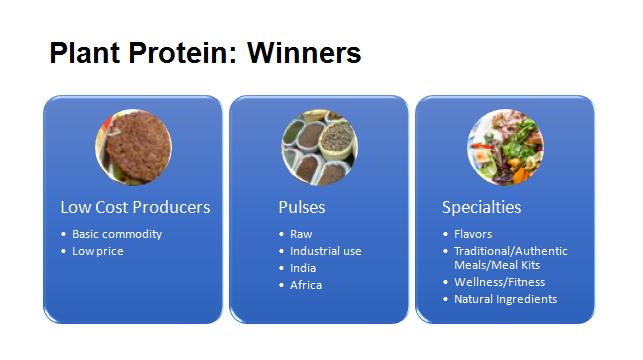
If going plant-based protein is more efficient than meat, and it is because it removes one layer in the food chain, then it would only be logical that plant-based be cheaper both in price and in cost, but it’s not because unfortunately most “future of food” products are not meant to cater the hungry poor. So, here is another price to keep in mind: the price for a pound of cooked beans, peas, chickpeas and lentils is around CAD0.99 per pound. If you wish to switch to vegetarian, using the wholesome grain in the first place without industrial processing is quite a financially attractive proposition and I believe that they will be winners for the future from a global perspective, not just the US market with its First World solutions for First World problems. The thing is that the First World does not seem to know about cooking anymore, in spite of trendy flashy kitchens. The market will also decide which businesses succeed and which ones fail. Start-ups little gods or not, the percentage of failure remains the same as ever: about 75% of businesses do not make it longer than 3 years. Often, the reason is ignoring competition and not understanding that it takes much more than production methods to win over customers. As for the animal protein sector, what will be the consequences? I have written a few articles about the subject (do a search on meat and protein in the search bar on the right hand side of this page to get the list of articles). I will simply finish with a chart that show past consumption and estimates of animal protein consumption for the future based on UN FAO data and you will see that animal protein are really not expected to suffer from competition of alternative protein sources.

There will be plenty of room for everybody: animal protein, plant protein, processed or wholesome, as well as traditional products and all sorts of innovative alternatives. There is no need for cockiness, belligerent statements and inexact claims. The markets and future economics will sort out the winners. In the end, we all have to work together and the key will be about producing and consuming sustainably. Production systems will change. That is normal. And it is going to take the efforts of all 10 billion people and their food choices, not just from food producers.

Copyright 2019 – Christophe Pelletier – The Happy Future Group Consulting Ltd.

Cow farts, or quite a bit of hot air?

Very likely, the only reason why one would have missed all the “commotion” around cow farts is to have been stranded on a desert island without any access to some telecom network. Who would have thought that those poor ruminants were actively busy suffocating us? Just in case anyone would doubt this is the case, some influential billionaires were ready to join the fight against animal protein and put their money to work in protein alternatives to save the world. Yeah, right. I will get back later on this with my views on the altruism of the one percent.

First things first. Cows have been blamed for climate change based on research. Actually, it is useful research, but like any research and statistics, it needs to be put in context. Here is a chart that shows the results of that research from Clark & Tilman, from the University of Minnesota.

On that chart, I have added two productions based on literature: Norwegian salmon fillet and Chinese aquaculture ponds. I did not put an emission number as it did not come from the same source and methodology as the Clark & Tilman research, but it is my best guess of where they would fit. My purpose here is to make the same point as the one I want to make on beef: there is a broad diversity of production systems and it is necessary to look at each of them on an individual basis.

The research results are an average of many different production systems, 742 in total for the entire research. The results are averages and that is a weakness because averages do not mean much if there is no mention of the standard deviation within the group. Before pointing fingers, they should analyze the variance between the various production systems for a particular type of food. Another weakness of their research is that it does not indicate which share of each link in the production and supply chain contributes to the environmental footprint. In the case of ruminants, where is the problem the largest? On the grasslands? In intensive fattening operations? In the logistics of meat? In the logistics of feed? And so on and so on. Several years ago, Brazilian beef producers were upset about a research showing that their footprint was much larger than the European Union’s, and they strongly disagreed. Yet, in the EU, most of the beef comes from the dairy herd (as you can see on the chart, the dairy footprint is much lower on average), the infrastructure is quite good and in particular, there is massive use of waterways, which have a much smaller carbon footprint than road transport by trucks, especially on sometimes terrible road conditions, on which there sometimes is massive loss of grains that fall off the trucks. Anyway, without getting into too many details, the bottom line of this story is that production and supply systems vary greatly between regions and those differences translate in differences in terms of environmental footprint. Another issue with the carbon footprint of beef from that study had also been pinpointed by another research from the Oxford Martin Programme at Oxford University that also showed that methane has not the same lifespan and long-term effect as CO2.

Back to GHG emissions of agricultural products, overall conclusion here are

  1. Don’t jump to conclusions and especially do not generalize
  2. Go beyond average numbers and look at the individual production system
  3. Learn from the best to improve production and supply systems
  4. Identify which links of the chain are the weakest ones in terms of greenhouse gasses and fix the weaknesses
  5. For governments, subsidize the systems that are the cleanest and tax (or possibly ban) the dirtiest

Another aspect to look at when it comes to ruminants is cellulose. There is plenty of cellulose in the world and the thing is that we, humans, do not have the enzyme (cellulase) to break down and metabolize it. Ruminants can break down cellulose thanks to the micro-organisms they have in their rumen, and this is how we can indirectly eat grass in the form of milk and meat provided by ruminants. This is all the more important as the world area of grasslands is twice the size of the world area of arable land. Actually there is between 3 and 4 times as much grassland acreage as arable land, but many of such grasslands barely can sustain animal farming so with twice the size of arable land, I give a safe estimate of what is usable. The beauty of using ruminants on grasslands, besides milk and meat, is that grazing is actually an amazingly circular economy (very trendy term nowadays and that should appeal) system: the animals eat the grass, and poop their excrements on the pastures and thus fertilizing and regenerating them. Another interesting fact to know is that grasslands actually fix more carbon on Earth than forests do, so proper grassland management is actually a great tool to mitigate climate change on a global basis. Sorry to disagree with all the anti-cow hype but ruminants are very useful. In quite a few of my past articles, I have mentioned the concept of externalities, or in other words the long-term costs (negative externalities) or benefits (positive externalities). Ruminants on grasslands generate quite some positive externalities and that should be taken in the conversation. Ruminants eat grass. That is a fact of Nature, and too bad for our societies which try desperately to make us lose our connection with Nature and even our own biology by transforming us mostly in passive thought-controlled not questioning anything consuming units. Ruminants eat grass and that is why I see grass-fed beef as a winner in the future of animal protein, not in volume but in value both nutritional and environmental, and actually from a farmer’s income point of view, too. Another statistic that everyone should have in mind in the discussion about livestock is that the UN FAO estimates at 1.7 billion (yes billion with a B) the number of people whose livelihoods depend on livestock.

So, from what I just wrote, do we want to remove two thirds of agricultural land from our potential from food production and do we take away the livelihoods of another 20% of all people on Earth so that hipsters from San Francisco and opportunistic billionaires can cash in on a very artificial hype? Food production used to be production-driven, then we started to convince ourselves that we changed it into market-driven (which has been mostly marketing-driven really) and now we are in a situation of making (some) food products investor-driven, which is not really about solving large-scale problems, but a mix of production-driven marketing-driven to play on people’s concerns about health and environment to convince them to buy new products and boost the share price of start-ups. We haven’t changed anything really: we still have the same volume-driven approach of always more that we know is not sustainable. Beware the pendulum will swing back. Let people choose what they want to eat. Don’t preach because most of the preaching, like all preaching is about control. I am an omnivore but I also cook and enjoy many vegetarian recipes. I do not believe that I should eat meat at every meal or every day for that matter. I also, and that may be because I can cook quite well, I do not need to get my plant-based servings from a food processing plant. I also believe that cooking and home economics, along with agriculture, should be taught in school, because they are essential for true sustainability. Moreover, since there is sexual education in school, it only seems normal that these matters belong in everyone’s curriculum.

I would say beware of social media as it is not a reliable source of information. It is only a digital form of the good old human habit of gossiping, and as such can spread all sorts of misinformation, just like the pre-digital era gossiping used to do. The difference is the number of people that can be reached.

So, to conclude, I would like to pinpoint a couple of things:

  1. Animal farming has indeed a higher carbon footprint than crops
  2. Therefore, it has to be carried out in a sustainable manner and what is not sustainable must be eliminated
  3. Therefore, animal protein production and supply systems will have to change in the future and they will change
  4. Meat is a valuable food and source of nutrients, but it is not for recreational everyday gluttony. After all, animal had to give their lives for us to have meat, and the concept of sacrifice should be present in our minds
  5. And to finish, a bit of a joke but not quite it either: there are indeed cow farts but there is also quite a bit of bullsh*t about the topic.

Copyright 2019 – Christophe Pelletier – The Happy Future Group Consulting Ltd.

The futuristic and the future

From the many requests I get, the one thing that excites people most about the future is to be presented with a futuristic picture of the future. They like the idea of seeing a different world than the one they know. Maybe it has to do with the fact that many feel unhappy with our world the way it is. Maybe they want to dream a bit or maybe they simply want to have a feeling that there is hope for a utopian world. Science fiction is full of that futuristic feeling. Sometimes it carries an optimistic feeling and sometimes it paints a brutally gloomy vision of the future.

Very often, conference organizers approach me because they would like me to present a futuristic view of food and agriculture. If all they are looking for is science fiction entertainment, I prefer to decline. Fiction is nice, but my business is about realistic and practical evolution of food and agriculture. Everyone who knows me well will tell you that I have no lack of imagination, on the contrary, but that is not what I do as a futurist. My main objective is that my audiences go home with a feeling that it is possible to evolve from today to tomorrow with feasible changes, instead of chasing dreams, which nobody can say whether they have any chance of succeeding. I believe in baby steps, and possibly quick ones.

Perhaps it is the advantage of having been around the block for quite a while, but I always take a circumspect attitude regarding futuristic visions. I am old enough to have heard that we were all going to shift away from traditional foods and that our future diet would be made of pills, one for energy, one for protein and one for God knows what else. That was the time of the Apollo space missions and of the movie 2001: A Space Odyssey. Our future meals would be an astronaut type of diet. Well, guess what, we have passed 2001 a long time ago and meat and potatoes are still on our plates. Be careful about science fiction, because although it certainly is a great source of inspiration for exciting innovations, it also contains the word “fiction”. To me, the most realistic part of 2001: A Space Odyssey is HAL 9000, the computer. As we are eagerly working on artificial intelligence, I can very well see that we could end up with machines that can think and feel the way that HAL does. If some genius finds a way of creating an artificial ego and implant it in such an AI machine, then humans would have a problem. Anyway, we are not there yet.

Another big change in our food, presented several decades ago, was making synthetic meat out of oil (does that sound somehow familiar; you know meat from an incubator?). I started my Career at BP Nutrition, which was part of the BP oil and gas company. Apparently, BP had moved into the food business because they thought that the “oil steaks” could be a reality and be a part of their business. Of course and as usual, nobody can foresee everything and the oil crisis of the 1970s hit and that was the end of the synthetic meat, because guess what? Money matters and if the numbers do not add up, the project dies.

In more current innovations, I remember feeling a bit of the ugly duckling in a conference about the future of agriculture where one of the hottest topics was the Google glass. Maybe you remember, some sort of portable smart device that would make you feel like a cyborg. I did not see the added value of the glasses for a farmer. Apparently, I was one of the very few and you know almost not much a futurist at all for not embracing unconditionally some tech innovation. No, I do not do unconditional support. Instead, in these current days of compulsively pressing “Like” buttons, I did –and still do- this almost heretic thing: I think and exercise my critical sense. Just as a short addendum, I would like to remind you of the quote by Descartes ”I think, therefore I am”. The way, I look at things, a derivative of that quote would be “I don’t think, therefore I am nothing”

Another recent hot topic that seems to have lost steam is the 3D printer that would produce food. I remember even posting a question on a futurist’s website. It was several years ago and I am still waiting for an answer. My question related to an article with the illustration of a banana laid on the printing area of a 3D printer. I was asking two things. The first was why anyone would use resources to make the banana peel as it appears on the posted picture, as the peel is waste. The second was to know what material would be used to make the flesh of the banana (and where it would be coming from) because if it were banana flesh, that would be rather absurd. This banana example is the perfect illustration of hypes being parroted by everyone who wants to be trendy without thinking about the most basic principles, such as the one expressed by Lavoisier “Nothing is created, everything is transformed” If you want to print a banana, you need some material to print with. Everyone seems to think that it would be created out of nothing. Great way to solve famine…

If I have an issue with the banana, I do not have any about 3D printing. When it comes to food, it could certainly crate new textures and new ways to experience foods and perhaps even discover new flavors that do not pop up in traditional textures. That is an area that could be useful. If lab meat is to be a viable production system, 3D printing might be a way of making it more appealing to the market. It is worth investigating. Another area that I would hope 3D printing to be useful is the production, possibly at home, of spare parts that you and I could use when some device gets broken (instead of having to buy an entire device all together), and possibly by using recycled raw materials to make the replacement parts. That would be a great step towards sustainability and in the fight against planned obsolescence.

I can name other hypes that have never impressed me. Remember the “new economy” that was going to make the old economy obsolete? Well, the result was the dotcom crash (bubbles are made out of hot air usually) and the good old-fashioned economy came back with a vengeance, as the good old care for our living environment will. Bitcoin and other cryptocurrencies were going to make existing currencies obsolete. Guess what? It is bursting simply because these are currencies that do not have any really economic roots. They are artificial with nothing to sustain them but hype, so poof goes the bubble. In the area of something more useful, I have not been impressed by blockchain either. I found it artificially inflated for something actually quite simple and basic. By the time, they complete it, if that ever happens, it will already be replaced by something more useful and effective. And I could go on with a list of things that would revolutionize our world and that nobody remembers.

To me, the main difference between the future and the futuristic is that the latter finds its source in imagination while the former is about practical and economical feasibility. We need both, but it is essential to make the distinction because it is difficult to find our way with a blurred vision. The virtual is not the real but it can become it under the right circumstances.

Similarly, we must not think that innovation is only about technology and that technology is only about high-tech. High tech is very sexy and the fact that teenagers can become billionaires overnight is very appealing but, in the grand scheme of things, that part is only a drop in the ocean of problems to solve for the future. I am convinced that many solutions will actually be low tech and inspired by old-fashioned wisdom. Innovation must address the causes of the problems it solves, not just the symptoms. Morphine can be very useful for cancer patients but it does not cure the disease. Another misconception is also to think that innovation is the same as progress. There is a difference. It may appear that way on the short term, but progress is also a relative concept. What seems progress today might appear as a disaster a few decades from now. I will let you think for yourselves of some examples for “progress” from the 19th and 20th centuries that hurt us today to illustrate my point.

A similar kind of confusion is to think that science and knowledge are the same. Indeed, good science is, but through the centuries people have known many facts even though they had not been scientifically proven. Here, I will only mean knowledge and not beliefs, as beliefs very often rest on non-proven concepts, and in some cases possibly improvable but beliefs are not about knowledge. They are about creating a system of values that help making sense of what we do not know or do not control. Therefore, beliefs and knowledge are two distinct things. Bordering on knowledge and science, but quite abundant in bad science is another confusion: statistics and facts. Anyone who has studied statistics knows that one must first make a hypothesis and then test it. If the test is negative, one must reject the hypothesis. That is the easy, and non-confusing, part. If the test result is positive, one can only say that one cannot reject the hypothesis and that is all. One cannot conclude that the hypothesis is correct. No, all one can say is that the hypothesis may just not be incorrect. But that subtle -yet essential- difference is never a problem for those who want to push their point of view and they will merrily go as far as using to claim the absence of evidence as being the evidence of absence. So much for intellectual integrity. Further, depending on which statistical test you chose, you may come to a different result about the same hypothesis. It can be a bit complicated, can’t it? That is the conundrum of research and science when they are not independent anymore, not to mention when they are funded by groups who are after making a profit of their “findings”, but that is the way human nature goes.

For a successful future, futuristic ideas are important but critical thinking, a solid dose of common sense, a practical approach and the ability to make the money work are essential. If we lose grip on reality or, worse, if we ignore it, it will catch up with us, a bit the way HAL 900 does in the movie. Dreaming is good as it feeds the human machine, but a strong sense of reality is essential to go in the right direction. It is a bit like both the legs and the brain when riding a bicycle.

Copyright 2018 – Christophe Pelletier – The Happy Future Group Consulting Ltd.

Why we are not solving the climate challenge

The latest report on climate change published last week was not cheerful. Instead of making progress towards the goals, it appears that we are off course and actually deviating further away. None of the G20 countries will achieve their goals. The world has had plenty of notice and time to act, but clearly success is further away than before, but probably less so than next year and the years after. Why is it so difficult to do the right thing, then? Well, there are a number of reasons for this and this does not bode well. Here they are, in no particular order.

Reason #1: We are not scared, yet

Whenever a devastating climatic event hits us, it is not really perceived as a threat for those who have not been affected. Like any dramatic piece of news, people read about it, think how terrible it is for a few moments and then move on and forget. It is a bit like car accidents. Everyone thinks that it won’t happen to them. Even if you are a good driver, you never know when a bad one will cross your path, and it is the exact same thing with climate. The consequences do not stay within the borders of the countries that produce emissions. It takes only one bad neighbour to spoil it for everybody. The consequences go all over to the neighbours just as well. In my book We Will Reap What We Sow, I addressed the denial and procrastination by making a comparison with Pharaoh in the movie The Ten Commandments by saying that the leaders of the world may pay attention when their first born will be killed in such a natural disaster and just like in the movie, they might grieve for some time and then decide to taunt fate again. I believe that is exactly where we are heading.

Next to that, as long as insurances are willing to cover the damage, a false illusion of protection will still exist. Be assured that if insurers decided to not cover climate change related damages, the debate would change rather quickly. Last summer, there was a wildfire rather close to my place. It was the second year on a row that the region had been hit by forest fires. I can tell you that this time, considering the location and the direction and strength of the wind, I was seriously worried. We were lucky and the fires were eventually contained. We had to breathe very smoky air for weeks and our air quality was worse than Beijing or Delhi, though. In my opinion, we should be a bit more scared by what is going on than we currently are.

It is difficult to scare people by talking about just a couple of degrees in 80 years from now. Presented in those terms, it sounds benign. That, too, is part of the procrastination problem. We need to hear where there is going to be devastation, how big it will be and how much it will cost. If the problem is big and serious, it must sound that way.

Reason #2: We have no real vision for a different, better world

It is nice to look at alternative energies and all sorts of innovations, but they will not happen unless the numbers (meaning the $$$) work out well. That is the problem. Technically, everything is possible. We could replace fossil fuels rather quickly but the economics as stated today do not stimulate change. To change the economics, it would be nice to start by stopping subsidizing the disaster, but we do not do that. The problem with climate a change and economics is that there is a simple reality: it will cost money and we all will have to pay a share. The worst part about this is that the longer we wait to invest in our future, the more expensive it will get.

But beyond the boring money concerns, what we need is a vision of our future world. How will it look like? How will people be able to have a decent standard of living (oops, money matters again)? What are the jobs of the future and which ones will disappear? Will it be a safe or dangerous world? There are many questions to answer if we want to create good will for change. There is no such thing as fear of change as such. Fear of change is actually the fear of loss. What I might lose is the primary concern. To alleviate this concern, clear and reliable vision is a prerequisite, and we do not have any at this moment. There is too much focus on problems and not enough on solutions. Without a vision that speaks to people, there is no reason why they should get excited about change.

Reason #3: There is no plan

Since there is no clear and strong vision, there cannot be a plan. When it comes to climate change, all we hear is an abstract-sounding target of limiting temperature increase to 2 degrees maximum, even though it sounds specific. What does that mean concretely for our daily lives, starting today? Who is supposed to do what and by when? All the climate agreements have been non-binding, which means that, in terms of determination, they compare with the average person’s New Year’s resolutions. It is obvious why the agreements are non-binding. If they were, there is not one single country who would commit. Countries have goals. It almost sounds like a plan, except that the goals are not really specific. Indeed, which sectors of society, business, governments and non-governmental organizations are supposed to do what? Does any industry have goals to achieve? Not really. Look at the car industry. Since the economy runs better, they have decided to stop the production of small cars and focus on larger cars, mostly SUVs and trucks, which consume more fuel  than the smaller sedans. Why? Just because the profit margin on larger vehicles is higher. At least, during the Great Recession of 2008 and the following years, when gas prices were much higher and the economy was hurting, sales of small economical cars were out performing the big gas guzzlers. Maybe economic hardship is what is needed to fix the problem. We just never really learn, it seems. Let’s face it, we have no plan and everybody does what is in his/her best interest, or just suits them best, on the short term.

If we and all the leaders in all sectors of society had a plan, there would be clear instructions about what is required from us. Nobody is giving instructions to people like me about how I should and could reduce my environmental footprint. There is a lot of PR and marketing, though, but the underlying message from businesses is really the same as before: buy as much goods as you can from me. It is all about volume, while the solution is to replace volume to shift from always more to always enough.

The most important part of the plan would be the transition plan. Setting targets without defining all the concrete practical steps and how to measure progress is rather pointless. How do we get from situation A to situation B? How long does it take and how do we ensure progress? Let me know if you know because I do not see anything of the kind.

Reason #4: There is no collective coordination

Besides the goals, a good plan would indicate clearly what the respective responsibilities are of all organizations and individuals. It would be clear what the contribution of each entity needs to be. This is essential for a plan and in particular for the transition plan. Since we are all in this together, success is about team work. Everybody must be motivated, must believe it is the right thing to do and participate. How many of you have received clear goals and a mandate to participate?

Yes, we can fix the problem. We did fix the hole in the ozone layer, didn’t we? We also fixed acid rains, didn’t we? How did we do that? Simply by defining very clear and specific goals and allocating them clearly. The team knew what to do, who had to do what… and they did it. Regarding climate change, we are just 25 years late. Countries reject the blame on each other instead of finding good agreements on how to fairly solve the problems and help each other out of trouble.

Reason #5: We prefer to blame than to fix

As I mentioned earlier, emissions from one country travel all around the Earth. Eventually, we all own and share all emissions, not just the ones we create. We are collectively responsible and the problem can be solved only collectively. That is tricky in a world where individualism spreads everywhere. The result is that we focus much more on who is to blame than on fixing the problem. We have limited time to fix the problem, but once it is fixed, we will have ample time to figure out who was to blame if we think it is a useful way to spend time.

Let’s face it, everyone who indulges in the consumption society is to blame, but of course, as Jean Paul Sartre wrote “Hell is the others”. Unfortunately, we have created a society in which we all feel so entitled to pretty much everything; we have lost the sense of what the value of things really is. Our entire economic system is about more for me here and now. Of course, changing this philosophy will not be easy because to fix the problem is going about to give up something and that is tough. Of course, we can choose not to act and Mother Nature is going to fix it for us. I suspect that then all the consumption aficionados will turn to their mother (nature) and say angrily that is it not fair and that they hate her. That is always how it goes when mommy decide to clean the little one’s messy bedroom. So who will fix it:  we or Mother Nature? The choice is ours.

Reason #6: Short term prevails

This is a basic human nature trait. The short-term always comes first, before the long-term. It is certainly interesting to try to bring a message of responsibility about future generations but the human animal is not wired that way. Only very few people are truly altruistic and have the willingness to give up their own interest. The only way to get people to have a balanced approach between the short term and the long term is by creating a trade off that is worth it. Here, the key word is trade. If we want people to give some of their short-term comfort for future generations, we must give them something in return. Give and take is a very basic human characteristic, too. So what can we trade off? Let’s not be naive, what will work is always something of a material nature, in particular money. As time runs out, there is not much time for cute negotiations. We are going to have to bribe the current generations to do something for the future ones. It is just that simple. Of course, somebody is going to have to pay for it. My guess is that it will be all of us, present and future. There is no real alternative to that, and it is time we all realize this it is what it is going to be.

Reason #7: Lame leadership

I wish I did not have to say that, but it is truly part of the problem. Our leaders are not really leading when it comes to climate change. As I mentioned earlier, they have not presented a vision of where our world is going and how our lives, private and professional, will be in the coming decades. They have no detailed specific plan to transition to the future and they do not have the gut to enforce change. They mostly give lip service. I understand that. When you have to face elections every so many years, you do not want to upset the voters. You do not want to put their jobs at risk and you do not want to cause a recession or worse. That, too, is very human. But the job of governing is not about trying to please all the time. Just as there is a difference between being friends and being parents, there is a difference between being a head of state and being a demagogue. In exceptional times, tough decisions come with the territory. As a leader, if you cannot take the heat, get out of the kitchen! Being a leader is first of all to take good care of your followers so that they can make it to the destination. Communication is a crucial part of leadership, especially when it comes to change. A leader must explain what must change, how it must change and what it will take to succeed. There is never enough communication about change. It is the only way of making it sink in the people’s minds. They have to get acquainted with the idea and they also must be part of the conversation to develop a sense of ownership of where things are going. About the climate change issue, the communication has been insufficient by far. This lack of communication is largely responsible for the lack of trust in politicians and why the people think their leadership is disconnected with the reality of their daily lives and concerns. Leaders must reassure people. Instead, they too often worry them. Other important thing to mention is that every society has the leaders it deserves.

Reason #8: There are powerful opponents

Not everybody is pleased with the potential change that the climate change challenges are calling for. This is the main reason why they work hard to discredit the scientists who report about their findings. As I said earlier, fear of change is really about fear of loss and the climate change deniers are no different than the average man about that, even when they happen to be millionaires or higher. What are they afraid to lose? Well, it is always about the same: money. Either because they would have to accept higher costs of operation or possibly seeing their business die or simply lose their jobs and livelihoods. I can understand such a fear when the person in question could lose his/her job and not find employment easily and land into financial hardship. I find it much more difficult to understand that from billionaires who have nothing to worry about in terms of financial security. Actually, I would expect from true captain of industries that they see opportunities in new business activities and venture into them for both their benefit and society’s. Perhaps, it depends if they are billionaires by hard work or just by birth.

Reason #9: We are addicted to materialism

The so-called consumption society has been acting like a drug dealer in a way. Most people are so hooked on buying stuff that they can’t stop. The banks have contributed greatly to the problem but lending money too easily so that people who cannot afford stuff can go to the mall and buy just like the rest. The flip side of this addiction is that withdrawal is not easy. Everything is about tempting the client. It is not just businesses that lure consumers but peer pressure joins into pushing people into buying more stuff. Perhaps, it is easy for me to say this because I must have some sort of a temptation resistance gene. Marketing leaves me completely cold and I buy something only if I need it, not because someone wants to sell it to me. My wife calls me a minimalist. I am not sure what that means but maybe I am. All I know is that I live happily and I do not have any creditor breathing in my neck. Along with this personality trait of mine, I also have no problem making sacrifices if needed. I can wait to buy something. In a way, my motto could be “if you don’t need it don’t buy it/if you can’t afford it, don’t buy it”.

About climate change, sacrifice will be part of the game one way or another. I believe that it will be quite useful to realize that life cannot be about instant gratification all the time and that happiness can be found through many other ways than through buying “stuff”. Of course, such an approach is going to conflict with our dominant economic model.

Reason #10: The economy and financial system is all about growth

All our economy revolves around always more. In a finite world, it is just a matter of time before such a model comes to an end. In biology, there is a distinction between growth and development. And it is a very important distinction.  I believe that when it comes to economy and finance, the distinction between the two terms has blurred out and it might very well be the root of a misunderstanding that might prove very costly in the future. I am all for development, but I have mixed feelings about growth. As an example, I would mention an animated graph that has been circulating recently on social media about the variation of GDP per country between 1961 and 2017. It is a cute animation, but I do not find it all that interesting because the GDP depends for a part of the size of the population. A graph showing the GDP per capita would have been a better indication of the wealth of the inhabitants of the different countries, although an average does not say much about distribution. I also would have preferred to see a graph showing the distribution of that wealth with the people of the countries, as this would be a good indication of whether the countries takes good care of their people or not. I also would have liked to see the graph with the ratio debt/GDP and deficit/GDP. I suspect those graphs would have told very interesting stories. For a country, the GDP is just the same as what the sales revenue is for a business. It is not a particularly good indicator of the profit or of cash-flow.

Growth is also the magic word for stock markets, and in particular of the share price. Since the entire financial system is locked in stocks directly and indirectly, any stock market crash will affect everyone, because even people who do not own stocks depend on the markets (just think of how deep in stocks some pension plans are).

This is why the climate is tricky to handle because if company stocks from environmentally damaging companies or industries crash, the entire system can potentially implode. The best way to prevent this would be to have a plan, and in particular a transition plan ready so that company could transition smoothly and thus avert a market crash, but we haven’t got that. As we all know, there is a lot of short-term activity on stock markets and there, too, short-term prevails over long-term. Speaking of short term, CEOs have to present their results quarterly to financial analysts. Compare that with elections only every 4 or 5 years!

Reason #11: We are increasingly disconnected from Nature

This is a consequence of how our societies and economies have evolved since the first Industrial Revolution. Today’s most obvious consequences are mass production and mass consumption, which relocated human populations from rural and agricultural areas into urban centers and the trend, continues. There are a couple of generations who have never really been in much contact with Nature. Surveys for city people about where they think food comes from are always revealing. In particular, with animal products, it is amazing to see how many people do not make a connection between eggs and hens or between milk and cows, or even between a live animal and its meat. I strongly believe that when we lose the connection with nature, we also lose a sense of where we come from and what we are about. If we do not understand how Nature works, it is difficult to respect it and when we do not understand our biological nature, we also lose respect for life. Unfortunately, we look at ourselves less and less as biological entities and more and more as legal entities. This trend worries me.

In a way, the so-called primitive societies (which I am less and less sure that they were that primitive at all) had a strong respect and fear for the forces of Nature. The term Mother Nature that I have used above is reminiscent from this respect and fear. We would not mess with it because we understood that we could be punished. Once the connection with Nature fades, the punishment part fades too. Then, we are just too happy to take and not give back and this is a serious mistake. Sustainability and circular economy are all about giving back so that the cycle can continue. This part we tend to have forgotten and this is why we shifted away from always enough to always more and that we will have to revert to the original concept because always more is not sustainable but always enough is. Here is your challenge!

Reason #12: We put too much faith in technology

Understand me well, I am all for technology and innovation. That said, technology is only as good as how we use it. I have mentioned in earlier articles how important this subtle distinction is. I am convinced that as of today we already have all the technology we need to mitigate climate change and have happy lives. So, why don’t we solve the problem? Once again the magic word is: money. For many of these technological solutions, the economics do not favour them, but favour the current destructive system. A part of the problem is in the allocation of where subsidies go. We encourage non-sustainable systems to survive while we do not reward enough sustainable solutions. Another important aspect of whether technology can help us overcome the challenges lies in our behaviour and that is independent of technology. Technology can only help us if we want to help ourselves first. Keeping our same bad habits of wasting and overconsumption and hoping that some new technology is going to clean the mess for us without us having to make any effort of any sort is completely delusional, not to say completely immature. There cannot be any solution if we do not change ourselves. I could paraphrase both Einstein’s quote saying that insanity is doing the same thing and expecting a different result and Ghandi’s saying that we must be the change we want to see.

Copyright 2018 – Christophe Pelletier – The Happy Future Group Consulting Ltd.
Making reliable predictions

One of the questions that I get the most is “what do you see in your crystal ball?

People love predictions and they like the idea that some among us might have some sort of a gift to see in the future.  For millennia, people have looked –or asked “psychics”- to look in the stars, in tea leaves, in cards, chicken insides or whatever esoteric medium to know the future. Why is there so much fascination about knowing the future? The answer is simple: people want to reduce uncertainty and want predictability.

Although it could be convenient at times to be able to predict the future with certainty, it is not possible. At best, it is a matter of foreseeing what is the most likely to happen. Even the most accurate predictions are really an exercise in probabilities. Predictions are difficult and the rate of error is not negligible. In my opinion, the trickiest kind of prediction is about figuring out numbers, such as future prices. Numbers have a pervert side to them. Numbers give a false sense of security. They seem to give certainty while in most cases they are not as useful as they seem, because the story behind the numbers is more important than the numbers themselves. Just look at stock market analysts. They all give their views on where stock prices are headed and then a couple of things happen. First, they do not all agree on the future stock prices. Since they do not all agree on the numbers, it is obvious that some of them will be wrong. Clearly, predicting is not an exact science. Otherwise, they would all come up with the same price targets. Actually, it is not a science at all, although there is quite a bit of science in the process to arrive to such predictions. The second observation is that very few of those analysts make accurate predictions. In the Netherlands and as a joke, every year a gorilla was pulling its top five stocks from the Amsterdam Stock Exchange listed companies for the coming year, and its pick would be compared with those of professional analysts. It was not rare that the gorilla had picked more of the top performing stocks than the analysts. Some other research (I unfortunately cannot remember from which source) had shown that predictions of economists were accurate only 47% of the time. In other words by flipping a coin, you would be more accurate than the economist’s average by 3 percentage points. That said, even these numbers come down to statistics. It is about averages of predictions, regardless of individual differences. It is the same with predictions as it is with anything else. Some people are good at it and deliver high rates of accuracy and some others (the large majority in my opinion) don’t.

With that in mind, here are my views on how to make reliable predictions.

Considering how uncertain predictions are, there is no point to make predictions solely for the sake of making predictions. Serious reliable predictions are about helping others see what changes are coming, what the challenges are and what the solutions will be. Making predictions just to satisfy one’s ego are vanity and just like everything else that is about pride, demise will come. The cornerstone for a reliable prediction is that it needs to come true. In this area too, over-promising and under-delivering will not serve anyone, and certainly not the one making the predictions. It is much better to stick on what makes sense and not try to overdo it. There is no need to be cute. It is better to predict slightly less but with a higher rate of accuracy than more and be just an average predictor at best. There is no need to believe you will be the next Nostradamus, and even Nostradamus did not predict all that much after all.

It is also quite useful to be clear and specific right from the start with the audience about which future you are talking about (What future do you want)

To make useful predictions, it is also necessary to free your mind and to keep it as open as possible. Since there is no reason for the future to be exactly like the past or the present, unusual situations or uncharted territory are very real possibilities. Reliable predictions are the logical conclusions of a thorough research and thought process. It has to be independent and critical. It is not because others say that this or that will happen that it will be so (remember what I said about how inaccurate most predictions are?). To make solid predictions, one has to be critical of any other opinions, screen them with a good dose of critical thinking as well as a good dose of common sense. In the realm of predictions, to assume can indeed end up making an ass of u and me. Like any other analysis, double checking information and sources is an absolute prerequisite for quality work. In this world overloaded with information and opinions, many of which are complete non-sense, it is better not to believe that it is true just because it is on internet. To be a reliable predictor of the future and to possibly become a reference as a futurist, you must create your own original material. Copy and paste is not foresight, it is only copying and pasting the work of those who created the original material. When you copy and paste, you are not a futurist. At best, you are a reporter. It is interesting to see how many futurists are actually people with a journalism background and how little original material they actually produce. Just like I do not preclude that what celebrities say is necessarily true, do not believe anything I write just because I present myself as The Food Futurist. Double check and review critically what I publish. Then you can decide if I am a reliable source or not. The social media world is full of so-called influencers. Yeah, right. Personally, I do not want to be influenced. I want to be convinced instead. Once again, use critical thinking and common sense.

It might sound a bit corny, but I believe that knowing and understanding history is essential for reliable predictions. Even though we live in an era of strong sense of self and individualism, humans are actually amazingly predictable. We are much less original that we like to think. In many ways we are all pre-programmed to see and understand things the way we do. It is part of how we are raised. It is part of culture. Taking distance from the “program” is not easy. The “program”, together with our cerebral cortex that seems to constantly try to make us rationalize the irrational and the emotional, makes it about impossible to be fully objective and eliminate totally our biases, big and small. The result is that humans act in ways that make history repeat itself. An example of how this can be used is what is called technical analysis in stock market analysis. The core of technical analysis is that people tend to act and react in similar ways over and over again. When you see how automated financial trading has become thanks to algorithms that are based for a large part on this predictability of human behavior, it is easy to understand how this can be used in all sorts of foresight exercise. On top of that, be also aware that financial traders’ jobs are being eliminated and replaced by programmers by financial companies and you have a great example of how predictability of humans is pivotal for predictions of the future.

To be reliable in predictions, the first person to be convinced is the one making the predictions. What would be the point of telling others about a certain vision of the future if you don’t believe in it yourself? This where a subtle detail is quite useful to spot: is the vision written in the future tense or in the conditional? Of course, sometimes it is good to give your audience a choice between scenarios. Then, the conditional is useful, but only if it is clear that the different scenarios are all highly likely. If the use of the conditional is mostly to cover your backside just in case the prediction might not come true, then it is necessary to grow more courage in foresight. The use of the future tense is quite powerful. It really makes the prediction much stronger and more credible. I also want to say a word of caution about the use of the future tense when it is misplaced, and I see it many times. The future tense alone does not necessarily refer to the future. One expression that ticks me off every time I hear it is “the future is already here”. If the future is already here, it is not the future anymore but it is the present, so present it as such. It can actually help people to know what is already currently available instead of being under the impression that it still is in the future and therefore not available yet. In my opinion telling the present in the future tense is a disservice.

Certain personality traits are quite useful to make reliable predictions. In particular, a sense of anticipation is a prerequisite in foresight. It is simple logic. If you do not have a sense of anticipation, how on Earth could you claim to have foresight? It would be like the joke about the mind reader who needs to ask who is knocking at the door. Martial arts have a reputation for developing a so-called sixth sense. I have no idea if this is true or not but perhaps my many years of martial arts have been helpful in my activities as a futurist. Perhaps I had it all along. Fact is that I always have had some a sense of how things can evolve and what to expect. I cannot explain it and I have never tried, either. I have not played much chess in my life, but I could envision quite well the moves ahead. It is there and it is quite useful to me. It has helped me make really good predictions and I have very rarely been wrong with my predictions, also probably because I make predictions following the principles that I mentioned above. Another useful personality trait is the ability to see the bigger picture and to connect the dots. I seem to see things earlier than most people. Sometimes if frustrates me but so be it. That is an ability that I have had all my life and it helps me a great deal in this work, and has with the previous ones as well. I am not wired for tunnel vision or silo thinking. I am naturally curious and I like to see how all things come together, where they come from and where they are going. My brain is always active. In this regard, making predictions is a natural process for me. I am always surprised to see how difficult it seems for organizations to escape their own area and see what is beyond their operations. It must be me, though. When I was in the corporate world, I was already different from most of my colleagues, apparently. I could change positions, business sectors and even locations without any difficulty to adapt and function in my new environment. I seem to have been a curious case, as all the testing and human resources could not stick any of their labels on me. I believe I was an impossible creature in the sense that I could not exist. I should have been either analytical or intuitive, I should have been either social or alone, I should have been either an individualist or a team player, I should have been either a doer or a thinker, and I should have been either technical or into soft skills, etc… In all the areas of personality mapping, they did not know where to place me because I could be both of the opposites every time and could shift within both opposites when needed. Regardless of all the headaches I may have caused HR people, this flexibility -or maybe fluidity- is quite useful to me. It helps me navigate smoothly through all the dimensions that are underlying the task of foreseeing the future. If it means that I have many personalities, then so be it because I can say that we are all happy in my head (OK this is just a joke, I do not really have multiple personalities).

Next to my personality traits, I must say that my life experience, and in particular my professional experience is a major asset for The Food Futurist work. I have filled so many different functions, been in so many different places and countries and dealt with so many different people and I have been involved in so many different types of businesses that I am very privileged to have an amazingly broad understanding of the many areas and dimensions of food and agriculture. Having experienced so many situations also helps me spot what makes sense or not and what their potential and limitations are. All those reasons explain why my predictions have been accurate and proved useful for others.

Copyright 2018 – Christophe Pelletier – The Happy Future Group Consulting Ltd.

Is animal farming really on the way out?

Lately in the food world, one can read many stories about alternatives to protein from animal farming. Animal farming also gets blamed for its contribution to greenhouse gas emissions. With so much finger pointing, one can wonder whether animal farming has a future. Proponents of alternatives do all they can to convince everyone that the writing is already on the wall. Personally, I believe that things are far from being that simple.

To predict what scenarios are likely for the future, it is necessary to look at the issue from its many dimensions, both on the production side as on the consumption side. I prefer to look at it first from the consumption side because consumer markets shape production systems more than production systems shape consumer markets.

From the consumer end, there is already much to say. First, as the population is increasing and more people are able to afford protein, the demand for protein is increasing and will continue to do so in the coming decades. I wrote already many articles about this during the nine years of this blog and the topic is also part of my books. The fact that more and more people can afford food is a positive development. The problem is that more and more of them now actually consume more than they should. Overconsumption boosts the need for more production beyond what nutritional needs are. Overconsumption comes down to excess, waste and pushes our use of resources too far. The goal must be to help people to eat balanced meals and not to overeat. If the purpose of the suppliers of alternative protein is to push for consumption of their products and not address the issue of overconsumption, they will be just as guilty as the current protein suppliers. The future challenge is not just to replace one overconsumption with another. It is to stop overconsumption. Unfortunately, as long as our economic model is about volume growth, one should not have too many illusions. Future food prosperity is really about having always enough, not about always more. To achieve this goal, we must shift from sheer volume growth thinking to high quality (including production of course but also social and environmental) with faire distribution of the created wealth between all links of the value chains, and in particular a fair price for farmers through proper planning between supply and demand. The purpose is to supply affordable food instead of just cheap food with all the consequences that we all can see of the race towards always cheaper. Unfortunately, the volume-driven model is heavily subsidized in the wrong places and that will also have to stop if we want change.

Consumers also need to realize the true value of food instead of taking it for granted because future food is anything but for granted. Regardless of the type of protein, one thing is sure: it is precious and rare. This is much more so than for carbohydrates. Protein should be treated with respect. Here are two examples why I make this point. I remember in the 1990s the CEO of Tyson Foods explaining in a conference that the poultry industry is a producer of lean protein and he lamented that, in the US at least, the favorite use was to deep fry it in cheap oil, and thus completely change the nutritional quality of chicken meat. The second example was during a presentation by the CEO of a German fish fast food restaurant chain called Nordsee, who was mentioning that breaded fish was very popular, but not so much because fish is healthy but because fish sticks were used to be a carrier of ketchup from the plate to the mouth. If the true purpose of meat for some consumers is to be a carrier of oil or ketchup, then this is a problem. Never should a product that required the sacrifice of an animal be used to soak into cheap and unhealthy product when over consumed. Speaking of sacrifice, it is good to remember that the word “sacrifice” comes from the word “sacred”. It is true that often our dealings with animal protein looks more like sacrilegious. This is a useful detail to think about when considering consumption of meat. The thing is that animal protein should never really be a commodity. It should remain special. But that is not the way or economic model has decided.

From the production side, agriculture has followed a similar pattern as most other industries. It is about lowering costs (nothing wrong with that) and standardization (maybe a topic more susceptible to debate). Regardless of what people may think of intensive animal husbandry, this system is not here per accident. It is the reflection of how we look at economy and ourselves. Have no illusion about alternatives to animal protein; they follow exactly the same economic philosophy. I always say that the dominant production system is the one that matches the desires of the larger number of consumers. The saying “we are what we eat” is very true. If you look at it that way, you can see that our economy is just as much about intensive human husbandry as it is with farm animals. Economy is organized around three components: resources, labor and capital. Depending on the prioritization and distribution of these three components, we build different systems. A simple example can illustrate what I mean is mechanization: workers have been replaced by machines backed with capital investment in machines. The tricky thing about heavy injection of capital is that the system becomes capital-dependent. The capital must deliver a return on the investment and very often the only way is inject even more capital, just to keep the head above water. It is good for the bankers, but as many farmers and food producers will tell you, less so for them.

So, will animal farming eventually disappear? Of course, it is difficult to answer this with certainty. My opinion is that it is not going to happen any time soon, if it ever happens. What will change are the production systems. After all, the current intensive production systems have not been around since the dawn of times. They are actually fairly recent. They have changed and are continuously adapting. Production systems that are not environmentally sensible will disappear, simply because they will not be able to be profitable and competitive. The reason for this is simple: sooner or later they will not be able to ignore the negative externalities anymore from their production costs. Environmentally sensible systems will take over. Note that I do not use the term environmentally friendly but I use environmentally sensible instead. I believe it is a much better reflection of reality. Will this transition be smooth? It might be, but it is much more likely that it will not be.

Another question to reflect about is whether animal farming is unnecessary? My answer to this is: no! First, like it or not humans are omnivores. Our dentition can testify about that. That is the result of dozens of thousands of years and it is ingrained in our system. It is nature. We are mammals, even though there’s no shortage of groups who try to even deny our biological reality and try to reduce people –and animals- to legal entities. Between Laws of Nature and man-made laws, we will see which ones will prevail. Our first food –milk- is animal in nature. There always will be people who want to eat animal protein. Every time that economic prosperity has increased, meat consumption has increased. It does not happen per accident. When money is tight, meat is often the first thing to decrease. To get back to the question, I believe that animal farming is alright, as long as it is respectful of the environment, of the animals, and also of the farmers. I believe that animal protein is a privilege what we must cherish, not a right that we should take for granted. Animal protein is not the sole source of protein and there are many delicious dishes to make with vegetal protein. Look at Indian cuisine! If the purpose of animal farming is to stuff oneself, then yes I am with those who have an issue that approach of farming and consumption.

Of course, most of the opposition to animal farming takes place in Western countries. It is kind of a First World problem. If certain animal farming systems are environmental time bombs, other systems are actually beneficiary. In many developing countries, having a few goats or cattle is actually essential for the economy and for the survival of farmers. Pastoral systems contribute to prosperity and social stability. Another important point is the biology of ruminants. Just as much as I was mentioning the biology of humans as the results of dozens of thousands years of evolution, the same is true for animals. Ruminants are amazing processors of cellulose. Humans can thrive on grass, because we are not equipped biologically to extract nutrients from it. Ruminants are experts at that. Since there is about twice as many hectares of grasslands as there is of arable land, grasslands represent a huge food potential and ruminants are superb transformers of cellulose in high-value foods for humans in the form of milk and meat. The key is that must be done sensibly and by taking future consequences into account. Many societies around the world know the value of farm animals. If ruminants are excellent transformers of cellulose, it is also important to mention that they have never evolved to be grain eaters, at least in large quantities. Sooner or later, this will become a much more vivid issue than it is now.

Suppliers of alternative protein bring a number of arguments why their products have the potential to replace “traditional” animal meat. The environment plays a central role, in particular the issue of greenhouse gasses. They also address the animal welfare as a driver for their products. The issue of slaughterhouse by-products is also a valid argument. Theoretically, texture proteins, lab meat, insects and vegetarian diets do address these concerns, indeed. So can alternative protein push animal farming out of business? The answer is complex and I will try to answer it as concisely as possible.

The animal protein market is huge and one cannot expect to replace it overnight. Since the demand for protein is going to increase further, alternative protein would probably happy to take only a chunk of the growth. They have to create their spot in an existing and very competitive market. Textured proteins have been around for decades and they have never represented a threat to traditional meat. That does not mean that it could not change of course. Lab meat is all new and there is at this stage no solid indication that they can even compete with traditional meat on world markets any time soon. They are still a long way of representing a force in the animal protein business. Time will tell. An important detail for both textured protein and lab meat is the number of factories, incubators and texturing lines that they need to build to replace animal farms. That will represent huge investments for which they will have to earn the money to carry out. Competing with traditional animal proteins means engage fully in a commodity markets where margins are often thin. They will compete with independent farmers who are often contracted by corporations and often hardly make minimum wage. These suppliers will have to fight against the huge animal protein corporations and deal with retailers and food service companies with strong bargaining power. Will they really want to take the road to commodity markets? I doubt it, or it will be a very long journey. When I hear or see their pricing objectives, nothing tells me that they are really willing to target the mass animal protein market. It looks more to me that they will try to work from a targeted marketing strategy and will work their way into niches for quite some time. Another hurdle is the consumer perception for their products. Vegetarian products already have exposure and are well-perceived. Lab meat may be a more difficult challenge. The mere fact that lab meat producers want to call it clean meat instead and are already facing opposition from meat producers who claim that lab meat is not real meat shows that they have not solved the perception challenge, yet. Even the term meat is not a given.

Where does that leave us for the future and the issue of animal farming greenhouse gas emissions? Considering the time that I believe it will take for alternatives, I do not see that they will play as big a role as they think and/or claim. I believe that reducing greenhouse gasses emissions will have to be enforced. Regulations on production systems will have to address this. This has to happen today already. There is no time to wait until these emerging industries will have developed critical mass. Also production volumes will have to be addressed. It is likely that if we want to be serious about curbing the environmental footprint of animal husbandry, they will not be many alternatives to capping production volumes. That will be a tough one as nobody will want to be at a disadvantage with their competitors. There will be the exact same discussions as there already are with climate change and those who refuse to participate. Neither governments nor corporations will take effective measures. The answer lies with consumers. They are the ones who have the power to reduce animal protein production and changing production systems. From an environment point of view, the only real option is a reduction of global consumption of animal protein. That is the easiest and fastest path to solve the problem, but I do not expect a massive shift from omnivore to vegetarian of such amplitude that anything significant will happen. Unfortunately and just like with anything else related to climate change and overconsumption, only a minority will really act voluntarily. On the consumer side, if prices remain too cheap to trigger a change in behavior and a reduction of consumption, then overconsumption will simply continue. What I wrote in my previous article will fully apply to the topic of animal protein and animal farming.

Copyright 2018 – Christophe Pelletier – The Happy Future Group Consulting Ltd.


Running out of time or simply not running at all?

Last week, the UN had a message. We must take unprecedented action if we want to avert a catastrophe because of rising temperatures. The tone is pessimistic, and we all should be, too. We have had warning after warning and let’s face it, we have not done much to really address the challenge. It kind of reminds me that episode from The West Wing https://www.youtube.com/watch?v=-RzF-Wg2g-k (the interesting bit starts at time point 1:00). It is not that concerns about modern technology and so-called progress are new. We knew long before there even were COP conferences, the Kyoto agreement or Al Gore’s Inconvenient truth. Sixty years ago, In 1958, the American (ironic isn’t it, considering the current US views on climate change) movie The Unchained Goddess was already warning about what was coming (see it here https://www.youtube.com/watch?v=x1ph_7C1Jq4 – duration 55 minutes). Sixty years ago, I was not born yet. All that time, we have chosen to not think about it and mortgage the future (possible bankrupt it) for the sake of short-term fun and I guess trying to be cool in some way.

The thing with procrastination is that the longer we wait to take action (and we already have procrastinated more than long enough), the steeper the hill on which we will have to fight the battle. The longer we wait, the more expensive it will be, but I suppose we all think it is someone else who will pay. I consider highly likely that the consequence of that will be a triple bottom line crisis: environmental, social/human and financial (The 1929 Great Depression will look like a holiday camp in comparison). That is my prediction. I am thrifty and cautious on predictions but history tells me that I tend to have a talent for predictions.

There has been and there is no shortage of conferences. You know those places where the self-proclaimed elite meet in obscenely luxurious surroundings enjoying a good time with plenty of good food and drinks. I wrote in an article a few years ago that the “deciders” (who never really decide anything that involves their accountability and commitment) should carry out their negotiations in a locked room without food, water and energy and be released only when they have done their work. I still think it is a good idea, although I have absolutely no expectations that it will ever happen. Well, except when Mother Nature is going to take charge of that.

The question now is: are we going to take unprecedented action? The answer is easy: NO. The obvious clue is that the news lived for about 3 days on the media websites and was not even the main headline. It gives a feeling of humankind is on the brink of extinction, but there are more important news. Perhaps. Clearly, not many people really care. Now that the economic crisis of 10 years ago seems to be a thing of the past (psst: beware it is coming back) and gas prices have been back to lower levels than a decade ago (psst again: they are rising again), car manufacturers have focused their production on the gas guzzlers again. Bigger cars that satisfy the fragile egos of males with insecurity issues in the downtown area is what sells. Well it sells because smaller, more efficient cars do not generate enough margin in comparison, and therefore are not going to be produced. Have you noticed how cars never get mentioned as a problem for climate change? No! Cars are fine and the more they consume, the better it seems to be, not to mention the decisions from the USA to pretty much eliminate anything that tried to alleviate the problem. Apparently, the real problem is agriculture and especially the cows. Those damn cows have been sneakily waiting their hour to take their revenge and finally free eradicate humankind by farting. OK, I will drop the cheap sarcasm. It is true that agriculture contributes to the problem, but I resent agriculture being singled out this simplistically. I will get back about this in a next article.

Agriculture is like most industries. It has evolved from mixed systems in which its by-products where reused and recycled on the farms. As one of my teacher at the Agricultural University used to say: animal production has moved from making high-value protein and fat from cheap food scraps to making cheap fat and protein from high-value feed ingredients. The loops have been open and food production moved from a circular system into a linear one in which by-products are considered useless and thrown away and replaced at the input area by their “replacement” produced with much resources and energy. The good news in this is since we knew how to have a circular food and agriculture, we can revert to it. The only problem is… $$$. The industrialization of agriculture led to much more affordable foods, just like most other industries that enjoy the so-called consumption society, which is actually a transaction society. Sellers do not really care if you even actually use their products. They just want you to buy again and again. This economic system is purely production-driven and linear: large volumes from large capacity units to keep costs low. The problem is this picture is that never ever are the collateral long-term costs taken in the cost break down. These negative externalities, as they are called, are never factored in the accounting and of course never addressed at the quarterly financial reports. There is no true circular economy without factoring externalities in the costs. Here is a note for the young readers, if you have been reading this far without falling asleep with my drivel: you, my poor friends, are the ones who are going to foot the bill of externalities that your parents and grandparents are leaving behind. They are the lucky ones because they have lived in obscene abundance on credit and you are the ones who will pay the interest. Unfortunately for you, Mother Nature (from whose bank the interest will come) does not do bailouts. She does not do politics or BS either. She does not print currency. Mother Nature is a ruthless accountant that believes not in liberalism or socialism or whatever dogma humans have invented to give a meaning to their lives. Mother Nature only lives by immutable laws of physics. Mother Nature is kind, though because she sends us message after message to warn us. We, on the other end, we act like squatters who do not even look in the mailbox to go through the unpaid bill reminders or threats of eviction notices. I hate to bring it to the young ones, but your life is going to be quite different than what you parents and grandparents have enjoyed. I am not a spring chicken anymore, but not really old (at least, that what I like to tell myself), and I am sure that I am going to face a very different world in the coming decades. For me, too, the good times are going to fade out. At least I will have had some. I suppose I could complain that it is not fair to me because I live quite a simple and frugal life and my environmental footprint is low. It won’t matter because life is not fair, and that is a fact of life. If everyone were like me, Wall Street would crash in less time than it takes to type “Wall Street”. I spend very little. I drive about 5,000 km per year and walk or bike every time I can. I repair instead of replacing every time I can, although it is not easy. Yep, I know how to repair socks, believe it or not, and I do it when it is needed. I cook all my meals and as you can see on my good food page, I eat quite well. I have a garden that produces a large chunk of my produce yearly needs. I can and preserve the summer surpluses. I make my own bread, and I also make my own wines. I have a little vineyard out of which I am going to make 6 different types this year. I have a small car because I need one, since I live in a rural area, but it unlike my neighbors who seem to need big engines, my little mules runs a gentle 5 liters/100 km (or if you prefer 47 miles per gallon). Speaking of fossil fuel, I am also the only one in the neighborhood who uses a broom instead of a gas-engine blower and uses a push mower instead of a gas-engine lawn mower, and the funny thing is that I do the job faster than my neighbors and much more quietly, which is a bonus. Another bonus is that it keeps me fit. I have a six-pack while my neighbors have beer kegs.

My point, I suppose, is that a good life is not about lots of stuff and/or being so afraid of missing out on something that you need to be addicted to consumption. Actually, the issue is not so much about consumption as it is about excesses, and the always more, as I have mentioned in previous articles (do a search in the window on top of this page), while we should strive to always enough. When you have enough, you are good every time. If you never have enough, perhaps it is time to reflect about why that is so.

Excessive consumption is only the visible part of the problem. The other –hidden- part is waste. And how wasteful are human beings. The amounts of resources, water, energy and food that are wasted are staggering. Earlier, I was mentioning my little car and my neighbors’ thirsty vehicles. On a same trip, at the same speed, I am sure that they consume between 2 and 3 times as much gas as I do. The extra gas consumption does not add anything to the outcome of the trip. Though, the result is that I use fewer resources, emit fewer gases than they do per mile, and most importantly of all: I spend between half and a third of the dollars at the pump. I have more money left for other things. Frugal pays off, big dividends.

A large part of the waste is truly a behavioral problem. Technology may help, but if behavior and attitude towards waste do not change at the same time, do not expect technology to save us. It won’t. Only WE can save ourselves, technology won’t, other people won’t. It comes down to the quote from Ghandi “Be the change you want to see in the world”. We want technology for a simple reason: we do not want to change because we are lazy and lack self-discipline.

Food waste has become a mainstream topic. I addressed it in my two books but it was before the UN addressed it. Sad that such a large organization with their resources could not figure that out before an independent guy like me working from his home office. I even had estimated the cost right. Can you imagine? Anyway and even with the higher profile the issue has received, they are a few waste issues that I never read about.

Obesity is presented as a health issue. It is, but it is also a major waste issue as well. Over consumption of calories that end up being stored in body fat are wasted calories. They serve no purpose, since the overweight people never really benefit from them, or when they die, the fat is buried under ground or cremated. Totally wasted calories that never fulfilled their purpose. In a world where, like in developed countries, people consume twice their nutritional needs in calories, fats and protein, feeding 9 or 10 billion people is not feeding 9 or 10 billion people; it is feeding 18 to 20 billion!

Other waste topic, I never read about (but I suspect I will in a few months from now) is also about fat: the fat in the meat that consumers cut off and throw away. The sad thing about fat in meat is that it requires much more energy for an animal to grow fat in its tissue than it requires to grow muscle. For the biochemists among you, the difference is fat requires two times as many ATP (Adenosine Tri Phosphates) to fix the same amount of fat than it does for muscle. ATP is the fuel used in mitochondria, the microscopic power plants inside our cells. Roughly, throwing fat away cost twice as much as throwing lean meat.

And what to say about food recalls? Food that is unfit for consumption gets destroyed and all the resources used along the entire value chain to produce have been wasted. It represents a lot more than just the tonnage of food that must go to destruction. I suspect the reason why we never connect the dots between the links of entire value chain is just because the different links of the chain are active within their own area. In a linear system, collateral waste and externalities are always someone else’s problem. In a circular system, it is everyone’s problem. It creates very different dynamics in terms of co-responsibility and solidarity and also willingness to act.

I hate waste, and in particular food waste. I am very rigorous in how I manage the foods I have at home. Unfortunately, it happens sometimes that something goes bad. It is rare, but it happens and it ticks me off beyond belief. Ask my wife about that! When that happens, I always cut out just what is not edible at all but no more than that. I will pinch little crumbs of bread out where the mold is and I eat the rest. Sometimes it does not taste great, but if I screwed up, it is only fair that I get some punishment for it. It never made me sick. All in all, I do not think that I waste even a pound of food a year, so I guess I am doing fine. Further, any organics, such as potato peels or even egg shells all end up in the compost that I use in my veggie garden. In town, we have a yard waste collection schedule from the municipality, but I hardly ever use it. I recycle all I can.

My conviction to meet the “unprecedented” efforts to curb the effect of climate change is to live a good but simple life. There is nothing that frustrates me more than those who oppose action on environment and jobs. They are not mutually exclusive. Actually they can work together, but the rules and laws need to change and integrate the externalities. Unfortunately, I do not see government leaders or business leaders even trying to get this done. After all, it is easier to pass it onto the next generation.

Trying to keep up with the Joneses or impress one’s little social circle with stuff is not my thing. Actually, moderation helps appreciate things better. Much better. Instead of wasting money on always more stuff, I prefer to buy quality stuff that lasts and to buy only when I need something. If I don’t need it, why should it clutter my home while not fulfilling any function? That is pretty stupid if you ask me. A long time ago, I posted on this blog an article titled “We will change or eating habits, one way or another”. You can be sure that sustainability, especially with a world population growing, is about “we will become frugal, one way or another”. Sustainability and excess do not match well. Be assured that Moderation is a key word if we want a prosperous future, and prosperity really is about inner harmony and happiness. Prosperity is not about more stuff; that is for empty people. The other key word for the future –and that is in stark contrast with our current philosophy of economy and of life is: Humility. How do we move from a world where so many of us use social media as their own narcissistic issue of People magazine in which they take center stage as self-proclaimed I-am-the center-of-the world-look at me? I venture for some time on Twitter and I left. I did not even try Facebook as soon as I got the form asking for personal information on my screen, and I think it was the smart thing to do.

So, will we make it? I believe the answer is the same as the one I gave to a journalist who was asking me if I thought we could feed the world in 2050: “Yes we can but it will take a terrifying crisis before we do what it takes”. I ended up Future Harvest with “we can but will we?” and We Will Reap What We Sow takes it from there. The cover has two halves: a prosperous farm field and a devastated barren land. I see many more signs that we are heading towards the latter, not the former. Maybe there is hope, though. Today, the Great Pumpkin said that he did not think climate change was a hoax after all.

Copyright 2018 – Christophe Pelletier – The Happy Future Group Consulting Ltd.

What is food -and implications for the future?

I recently realized that in the almost 10 years that I have been active with the topic of the future of food, one question has never been asked. I never brought it up, either -until now. Yet it is an important one, especially in a time where food start-ups are popping up like we were living in the dotcom era all over again, presenting all sorts of new foods with huge investments to back them up. The question is: what is food?

The question may sound simple, but the answer might not be as obvious as you might think. Food covers many dimensions, the importance of which varies greatly, depending on whom you are asking. The most essential dimension of food is nutrition. Living organisms need nutrients to live. Without food, they die. Food is what provides the nutrients. It sounds obvious, doesn’t it? Considering the high percentage of overweight people, nutrition clearly is not a discipline that many really master. One of the reasons for this health disaster lies in the psychological dimension of food. Let’s face it, how many of you ever build a meal solely on good rational nutritional logic? No, we eat what we like and we do not eat what we do not like. The reasons for our taste preferences are plenty. They have to do with the way our parents have taught us about food, with cultural preferences, with experiences in early life, with religious beliefs and with all sorts of beliefs that have nothing to do with religion just as well. We all have our own particular systems of reference when it comes to food.

To illustrate my point, here are a few anecdotes. Being French from birth, I will start with frogs and snails. As most people know, the French have a reputation for their cuisine, although some ingredients have shocked some of their neighbours for ages. Snails and frogs legs are among the typical clichés of French food, to the great disgust of the Brits who, besides snails and frogs, are not too keen on rabbit and, even more shocking, on horse meat. In turn, the French have quite the low appreciation about typical British cuisine. Tastes differ. If snails have been a disgusting thought, they seem to turn into a desirable delicacy as soon as they are served as “escargots” (the French translation of “snails”). Yes, food is a lot about psychology. Another example of the psychological aspect of food that has always baffled me is why vegetarian products have to mimic meat. It sounds contradictory, but that is the way it is.

When I moved to the Netherlands, where I spent 13 wonderful years, one of my first visits to a grocery store included buying eggs. It might sound like the simplest thing in the world. Think again! I walked around and around in the store looking for eggs and I could not see any. I finally spotted someone from the store and asked if they had eggs. He pointed right behind me and said: there they are! I turned around and it took me a couple of seconds to finally see them, and there they were indeed: an entire stack about as tall as I am. I passed by the stack of eggs several time during my search and did not “see” them. There was a simple reason for that: the eggs were white and all I had seen in my life were brown eggs, although I knew about white eggs. My brain simply did not make the connection. All I could see was a huge stack of what I genuinely thought were ping-pong balls, because the packaging was also different from what I was used to.

When it comes to food, taste is important but many other physical qualities influence what we like or don’t like such as colours, smells, texture, how it feels when touching. Food is really something that involves our senses, except maybe for sound, which is more useful when hunting, I suppose. It is not just about number of calories, grams of protein or fat. It is how we experience it from the moment we see it and inspect it with our noses, mouths and hands.

Our senses, and how they have been trained, decide what we perceive as desirable or as repugnant. This part is not in the realm of rationality, yet it is not about being irrational, either. The irrational part is more in the domain of our system of reference and beliefs. For how irrational they may seem to those who do not share these beliefs, they are quite logical and true beliefs for those who adhere to them. In the always controversial conversation about food and agriculture, it is quite important to acknowledge these beliefs and accept that different people have different views about food. Without this acknowledgement, there cannot be much of a constructive conversation, which then always evolves into a fight.

The question “What is food?” is only part of the equation when looking forward. The other –often neglected- question is: Do people know what food is? The answer to this one is really simple: it is a resounding NO!!! I can see that every day around me, and it is appalling. With urbanization comes the detachment from agriculture and Nature. Often what is left is some vague recollection or stories from previous generations that have been gradually altered and turn into beliefs of all sorts. The result is a lot of misconceptions, prejudices and dogmas, and this on all sides regardless of people are pro this or anti that. Every tribe now has its own mythology when it comes to food and agriculture, picking half-truths and only the facts that conveniently support those half-truths. Nonetheless and regardless of what beliefs they follow, most people have only a skewed knowledge of food at best, and most have none whatsoever. One of a side effects is the old adage that in the land of the blind, the one-eyed is king. Problem is that the one-eyed is not always ruling with integrity and truth in mind but more from a power and money point of view.

With all these points in mind, the question that needs to come next is what will food be about in the future? What will be the future beliefs, because they will play at least as important a role to define future foods as rational nutrition will? In fact, I believe that the psychology of food will largely prevail over rationality in what will be on our plates in the future, just like today. There are currently many popular topics.

One of them is insects. Insects are common foods in Asia and Africa, the two continents with the largest population growth for the future, unlike Western countries where insects are not really part of the food culture. So, is it a good idea to try to push insects into westerners’ mouths or would it be better to focus on markets where insects have a much more positive image? Insects remind me of the snails story. Originally, the French were not eating snails because it was fancy. Snails were a seasonal source of protein in times when protein was not abundant. The French simply used their cooking skills to make something rather unappealing to a delicacy. Another food that can be used as an example about insects is lobster. Lobster was not always a delicacy, on the contrary. Times change and so did the lobster’s image. If you like lobster and feel repulsed by insects, just think about what a lobster really looks like: a giant insect!

Another popular topic is plant-based protein. In my opinion, that is really not a novelty in the sense that people used to not eat that much meat and most of their protein used to come from plants: beans, peas, lentils and the entire family of legumes have always been a great source of protein. Also, textured soy burgers have been around for decades. In the future will such products made from these ingredients but processed and transformed into meat-like products really take over meat? I do not have the answer. Just with any new trend, the question is what will be short term and what will be long term. In times when processed industrial products have a poor image and are blamed for a number of nutrition-related health issues, one contradiction that I see, but food consumers are full of contradictions, is whether processed industrial products will be an appealing solution for the future.

Speaking of processed foods, a number of food start-ups that claim to re-invent food, are working on developing foods that sound more like synthetic foods. Perhaps some science-fiction writers from the 1950s and 60s had an amazing sense of foresight, or perhaps they are just a source of inspiration for producers who want to bring new products on the market. How will these foods of the future compare with our current system of reference? It is difficult to say. While currently, consumers long for authentic and natural, how do manufactured and synthetic answer their desire? And how will consumers’ desires evolve in a couple of decades from now? I have my views on it. The future will tell.

Another currently popular topic regarding the future of food is lab meat or clean meat or incubator meat. Although the claims that such products will be competitive with meat coming from an animal that has been slaughtered, the dollar numbers still are quite far from being so. When I wrote Future Harvests, the Dutch company that was at the front end of lab meat claimed it would be competitive and on the market in five years. That has clearly not materialized, yet. The same thing is true about the price at point of sale for incubator blue fin tuna flesh, which a start-up is developing. But maybe those products are only aimed at the 1% richest people. Regardless of those considerations, the big issue with these innovative protein products is the name. There is already a growing debate about the names “meat” and “milk”. Of course, it is convenient to use those names because it creates enough a confusion to lure meat and dairy eaters to alternative products. Of course, the producers of the “real thing” will argue that the alternative products are not meat or milk. After all, soy or almonds do not indeed have udders and nipples… Here, too, similar question as “What is food?” need to be asked:  What is meat? What is milk? In an environment where most people could not answer what food is, it is easy to imagine the confusion between traditional century old ways of looking at food and new concepts. Let’s face it, the debate will not be over any time soon and many clashes are on the way, not so much because the outcome is complicated to reach. It will be difficult because, both sides will want to win the debate instead of looking at it as just more alternatives in the market. All sides of the debates will want to win because they will be so afraid that losing the debate could mean their end as food businesses. That is the price to pay when truth matters less than perception.

However, it is also important to not forget that unlike food innovation, human physiology, human metabolism and human biochemistry have barely changed over the past few dozens of thousands of years. The needs for nutrients and the mechanics of food inside the body will still have to meet the same physical specific requirements. Food is a unique connector between humans and Nature, even though many seem to have lost the awareness of this connection, often to their detriment. Like it or not, we come from Nature and Nature rules over us. The foods of the future must not ignore our biological nature if they want to be beneficial. They must not ignore all the psychological, culture and social roles that food fulfils and are a source of happiness and mental health as well.

Copyright 2018 – Christophe Pelletier – The Happy Future Group Consulting Ltd.