Future Harvests – A preview of the book

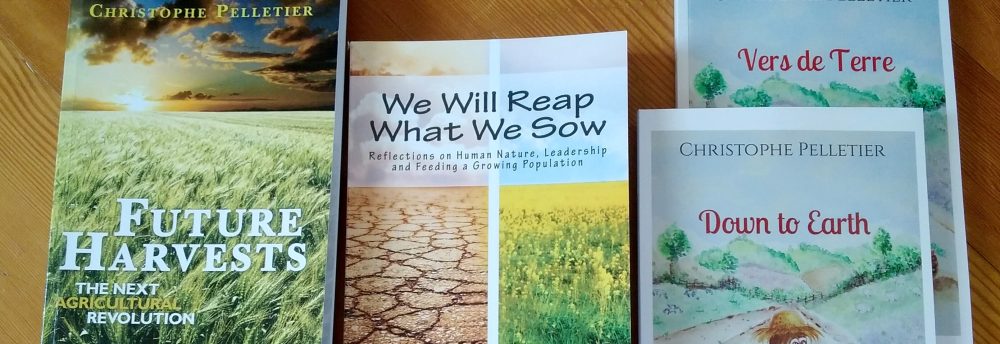
My book, Future Harvests, is expected to be published before the end of August.

Here is a preview to give you a flavor of the content.

For a full view, please click on the thumbnails.


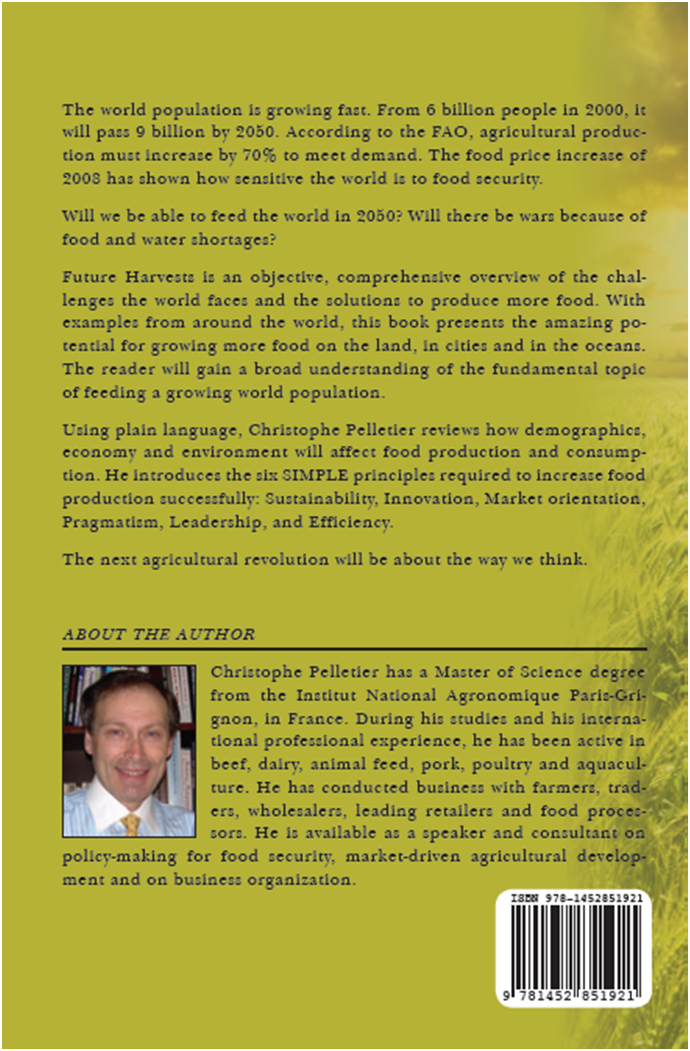
Here is a sample containing the table of contents and the preface of the book:


For the video trailers, please visit my YouTube channel.

Insects on the menu

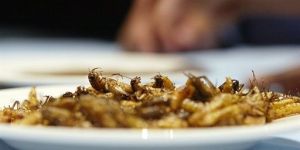
I came across a very interesting article from the French newspaper Le Monde, titled “Insects, the steak of the future”.

Photo: AFP/Mario Tama

The article reviews the potential of using insects as a food source to complement the traditional food production in order to meet the needs of the increasing world population.

Here are the main points.The nutritional quality of insects is high. They are a source of protein, fats, minerals (especially iron and zinc) and vitamins.

The production performance of insects out performs the one of traditional livestock, with a feed conversion ratio (number of kg of food to produce 1 kg of insect) ranging between 1 and 2.

There are already 1,400 species of insects consumed regularly in Africa, Asia and Latin America. Among the favorites, they name beetle larvae, ants, caterpillars, locusts, crickets, silkworm chrysalis, scorpions and spiders (although the two latter ones technically are not insects).

In most cases, insect consumption is the consequence of food shortage, but there is also a festive consumption of the bugs. The author mentions that in the old Roman Empire, caterpillars were a delicacy. Of course, in some Western countries, some restaurants offer insects at a premium price for a certain self-proclaimed sophisticated elite… After all, a lobster looks very much like a large aquatic bug.

However, trying to convince Western consumers to switch to insects and other bugs for their protein will be a tough call, especially when served in their original form. An possible alternative would be to process them into sausages and ground patties. There also could be the possibility to texture the protein in similar ways as it happens with soy.

Another interesting potential for insect is to use them as a raw material for animal feed. Bugs and worms can also be a good source of protein for poultry and pigs. After all, in nature, this was a regular part of their diet. Similarly, for many fish species, insects are a natural source of food. Currently, fish feed is made of increasingly expensive raw materials, such as fish meal, fish oil and vegetable oils, for which they compete with human consumption, or are used for feed destined to other farm animals.

There are talks about organizing the first congress on insect as a food source as early as 2012.

Copyright 2010 – The Happy Future Group Consulting Ltd.

Beyond the book

Now that the publishing company is working out the final details before the release of the book, time has come for me to spend some time again on the blog part.

During the making of the book, I have been asked about my opinions on a number of subjects. Listing opinions was not the theme of the book, but the blog is a good vector for this. In the course of the coming weeks and months, I will review as concisely as possible specific subjects, present which areas require attention and how I believe the topics will evolve in the future. If you have any request, please let me know.

In addition to these articles, I will develop new topics for seminars and conferences that relate to the book and that offer matter for reflection to the attendees. I also will introduce new modules aimed at improving organization and efficiency of –and within- food value chains. The purpose of these modules will be twofold. They will help participants understand the broader picture, and they will help improving the functioning and the performance of business relationships. This is not only about economic performance, but also about technical, environmental and social performance.

 More about this soon.

Future Harvests – The book is coming soon!


The editing of my book “Future Harvests – The next agricultural revolution” is about completed. All that is left to do is developing the cover and start the publishing.

I have already received orders, even before the book is out. That is quite a good sign. And a great surprise for me.

If you wish to be updated automatically when the book is published, just subscribe in the sidebar window on the right.

To describe the topics addressed, I have posted three short promotional videos on YouTube. In previous articles (The fun of writing this book and The next agricultural revolution), I had already given an idea about the content of the book.

Video #1: The Fundamentals (duration 2:37) – Introduction to the background and fundamental principles mentioned in the book “Future Harvests – The next agricultural revolution” to achieve food security for 9 billion people in 2050. Topics such as demographics, the shift in economic power, the control of food  and food security strategies are reviewed. Sustainability, innovation, efficient market driven food production and strong leadership are required.

or click here if video does not appear

Video #2: The Actions (duration 2:12) – A short review of some of the actions mentioned in the book to achieve the objectives. Solving the water challenge, finding new land for production, urban farming, hydroponics, farming the desert, rebuilding fisheries and developing aquaculture further are all possibilities.

or click here if video does not appear

Video #3: The Questions (duration 3:08) – A sample of some of the questions raised in the book. They cover technology, land deals in Africa, improving yields, restoring soil fertility, change in consumer needs, organic farming, risks of conflicts, biofuels or meat are some of the topics presented.

or click here if video does not appear

If you know someone who could be interested by the topics on this page, please pass it on!

The fun of writing this book

Over the last few months, I have been working quite a bit on writing this book about the future of agriculture.

I must say that compiling in one book a wide range of topics that, without any doubt, will be part of the future of our food production has been an exhilarating experience.

From demographics in full motion to the latest in technology, we can envision many different scenarios to set up the most efficient food production possible, as local farmers, industry NGOs and governments will need to find optimal solutions with the land, the water, the labor force and the capital available to them. Water and soil will be of vital importance, and their proper management is essential for the stability of many countries.

In the future, there will be no room left for wastage and inefficiencies, or we all will be punished if we get complacent. Similarly, we will need to change our thinking and accept that solving future problems will not be about transferring a one-fit-all model to very diverse situations. We might have had the illusion that it once worked, but it actually did not. We will learn from the mistake of the past to perform better. Sustainability is not an option; it is the only choice, because per definition what is not sustainable is doomed.

As food is a necessity, and since when we share between 9 billion people there is less left for each of us than when we shared between 4 billion, efficiency will be paramount. This will affect food prices and social stability. Technology is necessary but it is not the panacea in itself. The most needed resource for the future is strong visionary leadership to help us develop the plan for the next decades.

Let’s prepare ourselves for a deep change and we must accept the idea that we might have futuristic farms run by robots, satellites and computers in some regions as well as local urban gardeners in the heart of the cities, where 70% of the world population is expected to live. We will have small organic farmers and we will have large industrial farms using genetically engineered crops, but we also will have large highly efficient semi-organic farms that will combine the best of both worlds. We still will have specialized farms as well as mixed operations. Hydroponics and aquaponics will grow substantially in the future.

Today’s diet will be revisited and excesses will be out of place. Should we become vegetarians or do we simply need to eat less meat? Will aquaculture live up to the expectation and become the main source of animal protein? You will find out in the book.

Countries will have to think on how to guarantee food security to their populations. If it is not done well, this challenging task might end up in serious conflicts. Foreign and private investment in land and farming will continue in Asia and Africa. If managed properly, they will bring much prosperity to these regions, but if not managed properly, then we can fear the worst.

All these topics and many more will be presented in the book and I hope that it will help readers to understand all the variables that are at play, as well as it will help them get a more objective view of many controversial topics such as GMOs, nanotechnology or in-vitro meat. Once readers will have finished the book, they will be able to figure out whether and how we can feed 9 billion people. Thanks to examples from all over the world in as diverse countries as Uganda, Kenya, the USA, China, Indonesia, India, Brazil, Argentina, France, The Netherlands, Cuba, Kazakhstan and many more, we discover a myriad of different situations and solutions that illustrate human ingenuity to produce food.

However, for now just a few more months of patience as I need to get through the process of publishing.

Aquaculture: the solution to feed 9 billion people?

Last week, BioScience published an article based on the research of a group of researchers from the CSIC (Consejo Superior de Investigaciones Científicas), the Spanish High Council for Scientific Research.

They present their views on the potential of marine aquaculture to provide enough food for the growing world population. The authors of the report do not see fisheries as a significant option anymore, as the wild fish stocks are depleted, and the amount of time to replenish the stocks will be too long for fisheries to be able to meet the needs of the population. Aquaculture has gradually compensated the demand for fish that fisheries were not able to supply, and half of the seafood consumed today already originate from aquaculture. It is the fastest growing food supply activity and the projections for future growth are very strong. The researchers think that marine aquaculture could multiply its production by a factor 20 by 2050 and thus would play a major role in providing the world population with animal protein.

They bring up some interesting facts about agriculture and land animal farming. For instance, it takes 10 times more water per calorie to produce meat than it does to produce grains. Further, animal meat products represent only 3.5% of food production, but they consume 45% of the water used in agriculture. Considering demand for meat is expected to increase by 21% between 2005 and 2015, and will keep on increasing, this will only exacerbate this situation.

Another point that this group raises is the global nitrogen-use efficiency in animal productions. According to their sources, it is slightly more than 10% for land animals (5% for beef and 15% for pork), which makes their production a major source of nitrogen inputs to the environment. In contrast, marine animals have much greater nitrogen-use efficiency, at about 20% for shrimp and 30% for fish. Therefore, marine aquaculture culture releases two to three times less nitrogen to the environment than livestock production does.

From an environmental point of view, the idea of shifting the production of animal protein from the land where it uses scarce resources such as land and water, to the ocean where space and water are no limitations anymore sounds very sensible. From a nutritional point of view, replacing meat and dairy by seafood that is rich in healthy components such as omega-3 fatty acids is quite attractive, too.

They also notice that the land available for agriculture is shrinking, due to soil degradation and urbanism. Further, there is a growing scarcity of fresh water and increased competition for water as well. Therefore, activities on land do not offer the potential to grow all that much more food to feed the growing population. Even freshwater aquaculture faces these limitations. Freshwater aquaculture currently 57% of total aquaculture, therefore there is an untapped potential with marine aquaculture, as it does not use fresh water.

Of course, the main challenge to execute such a development of marine aquaculture production is to find the proper quality and quantity of feed. The researchers do not see the use of fishmeal and fish oil as an option anymore as they predict that the species used to make these products will not be able in sufficient quantities. Replacement by protein and oils from agriculture crops is an option for the short-term, but as aquaculture volumes would increase, the competition for these ingredients with meat production will make them too expensive, and for the reasons explained above, depending on land agriculture to feed marine species will face crop production limitations. Therefore, they prefer to envision a total new approach of aquaculture feeds, and recommend developing a new feed chain based on aquatic ingredients, such planktons, microalgae and seaweed. This approach makes sense, but the time lines to develop such a supply source and the cost of production of such an “aquatic” feed still need to be investigated. Several “seaweed farms” in production in China show interesting results and they seem to promise a strong potential of production for feed.

Another development that they expect is offshore aquaculture. Aquaculture operations located in coastal areas, although they are easier to access and generally in quieter waters, are very often located in zones where there are local issues to deal with, such as interaction with wild fish or recreational activities. Moving offshore can reduce these issues.

As you can see, developing the future of aquaculture is not simply a matter of growing fish in pens, but it requires a broader thinking that includes not only the oceans but agriculture on land, too. The future of food will require from us the ability to manage the whole planet!

Copyright 2010 – The Happy Future Group Consulting Ltd.

Study on waste production in meat and fish supply chains

A study to determine how much waste is produced in the meat and fish supply chains has been initiated in the UK by the Waste and Resources Action Program (aka WRAP) and Envirowise. The goal is to help reduce waste and save money.

To read the article from fis.com, please go to http://fis.com/fis/worldnews/worldnews.asp?l=e&ndb=1&id=34467

This confirms the issue I mentioned in my article “More action needed on food waste

The vertical farm

Here is a think-out-of-the-box article about the “vertical farm”.

It is an interesting vision of a replacement of agricultural land, by indoor robot-tended hydroponic agriculture. They also envision the possibility of raising farm animals and developing aquaculture in the water used to grow the plants; and the fish waste would be used as fertilizer.

All of this would be grown in a 30-floor skyscraper located in the city, powered by the energy coming from city sewage, and the ground floor would be a food supermarket that would provide food for 50,000 people.

Such projects are under review in Abu Dhabi, South Korea, Seattle, WA and Las Vegas, NV.

It looks like science-fiction, yet there are some really interesting arguments in favor of such a development.

The hot regions of the future

Food strategies for the world

Food strategies around the world

In this article, the term hot does not refer to climate, but to strategic and active food producing regions. Not only is the population growing, but also the demographics vary greatly between regions and this will change deeply where from and where to the trade is going. Here are, briefly, the main changes as I see them happening as we go forward.

The aging and increasingly health-conscious West will not show any increase in consumption per capita, and very likely it even will drop, as older people need less food than the youth and also because the shift from quantity to quality will continue. Of course, immigration policies in these countries might offset this somehow. The direct consequence of this is that suppliers are going to have to look for alternative markets for agricultural products. They should not have to worry too much, as there will be plenty of people to feed in other regions.

Asia, with about half of the world population is definitely a huge market, although it presents a great variety of conditions and situations.

The largest economy in the region, China, is developing a middle class with more disposable income. This results in a change of diet, with relatively more protein, especially animal protein than by the past. Although being the largest meat producing country in the world, China is struggling to feed its population, and I expect that it will remain a net food importer. Further, the country has major challenges to overcome when it comes to availability and quality of water. However, in the long run, the past one-child policy will affect the Chinese demographics and influence their need for food, as well as the dynamism of their economy at large, by the way.

The second largest economy, India, is very dependent on the monsoon for its food supplies, and climate will remain a challenge. They seem to struggle to be able to secure their self-sufficiency, rural development is still a challenge and poverty remains a concern to reach prosperity.

Emerging South Asian countries, on the other hand, for instance Vietnam, show a different picture. They have a young population and want to benefit of the economic momentum coming from China. They are actively developing agricultural and aquaculture production for export purposes, and they keep on this policy. Aquaculture is very active, as some of these countries have a very extensive shoreline, like for instance The Philippines.

Although food security in the region remains uncertain, and the scare of last year’s food price increase, some countries are trying to establish structures to protect from such risks. For instance, a number of ASEAN countries are trying to set up a rice cartel, some sort of an OPEC for rice, in order to have more control on the market and the prices. Of course, we will have to see if this will work as planned.

Another region that is showing booming demographics is the Arab world and the Middle East. Many countries in the region are wealthy thanks to oil, but also have the disadvantage to be located in desert areas. Attempts to increase food production have met their limits, and they do not guarantee food security. The main reason is the shortage of water and trying to grow more food would create a drinking water crisis. This is why some Arab countries are developing other strategies to “outsource” their food production like mentioned in the article “The Great Unseen Land Grab”. Other countries, like Qatar, are considering investing in food companies in order to secure their food supplies.

Some players are already making their moves

Some players are already making their moves

I expect stronger ties between the Middle East and former soviet republics. Russia, Ukraine and Kazakhstan are joining forces in the “Black Sea Wheat Pool”, another agricultural OPEC. Although we will see how this combination works. Another area that I see booming in the future is the Mediterranean region, which is the interface between Africa and Europe. Although immigration has been a hot issue in the past, there is a great potential for a win-win situation for both sides if managed properly. The idea of creating an Economic Zone around the Mediterranean has already been brought forward and considering the demographics of the region, it makes quite a lot of sense.

Africa, although plagued by many problems, be it natural, social, political, humanitarian or health, as a huge untapped potential. The plans of Arab and Asian countries to lease land on this continent and develop agriculture for their needs, could give the necessary impulse to develop African economies. I also believe that South Africa has the potential to be the driver of the economic surge for the continent.

Last but not least. South America and Brazil in particular, is going to play a major role in agricultural production. They have an amazing potential, but also many issues to solve, especially on the environmental and political level. Their position of producers of basic commodities as well as high value products like meat gives them a strategic role in the international food trade, and the upcoming merger between JBS and Pilgrim’s Pride in the US and between JBS and Bertin is another step in the creation of agribusiness giants, following the merger between Perdigao and Sadia.

Copyright 2009 The Happy Future Group Consulting Ltd.
Bringing cities to the countryside: Infrastructure will help rural development

Although the title of this article many sound a contradiction in terms, agriculture (in which I include aquaculture as well) needs cities and vice-versa. Rural development is more than just agricultural activities; it is about creating and improving a cluster of many economic activities that are necessary for the proper functioning of a community.

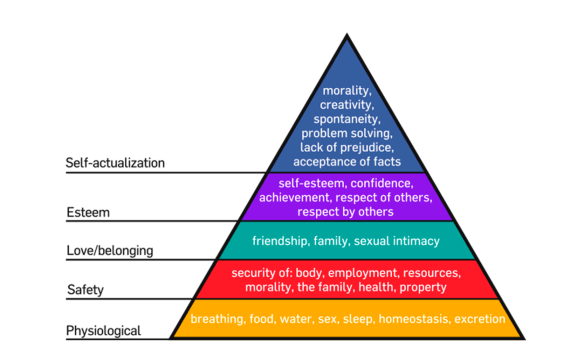
As such, this should not be a surprise, because in the history of man, human settlements always have been linked to drinking water and sufficient food supplies. By developing agriculture, the very first “farmers” created the conditions for sedentarism, instead of continuous migrations. On these sedentary communities, other activities developed later to cover the needs of the locals. Maslow's pyramid of needs - Picture WikipediaThe hierarchy of the needs that we must fill can be easily identified according to the pyramid of Maslow: food and water, shelter and physical safety. Once this is achieved, adding other activities become more natural and simple.

This is why developing large urban centers is no guarantee of prosperity. Like all things in life, the key is about balance. Of course, over the last 150 years, the focus has been about growing the industrial capabilities and this has been the engine for a massive migration of population from the countryside to the cities. Although the conditions were far from stellar, many companies in the early industrial development were providing their employees with housing. Their ways may not always have been very social, but they were showing some level of social responsibility.

With the ups and downs of industries, cities have increasingly faced a problem of poverty, as the development did not include a sense of community anymore and company loyalty towards their employees disappeared as the workforce became expendable and factories could move to other countries.

This industrialization and urbanization have also affected the rural areas and the agricultural world. Many rural areas have faced and are still facing isolation and poverty. Although in many cases there have been many efforts made to improve this situation, the situation has not always improved.

Yet, we now see the challenges of feeding an ever-increasing population, we all recognize that we will need to cultivate more land and water, but this still does not seem to make things turn around.

In my view, the problem is that, too often, we restrict rural development to agricultural development, and by looking at this part in a separate way, instead of focusing on integrating agriculture in the development of the whole local economy, we just do not create strong enough chances of success. Having large urban centers with their problems on the one hand, and remote and depopulated rural areas with their problems on the other hand, should be the clear sign for all of us that our economic model is out of balance. There can be life outside a huge metropolis where everyone has become an anonymous person, resulting is a dislocated social fabric. What has made the success of our species has been our ability to act as groups. As isolated creatures, we probably would not have survived very long.

To rebuild the necessary social fabric in rural areas, we must create the conditions to have balanced and complementary activities. This is why, while some see the future of agriculture as urban farming, I believe that it has to be urbanizing the countryside, not with large impersonal cities, but with human size settlements where we can provide for all the needs.  Isolated farmers with no direct connection with their markets and not getting the value for their products to make a decent living will look for alternatives. If we want more people to produce food, we must understand that they must make enough money to want to keep producing food. By creating a proper infrastructure around agricultural areas, we can create a more local market that will drive production. A profitable market for the farmers’ products also means more money in their pockets, which in turn means more spending power to develop demand for other business, be it for products or services. This is how we will be able to grow local economies and communities. This is not about a romantic or idealistic back to nature movement, or creating local farmers markets purely for marketing purposes, but this is a thorough and integrated process embracing modernity. In the current rural areas and probably in other regions, the future will about bringing the economy to the people before bringing people to the economy.

Copyright 2009 The Happy Future Group Consulting Ltd.