Organic foods not nutritionally superior. So what?

A bit of emotion, a bit of reasonA recent study from the UK concluded that organic foods are not nutritionally superior to “regular” foods. Of course, it did not take long for reactions to be published. The pro organics reject the protocol used and therefore the conclusions. The pro “industry” reacted satisfied. All of this is not surprising, and for a simple reason: people choose their foods greatly based on psychological reasons. Let’s face it the debate around organic food is largely about lifestyle and choices.

However, is the result of this survey a surprise? Not really, because in terms of nutritional value, the differences in production systems are not that different. When it comes to food safety, especially residues of chemicals, then it probably is a very different story.

What can affect the nutritional value of foods are the growth period and the timing of the harvest. Produce that grows fast and that is harvested before full ripeness contains relatively more water and therefore there can be a dilution of nutrients per kg of product. This is also true for meat products.

I do not believe that the real debate between” organic” and “industrial” should be so much about nutritional value as it should be about food safety. As consumers get more educated and have more choice, they will give the preference to something more natural and harmless, simply because it is common sense and the safe thing to do. On the other hand of course, agriculture must be in a position to offer affordable products. Organic foods are more expensive and this is what limits its market share to mostly well-off city residents.

If organic foods want to become the standard to feed people, it will have to work on its production costs and price. Retailers are playing a very important role in this, as they more and more dictate to suppliers how food should be produced. This is currently very obvious with seafood and the requirement set by supermarkets to buy only sustainable seafood.

My expectation for the future is that retailers will get more involved in agriculture and will impose on suppliers more restrictions on what kind of products they may use for crop treatment, more restrictions for better animal welfare. The market standards of the future will become “sustainable”, “natural” and “traceable”; not for emotional reasons, but for rational reasons. There will be pain to accept for producers to meet these requirements, and in the end the commercial negotiations will decide what the market price of “natural” foods will be.

Copyright 2009 The Happy Future Group Consulting Ltd.

Future approach of genetics in agriculture

Where we will decide of our future...

Genetic engineering, that we just mentioned, and traditional breeding and will be increasing intertwined in the future, as they will join their respective areas of expertise into combined genetic improvement programs. Actually, we can expect that these two disciplines will be merged into only one unified science of DNA. We can expect to see an increased number of joint ventures and mergers between genetic selection companies and biotech companies in the future.

So far, genetic engineering has been mostly known to the public opinion thanks to the development of GMOs (genetically modified organisms), and this has been a very controversial area. Genetic engineering will move from a support activity to, for instance, herbicides, to address much more real problems and bring much more real solutions to the challenges of the agriculture of tomorrow. GMOs have served the sales of herbicides produced by the same companies quite well, but of course, this will plateau rather soon, and there will be a need for something else to impress the financial markets. It should not be a surprise to see these corporations specialize in biotech completely, and divest their chemicals “heritage” at some point in the future. The real problems to solve include a broad range of topics. They include technical performance and yields of plants and farm animals. Genetic engineering will help increase the efficiency in the conversion of nutrients and water. It will help plants and animals to have a stronger resistance to diseases, in order to avoid severe production losses. It will provide alternatives to antibiotics, to herbicides and pesticides. It will find ways for plants to absorb or fix the nitrogen of the air to reduce the use of mineral fertilizers. Another area of research will be influencing the quality of final agricultural products, in particular producing healthier foods, and have plants produce medicines.

To solve such problems, the people in charge of such programs will have a very heavy moral responsibility towards society, as the choices they will make will affect the longer term and our ability to survive. The success criteria will go much beyond the financial performance of these companies. This will be translated in the type of bonus packages that the executives will receive. One can wonder whether the correct structure for such companies is to be publicly traded, since stock markets tend to induce a very strong preference to the short-term financial performance. The reflection on such programs will need to go through a serious test of “what ifs”. As per now, money still is the main driver, especially in the arguments of the producing companies and countries. For instance, they reiterate that the decision of the European Union to limit the production and use of GMO will make food more expensive in these countries. Then let’s ask ourselves what if the EU is wrong in their decision? Well, production systems and agriculture would not change much; their food might indeed be more expensive than somewhere else. The people will buy smaller cars and travel less far for their vacation. This is not a very threatening situation if you ask me. What if the ones in favor of GMOs are wrong and the EU is right? The debate is indeed very emotional and political, but this is simply because we lack long term testing of the effects of GMOs to have certainty. This is why the GMO producers have such a hard time convincing their opponents.

More than one species, a whole ecosystem

A better understanding and predictability of long-term effects is paramount in agriculture and food production. Agriculture is not just about producing a particular crop, it is also about managing the total ecosystem that a field is. Actions in genetics need to guarantee the long-term balance of these ecosystems (in which weeds, although of no economic interest, are a part of), because once an ecosystem has been altered, it has been changed forever. Genetic improvement programs must ensure to preserve, in whichever form, genetic diversity and survival of vegetal and animal species, because once extinct, they are lost forever. Long-term fertility of soils is another highly critical part of the protection of our food supplies, because once sterile, the land is lost forever.

So, as you see, we are facing many challenges and genetics is a key element of our food systems. By shifting away of rather superfluous projects, even though they have been quite lucrative for the producers; and by focusing more on true improvement and sustainability of production systems thanks to technical breakthroughs, a combined breeding and genetic engineering will bring constructive solutions. All it will require from the stakeholders is vigilance.

Copyright 2009 The Happy Future Group Consulting Ltd.

The future price of meat and fish: up

With a world population increasing strongly and an agricultural area that will not grow accordingly, the law of offer and demand clearly indicates that agricultural prices will increase in the future. This is true for agricultural commodities such as grains, but the increase will be even stronger for animal products, such as meat, poultry, dairy and fish.
This will be the result of an increasing and very likely quite aggressive competition between the need to feed people with the basic commodities, the need to feed farmed animals and possibly for some time the need to produce biofuels.
Since it takes more than one and even several kilograms of animal feed to produce one kilogram of meat, the feed conversion ratio (FCR) will affect by which factor the price of the various animal products will increase.
Efficient productions like chicken will be successful and will remain quite competitive pricewise against other sources of animal proteins, thanks to its low FCR, to its low water use and to the good agricultural value of its manure. In the aquaculture sector, efficient productions such us tilapia and pangasius have a bright future ahead, as they can help feed a large population for an affordable price. In general, aquaculture has the opportunity to fill the huge gap left by depleted wild fish stocks, although it will have to solve some issues in order to be successful (see my article titled “The lessons of intensive animal husbandry to aquaculture“). In terms of price, the scarcity of wild fish will make these quite expensive for the future.
Less efficient species such as pigs and beef cattle will see the price of their products increase relatively much more. Pigs also have the disadvantage of producing low quality manure, which will limit the level of intensification. However, pork plays an important role in some cultures, and therefore, it will still show a reasonable volume growth, with geographical variations.
A high FCR species such as beef cattle will probably undergo the most dramatic change. Higher feed costs, linked to a relatively high capital need will probably push a number of farmers to shift to other more efficient productions. Highly intensive systems such the feedlots will also undergo major changes, as regulations on the use of antibiotics and hormones will make them financially inefficient. Further, their high impact on the environment because of the manure will also work against them. I do not expect the 99-cent beef burger to be here for all that much longer, burgers will continue to exist, but just quite a bit more expensive. On the other hand, I can see good possibilities for specialty beef products, such as grass-fed beef, but customers will have to pay the right price for it. Grass is the animal feed that we all seem to underestimate, yet it covers vast areas of very often fragile soil, and cattle is one of the few species that can transform it into high value protein.
In the aquaculture sector, a carnivore species such as salmon will also meet its own limitations. Although, salmon feed has shifted from mostly fish oil and fishmeal to a much more complex mix of vegetal oils, this production will see its production costs rise strongly. I expect salmon to become a luxury product again.

Consumption per capita will decreaseWhat will a higher price mean?
There again, simple economics tell us that this will influence the level of consumption per capita. The price increase will moderate the level of consumption and the price differential between the type of protein, as well as health concerns, will cause a shift between the respective consumption of the different products. In Western countries, people consume quantities of animal products that are substantially higher than what they actually need, and this has led to many health issues. The decrease in consumption will help make people healthier, and reduce the burden of health costs in that part of the world.
In developing countries, the situation is different, as consumption trends show an increase of consumption of animal products, from rather low levels, though. In these countries, consumption per capita will increase, but will not reach the levels that Western countries have shown, simply because prices will be too high to get to such levels.
The decrease of consumption per capita that we will see in developed countries does not mean that the meat industry will get into trouble.  Less average consumption per capita in the West will be more than compensated by the growth in emerging countries, where population numbers are significantly higher, and this will lead to a higher global demand of animal products. The main change is that the consumers will be distributed geographically rather differently than they are today. This also means that production will be located in different areas than today.

Just as a teaser: if Western countries consumers were to reduce their meat consumption to just the necessary maintenance needs, it would free volumes enough to cover the maintenance needs of meat for the whole population of China!

Copyright 2009 The Happy Future Group Consulting Ltd.

G8 shifts focus from food aid to farming

Here is an interesting article from the Financial Times describing the new approach from G8 countries towards food security. It connects with my previous posting, and shows how strategic agriculture is becoming. It is also nice to see that some world leaders look at this issue in a more sensible manner than in the past, shifting from “give a man a fish, he will have food for a day” to” teach him to fish and he will have food every day”. Well, that is if we manage to replenish our oceans, which is a topic on which I will write in the future.

Of course, it must be clear that if they choose this new approach, it is because they have an advantage in doing so.

The competition for the control of food has started

A couple of recent articles (Foreign cropland deals and Professional investors look toward overseas farmland) show clearly how much action there currently is about securing food sources in the future. Many players are involved, from countries buying or leasing foreign land, to investment firms and hedge funds.

Agricultural commodities have become quite hot and are expected to become even hotter.

In the future, we can expect to see more of such land acquisition, we will see more alliances, like the “Black Sea Wheat Pool” in which Russia, Ukraine and Kazakhstan are supposedly joining forces to build a strong wheat sort of OPEC. Although considering the relationship between Russia and Ukraine about natural gas, one can wonder what will happen with this.

Taking control one piece at a timeWe must expect strategies about food supplies that will remind us of what we have seen about oil supplies. Politics are going to play an increasingly important role. After all, we can live without oil, but not without food. There will be aggressive moves from countries that are not self-sufficient, first friendly like the land purchases and leases, but there probably will be a point when this might not be enough and regional conflicts will happen. Some exporting countries will also take a more aggressive stance on prices and on availability, but they also will have to be aware that too much arrogance might end up in serious tensions.

In my view, we are going to see very interesting tactics that will include food, energy, trade agreements, diplomacy and military threats as part of the whole bargaining process.

Similarly, we can expect to see more tensions between private firms involved in food and governments. Locally, we can expect nationalizations of land and factories. More regulations of the markets will take place, probably after excesses from privately owned money, investors and businesses will create another “bubble” with agricultural commodities futures contracts, that will end up destabilizing food markets in a somehow similar manner as the financial world has acted for many years before it faced a meltdown.

Copyright 2009 The Happy Future Group Consulting Ltd.

The buried treasure: Arable land under our cities

Will we see science-fiction urbanism? Will we become urban gardeners?

As the population increases, so does the need for food. In the press, you can read statements like “we will need four Earths by 2050 to feed the world”, although some predict only three.
Fact is that we will not have extra planets to grow our food, and we will either find ways of increasing food production or the world population will regulate itself, be it through famine or wars.
The buried treasure underneath the asphaltInevitably, there will come a time when all apparent arable land will be in use for agricultural production, and there will be a need for more. Already today, we have a vast area of good agricultural land, which is inaccessible, because it is located under cities and roads. This is even more important as the prediction is that the world population will increasingly live in urban areas.

Since the beginning or urbanization, human settlements have developed around the bare necessities, which are water and fertile ground. Today’s major urban centers have been growing from their original core, and they cover a lot of such fertile land. One of the dilemmas for the future will be to accommodate this increasing concentration of population in cities and to keep arable land available. In a later stage, we might have to find ways of recovering this land in some way or another.
In order to conserve arable land from further housing and infrastructure development, we need to think “vertical”. This could mean the end of the individual house, and the further development of higher housing building as the unique model. It is not unthinkable that we will restart agricultural activities in the cities themselves, by allocating some area for gardens both at ground level and suspended on top of buildings, and even the return of farms in the cities. So far, infrastructure had chosen the easy, cheapest and most obvious solution, which was to lay cities and transport on the ground as much as possible. Maybe, we will see an increased redevelopment of roads and transport lines on elevated structures, such as the bridges and the monorail lines that we know today. This could free a huge amount of land for food production. Of course, this sounds like a very costly solution, but food scarcity will make its price skyrocket even more. Another solution, although it seems to go against the trend generally accepted today would be to redistribute the population more evenly between urban centers and agricultural areas.

Copyright 2009 The Happy Future Group Consulting Ltd.

Photos from AgriVision 2009 – Feeding the globe in 2050

Here is a link on a photo report published in World Poultry about the recent AgriVision 2009 held in the Netherlands.

Their objective was to answer the question of how to feed the world population by 2050, which is the basis of my own quest.

They seem to have come to rather optimistic conclusions. This is good news, but that will require the proper leadership as well from the world of politics as from the business world.

Managing water is paramount for the future of food production

The key for our future food productionWith an increasing population that needs more food and more water to live, we can expect that water is going to become a highly strategic and needed resource. As climate changes, the current rain distribution and geographic availability of water is likely to change dramatically, too. This increasing competition between agricultural areas and urban areas will bring major changes on how we use water for both personal use and for food production. On the personal side, we certainly can expect that current bathroom systems to disappear, as they use too much water. Every time we flush a toilet tank, we actually waste the daily drinking water needs of a couple of people, and local water reserves are gradually depleted as well. Clearly, this has no future. Similarly, we can expect the legislation on water use for lawn sprinkling and car washing to change.

Food production will become more and more focused on water efficiency. The main themes will be about taking what we need, but no more, and about collecting, conserving and recycling water. This will bring us to rethink our crop production, the watering systems we use and develop systems aimed at collecting and conserving water.

Our choice of crops will get under review. Some plants have such high needs for water that their production systems will have to be altered, or maybe even we will have no other choice of limiting them to small selected areas. The use of combined crop productions on the same field is likely to gain some popularity back, as this is a way of saving water and protecting the plants and the soil from excessive evaporation. This, of course, will mean a different look on yields and on harvesting systems. IrrigationMore efficient irrigation systems will replace the old ones. Computerized systems are already in use in wine production, using sensors for humidity and temperature, to determine how much water the plants needs at the most optimal time of the day and deliver it at the exact spot. You can expect that such an optimization approach will prevail. The path that Monsanto follows with the production of genetically modified (GM) wheat that needs only a third of regular wheat varieties is quite interesting. The tricky part is the GM part, as on the contrary to natural “mutations”, such a process does not undergo natural selection, and therefore we do not know what possible side effects it might bring. Nonetheless, this is an attempt to deal with future water shortages. Hopefully, other less controversial solutions can be found that will deliver a similar result. Once again, we can shape our future through continuing innovation.

Food processing, such as slaughterhouses or washing stations for produce, uses large amounts of water. In these sectors, too, new more efficient systems will have to be designed to reduce water use, and they will have to guarantee to meet hygiene and food safety standards. Water treatment and recycling have already been in use for years and they will continue to gain market share.

Next to the above, which is mostly in the hands of individuals and companies, there is a need for political action to address water shortages and water quality issues that expand far beyond the local operations. A number of agricultural areas suffer from drought on a regular basis, such as Australia and some parts of Canada. Other areas have seen the flow of rivers drop dramatically, like for instance the Yang Tse River in China, which has more and more difficulties to reach the sea. In other areas, such in the Arabic Peninsula, the countries realize that traditional irrigation systems are meeting some serious limitations because of the competition between need for drinking water and need for irrigation. Some very interesting projects are in the works to offer alternatives. For example, there are studies to consider the use of floating islands covered with solar panels in order to produce on the spot the energy necessary to desalinize seawater, therefore providing these areas with water that does not originate from underground reserves.

These problems affect the availability, the quality of the water and strongly affect the environment. Failure to address and more importantly to solve such problems properly would have catastrophic consequences for large populations. A balanced plan to offer the availability to water for people, agriculture and industries is absolutely necessary.

Copyright 2009 The Happy Future Group Consulting Ltd.

If we are what we eat, what will we eat in the future?

The past 50 years have seen, at least in the Western world, the development of the consumption society. The emphasis has been on consuming always more, by having an apparently unlimited quantity of increasingly cheaper consumption goods available. This trend happened in the agriculture and food sectors just as well, and followed a rather simple patter, actually. Mass consumption has been coupled to mass production, thanks to intensification, technical and technological progress and, last but not least, marketing.

Junk foodTechnical progress improved yields and productivity, while marketing was aimed at creating more, and new, needs. Our food has become standardized, industrialized, and processed in a wide variety of forms. As the emphasis moved to lifestyle and convenience, which came along with the rise of mass distribution, cheap energy and suburbia, we lost the connection between ourselves, the origin of our food and nature. Food became just things you buy at the supermarket, already packed in plastic and cardboard.

Now, we have come to the realization that this high production of waste, be it packaging material, be it blemished product that do not look good anymore while still perfectly edible, be it the overproduction of manure and its minerals, or be it the massive use of antibiotics and pesticides is not sustainable. Of course, much progress has already done to reduce this waste and there is a growing trend towards organic and traceable, but at this stage it not clear yet whether this is a true change in our behavior or whether it has more to do with a social status and marketing issue.

However, what the current situation might be, the fact that we understand that we cannot keep on intensifying and wasting the way we did, will inevitably bring a more fundamental change in how we consume in the future.

Some people predict such changes as the astronaut diet made out of pills, the use of a computer to tell us what and how much of it we should eat based on our activity level, or the tissue culture to replace meat, and many other scenarios. Will any of those ever happen? Who knows?

Personally, I believe that food as a very strong psychological connotation. We associate food with experiences and, although there are differences between cultures, that emotional bond will stay.

Clearly, the consumption society with all its excesses is coming to its end, and maybe the current economic crisis, which also originated in the excess of having it all at any cost, could very well be the turning point.

The next evolution is probably going to be a balanced approach between consumption, which we need to some extent, and the necessity of preserving what keeps us alive. There will be different graduations of this balance between geographic regions, but sustainability is the only way forward, as I mentioned in my previous article (Sustainability: as natural as balance).

Intensification is showing its limitations, waste of manure and of packaging are also hitting a wall, energy is getting more expensive and makes the production and the transport of food more expensive, too. This will reshape how we want to consume our food, how and where it is produced, how it is presented to us.

Cattle feedlotWe still are in a society where some people get obese by eating lots of food as quickly as they can, while they have less physical activity than the previous generations, thanks to automation. That food is produced on intensive farms and feedlots where the animals grow and fatten as quickly as possible, as they eat lots of food, while not having much physical activity. Similarly, in our society meat producers use hormones to boost growth and carcass quality, while body builders and sport professionals use steroids and growth hormone to boost their performance. Interesting similarities, don’t you think? We are indeed what we eat.

So, in a conservation society, should we expect the farms to be led by the need to preserve? This almost sounds like the farms we had at the beginning of the twentieth century. I think that there will be some of it, but the efficiency of production as well as the efficiency of preserving the environment will be much better, thanks to new technologies. We will have high yields, and at the same time, we will have highly efficient systems to use water, to recycle waste and preserve the fertility of our soils and the balance of our oceans.

Copyright 2009 The Happy Future Group Consulting Ltd.

Sustainability: As Natural As Balance

With the increasing awareness about climate change and our endangered environment, sustainability has become a widespread concept through all industries and the food value chains have embraced it like everyone else.

Yet, I do not quite understand why sustainability seems to be such a “revelation”, or even almost a revolutionary idea. Sustainability is the way that our societies have lived for thousands of years, probably because scarcity of goods made conserving and recycling a necessity of survival. Only over the last 50 years or so have we seemed to forget about it, because of our consuming frenzy and the abundance of goods that we thought to be about infinite.

To put the importance, and the obvious need for sustainability, let’s just look at its definition. What is not sustainable disappears. There is no need for any further philosophical or political discussion. Survival can (note that I only say can) come only from sustainability. All processes in nature that deal with life are all about recycling of organic matter in one form or another, and about balance. If the environment is favorable for a particular species, you will see this species thrive and its population grow quite strongly, to the point that it exceeds its abilities to provide for itself in its original ecosystem. Then, it starts to use more and other resources that nature can replace at the natural pace and this always results in a strong reduction of the population, as the weakest cannot find food and perish, or as the population density helps the spreading of diseases much faster than it would otherwise. Does this sound somehow familiar?

The soil that feeds usThere are many discussions in scientific, economic and political circles about whether we have reached such a stage either regarding pandemics or regarding food supplies. The specter of pandemics recently raised its head with the “swine flu” originating from Mexico. Last year, there were severe disruptions of food supplies in some parts of the world, not as much as the result of an actual shortage, but as the result of prices skyrocketing and fears that food would run out.
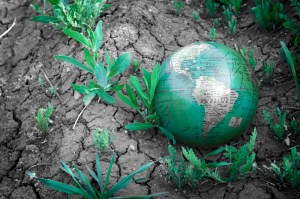
Are we about to run out of food? Malthus was warning about such a risk in the early nineteenth century, but since then, the world population has increased far further than he estimated was possible. Today, we probably are not in that dire a situation, yet the main food supply issue is more one of distribution between geographic regions. Some parts of the world are underfed while others die of all sorts of ailments related to overfeeding. This is more a matter of politics than purely of agricultural (including seafood) potential.

Sustainability is about allowing nature to do its work at its own pace. This is all about staying in balance and keeping natural cycles complete their courses. Since you cannot live without eating much more than 2 months, you cannot live without drinking for much more than 2 days and you cannot live without breathing for much more than 2 minutes, these cycles can be reduced to just a few critical areas for life:

  1. The cycle of air, necessary to remove, or to help nature remove the contaminants, so that air remains breathable.
  2. The cycle of water, necessary to remove, or to help nature remove, the contaminants that can make it undrinkable.
  3. The cycle of soils, necessary to preserve the fertility of the soils, and thus allow a continuous agricultural/livestock production to feed people.

Agricultural challenges aheadThis is why, with a growing human population, agriculture and food production at large, managed in a sustainable manner, will become increasingly strategic in the future, and sensible management of water resources will be a key factor for the success of agriculture as well.

Copyright 2009 The Happy Future Group Consulting Ltd.