Two-thirds of world population live in the 16 most populated countries

When looking at their respective demographics, economic situations and food security status possible future scenarios can arise from this list.

The most obvious is probably that many countries on this list have little food security. Considering that many of these countries have a young, poor and increasing population, political stability is quite fragile. As long as this remains, the consequences of food inflation must be taken very seriously.

Country

Population

% of world population

China

1,337,320,000

19.6

India

1,180,220,000

17.3

USA

309,199,000

4.5

Indonesia

231,369,500

3.4

Brazil

192,860,000

2.8

Pakistan

169,410,000

2.5

Bangladesh

162,221,000

2.4

Nigeria

154,729,000

2.3

Russia

141,927,297

2.1

Japan

127,530,000

1.9

Mexico

107,550,697

1.6

Philippines

92,226,600

1.4

Vietnam

85,789,573

1.3

Germany

81,882,342

1.2

Ethiopia

79,221,000

1.2

Egypt

78,200,000

1.2

 Total  

4,531,656,009


66.7


What came to my mind when I saw the list the first time was the following.

The cluster Pakistan-India-Bangladesh represents 22.2% of the world population. This region is very sensitive to climate events, as the current floods in Pakistan demonstrate. The monsoon is the main factor that influences the level of crop production. These countries are below food self-sufficiency, and their agricultural infrastructure (and overall infrastructure in general) is in bad need for further development. However, the quality of agricultural land is good with around 40% of arable land. The task of India is huge. It has about 70% of its population in agriculture, and if the USA had India’s population density, there would be 3 billion Americans, 10 times its current population. In such a situation, the USA would not be self-sufficient, either. Agricultural reforms are necessary to improve yields and economic development is necessary to provide more inhabitants with higher revenue. It will take time, but expectations for the Indian economy are positive. Subsistence is not a good economic model. A good relationship between India and Pakistan is paramount for the stability of the region. A stable Pakistan is essential for the stability of the world.

In North America, I can see dramatic change coming. With two countries, Mexico and the USA, in sharp contrast with each other in the top 16, something will happen. The USA will remain an economic superpower and any events in that country will affect the world economy and politics. Mexico is growing but it needs to improve its economy and achieve better social stability. Poverty is fuelling many issues and the price hike of corn of 2008 has showed that it would not take much to cause food riots. The issue of immigration of Mexicans into the US will not go away, and no wall will stop it, especially with Mexico having a strong population increase. The difference in population numbers of the two countries will shrink. The USA and Mexico will have to develop a joint economic development program for the region to avoid an uncontrollable situation in the long term. I think that we will see more and more Mexicans settling in the USA and become the farmers of the future over there. However, climate conditions will probably affect the geographical distribution of productions. The southwest of the USA is increasingly suffering from water scarcity, and the area spreads. This will affect the distribution of the population over the continent, and it will affect Canada as well.

South East Asia has three representatives on this list: Indonesia, The Philippines and Vietnam. This region shows a strong population increase. From a food production point of view, geography tells that aquaculture has to be a leading, if not the leading, food source for the future. And this is exactly the direction that these countries are following. Rice is essential in this part of the world, and there is no doubt that the South East Asian Emergency Rice Reserve will be tested at some point in time.

Brazil is growing, demographically and economically. It is becoming an economic powerhouse, in particular in agricultural products. However, much still needs to be done to improve infrastructure and performance. In the future, I expect to see joint agricultural policies between a number of Mercosur countries, especially with Brazil, Chile, Argentina and Uruguay as the initiators. Export has led agricultural production of these countries in the past, but I expect to see them to rebalance policies towards feeding the South America market as well in the years to come.

The other thing that jumped out of the list is Africa. I doubt that many people would have expected Nigeria to be ranking #7. Africa will be an important element in the 21st century economy. The continent’s population will double in the coming 40 years and many African countries are attracting foreign investments. If this happens in orderly manner, which is far from sure at this stage, I would expect Africa to experience a boom comparable to the one that China has had over the last three decades. The continent is open for business and the rules of engagement are exactly what adventurous pioneers can wish for. Africa has tremendous potential for food production and foreigners are developing agriculture actively for their own food supply, but neither African countries nor investors should forget to include the Africans in the wealth creation, and help them earn the money to feed themselves. What will happen in Africa, will affect all of us.

Copyright 2010 – The Happy Future Group Consulting Ltd.

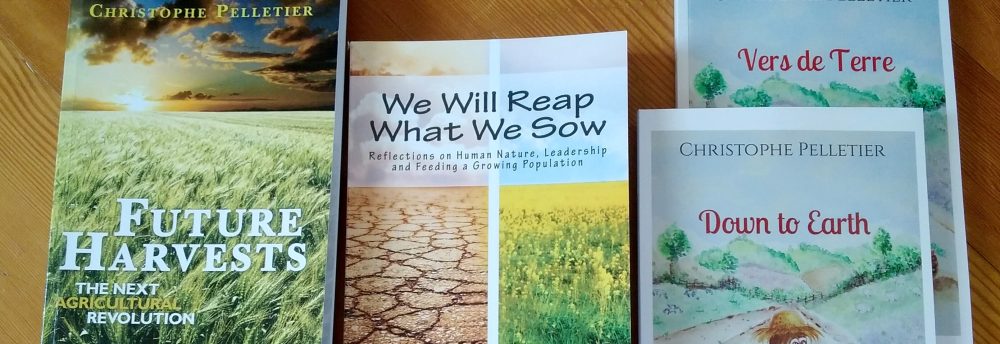
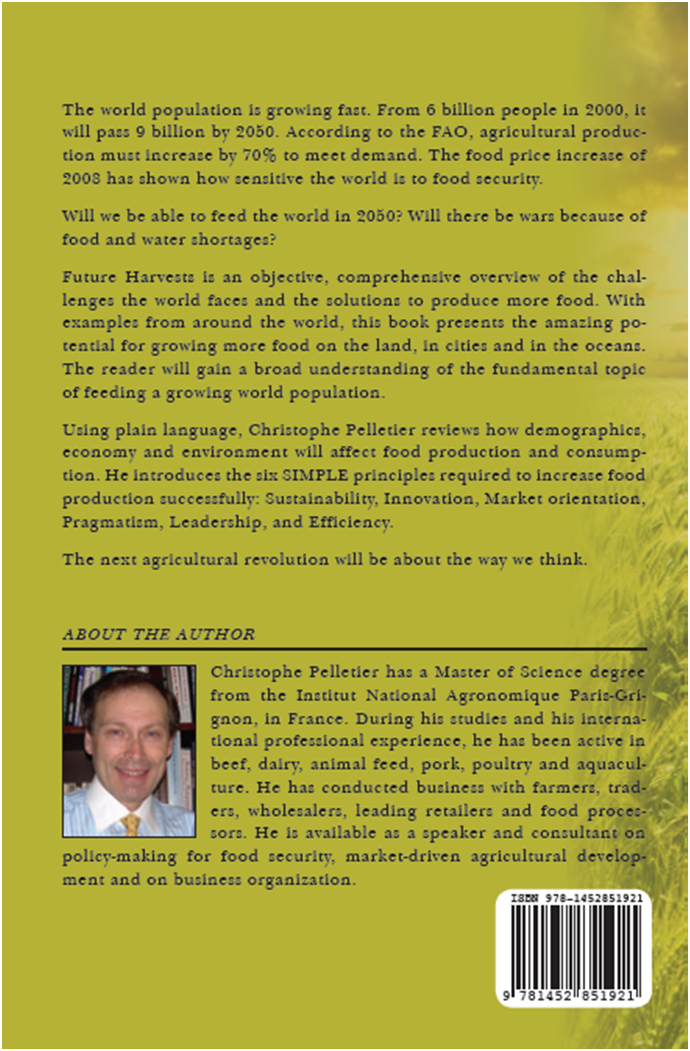
Future Harvests – A preview of the book

My book, Future Harvests, is expected to be published before the end of August.

Here is a preview to give you a flavor of the content.

For a full view, please click on the thumbnails.


Here is a sample containing the table of contents and the preface of the book:


For the video trailers, please visit my YouTube channel.

Is the food company grab the next step beyond the land grab?

In parallel with land tenure deals in developing countries, I foresee a new trend to develop strongly in the years to come.

In order to increase food security, countries in Asia and in the Arab world will invest more aggressively in food and agriculture companies.

In China, the search for acquisitions is gaining momentum. A first attempt, although failed, by China’s Bright Food group to acquire Australia’s CSR sugar is an indicator is this trend to come. But China is not the first country to initiate this.

For instance, Qatar’s sovereign wealth fund created Hassad Foods to invest in food related projects in Qatar and abroad. The purpose of Hassad Foods is to help Qatar achieve food security. They aim at developing their activities in South America and Africa, with the expressed goal of completing at least six projects by the end of 2010. Their focus is on basic crops such as sugar and wheat, but they look at projects in the poultry and livestock sectors as well. As countries realize the limitations and the political risks of focusing only on farmland ventures, they will diversify their possibilities to improve their food security situation.

As the approach of sovereign funds is to focus on long-term food security, the type of investments in food companies might change as well. This will be a different approach from activist investors, such as hedge funds, that try to influence short-term management decisions purely for share price purposes.

Copyright 2010 – The Happy Future Group Consulting Ltd.
Are “land grabs” a necessary evil?

The large land deals between African and Arab countries or Asian countries, mostly China, have drawn quite some attention.

I mentioned them in an earlier post on this blog (The great unseen land grab).

The discussion has taken an increasing political flavour, but very few people seem to look at the causes of the problem.

The reality is simple: the countries looking for land do so because they have a serious problem to feed their people and to guarantee them access to potable drinking water.

The water problem is obvious in Arab countries. In the past, they tried to grow more food on their land by developing irrigation. Unfortunately, they have concluded that this approach depleted their water reserves, while they also realize that they cannot feed their increasing population. For instance, Saudi Arabia has now turned away from its previous food security strategy and chooses to preserve water and look for other sources of food than their own agriculture. China and other Asian countries also realize that they cannot meet the increasing demand for food.

What should these countries do? Home production will not be sufficient. The first other possibility is to import, but volumes in the current world agriculture will also soon meet limitations. Keeping on buying on the world markets will solve some of the shortage problem, but it leaves the importing countries vulnerable to world market price increases. This is a threat for the domestic social stability as many of their inhabitants can hardly afford food at the current prices. These countries simply cannot remain passive. They needed to take action, and they did.

Why is Africa so attractive? Africa is the only continent where agricultural development has lagged behind. Yields are low. Infrastructure is far from optimal. Africa can increase production if African countries can fund their agricultural development. The main problem is one of money and policies. Africa has huge areas of arable land, but that land is not exploited. The FAO estimates at 700 million hectares the amount of land that could be developed for agricultural production. That area is about the size of Australia. It is twice the size of the current world wheat area. This offers huge potential.

What the importing countries bring to Africa are funds ready for investing in infrastructure and equipment. They could wait for African governments to develop agriculture and then buy from them. Considering how slow agricultural development has been in the past, this solution probably would come down to waiting for nothing to happen and cause serious food shortages in Asia and Arab countries, with all the risks of conflicts that this would generate.

The approach of going to Africa and offering to buy and develop the land makes a lot of sense. By being proactive, the importing countries actually speed up the process of getting investment money at work on the land, and the host countries do not have to worry about how to get the money.

Can these land deals work? In theory, they can. The main issue at stake is how both the importing/investing countries and the host countries set up such deals. The population of Africa is very young and it is growing fast. Africa will see its population double within the next 40 years.  Africa is also a poor continent and the combination poverty and high population increase has the potential to create many problems because of a lack of food security. Developing agriculture in Africa is the way to increase food security, but at the same time, a large part of the food produced on the newly developed land will go abroad, to China and Arab countries. This is why it is utmost important that such deals be set up as win-win situations. The foreign countries must help create agricultural and economic development in Africa in order to feed the local population by developing food production and offering employment so that they also can buy food. Failure to do so will very likely result in riots and violence against the new farms and their staff. This would not feed the local population, and could eventually result in not feeding the foreign countries either. Such land deals must be managed very carefully. The people in charge will have more than just agriculture to look after. Social, cultural and environmental aspects will play a very important role in the execution of these projects.

Africa is the continent where such deals have grown to large proportions, but similar deals are also being made in many Asian nations. It is interesting to see that other regions where large amount of investment money would be useful for agricultural development do not get as much attention from the importing countries. Yet, areas like in Kazakhstan, Ukraine or Russia could use some injection of funds, too. Brazil is starting to attract new money. For instance, the China National Agricultural Development Group Corporation has plans to grow corn and soybeans and it is looking for land in Brazil. The corporation has been allowed an annual budget of US$2 billion to realize the objectives and secure grain supplies to China.

More in my upcoming book Future Harvests.

Copyright 2010 The Happy Future Group Consulting Ltd.

Beyond the book

Now that the publishing company is working out the final details before the release of the book, time has come for me to spend some time again on the blog part.

During the making of the book, I have been asked about my opinions on a number of subjects. Listing opinions was not the theme of the book, but the blog is a good vector for this. In the course of the coming weeks and months, I will review as concisely as possible specific subjects, present which areas require attention and how I believe the topics will evolve in the future. If you have any request, please let me know.

In addition to these articles, I will develop new topics for seminars and conferences that relate to the book and that offer matter for reflection to the attendees. I also will introduce new modules aimed at improving organization and efficiency of –and within- food value chains. The purpose of these modules will be twofold. They will help participants understand the broader picture, and they will help improving the functioning and the performance of business relationships. This is not only about economic performance, but also about technical, environmental and social performance.

 More about this soon.

Future Harvests – The book is coming soon!


The editing of my book “Future Harvests – The next agricultural revolution” is about completed. All that is left to do is developing the cover and start the publishing.

I have already received orders, even before the book is out. That is quite a good sign. And a great surprise for me.

If you wish to be updated automatically when the book is published, just subscribe in the sidebar window on the right.

To describe the topics addressed, I have posted three short promotional videos on YouTube. In previous articles (The fun of writing this book and The next agricultural revolution), I had already given an idea about the content of the book.

Video #1: The Fundamentals (duration 2:37) – Introduction to the background and fundamental principles mentioned in the book “Future Harvests – The next agricultural revolution” to achieve food security for 9 billion people in 2050. Topics such as demographics, the shift in economic power, the control of food  and food security strategies are reviewed. Sustainability, innovation, efficient market driven food production and strong leadership are required.

or click here if video does not appear

Video #2: The Actions (duration 2:12) – A short review of some of the actions mentioned in the book to achieve the objectives. Solving the water challenge, finding new land for production, urban farming, hydroponics, farming the desert, rebuilding fisheries and developing aquaculture further are all possibilities.

or click here if video does not appear

Video #3: The Questions (duration 3:08) – A sample of some of the questions raised in the book. They cover technology, land deals in Africa, improving yields, restoring soil fertility, change in consumer needs, organic farming, risks of conflicts, biofuels or meat are some of the topics presented.

or click here if video does not appear

If you know someone who could be interested by the topics on this page, please pass it on!

The next agricultural revolution

(Excerpt from my upcoming book, Future Harvests)

The next agricultural revolution to feed nine billion people will be different from the previous one. After World War II, agriculture advanced thanks to chemistry and petroleum. This time, biology and renewable energies will lead us to progress. It will not be just a revolution in science and technology. It also will be a different way to think about the economy and the environment. Knowledge and communication will become increasingly important, even more so than today.

Agriculture is a life science. Biological solutions will gradually replace chemical applications. All sorts of organisms will be involved to improve the way farmers and the food industry will produce.

Bacteria and viruses will help fight pests and diseases. They will help us reduce our use of chemical herbicides and pesticides dramatically. Genetic engineering will evolve and, as a business, it will mature. DNA science will focus on eliminating flaws and on increasing the metabolic efficiency of living organisms. Genetic engineering cannot continue to be about intellectual property and patents. Soon, seed companies all over the world will know how to do the same. Competition and market forces will determine which model will survive. Governments will not allow a select few to control food. They will get involved in genetic engineering programs and they will break monopolies. Genetic improvement will become collective property again.

Ecology will be a part of food production. Agriculture will manage ecosystems, and economy will become the management of the planet. Living organisms on land and in water will assist us. Farmers will think in terms of systems and cycles. Instead of isolating the field, they will integrate environmental parameters as well.

Organic matter will become central in the future agriculture. Farmers will recreate the cycles to improve the structure of the soil and its fertility. Agriculture will help fixing carbon. The use of mineral fertilizers will decrease sharply.

The economics of agriculture will be different, because the economics of energy will be different. New technologies will come. Solar power and wind energy will become common sources of energy. The economics of water will change, too. The management of water will reshape our food production. Water will become substantially more expensive and only systems that save and preserve water will survive.

Information technology will help make decisions faster than ever before. Portable computers will give the farmer the ability to get data almost instantly about the status of the crops, markets, health status and conditions of production. It will allow them to optimize inputs and outputs better and faster. It will save time, inputs and money. Knowledge and information will be our best tool to act efficiently and to improve our food production.

Transparency will become the rule. There will be no secret because consumers will be better informed and because there will be nothing left to hide.

The most critical part of the next agricultural revolution is leadership. Having a responsible long-term vision is critical, but it will not be enough. The world will need leaders that will make the right things happen. In all sectors of the society, there will be a need for such leaders who can muster the energies and who make the general interest and the long-term come first. The need for food security will alter our governance systems, in government as in business ethics. A challenge will be to manage greed and fear. First, there will be greed. Then, there will be fear. Until this day, humans have done a poor job of feeding the world. Famines have come and have gone and there still are hungry people. Humans have done a poor job at preserving their environment, too. With nine billion people, such a poor performance will have much heavier consequences. Procrastinate or being sloppy are attitudes the world cannot afford anymore. The proper leadership will come, but the change will not happen per accident. There will be a heavy crisis first.

Agriculture will regain its place in the economy as the most important activity. A change in the attitude towards funding and investments will also be part of the revolution. More players will engage in agriculture because returns will be higher for all.

The revolution will not just be for farmers and the other players in agriculture to carry out, but consumers will have their share to deliver. A change in mentalities is necessary. Wasting food is not acceptable. Selfishness will not work anymore. Food security is not a given, it is work in progress.

Copyright 2010 – The Happy Future Group Consulting Ltd.

The fun of writing this book

Over the last few months, I have been working quite a bit on writing this book about the future of agriculture.

I must say that compiling in one book a wide range of topics that, without any doubt, will be part of the future of our food production has been an exhilarating experience.

From demographics in full motion to the latest in technology, we can envision many different scenarios to set up the most efficient food production possible, as local farmers, industry NGOs and governments will need to find optimal solutions with the land, the water, the labor force and the capital available to them. Water and soil will be of vital importance, and their proper management is essential for the stability of many countries.

In the future, there will be no room left for wastage and inefficiencies, or we all will be punished if we get complacent. Similarly, we will need to change our thinking and accept that solving future problems will not be about transferring a one-fit-all model to very diverse situations. We might have had the illusion that it once worked, but it actually did not. We will learn from the mistake of the past to perform better. Sustainability is not an option; it is the only choice, because per definition what is not sustainable is doomed.

As food is a necessity, and since when we share between 9 billion people there is less left for each of us than when we shared between 4 billion, efficiency will be paramount. This will affect food prices and social stability. Technology is necessary but it is not the panacea in itself. The most needed resource for the future is strong visionary leadership to help us develop the plan for the next decades.

Let’s prepare ourselves for a deep change and we must accept the idea that we might have futuristic farms run by robots, satellites and computers in some regions as well as local urban gardeners in the heart of the cities, where 70% of the world population is expected to live. We will have small organic farmers and we will have large industrial farms using genetically engineered crops, but we also will have large highly efficient semi-organic farms that will combine the best of both worlds. We still will have specialized farms as well as mixed operations. Hydroponics and aquaponics will grow substantially in the future.

Today’s diet will be revisited and excesses will be out of place. Should we become vegetarians or do we simply need to eat less meat? Will aquaculture live up to the expectation and become the main source of animal protein? You will find out in the book.

Countries will have to think on how to guarantee food security to their populations. If it is not done well, this challenging task might end up in serious conflicts. Foreign and private investment in land and farming will continue in Asia and Africa. If managed properly, they will bring much prosperity to these regions, but if not managed properly, then we can fear the worst.

All these topics and many more will be presented in the book and I hope that it will help readers to understand all the variables that are at play, as well as it will help them get a more objective view of many controversial topics such as GMOs, nanotechnology or in-vitro meat. Once readers will have finished the book, they will be able to figure out whether and how we can feed 9 billion people. Thanks to examples from all over the world in as diverse countries as Uganda, Kenya, the USA, China, Indonesia, India, Brazil, Argentina, France, The Netherlands, Cuba, Kazakhstan and many more, we discover a myriad of different situations and solutions that illustrate human ingenuity to produce food.

However, for now just a few more months of patience as I need to get through the process of publishing.