With the increasing awareness about climate change and our endangered environment, sustainability has become a widespread concept through all industries and the food value chains have embraced it like everyone else.
Yet, I do not quite understand why sustainability seems to be such a “revelation”, or even almost a revolutionary idea. Sustainability is the way that our societies have lived for thousands of years, probably because scarcity of goods made conserving and recycling a necessity of survival. Only over the last 50 years or so have we seemed to forget about it, because of our consuming frenzy and the abundance of goods that we thought to be about infinite.
To put the importance, and the obvious need for sustainability, let’s just look at its definition. What is not sustainable disappears. There is no need for any further philosophical or political discussion. Survival can (note that I only say can) come only from sustainability. All processes in nature that deal with life are all about recycling of organic matter in one form or another, and about balance. If the environment is favorable for a particular species, you will see this species thrive and its population grow quite strongly, to the point that it exceeds its abilities to provide for itself in its original ecosystem. Then, it starts to use more and other resources that nature can replace at the natural pace and this always results in a strong reduction of the population, as the weakest cannot find food and perish, or as the population density helps the spreading of diseases much faster than it would otherwise. Does this sound somehow familiar?
 There are many discussions in scientific, economic and political circles about whether we have reached such a stage either regarding pandemics or regarding food supplies. The specter of pandemics recently raised its head with the “swine flu” originating from Mexico. Last year, there were severe disruptions of food supplies in some parts of the world, not as much as the result of an actual shortage, but as the result of prices skyrocketing and fears that food would run out.
Are we about to run out of food? Malthus was warning about such a risk in the early nineteenth century, but since then, the world population has increased far further than he estimated was possible. Today, we probably are not in that dire a situation, yet the main food supply issue is more one of distribution between geographic regions. Some parts of the world are underfed while others die of all sorts of ailments related to overfeeding. This is more a matter of politics than purely of agricultural (including seafood) potential.
Sustainability is about allowing nature to do its work at its own pace. This is all about staying in balance and keeping natural cycles complete their courses. Since you cannot live without eating much more than 2 months, you cannot live without drinking for much more than 2 days and you cannot live without breathing for much more than 2 minutes, these cycles can be reduced to just a few critical areas for life:
- The cycle of air, necessary to remove, or to help nature remove the contaminants, so that air remains breathable.
- The cycle of water, necessary to remove, or to help nature remove, the contaminants that can make it undrinkable.
- The cycle of soils, necessary to preserve the fertility of the soils, and thus allow a continuous agricultural/livestock production to feed people.
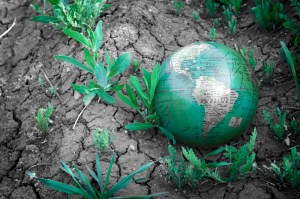 This is why, with a growing human population, agriculture and food production at large, managed in a sustainable manner, will become increasingly strategic in the future, and sensible management of water resources will be a key factor for the success of agriculture as well.
Copyright 2009 The Happy Future Group Consulting Ltd.
 Here is a funny coincidence, as I wrote about innovation as the way forward for the animal feed industry, today I found this article about innovation in the chicken market in order to drive chicken consumption and improve profitability.
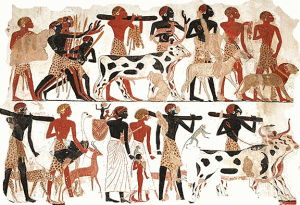 The domestication of animals for food production started thousands of years ago, and has gone through a slow evolution since then. In the last 50 years, we have intensified productions systems to a very high degree. Aquaculture, although not unusual in ancient times, has really experienced an economic boom only rather recently, and future growth predictions are quite optimistic.
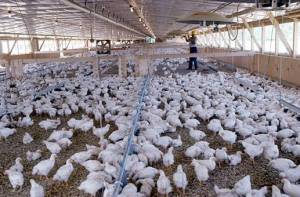 With high densities of animal in some regions, animal husbandry has had to deal with a number of health issues, such as not long ago avian flu and swine fever. The presence of large number of animals in limited areas has increased the “disease pressure” on farms and regions, making epizooties quite devastating, considering the amount of culling that health prevention measures require. This always takes a heavy economic toll, and not only on farmers. This has forced many countries to review their policies about intensive animal husbandry and downsized the sector.
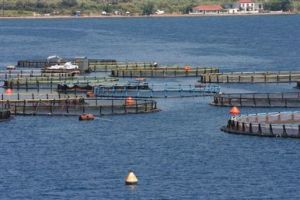 Therefore, above, I have tried to sum up the most noticeable results of intensification of land animal production. Clearly, there are lessons to be learned for the “new” aquaculture industry, and by this, I mean the intensive, high investment aquaculture. Most companies involved in this business have been inspired mainly by the evolution-and the success- in the chicken industry. They try to copy and adapt a similar model. Therefore, it is rather predicable that they will have to deal eventually with similar consequences.
 The Food Futurist Solutions - Anticipate, Adapt, Succeed