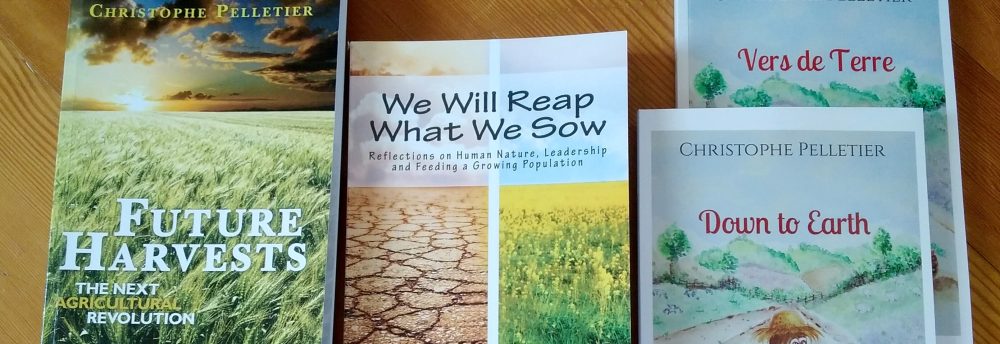
The next agricultural revolution

(Excerpt from my upcoming book, Future Harvests)

The next agricultural revolution to feed nine billion people will be different from the previous one. After World War II, agriculture advanced thanks to chemistry and petroleum. This time, biology and renewable energies will lead us to progress. It will not be just a revolution in science and technology. It also will be a different way to think about the economy and the environment. Knowledge and communication will become increasingly important, even more so than today.

Agriculture is a life science. Biological solutions will gradually replace chemical applications. All sorts of organisms will be involved to improve the way farmers and the food industry will produce.

Bacteria and viruses will help fight pests and diseases. They will help us reduce our use of chemical herbicides and pesticides dramatically. Genetic engineering will evolve and, as a business, it will mature. DNA science will focus on eliminating flaws and on increasing the metabolic efficiency of living organisms. Genetic engineering cannot continue to be about intellectual property and patents. Soon, seed companies all over the world will know how to do the same. Competition and market forces will determine which model will survive. Governments will not allow a select few to control food. They will get involved in genetic engineering programs and they will break monopolies. Genetic improvement will become collective property again.

Ecology will be a part of food production. Agriculture will manage ecosystems, and economy will become the management of the planet. Living organisms on land and in water will assist us. Farmers will think in terms of systems and cycles. Instead of isolating the field, they will integrate environmental parameters as well.

Organic matter will become central in the future agriculture. Farmers will recreate the cycles to improve the structure of the soil and its fertility. Agriculture will help fixing carbon. The use of mineral fertilizers will decrease sharply.

The economics of agriculture will be different, because the economics of energy will be different. New technologies will come. Solar power and wind energy will become common sources of energy. The economics of water will change, too. The management of water will reshape our food production. Water will become substantially more expensive and only systems that save and preserve water will survive.

Information technology will help make decisions faster than ever before. Portable computers will give the farmer the ability to get data almost instantly about the status of the crops, markets, health status and conditions of production. It will allow them to optimize inputs and outputs better and faster. It will save time, inputs and money. Knowledge and information will be our best tool to act efficiently and to improve our food production.

Transparency will become the rule. There will be no secret because consumers will be better informed and because there will be nothing left to hide.

The most critical part of the next agricultural revolution is leadership. Having a responsible long-term vision is critical, but it will not be enough. The world will need leaders that will make the right things happen. In all sectors of the society, there will be a need for such leaders who can muster the energies and who make the general interest and the long-term come first. The need for food security will alter our governance systems, in government as in business ethics. A challenge will be to manage greed and fear. First, there will be greed. Then, there will be fear. Until this day, humans have done a poor job of feeding the world. Famines have come and have gone and there still are hungry people. Humans have done a poor job at preserving their environment, too. With nine billion people, such a poor performance will have much heavier consequences. Procrastinate or being sloppy are attitudes the world cannot afford anymore. The proper leadership will come, but the change will not happen per accident. There will be a heavy crisis first.

Agriculture will regain its place in the economy as the most important activity. A change in the attitude towards funding and investments will also be part of the revolution. More players will engage in agriculture because returns will be higher for all.

The revolution will not just be for farmers and the other players in agriculture to carry out, but consumers will have their share to deliver. A change in mentalities is necessary. Wasting food is not acceptable. Selfishness will not work anymore. Food security is not a given, it is work in progress.

Copyright 2010 – The Happy Future Group Consulting Ltd.

The fun of writing this book

Over the last few months, I have been working quite a bit on writing this book about the future of agriculture.

I must say that compiling in one book a wide range of topics that, without any doubt, will be part of the future of our food production has been an exhilarating experience.

From demographics in full motion to the latest in technology, we can envision many different scenarios to set up the most efficient food production possible, as local farmers, industry NGOs and governments will need to find optimal solutions with the land, the water, the labor force and the capital available to them. Water and soil will be of vital importance, and their proper management is essential for the stability of many countries.

In the future, there will be no room left for wastage and inefficiencies, or we all will be punished if we get complacent. Similarly, we will need to change our thinking and accept that solving future problems will not be about transferring a one-fit-all model to very diverse situations. We might have had the illusion that it once worked, but it actually did not. We will learn from the mistake of the past to perform better. Sustainability is not an option; it is the only choice, because per definition what is not sustainable is doomed.

As food is a necessity, and since when we share between 9 billion people there is less left for each of us than when we shared between 4 billion, efficiency will be paramount. This will affect food prices and social stability. Technology is necessary but it is not the panacea in itself. The most needed resource for the future is strong visionary leadership to help us develop the plan for the next decades.

Let’s prepare ourselves for a deep change and we must accept the idea that we might have futuristic farms run by robots, satellites and computers in some regions as well as local urban gardeners in the heart of the cities, where 70% of the world population is expected to live. We will have small organic farmers and we will have large industrial farms using genetically engineered crops, but we also will have large highly efficient semi-organic farms that will combine the best of both worlds. We still will have specialized farms as well as mixed operations. Hydroponics and aquaponics will grow substantially in the future.

Today’s diet will be revisited and excesses will be out of place. Should we become vegetarians or do we simply need to eat less meat? Will aquaculture live up to the expectation and become the main source of animal protein? You will find out in the book.

Countries will have to think on how to guarantee food security to their populations. If it is not done well, this challenging task might end up in serious conflicts. Foreign and private investment in land and farming will continue in Asia and Africa. If managed properly, they will bring much prosperity to these regions, but if not managed properly, then we can fear the worst.

All these topics and many more will be presented in the book and I hope that it will help readers to understand all the variables that are at play, as well as it will help them get a more objective view of many controversial topics such as GMOs, nanotechnology or in-vitro meat. Once readers will have finished the book, they will be able to figure out whether and how we can feed 9 billion people. Thanks to examples from all over the world in as diverse countries as Uganda, Kenya, the USA, China, Indonesia, India, Brazil, Argentina, France, The Netherlands, Cuba, Kazakhstan and many more, we discover a myriad of different situations and solutions that illustrate human ingenuity to produce food.

However, for now just a few more months of patience as I need to get through the process of publishing.

Aquaculture: the solution to feed 9 billion people?

Last week, BioScience published an article based on the research of a group of researchers from the CSIC (Consejo Superior de Investigaciones Científicas), the Spanish High Council for Scientific Research.

They present their views on the potential of marine aquaculture to provide enough food for the growing world population. The authors of the report do not see fisheries as a significant option anymore, as the wild fish stocks are depleted, and the amount of time to replenish the stocks will be too long for fisheries to be able to meet the needs of the population. Aquaculture has gradually compensated the demand for fish that fisheries were not able to supply, and half of the seafood consumed today already originate from aquaculture. It is the fastest growing food supply activity and the projections for future growth are very strong. The researchers think that marine aquaculture could multiply its production by a factor 20 by 2050 and thus would play a major role in providing the world population with animal protein.

They bring up some interesting facts about agriculture and land animal farming. For instance, it takes 10 times more water per calorie to produce meat than it does to produce grains. Further, animal meat products represent only 3.5% of food production, but they consume 45% of the water used in agriculture. Considering demand for meat is expected to increase by 21% between 2005 and 2015, and will keep on increasing, this will only exacerbate this situation.

Another point that this group raises is the global nitrogen-use efficiency in animal productions. According to their sources, it is slightly more than 10% for land animals (5% for beef and 15% for pork), which makes their production a major source of nitrogen inputs to the environment. In contrast, marine animals have much greater nitrogen-use efficiency, at about 20% for shrimp and 30% for fish. Therefore, marine aquaculture culture releases two to three times less nitrogen to the environment than livestock production does.

From an environmental point of view, the idea of shifting the production of animal protein from the land where it uses scarce resources such as land and water, to the ocean where space and water are no limitations anymore sounds very sensible. From a nutritional point of view, replacing meat and dairy by seafood that is rich in healthy components such as omega-3 fatty acids is quite attractive, too.

They also notice that the land available for agriculture is shrinking, due to soil degradation and urbanism. Further, there is a growing scarcity of fresh water and increased competition for water as well. Therefore, activities on land do not offer the potential to grow all that much more food to feed the growing population. Even freshwater aquaculture faces these limitations. Freshwater aquaculture currently 57% of total aquaculture, therefore there is an untapped potential with marine aquaculture, as it does not use fresh water.

Of course, the main challenge to execute such a development of marine aquaculture production is to find the proper quality and quantity of feed. The researchers do not see the use of fishmeal and fish oil as an option anymore as they predict that the species used to make these products will not be able in sufficient quantities. Replacement by protein and oils from agriculture crops is an option for the short-term, but as aquaculture volumes would increase, the competition for these ingredients with meat production will make them too expensive, and for the reasons explained above, depending on land agriculture to feed marine species will face crop production limitations. Therefore, they prefer to envision a total new approach of aquaculture feeds, and recommend developing a new feed chain based on aquatic ingredients, such planktons, microalgae and seaweed. This approach makes sense, but the time lines to develop such a supply source and the cost of production of such an “aquatic” feed still need to be investigated. Several “seaweed farms” in production in China show interesting results and they seem to promise a strong potential of production for feed.

Another development that they expect is offshore aquaculture. Aquaculture operations located in coastal areas, although they are easier to access and generally in quieter waters, are very often located in zones where there are local issues to deal with, such as interaction with wild fish or recreational activities. Moving offshore can reduce these issues.

As you can see, developing the future of aquaculture is not simply a matter of growing fish in pens, but it requires a broader thinking that includes not only the oceans but agriculture on land, too. The future of food will require from us the ability to manage the whole planet!

Copyright 2010 – The Happy Future Group Consulting Ltd.

Who will be the farmers of the future?

While most of the discussions about the future of agriculture and food tend to focus about how to feed 9 billion people, and about whether it should be organic or industrial, one question seems to be left aside, though it is a very important one: who will be the farmers.

If the forecast of the UN is correct and by 2050 when we are 9 billion, 70% of the people will live in cities, while today this number  is only 47%, this means that in fact the rural population will decrease by about 25% from the current numbers (2.7 billion vs. 3.6 billion today). This means that there will be a lot less farmers in the future.

Farmer of the futureSo, who will they be and where will they be?

A lot of the good agricultural land is in the Northern hemisphere, and in areas where not only the population numbers  are stagnating, but these are regions where the average age of the population is increasing from an already rather high level of about 50% of the population older than 37. These regions, North America, Western Europe and Eastern Europe are not likely the countries where we can expect a surge in urban population. This will happen mostly in Africa, Asia and Arab countries.

These Northern hemisphere countries already have large commercial farming structures and, unless they train many new farmers, the concentration trend is likely to continue, meaning even less farms, and larger farms than today.

In countries where the agriculture infrastructure is more fragmented and farms are smaller, which are the countries where the urban population is going to increase the most, there clearly is a need to rationalize production and increase yields to feed this new population that will have very little possibilities to grow food where they live. This means a “revolution” in the way agriculture will have to be organized and structured. Asia and South America have already engaged in this process for a few decades, yet depending on the countries they will face different challenges, mostly about access to water and ensuring the sustainability of their environment.

The continent where agriculture has stayed the most traditional is Africa, where a large share of the land is used for subsistence. Many African countries have struggled for years with poor policies and a lack of investment to help a proper development. This has resulted in lower yields over time. As such, this also means that Africa is the continent with the highest potential for improvement, although this would have to be managed very carefully, as climatic and socio-cultural conditions are very sensitive.

Therefore, we can conclude that in the future, not only will we have fewer farmers, meaning fewer farms, but also in the same time, we will need to increase production and train a new generation. All of this will require a fair amount of capital that many farmers alone cannot afford, especially considering how their income situation usually is.

This will be no surprise to see more capital coming from large corporations, investors and governments. This is already happening in Africa with the land purchases and leases, and we can expect his to happen. There is a huge (rather captive) market where demand probably is going to outpace supply, and there is a lot of capital waiting to enter markets where money can be made in trade activities.

Farmers wanted!

Copyright 2009 The Happy Future Consulting Group Ltd.

Feeding the world in 2050 – FAO coming summit

This question seems to keep many people busy, and this article sums up a number of conclusions drawn by the FAO about the subject.

The information that I find the most interesting is their estimate of the percentage of the world population living in cities, moving up from 49% today to 70% by 2050. Expressed in number of people living in rural areas, this means a drop from roughly 3.2 billion people today to roughly 2.9 billion people in 2050, or around 10% less! This clearly indicates that the future of food supply is not with small farms, but that large units will have to do most of the work in order to feed everyone.

When it comes to their estimate of a necessary increase of 70% of agricultural production to meet the food demand, I have some reservations about their expectations. I doubt that with such a tight supply, people will eat as much meat and animal products as they claim. I believe that money will talk and meat being more expensive that they expect, the diet will probably include relatively more vegetal products and relatively less meat than the numbers that they present.

As I showed at the end of my previous article titled “Price of fish and meat: up”, a healthy readjustment of the Western diet will free a lot of food to feed many more people. As per today, we already are much closer, theoretically, to be able to feed these 9 billion people than we think. I say theoretically because the main problems are:

  1. Guaranteeing access to food through proper infrastructure, which in large part rests on the shoulders of politicians, and
  2. Ensuring that people have enough money to pay for food.

For those who claim that we need three or even four Earths to deal with the problem, clearly, their assumptions are based on having the whole world on the American diet, but that will not happen. We have only one Earth and that will not change. Other things will, though.

Food production and environmentalists: time to co-operate

Food is loaded with emotional symbolism. Therefore, this is no wonder that agribusiness industry and environmentalists regularly have conflicts.

After my graduation, I remember reading a book on such matters, which had as introduction about half a page of complaining about how low the quality of bread had gone. The funny part was that the complaint had been found on some ancient Egypt papyrus document!
The agribusiness, being a business, is about making money. As such, this is not shocking since this is what business is about. Of course, this is acceptable as long as this is does not imperil us, and this is, in my opinion, where environmentalists play a very important role. They balance the power and challenge what the food industry does. This is very useful, as it stimulates thinking about what we do, and it can help stopping us from making mistakes. The problem is when this debate slides into the dogmatic and doctrinal sphere. Then, this is no more about the general interest, but about partisan interests only. The debate shifts from the moral to the political.

On the one hand, we have aggressive opponents to the industry, unfortunately too often supported by the media, because sensation is good for ratings. On the other hand, we have the industry that tends to react too rigidly and too defensively, as they resist change very often because of short-term production costs increase, while on the long term they actually delay the possibility of securing their business. Moreover, they spend a lot of money for lobbying purposes, which could be invested in the systems of the future.

Clearly, neither approach benefits the general interest. The sad thing is that both sides always claim to possess the absolute science to demonstrate their points of view. The main result is that the public opinion is confused, which is normal, since unless you are a specialist of these matters, there is no way of knowing who tells the truth. Once, I was attending a conference organized by Marks & Spencer on public perception of animal husbandry and animal production practices. The master of conference then said one very relevant thing: the main source of scientific knowledge for the public over there was The Sun (very popular British tabloid), not Scientific American!

I believe that most has been said in the debate between the food industry and the environmentalists. They rarely say anything new, just the same old things being repeated over and over again.

Not everything is perfect in the agribusiness, as it is work in progress; and consumers deserve to be properly informed, so that they can cast their vote when they shop by electing the good products and rejecting the bad ones. Eliminating bad practices is exactly what can benefit us all.

This cannot be done through confrontation only. It is highly frustrating to hear people opposing something while not offering a solid alternative based on solid evidence, facts and thorough analysis.

The way of the future is a co-operation between the industry and environmental groups, by joining not only their knowledge and science, but also their financial and business understanding to develop and support sustainable solutions. By joining forces, they will help us develop a better agriculture and find the most sensible ways to feed nine billion people and preserve our ecosystems. Such an approach has already started, for instance with the WWF (World Wildlife Fund) and Unilever that created the MSC (Marine Stewardship Council), which certifies sustainable fisheries. The WWF is busy with a similar approach with aquaculture. In Brazil, the beef industry has agreed with Greenpeace on a moratorium on deforestation and they will not expand their ranches at the expense of the rainforest anymore. This type of co-operation needs to be developed to a much larger scale!

Copyright 2009 The Happy Future Group Consulting Ltd.

The challenge of feeding the world and preserving the planet

The world population is increasing at an amazing rate.
From 6 billion people on the planet in 2000, we will be 9 billion by 2050; an increase of 50%; and we were only 3 billion in 1960.

By looking how much damage has been made to the environment and the huge depletion of natural resources that we have created in the last 50 years (or last time the population grew by 3 billion), one can wonder how we will be able to feed, shelter, provide water and energy to the whole population in 40 years from now.
When it comes to feeding the world, the first question that comes to mind is where can we produce 50% more agricultural products on a land area that will decrease as a result of more area needed for urbanism (unless, we grow cities in height) and 50% more demand for drinking water than now. And these percentages are actually very conservative if we think that the emerging countries are seeing their standard of living increasing, which unfortunately also means that more resources are wasted than just the incremental growth of 50%.
We need to feed 3 billion people more who on average will tend to eat more animal protein at the expense of grain and legumes. This demand for animal protein means more competition between humans and farm animals for the grains and legumes. So, we have less land available to grow so much more food of vegetal and animal origin.
We could consider increasing the agricultural area, but this means more deforestation and a strong reduction of natural habitats. More agriculture will mean more use of energy and water, which will have a huge impact on our environment and the price of commodities. And I am not even taken in the picture the fact that we also want to feed our cars with agricultural product, bio-ethanol.
On the other side of things, we hear more and more calls to restore more balance our environment, to use our resources more carefully. And this is the challenge, if not the dilemma of the coming years: we have only one Earth and it is not expandable, while our population is exploding.
How will we be able to meet both targets? Personally, I do not have the answer to this, but I am sure of one thing: a dramatic change must come, either of our own free will or forced by Nature, and we need to anticipate for this as this will require an adaptability as mankind has not known for a long time.

Copyright 2009 The Happy Future Group Consulting Ltd.