
We all have heard about this rule across all industries, including agriculture and food. Eighty percent of the food would be produced on 20% of the farms and vice-versa. If it still applies in the future, it can indicate us how our food production and supplies will look like in the future. Of course, this is always a theoretical exercise, but it is quite convenient to elaborate on our thoughts.
As the population is expected to grow quite strongly in the coming decades, especially in urban areas, this could indicate two dominant trends:
• Further size increase of the largest farms and further industrialization of agriculture and food for global markets, although the number of farms in this segment would not increase strongly.
• Strong increase of the number of small farms involved in specific value chains and strongly linked with their local economy.
Industrial agriculture
 This group will continue to be involved in mass production of commodities for global supplies, like this is the case today.
Yet, they will face an increased pressure to adapt to the requirements of sustainability, which technically is quite possible. New systems and more efficient technologies will be the pillars of its growth and development. They will have to find ways of reducing the amount of chemicals in crops and the amount of pharmaceuticals in animal productions
The requirements for capital will be quite high and the sector will be led by increasing larger corporations, by an increasing level of capital by large private investors and, last but not least, by some governments. This agriculture will innovate further and will be developed thanks to this capital. It will use automation and mechanization to reduce the dependence on labor. Mergers & acquisitions will continue in the agricultural sector and a few large blocks will remain, dominating their sectors.
Their mandate will be about more control the natural conditions of production and about reducing to a minimum their impact on air, water and soil, by using less polluting transport methods, water preservation, effluent treatment and soil preservation. They also will have to engage in maintenance of their environment.
The role of this type of agriculture will be to bring to market large amounts of affordable food for the masses, and should play an important role in strategies around food security, which is where corporations and government will interact on a regular basis.
Local food value chains
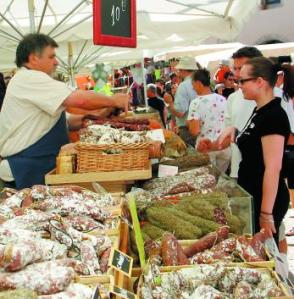
 This sector should undergo a strong growth and be build in a market-driven approach. These are the farmers that produce specialty products aimed at serving either a very specific segment of the retail or foodservice market.
This trend, which has been already initiated around concepts such as organic or authentic, will evolve into a more integrated local economy, and the initial concepts will probably become less differentiated as food production in general, be it industrial or traditional, will use more sustainable techniques.
Contrarily to the common belief, this agriculture will be developed thanks to very efficient techniques, but will be centered relatively more about labor and relatively less about capital. In this case, efficiency does not necessarily mean intensification.
We must not underestimate the significance of this part of the food production, as it will play an important role. However, we must not expect this type of agriculture to be the solution to feed the world, and this is not the purpose of the farmers involved in such food production chains.
This type of farming will grow in two different environments:
- In “developed” countries to serve a increasing, but aging, population more demanding about the origin and the production methods, and who is ready to pay a premium for the perceived better quality. The angle will be about quality, transparency, sustainability, traceability and as close to zero a use of chemicals and pharmaceuticals. In some areas, it could help strengthening a local economy and local communities.
 In emerging countries, the development of a local agriculture, and aquaculture, will be a key driver of economic development for under industrialized and/or under urbanized regions. It also will be a way of slowing down the migration of population to urban centers and limit social problems, by creating satisfying economic conditions and by securing food supplies locally. This farming will be about basic needs, before marketing.
Copyright 2009 The Happy Future Group Consulting Ltd.
 In order to understand what changes are ahead of us, we need to realize that opposite forces are engaged in shaping the world of the future. As we all know, accepting change is always a slow and sometimes a difficult process. There are those who see the possibilities and those who see the drawbacks. The first train was going, supposedly, to get cows stop giving milk, but we now know that cows love to watch trains passing by. Probably, the first caveman who drew a picture of an animal on the wall was considered by some as a great magician and probably by others as pure evil. As such, such a struggle is very useful, as on the one hand it shakes immobility and open new doors, and on the other hand it prevents us to rush into the unknown without thinking first.
 More technology to improve efficiency of water use, fertilizer use, animal feed use, land use, energy use (objective: zero waste).

 With an increasing population that needs more food and more water to live, we can expect that water is going to become a highly strategic and needed resource. As climate changes, the current rain distribution and geographic availability of water is likely to change dramatically, too. This increasing competition between agricultural areas and urban areas will bring major changes on how we use water for both personal use and for food production. On the personal side, we certainly can expect that current bathroom systems to disappear, as they use too much water. Every time we flush a toilet tank, we actually waste the daily drinking water needs of a couple of people, and local water reserves are gradually depleted as well. Clearly, this has no future. Similarly, we can expect the legislation on water use for lawn sprinkling and car washing to change.
 More efficient irrigation systems will replace the old ones. Computerized systems are already in use in wine production, using sensors for humidity and temperature, to determine how much water the plants needs at the most optimal time of the day and deliver it at the exact spot. You can expect that such an optimization approach will prevail. The path that Monsanto follows with the production of genetically modified (GM) wheat that needs only a third of regular wheat varieties is quite interesting. The tricky part is the GM part, as on the contrary to natural “mutations”, such a process does not undergo natural selection, and therefore we do not know what possible side effects it might bring. Nonetheless, this is an attempt to deal with future water shortages. Hopefully, other less controversial solutions can be found that will deliver a similar result. Once again, we can shape our future through continuing innovation.
 Technical progress improved yields and productivity, while marketing was aimed at creating more, and new, needs. Our food has become standardized, industrialized, and processed in a wide variety of forms. As the emphasis moved to lifestyle and convenience, which came along with the rise of mass distribution, cheap energy and suburbia, we lost the connection between ourselves, the origin of our food and nature. Food became just things you buy at the supermarket, already packed in plastic and cardboard.
 We still are in a society where some people get obese by eating lots of food as quickly as they can, while they have less physical activity than the previous generations, thanks to automation. That food is produced on intensive farms and feedlots where the animals grow and fatten as quickly as possible, as they eat lots of food, while not having much physical activity. Similarly, in our society meat producers use hormones to boost growth and carcass quality, while body builders and sport professionals use steroids and growth hormone to boost their performance. Interesting similarities, don’t you think? We are indeed what we eat.
 As such, a feed mill is a rather simple process that feed producers know and master. To put it in simple terms, the recipe is prepared in a big kitchen blender. As a very standardized industrial process, the focus, for a given quality specification is to produce at the lowest cost possible. So, has feed become a commodity or are there ways of offering added value to farmers?
 The Food Futurist Solutions - Anticipate, Adapt, Succeed