
From all economic activities, agriculture seems to have a different status. While most of the polluting industries with unsustainable processes or products seem to look to a cleaner future through new technology, it sounds as if agriculture can have a future only by downsizing. Everyone seems to support and praise the move to green new technology in all industrial sectors, but when it comes to agriculture, the most vocal proponents of sustainability seem to reduce the possibilities to only organic and small scale farming. This in my view is very simplistic, and may fit in the North American city baby boomer nostalgia of things that never were, but it is not the solution for the future when we look at it from a global perspective. However, it is quite clear that food is loaded with emotional and psychological symbolism.
Of course, I am not the cross-industry sustainability guru, but I do not seem to hear the requirement for most other industries to go small scale. Where are the voices to demand that we get rid of large factories, and go back to small local workshops? Yet, for instance, that would hurt the toy industry in China for sure, although it could make sense as most of the production is bought in the West.
Why don’t we hear many voices to encourage the search of better practices that fit with modern and efficient techniques? We have reached a level of scientific and technical knowledge that we never have before. This can help us having the best of both worlds by combining old empirical techniques with new high-tech ones. We can be so precise and efficient in the use of water and fertilizer to feed the plants with exactly the right amount of what they need when they need it. By combining the old and new, we can protect and improve the fertility of the soils, we can reduce the amounts of pesticides and herbicides, and we can reduce the amount of antibiotics. We can do all the things that the small scale organic farmers currently do, just on a bigger scale, because, as I have mentioned in previous articles on this website, like it or not, feeding an increasing world population will require large scale agriculture, too. The main challenge that we are facing is to figure out the right economic model. A large-scale sustainable agriculture requires a shift in how we distribute the land, the capital and the labor. The only reason why manufacturing production units moved to other countries over time is purely because of lower labor costs. It has very little to do with proximity of markets, with location of raw materials, environmental or social reasons, or any other common sense thinking. The only reason is to maximize profits.
What we lack to make the move to the future is a plan. We tend to stick to the present, and to some extent to the past, too. We need people who, like me, will ignore the emotional baggage and figure out what are solid and successful models taking into account the local situations, and consider without prejudice the best possibilities that the knowledge that we have acquired through the millennia has to offer.
Copyright 2009 The Happy Future Group Consulting Ltd.


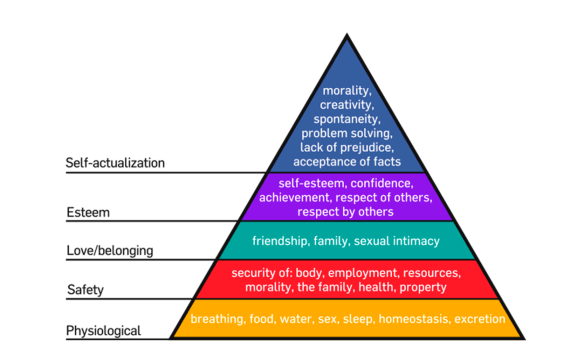 The hierarchy of the needs that we must fill can be easily identified according to the pyramid of Maslow: food and water, shelter and physical safety. Once this is achieved, adding other activities become more natural and simple.
 There is a growing concern about environmental and health aspects of food production. About the environment, you can list very diverse things such as the depletion of wild fish stocks in the oceans, the interaction between aquaculture and wild fish stocks, manure and smell of intensive animal husbandry and impact of manure on soils and drinking water, deforestation of rainforest for ranching of beef or about growing GMOs (Genetically Modified Organisms). On the health side, consumers worry about food poisoning due to bacteria, such as E. Coli, listeria, campylobacter and salmonella, but also about residues of pesticides or antibiotics, as well as they worry about the use of hormones in animal productions. As the discussions get more animated in the US about the reform of health care and the cost of obesity, more and more people are wondering about whether the fast food diet is a proper one. Next to this, animal welfare is a growing concern by more and more consumers.
 This group will continue to be involved in mass production of commodities for global supplies, like this is the case today.
 This sector should undergo a strong growth and be build in a market-driven approach. These are the farmers that produce specialty products aimed at serving either a very specific segment of the retail or foodservice market.
 In emerging countries, the development of a local agriculture, and aquaculture, will be a key driver of economic development for under industrialized and/or under urbanized regions. It also will be a way of slowing down the migration of population to urban centers and limit social problems, by creating satisfying economic conditions and by securing food supplies locally. This farming will be about basic needs, before marketing.
 As such, criticism is not a bad thing as long as it is not done in bad faith with the only purpose to bring damage. There is nothing wrong with consumers being concerned about the quality of the food they eat, and about the way it is produced. Being worried about whether and how antibiotics or hormones are used, about the potential problems to the environment linked to intensive production is quite legitimate when you are rather ignorant of production techniques. After all, nobody has ever claimed that any industry was perfect, and business is always work in progress. It is utmost important for all of us to have watchdogs in order to make sure that we do not get into excesses that can lead to irreparable damage.
 In my opinion, the only proper way forward about information on agriculture and food is transparency. Only transparency can eliminate (or at least reduce to a minimum) negative publicity. Only by being candid and open about the way food is produced, can the agricultural community inform properly the public.
 This is an
 The Food Futurist Solutions - Anticipate, Adapt, Succeed