Soylent Green is on some people’s minds

Funny how coincidences occur. In less than two weeks, I heard several times about Soylent Green, the futuristic movie. It came first in a couple of conversations I have had about the book I am about to publish (hardcopy proof is on its way to me), and it came up in the very serious French economic paper Les Echos, too. Considering the area I am involved in, I had to find out more about Soylent Green.

Soylent Green is a movie made in 1973, starring Charlton Heston. As such, I would not describe Soylent Green as a great movie, but it contains some interesting elements that resonate in today’s environment. To sum it up, the action takes place in a devastated New York in 2022, where 40 million people live is dismal conditions. The planet is in bad shape, the economy is just as bad and food is scarce. A powerful multinational, Soylent Corporation controls food supply, thanks to its very successful product Soylent Green, a high protein food. Natural foods are very difficult to find. Strawberries sell for $150 a jar and to get beef, one needs to have the right connection. Cooking is a lost art, but some still have the nostalgia of the yesteryears, when life was good.

Although made around the time of the first oil crisis, it mentions very current topics, such as a collapsing economic system, greenhouse gases and the power of multinationals over our food supply. That is not bad, considering, it is almost 40 years old, an age than more than half of the world population has not reached yet. The author certainly had a strong vision of where our world is heading.

The plot is rather creepy, though. The production of Soylent Green is anything but appetizing, and quite different from plankton as mentioned at the beginning of the movie. You can watch it here: http://www.watchonscreen.com/videos/1549/soylent-green-is-people.html

For those who may worry, my book envisions the future of food production from a very different angle.

Some basics about nutrition and metabolism that can improve your life

With obesity on the rise in more and more countries and legions of diets with little results, if any, I had been thinking about writing something about proper nutrition and some of the key physiological mechanisms involved in human metabolism. It is a bit away from envisioning the future, although the fight against obesity will gain momentum in the years to come.

There are many misconceptions out there. For instance, we all have heard that carbohydrates are not good, fat is not good or meat is not good. This is total non-sense. Carbohydrates, fat and protein are good. Actually, they are indispensable to our health. What is bad is too much, especially too much of the nutritionally poor quality carbohydrates, fats and protein sources.

Obesity and overweight are increasing health issues. In the world there are about as many overweight people as they are people suffering from hunger: around one billion people in each group. What causes overweight? The answer is simple. A person gains weight when he/she ingests more calories than he/she burns. The cause can be either too rich a diet and/or not enough physical activity. In most cases, it is a combination of both. The source of unburned calories are metabolized into fat and stored in the fat tissues. This is a problem, because fat tissues are poorly irrigated with blood vessels. This makes the stored fat difficult to eliminate. The body will use calories coming from the meals before it uses the fat reserves. This is why it is so difficult to get rid of extra pounds. The only way to use the fat reserves is through long intensive physical activity.
Some might wonder why our body does not tell us when to stop eating. Actually the body does, through two physiological mechanisms. One is a mechanical mechanism. When the stomach is stretched, the nervous system sends the information to the brain that the stomach is full and the brain makes us stop eating. The other mechanism is biochemical, through the blood composition, the brain sensors can detect when we have ingested enough energy, and the brain makes us stop eating. We feel “full”.

This could make you think that we should never overeat because the brain would let us know on time. Theoretically, this is true but the modern lifestyle has found a way of deceiving the brain. The biochemical mechanism takes time to react. It needs to detect a glycaemia level high enough to act. When we eat food and beverages that are highly concentrated in energy, and therefore have a relatively small volume, we ingest more calories than we would need before the stomach gets stretched, and before the glycaemia level rises in the blood to the normal level. Such foods are generally low in fibre and high in fat, such as fried foods. Soft drinks are not filling and they contain many calories. You can imagine the result of a combo bacon cheeseburger-French fries-pop package meal! The carbohydrates that they contain pass in the blood almost instantaneously. One of the advantages of fibre-rich food, such as fruit and vegetables, is that they fill the stomach and contain relatively few calories per volume unit. This activates the mechanical nervous mechanism and limits our food intake much faster than foods with little fibre. Do not fool yourself! The little leaf of lettuce in your burger is not enough to protect you.

This brings me to talk about carbohydrates. There are two types of carbohydrates: the slow ones and the fast ones. The main representative of slow carbohydrate is starch. Starch is a long molecule that does not get into the blood stream as such. When we consume starch in bread, rice, pasta or potatoes, the starch gets cuts in a smaller component, called glycogen. The glycogen is stored in the liver where it waits for instructions from the brain to be released in the blood stream. This happens through a biochemical mechanism. The brain sensors detect a state of hypoglycaemia, and it orders the liver to release the glycogen. As long as our liver still has glycogen in store, we do not feel hungry. The system regulates itself smoothly. When we run out of glycogen, which is between 2 and 4 hours after the meal, we get into a hypoglycaemic state and we feel hungry. Usually it happens around 11.00 am and noon. That is why lunch exists! Same thing happens around 5.00 pm. Starch is good and necessary for us (as mentioned before, too much, on the other hand, is not).

The second group of carbohydrates, the fast ones, follows a different process. This group consists of what we call sugars, such as saccharose, fructose or glucose. When ingested, they do not get stored for later release, unlike starch. They flow into the bloodstream almost instantaneously and there are two possible scenarios. If our activity level is high enough when we consume them, they are burned to provide us with energy. If our activity level is too low for the amount we consume, our metabolism deals with the fast carbohydrates in only one manner: it transforms the sugars into fat that then get stored in the fat tissue. This is why drinking large amounts of pop or snacking on candy bars while sitting on your couch watching TV or playing video games will make you fat. There again, the rule is enough sugar to sustain yourself is good, too much consumption is bad.

About fat, I can tell a similar story. Within the amount necessary to allow all our functions to work properly, fats are fine. As their name indicates, essential fatty acids are indispensable. Even the dreaded cholesterol is an essential element for us. What is not good is to consume too much fat, and to consume too much of the less good ones. The length of the carbon chain, the level of saturation and the configuration of the molecules also affect your health. The excess of fat in your diet will end up as fat deposit in your body. This is why potato chips while watching TV will hurt you, too.

Protein is good, but with moderation as well. As for the other elements, too much protein can cause some problems, as protein stored in the intestine before release will not ferment, unlike fibre, but will undergo a rotting process, resulting in the production of harmful amines. The kidneys have also more work to do, and a long exposure to a diet too rich in protein may cause kidney problems.

So, what is the lesson from all of this? For me, it is that food one of the enjoyable things in life, as long as it is consumed with moderation (an incidental excess once in a while is fine, too; it means that you enjoy life) and it goes together with a healthy lifestyle. A person should have 7 hours of physical activity (the kind that makes you sweat) per week. Also, remember that the best is to not gain extra pounds in the first place, because the fat tissue is remarkably persistent.

Copyright 2010 – The Happy Future Group Consuting Ltd.
Is science being taken hostage? The “killer canola” example

In the debate between environmentalists and industry, science is a word that comes regularly in their arguments. However, scientific “evidence” seems to be used to support an agenda instead of making us all wiser.

The recent example of the “killer canola” that has been widely spread in the media over the past week illustrates the concerns we should have about the use of science for non-scientific purposes.

To sum up the story about canola, researchers from the University of Arkansas found herbicide-resistant genetic traits included in the plants through genetic engineering in canola growing in the wild in North Dakota. They even found traits from two different GMO producers. This does not exist in commercial varieties. They claimed that they demonstrated these GMO escaped into the USA.

Of course, all media, internationally, with a bias against GMOs jumped on the occasion to make their point about the risks of genetic engineering.

Very quickly, media favourable to the GMO industry, actually funded by that industry reacted to undermine the finding of the researchers. In particular, I enjoyed this column in AG Network. To counter the results of the researchers, the author claims that most scientists reject their theory. He names only two, one in the UK and one in Canada. Is a sample of two scientifically representative? I think not. He does not review the protocol of the research. Does that mean it was in order? I would tend to think so; otherwise, he would surely have attacked it. His main argumentation is about canola not being able to thrive in the wild; therefore, the “gene escape” is about a non-event, so let’s not talk about it anymore. Case closed.

What really disappoints me in this process is the bias. The opponents of GMO see this research as a proof of their point of view without really looking into the research and challenging it, or at least asking a few questions to the researchers. The proponents of GMOs, at least this one, elude the conclusions of the research by shifting the debate to the survival chances of wild canola. The real questions that arises from this survey is to find out how a genetic trait introduced by people (therefore, not the result of natural evolution and selection) can spread outside of our control (nature does not care about intellectual property), and what can be done to have more control on this. What all participants in this debate should do is to join their science and collaborate. It deserves the necessary attention.

The purpose of science is to help us understand our world so that we can take the proper measures to stay in control of what we created. If science tells us something that we do not like, that is too bad, but what we can learn is for our best interest. In the end, it would serve nobody to take chances with food security. The long-term interests must come before the short-term ones. The example of the canola is just one out of many. I could have chosen other food production sectors with similar cases.

Selectively picking the science that suits one’s agenda is not scientific. It does not serve anyone on the long run. On this blog, I posted a poll asking what should come first between morals and science. Although, this poll has no scientific value, it shows an interesting trend that I had not expected.

Copyright 2010 – The Happy Future Group Consulting Ltd.

The Russian heat wave gives some people sunstroke

The heat wave combined with the drought in wheat-producing region of Russia is causing some concerns, as the wheat production will be affected. That is annoying but not terribly threatening. Moreover, the price of wheat, as well as the prices of other agricultural commodities were due for a rebound because farmers had reduced production after the price fall of the previous year.
But when politicians and speculators get involved, the problem takes a new dimension.  Vladimir Putin announced a possible ban on Russian wheat exports and hell broke loose. The crisis then appears on all media. From mainstream media to the financial press, the world must know that we are in very big trouble, apparently.

Bloomberg and CNBC reports on the price of wheat on the commodity exchange. The speculators are there, looming. The Wall Street Journal asks whether US farmers should plant more wheat and take advantage of the good wheat prices. The Financial Times reports about the quiet doubling of the price of barley. This is bad news for beer drinkers. Food inflation is around the corner. And what if Ukraine and Kazakhstan have the same problem? The Black Sea region is one of the main wheat producers. Even Lester Brown, of Earth Policy, flooded twitter this morning with an unusual amount of tweets expressing his concerns about the effect of climate change and the rise in temperatures. This is all well-known and well-studied stuff, but suddenly my friends, we are close to the end of the world. Or are we really? Mr. Brown even suggests that an increase of 14 F in temperature in the Mid-West would cause a drop of corn production by 50%. Considering that US corn is used for three purposes: biofuels (not food), high-fructose corn syrup (not food) and animal feed, the consequences for Americans would be positive: less driving, less soft drinks and less meat, all three items for which they largely over-consume, at the expense of their health. The ones who would hurt the most would be the Mexicans.

When hysteria hits, it is always good to sit back, reflect quietly and maybe enjoy a cool drink, as long as we can afford it.

What is really going on? Well, we have a climatic event that affects wheat production. It is not new. We have managed worse crises in the past.

The excitement comes from two events. First, speculators have been active for quite some time on the wheat market and this gives them a good opportunity to jack up the prices. Although, remember the price hike of agricultural commodities of 2008! It was all on paper and not so much in the physical world. Yet, people were hoarding food in supermarkets like there was no tomorrow. Are we going to see the futures contract impact the real economy once more. I believe that if this happens again, we will see governments take action to regulate the trading of futures contracts. The bad thing about this is that the example of the new Wall Street regulations have been very slow to take shape and will take a long time to be implemented. Therefore, the “golden boys” still have some good times ahead with markets. Second event, which has reinforced the first one is the declaration of Vladimir Putin. Should we worry about it? Yes and no. Russia is now famous for its muscle showing policies. When oil prices were jumping up, the Russian government played quite rough with oil companies, especially Shell and BP. Their relation got a chill, and later they became good friends again. Russia’s policy on import of meat and poultry shows a similar pattern. Import restrictions alternate with more relaxed policies. Russia is struggling to achieve a satisfying level of food security and it uses all the means it has to develop and protect its domestic production, while sending a message abroad that Russia is strong. In my first language, a roller coaster is called “montagnes russes” (Russian mountains). That is quite relevant to describe this country’s style.

Is the world food situation at risk? As usual, we need to be vigilant, but there is no need for more panic than last year. What we need is a global production plan and increase production on a regular basis, simply because there is an increasing number of mouths to feed. If our approach is knee jerking on the actions of speculators, we will not achieve greatness. Farmers should consider planting more when the market demand increases. That is market-oriented production! If the farmers rush to plant more out of short-term speculation, they will experience the same as after the situation in 2008. Their suppliers (the ones listed on the stock markets) will increase the prices of inputs, especially fertilizers and gobble up the margin away from the farmers, like in 2009. The reality is that food is going to become more expensive, especially animal products. We need to get used to this idea right now, because over the long-term, this trend will not disappear. We need to act with vision and determination to achieve the goals, as I describe in the soon-t0-be-published “Future Harvests”.

Today ended up on a positive note after all. US Agriculture Secretary Ed Vilsack declared that we were not facing a wheat crisis. And wheat prices eased on news that farmers were planting more. Famine averted.

We need more long-term focused leaders and fewer speculators.

Copyright 2010 – The Happy Future Group Consulting Ltd.

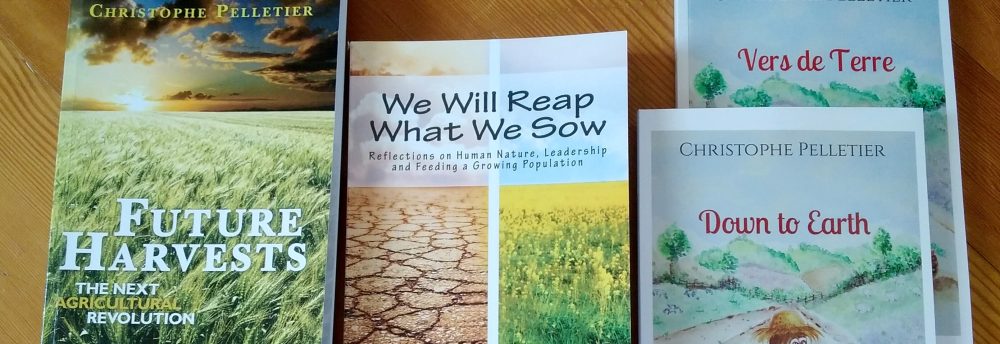
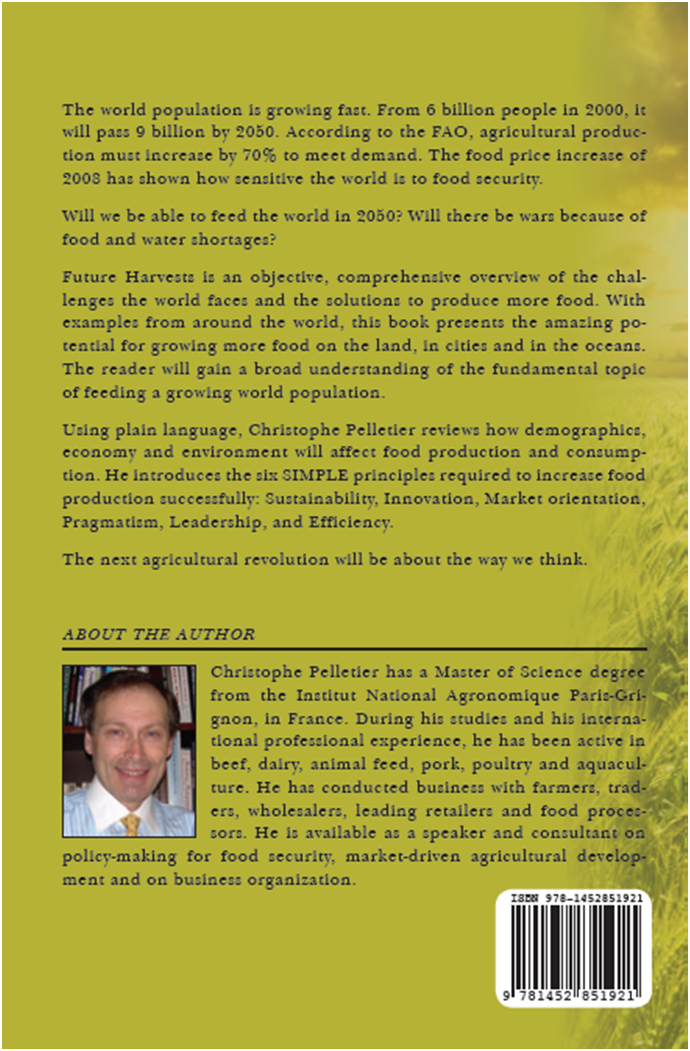
Future Harvests – A preview of the book

My book, Future Harvests, is expected to be published before the end of August.

Here is a preview to give you a flavor of the content.

For a full view, please click on the thumbnails.


Here is a sample containing the table of contents and the preface of the book:


For the video trailers, please visit my YouTube channel.

Is the food company grab the next step beyond the land grab?

In parallel with land tenure deals in developing countries, I foresee a new trend to develop strongly in the years to come.

In order to increase food security, countries in Asia and in the Arab world will invest more aggressively in food and agriculture companies.

In China, the search for acquisitions is gaining momentum. A first attempt, although failed, by China’s Bright Food group to acquire Australia’s CSR sugar is an indicator is this trend to come. But China is not the first country to initiate this.

For instance, Qatar’s sovereign wealth fund created Hassad Foods to invest in food related projects in Qatar and abroad. The purpose of Hassad Foods is to help Qatar achieve food security. They aim at developing their activities in South America and Africa, with the expressed goal of completing at least six projects by the end of 2010. Their focus is on basic crops such as sugar and wheat, but they look at projects in the poultry and livestock sectors as well. As countries realize the limitations and the political risks of focusing only on farmland ventures, they will diversify their possibilities to improve their food security situation.

As the approach of sovereign funds is to focus on long-term food security, the type of investments in food companies might change as well. This will be a different approach from activist investors, such as hedge funds, that try to influence short-term management decisions purely for share price purposes.

Copyright 2010 – The Happy Future Group Consulting Ltd.

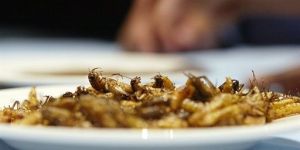
Insects on the menu

I came across a very interesting article from the French newspaper Le Monde, titled “Insects, the steak of the future”.

Photo: AFP/Mario Tama

The article reviews the potential of using insects as a food source to complement the traditional food production in order to meet the needs of the increasing world population.

Here are the main points.The nutritional quality of insects is high. They are a source of protein, fats, minerals (especially iron and zinc) and vitamins.

The production performance of insects out performs the one of traditional livestock, with a feed conversion ratio (number of kg of food to produce 1 kg of insect) ranging between 1 and 2.

There are already 1,400 species of insects consumed regularly in Africa, Asia and Latin America. Among the favorites, they name beetle larvae, ants, caterpillars, locusts, crickets, silkworm chrysalis, scorpions and spiders (although the two latter ones technically are not insects).

In most cases, insect consumption is the consequence of food shortage, but there is also a festive consumption of the bugs. The author mentions that in the old Roman Empire, caterpillars were a delicacy. Of course, in some Western countries, some restaurants offer insects at a premium price for a certain self-proclaimed sophisticated elite… After all, a lobster looks very much like a large aquatic bug.

However, trying to convince Western consumers to switch to insects and other bugs for their protein will be a tough call, especially when served in their original form. An possible alternative would be to process them into sausages and ground patties. There also could be the possibility to texture the protein in similar ways as it happens with soy.

Another interesting potential for insect is to use them as a raw material for animal feed. Bugs and worms can also be a good source of protein for poultry and pigs. After all, in nature, this was a regular part of their diet. Similarly, for many fish species, insects are a natural source of food. Currently, fish feed is made of increasingly expensive raw materials, such as fish meal, fish oil and vegetable oils, for which they compete with human consumption, or are used for feed destined to other farm animals.

There are talks about organizing the first congress on insect as a food source as early as 2012.

Copyright 2010 – The Happy Future Group Consulting Ltd.

Are “land grabs” a necessary evil?

The large land deals between African and Arab countries or Asian countries, mostly China, have drawn quite some attention.

I mentioned them in an earlier post on this blog (The great unseen land grab).

The discussion has taken an increasing political flavour, but very few people seem to look at the causes of the problem.

The reality is simple: the countries looking for land do so because they have a serious problem to feed their people and to guarantee them access to potable drinking water.

The water problem is obvious in Arab countries. In the past, they tried to grow more food on their land by developing irrigation. Unfortunately, they have concluded that this approach depleted their water reserves, while they also realize that they cannot feed their increasing population. For instance, Saudi Arabia has now turned away from its previous food security strategy and chooses to preserve water and look for other sources of food than their own agriculture. China and other Asian countries also realize that they cannot meet the increasing demand for food.

What should these countries do? Home production will not be sufficient. The first other possibility is to import, but volumes in the current world agriculture will also soon meet limitations. Keeping on buying on the world markets will solve some of the shortage problem, but it leaves the importing countries vulnerable to world market price increases. This is a threat for the domestic social stability as many of their inhabitants can hardly afford food at the current prices. These countries simply cannot remain passive. They needed to take action, and they did.

Why is Africa so attractive? Africa is the only continent where agricultural development has lagged behind. Yields are low. Infrastructure is far from optimal. Africa can increase production if African countries can fund their agricultural development. The main problem is one of money and policies. Africa has huge areas of arable land, but that land is not exploited. The FAO estimates at 700 million hectares the amount of land that could be developed for agricultural production. That area is about the size of Australia. It is twice the size of the current world wheat area. This offers huge potential.

What the importing countries bring to Africa are funds ready for investing in infrastructure and equipment. They could wait for African governments to develop agriculture and then buy from them. Considering how slow agricultural development has been in the past, this solution probably would come down to waiting for nothing to happen and cause serious food shortages in Asia and Arab countries, with all the risks of conflicts that this would generate.

The approach of going to Africa and offering to buy and develop the land makes a lot of sense. By being proactive, the importing countries actually speed up the process of getting investment money at work on the land, and the host countries do not have to worry about how to get the money.

Can these land deals work? In theory, they can. The main issue at stake is how both the importing/investing countries and the host countries set up such deals. The population of Africa is very young and it is growing fast. Africa will see its population double within the next 40 years.  Africa is also a poor continent and the combination poverty and high population increase has the potential to create many problems because of a lack of food security. Developing agriculture in Africa is the way to increase food security, but at the same time, a large part of the food produced on the newly developed land will go abroad, to China and Arab countries. This is why it is utmost important that such deals be set up as win-win situations. The foreign countries must help create agricultural and economic development in Africa in order to feed the local population by developing food production and offering employment so that they also can buy food. Failure to do so will very likely result in riots and violence against the new farms and their staff. This would not feed the local population, and could eventually result in not feeding the foreign countries either. Such land deals must be managed very carefully. The people in charge will have more than just agriculture to look after. Social, cultural and environmental aspects will play a very important role in the execution of these projects.

Africa is the continent where such deals have grown to large proportions, but similar deals are also being made in many Asian nations. It is interesting to see that other regions where large amount of investment money would be useful for agricultural development do not get as much attention from the importing countries. Yet, areas like in Kazakhstan, Ukraine or Russia could use some injection of funds, too. Brazil is starting to attract new money. For instance, the China National Agricultural Development Group Corporation has plans to grow corn and soybeans and it is looking for land in Brazil. The corporation has been allowed an annual budget of US$2 billion to realize the objectives and secure grain supplies to China.

More in my upcoming book Future Harvests.

Copyright 2010 The Happy Future Group Consulting Ltd.