Consumers shape food production systems

Although it is tempting to think that food production systems are created by agribusiness, they depend greatly on the choices and the attitude of consumers and society. For humans, food is not just about nutrition, but it is loaded with a high emotional content.

Consumer choices are highly irrational. To demonstrate this, here are some examples.

When the mad cow disease, or BSE, hit the UK in 1996, beef consumption dropped, but the behavior of consumers was odd. A leading retailer put British beef on sale at 50% off the normal price. They had their best weekend sales ever by then. When asked why they had bought beef, while there were concerns about health risks, some consumers gave answers such as “At that price it is worth taking the risk” or, even better, “ I will freeze it and eat it once the mad cow crisis is over”! At the same time, customers’ visits to the leading fast food chain drop sharply and beef burgers were not in demand, although their beef was from the Netherlands, a country free of BSE by then.

In Europe, mostly in France, consumers used to demand veal to be white. Not slightly pink, just plain white. To achieve this, calves were fed a milk powder diet, which kept them anemic. Yet, at some point, consumers denounced this technique as being against proper treatment of animals. The demand of white meat with a normal diet could not be reconciled. It took years before consumers finally understood that veal was supposed to be pink.

For most customers, white eggs are perceived as being from intensive cage production, while brown eggs are perceived as being more “natural”. Everyone with knowledge of the industry knows that the color of the shell has nothing to do with the nutritional quality of the egg. The belief that the egg color indicates a difference persists, though.

Some blind tests carried out between “industrial” and free-range chicken meat carried out in the Netherlands in the 1980s showed interesting results. When consumers were not told which was which, they could not clearly taste a difference, while when they knew which meat was from which production system, they overwhelmingly gave the preference to the free-range chicken.

Here, in Vancouver, there is a strong trend towards organic foods produced locally. Farmers markets flourish and the environmentally conscious consumers choose to buy their “natural” food on these markets. Ironically, many of them drive in their gas-guzzling SUVs to go there. So much for caring for the environment.

Who, with a rational mind, would choose to eat junk? Yet, junk food is quite a popular item in North America, and it has been a growing trend in many European and emerging countries as well.

In the case of tobacco, not a food, but an agricultural product nonetheless, the warning on the package is quite clear. Yet, some people decide to smoke.

The list could continue and I am sure that everyone has more examples of irrational behavior. Consumer demand (both the rational kind as the irrational one) determines what farmers and food companies produce and sell. In this regard, consumers also share a responsibility in what is produced, how it is produced, where it is produced and how it is distributed to them. Blaming retail or the agribusiness alone for the kind food systems that are in place is unfair.

Of course, it would be interesting to imagine what people would eat if they were rational, and what impact on our food production this would have. A rational diet would follow proper nutritional recommendation, and to this extent would follow the same principles as those used in animal nutrition. However, this would not have to be as boring a diet as what animals are fed. A rational diet does not need to be a ration. After, the human genius that is cooking would help prepare delicious rational meals. It would be like having the best of both worlds. The emotional, social and hedonistic functions of food would remain. The key would be about balance and moderation. If people were eating rationally, there would not be any diet-related illnesses. There would not be obesity. There also would be a lot less food waste. This would improve the level of sustainability of agriculture.

Will consumers become more rational in the future? I do not think so, but I believe that they will become better informed and more critical over time. Especially with the rise of social media, information circulates much faster and trends can gather momentum faster than in the past. More programs for healthier eating are currently running and action is taking place at many levels. In particular, schools are a place where much can be achieved. One can wonder how long the “lunch money and self-service system” will last. Having schools placing vending machines selling items that are highly unbalanced foods and leaving the decision over to kids to decide what they want to eat was of course a disaster waiting to happen. I cannot believe that anyone would expect kids to consciously making the choice of spending their lunch money on broccoli and mineral water. Kids will choose what they like best, not what is best for their health. They need adults for guidance.

Attitude towards food is changing all over the world. Currently, I can see two major trends growing. One is taking place in North America and the other is happening in emerging countries.

In North America, consumers are waking up and starting to question the way their food is produced. This is a major change compared with their attitude until a few years ago. When I moved to this part of the world in 1999, I was amazed by how easy consumers, and retailers, were for the food industry. Consumers simply seemed to consume without trying to know about production methods. Hormones, antibiotics or GMOs (genetically modified organisms) seemed to be accepted. This was a sharp contrast with what I had known in Europe, where all of the above was meeting strong resistance from consumers and retailers. What I currently see happening currently in North America reminds me strongly of what I had seen happen in Europe 20 to 30 years ago. The similarities are almost disturbing. Consumers are losing trust in government agencies, and retailers seem to be the ones to champion food quality, traceability and production methods. This will have much more profound consequences in the way food is produced in the USA and in Canada than the agribusiness seem to realize, or is willing to admit. The population is aging, the generations are changing and the values about food are shifting. The current opposition is not a short-term fad. Consumers will make different choices. Some food producers see that and are already adapting, but many producers still seem to think that opposition will pass. I believe that they are in for a surprise. The expressed plan of Wal-Mart to buy more from small and mid-size farms, to reduce waste, and to develop sustainable sources of agricultural products is a very clear signal that business is changing!

In emerging countries, consumers are changing their eating habits, too, but for a different reason. They now have better wages and more disposable income. The previous “”subsistence” diet made of mostly grain, such as rice, wheat or corn, are now including more animal protein, as well as fruit and vegetables. In these countries, consumers are not overly critical of their food production and distribution systems, but issues that arose in developed countries affect the way food is produced, especially in the area of food safety. These consumers probably would like to experience the same level of food security and affordability of food as in the West over the past 5 decades, but the growing population, and the financial markets will temper this trend. Food prices will be firm at best and they are more likely to increase in the future on an ongoing basis.

There is no doubt in my mind that consumers and retailers are increasingly going to put the emphasis on sustainability, health, food safety and transparency. This may sometimes lead to conflicting objectives with the need to produce more food globally. This does not need to be a problem, but this is why the world needs strong leaders to show the way towards meeting both the objectives of better food and of more food.

Copyright 2010 – The Happy Future Group Consulting Ltd.

Since we cannot beat Nature…

It is convenient to paraphrase the saying “if you cannot beat them, join them”. This applies to our dealing with Nature just as well.

As a species, we have been very successful in conquering our environment and exterminating what threatens us. Actually, we have been successful up to a certain point. The very success that generated the current pace in human population increase brings the next challenge. Sustainability is just as much about the population increase as about how we use the resources. In 1950, there were “only” 2.5 billion humans on Earth. Compared with almost 7 billion today and the expected 9 billion in 2050, it sounds almost like a desert. How does this relate to sustainability? When 2.5 billion people behaved badly, from an environmental point of view, it had consequences, but there was room and time to correct the situation. When 7 or even 9 billion people consume, possibly waste precious resources, damage the environment and pollute beyond what is acceptable, the consequences are a lot more serious and a lot faster to hit back at us.

Sustainability is not just about production techniques, but it is at least as much about our attitude. Sustainability is even more a moral and behavioral necessity than one of a technological nature. The natural instinct when facing a problem is to look for the fastest and easiest way of solving it. This preference of the present tends to make us forget about the long-term effects of our actions. This behavior also tends to ignore how Nature works.

The first rule to remember is that Nature simply does not care whether we exist or not. Nature was there long before us, and it will be there after us, too. The calls to “save the planet” are in fact calls to save humanity. Nature is an open field where evolving life forms compete and fill the spaces left available. This is also what mankind has done since the beginning of its existence: compete, fight and conquer new habitats.

Nature does not care whether a particular species goes extinct. Only some people do. When a species disappears, others compete to take over the vacuum left, and life goes on. Nature is all about creating balances between species. This is why when a species’ population grows fast because of favorable conditions, it always becomes victim of its success. Even insects deplete food resources beyond what could have sustained them. When the food is gone, they simply die by the millions. As far as Nature is concerned, if climate changes, if the nitrate content of drinking water is too high, if soil is eroded, it does not matter. Let the best species win!

This ability of Nature to constantly adjust to changes in populations of life forms also explains why our efforts to kill threats in agriculture and food production will never be quite successful. Farmers may kill lots of pests and weeds thanks to chemicals, pharmaceuticals and now genetically engineered crops, they also create a vacuum for others or better organism to conquer. This is why we face antibiotic-resistant bacteria or herbicide-resistant weeds. This is simply the result of natural selection and evolution happening right before our eyes. Organisms mutate constantly and when a trait helps them survive some of our techniques and products, they thrive. The problem for us is that if forces us to find more specific treatment products as we go on, and this is getting more and more difficult. Are we going to have to fight ever increasingly resistant and strong superbugs, super bacteria and super weeds? If so, we are facing an uphill battle, because we are always at least one step behind new mutations and natural selection. It is not impossible for us to keep the upper hand, though, but the margin of error when looking for solutions will become thinner and thinner.

To stay ahead of the game, farmers and all the people involved in food production need to thinks like ecologists. Science and technology will be the basis for progress, but thinking only like chemists is too limiting. Managing ecosystems is one of the underlying principles of sustainability in food production. We will succeed only by understanding the big picture and thinking like chess players, and anticipate what the several following moves will be, as well from Nature’s side as from ours. We cannot make Nature checkmate, but Nature can do that to us.

The secret ingredient is long-term responsible thinking, even if this goes against the short-term interests of shareholders.

Copyright 2010 – The Happy Future Group Consulting Ltd.

Is science being taken hostage? The “killer canola” example

In the debate between environmentalists and industry, science is a word that comes regularly in their arguments. However, scientific “evidence” seems to be used to support an agenda instead of making us all wiser.

The recent example of the “killer canola” that has been widely spread in the media over the past week illustrates the concerns we should have about the use of science for non-scientific purposes.

To sum up the story about canola, researchers from the University of Arkansas found herbicide-resistant genetic traits included in the plants through genetic engineering in canola growing in the wild in North Dakota. They even found traits from two different GMO producers. This does not exist in commercial varieties. They claimed that they demonstrated these GMO escaped into the USA.

Of course, all media, internationally, with a bias against GMOs jumped on the occasion to make their point about the risks of genetic engineering.

Very quickly, media favourable to the GMO industry, actually funded by that industry reacted to undermine the finding of the researchers. In particular, I enjoyed this column in AG Network. To counter the results of the researchers, the author claims that most scientists reject their theory. He names only two, one in the UK and one in Canada. Is a sample of two scientifically representative? I think not. He does not review the protocol of the research. Does that mean it was in order? I would tend to think so; otherwise, he would surely have attacked it. His main argumentation is about canola not being able to thrive in the wild; therefore, the “gene escape” is about a non-event, so let’s not talk about it anymore. Case closed.

What really disappoints me in this process is the bias. The opponents of GMO see this research as a proof of their point of view without really looking into the research and challenging it, or at least asking a few questions to the researchers. The proponents of GMOs, at least this one, elude the conclusions of the research by shifting the debate to the survival chances of wild canola. The real questions that arises from this survey is to find out how a genetic trait introduced by people (therefore, not the result of natural evolution and selection) can spread outside of our control (nature does not care about intellectual property), and what can be done to have more control on this. What all participants in this debate should do is to join their science and collaborate. It deserves the necessary attention.

The purpose of science is to help us understand our world so that we can take the proper measures to stay in control of what we created. If science tells us something that we do not like, that is too bad, but what we can learn is for our best interest. In the end, it would serve nobody to take chances with food security. The long-term interests must come before the short-term ones. The example of the canola is just one out of many. I could have chosen other food production sectors with similar cases.

Selectively picking the science that suits one’s agenda is not scientific. It does not serve anyone on the long run. On this blog, I posted a poll asking what should come first between morals and science. Although, this poll has no scientific value, it shows an interesting trend that I had not expected.

Copyright 2010 – The Happy Future Group Consulting Ltd.

Future Harvests – The book is coming soon!


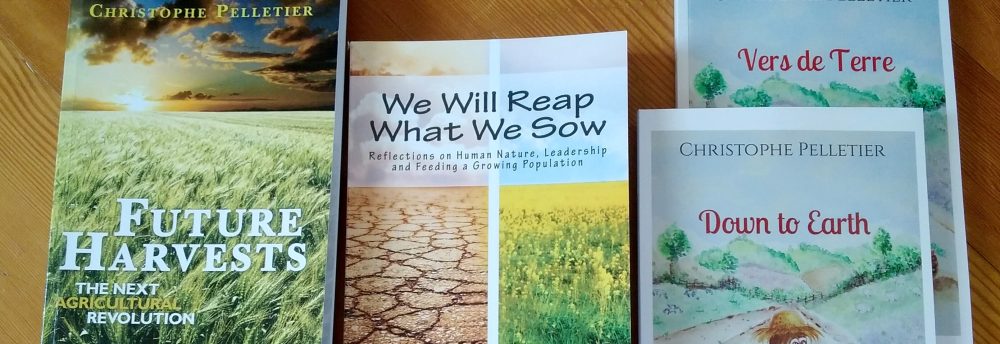
The editing of my book “Future Harvests – The next agricultural revolution” is about completed. All that is left to do is developing the cover and start the publishing.

I have already received orders, even before the book is out. That is quite a good sign. And a great surprise for me.

If you wish to be updated automatically when the book is published, just subscribe in the sidebar window on the right.

To describe the topics addressed, I have posted three short promotional videos on YouTube. In previous articles (The fun of writing this book and The next agricultural revolution), I had already given an idea about the content of the book.

Video #1: The Fundamentals (duration 2:37) – Introduction to the background and fundamental principles mentioned in the book “Future Harvests – The next agricultural revolution” to achieve food security for 9 billion people in 2050. Topics such as demographics, the shift in economic power, the control of food  and food security strategies are reviewed. Sustainability, innovation, efficient market driven food production and strong leadership are required.

or click here if video does not appear

Video #2: The Actions (duration 2:12) – A short review of some of the actions mentioned in the book to achieve the objectives. Solving the water challenge, finding new land for production, urban farming, hydroponics, farming the desert, rebuilding fisheries and developing aquaculture further are all possibilities.

or click here if video does not appear

Video #3: The Questions (duration 3:08) – A sample of some of the questions raised in the book. They cover technology, land deals in Africa, improving yields, restoring soil fertility, change in consumer needs, organic farming, risks of conflicts, biofuels or meat are some of the topics presented.

or click here if video does not appear

If you know someone who could be interested by the topics on this page, please pass it on!

The fun of writing this book

Over the last few months, I have been working quite a bit on writing this book about the future of agriculture.

I must say that compiling in one book a wide range of topics that, without any doubt, will be part of the future of our food production has been an exhilarating experience.

From demographics in full motion to the latest in technology, we can envision many different scenarios to set up the most efficient food production possible, as local farmers, industry NGOs and governments will need to find optimal solutions with the land, the water, the labor force and the capital available to them. Water and soil will be of vital importance, and their proper management is essential for the stability of many countries.

In the future, there will be no room left for wastage and inefficiencies, or we all will be punished if we get complacent. Similarly, we will need to change our thinking and accept that solving future problems will not be about transferring a one-fit-all model to very diverse situations. We might have had the illusion that it once worked, but it actually did not. We will learn from the mistake of the past to perform better. Sustainability is not an option; it is the only choice, because per definition what is not sustainable is doomed.

As food is a necessity, and since when we share between 9 billion people there is less left for each of us than when we shared between 4 billion, efficiency will be paramount. This will affect food prices and social stability. Technology is necessary but it is not the panacea in itself. The most needed resource for the future is strong visionary leadership to help us develop the plan for the next decades.

Let’s prepare ourselves for a deep change and we must accept the idea that we might have futuristic farms run by robots, satellites and computers in some regions as well as local urban gardeners in the heart of the cities, where 70% of the world population is expected to live. We will have small organic farmers and we will have large industrial farms using genetically engineered crops, but we also will have large highly efficient semi-organic farms that will combine the best of both worlds. We still will have specialized farms as well as mixed operations. Hydroponics and aquaponics will grow substantially in the future.

Today’s diet will be revisited and excesses will be out of place. Should we become vegetarians or do we simply need to eat less meat? Will aquaculture live up to the expectation and become the main source of animal protein? You will find out in the book.

Countries will have to think on how to guarantee food security to their populations. If it is not done well, this challenging task might end up in serious conflicts. Foreign and private investment in land and farming will continue in Asia and Africa. If managed properly, they will bring much prosperity to these regions, but if not managed properly, then we can fear the worst.

All these topics and many more will be presented in the book and I hope that it will help readers to understand all the variables that are at play, as well as it will help them get a more objective view of many controversial topics such as GMOs, nanotechnology or in-vitro meat. Once readers will have finished the book, they will be able to figure out whether and how we can feed 9 billion people. Thanks to examples from all over the world in as diverse countries as Uganda, Kenya, the USA, China, Indonesia, India, Brazil, Argentina, France, The Netherlands, Cuba, Kazakhstan and many more, we discover a myriad of different situations and solutions that illustrate human ingenuity to produce food.

However, for now just a few more months of patience as I need to get through the process of publishing.

German agriculture Minister says “Eat less meat!”

Ilse Aigner made that statement during the “Green Week” held in Berlin early January, one of the largest shows about food and agriculture in the world.

This is quite remarkable to hear a Minister of Agriculture making such a statement, based on the recommendation of the German Nutrition Society that indicates that 300 to 600 grams (that is about 11 to 22 ounces for our American friends, who usually consume this amount in less than two meals…) of meat per capita per week is enough for a person to cover their nutritional needs. Yet, her statement was linked to environmental concerns, since it is fashionable to blame meat production for climate change issues.

From a nutritional point of view, this recommendation is correct. That is all we need. That is less than most of us want, but that is a very different topic. I had addressed this, mentioning that 30 kg per capita per year (equals 600 g per week) was plenty,  in my earlier posting “The future price of meat and fish: up” a few months ago,. I also mentioned that if we ate only what we need, the West would free a quantity of meat large enough to feed a population as large as China’s.

It is unlikely that the Minister’s statement will change consumption patterns any time soon, but the future price of animal protein will. Considering the feed conversion ratio of farm animals and the increased competition between human consumption, animal feed industry needs and biofuels, the production cost of meat will increase. Feed is the main cost in those productions. Further, the amount of water required by farm animals and the manure issues that still linger with intensive animal husbandry, will add to the price pressure.

There is no need to become vegetarians, but the days of gluttony are numbered.

Copyright 2010 – The Happy Future Group Consulting Ltd.

Aquaculture: the solution to feed 9 billion people?

Last week, BioScience published an article based on the research of a group of researchers from the CSIC (Consejo Superior de Investigaciones Científicas), the Spanish High Council for Scientific Research.

They present their views on the potential of marine aquaculture to provide enough food for the growing world population. The authors of the report do not see fisheries as a significant option anymore, as the wild fish stocks are depleted, and the amount of time to replenish the stocks will be too long for fisheries to be able to meet the needs of the population. Aquaculture has gradually compensated the demand for fish that fisheries were not able to supply, and half of the seafood consumed today already originate from aquaculture. It is the fastest growing food supply activity and the projections for future growth are very strong. The researchers think that marine aquaculture could multiply its production by a factor 20 by 2050 and thus would play a major role in providing the world population with animal protein.

They bring up some interesting facts about agriculture and land animal farming. For instance, it takes 10 times more water per calorie to produce meat than it does to produce grains. Further, animal meat products represent only 3.5% of food production, but they consume 45% of the water used in agriculture. Considering demand for meat is expected to increase by 21% between 2005 and 2015, and will keep on increasing, this will only exacerbate this situation.

Another point that this group raises is the global nitrogen-use efficiency in animal productions. According to their sources, it is slightly more than 10% for land animals (5% for beef and 15% for pork), which makes their production a major source of nitrogen inputs to the environment. In contrast, marine animals have much greater nitrogen-use efficiency, at about 20% for shrimp and 30% for fish. Therefore, marine aquaculture culture releases two to three times less nitrogen to the environment than livestock production does.

From an environmental point of view, the idea of shifting the production of animal protein from the land where it uses scarce resources such as land and water, to the ocean where space and water are no limitations anymore sounds very sensible. From a nutritional point of view, replacing meat and dairy by seafood that is rich in healthy components such as omega-3 fatty acids is quite attractive, too.

They also notice that the land available for agriculture is shrinking, due to soil degradation and urbanism. Further, there is a growing scarcity of fresh water and increased competition for water as well. Therefore, activities on land do not offer the potential to grow all that much more food to feed the growing population. Even freshwater aquaculture faces these limitations. Freshwater aquaculture currently 57% of total aquaculture, therefore there is an untapped potential with marine aquaculture, as it does not use fresh water.

Of course, the main challenge to execute such a development of marine aquaculture production is to find the proper quality and quantity of feed. The researchers do not see the use of fishmeal and fish oil as an option anymore as they predict that the species used to make these products will not be able in sufficient quantities. Replacement by protein and oils from agriculture crops is an option for the short-term, but as aquaculture volumes would increase, the competition for these ingredients with meat production will make them too expensive, and for the reasons explained above, depending on land agriculture to feed marine species will face crop production limitations. Therefore, they prefer to envision a total new approach of aquaculture feeds, and recommend developing a new feed chain based on aquatic ingredients, such planktons, microalgae and seaweed. This approach makes sense, but the time lines to develop such a supply source and the cost of production of such an “aquatic” feed still need to be investigated. Several “seaweed farms” in production in China show interesting results and they seem to promise a strong potential of production for feed.

Another development that they expect is offshore aquaculture. Aquaculture operations located in coastal areas, although they are easier to access and generally in quieter waters, are very often located in zones where there are local issues to deal with, such as interaction with wild fish or recreational activities. Moving offshore can reduce these issues.

As you can see, developing the future of aquaculture is not simply a matter of growing fish in pens, but it requires a broader thinking that includes not only the oceans but agriculture on land, too. The future of food will require from us the ability to manage the whole planet!

Copyright 2010 – The Happy Future Group Consulting Ltd.

Reducing waste works – The example of Hormel Foods

Hormel Foods issued a press release yesterday about their packaging waste reduction program, and the amount of packaging material that they saved is simply impressive. Reduction covers cartons, paper sleeves, thinner glass jars, plastic trays or shrink-wrap.

Not only this program has a direct effect on the packaging of Hormel products, but it indirectly also saves a lot of resources, such as a significant reduction of paper fiber, less trailers on the road using fuel and less petroleum for plastics of all sorts.

The only detail that do not mention in their press release is the money savings. You can be sure that they would not go through all this effort if it was not bringing significant savings.

Economy meets environment and vice-versa. This only proves that common sense and a clearly defined strategy deliver positive results.

Yes you can! You just need to want to!

Click here for the complete press release from Hormel Foods

The hen house of the future

The Ministry of Agriculture from Israel organized an architectural competition for the design of a new generation of layer hen houses for the North of the country.

It is interesting to see how much architecture is involved in the design of future systems, as it is the case of vertical farming that I mentioned in my article “The vertical farm

The design had to integrate all aspects of production, including efficiency, energy, sustainability and dealing with waste. It can produce its own energy from litter, and it is equipped with solar panel and wind turbines.

The winning design meets European regulations on animal welfare, and is suitable for free-range production as well as more intensive systems.

The only thing that does not appear in this article is the financial aspects. They do not tell anything about the price of the house and of its cost of operation and maintenance, as well as the impact on the cost price of eggs.

Click here to read the whole article from WorldPoultry.com

Coca-Cola and the bottle of the future

Coca-Cola will start selling its beverages in a special bottle, called the PlantBottle, which is made from PET plastic and from plant-based materials by the end of 2010. A first launch will take place in Western Canada during the Olympic Games held in Vancouver, BC.

In the US and Canada, the bottles will include 30% of plant material, and the bottles are 100% recyclable. The biological material will come from sugar cane by-products, originating from the production of ethanol, mostly from Brazil. Including this material in the PET plastic reduces the carbon footprint of the bottles, and reduces the dependence on oil-based materials. The benefits are both environmental and economic.

The ultimate goal of the company is to produce bottles that will be made of 100% non-food plant-based materials such as wood chips and wheat stalks.

For further details, read the Coca-Cola press release at http://www.thecoca-colacompany.com/presscenter/presskit_plantbottle.html.