 This might sound contradictory, but one of the effects of globalization could very well be a new impulse for the development of a local economy, with energy as the main driver.
Let’s review a few things! One driver of globalization has been the search for low wages, therefore making corporations relocating their manufacturing units to the emerging countries. Another pillar of globalization has been the ability to transport goods across the world at a low cost, as energy has been in fact quite cheap. A clear effect of the success created by the above is an economic boom in the emerging countries, where employment has risen and where the standard of living has increased, on average. Currently, we are going through this difficult economic situation, but in the future, we very likely will face an increase in the price of oil. This is the energy effect that I just mentioned. Higher energy costs and food prices will drive inflation higher, although not to alarming levels. Nonetheless, this will be pushing wages up in the emerging countries, while unemployment will stay high for a while in the West, where the main consumer markets are. Therefore, we can expect to see the wage differential between those two groups of countries shrink, while transporting goods will become more expensive. In such a situation, it is not unreasonable to think that some manufacturing will come back closer to the Western consumers market. In addition, in the same time, emerging countries should have been able to develop a middle class that will drive domestic consumption, and thus sustain a certain level of economic momentum, even if their exports decrease in relative volume. An interesting consequence of the above would then be global trend towards a more local economy. The currently emerging countries would produce to satisfy their domestic markets and exporting lower surpluses, while the Western countries would repatriate some of the production units back home since it might be cheaper to produce and to transport goods that way to satisfy their own consumers.
Agriculture has followed the same pattern as other industries, and regions have specialized for the foods that they could produce at the cheapest cost. Of course, the cost of production and of distribution to consumers depends largely on the price of inputs, such as energy, fertilizers, animal feed, etc, but from a pure financial, and also climatic, point of view, it could not make sense to try to produce everything everywhere. Thanks to cheap fuel, the model was to go to global trade and transport foods over long distances. This is quite a change compared with the local agricultural model that dominated until the nineteenth century.
This search for the lowest cost of production will not go away, for a very simple reason. The overwhelming majority of the world population has a limited budget and keeping food affordable is an absolute necessity. We have seen during the sharp food price increase of 2008 that it would not take much to create a panic and riots, because even a slight price increase is almost unbearable for most people, especially in developing countries. This is quite a contrast with the wealthy Westerners who claim that cheap food is a bad thing, and that agriculture should be local and small-scale.
Another aspect that is not addressed very often is the actual carbon footprint of food transport. In the partisan debate, most of the arguments focus on the number of miles travelled, but they rarely look at the qualitative aspect of the transport. Depending on whether we transport food by road, by rail or on water, the results vary greatly. For instance, in Brazil, only 5% of exported products were transported by waterway in Brazil, compared to 61% in the U.S. Conversely, 67% of Brazil’s exported products are transported on highways, compared to just 16% in the U.S. In the European Union, almost 90% of the external freight trade is moved by water, and short sea shipping represents 40% of trade within the European Union in terms of ton-kilometers. As you can imagine, the consequences for the environment, as well as in terms of transportation costs differ greatly.
There are also significant differences between transporting fresh foods or frozen foods. A study carried out by Astrid Scholz, Ulf Sonesson and Peter Tyedmers on salmon showed that consuming frozen salmon transported by sea was the better environmental choice for salmon. To illustrate this, their conclusion was “If seafood-loving Japanese consumers, who get most of their fish via air shipments, were to switch to 75 percent frozen salmon, it would have a greater ecological benefit than all of Europe and North America eating only locally farmed or caught salmon.”
Another important parameter in the environmental impact of the distribution of food is the filling rate of the transportation unit. An efficient fleet of trucks that organize back transport for other goods is more efficient than a small truck used by a farmer to bring his products to the city’s farmers’ market 400 kilometers away and who drives back empty.
As you can see, in the choice between global or local, we need to think in pragmatic terms because the reality is more complex than it may seem at first.
Copyright 2009 The Happy Future Group Consulting Ltd.
 As everyone knows, fish stocks have been depleted to levels that are not acceptable. This is the result of short-term thinking combined with highly efficient but stupid fishing methods. Not only fish is a high value food source, but oceans are complex ecosystems that we cannot afford to lose. Although aquaculture claims to be the way to compensate the supply of wild fish, this is only true within limits, as some aquaculture species are fed with fish meal and fish oil, and replacement of these products is also limited by the quantities that agricultural crops can supply, and consequently their price.
 We must expect strategies about food supplies that will remind us of what we have seen about oil supplies. Politics are going to play an increasingly important role. After all, we can live without oil, but not without food. There will be aggressive moves from countries that are not self-sufficient, first friendly like the land purchases and leases, but there probably will be a point when this might not be enough and regional conflicts will happen. Some exporting countries will also take a more aggressive stance on prices and on availability, but they also will have to be aware that too much arrogance might end up in serious tensions.
 Although some still try to resist and deny the obvious, this system is no longer sustainable and we must rethink what should drive our economy. In an earlier article, I made a reference of how previous generations used to be very cautious about what and how they consumed. The positive side of the last 60 years has been the incredible progress we have made in science, knowledge and technology, which offers possibilities unthinkable for the previous generations I was referring to. We understand our world and how it functions like never before. We have all the technological solutions to solve the climate issue, but the key is the will and the determination to change and to act. This cannot happen as long as we keep thinking the economy in terms of growth only. Growth will not go on for ever, simply because our space and our resources are limited. As there are more and more people needing more and more energy, food and other goods, the law of offer and demand will rule. Prices will inevitably go up and consumption will slow down. A new time has come. The priority must now be quality, not quantity, we must think about having enough, not having always more. This thinking is not a nostalgia to a past that also had its limitations. It is not about rejecting a market-based economy. It is about looking at the market that has always been here, but that has been pushed in the background for the easier approach of just producing more and selling it. What we will have to bring to market is not so much products as services. These services are the ones that are directly related to making all the natural and industrial cycles run harmoniously in a durable way. Just to name a few examples, I would mention all activities that are related to cleaning the damage we have caused, and recycling activities will become more and more important in our whole economy. In the same way, water treatment is going to be a crucial activity, even more so than it has been so far. Clean industries producing durable goods and services will prevail. This change will also make some jobs disappear and some appear or even reappear. As usual change always brings opportunities. It is to us to recognize them and to take them. The time has come to make the transition from this consumption society, based on wasting resources, and with no future, to a maintenance society, where wealth, and not growth, will be the economic success indicator. By acting today, we can ensure this process to happen in a smoother way than if we wait until we have no choice anymore.
 With an increasing population that needs more food and more water to live, we can expect that water is going to become a highly strategic and needed resource. As climate changes, the current rain distribution and geographic availability of water is likely to change dramatically, too. This increasing competition between agricultural areas and urban areas will bring major changes on how we use water for both personal use and for food production. On the personal side, we certainly can expect that current bathroom systems to disappear, as they use too much water. Every time we flush a toilet tank, we actually waste the daily drinking water needs of a couple of people, and local water reserves are gradually depleted as well. Clearly, this has no future. Similarly, we can expect the legislation on water use for lawn sprinkling and car washing to change.
 More efficient irrigation systems will replace the old ones. Computerized systems are already in use in wine production, using sensors for humidity and temperature, to determine how much water the plants needs at the most optimal time of the day and deliver it at the exact spot. You can expect that such an optimization approach will prevail. The path that Monsanto follows with the production of genetically modified (GM) wheat that needs only a third of regular wheat varieties is quite interesting. The tricky part is the GM part, as on the contrary to natural “mutations”, such a process does not undergo natural selection, and therefore we do not know what possible side effects it might bring. Nonetheless, this is an attempt to deal with future water shortages. Hopefully, other less controversial solutions can be found that will deliver a similar result. Once again, we can shape our future through continuing innovation.
 There are many discussions in scientific, economic and political circles about whether we have reached such a stage either regarding pandemics or regarding food supplies. The specter of pandemics recently raised its head with the “swine flu” originating from Mexico. Last year, there were severe disruptions of food supplies in some parts of the world, not as much as the result of an actual shortage, but as the result of prices skyrocketing and fears that food would run out.
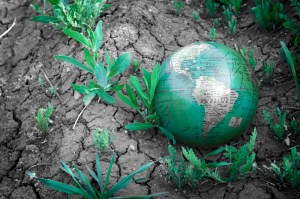 This is why, with a growing human population, agriculture and food production at large, managed in a sustainable manner, will become increasingly strategic in the future, and sensible management of water resources will be a key factor for the success of agriculture as well.
 The Food Futurist Solutions - Anticipate, Adapt, Succeed