Soylent Green is on some people’s minds

Funny how coincidences occur. In less than two weeks, I heard several times about Soylent Green, the futuristic movie. It came first in a couple of conversations I have had about the book I am about to publish (hardcopy proof is on its way to me), and it came up in the very serious French economic paper Les Echos, too. Considering the area I am involved in, I had to find out more about Soylent Green.

Soylent Green is a movie made in 1973, starring Charlton Heston. As such, I would not describe Soylent Green as a great movie, but it contains some interesting elements that resonate in today’s environment. To sum it up, the action takes place in a devastated New York in 2022, where 40 million people live is dismal conditions. The planet is in bad shape, the economy is just as bad and food is scarce. A powerful multinational, Soylent Corporation controls food supply, thanks to its very successful product Soylent Green, a high protein food. Natural foods are very difficult to find. Strawberries sell for $150 a jar and to get beef, one needs to have the right connection. Cooking is a lost art, but some still have the nostalgia of the yesteryears, when life was good.

Although made around the time of the first oil crisis, it mentions very current topics, such as a collapsing economic system, greenhouse gases and the power of multinationals over our food supply. That is not bad, considering, it is almost 40 years old, an age than more than half of the world population has not reached yet. The author certainly had a strong vision of where our world is heading.

The plot is rather creepy, though. The production of Soylent Green is anything but appetizing, and quite different from plankton as mentioned at the beginning of the movie. You can watch it here: http://www.watchonscreen.com/videos/1549/soylent-green-is-people.html

For those who may worry, my book envisions the future of food production from a very different angle.

Is science being taken hostage? The “killer canola” example

In the debate between environmentalists and industry, science is a word that comes regularly in their arguments. However, scientific “evidence” seems to be used to support an agenda instead of making us all wiser.

The recent example of the “killer canola” that has been widely spread in the media over the past week illustrates the concerns we should have about the use of science for non-scientific purposes.

To sum up the story about canola, researchers from the University of Arkansas found herbicide-resistant genetic traits included in the plants through genetic engineering in canola growing in the wild in North Dakota. They even found traits from two different GMO producers. This does not exist in commercial varieties. They claimed that they demonstrated these GMO escaped into the USA.

Of course, all media, internationally, with a bias against GMOs jumped on the occasion to make their point about the risks of genetic engineering.

Very quickly, media favourable to the GMO industry, actually funded by that industry reacted to undermine the finding of the researchers. In particular, I enjoyed this column in AG Network. To counter the results of the researchers, the author claims that most scientists reject their theory. He names only two, one in the UK and one in Canada. Is a sample of two scientifically representative? I think not. He does not review the protocol of the research. Does that mean it was in order? I would tend to think so; otherwise, he would surely have attacked it. His main argumentation is about canola not being able to thrive in the wild; therefore, the “gene escape” is about a non-event, so let’s not talk about it anymore. Case closed.

What really disappoints me in this process is the bias. The opponents of GMO see this research as a proof of their point of view without really looking into the research and challenging it, or at least asking a few questions to the researchers. The proponents of GMOs, at least this one, elude the conclusions of the research by shifting the debate to the survival chances of wild canola. The real questions that arises from this survey is to find out how a genetic trait introduced by people (therefore, not the result of natural evolution and selection) can spread outside of our control (nature does not care about intellectual property), and what can be done to have more control on this. What all participants in this debate should do is to join their science and collaborate. It deserves the necessary attention.

The purpose of science is to help us understand our world so that we can take the proper measures to stay in control of what we created. If science tells us something that we do not like, that is too bad, but what we can learn is for our best interest. In the end, it would serve nobody to take chances with food security. The long-term interests must come before the short-term ones. The example of the canola is just one out of many. I could have chosen other food production sectors with similar cases.

Selectively picking the science that suits one’s agenda is not scientific. It does not serve anyone on the long run. On this blog, I posted a poll asking what should come first between morals and science. Although, this poll has no scientific value, it shows an interesting trend that I had not expected.

Copyright 2010 – The Happy Future Group Consulting Ltd.

Future Harvests – A preview of the book

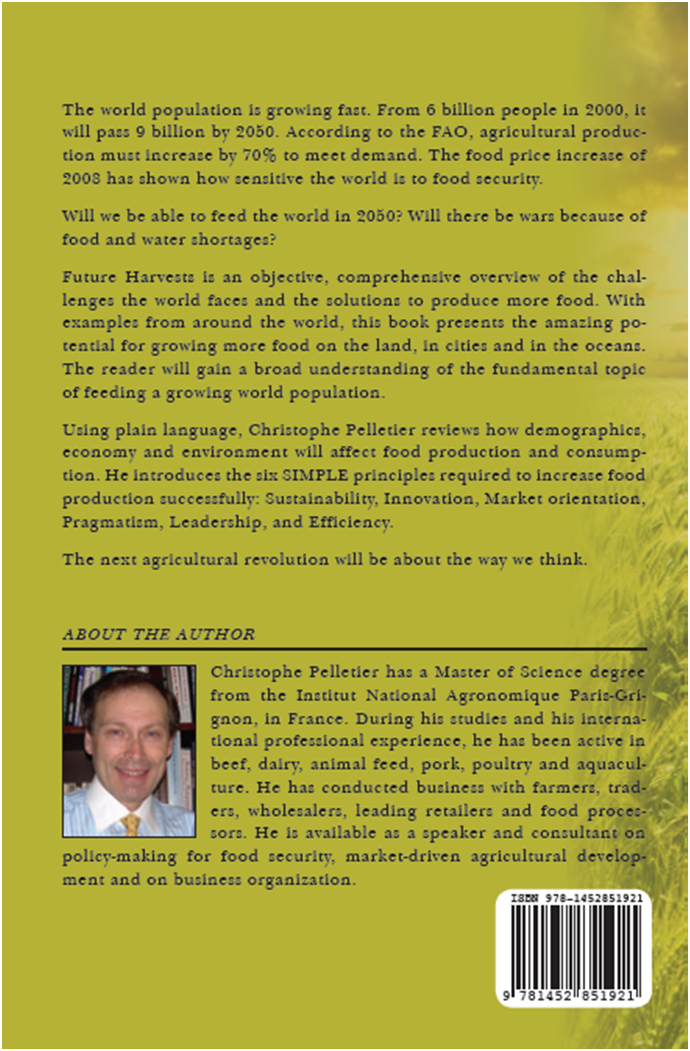
My book, Future Harvests, is expected to be published before the end of August.

Here is a preview to give you a flavor of the content.

For a full view, please click on the thumbnails.


Here is a sample containing the table of contents and the preface of the book:


For the video trailers, please visit my YouTube channel.

Is the food company grab the next step beyond the land grab?

In parallel with land tenure deals in developing countries, I foresee a new trend to develop strongly in the years to come.

In order to increase food security, countries in Asia and in the Arab world will invest more aggressively in food and agriculture companies.

In China, the search for acquisitions is gaining momentum. A first attempt, although failed, by China’s Bright Food group to acquire Australia’s CSR sugar is an indicator is this trend to come. But China is not the first country to initiate this.

For instance, Qatar’s sovereign wealth fund created Hassad Foods to invest in food related projects in Qatar and abroad. The purpose of Hassad Foods is to help Qatar achieve food security. They aim at developing their activities in South America and Africa, with the expressed goal of completing at least six projects by the end of 2010. Their focus is on basic crops such as sugar and wheat, but they look at projects in the poultry and livestock sectors as well. As countries realize the limitations and the political risks of focusing only on farmland ventures, they will diversify their possibilities to improve their food security situation.

As the approach of sovereign funds is to focus on long-term food security, the type of investments in food companies might change as well. This will be a different approach from activist investors, such as hedge funds, that try to influence short-term management decisions purely for share price purposes.

Copyright 2010 – The Happy Future Group Consulting Ltd.