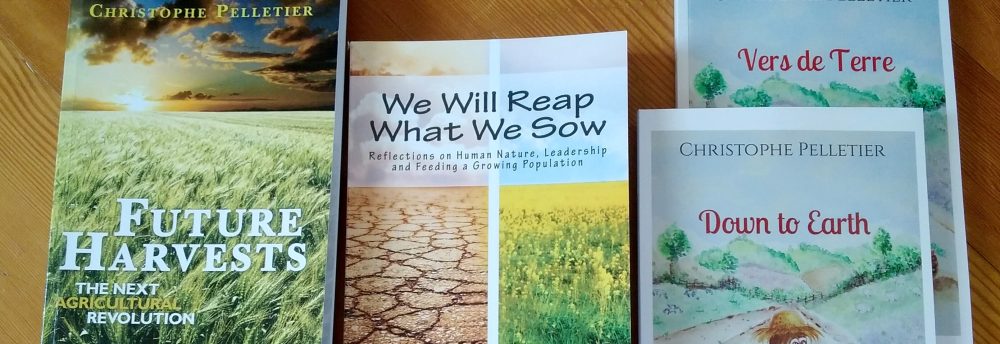
What a game changer my book is!

Future Harvests has been published less than two weeks ago, and it is going to change my company rather profoundly.

What started as a blog on the side of The Happy Future Group Consulting Ltd. is now about to become the very core of my business.

Not only the book sales are already higher than I would have thought, the book is creating much interest for my other activities. The book has already been shipped not only to Canada or the USA, but also as far as South America, Asia and Europe. This is truly amazing.

The reactions to the announcement of the book’s publication have been amazingly enthusiastic and they made me feel like I had just produced something that many were waiting for. This is both very rewarding and very humbling, because working on solutions for future food supply to an increasing world population is a huge task. Since the publication, people with whom I never had contact before, from all around the world, have approached me, thanking me for having engaged in this venture.

New contacts are asking me to participate in conferences and to organize workshops and seminars for them. The CBC (Canadian Broadcasting Corporation) is interested in having me on one of their programs. Of course, the concrete discussions are still to come, but I have to admit that my Food Futurist is now showing incredible potential.

The part on policy making and strategy is getting more attention, too. This activity has the potential to become a solid business that will need to involve more people in my organization. I have already started to develop a plan for this. I can see interest coming from companies, professional associations and governments, not only in Western countries, but in many emerging countries, such as in South America, Southeast Asia, India, or Russia to name a few.

The first step that results from all of the above is for me to formalize the Food Futurist further into a more structured activity than it has been so far. This has started with my defining and posting the mission on all the business pages of the website. The mission is “To help our clients challenge today’s certainties, shape the future, and manage the transition with a targeted and practical action plan for the coming 10 years and beyond”.

The following step is going to be to develop business around this mission and the principle expressed in Future Harvests.

If you are interested in this, please do not hesitate to contact me. Talking is cheap. If you know people who would be interested, please pass it on to them.

As Humphrey Bogart’s character said in the movie Casablanca, “I think this is the beginning of a beautiful friendship”.

Two-thirds of world population live in the 16 most populated countries

When looking at their respective demographics, economic situations and food security status possible future scenarios can arise from this list.

The most obvious is probably that many countries on this list have little food security. Considering that many of these countries have a young, poor and increasing population, political stability is quite fragile. As long as this remains, the consequences of food inflation must be taken very seriously.

Country

Population

% of world population

China

1,337,320,000

19.6

India

1,180,220,000

17.3

USA

309,199,000

4.5

Indonesia

231,369,500

3.4

Brazil

192,860,000

2.8

Pakistan

169,410,000

2.5

Bangladesh

162,221,000

2.4

Nigeria

154,729,000

2.3

Russia

141,927,297

2.1

Japan

127,530,000

1.9

Mexico

107,550,697

1.6

Philippines

92,226,600

1.4

Vietnam

85,789,573

1.3

Germany

81,882,342

1.2

Ethiopia

79,221,000

1.2

Egypt

78,200,000

1.2

 Total  

4,531,656,009


66.7


What came to my mind when I saw the list the first time was the following.

The cluster Pakistan-India-Bangladesh represents 22.2% of the world population. This region is very sensitive to climate events, as the current floods in Pakistan demonstrate. The monsoon is the main factor that influences the level of crop production. These countries are below food self-sufficiency, and their agricultural infrastructure (and overall infrastructure in general) is in bad need for further development. However, the quality of agricultural land is good with around 40% of arable land. The task of India is huge. It has about 70% of its population in agriculture, and if the USA had India’s population density, there would be 3 billion Americans, 10 times its current population. In such a situation, the USA would not be self-sufficient, either. Agricultural reforms are necessary to improve yields and economic development is necessary to provide more inhabitants with higher revenue. It will take time, but expectations for the Indian economy are positive. Subsistence is not a good economic model. A good relationship between India and Pakistan is paramount for the stability of the region. A stable Pakistan is essential for the stability of the world.

In North America, I can see dramatic change coming. With two countries, Mexico and the USA, in sharp contrast with each other in the top 16, something will happen. The USA will remain an economic superpower and any events in that country will affect the world economy and politics. Mexico is growing but it needs to improve its economy and achieve better social stability. Poverty is fuelling many issues and the price hike of corn of 2008 has showed that it would not take much to cause food riots. The issue of immigration of Mexicans into the US will not go away, and no wall will stop it, especially with Mexico having a strong population increase. The difference in population numbers of the two countries will shrink. The USA and Mexico will have to develop a joint economic development program for the region to avoid an uncontrollable situation in the long term. I think that we will see more and more Mexicans settling in the USA and become the farmers of the future over there. However, climate conditions will probably affect the geographical distribution of productions. The southwest of the USA is increasingly suffering from water scarcity, and the area spreads. This will affect the distribution of the population over the continent, and it will affect Canada as well.

South East Asia has three representatives on this list: Indonesia, The Philippines and Vietnam. This region shows a strong population increase. From a food production point of view, geography tells that aquaculture has to be a leading, if not the leading, food source for the future. And this is exactly the direction that these countries are following. Rice is essential in this part of the world, and there is no doubt that the South East Asian Emergency Rice Reserve will be tested at some point in time.

Brazil is growing, demographically and economically. It is becoming an economic powerhouse, in particular in agricultural products. However, much still needs to be done to improve infrastructure and performance. In the future, I expect to see joint agricultural policies between a number of Mercosur countries, especially with Brazil, Chile, Argentina and Uruguay as the initiators. Export has led agricultural production of these countries in the past, but I expect to see them to rebalance policies towards feeding the South America market as well in the years to come.

The other thing that jumped out of the list is Africa. I doubt that many people would have expected Nigeria to be ranking #7. Africa will be an important element in the 21st century economy. The continent’s population will double in the coming 40 years and many African countries are attracting foreign investments. If this happens in orderly manner, which is far from sure at this stage, I would expect Africa to experience a boom comparable to the one that China has had over the last three decades. The continent is open for business and the rules of engagement are exactly what adventurous pioneers can wish for. Africa has tremendous potential for food production and foreigners are developing agriculture actively for their own food supply, but neither African countries nor investors should forget to include the Africans in the wealth creation, and help them earn the money to feed themselves. What will happen in Africa, will affect all of us.

Copyright 2010 – The Happy Future Group Consulting Ltd.

The Russian heat wave gives some people sunstroke

The heat wave combined with the drought in wheat-producing region of Russia is causing some concerns, as the wheat production will be affected. That is annoying but not terribly threatening. Moreover, the price of wheat, as well as the prices of other agricultural commodities were due for a rebound because farmers had reduced production after the price fall of the previous year.

But when politicians and speculators get involved, the problem takes a new dimension.  Vladimir Putin announced a possible ban on Russian wheat exports and hell broke loose. The crisis then appears on all media. From mainstream media to the financial press, the world must know that we are in very big trouble, apparently.

Bloomberg and CNBC reports on the price of wheat on the commodity exchange. The speculators are there, looming. The Wall Street Journal asks whether US farmers should plant more wheat and take advantage of the good wheat prices. The Financial Times reports about the quiet doubling of the price of barley. This is bad news for beer drinkers. Food inflation is around the corner. And what if Ukraine and Kazakhstan have the same problem? The Black Sea region is one of the main wheat producers. Even Lester Brown, of Earth Policy, flooded twitter this morning with an unusual amount of tweets expressing his concerns about the effect of climate change and the rise in temperatures. This is all well-known and well-studied stuff, but suddenly my friends, we are close to the end of the world. Or are we really? Mr. Brown even suggests that an increase of 14 F in temperature in the Mid-West would cause a drop of corn production by 50%. Considering that US corn is used for three purposes: biofuels (not food), high-fructose corn syrup (not food) and animal feed, the consequences for Americans would be positive: less driving, less soft drinks and less meat, all three items for which they largely over-consume, at the expense of their health. The ones who would hurt the most would be the Mexicans.

When hysteria hits, it is always good to sit back, reflect quietly and maybe enjoy a cool drink, as long as we can afford it.

What is really going on? Well, we have a climatic event that affects wheat production. It is not new. We have managed worse crises in the past.

The excitement comes from two events. First, speculators have been active for quite some time on the wheat market and this gives them a good opportunity to jack up the prices. Although, remember the price hike of agricultural commodities of 2008! It was all on paper and not so much in the physical world. Yet, people were hoarding food in supermarkets like there was no tomorrow. Are we going to see the futures contract impact the real economy once more. I believe that if this happens again, we will see governments take action to regulate the trading of futures contracts. The bad thing about this is that the example of the new Wall Street regulations have been very slow to take shape and will take a long time to be implemented. Therefore, the “golden boys” still have some good times ahead with markets. Second event, which has reinforced the first one is the declaration of Vladimir Putin. Should we worry about it? Yes and no. Russia is now famous for its muscle showing policies. When oil prices were jumping up, the Russian government played quite rough with oil companies, especially Shell and BP. Their relation got a chill, and later they became good friends again. Russia’s policy on import of meat and poultry shows a similar pattern. Import restrictions alternate with more relaxed policies. Russia is struggling to achieve a satisfying level of food security and it uses all the means it has to develop and protect its domestic production, while sending a message abroad that Russia is strong. In my first language, a roller coaster is called “montagnes russes” (Russian mountains). That is quite relevant to describe this country’s style.

Is the world food situation at risk? As usual, we need to be vigilant, but there is no need for more panic than last year. What we need is a global production plan and increase production on a regular basis, simply because there is an increasing number of mouths to feed. If our approach is knee jerking on the actions of speculators, we will not achieve greatness. Farmers should consider planting more when the market demand increases. That is market-oriented production! If the farmers rush to plant more out of short-term speculation, they will experience the same as after the situation in 2008. Their suppliers (the ones listed on the stock markets) will increase the prices of inputs, especially fertilizers and gobble up the margin away from the farmers, like in 2009. The reality is that food is going to become more expensive, especially animal products. We need to get used to this idea right now, because over the long-term, this trend will not disappear. We need to act with vision and determination to achieve the goals, as I describe in the soon-t0-be-published “Future Harvests”.

Today ended up on a positive note after all. US Agriculture Secretary Ed Vilsack declared that we were not facing a wheat crisis. And wheat prices eased on news that farmers were planting more. Famine averted.

We need more long-term focused leaders and fewer speculators.

Copyright 2010 – The Happy Future Group Consulting Ltd.

Beyond the book

Now that the publishing company is working out the final details before the release of the book, time has come for me to spend some time again on the blog part.

During the making of the book, I have been asked about my opinions on a number of subjects. Listing opinions was not the theme of the book, but the blog is a good vector for this. In the course of the coming weeks and months, I will review as concisely as possible specific subjects, present which areas require attention and how I believe the topics will evolve in the future. If you have any request, please let me know.

In addition to these articles, I will develop new topics for seminars and conferences that relate to the book and that offer matter for reflection to the attendees. I also will introduce new modules aimed at improving organization and efficiency of –and within- food value chains. The purpose of these modules will be twofold. They will help participants understand the broader picture, and they will help improving the functioning and the performance of business relationships. This is not only about economic performance, but also about technical, environmental and social performance.

 More about this soon.

Future Harvests – The book is coming soon!


The editing of my book “Future Harvests – The next agricultural revolution” is about completed. All that is left to do is developing the cover and start the publishing.

I have already received orders, even before the book is out. That is quite a good sign. And a great surprise for me.

If you wish to be updated automatically when the book is published, just subscribe in the sidebar window on the right.

To describe the topics addressed, I have posted three short promotional videos on YouTube. In previous articles (The fun of writing this book and The next agricultural revolution), I had already given an idea about the content of the book.

Video #1: The Fundamentals (duration 2:37) – Introduction to the background and fundamental principles mentioned in the book “Future Harvests – The next agricultural revolution” to achieve food security for 9 billion people in 2050. Topics such as demographics, the shift in economic power, the control of food  and food security strategies are reviewed. Sustainability, innovation, efficient market driven food production and strong leadership are required.

or click here if video does not appear

Video #2: The Actions (duration 2:12) – A short review of some of the actions mentioned in the book to achieve the objectives. Solving the water challenge, finding new land for production, urban farming, hydroponics, farming the desert, rebuilding fisheries and developing aquaculture further are all possibilities.

or click here if video does not appear

Video #3: The Questions (duration 3:08) – A sample of some of the questions raised in the book. They cover technology, land deals in Africa, improving yields, restoring soil fertility, change in consumer needs, organic farming, risks of conflicts, biofuels or meat are some of the topics presented.

or click here if video does not appear

If you know someone who could be interested by the topics on this page, please pass it on!

The next agricultural revolution

(Excerpt from my upcoming book, Future Harvests)

The next agricultural revolution to feed nine billion people will be different from the previous one. After World War II, agriculture advanced thanks to chemistry and petroleum. This time, biology and renewable energies will lead us to progress. It will not be just a revolution in science and technology. It also will be a different way to think about the economy and the environment. Knowledge and communication will become increasingly important, even more so than today.

Agriculture is a life science. Biological solutions will gradually replace chemical applications. All sorts of organisms will be involved to improve the way farmers and the food industry will produce.

Bacteria and viruses will help fight pests and diseases. They will help us reduce our use of chemical herbicides and pesticides dramatically. Genetic engineering will evolve and, as a business, it will mature. DNA science will focus on eliminating flaws and on increasing the metabolic efficiency of living organisms. Genetic engineering cannot continue to be about intellectual property and patents. Soon, seed companies all over the world will know how to do the same. Competition and market forces will determine which model will survive. Governments will not allow a select few to control food. They will get involved in genetic engineering programs and they will break monopolies. Genetic improvement will become collective property again.

Ecology will be a part of food production. Agriculture will manage ecosystems, and economy will become the management of the planet. Living organisms on land and in water will assist us. Farmers will think in terms of systems and cycles. Instead of isolating the field, they will integrate environmental parameters as well.

Organic matter will become central in the future agriculture. Farmers will recreate the cycles to improve the structure of the soil and its fertility. Agriculture will help fixing carbon. The use of mineral fertilizers will decrease sharply.

The economics of agriculture will be different, because the economics of energy will be different. New technologies will come. Solar power and wind energy will become common sources of energy. The economics of water will change, too. The management of water will reshape our food production. Water will become substantially more expensive and only systems that save and preserve water will survive.

Information technology will help make decisions faster than ever before. Portable computers will give the farmer the ability to get data almost instantly about the status of the crops, markets, health status and conditions of production. It will allow them to optimize inputs and outputs better and faster. It will save time, inputs and money. Knowledge and information will be our best tool to act efficiently and to improve our food production.

Transparency will become the rule. There will be no secret because consumers will be better informed and because there will be nothing left to hide.

The most critical part of the next agricultural revolution is leadership. Having a responsible long-term vision is critical, but it will not be enough. The world will need leaders that will make the right things happen. In all sectors of the society, there will be a need for such leaders who can muster the energies and who make the general interest and the long-term come first. The need for food security will alter our governance systems, in government as in business ethics. A challenge will be to manage greed and fear. First, there will be greed. Then, there will be fear. Until this day, humans have done a poor job of feeding the world. Famines have come and have gone and there still are hungry people. Humans have done a poor job at preserving their environment, too. With nine billion people, such a poor performance will have much heavier consequences. Procrastinate or being sloppy are attitudes the world cannot afford anymore. The proper leadership will come, but the change will not happen per accident. There will be a heavy crisis first.

Agriculture will regain its place in the economy as the most important activity. A change in the attitude towards funding and investments will also be part of the revolution. More players will engage in agriculture because returns will be higher for all.

The revolution will not just be for farmers and the other players in agriculture to carry out, but consumers will have their share to deliver. A change in mentalities is necessary. Wasting food is not acceptable. Selfishness will not work anymore. Food security is not a given, it is work in progress.

Copyright 2010 – The Happy Future Group Consulting Ltd.

The fun of writing this book

Over the last few months, I have been working quite a bit on writing this book about the future of agriculture.

I must say that compiling in one book a wide range of topics that, without any doubt, will be part of the future of our food production has been an exhilarating experience.

From demographics in full motion to the latest in technology, we can envision many different scenarios to set up the most efficient food production possible, as local farmers, industry NGOs and governments will need to find optimal solutions with the land, the water, the labor force and the capital available to them. Water and soil will be of vital importance, and their proper management is essential for the stability of many countries.

In the future, there will be no room left for wastage and inefficiencies, or we all will be punished if we get complacent. Similarly, we will need to change our thinking and accept that solving future problems will not be about transferring a one-fit-all model to very diverse situations. We might have had the illusion that it once worked, but it actually did not. We will learn from the mistake of the past to perform better. Sustainability is not an option; it is the only choice, because per definition what is not sustainable is doomed.

As food is a necessity, and since when we share between 9 billion people there is less left for each of us than when we shared between 4 billion, efficiency will be paramount. This will affect food prices and social stability. Technology is necessary but it is not the panacea in itself. The most needed resource for the future is strong visionary leadership to help us develop the plan for the next decades.

Let’s prepare ourselves for a deep change and we must accept the idea that we might have futuristic farms run by robots, satellites and computers in some regions as well as local urban gardeners in the heart of the cities, where 70% of the world population is expected to live. We will have small organic farmers and we will have large industrial farms using genetically engineered crops, but we also will have large highly efficient semi-organic farms that will combine the best of both worlds. We still will have specialized farms as well as mixed operations. Hydroponics and aquaponics will grow substantially in the future.

Today’s diet will be revisited and excesses will be out of place. Should we become vegetarians or do we simply need to eat less meat? Will aquaculture live up to the expectation and become the main source of animal protein? You will find out in the book.

Countries will have to think on how to guarantee food security to their populations. If it is not done well, this challenging task might end up in serious conflicts. Foreign and private investment in land and farming will continue in Asia and Africa. If managed properly, they will bring much prosperity to these regions, but if not managed properly, then we can fear the worst.

All these topics and many more will be presented in the book and I hope that it will help readers to understand all the variables that are at play, as well as it will help them get a more objective view of many controversial topics such as GMOs, nanotechnology or in-vitro meat. Once readers will have finished the book, they will be able to figure out whether and how we can feed 9 billion people. Thanks to examples from all over the world in as diverse countries as Uganda, Kenya, the USA, China, Indonesia, India, Brazil, Argentina, France, The Netherlands, Cuba, Kazakhstan and many more, we discover a myriad of different situations and solutions that illustrate human ingenuity to produce food.

However, for now just a few more months of patience as I need to get through the process of publishing.

Who will be the farmers of the future?

While most of the discussions about the future of agriculture and food tend to focus about how to feed 9 billion people, and about whether it should be organic or industrial, one question seems to be left aside, though it is a very important one: who will be the farmers.

If the forecast of the UN is correct and by 2050 when we are 9 billion, 70% of the people will live in cities, while today this number  is only 47%, this means that in fact the rural population will decrease by about 25% from the current numbers (2.7 billion vs. 3.6 billion today). This means that there will be a lot less farmers in the future.

Farmer of the futureSo, who will they be and where will they be?

A lot of the good agricultural land is in the Northern hemisphere, and in areas where not only the population numbers  are stagnating, but these are regions where the average age of the population is increasing from an already rather high level of about 50% of the population older than 37. These regions, North America, Western Europe and Eastern Europe are not likely the countries where we can expect a surge in urban population. This will happen mostly in Africa, Asia and Arab countries.

These Northern hemisphere countries already have large commercial farming structures and, unless they train many new farmers, the concentration trend is likely to continue, meaning even less farms, and larger farms than today.

In countries where the agriculture infrastructure is more fragmented and farms are smaller, which are the countries where the urban population is going to increase the most, there clearly is a need to rationalize production and increase yields to feed this new population that will have very little possibilities to grow food where they live. This means a “revolution” in the way agriculture will have to be organized and structured. Asia and South America have already engaged in this process for a few decades, yet depending on the countries they will face different challenges, mostly about access to water and ensuring the sustainability of their environment.

The continent where agriculture has stayed the most traditional is Africa, where a large share of the land is used for subsistence. Many African countries have struggled for years with poor policies and a lack of investment to help a proper development. This has resulted in lower yields over time. As such, this also means that Africa is the continent with the highest potential for improvement, although this would have to be managed very carefully, as climatic and socio-cultural conditions are very sensitive.

Therefore, we can conclude that in the future, not only will we have fewer farmers, meaning fewer farms, but also in the same time, we will need to increase production and train a new generation. All of this will require a fair amount of capital that many farmers alone cannot afford, especially considering how their income situation usually is.

This will be no surprise to see more capital coming from large corporations, investors and governments. This is already happening in Africa with the land purchases and leases, and we can expect his to happen. There is a huge (rather captive) market where demand probably is going to outpace supply, and there is a lot of capital waiting to enter markets where money can be made in trade activities.

Farmers wanted!

Copyright 2009 The Happy Future Consulting Group Ltd.

The vertical farm

Here is a think-out-of-the-box article about the “vertical farm”.

It is an interesting vision of a replacement of agricultural land, by indoor robot-tended hydroponic agriculture. They also envision the possibility of raising farm animals and developing aquaculture in the water used to grow the plants; and the fish waste would be used as fertilizer.

All of this would be grown in a 30-floor skyscraper located in the city, powered by the energy coming from city sewage, and the ground floor would be a food supermarket that would provide food for 50,000 people.

Such projects are under review in Abu Dhabi, South Korea, Seattle, WA and Las Vegas, NV.

It looks like science-fiction, yet there are some really interesting arguments in favor of such a development.