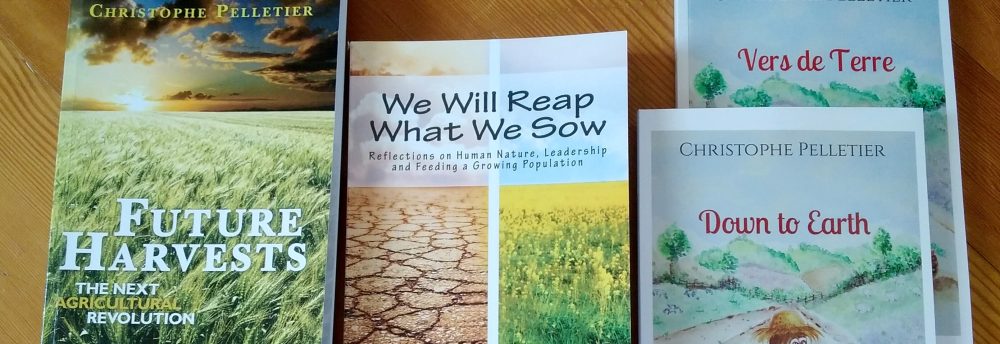
Future Harvests – The book is coming soon!


The editing of my book “Future Harvests – The next agricultural revolution” is about completed. All that is left to do is developing the cover and start the publishing.

I have already received orders, even before the book is out. That is quite a good sign. And a great surprise for me.

If you wish to be updated automatically when the book is published, just subscribe in the sidebar window on the right.

To describe the topics addressed, I have posted three short promotional videos on YouTube. In previous articles (The fun of writing this book and The next agricultural revolution), I had already given an idea about the content of the book.

Video #1: The Fundamentals (duration 2:37) – Introduction to the background and fundamental principles mentioned in the book “Future Harvests – The next agricultural revolution” to achieve food security for 9 billion people in 2050. Topics such as demographics, the shift in economic power, the control of food  and food security strategies are reviewed. Sustainability, innovation, efficient market driven food production and strong leadership are required.

or click here if video does not appear

Video #2: The Actions (duration 2:12) – A short review of some of the actions mentioned in the book to achieve the objectives. Solving the water challenge, finding new land for production, urban farming, hydroponics, farming the desert, rebuilding fisheries and developing aquaculture further are all possibilities.

or click here if video does not appear

Video #3: The Questions (duration 3:08) – A sample of some of the questions raised in the book. They cover technology, land deals in Africa, improving yields, restoring soil fertility, change in consumer needs, organic farming, risks of conflicts, biofuels or meat are some of the topics presented.

or click here if video does not appear

If you know someone who could be interested by the topics on this page, please pass it on!

The next agricultural revolution

(Excerpt from my upcoming book, Future Harvests)

The next agricultural revolution to feed nine billion people will be different from the previous one. After World War II, agriculture advanced thanks to chemistry and petroleum. This time, biology and renewable energies will lead us to progress. It will not be just a revolution in science and technology. It also will be a different way to think about the economy and the environment. Knowledge and communication will become increasingly important, even more so than today.

Agriculture is a life science. Biological solutions will gradually replace chemical applications. All sorts of organisms will be involved to improve the way farmers and the food industry will produce.

Bacteria and viruses will help fight pests and diseases. They will help us reduce our use of chemical herbicides and pesticides dramatically. Genetic engineering will evolve and, as a business, it will mature. DNA science will focus on eliminating flaws and on increasing the metabolic efficiency of living organisms. Genetic engineering cannot continue to be about intellectual property and patents. Soon, seed companies all over the world will know how to do the same. Competition and market forces will determine which model will survive. Governments will not allow a select few to control food. They will get involved in genetic engineering programs and they will break monopolies. Genetic improvement will become collective property again.

Ecology will be a part of food production. Agriculture will manage ecosystems, and economy will become the management of the planet. Living organisms on land and in water will assist us. Farmers will think in terms of systems and cycles. Instead of isolating the field, they will integrate environmental parameters as well.

Organic matter will become central in the future agriculture. Farmers will recreate the cycles to improve the structure of the soil and its fertility. Agriculture will help fixing carbon. The use of mineral fertilizers will decrease sharply.

The economics of agriculture will be different, because the economics of energy will be different. New technologies will come. Solar power and wind energy will become common sources of energy. The economics of water will change, too. The management of water will reshape our food production. Water will become substantially more expensive and only systems that save and preserve water will survive.

Information technology will help make decisions faster than ever before. Portable computers will give the farmer the ability to get data almost instantly about the status of the crops, markets, health status and conditions of production. It will allow them to optimize inputs and outputs better and faster. It will save time, inputs and money. Knowledge and information will be our best tool to act efficiently and to improve our food production.

Transparency will become the rule. There will be no secret because consumers will be better informed and because there will be nothing left to hide.

The most critical part of the next agricultural revolution is leadership. Having a responsible long-term vision is critical, but it will not be enough. The world will need leaders that will make the right things happen. In all sectors of the society, there will be a need for such leaders who can muster the energies and who make the general interest and the long-term come first. The need for food security will alter our governance systems, in government as in business ethics. A challenge will be to manage greed and fear. First, there will be greed. Then, there will be fear. Until this day, humans have done a poor job of feeding the world. Famines have come and have gone and there still are hungry people. Humans have done a poor job at preserving their environment, too. With nine billion people, such a poor performance will have much heavier consequences. Procrastinate or being sloppy are attitudes the world cannot afford anymore. The proper leadership will come, but the change will not happen per accident. There will be a heavy crisis first.

Agriculture will regain its place in the economy as the most important activity. A change in the attitude towards funding and investments will also be part of the revolution. More players will engage in agriculture because returns will be higher for all.

The revolution will not just be for farmers and the other players in agriculture to carry out, but consumers will have their share to deliver. A change in mentalities is necessary. Wasting food is not acceptable. Selfishness will not work anymore. Food security is not a given, it is work in progress.

Copyright 2010 – The Happy Future Group Consulting Ltd.

The fun of writing this book

Over the last few months, I have been working quite a bit on writing this book about the future of agriculture.

I must say that compiling in one book a wide range of topics that, without any doubt, will be part of the future of our food production has been an exhilarating experience.

From demographics in full motion to the latest in technology, we can envision many different scenarios to set up the most efficient food production possible, as local farmers, industry NGOs and governments will need to find optimal solutions with the land, the water, the labor force and the capital available to them. Water and soil will be of vital importance, and their proper management is essential for the stability of many countries.

In the future, there will be no room left for wastage and inefficiencies, or we all will be punished if we get complacent. Similarly, we will need to change our thinking and accept that solving future problems will not be about transferring a one-fit-all model to very diverse situations. We might have had the illusion that it once worked, but it actually did not. We will learn from the mistake of the past to perform better. Sustainability is not an option; it is the only choice, because per definition what is not sustainable is doomed.

As food is a necessity, and since when we share between 9 billion people there is less left for each of us than when we shared between 4 billion, efficiency will be paramount. This will affect food prices and social stability. Technology is necessary but it is not the panacea in itself. The most needed resource for the future is strong visionary leadership to help us develop the plan for the next decades.

Let’s prepare ourselves for a deep change and we must accept the idea that we might have futuristic farms run by robots, satellites and computers in some regions as well as local urban gardeners in the heart of the cities, where 70% of the world population is expected to live. We will have small organic farmers and we will have large industrial farms using genetically engineered crops, but we also will have large highly efficient semi-organic farms that will combine the best of both worlds. We still will have specialized farms as well as mixed operations. Hydroponics and aquaponics will grow substantially in the future.

Today’s diet will be revisited and excesses will be out of place. Should we become vegetarians or do we simply need to eat less meat? Will aquaculture live up to the expectation and become the main source of animal protein? You will find out in the book.

Countries will have to think on how to guarantee food security to their populations. If it is not done well, this challenging task might end up in serious conflicts. Foreign and private investment in land and farming will continue in Asia and Africa. If managed properly, they will bring much prosperity to these regions, but if not managed properly, then we can fear the worst.

All these topics and many more will be presented in the book and I hope that it will help readers to understand all the variables that are at play, as well as it will help them get a more objective view of many controversial topics such as GMOs, nanotechnology or in-vitro meat. Once readers will have finished the book, they will be able to figure out whether and how we can feed 9 billion people. Thanks to examples from all over the world in as diverse countries as Uganda, Kenya, the USA, China, Indonesia, India, Brazil, Argentina, France, The Netherlands, Cuba, Kazakhstan and many more, we discover a myriad of different situations and solutions that illustrate human ingenuity to produce food.

However, for now just a few more months of patience as I need to get through the process of publishing.